
50 Amp to 15 Amp Adapter: Safe Use for Utah RVs

You pull into a Utah campground after dark, plug your 50-amp cord into the only household-style outlet available, and discover that the coach has no usable power. A 50 amp to 15 amp adapter can get the lights on and the refrigerator cooling, but it can't turn that outlet into a campground hookup. The household circuit remains the limit.
That distinction matters around Moab, near Zion, and at a friend's property outside Salt Lake City, where a convenient overnight connection may be all you have. Used correctly, the adapter is a practical bridge. Used like a power upgrade, it can trip breakers, overheat plugs, or damage RV equipment. Our team at Motor Sportsland treats it as emergency and maintenance gear, not a replacement for proper shore power.
When a 50 Amp to 15 Amp Adapter Saves Your Weekend
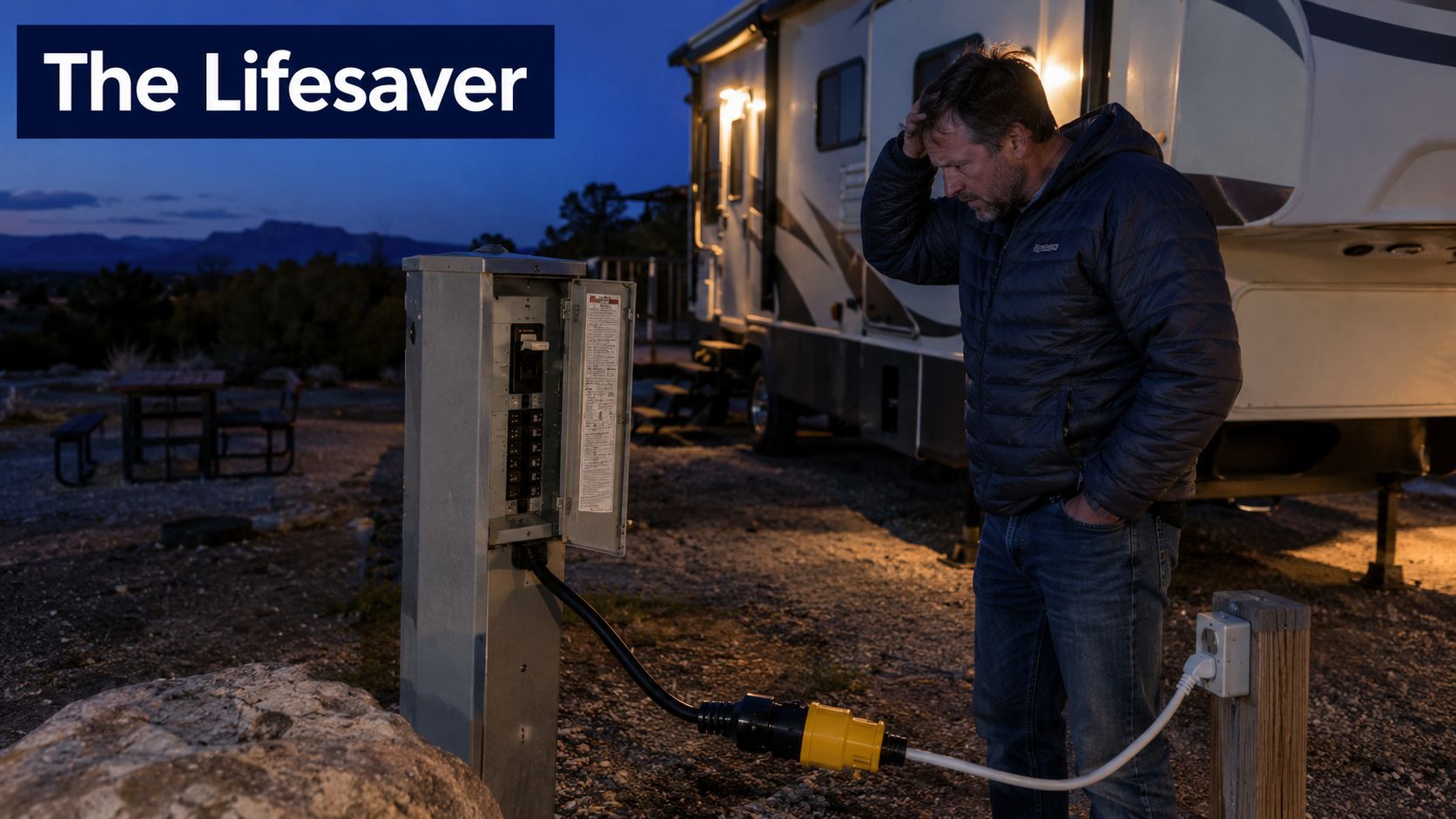
A Utah RVer arrives at a late campground check-in and finds the 50-amp pedestal breaker tripped. The campground has no immediate site change available, but a standard household receptacle is working. The dogbone adapter earns its place in the electrical kit.
The adapter lets the RV draw limited 120-volt power from the smaller circuit. It doesn't add capacity. The source breaker still controls how much electricity the RV can use, and industry guidance describes this setup as a low-power convenience connection rather than full-service shore power. RV electrical guidance explains the source-breaker limitation.
For a functional overnight, we'd keep the load simple:
- Refrigerator on propane: Let gas handle cooling while electricity handles the control board.
- Interior and exterior lights: LED lighting is usually a manageable essential load.
- Furnace fan: Use the furnace as needed, while remembering its fan still consumes electricity.
- Water heater on propane: Keep the electric heating element switched off.
- Battery charging: Allow the converter to maintain the batteries, but don't combine it with unnecessary high-draw appliances.
Leave the roof air conditioner, microwave, hair dryer, electric space heater, and electric water-heater element off. A single large appliance can consume most of the available branch-circuit capacity, especially when another load starts at the same time.
Where this setup makes sense
A late-arrival weekend in Moab may call for lights, refrigeration, and battery charging until morning. A last-minute pull-through near Zion may offer a household receptacle when the advertised pedestal isn't working. At a friend's property outside Salt Lake, the adapter can keep the coach usable without asking the home's circuit to run every appliance.
Practical rule: Think “lights-on weekend,” not “full RV living.” If you need air conditioning, cooking appliances, or electric heating, arrange proper shore power or use an appropriate generator.
The adapter solves access. It doesn't solve capacity, wiring defects, or poor load management.
What 50 Amp and 15 Amp Actually Mean for Your RV
The numbers describe the electrical service available at the source. A typical North American 50-amp RV connection uses a NEMA 14-50 setup rated at 125/250 volts and can supply up to 12,500 watts at full capacity, according to the 50-amp adapter and connection specifications. A standard household 15-amp receptacle is rated at 125 volts and 1,875 watts.
That math explains the whole issue. Power equals volts multiplied by amps. The adapter changes the physical connection so the larger RV plug can connect to the smaller receptacle, but it doesn't change the source breaker, wire size, or available wattage.
A 50-amp RV inlet normally receives two hot legs, along with neutral and ground. The 15-amp household connection supplies only one 120-volt branch circuit. The adapter therefore acts as a one-way reducer. Some coach circuits may remain unavailable, while the circuits that do receive power share the smaller source limit.
Identify the plug before connecting
A NEMA 14-50 RV connection has four contacts and is the familiar large 50-amp configuration. A household receptacle uses the NEMA 5-15 pattern, with two vertical slots and a grounding opening. A TT-30 is the three-prong, 30-amp RV receptacle commonly found on campground pedestals. These aren't interchangeable just because the plugs look similar.
The adapter itself is commonly a dogbone with a 15-amp male plug on one end and a 50-amp female RV socket on the other. Its rating follows the smaller side, not the large coach inlet. The dogbone design and 15-amp adapter rating are described by RV parts guidance.
| Service | Plug type | Voltage | Max amps | Max watts |
|---|---|---|---|---|
| Typical 50-amp RV shore connection | NEMA 14-50 | 125/250 volts | 50 amps | Up to 12,500 watts |
| Standard household connection | NEMA 5-15 | 125 volts | 15 amps | 1,875 watts |
For a deeper explanation of RV power centers, converters, breakers, and shore connections, use our guide to demystifying your RV electrical system.
Safety and Compatibility Considerations You Should Not Skip
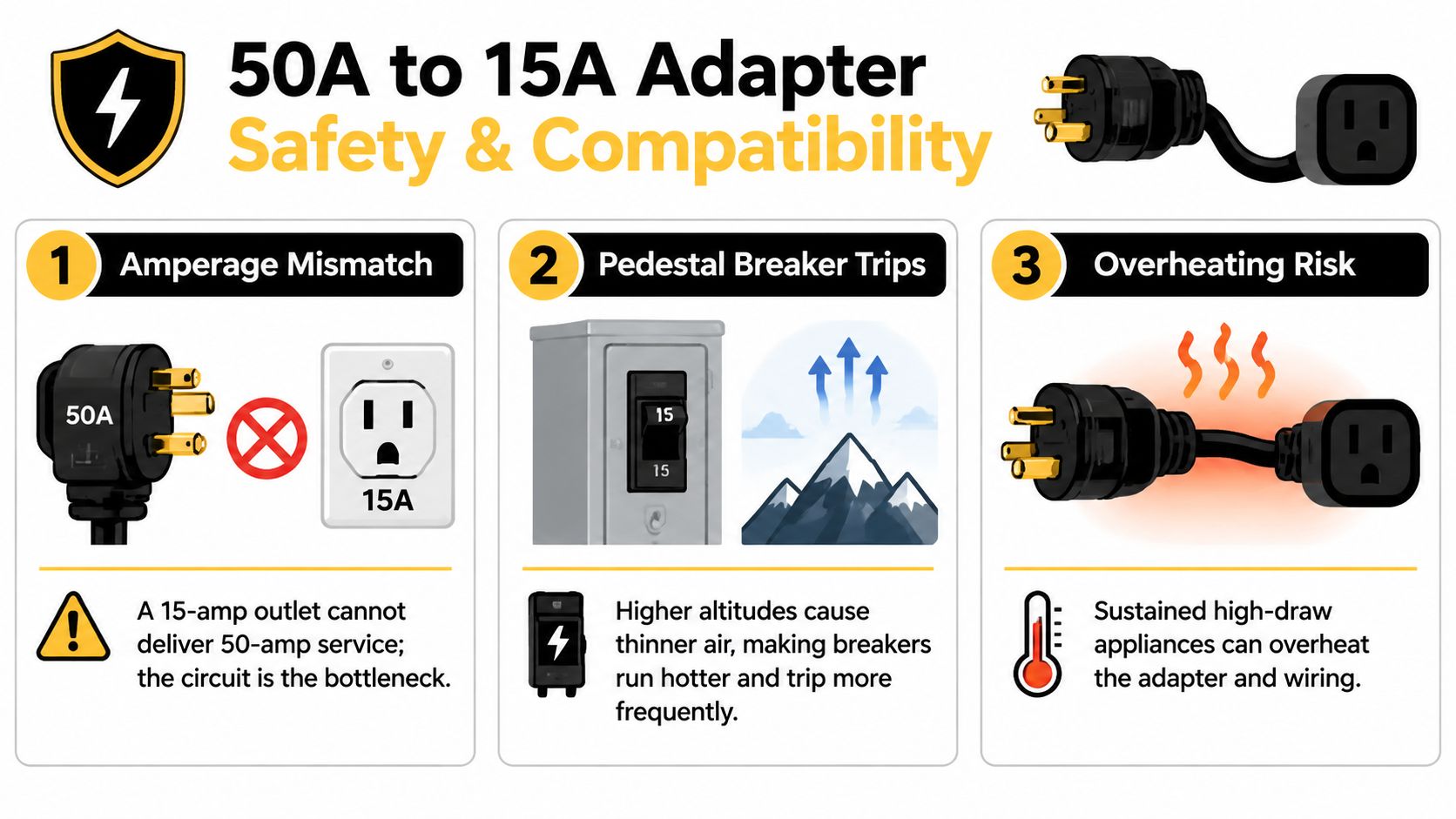
A 15-amp outlet can't deliver 50-amp service. The source circuit is the bottleneck, and the adapter only provides a compatible physical path. If the RV demands more than the branch circuit can safely supply, the breaker should trip. If a fault or poor connection prevents proper protection, the cord and adapter can overheat.
The danger usually starts at a connection, not inside the RV's large inlet. A loose household receptacle, corroded blade, damaged extension cord, or undersized connection creates resistance. Resistance creates heat, and heat can discolor or melt the plug before the breaker reacts.
Utah conditions change the margin
At elevation, breakers can behave differently because thinner air can reduce cooling and make heat management more difficult. Our Wasatch Mountain customers also deal with cold-weather storage, damp mornings, and long periods when a coach sits connected without supervision. Those conditions make inspection more important.
Keep these compatibility problems off your list:
- Don't stack adapters: Each extra connection adds another failure point.
- Don't use a distant household extension cord: A general-purpose cord may not be suitable for sustained RV demand.
- Don't use a cube tap or splitter: Multiple outlets don't create more capacity.
- Avoid kitchen and bathroom GFCI outlets: RV leakage and converter operation can cause nuisance trips.
- Never backfeed a home: A male-to-male cord or improvised connection can energize wiring and create a severe shock hazard.
- Don't remove the grounding pin: Grounding is part of the protection system.
For winter storage, use a quality surge protector or electrical management system, keep the connection high and weather-protected, and inspect for condensation inside the adapter housing. A breaker that trips is signaling a problem. Don't tape it, bypass it, or reset it repeatedly without reducing the load. Our electrical service team also handles RV power converter repair and testing when the coach shows charging or power-center symptoms.
How to Connect the Adapter Safely From the Pedestal to the RV
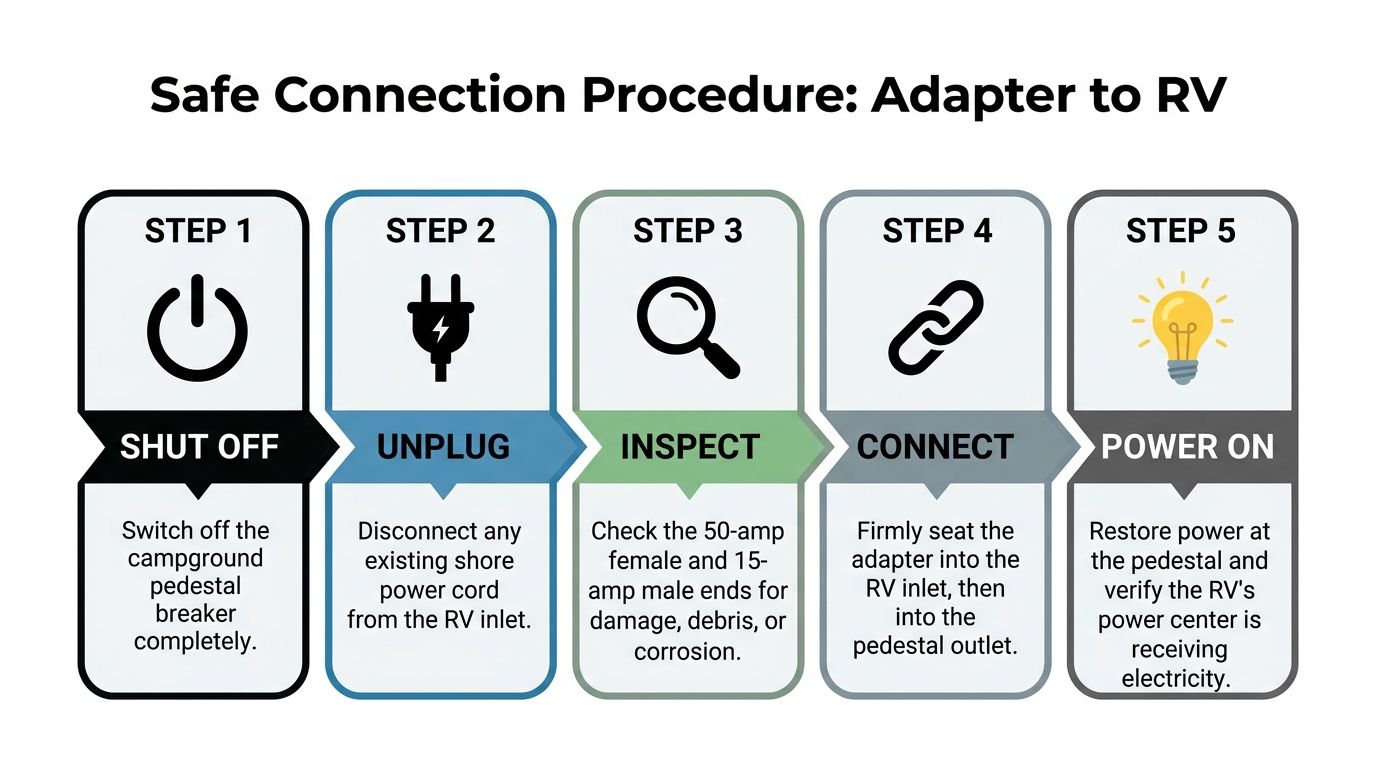
The breaker-off-first habit prevents a rushed arrival from becoming an electrical repair. Treat the connection as a short inspection process, even when it's cold, dark, or raining.
Start with a complete shutdown
- Switch off the pedestal breaker. Confirm the existing shore cord is unplugged before handling the adapter.
- Inspect every connection. Look at the 50-amp female end, 15-amp male plug, RV cord, and pedestal receptacle. Reject anything with cracks, corrosion, bent blades, loose fittings, heat discoloration, or melted plastic.
- Check the receptacle. It should be grounded, weather-resistant, and protected as required for the location. Never use a cheater plug or remove the adapter's grounding pin.
- Make the connection firmly. Seat the adapter in the compatible 15-amp receptacle, then connect the RV's 50-amp cord to the adapter. Keep connections dry, off the ground, and covered with a tight weatherproof protector.
- Prepare the coach. Turn off high-wattage appliances, set thermostats low, and confirm the electrical management system shows acceptable voltage and correct polarity.
- Restore power once. Turn on the pedestal breaker and watch the RV power center and EMS for abnormal readings.
Check the connection after energizing
At elevation, during cool mornings, and throughout winter storage, run only essential loads. After the connection has operated for 15 to 30 minutes, check the plug and receptacle carefully for unusual warmth. That inspection interval is part of the practical connection guidance in this section, not permission to run heavy appliances.
Stop immediately if you find melting, a burning smell, buzzing, flickering, or repeated breaker trips. Turn the breaker off before disconnecting anything. RV safety guidance recommends switching off appliances and the pedestal breaker before making the connection.
Connection rule: Power off first, inspect second, connect third, energize last.
A suspect pedestal isn't worth saving a campsite fee. Ask the campground host for another source, or have the outlet tested before using it again.
Alternatives Worth Considering Before You Plug In
Choose the power source according to what you need to run. The adapter is inexpensive convenience gear, but the cheapest connection becomes the wrong choice when the trip requires air conditioning, electric cooking, or sustained heating.
| Power option | Best for | Key limitation |
|---|---|---|
| 50 amp to 15 amp adapter | Lights, refrigeration, controls, battery maintenance, and short overnight stops | The household circuit remains limited and isn't full-service shore power |
| 30-amp campground connection | A 50-amp coach at a campground with no 50-amp pedestal | Requires the correct 30-to-50 dogbone and careful load management |
| Portable or built-in generator | Dry camping and locations without shore power | Running and starting capacity must cover the combined RV load |
| Dedicated home RV receptacle | Regular driveway use and winter storage | Requires correct installation, grounding, protection, and local code compliance |
| EV-related equipment | Only when the equipment and circuit are specifically approved for the RV use | EV connectors, continuous-load requirements, and RV connections aren't automatically interchangeable |
A 30-amp RV connection is usually the better campground fallback. It preserves a proper RV-style shore connection and offers substantially more practical capacity than a household outlet, though you still need the correct adapter, cord, and EMS.
Generators require more caution than a simple plug swap. The generator's running and starting output must cover the air conditioner, microwave, converter, battery charger, and any other active load. A small inverter generator may run some equipment but fail when a compressor starts. Use an approved transfer switch and connection equipment. Never energize an outlet through a dryer or range receptacle, and never backfeed a building.
Home EV charging adds another layer of risk. Current product listings show adapters marketed for RVs, generators, household outlets, and EV-related use, while some include breaker protection or warnings such as “Not for EV.” That crossover makes the label and approval details important. A 50-amp EV outlet isn't automatically an RV hookup.
Before investing in batteries or generator equipment, review our Utah RV lithium battery upgrade guide. Match the system to expected watts, runtime, weather exposure, and installation requirements.
Real Mistakes Our Service Team Sees Every Utah Season
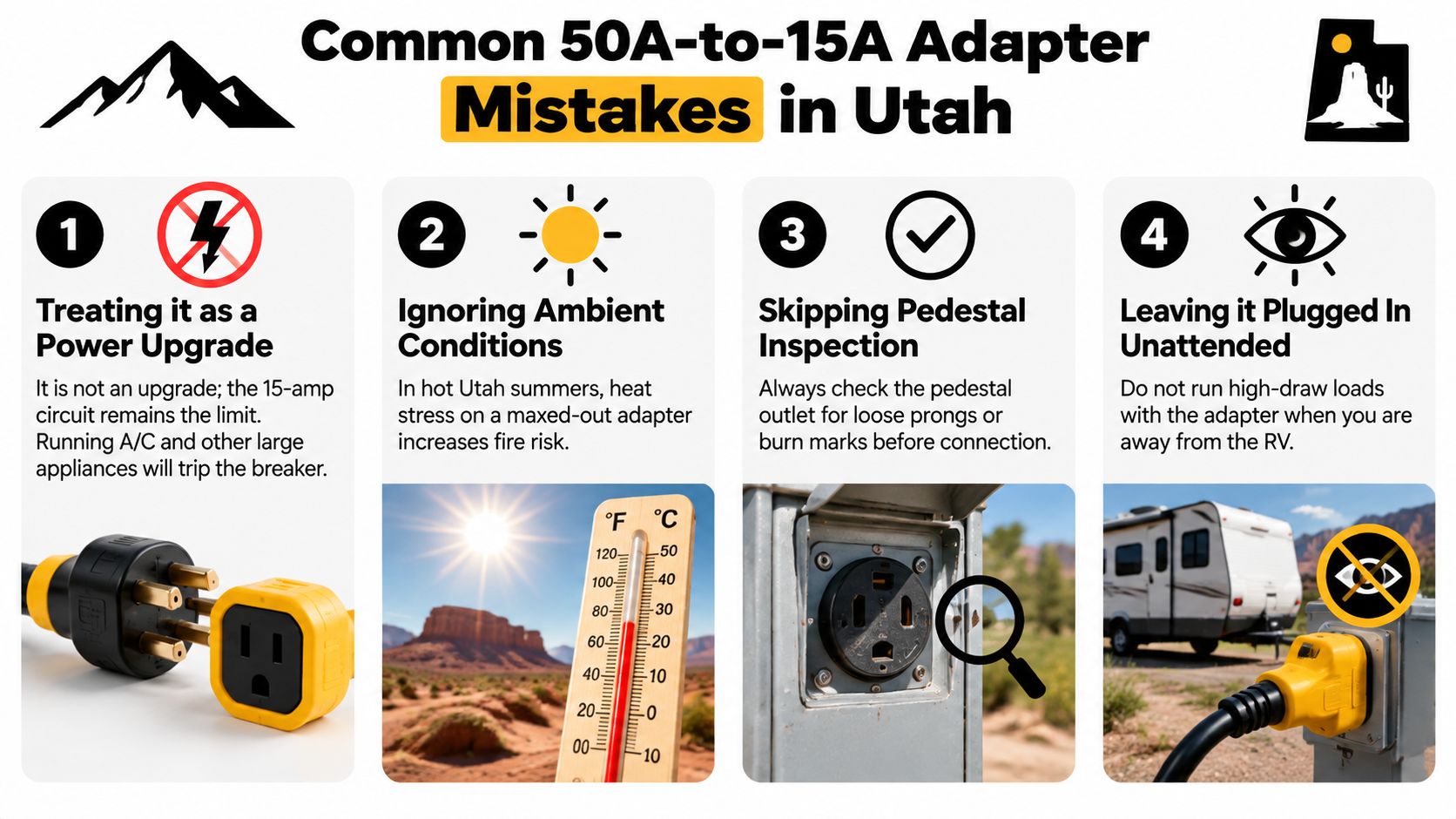
The most common mistake is simple. An owner sees a large 50-amp RV plug and assumes a 50 amp to 15 amp adapter brings the same power to the coach. It doesn't. The 15-amp branch circuit stays in charge, and running the air conditioner, microwave, electric heater, water heater, and converter together invites voltage drop, nuisance trips, and overheated connections.
Utah elevation makes poor load management less forgiving. Motors can work harder in mountain conditions and draw more current during startup. That matters when a small household circuit is already carrying the converter and refrigerator controls.
The connection often tells the story
A damaged adapter can hide beneath an innocent-looking exterior. We see loose campground receptacles, corroded blades, poorly seated plugs, and cords stored damp or tightly coiled. A plug that feels hot, smells burned, or shows dark marks needs replacement, not another trip.
Generator connections create another group of failures. Owners sometimes check only the generator's advertised output and ignore running capacity, starting demand, grounding, bonding, and transfer equipment. Improvised backfeeding through a household dryer or range outlet can energize utility lines and injure someone working on the electrical system.
Winter storage causes a quieter version of the same problem. A converter, space heater, engine-block heater, and battery charger can remain active for hours while nobody is standing beside the coach. The battery may appear healthy while a failing converter or overheated plug continues to draw attention away from the fault.
- Resetting the breaker repeatedly: Reduce the load and investigate the cause.
- Taping a breaker closed: This removes a protective response and creates a serious fire risk.
- Leaving high-draw appliances running unattended: Don't use a limited adapter connection as unattended heating or cooling service.
- Ignoring a hot plug: Turn power off and replace the damaged component.
The cost of a professional cord test, adapter replacement, or EMS inspection is easier to manage than scorched wiring, a failed converter, or a damaged compressor. If your RV has already tripped the breaker repeatedly, bring the cord and adapter with the coach so a technician can inspect the entire path.
Get the Right Adapter and the Right Backup Plan at Motor Sportsland
At the parts counter, bring the RV's plug information instead of guessing from memory. A clear photo of the campground pedestal helps us identify whether you need a household adapter, a 30-to-50 dogbone, or a different connection entirely. Also tell us which appliances you expect to run, especially if the plan includes air conditioning, electric heat, cooking, or winter charging.
For a 50-amp RV that occasionally needs a household outlet, ask for a dogbone-style 50 amp to 15 amp adapter with a properly rated 15-amp male end and 50-amp female RV socket. Pair it with a plug-in surge protector or EMS that can identify wiring faults and help you monitor the incoming supply. We won't treat a breaker-protected adapter, a pass-through adapter, a splitter, and an EV-marketed product as the same item. Their applications and protections differ.
Our parts and service teams in Millcreek and Spanish Fork can help you assemble a practical electrical kit, including the adapter, weather protection, and a printed load worksheet. If the pedestal is suspect, bring a photo or ask about testing before you leave. If the RV has a warm plug, damaged cord, repeated trips, or converter symptoms, schedule an electrical inspection rather than continuing to experiment at the campsite.
A good backup plan may be a 30-amp dogbone for campground use, a properly installed home receptacle for storage, or an approved generator setup for dry camping. The right choice depends on whether you're trying to keep batteries charged, sleep comfortably overnight, or operate the coach normally.
Motor Sportsland offers RV parts, electrical inspections, service, repairs, and upgrades through our Utah locations, including help choosing a 50 amp to 15 amp adapter that matches your coach and power source. Visit Motor Sportsland, bring your pedestal photo and RV plug details, or contact our parts and service team before your next Utah trip.
Frequently asked questions
Can a 50 amp to 15 amp adapter give my RV 50 amp power?
No. The adapter only changes the connection shape. The household breaker and wiring remain the limit, so the RV can draw only the capacity allowed by that source.
What can I run with a 50 amp to 15 amp adapter?
Keep the load to essentials such as lights, refrigerator controls, furnace fan, and battery maintenance. Run the water heater on propane, and leave the roof air conditioner, microwave, hair dryer, electric heater, and electric water-heater element off.
Why does my adapter keep tripping the breaker?
The total RV demand may exceed the branch circuit, or the receptacle, adapter, cord, or RV system may have a fault. Turn everything off, inspect for heat or damage, and don't keep resetting the breaker without finding the cause.
Can I use a regular household extension cord?
Avoid it. Extension cords add another connection and may not be rated for sustained RV demand. Use a properly rated RV connection, keep it dry, and ask a qualified technician if the outlet is far from the coach.
Can I use the adapter with a generator?
Only if the generator, cord, grounding arrangement, and connection equipment are approved for that use. Never backfeed a home through a dryer or range outlet.
Can I use the same adapter for an EV outlet?
Not automatically. EV equipment can have different connector, circuit, continuous-load, and approval requirements. Confirm that the specific equipment is approved for your RV application before connecting it.
