
Awning for RV Guide for Utah Shade and Comfort

You pull into Jordanelle or Bear Lake on a bright Utah afternoon, step out of the truck, and feel the sun hit hard off the water and gravel. The kids want lunch outside. You want five minutes of shade before unloading anything else. That's the moment an awning for an RV stops feeling like a nice extra and starts feeling like part of how the campsite works.
In Utah, shade changes the whole day. It makes the patio side of the rig usable, helps with glare, and can make the inside of the RV feel less baked in the late afternoon. If you're also working on interior comfort, our guide to camper window treatments that actually work in Utah pairs well with awning planning. And if you're trying to visualize how outdoor shade might shape your campsite setup before you buy anything, tools like AI patio design can help you think through table placement, traffic flow, and where the sun lands.
Our team at Motor Sportsland talks about awnings with Utah campers every season because the same questions keep coming up. Manual or electric. Acrylic or polyester. Safe in canyon wind or not. Good for rain or only for sun. The tricky part is that most awning advice is too generic for places like the Wasatch front, high desert campgrounds, and exposed lakeside sites. The details matter here.
Introduction Why Shade Matters More in Utah
Utah sun feels different because it often is different in practice. Campsites around the Wasatch Mountains, Great Salt Lake basin, and southern desert country can swing from calm mornings to gusty afternoons fast, and your patio side catches all of it. An awning for an RV isn't just about comfort. It's about making the outside of your site usable without turning your awning into a sail at the wrong time.
What shoppers usually want versus what the awning actually does
A lot of first-time buyers walk into the showroom thinking of an awning as a little roof attached to the side of the trailer. That's close, but not quite right. It's better described as a big outdoor window shade with structure behind it.
It has three basic jobs:
- Create shade where you live outside
- Handle light rain when set up correctly
- Expand your campsite living space
What it is not built to do is act like a storm shelter.
An RV awning helps with sun and light weather. It isn't meant to stay out through strong gusts, passing storm fronts, or all-night uncertainty.
The main parts in plain English
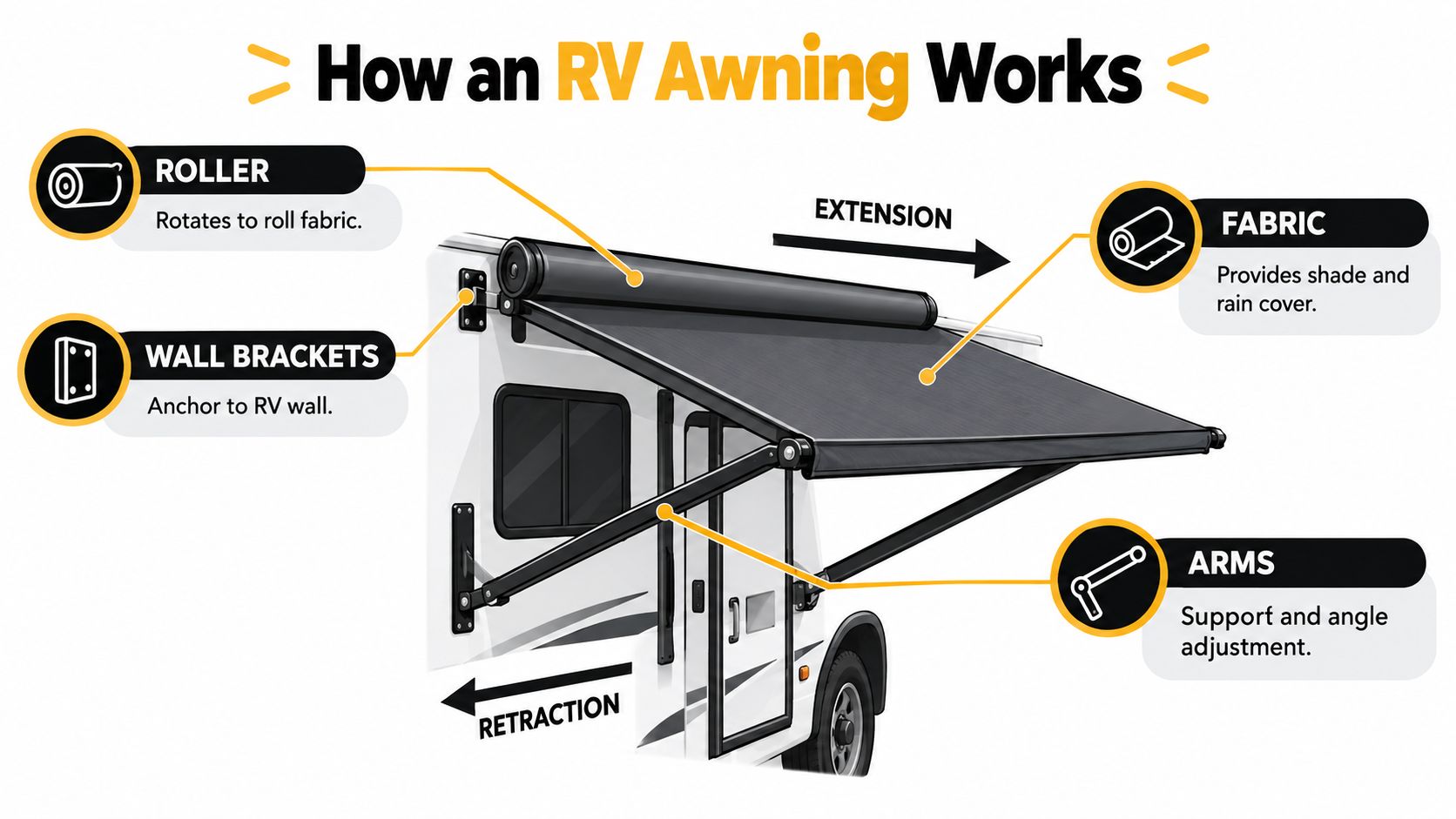
Most patio awnings use the same basic system:
- Roller tube holds and rolls the fabric
- Fabric stretches out to create the covered area
- Arms support the awning as it extends and retracts
- Wall brackets anchor the whole system to the RV
That's why repairs often come down to one of those four zones. If the fabric tears, you're solving a different problem than if an arm twists or a wall bracket loosens.
Electric and manual setups
A manual awning asks you to release it, pull it out, and set the arms yourself. Some owners like that because the system is simple and gives you a direct feel for what the awning is doing.
An electric awning extends with a switch. That's convenient at quick stops or when you want shade fast. It's common on newer rigs, especially family travel trailers and motorhomes.
Some patio awnings also offer dual-pitch or adjustable-pitch features, which let you change the shade angle for low morning or evening sun, as shown on a published awning product page from Carefree of Colorado. That matters more than people expect in Utah, where the sun can sit low and still feel intense late in the day.
RV Awning Types Compared and Which Fits Your Rig
Not every awning for an RV solves the same problem. A patio awning creates living space. A slide-out topper protects the top of the slide. A small window awning cuts glare and heat on one side of the coach. A portable shade structure gives flexibility, but it isn't integrated into the RV.
RV Awning Types at a Glance
| Awning Type | Best For | Operation | Key Trade-off |
|---|---|---|---|
| Patio awning | Main campsite shade and outdoor seating | Manual or electric | Most useful, but most exposed to wind |
| Window awning | Reducing direct sun and glare at specific windows | Fixed or simple support design | Helps comfort, but doesn't create patio space |
| Slide-out awning | Keeping debris and water off slide tops | Automatic with slide movement on many rigs | Functional, but not a hangout feature |
| Portable freestanding awning | Flexible shade away from the RV wall | Separate setup | Versatile placement, but more gear to carry |
Matching the type to your RV style
A Class B van owner may want compact shade without bulky side hardware. A travel trailer family usually gets the biggest daily benefit from a patio awning because that patio side becomes the dining room, shoe drop, and kid hangout zone. A fifth wheel owner staying longer at one site may care more about shade angle, fabric durability, and how the awning works with slide-outs and outdoor kitchens.
Toy hauler owners often think differently too. If the ramp patio, side patio, or gear flow matters, the awning has to work with chairs, coolers, helmets, and traffic patterns, not just look good when extended.
Electric versus manual for real-world use
Here's the simple version.
- Electric fits buyers who want speed. Tap a switch, make shade, get on with lunch.
- Manual fits owners who prefer fewer powered components. There's less electrical troubleshooting if something quits.
- Adjustable pitch matters if you camp with low-angle sun. Morning at Bear Lake and evening in open desert can both expose the weak spot of a flat shade angle.
Practical rule: Buy the awning type that matches how you actually camp, not the one that sounds nicest on a feature sheet.
Common fit questions we hear in the showroom
Some buyers ask if a bigger awning is always better. Not necessarily. A very large patio awning covers more living space, but it also becomes harder to manage when weather gets unpredictable.
Others ask if a freestanding canopy can replace the built-in awning. Sometimes. But if you move often, a built-in awning usually wins for convenience. If you stay longer and want shade that can be moved away from the RV wall, a portable option can complement, not replace, the main setup.
Choosing Fabric Size and Mounting for Utah Conditions
You feel sizing mistakes later, usually on a hot afternoon. The awning rolls out, but the shade stops short of the chairs. Or the replacement fabric slides in fine, then you learn the arms and rail do not quite match the hardware that is already on the coach.
Utah makes those mistakes show up faster. High elevation sun fades fabric sooner, west-facing campsites stay hot later in the day, and sudden runoff from a brief storm can pool on the low side if the pitch is wrong. Fabric choice matters, but so does how far the awning projects and how well the mounting setup matches your rig.
Fabric choices that hold up better in strong sun
Awnings in Utah work a lot like patio furniture left on a mountain deck. The sun ages them every day, even when the weather feels mild.
As noted earlier, acrylic fabric is usually the safer long-term pick for frequent full-sun camping because it tends to keep its color better under heavy UV exposure. Polyester often costs less and weighs less, but it usually shows fading sooner. PVC-coated fabric sheds water well, though it can hold more heat underneath and feel less airy during a hot afternoon.
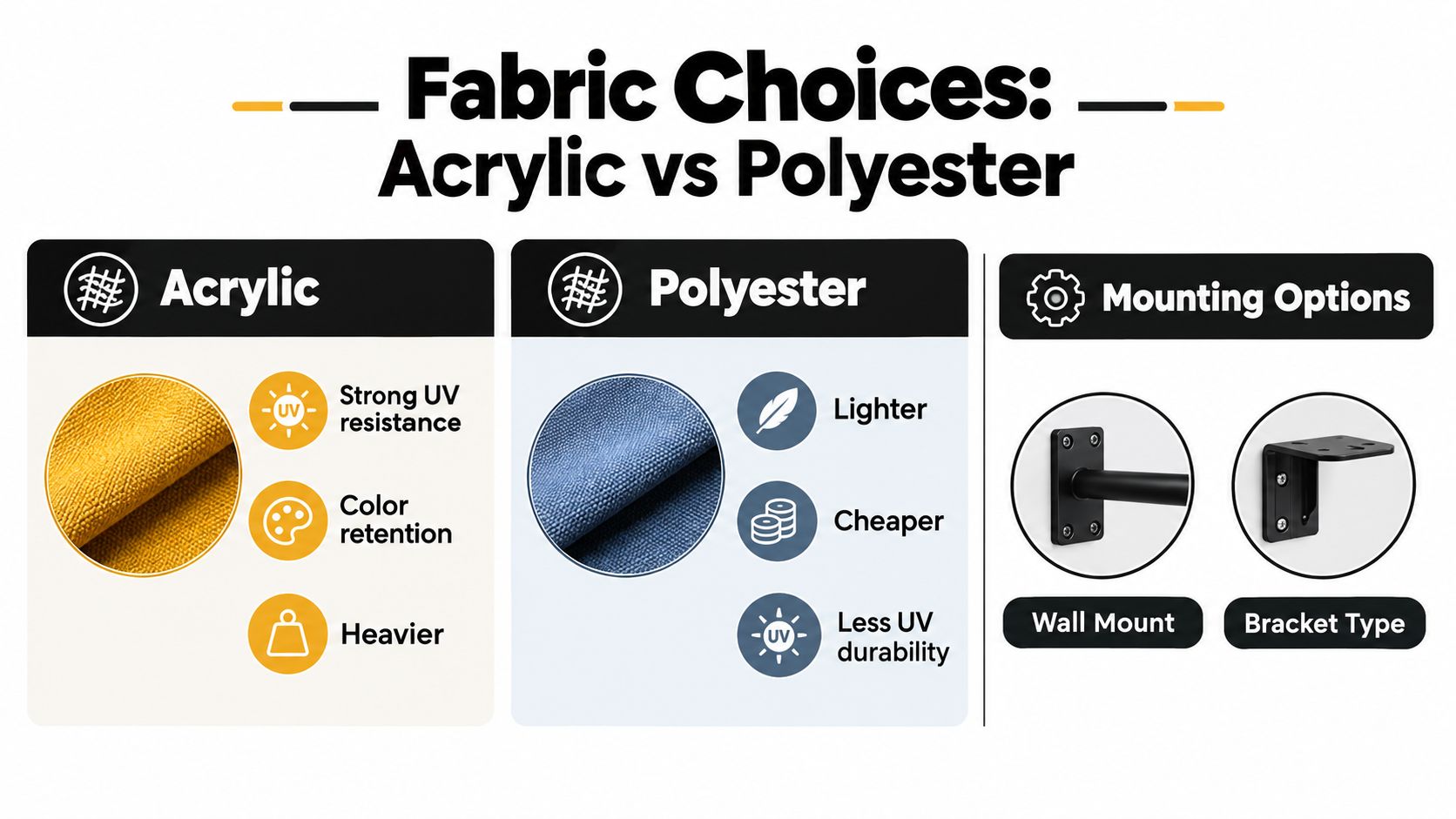
For a family that camps around Lake Powell, Sand Hollow, or open desert sites with long western sun, paying more for better UV resistance often makes sense. For lighter use or shorter summer trips, a lower-cost fabric can still work if you accept that color and surface wear may show up sooner.
The sizing quirk that confuses buyers
Awning size labels and fabric size are not the same measurement.
As noted earlier, replacement fabric is commonly shorter than the advertised awning assembly size by several inches because the listed size usually refers to the full hardware span, not just the cloth. That is why a buyer can order by the sticker on the arm and still end up with a fabric panel that does not match.
The safe approach is simple. Measure the existing fabric groove to groove, confirm the awning model if you can, and compare that with the roller and arm setup already on the RV. If any of those numbers disagree, stop and verify before ordering.
Mounting choices matter more on retrofit jobs
Retrofit work is where many owners get tripped up. The fabric may be worn out, but the bigger question is whether the old arms, roller tube, and wall brackets belong to the same hardware family.
As noted earlier, some replacement hardware is built around a standard projection and marketed to fit major awning families such as Solera, Dometic, and Carefree. That sounds simple on paper. On the RV wall, small differences in arm geometry, mounting height, or rail position can decide whether the awning opens cleanly or rubs, binds, or sits at an awkward angle.
Projection matters in real campsite use too. A longer projection gives more living space, but it also changes where runoff falls and how low the outer edge sits when you add pitch for evening sun or drainage. On an uneven Utah pad, that can be the difference between comfortable shade and everyone ducking under a corner.
Practical go or no-go sizing rules for Utah campsites
Here is the part many guides skip. The right size depends on the places you camp, not only the length of your RV wall.
Use these rules as a showroom shortcut:
- Choose enough projection to cover chairs, not the whole campsite. More fabric means more shade, but it also creates more exposure to gusts and more chance of low clearance at the outer edge.
- If your patio side often faces west, favor adjustable pitch and heat-tolerant fabric. Utah afternoon sun comes in low and harsh.
- If you camp where brief rain is common, make sure the mounting height allows one side to drop enough for runoff. A nearly flat awning is more likely to hold water.
- If you are replacing fabric only, confirm the hardware is still straight and secure first. New cloth on tired arms is like putting new tires on a bent axle.
- If slide-outs, doors, or an outdoor kitchen share that wall, check swing and clearance before sizing up. A longer awning can create fit problems even when the wall space looks open.
One more local tip. Owners who camp in southern Utah often want the largest shade they can get, and that instinct makes sense. But if you also camp in canyon areas or exposed reservoirs, a slightly more modest awning with the right pitch and fabric can be the better everyday setup because it handles mixed conditions with fewer compromises.
A good awning fit is not just length. It is length, projection, pitch, runoff, and hardware compatibility all working together.
When to Extend or Retract Wind Rain and Heat Decisions
You pull into a reservoir campground at 4 p.m. The sun is beating on the patio side, the air feels mostly calm, and putting the awning out sounds like an easy yes. Then the breeze starts bouncing off the water and the hill behind your site. Ten minutes later, the fabric is twitching, one corner lifts, and now you are deciding whether to sprint for the retract switch.
That is how awning damage usually starts in Utah. Not with a dramatic storm warning, but with a campsite that feels fine until it suddenly does not.
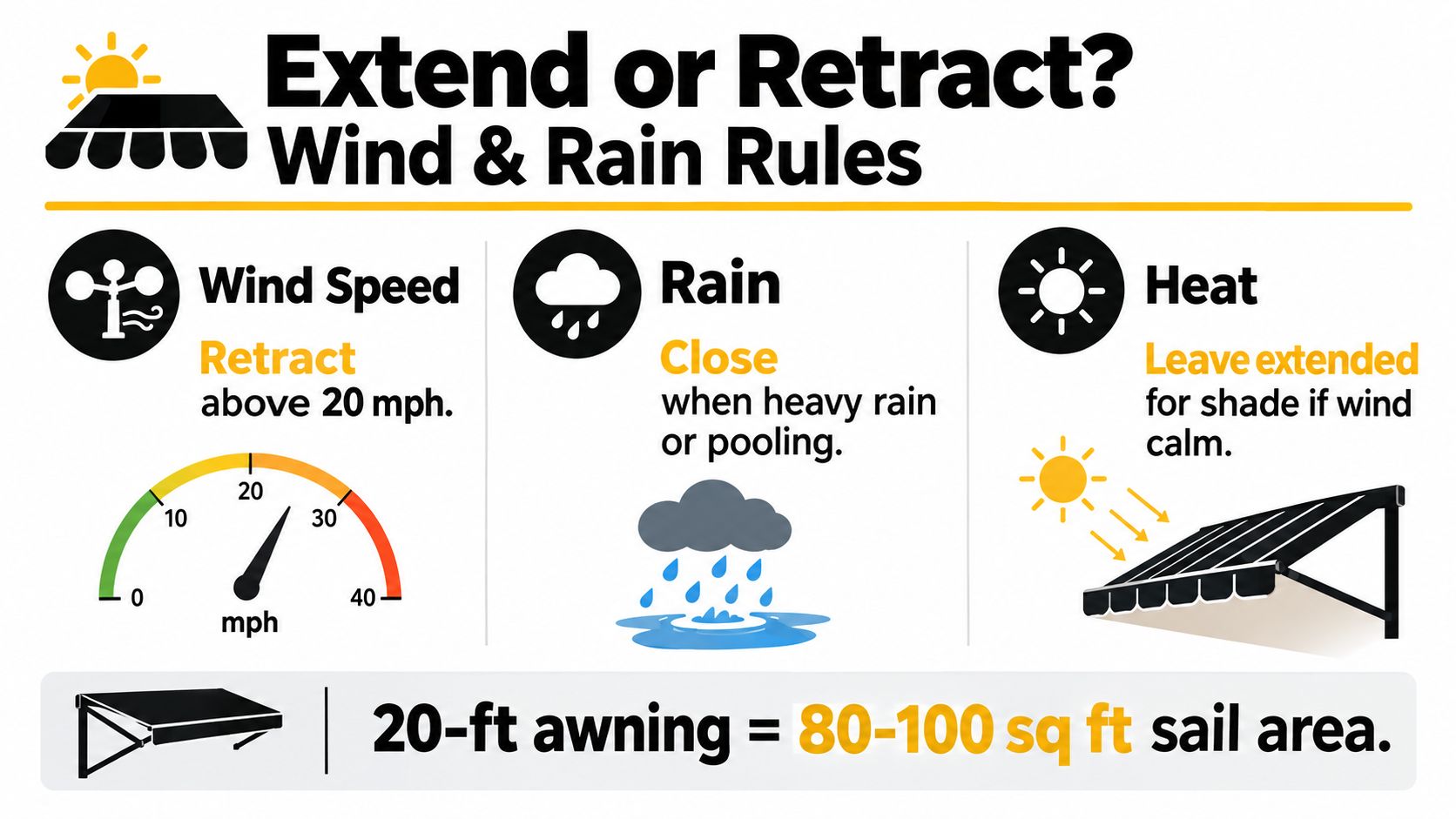
A good rule is to treat your awning like a folding patio roof, not a permanent porch. It gives great shade when conditions are stable. It has much less margin than many owners expect once gusts, runoff, or low evening sun enter the picture. Independent safety guidance tied to manufacturer installation manuals notes that a 20-foot awning can expose roughly 80 to 100 square feet of fabric, which is a lot of surface for wind to grab. That same guidance says many awnings should be retracted around 20 mph sustained wind or earlier if gusts exceed 25 mph, as summarized by Pick RV's awning deployment safety guidance.
Use site conditions, not just the weather app
Utah adds a few twists that national guides often miss. A canyon campground can stay calm and then send one hard gust through like air rushing down a hallway. Open desert sites can feel manageable until late afternoon thermals build. West-facing campsites can be brutal in the evening even when the temperature itself is not extreme, because the lower sun angle sneaks under the shade line and heats up your sitting area.
So the question is usually not, “What is the wind limit?” It is, “Is this a good hour to have it out?”
A practical go or no-go checklist
Good time to extend
- You need shade for a short window and someone is outside. Lunch, reading time, or a couple of hours at camp are reasonable uses.
- The air is steady, not jumpy. A light breeze is one thing. Sudden pulses are another.
- The fabric hangs calm. Small movement is normal. Repeated snapping or lifting is not.
- You can pitch one side lower if light rain shows up. Water needs a path off the fabric.
Time to retract
- You are leaving, napping, or turning in for the night. An unattended awning has no reaction time.
- The breeze is shifting directions every few minutes. That often means gusts are building.
- Your chairs feel cooler, but the awning edge keeps fluttering. Shade is helping, but the structure is warning you.
- Rain starts pooling instead of draining. Water weight can strain the arms fast.
- Your site is exposed to open water, a canyon mouth, or a broad gravel lot. Those places can amplify gusts.
If you want a simple showroom rule, use this one. Extend for comfort. Retract at the first sign you are starting to justify it.
Wind changes faster than people expect
Owners often look for one safe number, but campsites do not behave like airport runways. Wind can hit one side of the rig harder than the rest of the site. Passing trucks, nearby terrain, and evening thermal changes can all create a sudden shove.
That is why audible flapping matters so much. Once the fabric starts popping or the arms begin to pulse up and down, the awning is already telling you the load is becoming irregular. Waiting for one more minute can be the expensive choice.
Tie-downs do not turn an awning into a storm structure
Many RV owners assume straps and anchors solve the problem. They can help limit small movement in the right setup, but they can also move stress into the arms, roller tube, or wall mounts. Guidance on RV awning wind ratings points out that some tie-down setups can increase stress at the mounting points, as discussed in this RV awning wind-threshold analysis.
Use accessories as helpers, not permission to ignore conditions.
Rain and heat call for different decisions
Rain is mostly about runoff. Heat is mostly about sun angle.
In light rain, an awning can still be useful if one side is dropped enough for water to shed cleanly. A flat awning works like a shallow pan. Once water starts collecting, the added weight can bend hardware or stretch fabric. Broader RV care guidance also warns against rolling up wet fabric and leaving it that way, as highlighted in My Camper Friend's awning care tips.
Heat takes a different kind of judgment. On a hot Utah morning, a fully extended awning may be perfect. On a west-facing site at 6 p.m., you might still feel roasted because the sun is coming in low under the outer edge. In that case, the awning is not failing. The sun angle changed. Adjustable pitch helps, but there is a limit to what any patio awning can block late in the day.
A clear way to decide is this:
- Use the awning for shade during stable weather and active camp time.
- Pitch it for runoff if light rain is possible.
- Retract it before gusts, pooling water, unattended time, or overnight hours enter the picture.
That approach fits how Utah camping works. Conditions shift by location, by time of day, and by exposure. A smart awning habit is less about chasing an exact wind number and more about reading the site before the site makes the decision for you.
Maintenance and Care That Prevents Costly Damage
Most awning damage doesn't start with a dramatic failure. It starts with small neglect. Dirt left in the fabric, wet material rolled up, a loose bracket, or an arm that's just slightly out of line can turn into a larger repair by the next trip.
The market itself shows that awnings are a well-established and growing part of RV ownership. One industry estimate says the U.S. RV awnings market posted a 5.2% historical growth rate during 2020 to 2025, with the strongest annual jump in 2021 at 21.0% as RV shipments hit a record 600,240 units. The same market report notes a 10.9% contraction in 2023, followed by recovery in 2024 and an estimated market value of USD 547.8 million in 2025, according to Ken Research's U.S. RV awnings market report. In plain language, more owners are using these systems, replacing fabrics, and repairing hardware because awnings have become a normal part of RV living, not a niche add-on.
A seasonal care routine that works
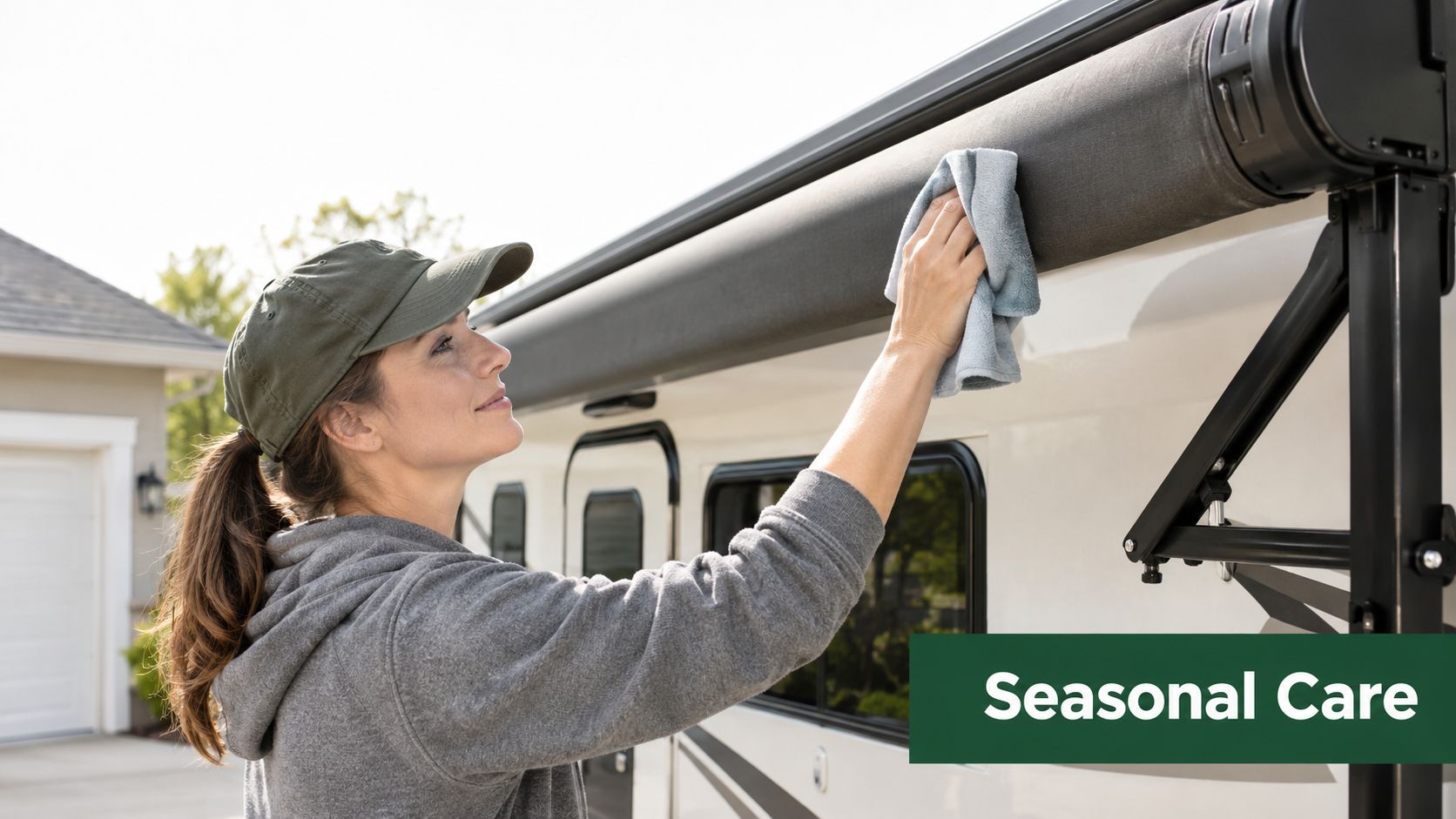
Utah weather rewards routine. A quick check before and after trips saves headaches.
Before a trip
- Look at the fabric edge. Small frays can spread under UV and wind load.
- Watch the arms during extension. If one side hesitates or binds, stop and inspect.
- Check mounting points. Movement at the wall bracket is never something to ignore.
After a trip
- Dry it before storing. Wet rolled fabric invites staining and mildew problems.
- Brush off dust and grit. Utah dust works like sandpaper over time.
- Listen during retraction. New squeaks or uneven rolling usually mean it's time for a closer look.
Winter and off-season habits
Snow load and freeze-thaw cycles are hard on any exterior RV component. During winter storage, keep the awning retracted and make sure it went in clean and dry. If you had a late-season storm trip, open it back up on a dry day before long-term storage if conditions allow.
For owners replacing worn fabric or trying to diagnose whether the problem is fabric, arms, or hardware, our guide to Utah RV awning replacement is a useful next step.
A quick walkthrough can also help you spot issues before they become parts orders or insurance claims:
When it's time for service instead of DIY
Some jobs are reasonable for owners. Cleaning, visual inspection, and basic operation checks fit that category.
These usually belong in a service bay:
- Bent arms or twisted geometry
- Bracket movement at the RV wall
- Electrical faults on power awnings
- Replacement work where sizing or compatibility is unclear
Our team sees plenty of awnings that could have been saved earlier with a simple inspection. Once the wall attachment or arm alignment is compromised, guessing often makes the repair bigger.
Finding Your Perfect Awning for RV Adventures With Motor Sportsland
The right awning for an RV comes down to three things. First, pick the style that matches how you camp. Second, choose fabric and hardware with Utah sun and site exposure in mind. Third, use it like shade equipment, not storm gear.
That sounds simple, but the details matter. A family parked at Bear Lake for long afternoons has different needs than a couple doing quick overnight stops in a Class B. A fifth wheel owner staying out through shoulder season may care more about fabric longevity and pitch adjustment than someone buying a lighter used trailer for weekend trips.
Historical patent records also show this isn't a new category with a quick trend cycle. RV awning innovation has been documented for decades, including U.S. Patent US4171013A for a retractable awning assembly filed in 1976 and published in 1979, US4191418A for a modular multi-sided awning filed in 1978 and published in 1980, and the later RV-specific US5400813A, filed on December 3, 1991, all summarized in a market overview from Grand View Research. In other words, awnings have a long engineering history, and the little fit and use details really do matter.
If you're comparing repair versus replacement, our article on RV awning repair cost and Utah pricing can help you sort that decision. And if you're building out a larger outdoor living setup at home between trips, ideas from timber shade structures can give you a useful point of comparison for how permanent shade differs from RV-mounted shade.
Quick buyer checklist
- Know your awning type. Patio, window, slide-out, or portable all solve different problems.
- Match fabric to exposure. Strong sun favors better UV resistance.
- Verify size and hardware family. Retrofit mistakes usually happen here.
- Use a real campsite rule. Calm and attended is different from gusty and unattended.
- Treat care as routine. Clean, dry, inspect, repeat.
Common questions we hear at the showroom
Buy for your most common campsite, not your most optimistic weather forecast.
If you camp across the Wasatch front, around Spanish Fork, or up toward reservoir country, it helps to talk with someone who sees these use patterns every day. In the article body, the simplest factual option worth noting is that Motor Sportsland carries RV inventory pages that list awning-related specifications on many units, which can help shoppers compare features before they visit.
FAQ
Is an awning for an RV mainly for shade or for rain?
In Utah, shade is usually the main job.
An RV awning can handle light rain if you set one side lower so water runs off instead of pooling in the middle. It is better to treat it like a porch roof, not like storm protection. If dark clouds are building fast or runoff has nowhere clear to go, bring it in.
When should I retract my RV awning?
Use a campsite rule instead of waiting for a perfect wind number. If the fabric is snapping, the arms are bouncing, or you would not leave a camp chair standing there unattended, retract the awning.
Utah weather can turn in a hurry, especially in canyon areas, open desert, and near reservoirs where gusts arrive sideways. Late afternoon is a common trouble window. If you are leaving the campsite, sleeping, or heading out on the trail, the safe call is to bring the awning in even if the weather looks decent at that moment.
Is acrylic or polyester better for Utah camping?
Acrylic is usually the better match for Utah sun, especially if your rig spends long hours parked with the awning out. It tends to hold color better and cope with hard UV exposure more gracefully.
Polyester can still make sense for lighter use, tighter budgets, or rigs that stay covered between trips. The trade-off is simple. More sun usually means faster fading. The fabric section above explains those differences in more detail.
Do tie-downs make my awning safe in wind?
Tie-downs can reduce flapping in mild conditions, but they do not turn an awning into a wind-rated structure. In some setups, they can shift stress back to the arms or wall mounts.
A good way to picture it is a screen door with someone pulling on the handle. The pull may steady one part while straining the hinge. If gusts are building or changing direction, retracting the awning is a better answer than adding more straps.
How do I know what replacement fabric size I need?
Measure the awning itself, not just the fabric, and do not assume the listed awning length matches the fabric cut size one-for-one. That is where many retrofit orders go sideways.
Replacement fabric is often shorter than the full awning width because it fits into hardware channels and leaves room at the ends. Measure your roller tube and arm spacing carefully, then confirm the sizing chart for your hardware family. If your RV is used, verify that the awning is still the original one, because previous owners sometimes swap hardware without updating labels.
Are most replacement hardware kits universal?
Some kits are made to fit several common awning families, but "universal" usually means "check carefully before ordering." Projection, arm style, mounting height, and roller compatibility still have to match.
This matters more on retrofits than many buyers expect. Two awnings can look nearly identical from ten feet away and still use different brackets or arm geometry. If you want help choosing the right awning setup, checking fit on a used RV, or scheduling an inspection before the next Utah trip, our team can help with sales, parts, and service questions in plain language. Browse inventory, compare awning-equipped RVs, or plan your next service visit with Motor Sportsland.
