
Best Travel Trailers for Utah Mountains

You're halfway up Big Cottonwood Canyon, the truck is working hard, and the trailer you bought for easy valley towing suddenly feels much larger than it did on the sales lot. The headwind pushes the coach toward the lane line, the grade keeps going, and the temperature has dropped from sunshine to sleet. That's the moment Utah buyers learn that the best travel trailers for Utah mountains aren't chosen by floorplan or dry weight alone.
Mountain towing exposes every weak decision, from insufficient payload to undersized tires and poor brake setup. We help buyers around Salt Lake City, the Wasatch Mountains, and the Great Salt Lake region sort through those details before they commit. The right trailer should leave room for altitude-related power loss, passengers, water, propane, gear, and long descents. It should also protect you from cold nights, sharp switchbacks, and the maintenance demands of Utah winters.
This guide focuses on the numbers and specifications that matter above 8,000 to 10,000 feet, then matches trailer categories and floorplans to real trips near Jordanelle, Bear Lake, Flaming Gorge, Moab, and the Alpine Loop.
What Utah Mountain Towing Really Demands From a Travel Trailer
A late-September climb toward Alta exposes a trailer's weaknesses quickly. The pavement rises, the engine has less breathing room, and a coach that tracked calmly on I-15 can tug at the truck near canyon walls. Guardsman Pass, Mirror Lake Highway, and the Alpine Loop add steep grades, tight turns, elevation, and weather that can change before camp.
Utah buyers often compare trailers in the 21 to 32-foot range, with sleeping space for 4 to 10 people. That general market range can suit Utah trips, but length and loaded weight increase the work required from the tow vehicle. We tell buyers to judge every floorplan against real payload, not the dry figure printed on a brochure.
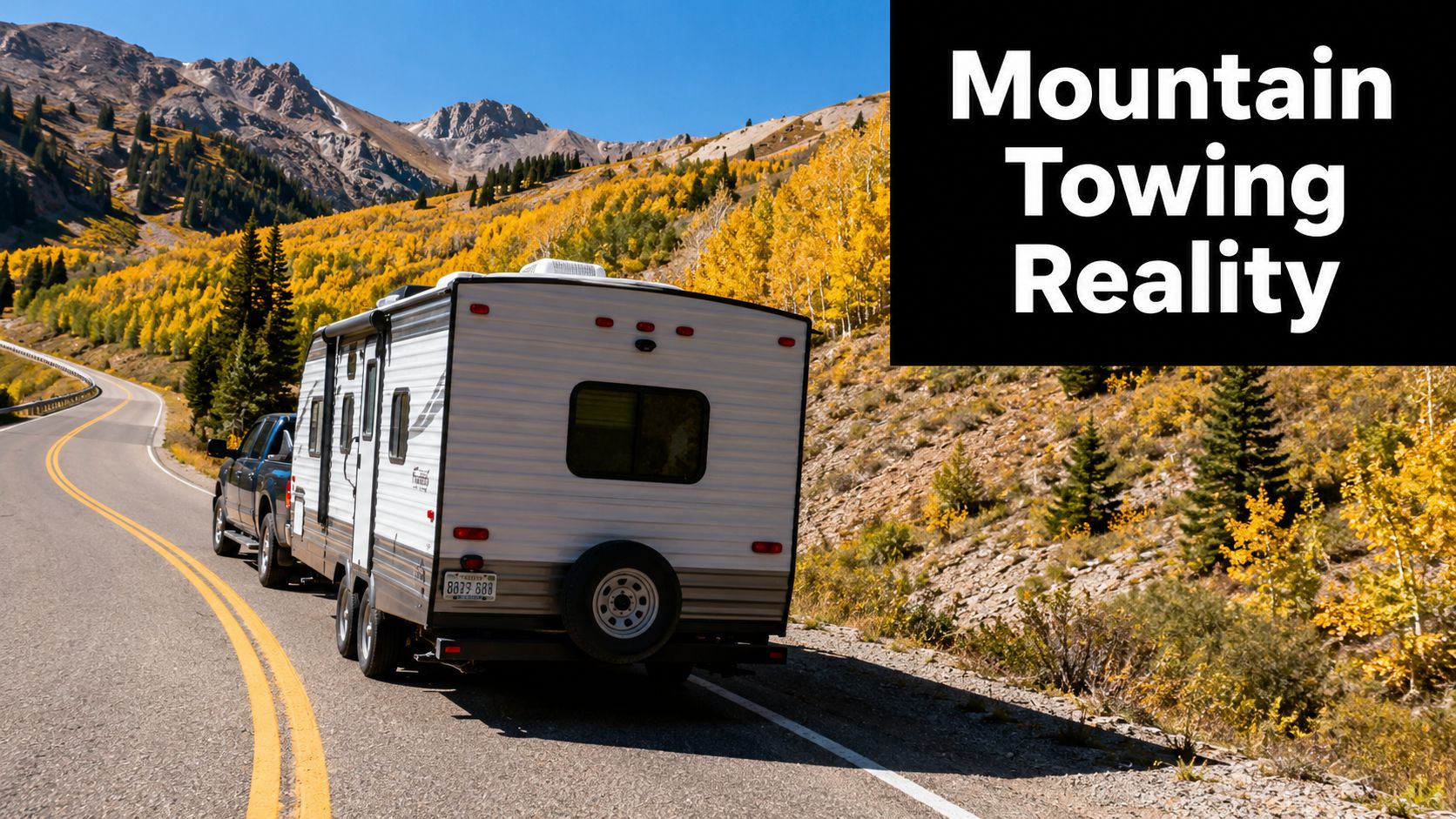
Thin air changes the tow
Gasoline engines lose about 3% to 4% of rated power per 1,000 feet of elevation. Ford's towing guidance recommends reducing GVW and GCW by 2% per 1,000 feet to preserve performance, as explained in this mountain towing reference. At 8,000 feet, a naturally aspirated engine can experience roughly a 25% to 30% power reduction, depending on starting elevation and conditions.
That loss shows up during long climbs. The truck downshifts more often, takes longer to pass, and has less reserve when the grade continues. A trailer that consumes nearly all available capacity at valley elevation will feel strained in the mountains. We prefer meaningful headroom, even when that means choosing a shorter trailer or leaving a larger floorplan on the lot.
Grades punish weak brake and sway setups
Utah mountain roads can combine sustained grades of 6% to 10% with elevations reaching 10,000 feet. The Moki Dugway includes an 11% grade, and official signage warns against RVs and vehicles towing there, according to this industry buyer guide for Utah travel trailers. That warning makes brake condition, loading, and route selection part of the purchase decision.
Weather adds risk. Sun at the trailhead can become sleet near the pass, while a narrow switchback leaves little room to correct sway. We prioritize altitude-derated capacity, payload, insulation, ground clearance, and tire load range before upgraded countertops or a larger television.
Our sales-lot rule: If a trailer only feels comfortable on flat roads at valley elevation, it isn't ready for Utah mountain travel.
The Core Specs Mountain Buyers Must Understand
Start with the trailer's loaded weight, not its unloaded vehicle weight. The useful calculation begins with the tow vehicle's gross combined weight rating, or GCWR. Subtract the truck's actual loaded weight, including passengers, fuel, cargo, hitch equipment, and accessories. Use this Utah travel-trailer weight guide to separate trailer ratings from the capacity your truck has left for a real Utah trip.
Start with altitude, then check the numbers
A vehicle rated to tow 9,000 pounds under ideal conditions does not retain the same climbing reserve at elevation. Using the verified 3% to 4% per 1,000 feet planning range, the figures below show how much capacity remains from that base rating. They are planning estimates, not replacements for the manufacturer's ratings.
| Elevation | Power Loss vs Sea Level | Effective Tow Capacity from 9,000-pound base |
|---|---|---|
| 2,500 feet | About 7.5% to 10% | About 8,100 to 8,325 pounds |
| 5,000 feet | About 15% to 20% | About 7,200 to 7,650 pounds |
| 8,000 feet | About 24% to 32% | About 6,120 to 6,840 pounds |
| 10,000 feet | About 30% to 40% | About 5,400 to 6,300 pounds |
At 8,000 feet, a 9,000-pound base rating leaves roughly 6,120 to 6,840 pounds of effective planning capacity. That is the reserve your truck may have for sustained climbing under this calculation, not permission to tow beyond its certified limits. At 10,000 feet, the same math leaves about 5,400 to 6,300 pounds, which is why we size the trailer around real payload and route demands rather than the largest number on a sales sticker.
The manufacturer's rating still controls. A GCWR towing explanation reinforces the correct starting point: real towing capacity comes from GCWR minus actual loaded vehicle weight, not the brochure tow number.
Six specifications deserve a hard look
- GVWR and payload: GVWR is the maximum loaded trailer weight. Payload is what the trailer can carry before reaching that limit. Water, propane, batteries, food, tools, and outdoor equipment use it quickly.
- Dry weight versus loaded weight: Dry weight excludes much of what makes a mountain trip possible. Build a realistic loaded estimate before comparing floorplans.
- Tongue weight: A loaded trailer should generally place 10% to 15% of its weight on the hitch ball. A 6,500-pound trailer therefore needs about 650 to 975 pounds of tongue weight for stability, as outlined in this mountain towing best-practices guide.
- Brakes: Electric drum brakes are common and serviceable. Disc brakes deliver stronger, more consistent braking on long descents as heat builds.
- Suspension: Torsion axles keep the design compact and can ride smoothly. Leaf springs are familiar and widely repairable. Inspect ratings, condition, and travel instead of assuming one design wins.
- Axle count and tires: Tandem axles usually give longer trailers more stability and load support. Check tire load range, age, condition, and inflation against the manufacturer's specification.
Our buying checklist is direct. Match the loaded trailer weight to the vehicle's real GCWR, apply altitude derating for routes reaching 8,000 to 10,000 feet, confirm payload and hitch capacity, and choose brakes and tires for sustained grades. That margin matters more than a larger floorplan.
Trailer Categories That Actually Work in Utah Terrain
Not every trailer category deserves equal consideration on Utah mountain roads. We rank them by how much capability they provide without forcing the tow vehicle to operate at its limit.
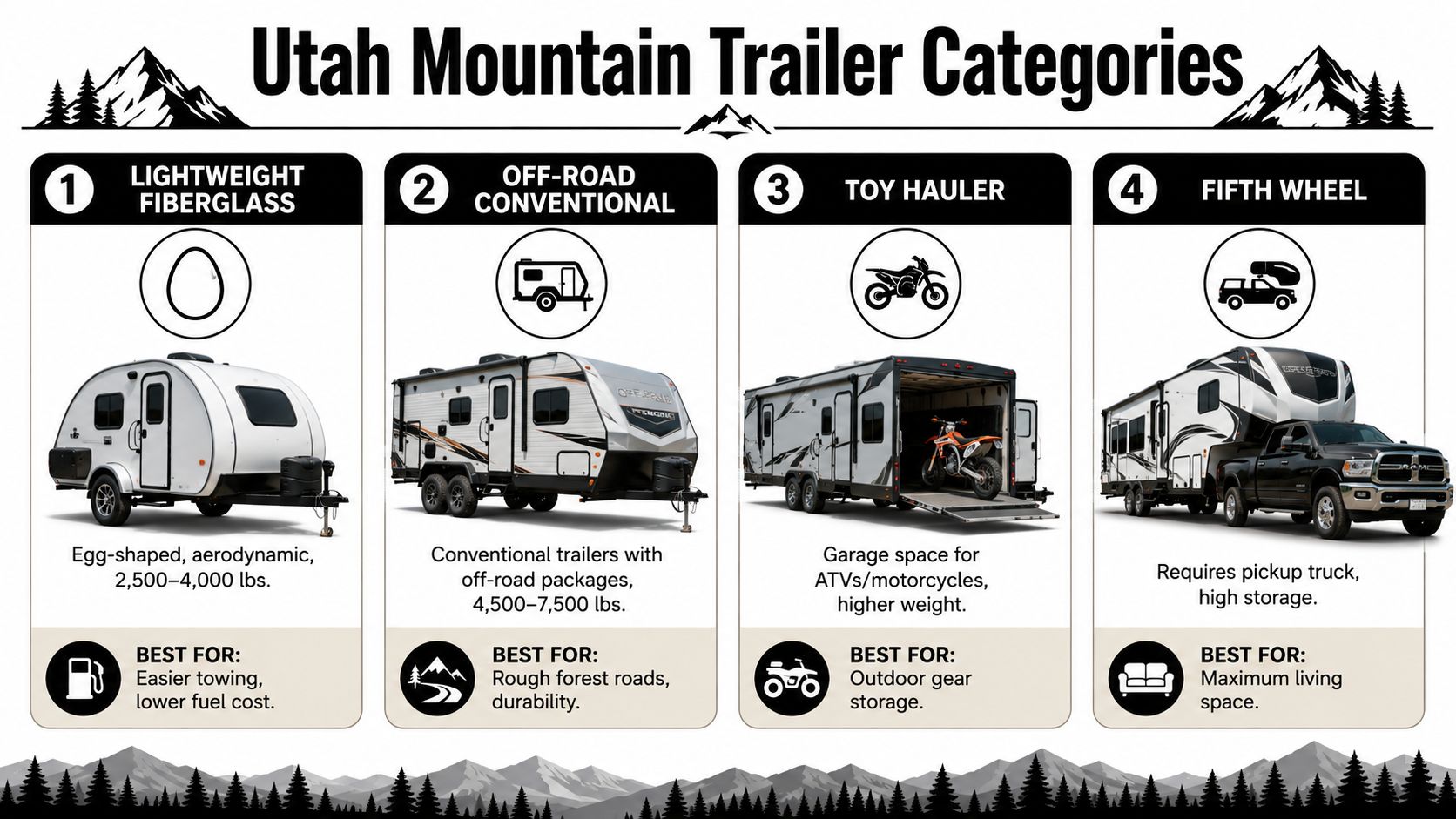
First choice for many couples
Lightweight fiberglass trailers are our first choice for solo travelers and couples who value easy handling. Egg-shaped construction reduces frontal area, and compact examples may weigh around 2,500 to 4,000 pounds, based on the category ranges supplied for Utah mountain buyers. They're easier to maneuver through switchbacks and less demanding for a properly equipped SUV or smaller pickup.
The downside is space and construction sensitivity. Thin-shell units can develop popped rivets or body damage if owners overload storage or neglect inspections. Interior finishes matter less than axle ratings, tire load range, hitch balance, and brake condition.
The best overall compromise
Conventional travel trailers with off-road packages rank second and fit the most common Utah buyer. They offer beds, bathrooms, kitchens, and family layouts while adding features such as higher clearance, protective underbody components, and more durable suspension choices. Typical examples fall around 4,500 to 7,500 pounds before real trip loading.
Stock conventional trailers can sit too low for rough forest roads. Owners who take them beyond maintained campground approaches need to inspect clearance and avoid dragging stabilizers or plumbing.
Useful, but easy to overbuy
Toy haulers make sense for dirt bikes, motorcycles, and side-by-sides. Their category often reaches 5,500 to 9,000 pounds, and the garage adds length, structure, and payload demand. Overloading the garage can produce poor tongue balance, while repeated heavy loading can contribute to sagging cargo doors.
Toy haulers rank fourth for mountain towing. They're the right tool for a powersports buyer, but not the smart default for someone who only needs extra storage.
Where hybrids fit
Hybrid expandables offer a lower-profile towing shape and can work for seasonal park-and-stay use. Their lighter road profile may help in wind, but expandable sleeping sections bring more weather exposure and inspection needs than a fully hard-sided coach.
Our verdict is direct: for the typical Utah couple or family towing through the Wasatch, choose a moderate-length, tandem-axle, insulated conventional trailer with conservative loading. Put axle count and tire load range ahead of decorative interior upgrades.
Matching Floorplans to Utah Adventures
Square footage doesn't tell you whether a trailer fits your trips. A family heading to Zion and Bryce needs beds and storage for people, while a couple hauling a UTV toward Moab needs garage volume, tie-down strength, and enough payload for equipment.
| Floorplan Type | Typical Sleeping | Loaded Weight Range | Best Utah Use | Trade-Off |
|---|---|---|---|---|
| Bunkhouse | Family-oriented sleeping | Can exceed 6,000 pounds loaded | Zion, Bryce, Jordanelle, and Bear Lake trips | More beds add structure and weight |
| Couple's rear kitchen | Two travelers | Often lighter than large family layouts | Wasatch weekends and longer couple trips | Less sleeping flexibility |
| Toy hauler | Couples or families plus gear | Frequently heavier because of garage and cargo | UTV, dirt-bike, and motorcycle weekends | Cargo can consume payload and alter balance |
| Hybrid expandable | Flexible sleeping | Depends heavily on furnishings and gear | Seasonal park stays | More exposure to cold and weather |
Families need beds, but not unlimited beds
A bunkhouse is convenient when children need dedicated sleeping space. It also adds cabinets, mattresses, framing, and often a larger body. Many bunkhouse layouts can move beyond 6,000 pounds loaded, so the buyer must compare that actual weight with the tow vehicle's payload and GCWR.
For a family of four, we'd rather see a well-balanced bunkhouse with useful pass-through storage than a longer floorplan with sleeping space nobody uses. Count the people, coolers, chairs, firewood, bikes, and food before deciding how much room you need.
Couples should protect payload
A rear-kitchen couple's coach can keep the layout efficient and the hitch balance friendlier for an appropriately equipped half-ton tow vehicle. That doesn't make every rear-kitchen trailer half-ton compatible. It means the floorplan often avoids the unnecessary weight of extra bunks and oversized entertainment areas.
A solo angler base-camping at Flaming Gorge needs a different setup. A compact coach with pass-through storage, a comfortable bed, and room for tackle can be more useful than a large family trailer. The best travel trailers for Utah mountains give you room for the gear you carry, not empty cabinets.
Used Versus New Trailers for Utah Mountain Use
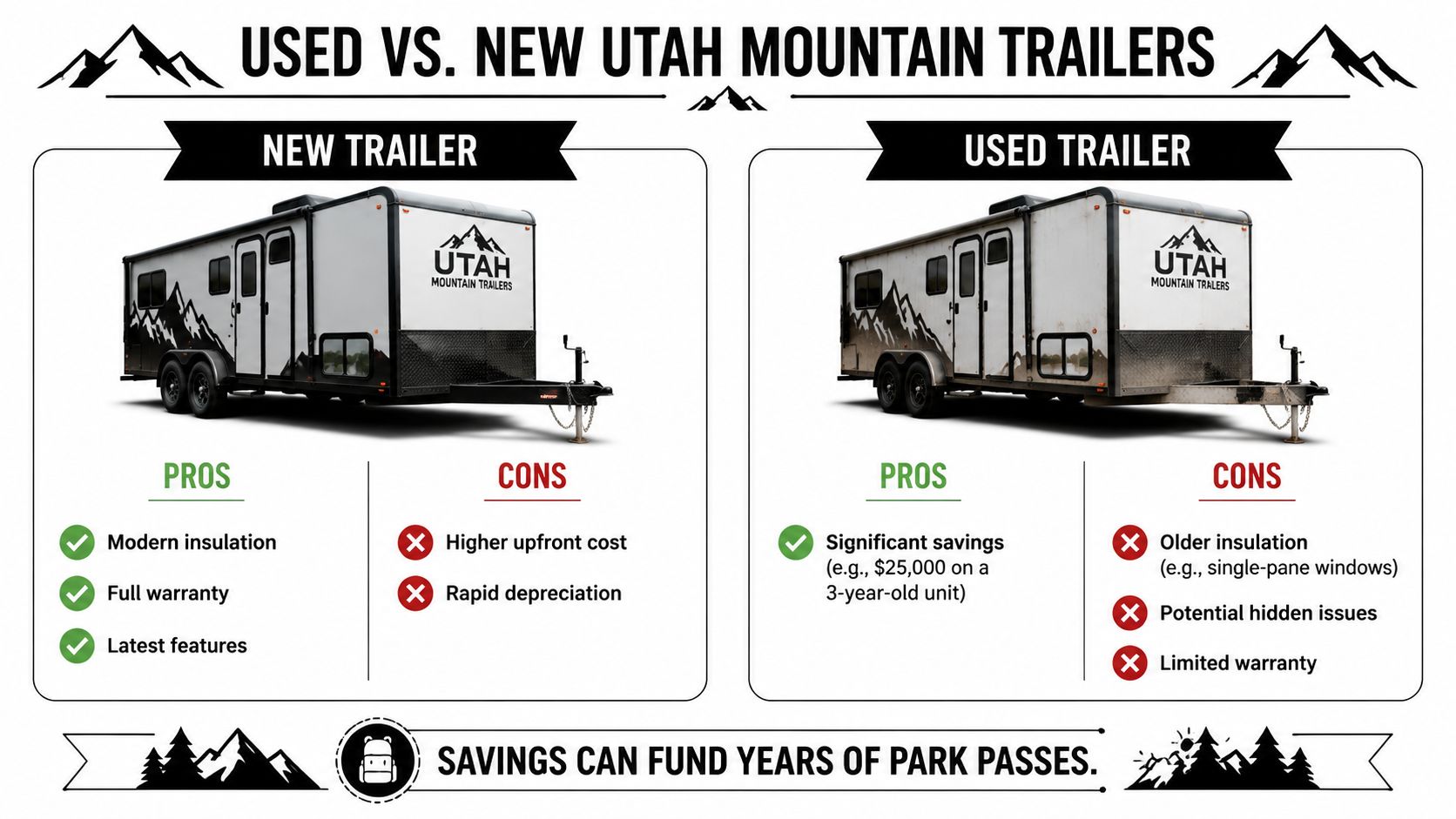
A used trailer can be an excellent value, but mountain use makes inspection more important. The savings on a three-year-old unit can reach $25,000 in the supplied comparison scenario, which may fund park passes and travel, as represented in this used versus new trailer comparison infographic. The purchase price is only part of the decision.
What new buys you
Newer trailers may offer improved insulation, updated seals, radial 16-inch tires, lithium-ready solar systems, and factory warranty coverage. Those features matter when a component fails far from a service bay or when you want to extend the camping season into colder weather.
Warranty support also has practical value. A local service department can diagnose a refrigerator, brake, plumbing, or seal issue before it becomes a mountain-trip failure.
What used buyers must inspect
Older units may have weaker insulation packages, single-pane windows, or 15-inch tires with aged sidewalls. Before buying, inspect:
- Roof seams: Look for hail pockmarks and sealant damage after Park City storms.
- Underbelly: Check for road-salt corrosion, damaged wiring, and exposed plumbing.
- Propane system: Verify that the system passes a current leak test.
- Running gear: Examine tires, brakes, bearings, suspension, and axle alignment.
- Water intrusion: Check corners, slide-out areas, windows, and roof penetrations for staining or softness.
Buy used when the inspection is thorough and the running gear leaves you confident. Buy new when insulation, warranty access, and cold-weather dependability outweigh the initial savings.
Financing, Trade-In, and Local Service Options
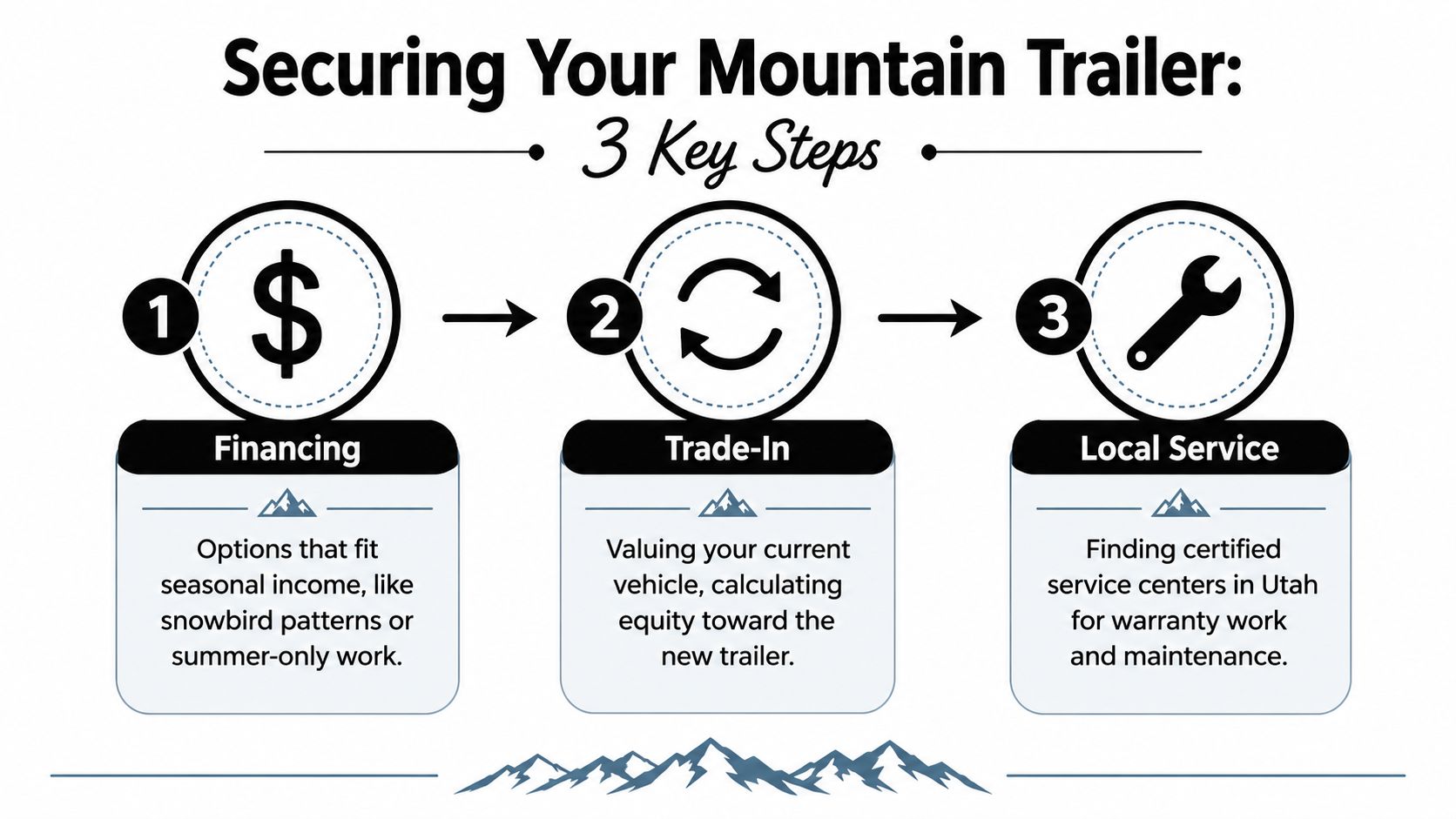
The trailer can be perfectly matched to your truck and still become a poor ownership decision if financing, trade-in value, or service access gets ignored. Seasonal Utah buyers often have income patterns tied to summer work, winter travel, or snowbird schedules. The payment structure should reflect the household's actual cash flow rather than an optimistic camping calendar.
RV loans can stretch to 20 years, which lowers the monthly payment but extends the obligation. Compare that payment with your realistic camping and storage costs, then leave room for tires, winterization, brake service, roof work, and unexpected repairs. A long term can make a trailer easier to own month to month, but it doesn't make an overloaded trailer safer.
Local service changes the ownership equation
Mountain trailers need brake inspections, winterization, roof resealing, plumbing work, electrical repairs, and tire checks. A Utah dealer with service and parts support can handle those jobs without requiring you to ship a trailer across state lines.
Trade-in equity also deserves an in-person evaluation. Online buyers often focus on a purchase price and overlook the value of trading a current vehicle or RV locally. A proper appraisal can account for condition, equipment, maintenance history, and demand.
If you're adding electrical equipment at home for an EV or tow-vehicle setup, use a qualified electrician and review resources on EV charger installation before work begins. The same habit applies to trailer electrical upgrades. Have the system evaluated rather than improvising around a high-load connection.
Financing advice: Get the trailer, tow vehicle, payload, and service plan evaluated together. A low payment doesn't fix a poor match.
Motor Sportsland offers new and used RV inventory, trade-in evaluations, financing tools, and service support from Utah locations in Millcreek and Spanish Fork. That combination is useful when your trailer needs adjustments before the next climb, not just a sales transaction on purchase day.
Utah Towing Tips and Winter Storage Essentials
A trailer that feels stable leaving Salt Lake City can behave differently on the grades into Big Cottonwood, Little Cottonwood, or SR-190 near Sundance. Downshift before the descent, use the brake controller with short, firm applications, and avoid riding the truck brakes continuously down an 8% descent. If the controller warns of overheating, use a pull-out and let the system cool.
Tires deserve attention before every mountain season. Check pressure cold, inspect sidewalls for cracking, and verify that the load range matches the trailer's actual demand. Some owners prefer LT tires for particular tow setups, but the correct choice depends on wheel compatibility, axle ratings, and manufacturer specifications. Don't change tire type without confirming those details.
Cold-weather preparation protects the plumbing
At elevation, propane demand can rise while cooking takes longer. Water boils at about 208°F around 2,000 feet, compared with 212°F at sea level, and moist-heat cooking can take up to 25% longer, according to these high-altitude RV cooking tips. A tank monitor helps prevent a cold night caused by an empty cylinder.
Before winter storage, our service checklist includes:
- Drain the fresh tank: Remove all fresh water before freezing weather.
- Open low-point drains: Clear water from the plumbing system.
- Bypass the water heater: Don't fill the heater with antifreeze.
- Protect the lines: Run pink RV antifreeze through the plumbing.
- Remove inline filters: Filters can trap water and freeze.
- Store batteries properly: Follow the battery maker's charging and storage guidance.
- Inspect seals: Check roof seams, windows, doors, slide-outs, and exterior penetrations.
- Prevent rodents: Seal access points and remove food or nesting material.
If home storage isn't practical, compare covered RV storage units and verify access, security, clearance, and winter conditions before signing. Covered storage can reduce exposure, but it doesn't replace winterization or seal inspections.
For sway setup and loading technique, use our Utah RV sway-control guide. The seasonal routine is simple: inspect before spring, service brakes before mountain trips, check tires before every departure, and winterize before the first hard freeze.
Our Recommendation and Your Next Steps
Our buying rule is straightforward: match the trailer to the tow vehicle's true altitude-derated capacity, not the brochure rating. For buyers camping above 7,000 feet, we recommend a tandem-axle insulated trailer with four-season capability, a properly matched brake controller, and an off-grid power package.
Couples should start with lighter 20 to 23-foot layouts that provide the essentials without forcing a large tow vehicle. Families carrying dirt bikes or side-by-sides should consider a 24 to 28-foot toy hauler with a 12-foot garage, but only after confirming cargo capacity, hitch weight, and GCWR with the equipment loaded.
The final review should cover:
- Weight and payload: Use loaded figures, not dry weight alone.
- Braking and sway: Confirm controller compatibility, brake condition, and hitch setup.
- Insulation: Ask about cold-weather construction and insulation ratings.
- Clearance: Check the underbody, stabilizers, plumbing, and approach angles.
- Storage discipline: Plan winterization, battery care, seal inspections, and tire checks.
Bring your tow vehicle's exact specifications to the lot. Walk through a realistic weight ticket, load the passengers and gear you carry, compare layouts in person, and review financing and service before signing. Our Utah travel-trailer buyer guide can help you organize that conversation before you arrive.
The right trailer won't eliminate mountain driving demands. It will give you enough stability, braking reserve, payload capacity, and power margin to handle them with confidence.
Motor Sportsland offers new and used travel trailers, bunkhouse layouts, toy haulers, trade-in evaluations, financing options, and Utah-based service for mountain-ready RV ownership. Bring your tow-vehicle details to our Millcreek or Spanish Fork team, then visit Motor Sportsland to browse current inventory and plan your next Utah mountain trip.
Frequently asked questions
What makes a travel trailer suitable for Utah mountains?
A suitable trailer has a loaded weight that stays comfortably below the tow vehicle's altitude-adjusted capability, plus stable suspension, correctly rated tires, reliable brakes, useful payload, and insulation for changing weather.
Should I buy by dry weight or GVWR?
Use GVWR and realistic loaded weight. Dry weight usually excludes passengers, water, propane, batteries, food, tools, and recreational gear that consume payload and add hitch weight.
How much tongue weight should a travel trailer have?
Tongue weight should generally be 10% to 15% of loaded trailer weight, according to this mountain towing guidance. The exact setup must also remain within the tow vehicle's hitch and payload ratings.
Are toy haulers good for Utah mountain trips?
They're good for buyers who regularly carry motorcycles, dirt bikes, or side-by-sides and have enough tow-vehicle capacity. They're a poor default choice for buyers who don't need the garage because cargo weight, length, and hitch demand can grow quickly.
Is a used trailer safe above high elevation?
It can be, provided you inspect the roof, underbelly, propane system, tires, brakes, bearings, suspension, and water-intrusion points. Older insulation, single-pane windows, and aged tire sidewalls deserve particular attention.
What should I do before storing a trailer for a Utah winter?
Drain the fresh tank, open low-point drains, bypass the water heater, run RV antifreeze through the lines, remove inline filters, care for the batteries, inspect seals, and block rodent entry points before freezing weather arrives.
