
Class a Motorhome Gas vs Diesel Guide for Utah

You're standing on a Utah RV lot, comparing two Class A coaches that both look ready for the road. One has a front-mounted gasoline engine and a lower entry cost. The other is a rear-engine diesel pusher with a quieter cockpit, more storage, and the kind of chassis that feels built for long grades. Your family wants Jordanelle and Bear Lake weekends, but someone is already talking about cross-country trips, a heavy towed vehicle, and snowbird travel.
That's why the Class A motorhome gas vs diesel decision isn't really about choosing the “better” engine. It's about choosing the coach that matches how you'll drive, tow, maintain, store, and finance it. The wrong match can leave you paying for diesel capability you rarely use, or wishing your gas coach had more cargo capacity on the first serious mountain trip.
This guide gives you the practical comparison we use with Utah buyers, including chassis design, fuel economy, towing, GVWR, maintenance, depreciation, high-altitude driving, winter storage, and the point where diesel may or may not pay back. Our team at Motor Sportsland has helped RV shoppers for more than 55 years from Millcreek and Spanish Fork. Use the framework below, then compare current options on motorsportsland.com or talk with us before you commit.
Introduction That Helps You Choose With Confidence
A couple shopping for their first Class A often starts with a simple question: “Which one gets better mileage?” That question matters, but it rarely decides the purchase by itself. A gas coach may be easier to buy, service, and justify for occasional trips, while a diesel pusher can make more sense for demanding towing, frequent mountain travel, and long periods behind the wheel.
We've seen buyers focus on engine power and overlook the rest of the ownership experience. They forget to check available cargo capacity after the freshwater tank is full, compare tow ratings without including the actual towed vehicle, or assume fuel savings will automatically recover diesel's higher ownership cost. Those oversights show up quickly on Utah grades and during long service waits.
The useful question is more specific:
Which platform fits your actual travel pattern, not the most ambitious trip you might take someday?
The comparison below separates the two platforms by capability and cost. It also accounts for Wasatch Mountain driving, high-altitude camping, winter storage, DEF-equipped emissions systems, and service access. If you're still narrowing the field afterward, our team can help you compare floorplans, weights, tow ratings, and available inventory without pushing you toward a fuel type that doesn't fit.
Understanding What Separates Gas and Diesel Class A Platforms
Gas and diesel Class A motorhomes are built around different chassis philosophies. Understanding that architecture makes the later performance numbers much easier to interpret.
Front-engine gas chassis
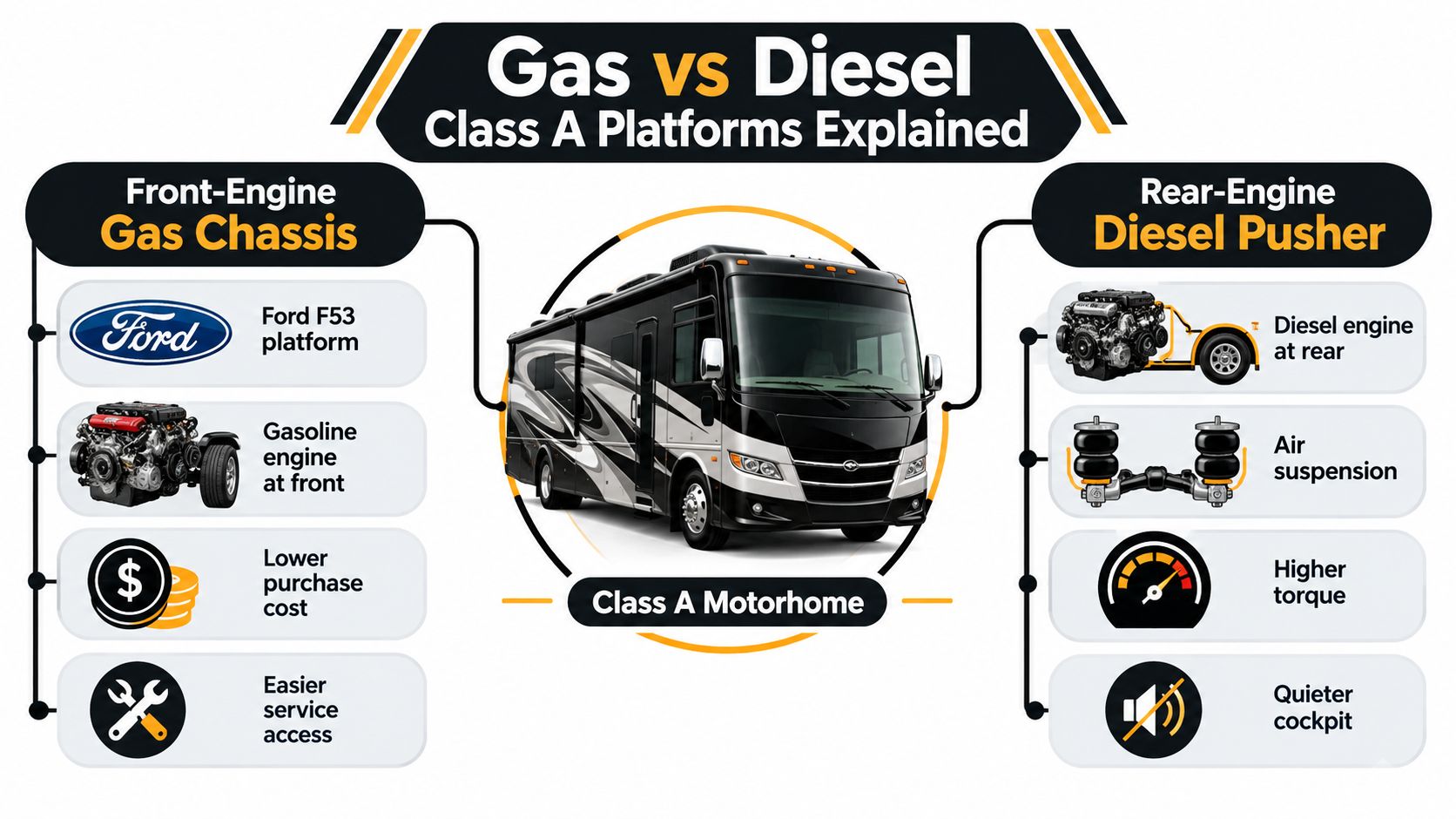
A common gasoline Class A uses a front-engine chassis similar to the Ford F53. The engine sits ahead of the cockpit, and the coach body is built behind it. This layout is familiar to many service facilities, generally keeps the purchase price lower, and works well for buyers who want a large motorhome without stepping into a heavy-duty diesel platform.
The tradeoff is packaging. A front engine can contribute more cockpit noise and heat, while the chassis typically carries less weight than a diesel pusher platform. Common Ford gas Class A coaches are typically rated around 16,000 to 22,000 pounds GVWR, according to this gas and diesel motorhome comparison. That rating includes the motorhome, passengers, fuel, water, belongings, and installed equipment, so the number matters long after the test drive.
Rear-engine diesel pusher
A diesel pusher places the engine behind the living area. The front of the coach can be quieter, and the platform commonly uses air suspension and heavier-duty running gear. Diesel torque and chassis capacity support larger coach systems, more cargo, and stronger towing equipment.
Diesel pusher Class A coaches are commonly rated around 25,000 to 40,000-plus pounds GVWR, using the same comparison source above. That larger platform can support more freshwater and holding capacity, heavier cabinetry, larger slides, and higher hitch ratings before the coach reaches its weight limits.
The difference isn't “gas versus diesel.” You're choosing between a lighter front-engine platform and a heavier rear-engine platform with a different ride, service profile, and intended workload.
Head to Head Performance Fuel Economy and Towing Compared
On a Utah trip from the Wasatch Front toward higher elevations, the difference shows up quickly. A gas Class A can handle the climb, but a diesel pusher gives our team more reserve for a heavy coach, extended grades, and a substantial tow vehicle. That extra capacity matters more than a small change in advertised fuel economy.
| Criteria | Gas Class A | Diesel Pusher Class A |
|---|---|---|
| Typical chassis GVWR | About 16,000 to 22,000 pounds | About 25,000 to 40,000-plus pounds |
| Common fuel economy estimates | About 6 to 8 mpg on common gas chassis, with broader guides listing about 8 to 14 mpg depending on chassis and loading | Commonly about 7 to 10 mpg or 8 to 12 mpg, with some optimistic estimates higher |
| Practical 100-gallon tank range | Roughly 600 to 800 miles at the historical gas benchmark | Roughly 800 to 1,000-plus miles at common diesel averages |
| Typical tow rating | Often around 5,000 pounds | Often around 10,000 pounds |
| Engine position | Front engine | Rear engine |
| Best fit | Lighter use, value-focused ownership, moderate towing | Heavy towing, high mileage, larger coach systems, demanding travel |
The table provides useful planning ranges, not guarantees. Coach length, cargo, speed, headwind, tire pressure, generator use, and grade can move actual results considerably. A Ford F53 benchmark places many gas coaches near 6 to 8 mpg, while many diesel pushers run roughly 8 to 10 mpg. With a 100-gallon tank, those averages indicate about 600 to 800 miles for gas and 800 to 1,000-plus miles for diesel.
Fuel economy and range
Diesel usually gains ground on long Utah routes, especially when the coach carries full supplies and climbs repeated grades. Gas still wins the ownership math for lighter, occasional use because the fuel difference accumulates gradually, while the diesel platform costs more to buy and service.
A family that takes short trips and returns home between fuel stops may never reach the diesel payback point. A couple traveling frequently, carrying more cargo, and keeping the coach for many years has a stronger case for paying for diesel capability. Use our guide to get more memories per gallon when comparing routes, speed, and driving habits.
Mountain grades and towing
Utah's Wasatch grades expose sustained power delivery. A gas coach can climb them, but the engine may run louder and require more speed management on extended grades. A diesel pusher generally feels calmer under load because its higher torque and heavier running gear suit that work. Air-brake-equipped configurations can also provide added control on long descents, depending on the specific coach.
Tow rating often matters more than engine feel. Gas Class A coaches are commonly rated around 5,000 pounds, while diesel pushers are often around 10,000 pounds. Choose diesel for a heavy SUV, enclosed cargo trailer, or stacker-style utility trailer. Before buying, compare the actual hitch rating, loaded coach weight, towed weight, and combined ratings for that exact unit. A lighter travel pattern does not justify paying for capacity you will rarely use.
Total Cost of Ownership and Long Term Value in Utah
Diesel capability does not automatically make a coach the better financial choice. In Utah, the crossover point depends on annual mileage, workload, ownership length, and how much value you place on a heavier platform's comfort and resale potential. Our team sees gas win for lighter, occasional travel, while diesel earns its premium for frequent routes, heavy towing, and long-term ownership.
Where the money goes
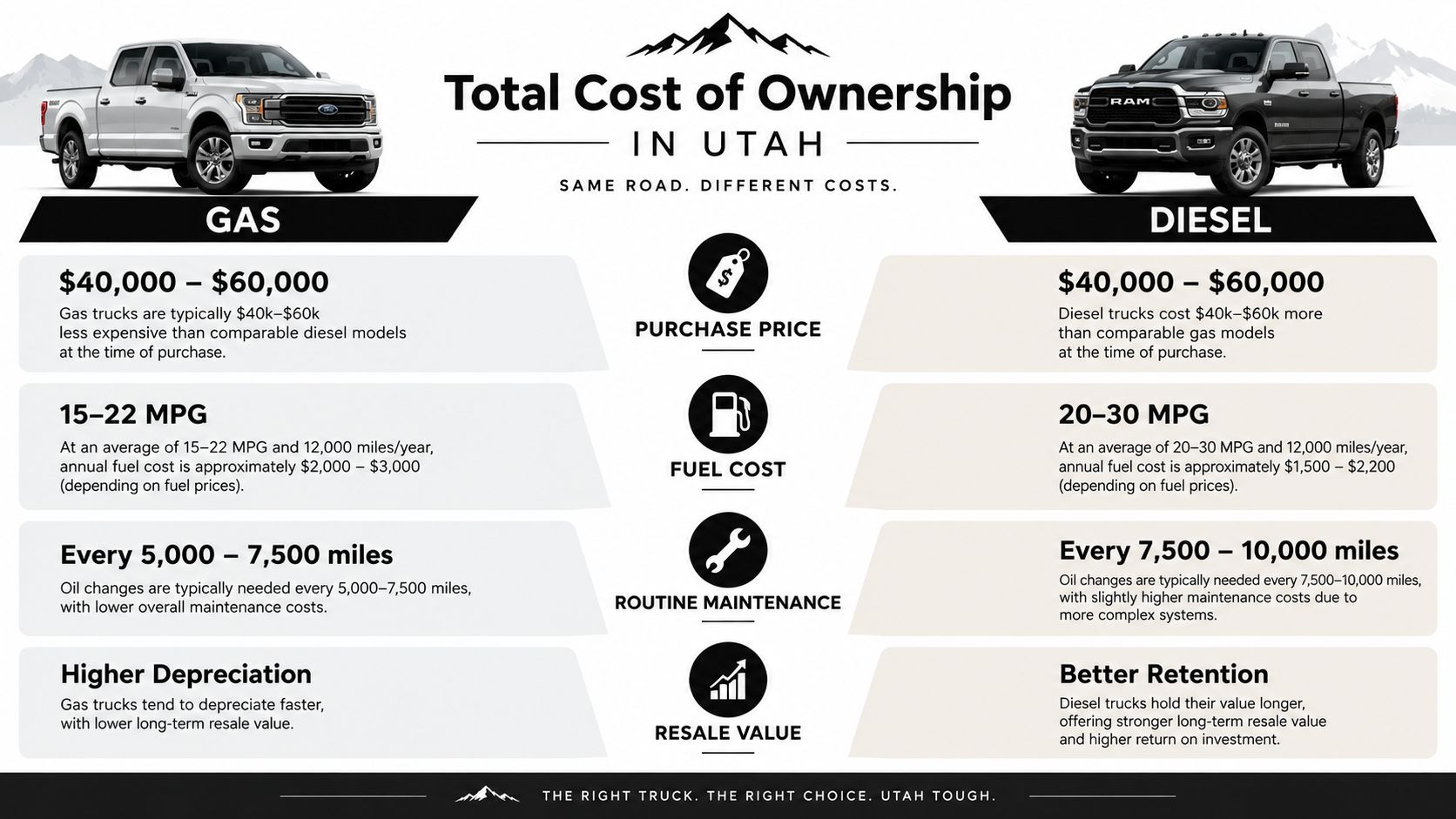
A diesel pusher typically costs more upfront because its chassis, drivetrain, suspension, braking equipment, and coach construction are designed for harder use. An infographic comparing gas and diesel trucks shows a $40,000 to $60,000 purchase gap as an illustrative example, not a universal pricing rule. Actual prices change with age, brand, floorplan, condition, equipment, and market.
Fuel savings build slowly. Diesel may use less fuel, but diesel fuel can cost more per gallon, and owners also budget for DEF refills and emissions-system service. An RV Life analysis estimates routine diesel maintenance at 200% to 300% higher than gas in some comparisons, as summarized by this gas-versus-diesel motorhome analysis.
| Ownership factor | Gas Class A | Diesel Pusher Class A |
|---|---|---|
| Entry cost | Usually lower | Usually higher |
| Fuel consumption | Generally higher | Generally lower |
| Routine service | Usually simpler and less expensive | Often more expensive and more specialized |
| Emissions equipment | Gas emissions systems | Modern diesel systems commonly include DPF, SCR, and DEF |
| Resale pattern | Can depreciate faster over time | May retain value better, depending on condition and market |
| Financial fit | Occasional trips and lighter annual use | Heavy use, towing, long-distance travel, and extended ownership |
TruRV's depreciation breakdown estimates diesel depreciation at 18% to 22% in year one, 40% to 50% by year five, and 55% to 65% by year ten. Its gas Class A estimates are 20% to 25% in year one, 45% to 55% by year five, and 65% to 75% by year ten, according to this RV depreciation breakdown. These ranges do not guarantee a resale result. Mileage, service records, floorplan demand, condition, and market timing still determine what buyers will pay.
The crossover rule: Diesel can justify its premium when you drive often, tow heavily, and keep the coach long enough to benefit from its capability and potential resale strength. For occasional family travel, higher purchase and maintenance costs can erase the fuel advantage.
How to estimate your own break-even
Use your real travel calendar. List expected trips, route lengths, towing plans, storage costs, service costs, and the period you expect to own the coach. Then compare the full ownership picture:
- Annual driving: More miles give diesel efficiency more opportunity to offset its added cost.
- Towing load: A heavy toad or trailer can justify diesel capability before fuel savings do.
- Service access: Specialized diesel work may require more planning and travel.
- Ownership duration: Keeping the coach longer gives depreciation and durability more influence.
- Financing: A higher purchase price affects every payment and the cash tied up in the coach.
Recent market commentary reports that motorhome demand remained active and shipments rose year over year in 2025 and 2026, which may influence used values and financing decisions, as described in the depreciation source above. Do not buy diesel solely for expected resale strength. If your Utah trips are occasional, gas usually carries less annual financial risk and simpler service needs.
How Utah Terrain Climate and Service Access Change the Answer
Utah buyers need to evaluate more than horsepower. A motorhome that feels perfect on a flat dealership route may feel very different climbing through the Wasatch Mountains with passengers, gear, full tanks, and a vehicle behind it.

Grades, altitude, and heat
Long Utah grades place sustained demands on the engine, cooling system, transmission, tires, and brakes. High-altitude camping near mountain reservoirs can also change how a loaded coach feels under acceleration. Diesel platforms are often favored for this type of work because turbocharged diesel engines maintain their operating advantage more effectively at altitude, while the heavier chassis gives the coach more braking and towing equipment to work with.
Gas coaches remain sensible for buyers who travel to places such as Jordanelle or Bear Lake occasionally, especially when the coach is loaded within its ratings and the driver is comfortable managing grades. The important habit is controlling speed before a descent, rather than waiting until the coach is already moving too quickly.
Summer heat adds another local consideration. Keep cooling-system condition, tire condition, brake inspection, and load distribution on the service checklist before a demanding trip. Our Utah RV repair and maintenance guide covers the ownership planning that helps reduce avoidable downtime.
Winter storage and emissions equipment
Cold storage affects both fuel systems and house systems. Our service team recommends preparing the coach according to its manufacturer instructions, protecting plumbing from freezing, checking batteries, and scheduling an inspection before spring travel. Diesel owners also need to understand that modern diesel Class A motorhomes commonly use selective catalytic reduction with DEF.
The EPA explains that DEF-equipped vehicles use onboard diagnostics to detect low DEF levels and system failures, as described in its diesel exhaust fluid guidance. Modern diesel aftertreatment exists because heavy-duty diesel emissions rules tightened in 2010. Particulate matter limits dropped from 0.1 to 0.01 g/bhp-hr, while NOx limits dropped from 2.5 to 1.2 g/bhp-hr, according to this overview of the 2010 EPA diesel standards.
Those systems are manageable, but they add components, warning messages, fluid planning, and specialized diagnostic needs. Gas chassis service is generally available through a wider range of facilities, while diesel pusher service can require technicians familiar with heavy-duty engines, air systems, and emissions equipment.
Here's a useful local test before buying. Ask where you'll take the coach for routine service, emissions-system diagnosis, tire work, and urgent repairs while traveling. If the answer is unclear, the diesel's extra capability may come with more downtime than you expect.
Matching Your Travel Style to the Right Fuel Type
The most reliable way to decide is to match the engine to your recurring trips. Don't choose based on the longest vacation you might take once. Choose based on the work the coach will perform year after year.
Occasional family weekenders
Choose gas if your family mainly takes shorter trips from Salt Lake City, uses established campgrounds, and doesn't tow a heavy vehicle. The lower entry cost leaves more room in the budget for campsite fees, outdoor equipment, and a floorplan with beds that work for everyone.
A gas Class A also makes sense when the coach will spend much of the year stored. You won't gain much from diesel fuel economy if the motorhome sits between trips.
Wasatch weekend explorers
Choose diesel if you regularly cross mountain grades, carry substantial gear, or tow a vehicle that pushes beyond a gas coach's comfortable limits. The decision isn't about conquering every road. It's about having more chassis reserve when the coach is loaded and the route includes sustained climbs and descents.
Gas can still work for occasional mountain travel, but keep the coach within its weight and hitch ratings and accept that the drive may be noisier and slower on long grades.
Retirees planning extended tours
Retirees planning long-haul travel across the Mountain West and beyond should lean toward diesel, especially if the coach will cover substantial mileage, carry full tanks, and tow a heavier vehicle. The quieter front cockpit, larger chassis, and stronger towing platform can improve the day-to-day travel experience.
Choose gas instead if extended tours are occasional and the budget difference would reduce the length or frequency of your trips.
Full-time high-mileage travelers
For full-time, high-mileage use, diesel is the clear fit when the budget supports its maintenance and service requirements. Long-term travelers benefit from the heavier chassis, larger cargo potential, and improved range described earlier.
This buyer should also budget for specialized service and DEF system awareness. Capability doesn't remove maintenance. It changes the kind of maintenance you need to plan.
Luxury resort campers
Luxury amenities alone don't require diesel, but a heavier coach with multiple slides, larger tanks, and a quieter ride often points in that direction. If you spend extended time in the motorhome and value a stable, refined highway experience, compare diesel pushers first.
Use this quick filter before visiting a showroom:
- Mostly short trips: Gas is usually the rational starting point.
- Frequent grades: Diesel deserves serious consideration.
- Heavy towed vehicle: Verify the numbers, but diesel is often the practical match.
- Limited service tolerance: Gas may reduce logistical complexity.
- Long ownership and high mileage: Diesel's capability and resale potential become more relevant.
Our Recommendation and Next Steps at Motor Sportsland
Our recommendation is direct. Choose a gas Class A when you want the best balance of entry cost, accessible service, and occasional-use practicality. Choose a diesel pusher when you'll tow heavily, drive long distances regularly, spend substantial time in the coach, or routinely travel demanding mountain routes.
Neither choice wins for every Utah buyer. A gas coach can be the smarter financial decision for a family taking weekend trips to nearby campgrounds. A diesel pusher can be worth the additional ownership responsibility for retirees touring across the country or owners hauling a heavy vehicle through the Wasatch and beyond.
Before you shop, write down your expected passengers, cargo, water use, towed vehicle, annual mileage, storage plan, and preferred service location. Then compare actual GVWR, hitch ratings, floorplan weight, and maintenance records rather than relying on engine labels.
Motor Sportsland has served Utah RV buyers for more than 55 years from Millcreek and Spanish Fork, with sales and service support for new and used recreational vehicles. You can browse current motorhome inventory in Utah, compare floorplans, and bring your shortlist to our team for a practical review.
Motor Sportsland offers new and used motorhomes, financing support, trade-in assistance, and service for the maintenance and repairs that keep your coach ready for Utah travel. Visit Motor Sportsland to compare Class A gas and diesel options, then stop by our Millcreek or Spanish Fork location for a personalized walk-through before you buy.
Class A Motorhome Gas vs Diesel FAQ
Is gas or diesel better for a Class A motorhome?
Gas is usually better for occasional travel, lower entry cost, and simpler service access. Diesel is better for heavy towing, frequent mountain driving, high mileage, larger chassis capacity, and long-distance comfort.
Do diesel Class A motorhomes get much better fuel economy?
The difference is usually meaningful but modest. Common guides place gas Class A coaches around 6 to 8 mpg or 8 to 14 mpg, while diesel coaches are commonly listed around 7 to 10 mpg or 8 to 12 mpg, depending on chassis, loading, and driving conditions. See the cited fuel-economy comparison.
Is diesel worth it for Utah mountain driving?
Diesel is worth considering if you regularly drive sustained grades, carry a heavy load, or tow a substantial vehicle. Gas remains adequate for occasional mountain trips when the coach is loaded and operated within its ratings.
Which Class A motorhome can tow more?
Gas Class A tow ratings are often around 5,000 pounds, while diesel pushers are often around 10,000 pounds, according to the gas and diesel chassis comparison. Always verify the specific coach's hitch, weight, and combined ratings.
Are diesel motorhomes more expensive to maintain?
They often are. Some comparisons estimate routine diesel maintenance at 200% to 300% higher than gas, and diesel owners also need to account for DEF and emissions-system service. The exact cost depends on the coach, service provider, mileage, and repairs.
Should a first-time buyer choose a gas or diesel Class A?
Most first-time buyers who plan occasional family trips should start with gas. Choose diesel when your travel plan already includes heavy towing, frequent long-distance driving, full-time use, or demanding mountain routes.
