
How to Choose a Travel Trailer for Utah Adventures

You're standing on the lot with your family, comparing a roomy bunkhouse trailer with a smaller model that your SUV appears to tow easily. The larger trailer has the beds, kitchen, and bathroom everyone wants. The smaller one leaves more margin for mountain grades, cargo, and high-altitude camping. The right choice isn't the trailer with the most impressive floorplan. It's the one your vehicle can tow after passengers, water, propane, batteries, hitch equipment, and camping gear are loaded.
That's the part many first-time buyers miss. Learning how to choose a travel trailer means starting with real-world weight, then matching your family's camping style, floorplan, budget, service needs, and Utah storage realities. From weekend trips to Jordanelle and Bear Lake to longer stays near the Wasatch Mountains, our team at Motor Sportsland helps buyers work through those trade-offs before they fall in love with the wrong layout.
Start With How You Will Actually Use Your Travel Trailer
A Utah family recently came in looking for a trailer that could sleep two adults and three children. They liked a large bunkhouse immediately because it gave every child a dedicated bed. But their usual trips were short weekends, they planned to camp near established hookups, and their tow vehicle had limited payload. A smaller bunkhouse with practical storage solved the actual problem better than the biggest trailer on the lot.
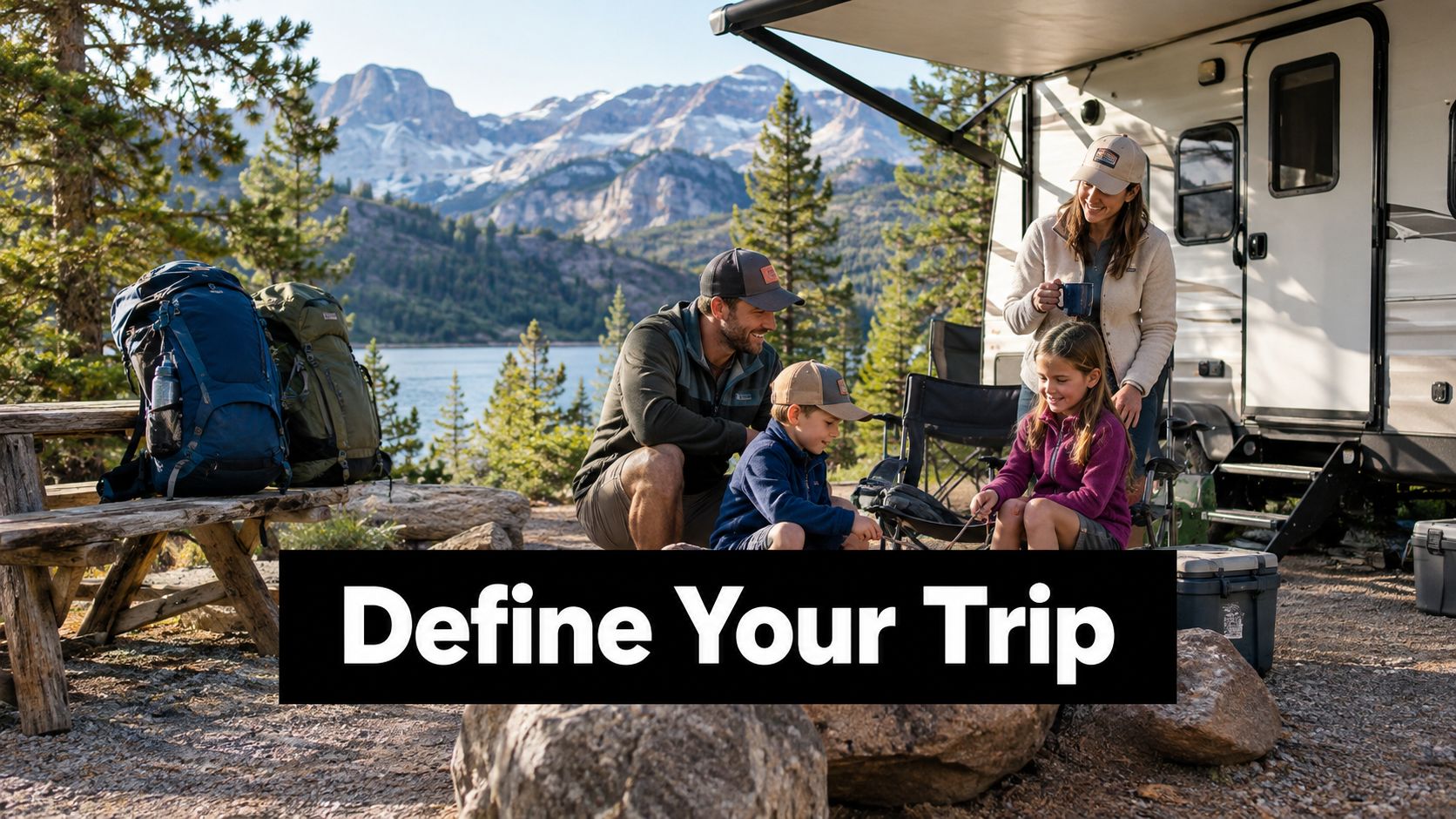
That's the first rule for how to choose a travel trailer. Buy for the trips you'll take, not the imaginary trip you might take someday. A couple who spends weekends near Bear Lake has different needs from a family planning long stays at high-altitude sites in the Wasatch Mountains. A powersports enthusiast headed toward Utah's public lands needs cargo flexibility. A retiree planning long-haul travel may value a comfortable living area more than a dedicated bunk room.
Write a short needs brief
Before comparing brands or appliances, write down:
- Travel party: Count regular travelers, children, pets, and occasional guests.
- Trip pattern: Separate quick weekends from extended stays or seasonal travel.
- Camping style: Decide whether you'll use full hookups, partial hookups, or boondock.
- Sleeping priorities: Choose between bunk beds, a private bedroom, convertible beds, and flexible guest space.
- Gear requirements: List bikes, coolers, chairs, fishing equipment, tools, and powersports equipment.
- Storage reality: Decide where the trailer will sit during Utah's winter months.
Self-sufficiency also deserves an honest answer. The 1958 Airstream International is described as the first self-contained travel trailer, designed to operate without external hookups. Modern trailers still force the same basic decision, whether you want more autonomy with onboard systems or more convenience from developed campgrounds. Compact teardrops, pop-ups, conventional bumper-pulls, and larger slideout models offer different ways to balance that choice. RV towing calculators and category guidance outline how trailer categories map to common use cases and tow vehicles.
Practical rule: If you can't describe your normal camping weekend, don't choose a floorplan yet.
Leave the dealership with a shortlist, not a purchase decision. Your needs brief should identify two or three essentials, such as a bunkhouse, a dry bathroom, a manageable length, or enough storage for family gear. Then weight and payload can determine which of those layouts are realistic.
Match Your Tow Vehicle to Real Loaded Weight and Payload
A truck that handles an empty trailer comfortably may struggle once your family, water, propane, batteries, food, and gear are aboard. Start with the actual loaded combination, not the tow rating printed in a brochure. Utah grades, altitude, wind, and long mountain descents expose weak matches quickly.
Travel trailers commonly weigh about 2,000 to 9,000 pounds dry, but loaded weight can run 1,000 to 2,500 pounds above the brochure figure. A typical 23- to 26-foot trailer may land around 7,000 to 9,500 pounds GVWR, while 31- to 36-foot models can reach 10,000 to 14,500 pounds GVWR. Travel trailer weight guidance explains why dry weight is a poor basis for choosing a tow vehicle.
Do the math before browsing floorplans
Use this order:
- Read the driver-door sticker. Find payload capacity for the exact vehicle.
- Check the owner's manual. Confirm tow rating for the precise engine, axle, drivetrain, trim, and factory towing equipment.
- Verify the ratings. Check vehicle GVWR, front and rear GAWR, receiver rating, ball size, and tongue-weight limit.
- Use the trailer's GVWR. Plan for the trailer's loaded rating, not its dry weight.
- Reserve margin. Industry guidance commonly recommends keeping the trailer near 80% of the tow vehicle's rated capacity, rather than operating at the limit. Review towing safety rules and tow-matching guidance before choosing a match.
Payload includes tongue weight. A conventional travel trailer typically places 10% to 15% of its loaded weight on the hitch. For a 7,500-pound loaded trailer, that means roughly 750 to 1,125 pounds added to the tow vehicle. Passengers, pets, luggage, and hitch hardware consume the rest of the payload.
A weight-distribution hitch can weigh about 80 to 120 pounds in commonly discussed truck setups, further reducing available payload. Include that equipment in your calculation instead of treating it as invisible. The hitch also needs to match the trailer and receiver, especially when towing through Utah mountain passes.
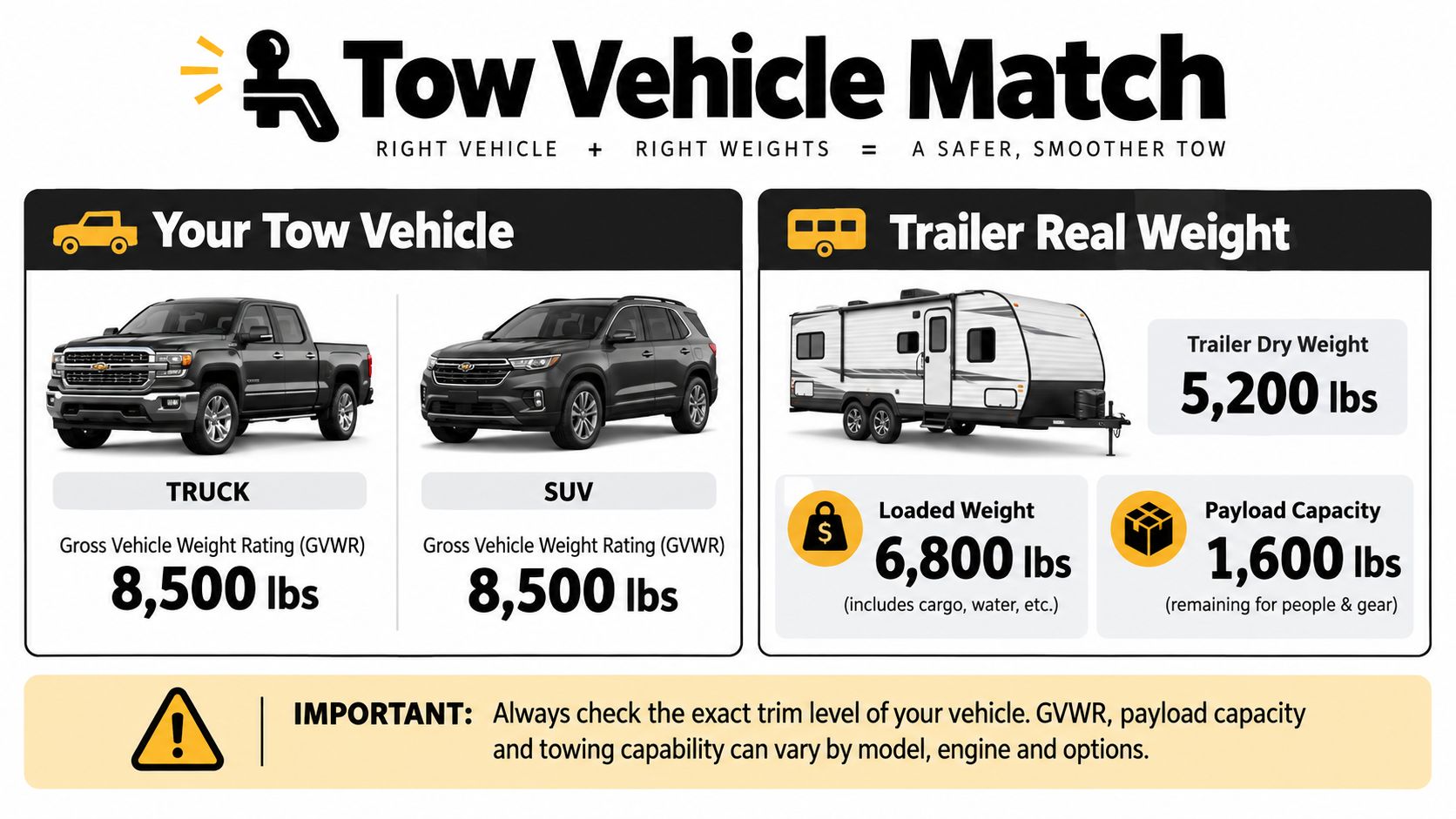
The infographic's example uses an 8,500-pound truck GVWR, a 5,200-pound trailer dry weight, a 6,800-pound loaded weight, and 1,600 pounds of payload capacity. Treat those figures as a visualization, not a replacement for your door sticker and owner's manual.
Family use changes the answer. A trailer that works for two adults may leave too little payload for children, bikes, coolers, camping furniture, and winter clothing. Altitude can also reduce performance, so a truck that feels adequate on level roads may work harder climbing toward higher Utah campgrounds. Choose a comfortable match, not the closest match that passes a calculator.
A used truck's value can affect the purchase decision. If you are considering selling or trading a pickup before buying a trailer, research how much is a Tacoma worth before setting your vehicle budget.
| Trailer Size Band | Typical Loaded GVWR | Tongue Weight at 10-15% | What to Check on Tow Vehicle |
|---|---|---|---|
| Teardrop | 1,500 to 2,500 pounds | Calculate from loaded weight | Payload, receiver rating, and brakes |
| Pop-up camper | 2,000 to 4,000 pounds | Calculate from loaded weight | Payload, tow rating, and hitch limits |
| Conventional mid-size trailer | 7,000 to 9,500 pounds for many 23- to 26-foot models | About 700 to 1,425 pounds | Exact tow rating, payload, GAWR, and receiver |
| Large travel trailer | 10,000 to 14,500 pounds for some 31- to 36-foot models | About 1,000 to 2,175 pounds | Heavy-duty payload, axle ratings, brakes, and hitch setup |
Before narrowing inventory, read this Utah-focused guide on how much travel trailers weigh. Then compare the loaded trailer against the exact truck, SUV, or van you will drive.
Find the Floorplan That Fits Your Family and Gear
Once the tow vehicle sets the boundaries, the floorplan becomes a lifestyle decision. Don't assume a longer trailer automatically delivers a better camping experience. Length adds room, but it can also make fuel stops, backing, storage, mountain roads, and smaller campgrounds more demanding.
Bunkhouses suit families, with one warning
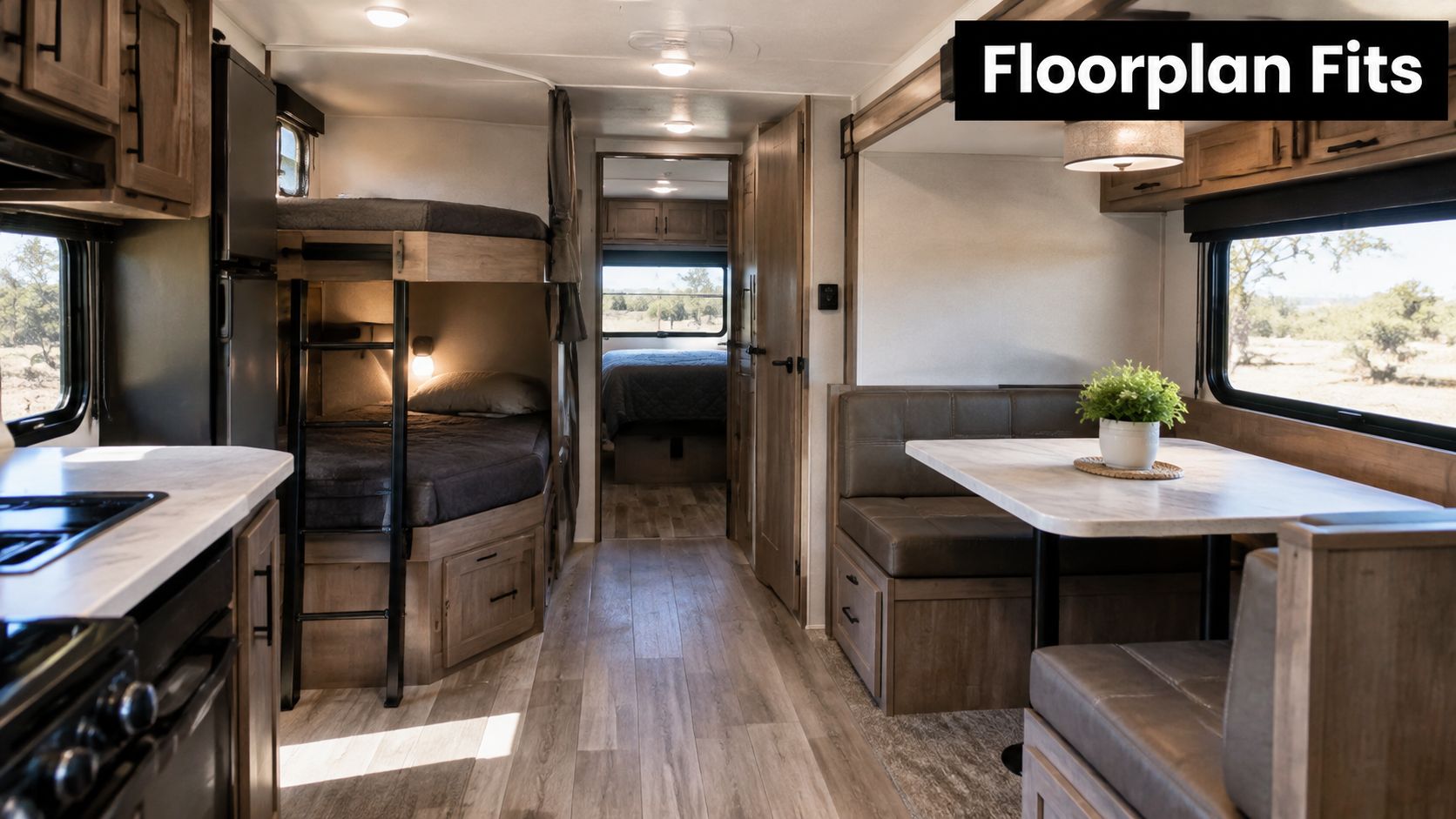
Bunkhouse trailers are the natural choice for families because children get a defined sleeping area and adults can preserve the main bed. They're especially convenient for a weekend at Bear Lake, where the kids can settle in while the adults use the dinette and kitchen.
The trade-off is cargo. A bunkhouse may look light before you add food, clothing, outdoor toys, water, propane, batteries, and children's gear. Choose the smallest bunkhouse that gives your family comfortable sleeping space, then return to the payload calculation before signing anything.
Couples layouts favor livability
A couple's trailer often makes better use of space with a comfortable bedroom, larger kitchen, and living area. If you're retired or planning long-haul travel, you'll spend more time appreciating comfortable seating, pantry access, bathroom design, and storage than an extra set of beds.
Slideouts can make a trailer feel substantially more open at camp. They also add mechanical components and weight, so inspect the slide mechanism carefully and make sure the expanded living space doesn't push you beyond your tow vehicle's practical margin.
Toy haulers solve a gear problem
Toy haulers make sense when motorcycles, ATVs, or other powersports equipment are central to the trip. The garage can become sleeping space or a multipurpose room after the equipment comes out. But cargo placement matters, and the loaded configuration should be checked carefully because equipment changes axle loading and tongue weight.
Use this quick comparison:
| Floorplan | Best fit | Main advantage | Main compromise |
|---|---|---|---|
| Bunkhouse | Families | Dedicated child sleeping space | Cargo and loaded weight can rise quickly |
| Couples trailer | Two travelers and long stays | Comfortable living and bedroom separation | Less flexible for larger groups |
| Toy hauler | Powersports users | Garage and flexible cargo space | Payload and weight distribution require careful planning |
| Compact trailer | Couples and short trips | Easier towing and storage | Less indoor space and fewer amenities |
| Slideout model | Campers who stay longer | More room at the campsite | Added weight and more components to inspect |
For a closer look at layout trade-offs, use travel trailer floor plans and layout comparisons. I'd rather see a buyer choose a simpler trailer they can tow confidently than a spacious layout that spends most trips parked because it's stressful to move.
Set Your Budget and Weigh New Versus Used Value
A travel trailer budget includes more than the advertised unit price. Plan for tax and fees, hitch equipment, insurance, storage, maintenance, winter preparation, and upgrades. Utah's seasonal weather makes serviceability important, especially if the trailer will sit outside through freezing conditions.
The market may give buyers more room to negotiate than it did during hotter buying periods. Black Book reported that average towable selling prices reached $16,376 in Q4 2025, down 5.3% month over month, while dealer inventory was rising in industry commentary. See the Black Book Q4 2025 RV market update for that market context. RVIA reported 342,220 total U.S. RV shipments in 2025, up 2.5% year over year, with conventional travel trailers remaining the largest towable category, according to its December 2025 market report.
New versus used ownership
A new trailer gives you current features, a full manufacturer warranty, and a cleaner service history. You'll usually pay more upfront and may experience faster depreciation. A used trailer can offer a lower entry price and slower depreciation, but condition matters more than age alone.
Inspect roof seals, appliance operation, slideouts, tires, brakes, plumbing, electrical systems, and signs of water intrusion. A trailer that looks inexpensive can become costly if it needs extensive repairs or lacks parts and service support. For an inspection-focused buying approach, read the Utah guide to buying a used RV.
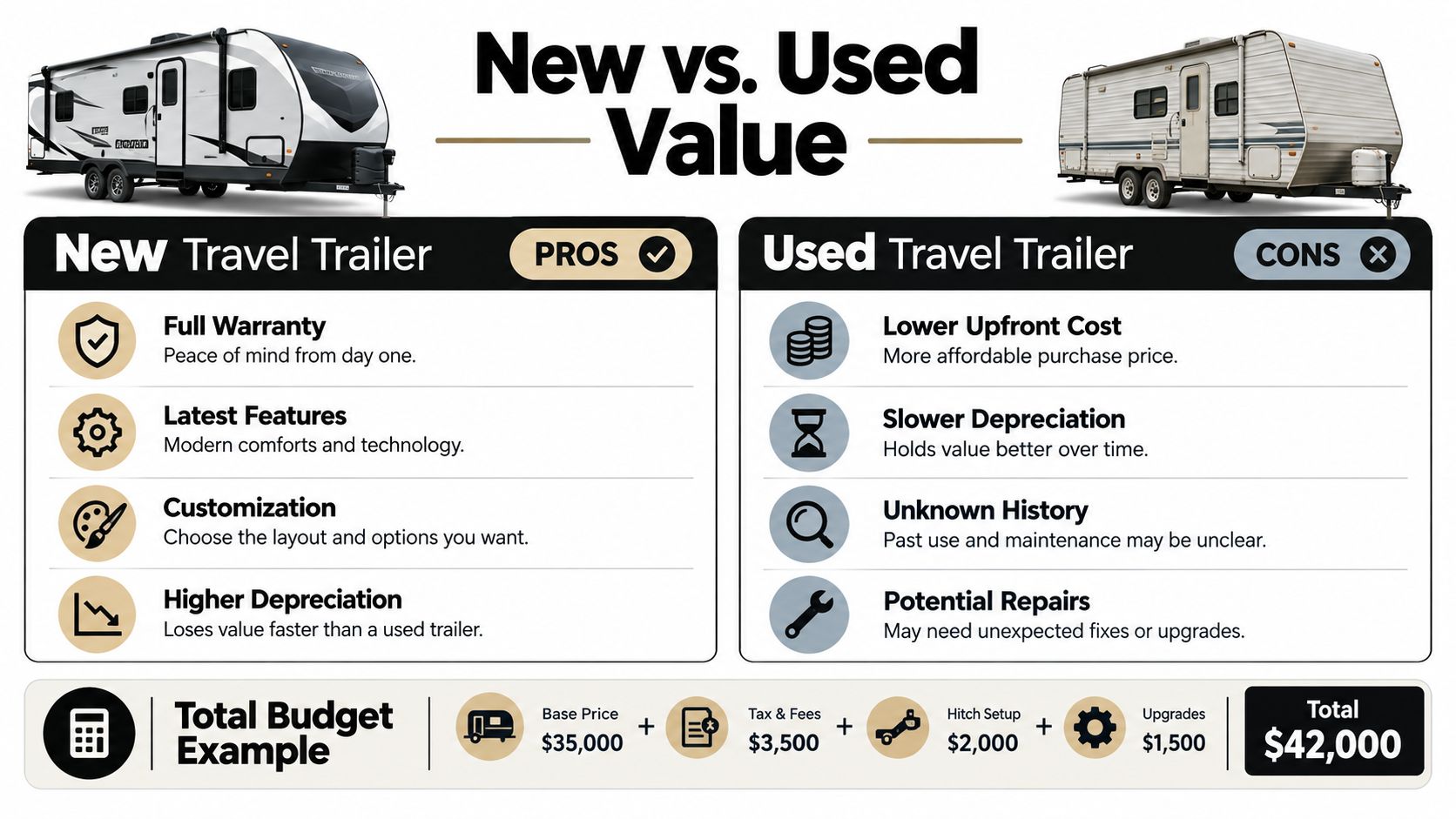
The required budget example shown in the visual totals $42,000, built from a $35,000 base price, $3,500 in tax and fees, $2,000 for hitch setup, and $1,500 in upgrades. Use it as a planning model, not a universal quote.
Think beyond the first season
Ask these questions before financing:
- Service access: Can local technicians repair the appliances, plumbing, electrical systems, and slide mechanisms?
- Winter storage: Can you protect the roof, tires, batteries, plumbing, and seals during Utah's off-season?
- Mountain use: Does the tow vehicle still have comfortable braking and handling margin on grades?
- Parts availability: Are common replacement parts easy to source?
- Trade-in flexibility: Will the floorplan remain useful if your family or travel style changes?
RVIA's forecast projects approximately 349,300 shipments in 2026, which points to a stabilizing market rather than a sudden surge. That can support a patient buying process, especially when you compare total ownership cost instead of chasing the lowest sticker price.
Check Must-Have Features and Safety Before You Buy
A trailer can have the right floorplan and still be a poor purchase if the hitch, tires, brakes, axles, and cargo plan don't work together. Perform the inspection with the trailer loaded as realistically as possible, and verify the final setup at a certified scale before a long Utah trip.
Verify the hitch and weight structure
Calculate tongue weight from actual loaded trailer weight, not dry brochure weight. A conventional trailer is generally most stable when tongue weight falls between 10% and 15% of loaded weight, with 12% to 13% often described as a common stability target for standard trailers. Tongue-weight and weight-distribution guidance explains why the figure affects sway, rear-end squat, and hitch sizing.
Check the trailer's certification label and ratings. For RV trailers, the sum of all axle GAWRs plus the manufacturer's recommended tongue weight must not be less than the trailer's GVWR. If the manufacturer provides a tongue-weight range, the minimum value is used for compliance. Federal RV trailer weight-rating guidance explains this relationship between axle ratings, tongue weight, and GVWR.
Inspect the running gear
Use this walkaround before purchase:
- Tires: Confirm size, load range, age, visible condition, and cold inflation pressure. For vehicles using LT tires, federal safety standards state that normal tire load must be no greater than 94% of the tire's load rating at the manufacturer's recommended cold inflation pressure. Review the travel trailer tire-loading explanation for the practical check.
- Brakes: Confirm electric trailer brakes operate correctly and match the tow vehicle's brake controller.
- Breakaway system: Pull-test the breakaway switch according to proper service procedure and confirm the battery supports the system.
- Hitch hardware: Verify receiver rating, ball size, coupler fit, safety-chain attachment, and weight-distribution setup.
- Cargo placement: Keep heavier cargo toward the front half, secure everything, and avoid loading all dense items at the rear.
- Connections: Cross the safety chains beneath the coupler and verify lighting, wiring, and connector fit.
Altitude changes the experience even when the ratings look acceptable. Long grades around Utah's mountain routes expose weak braking, poor sway control, cooling limitations, and insufficient payload margin quickly. Take the fully loaded rig to a scale, record axle weights, and correct the setup before heading toward a high-elevation campground.
Make a Confident Choice With Utah Ready Next Steps
The cleanest buying sequence is simple: define your trips, verify the tow vehicle, select a floorplan, build the full budget, and inspect the loaded trailer and hitch. Don't reverse that order by choosing a bunkhouse or slideout first and asking whether your SUV can handle it afterward.
The most common mistakes are predictable:
- Shopping by dry weight: Brochure numbers don't include the gear your family will carry.
- Trusting a generic tow rating: Exact trim, drivetrain, axle, and factory towing equipment matter.
- Ignoring payload: Tongue weight, passengers, pets, and hitch hardware all consume the door-sticker payload.
- Buying too much trailer: Extra space can make mountain driving, storage, and campsite access harder.
- Skipping service planning: A trailer that's difficult to maintain can cost more over its ownership life.
Utah buyers should also plan for winter storage before delivery. Protect plumbing from freezing, maintain seals, care for the battery, cover or properly support tires, and schedule a service inspection before the first spring trip. Our team can help you compare inventory by weight, length, price, floorplan, and features, then connect the trailer choice to financing, trade-in planning, parts, and service.
A good trailer doesn't fit your driveway or sleep your family. It fits the loaded rig, the roads you'll travel, the way you camp, and the ownership plan you can sustain.
Motor Sportsland offers new and used travel trailers, towing guidance, financing support, trade-in options, parts, and service for Utah RV owners. Visit Motor Sportsland to browse current inventory, then stop by our Millcreek or Spanish Fork location so our team can help match a trailer to your real payload and camping needs.
Frequently asked questions
What is the first step in how to choose a travel trailer?
Start by defining how you'll use it, including travelers, pets, trip length, camping style, gear, sleeping needs, and storage. Then verify the tow vehicle's exact payload and towing ratings before looking seriously at floorplans.
Should I use dry weight or GVWR when choosing a trailer?
Use the trailer's GVWR for conservative planning. Loaded equipment, water, propane, batteries, food, clothing, and family gear can place the trailer well above its brochure dry weight.
How much tongue weight should a travel trailer have?
A conventional travel trailer is typically most stable with tongue weight at 10% to 15% of loaded trailer weight. Calculate it from the loaded trailer, not the dry brochure figure.
Why does payload matter if my vehicle has enough towing capacity?
Payload covers passengers, pets, cargo, hitch equipment, and trailer tongue weight. You can remain below a vehicle's advertised tow rating while exceeding the door-sticker payload.
Is a bunkhouse trailer a good choice for a Utah family?
It can be, especially when children need dedicated sleeping space. Choose the smallest bunkhouse that meets your needs, then confirm that its loaded GVWR and tongue weight fit your tow vehicle with adequate margin.
Should I buy a new or used travel trailer?
Buy new when warranty coverage, current features, and a known starting condition matter most. Buy used when you can complete a careful inspection and the trailer offers strong serviceability, parts support, and a lower total ownership cost.
