
Pop Up Camper vs Travel Trailer: Utah Guide

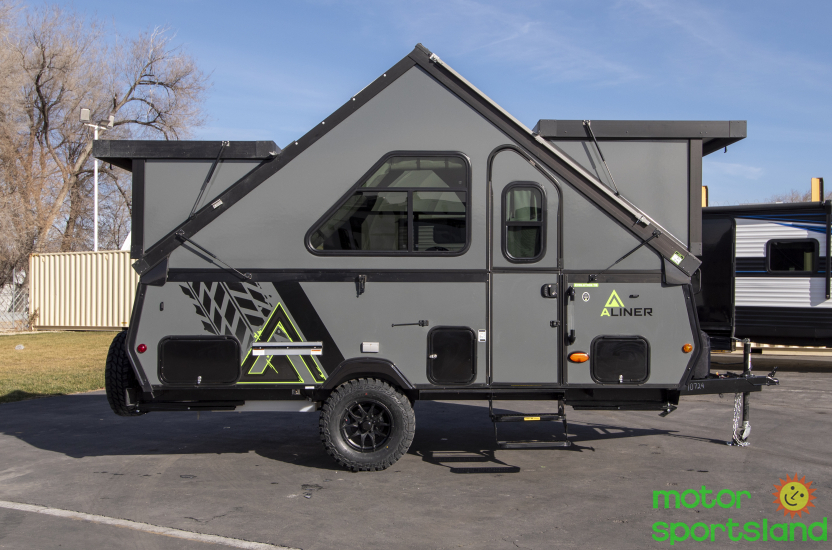
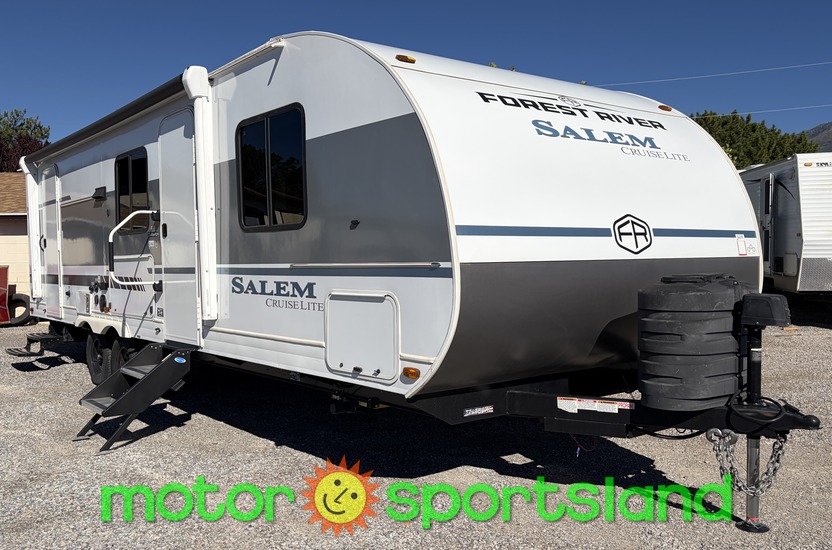
Both answers are parked on our lots. Our pop up campers, 10 of them from A-LINER and BASECAMP, all sit at the Millcreek store in Salt Lake City, light and short and easy to hook to a half ton or even a smaller SUV. Our travel trailers, from lines like R-POD, MICRO MINNIE, HIDEOUT, SPORTSMEN, SURVEYOR, CONNECT, ACCESS, THRIVE and SALEM, are split between Millcreek and Spanish Fork, with more bed space, more tank capacity and a bigger footprint behind you. Neither one is the better RV in general. One of them is probably the better RV for your tow vehicle, your driveway and the way your family actually camps.
Pop Up Camper vs Travel Trailer at a Glance
Here is the size and weight picture from the new units sitting on our lots right now. Read the ranges, not just the middle, because the spread is where you find your unit.
| Spec | Pop up camper | Travel trailer |
|---|---|---|
| Sleeps | 2 to 4 | 3 to 8 |
| Length | 10 to 18 feet | 19 to 31.58 feet |
| Ext Height (listed exterior height) | 5 to 10 feet | 9 to 11.25 feet |
| Hitch Weight | 150 to 240 lbs | 313 to 801 lbs |
| Dry Weight | 1,510 to 1,985 lbs | 2,690 to 6,700 lbs |
| GVWR | 3,000 to 5,500 lbs | 3,765 to 8,800 lbs |
| Cargo Capacity | 940 to 1,450 lbs | 911 to 2,208 lbs |
| Axle Count | 1 where listed | 1 to 2 |
| Slides | none listed | 1 to 2 |
| Fresh Water | 11 to 22 gallons | 26 to 55 gallons |
| Grey Water | not listed | 26 to 70 gallons |
| Black Water | not listed | 26 to 42 gallons |
| Furnace | 16,000 to 18,000 BTU | 8,000 to 35,000 BTU |
| Air Conditioning | 9,200 BTU where listed | 5,000 to 15,000 BTU |
| Solar | 200 to 220 watts where listed | 200 to 400 watts where listed |
That table is the whole argument in miniature. A pop up camper keeps every number small, which keeps your tow vehicle options wide and your storage headaches few. A travel trailer trades weight and length for sleeping room, holding tanks and climate equipment.
Towing Up Utah Canyon Grades
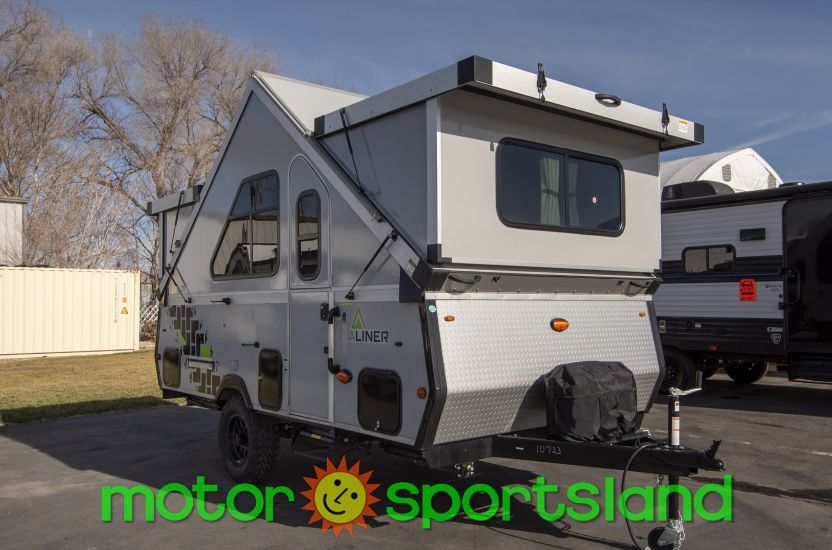
Weight is what you feel on Parleys, on the climb toward Mirror Lake, and anywhere you leave I-15 and start gaining a few thousand feet. Most of the new pop up campers on our lot run from 1,510 to 1,985 pounds dry, with a GVWR from 3,000 to 5,500 pounds and hitch weight from 150 to 240 pounds. Where an axle count is listed, those units show a single axle. The benefit is simple. A lot of mid size SUVs and small trucks already in Utah driveways can pull that without you shopping for a new tow vehicle first, and the climb out of a canyon feels like a climb rather than an event.
Travel trailers ask more. Most of the new ones on our lot run from 2,690 to 6,700 pounds dry, with a GVWR from 3,765 to 8,800 pounds and hitch weight from 313 to 801 pounds, and most of them sit on two axles rather than one. That extra axle and extra mass mean more trailer brake work on the way down Provo Canyon and more payload used up at the ball. Bring us your door jamb sticker and your hitch receiver rating before you fall in love with a floorplan. We would rather point you one size down than sell you something your truck resents on every grade.
Length matters too, and not just for the scale. Pop ups run from 10 to 18 feet, travel trailers from 19 to 31.58 feet. The short end backs into a tight forest service site at Payson Lakes without a spotter. The long end wants a reserved, graded spot, which in Utah means planning your summer weekends early.
Setup, Teardown and How You Actually Camp
A travel trailer is ready when you are level and unhitched. That is a real benefit when you roll into a campground at nine at night with kids asleep in the back seat. A pop up camper asks you for a few minutes of setup when you arrive and a few minutes of teardown when you leave. If you are a one or two night camper who moves often, those minutes repeat. If you park for a week, they vanish.
Sleeping capacity usually settles the argument for families. Pop ups sleep 2 to 4. Travel trailers sleep 3 to 8, and most of them have 1 to 2 slides that open up the living space once you are parked. Two adults and a dog can be very comfortable in a pop up. Two adults, three kids and a cousin cannot.
Water tells the same story. Pop up fresh water capacity runs from 11 to 22 gallons, and the listed holding tanks stop there. Travel trailers carry 26 to 55 gallons fresh, 26 to 70 gallons grey and 26 to 42 gallons black. If your idea of camping is a full hookup site at a state park, that gap barely registers. If you want five days on BLM ground south of Green River without moving the trailer, those tanks are the reason you can.
Weather, From Mountain Nights to Desert Heat
Utah does not give you one climate. A September night at 9,000 feet can drop near freezing while St. George is still running in the nineties the same week.
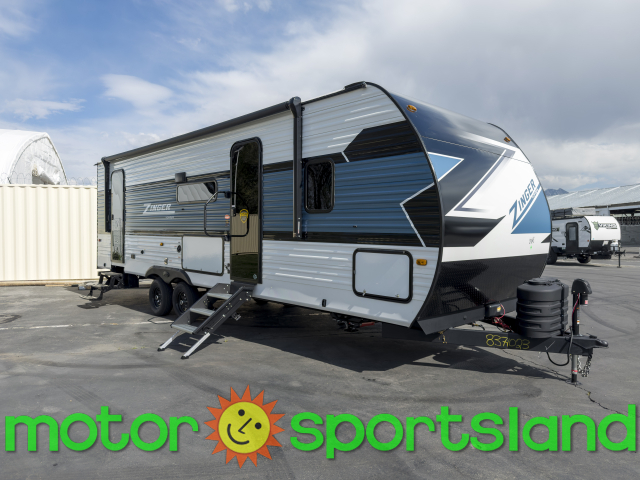
For cold, look at the furnace. Pop up campers on our lot list 16,000 to 18,000 BTU, which is a lot of heat for 10 to 18 feet of trailer. Travel trailers list 8,000 to 35,000 BTU, a wide spread because a 19 foot unit and a 31 foot unit are not heating the same volume. Match the number to the length, not to the biggest figure on the page.
For heat, look at air conditioning and solar. Where air conditioning is listed on our pop ups, it is 9,200 BTU. Travel trailers list 5,000 to 15,000 BTU. Solar runs 200 to 220 watts on the pop ups that list it and 200 to 400 watts on the travel trailers that list it, which is what keeps the fridge and the fans running when you are camped away from shore power in July.
Storage at Home and HOA Rules
This is the part people forget until the first HOA letter arrives. Measure your gate, your side yard and your garage door before you buy anything.
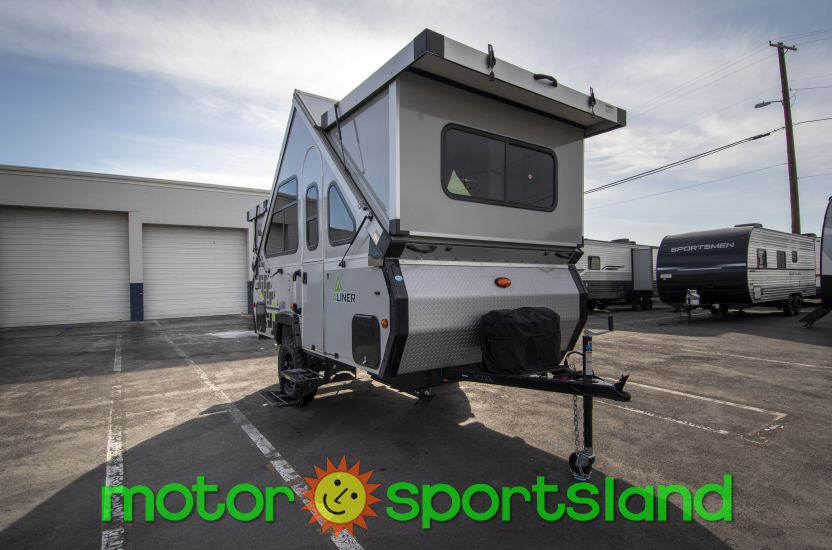
Listed exterior height on our pop up campers runs from 5 to 10 feet. On travel trailers it runs from 9 to 11.25 feet. Combine that with length, 10 to 18 feet versus 19 to 31.58 feet, and you can see which one disappears behind a fence in a Millcreek or Sandy neighborhood and which one needs a storage lot in Spanish Fork or Lehi. Paying for storage every month is a real cost of ownership, and so is the drive to go get your RV before every trip.
Cargo capacity is worth a look here as well, since it decides what you can load at home instead of buying on the road. Pop ups list 940 to 1,450 pounds of cargo capacity, travel trailers 911 to 2,208 pounds. Notice the overlap at the low end. A well equipped pop up can carry as much gear as a small travel trailer, even though it tows like far less trailer.
Frequently asked questions
Which one should I buy if this is my first RV?
If you are towing with an SUV or a smaller truck, camping as a couple or with one or two kids, and storing at home, start with the pop up campers at our Millcreek store. Sleeps 2 to 4, dry weight 1,510 to 1,985 pounds and length 10 to 18 feet make the learning curve short. If you have a capable tow vehicle, need to sleep 3 to 8, and want holding tanks in the 26 to 55 gallon fresh range, start with travel trailers and let your payload number set the ceiling.
Can a pop up camper handle cold nights in the Uintas?
The furnaces on our pop up campers list 16,000 to 18,000 BTU, heating an interior of 10 to 18 feet. That is a strong ratio for shoulder season camping. Travel trailer furnaces list 8,000 to 35,000 BTU across a 19 to 31.58 foot range, so a larger trailer is not automatically warmer than a small one. Compare furnace output against length on the specific unit you like.
How much does the extra hitch weight really matter?
A great deal, because hitch weight comes out of your tow vehicle payload along with passengers and gear. Pop ups put 150 to 240 pounds on the ball. Travel trailers put 313 to 801 pounds there. On a half ton loaded with five people and a cooler, several hundred extra pounds at the hitch is the difference between a comfortable trip up Sardine Canyon and a truck working at its limit.
Can I keep either one at my house?
Depends on your community and your gate. Listed exterior height is 5 to 10 feet on pop ups and 9 to 11.25 feet on travel trailers, with lengths of 10 to 18 feet and 19 to 31.58 feet. Many Utah HOAs set a height or length limit, or require the RV be out of street view. Bring us your measurements and your HOA rule, and we will show you only what fits. Come see us in Millcreek in Salt Lake City for both types, or in Spanish Fork for travel trailers, and we will walk you through the differences in one afternoon.
Browse pop up campers for sale in Utah, travel trailers for sale in Utah or all our inventory.
