
RV Water Heater Anode Rods

The cheapest part in your water heater is the one doing the hardest work
RV water heater anode rods are a few dollars of soft metal that exist to corrode so your water heater tank doesn't. That's the whole job. Inside a steel tank, hot water and dissolved minerals go after the weakest metal available, and an anode rod is engineered to be that metal. It gives itself up over a season or two, and when it's gone, the tank is next in line.
Utah water doesn't make this easier. A lot of what comes out of the tap along the Wasatch Front is hard, and campground water around the state ranges from pretty good to rough. That's why we tell people to look at the rod twice a year: once at spring start-up when you're de-winterizing, and again in the fall before the rig goes into storage.
What you're actually looking at when you pull one
The rod threads into the front of the water heater, usually doubling as the drain plug. You shut off the water and the heater, let everything cool completely, relieve the pressure, then back the rod out with a socket and let the tank drain.
A new rod is a straight cylinder of metal. A used one looks chewed. Pitting, deep grooves, sections eaten down to the steel core wire. The common rule of thumb is to replace it once it's lost roughly 75 percent of its material, or any time the core wire is showing through for much of its length. If you're pulling it and it looks like a knobby chain of leftovers, it was overdue.
While the tank's open, flush it. A cheap tank rinser wand through the drain opening knocks out the sediment that settles on the bottom, and that sediment is part of what accelerates rod loss in the first place. Then wrap the threads of the new rod with fresh thread sealant tape and install it.
One important caveat. Not every RV water heater uses an anode rod. Some tanks are lined in a way that doesn't need one and use a plain plastic drain plug instead. Putting an anode rod into a tank that wasn't built for one isn't the right move. If you're not sure which kind you have, bring the old plug to our parts counter in Millcreek or Spanish Fork and we'll tell you what you're looking at.
How to tell which one you need
Three things decide it: the thread size, the length, and the metal.
Thread size is the non-negotiable part. Different water heater brands use different plug threads, and a rod that doesn't match won't seal, full stop. The fastest way to get this right is to bring the old rod or plug in with you. We can measure it against what's on the shelf in about a minute.
Length matters because a rod that's too long can bottom out or interfere inside the tank, and one that's too short gives you less protection per season. Again, matching the old one is the reliable method.
Metal is the part owners actually get to choose. Magnesium and aluminum are the two you'll see. Magnesium is generally the more active of the two, so it protects well but tends to be consumed faster. Aluminum usually lasts longer in service. Water chemistry plays into it, and some people find one smells better than the other in their tank. Neither choice is wrong.
The two RV water heater anode rods we stock
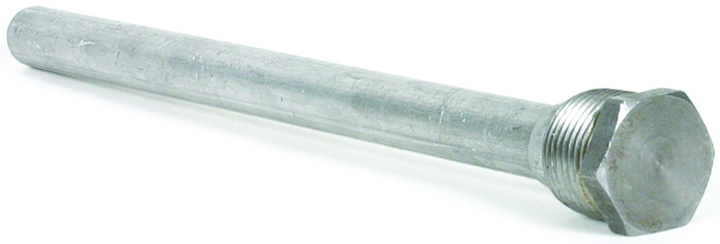
We carry a Camco Anode Rod - Alum 3/4 - 14 Npt X 9-1/2 L X 0.625 Od (suburban Morflo). Camco describes it as an aluminum rod for Suburban (Mor-Flo) heaters, .75 diameter and 9-1/2 inches long. It's the longer of the two we keep on the counter, and it's the aluminum option if that's the metal you want.
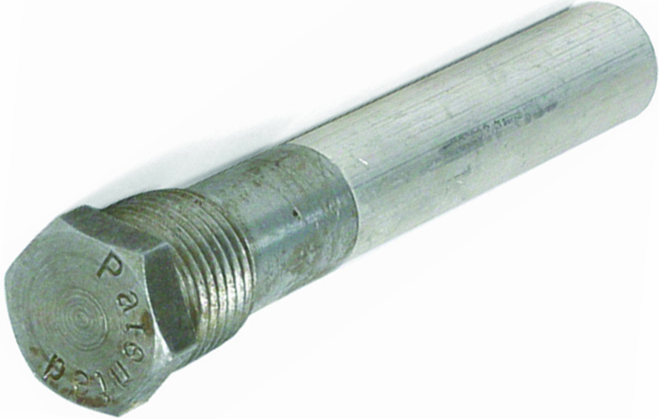
The other is the Camco Anode Rod - Mag 1/2 -14 Npt X 4-1/2 L X 0.600 Od (atwood). Camco lists it as a magnesium rod for Atwood heaters, .50 diameter and 4-1/2 inches long. Shorter rod, smaller thread, different metal.
So the practical difference between the two is thread size, length and metal: 3/4 NPT aluminum at 9-1/2 inches versus 1/2 NPT magnesium at 4-1/2 inches. Those aren't interchangeable. Don't guess from a photo or from what a neighbor at the campground runs. Bring the old one in and our parts counter will match it to your RV.
Spring and fall, same five minutes
At spring start-up, pull the rod before you sanitize and fill. You're in there anyway, and a rod that survived last season may not survive this one. At winterizing time in the fall, pull it again when you drain the tank. A tank that goes into storage empty and clean comes out of storage in much better shape.
If your water heater is acting up beyond the rod (no hot water, a burner that won't light, anything on the gas or 120-volt side), stop there and let our service department handle it. Propane and electrical work on a water heater isn't a parking-lot job.
Frequently asked questions
How often should I replace the anode rod?
Most owners check it twice a year and replace it somewhere between every season and every two seasons, depending on how much you use the rig and how hard your water is. The condition of the rod tells you more than the calendar does.
Can I just leave the anode rod out and run a plain plug?
You can, but the tank corrosion that the rod was absorbing will start working on the tank itself. A rod costs a small fraction of a water heater, so it's a poor trade.
Does the rod affect how my water smells?
It can. A sulfur smell in hot water is a common complaint and is often related to a reaction between the rod metal and bacteria or minerals in the water. Flushing the tank and switching to the other rod metal is a typical thing owners try.
What should I bring to the parts counter?
Bring the old rod or drain plug if you can get it out, and know the brand of your water heater if you have it handy. That's usually all we need to match you up at either Millcreek or Spanish Fork.
Parts in this post:
- Camco Anode Rod - Alum 3/4 - 14 Npt X 9-1/2 L X 0.625 Od (suburban Morflo)
- Camco Anode Rod - Mag 1/2 -14 Npt X 4-1/2 L X 0.600 Od (atwood)
Order now: call our parts counter at 801-262-2922, or stop in at either store, Millcreek in Salt Lake City or Spanish Fork. Browse all our RV parts and accessories.
