
RV Leveling Blocks

What RV leveling blocks are
RV leveling blocks are plastic pads you drive onto or stack under a tire, a tongue jack or a stabilizer to raise one side of your rig until the floor sits flat. Some styles are interlocking squares you build up an inch at a time. Others are a single curved ramp you pull forward onto until the bubble centers. Either way, the job is the same: make up the difference when the ground under you isn't even.
They're cheap insurance and they live in a bin in your pass-through, which is why almost every RVer in Utah ends up owning a set.
Why an uneven site makes this necessary
Utah campgrounds are carved into hillsides, gravel washes and old forest roads. Flat is the exception. We hear about it constantly from folks coming back from the Uintas, the Manti-La Sal and the dispersed spots along the Mirror Lake Highway, where the pad looks level until you park on it and the shower door swings shut on its own.
Beyond comfort, an off-level rig causes real problems. Absorption refrigerators don't circulate their coolant correctly when they sit tilted, and running one out of level for days can shorten its life. Slide-outs and slide seals bind when the frame is twisted. Doors stick, drawers roll open and your water drains to one corner of the tank instead of out the low point. Stabilizer jacks also work better when they're only steadying a level rig, not trying to lift a corner they were never meant to lift.
If your rig has automatic leveling and it isn't behaving, bring it to our service department instead of fighting it in a campsite.
How to use them
Walk the site first and pick the spot where you'll need the least lift. Then figure out which side is low. A small level mounted on the A-frame or a window sill tells you fast, and it's worth checking against a level set on the floor inside the first time you mount it so you know your reference is honest.
For a curved ramp, set it tight against the low-side tire, pull or back on slowly with a spotter, and stop when the bubble centers. Chock it so it can't roll back off. For stacking blocks, build a ramp in front of the tire (a short stair step, not a cliff), drive up onto the top, and make sure the whole tread is supported and nothing is hanging over an edge.
Level side to side first, then unhitch and level front to back with the tongue jack. Chock the wheels before you unhitch, every time. Then drop your stabilizers onto blocks if the ground is soft, since gravel and forest duff swallow jack feet. Never crawl under a rig that's resting only on leveling blocks or jacks.
The RV leveling blocks and tools we carry
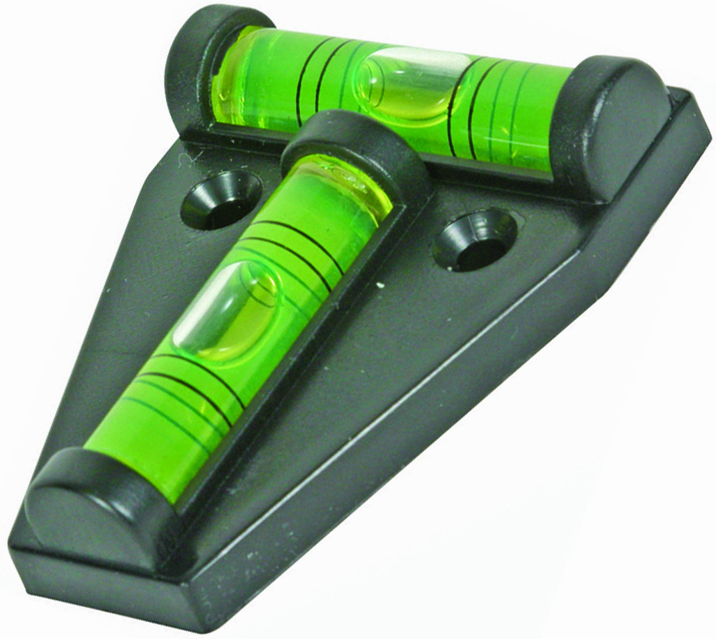
The Camco Level - T Level, Precision Two-Way is a screw-mounted level that reads front-to-back and side-to-side at the same time. Mount it once somewhere you can see it while you're maneuvering and you stop guessing. It's a small part, but it's the one that makes everything else go faster.
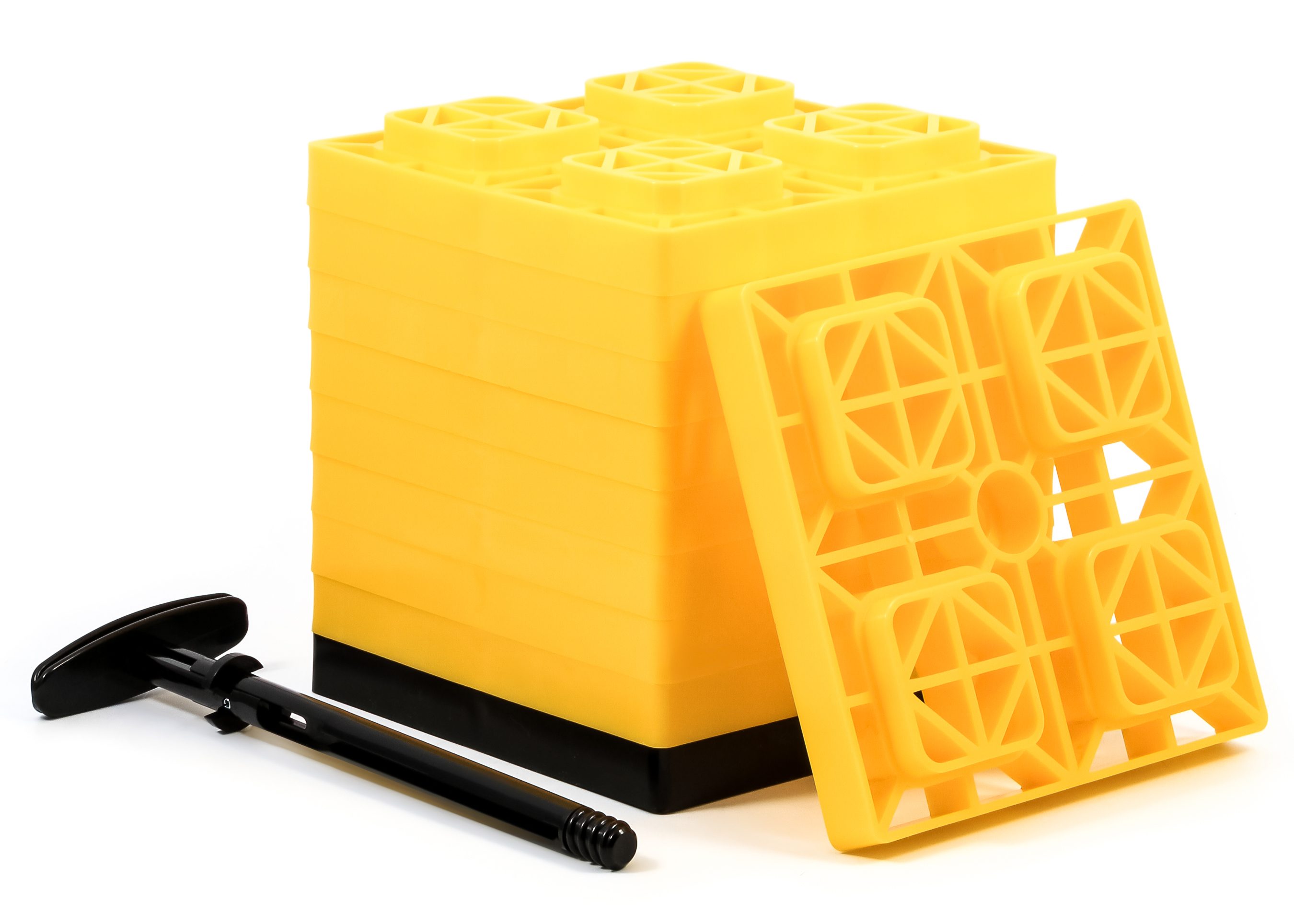
Camco FasTen Leveling Blocks with T-Handle come as a 10 pack of 2x2 yellow blocks that interlock so you can stack them to the height you need. Each block adds a full inch of stack height, and Camco notes the stack shouldn't go past 4 1/2 inches. They work under single wheels, double wheels, hydraulic jacks, tongue jacks, stabilizer jacks, 5th wheel jacks and tandem axles. The T-handle pulls up to carry the set and twists down to lock the blocks together for storage, so they don't scatter all over the basement compartment. The resin is UV stabilized, which matters if they end up living outside in the sun.
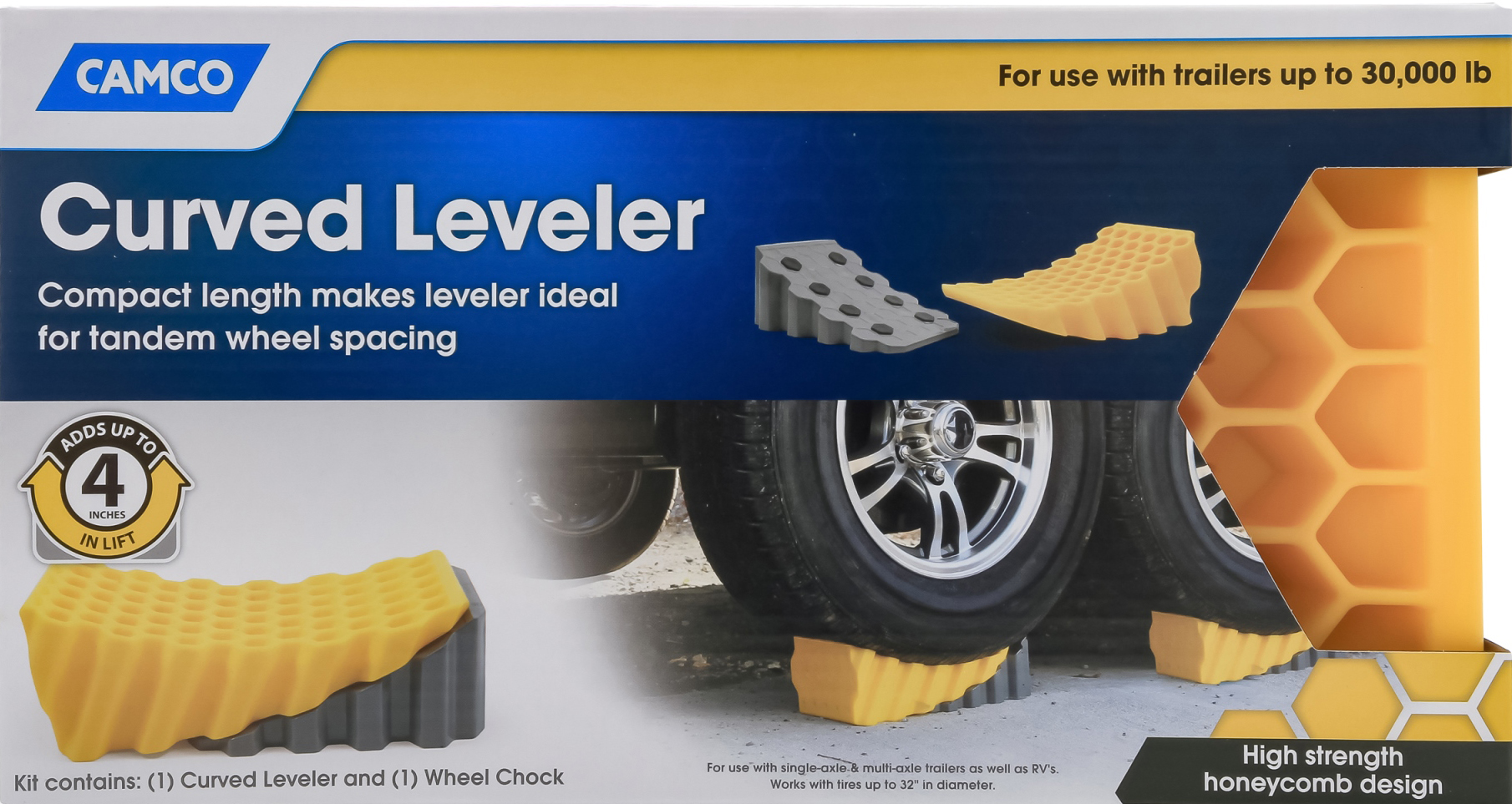
The Camco Curved Leveler and Wheel Chock is the drive-on option. You pull up onto it only as far as you need for up to 4 inches of lift, then chock it at that exact height with the included chock, which has non-slip rubber grippers on the bottom. The honeycomb design keeps it light without giving up durability, and the compact length is made to work with tandem wheel spacing without modification. Camco rates it for trailers up to 30,000 pounds.
Not sure which style suits your setup or how many blocks to carry? Our parts counter in Millcreek or Spanish Fork can match it to your rig.
Frequently asked questions
How many blocks do I need for a typical site?
Most people get by with one 10 pack, and plenty of owners carry two so they can build under both wheels of a tandem axle and still have some left for the jacks. If you camp on rough forest service sites often, carry more than you think you need.
Can I stack leveling blocks as high as I want?
No. Camco's FasTen blocks are rated for a stack height no greater than 4 1/2 inches, and stacking any blocks past the manufacturer's limit gets unstable. If you need more lift than that, move the rig to a better spot on the site.
Do I still need wheel chocks if I'm on leveling blocks?
Yes. Blocks hold the rig up, chocks keep it from rolling, and those are two different jobs. Chock before you unhitch and keep the chocks in place the whole time you're parked.
Can I use leveling blocks under my stabilizer jacks?
That's a common use, especially on soft ground where a jack foot would sink. Build a solid, flat pad under the foot and lower the jack onto it. Stabilizers steady the rig, they don't lift it, so get the rig level on its tires first.
My automatic leveling system won't level the coach. What now?
Stop using it and have our service department look at it. Hydraulic and electric leveling systems involve pumps, sensors and wiring that aren't a campsite fix.
Parts in this post:
- Camco Level - T Level, Precision Two-Way
- Camco Fas Ten Leveling Blocks W/ T-Handle, 2x2, Yellow 10 Pk
- Camco Curved Leveler And Wheel Chock
Order now: call our parts counter at 801-262-2922, or stop in at either store, Millcreek in Salt Lake City or Spanish Fork. Browse all our RV parts and accessories.
