
New RVs for Sale Utah: A Local Buyer's Guide

A Utah family can spend an entire Saturday comparing a bunkhouse travel trailer with a Class C motorhome, then leave with more questions than answers. The trailer may sleep everyone comfortably and let the tow vehicle handle grocery runs after camp is set up. The motorhome may be easier to load and ready to drive, but its size, fuel needs, and route limitations deserve a serious look before a trip through Zion, Bryce Canyon, or the Uintas.
That decision is rarely about which RV has the longest feature list. It's about mountain towing, winter storage, weekday transportation, campsite style, sleeping arrangements, service access, and whether the payment still feels comfortable after the first season. Utah is a strong market for new RVs for sale in Utah, and Motor Sportsland gives local shoppers a place to compare travel trailers, fifth wheels, toy haulers, and motorhomes with those real conditions in mind.
A Utah Family Standing in the Showroom Lot
The family in front of us has already made a list of destinations. They want red-rock weekends, cool mountain escapes, and enough sleeping space for the children without turning every trip into a logistics exercise. The bunkhouse travel trailer looks practical. Its dedicated sleeping area gives the kids their own space, and the family can leave the trailer at a campground while using the truck for a hike, groceries, or a scenic drive.
Then the Class C enters the conversation. Loading is simpler because the sleeping and driving spaces are combined. Once parked, the family doesn't need to manage a separate tow vehicle and trailer combination. But the motorhome still has to fit the route, the campsite, and the family's daily habits. A larger coach may be less comfortable on tight campground roads or in crowded parking areas, while a trailer requires more attention on steep grades and mountain passes.
The trip matters more than the destination list
We ask buyers questions that brochures don't answer:
- Weekday transportation: Will the truck or SUV remain useful for commuting, or will it become a dedicated tow vehicle?
- Campground style: Are you choosing full-hookup sites, state parks, or more remote locations?
- Trip length: Do you need a family bunkhouse for repeated weekend travel, or a comfortable couples layout for extended stays?
- Climate: Will the RV see high-elevation nights, desert heat, or winter storage along the Wasatch Front?
- Driving rhythm: Will you move every day, or stay several nights at each campground?
Utah isn't one RV market. Wasatch Front traffic creates different demands from high-elevation passes, while desert heat around Moab and Sand Hollow raises different concerns from winter storage near Salt Lake City. The right purchase starts with the job the RV must perform, not the number of amenities on the sidewall.
Practical rule: Choose the RV that fits your ordinary weekends. The spectacular destination is only part of the ownership experience.
Utah Towing and Registration Rules That Shape Your Shortlist
Utah's towing rules can remove unsuitable RVs from your shortlist before you ever compare interior finishes. Start with the tow vehicle's payload, receiver rating, axle ratings, and manufacturer towing guidance. Then compare those limits with the trailer's GVWR, not just its unloaded or dry weight.
Utah requires trailers weighing more than 750 pounds to be titled and registered, and the Utah DMV specifically includes travel and tent trailers above that threshold under the rule. Utah's trailer registration guidance should be part of your paperwork checklist. Registration fees for combinations with trailers are weight-based. Under Utah's 2026 fee law, a motor vehicle combined with a trailer must register for the total gross combined weight rating when the combination exceeds 14,000 pounds, with gross combined weight calculated in 2,000-pound units and any fraction rounded up. The Utah code provision explains the calculation.
Utah also sets a 14-foot legal height limit, a 102-inch width limit, and a 65-foot maximum combined length for a tow vehicle and trailer. Trailers over 10,000 pounds GVWR must have brakes on all wheels, while trailers over 15,000 pounds GVWR must also have a breakaway braking system. Verify the exact equipment and limits for your combination before signing.
| Item | What to Verify | Why It Matters |
|---|---|---|
| Tow vehicle | Payload, axle ratings, receiver rating, and manufacturer tow rating | Passengers, cargo, hitch weight, and trailer contents reduce available capacity |
| Trailer | GVWR, actual loaded weight, hitch weight, and brake configuration | Dry weight can understate the mass you'll tow on a real trip |
| Dimensions | Height, width, and combined length | Mountain routes, bridge clearances, and campsites may restrict larger rigs |
| Registration | Trailer title, registration, and combined-weight calculation | Fees and paperwork depend on trailer and combination weight |
| Equipment | Brake controller, breakaway connection, tires, chains, and weight distribution | Properly rated equipment improves control on Utah grades |
The Motor Sportsland tow guide is a useful starting point, but the final decision should use the exact truck, trailer, passengers, and gear. A half-ton pickup may tow a light travel trailer comfortably while remaining a poor match for a loaded fifth wheel or toy hauler.
Matching RV Types to Utah Adventures
Travel trailers are usually the most sensible starting point for Utah families that already own a properly equipped SUV or truck. They offer a broad range of layouts, and the tow vehicle remains available after the trailer is leveled at camp. That matters at Jordanelle, Bear Lake, and other destinations where you may want to explore beyond the campground.
Fifth wheels make more sense for buyers who tow frequently, stay longer, or want a larger living area and substantial storage. The raised front section creates useful interior space, but the pickup must have the right payload and fifth-wheel hitch setup. Tight canyon roads and campground turns also require more planning than many first-time buyers expect.
Toy haulers deserve a close look from Utah riders. The garage can carry dirt bikes, motorcycles, kayaks, or other gear for Moab and Sand Hollow, and it remains useful as flexible storage even when no toy is onboard. Class A motorhomes suit travelers who prioritize onboard living and can confidently manage a larger vehicle. Class C models offer a more familiar truck-based driving position, while Class B vans are better suited to couples who value compact travel and simpler maneuvering.
This travel trailer buying guide can help you compare layouts before walking the lot.
| RV Type | Best Utah Fit | Main Trade-Off |
|---|---|---|
| Travel trailer | Families wanting bunkhouse space and a separate tow vehicle at camp | Mountain towing requires careful weight and brake planning |
| Fifth wheel | Frequent campers, retirees, and long-stay travelers | Needs a compatible pickup and more hitch awareness |
| Toy hauler | Powersports families carrying bikes, kayaks, or smaller toys | Garage weight affects payload and handling |
| Class A motorhome | Travelers who want extensive onboard living | Larger dimensions can complicate passes and parking |
| Class C motorhome | Families wanting a familiar driving layout | Less flexible than a trailer once camp is established |
| Class B van | Couples seeking compact, efficient travel | Limited sleeping, storage, and living space |
Don't buy the largest RV you can technically move. Buy the one you can tow, park, store, and use without avoiding the trips you bought it for.
Floorplans, Weights, and Features That Actually Matter Here
A bunkhouse is the clear choice for many families visiting Utah's canyon country. Kids get defined sleeping space, adults avoid converting the entire living room every night, and the trailer remains usable when the weather turns cold. Couples often prefer rear-living layouts because they trade extra beds for seating, kitchen space, and a more relaxed long-stay arrangement.
Toy haulers solve a different problem. If your weekends include UTVs or dirt bikes, a garage layout can make Sand Hollow or Moab trips much easier. The garage also gives you a place for muddy equipment, tools, coolers, and outdoor furniture.
Dry weight is only the beginning
A Utah travel trailer listing illustrates the issue clearly. One representative unit shows a dry weight around 6,970 pounds, a 9,500-pound GVWR, and an 860-pound hitch weight. Those figures appear in the Utah Outback listing, and they show why buyers shouldn't shop by dry weight alone.
Water, propane, batteries, food, clothing, tools, and recreational equipment all consume capacity. The actual loaded trailer should be weighed, and the truck's payload sticker, rear axle rating, hitch rating, and receiver limit should be checked together. For balanced towing, U.S. Fish and Wildlife Service guidance places approximately 10% to 15% of a properly loaded trailer's total weight on the hitch. That towing guidance gives buyers a useful loading reference.
| Buyer Profile | Recommended Floorplan | Typical Dry Weight | Utah-Specific Feature |
|---|---|---|---|
| Family with children | Bunkhouse travel trailer | Check the individual listing | Heated underbelly and strong storage |
| Couple on longer trips | Rear-living travel trailer or fifth wheel | Check the individual listing | Comfortable seating and cold-weather insulation |
| Powersports owner | Toy hauler | Check the individual listing | Garage tie-downs, ramp, and cargo capacity |
| Mountain-focused traveler | Compact trailer or Class C | Check the individual listing | Maneuverability, appropriate tires, and brake capacity |
For winter use, look for an insulation package, a heated underbelly, protected plumbing, and, when the budget and floorplan justify it, dual-pane windows. Those features don't eliminate winter preparation, but they make cold nights more manageable.
Financing, Trade-Ins, and Working with Motor Sportsland
A good RV purchase starts before the showroom visit. Pre-qualification gives you a clearer budget and lets you compare the total payment across different floorplans instead of focusing only on a monthly figure presented for one unit.
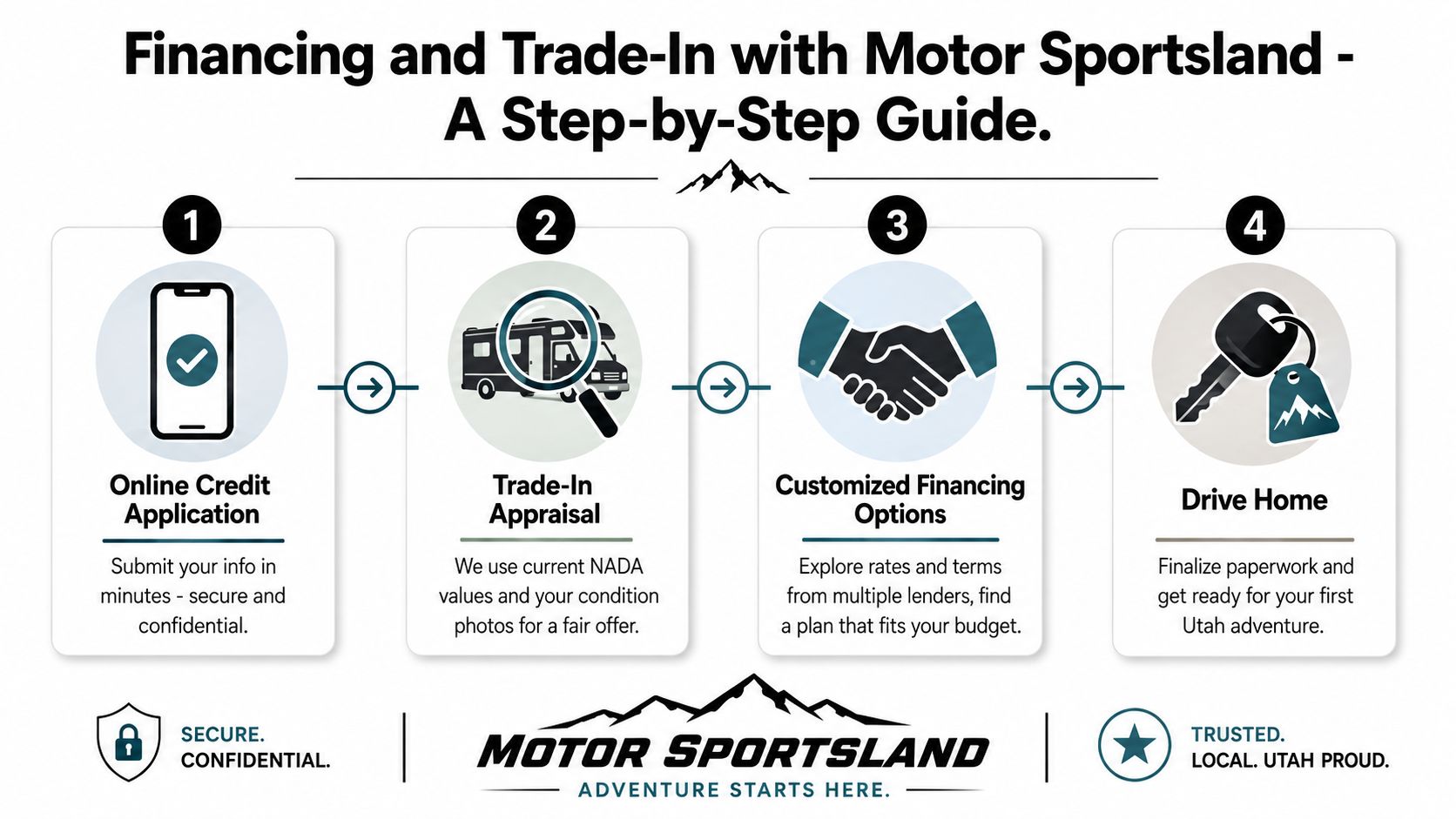
A practical financing sequence
- Submit an online credit application. Provide accurate income, housing, and employment information so lenders can evaluate the application without avoidable delays.
- Prepare the trade-in. Gather condition photos, current registration, payoff information, and maintenance records. A clean, complete presentation helps the appraisal process.
- Compare lender options. RV-specialized lenders may structure terms differently from ordinary vehicle lenders. Compare the rate, term, total repayment, required down payment, and any add-on products.
- Review the final figures. Confirm taxes, registration, document fees, trade equity, payoff amounts, warranty products, and insurance requirements before signing.
Bring a photo ID, recent pay stubs, proof of insurance, and current registration for a trade-in. If there's a lien, ask how the payoff will be handled and confirm the timing before delivery. Utah residents should also expect title and lien information to be checked through the DMV process.
Why local service changes the ownership equation
The lowest advertised price isn't always the lowest ownership cost. Buying from a Utah-based full-service dealer gives you a nearby place for warranty questions, appliance checks, propane work, winterization, parts, and repairs. That matters when a problem appears before a trip to the Uintas, not after you've already reached a distant campground.
A local team can also walk you through the unit's systems before delivery, verify dealer-installed options, explain the first service interval, and help with winter storage preparation. Private online purchases and out-of-state discount lots may offer a different price, but they often leave the buyer responsible for transportation, inspection, title work, and future warranty coordination.
Use this Utah RV financing guide to organize your questions before applying. Ask for an out-the-door worksheet, not just a payment estimate.
A sound payment structure should leave room for tires, storage, fuel, campsite fees, and maintenance. Don't let a longer term turn an oversized RV into an apparently affordable one.
Seasonal Care and Service the Motor Sportsland Team Recommends
Utah's winter can damage an RV before the owner notices a problem. Water left in plumbing lines, filters, pumps, and appliances can freeze, while dry sun and wind work on roof seals, graphics, awnings, and exterior finishes. Winterization should happen before the first hard freeze in the Wasatch Front valleys, and earlier for higher-elevation storage.
The seasonal checklist we use
- Winterize early: Drain the water system, bypass the water heater where appropriate, and use the correct RV antifreeze procedure.
- Inspect brakes and tires: Check pressure, tread, lug torque, brake operation, and the breakaway cable before mountain travel.
- Check wheel bearings: Service them before demanding trips and after long storage periods.
- Inspect the roof and seals: Look for cracked sealant around vents, slide-outs, windows, and roof penetrations.
- Test batteries: Check charge, terminals, and connections before the first spring departure.
- Service propane and appliances: A propane leak test and appliance inspection can prevent failures at camp.
- Lubricate slides and protect awnings: Use products approved for the specific slide mechanism and keep awning fabric clean and dry.
- Schedule generator service: Don't wait until you're boondocking near Moab to discover the generator won't carry the load.
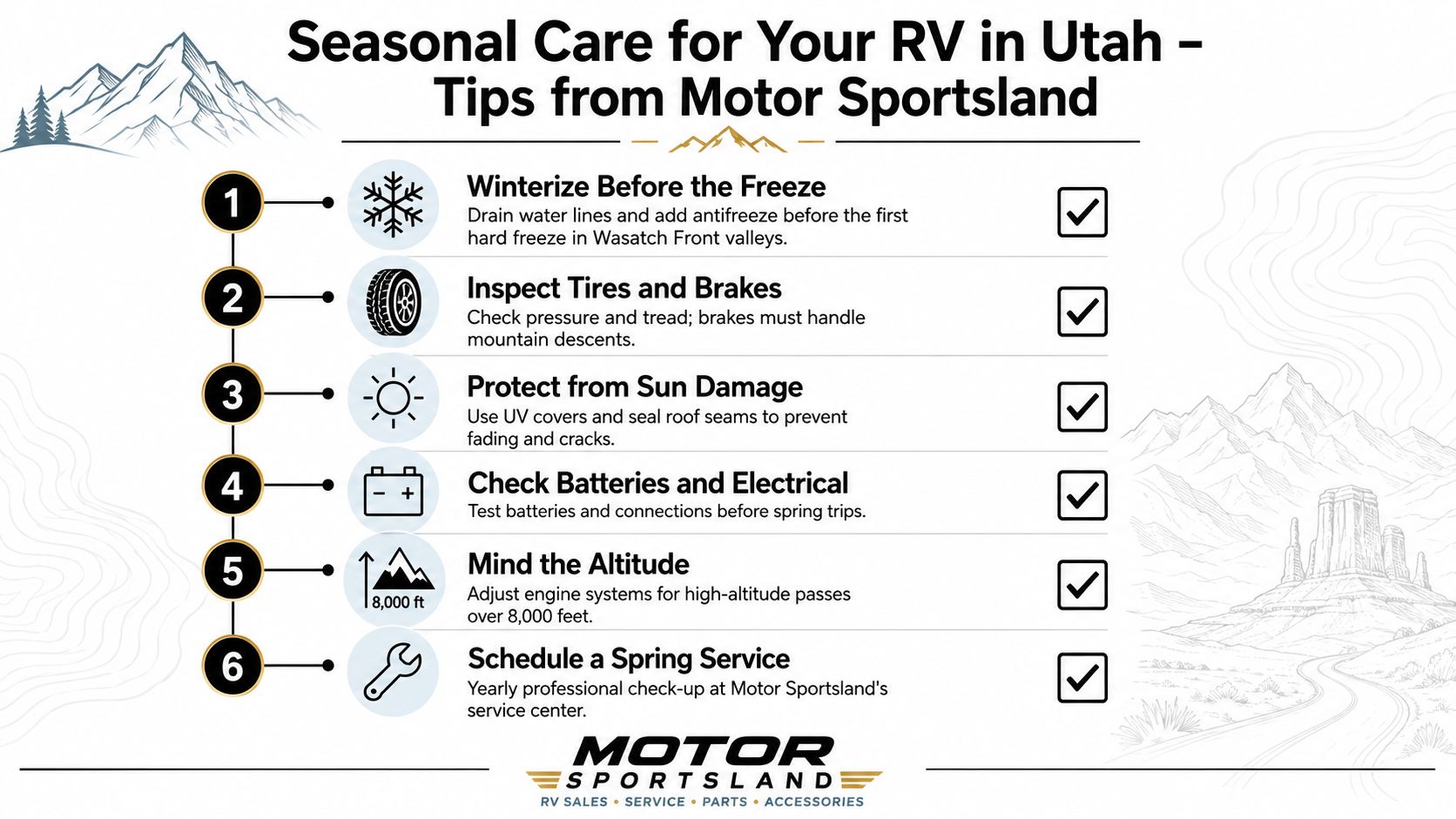
Mountain descents put sustained demand on brakes, tires, and hitch components. Before heading over Big or Little Cottonwood, inspect the trailer connection, brake controller, breakaway cable, and tire condition. Schedule service before peak travel season, because a preventive appointment in Salt Lake City or Spanish Fork is far easier than a breakdown near Zion or a remote desert trailhead.
Timing, Pricing, and Smart Shopping Strategies
The best time to shop depends on what you value. Late summer and fall often bring incoming model-year inventory, while winter can create more negotiating opportunities on units a dealer wants to move. Spring brings fresh enthusiasm and more shoppers, so the exact floorplan you want may attract stronger competition.
Don't treat the manufacturer's suggested retail price as the final measure of value. Compare the actual unit's equipment, freight and preparation charges, dealer-installed options, warranty coverage, trade value, and total out-the-door figure. Two trailers that look similar online can carry different practical value once you account for tires, batteries, hitch equipment, winter packages, and service needs.
The market deserves a careful answer
Black Book's Q1 2026 update reported average motorhome wholesale selling prices of $62,637, down 2.2% quarter over quarter and 1.5% year over year, while 2025 RV shipments were about 342,220 units. Black Book's market update points to a softer pricing environment and a market still normalizing after high production.
That doesn't mean every new RV will become cheaper if you wait. It does mean buyers should compare inventory age, current incentives, trade equity, and financing terms instead of accepting the claim that buying new is automatically the safest value choice. Utah's recreational vehicle dealer industry expanded to 215 businesses and 1,685 workers in 2026, according to the verified industry data, but industry growth doesn't guarantee strong resale performance for every floorplan or brand.
Visit during a weekday if you want a slower walk-around, open every storage compartment, test the bathroom and kitchen workflow, and connect the floorplan to your tow vehicle. Ask for a vehicle-specific trade appraisal and a current incentives check before comparing payments.
Your Next Steps Toward the Right New RV
Use four filters before choosing among new RVs for sale in Utah:
- Tow capacity: Match the loaded RV to payload, axle, hitch, brake, and combined-weight limits.
- Actual camping habits: Choose a bunkhouse, rear-living layout, toy hauler, fifth wheel, or motorhome based on how you spend Utah weekends.
- Service relationship: Confirm where winterization, warranty repairs, appliance work, parts, and pre-season inspections will happen.
- Payment resilience: Leave room in the budget for storage, fuel, registration, insurance, maintenance, and campground costs.
Pull current inventory between the Salt Lake City and Spanish Fork locations, then filter by tow vehicle compatibility, length, floorplan, and required features. Book a weekday walk-through and ask the associate to confirm dealer-installed options, warranty start dates, included equipment, and a first-service appointment before delivery.
If you're comparing a trade-in or a unit purchased elsewhere, you can also find RV vehicle records using the VIN before committing. Records won't replace a physical inspection, but they can help you organize questions about ownership, title status, and documented history.
Frequently asked questions
What type of RV is usually easiest for a first-time Utah buyer?
A travel trailer is often the most practical starting point for a buyer with a properly rated tow vehicle, especially when a separate vehicle will be useful at camp. The correct choice still depends on loaded weight, sleeping needs, and storage.
Should I choose a travel trailer or a motorhome for canyon trips?
Choose a travel trailer if you want to leave the RV at camp and use the tow vehicle for exploring. Choose a motorhome if combining driving and living space is more important and you're comfortable with its size, fuel needs, and route limitations.
What weight should I use when checking tow compatibility?
Use the trailer's GVWR and your real cargo plan, not dry weight alone. Include passengers, water, propane, batteries, food, tools, and recreational equipment, then verify the truck's payload and axle limits.
Do Utah trailers need registration?
Trailers weighing more than 750 pounds must be titled and registered in Utah. Confirm the current requirements for your specific trailer with the Utah DMV before purchase.
When should I winterize an RV in Utah?
Winterize before the first hard freeze in the Wasatch Front valleys, and plan earlier preparation for higher-elevation storage. A service appointment before the seasonal rush is easier than repairing frozen plumbing later.
Is now a good time to buy a new RV?
There isn't one answer for every floorplan. Current market data shows softer motorhome wholesale pricing and normalized shipment conditions, so compare live inventory, incentives, trade equity, and total ownership cost rather than waiting on a guaranteed future discount.
Motor Sportsland offers new and used RV inventory, financing, trade-ins, parts, and service support for Utah buyers comparing travel trailers, fifth wheels, toy haulers, and motorhomes. Visit Motor Sportsland to browse current units, then schedule a showroom walk-through in the Salt Lake City area or Spanish Fork so our team can match the RV to your tow vehicle, camping plans, and first season on the road.
