
RV Financing Pre Approval: Your Step-by-Step Guide

Getting pre-approved for an RV typically takes 24-48 hours with complete paperwork and a credit score of 670+, but the actual timeline depends on which lender you choose and how soon you lock in your rate. Pre-approval gives you a realistic spending boundary, but it doesn't guarantee that the specific RV you choose will receive final funding.
You may be sitting at home in Salt Lake City comparing bunkhouse travel trailers, fifth wheels, or toy haulers, already picturing weekends at Jordanelle or Bear Lake. Then you find the right floorplan, only to learn that the lender won't finance its age, the appraisal comes in below the purchase price, or the approval window expires before you finish the deal.
That gap between RV financing pre approval and final funding is where many otherwise sound purchases get delayed. The process also looks different from ordinary car financing because RV loans can involve larger balances, longer repayment periods, collateral rules, and closer review of the unit itself. This guide explains what lenders check, how credit and down payment affect your options, and what Utah buyers should do before signing paperwork.
At Motor Sportsland, our team works with families shopping for everything from affordable travel trailers to long-haul fifth wheels. We also see the practical costs that don't appear in a monthly payment, including fuel on Wasatch Mountain grades, winter storage, insurance, campground fees, and service needs. A clear pre-approval is useful only when it supports the whole ownership budget.
Understanding the RV Financing Pre-Approval Process
A Utah camping trip can look simple on paper. You choose a trailer, connect it to the family tow vehicle, and head toward the mountains. The financing is less simple because the lender isn't evaluating only you. It is evaluating you, the requested loan, and the RV that will secure the debt.
RV financing is a large, established category. One market estimate values it at USD 36.75 billion in 2024 and projects growth to USD 48 billion by 2029, at a 7.69% CAGR, according to Mordor Intelligence's recreational vehicle financing market estimate. That scale gives buyers access to many lenders, standardized underwriting practices, and a broad range of terms. Neutral lending guidance commonly places RV loan terms between 60 and 240 months, depending on the loan size and lender policy.
What pre-approval actually means
Pre-approval is conditional underwriting, not a promise that every RV will qualify. The lender estimates an amount, APR, and term after reviewing factors such as:
- Credit profile: Your score and payment history help determine eligibility and pricing.
- Income stability: The lender needs confidence that your household can support the proposed payment.
- Debt-to-income ratio: Existing housing, auto, credit card, and other debts affect borrowing capacity.
- Down payment: More money down can reduce the loan-to-value ratio.
- RV value: The lender may compare the requested loan with the unit's age, condition, and appraised value.
The process usually starts with a full application, followed by income and liability verification. After that, the lender checks whether the proposed RV fits its age, condition, title, and value rules. Buyers should shop inside the approved payment range, then complete the purchase while the approval remains valid.
A practical five-step workflow
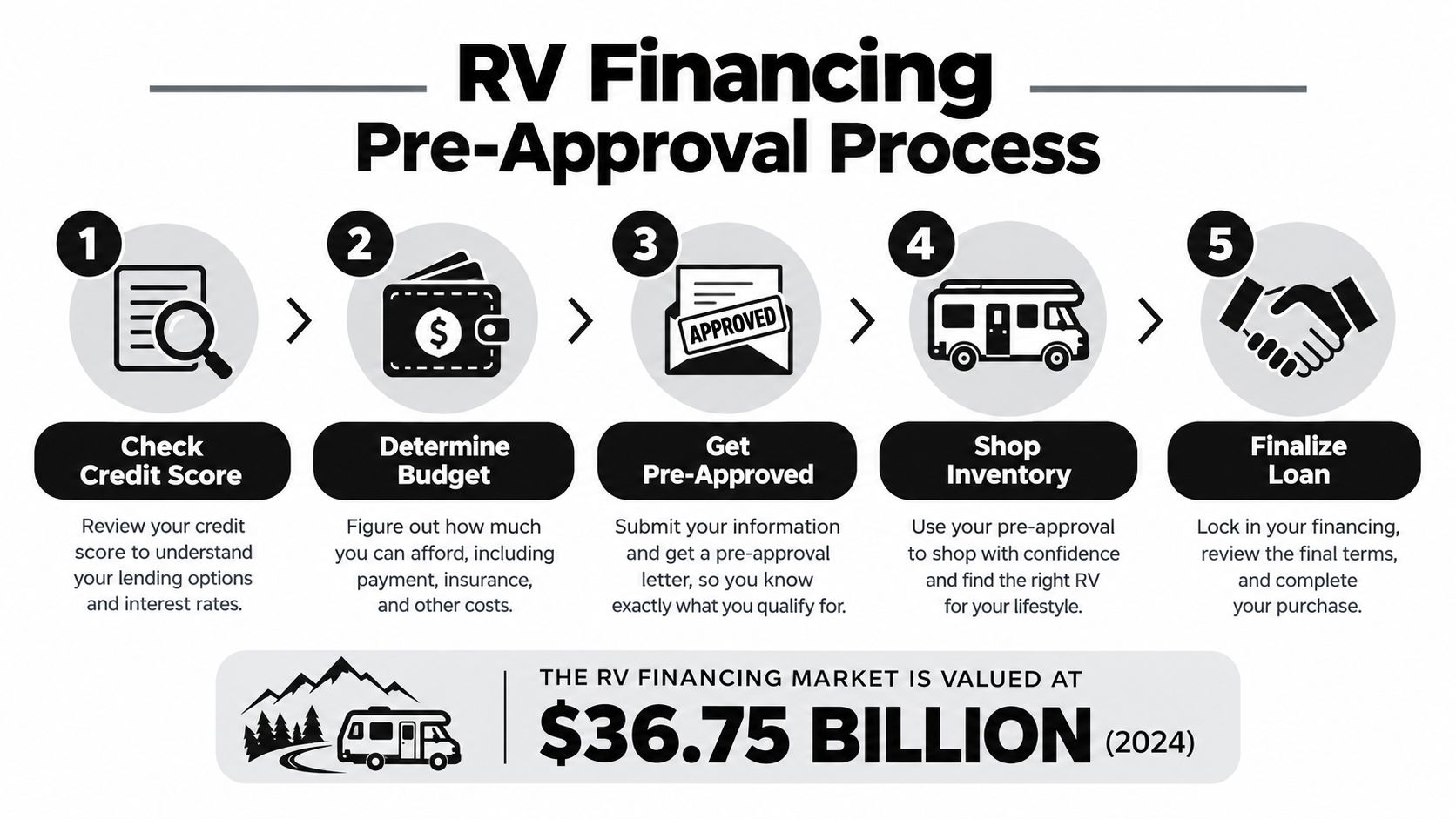
- Gather your records. Prepare income documents, debt information, identification, down payment evidence, and trade-in details if applicable.
- Submit the application. A complete application produces a more useful answer than a rough payment estimate.
- Review the approval conditions. Ask about the maximum amount, estimated APR, term, down payment, RV age limits, and expiration date.
- Shop with discipline. A pre-approval isn't permission to spend to the maximum. Keep room for insurance, storage, maintenance, and Utah travel fuel.
- Lock the purchase. One credit-union example provides a pre-approval valid for 90 days, while industry guidance shows that approval windows can range from 30 to 180 days, depending on the lender. Confirm your exact deadline in writing.
A separate finance check guide for dealers can help explain why verifying the financial details early prevents avoidable delays. You can also begin by reviewing the RV pre-qualification process before choosing a specific unit.
For Utah buyers, the payment should reflect how the RV will really be used. A trailer headed up steep grades may require more tow vehicle capability and fuel than a flat-road weekend rig. A motorhome that will sit outside through winter may need storage planning, battery care, plumbing protection, and service attention. Those costs don't change the lender's approval, but they should change your personal budget.
Practical rule: Treat the approval amount as a ceiling for lender risk, not as a recommendation for your household spending.
Dealership Financing Versus Bank and Credit Union Options
You can pursue RV financing through a dealership, a bank, a credit union, or a specialty lender. The right route depends on how much comparison work you want to do, whether the lender understands recreational collateral, and how quickly you need to move on a particular RV.
A direct bank or credit union application gives you control over the initial offer. You can compare the APR, term, fees, and required down payment before visiting a showroom. The trade-off is that you handle the document requests and may need to coordinate separately with the seller once you find the right unit.
Dealership-arranged financing is more centralized. Our finance staff can submit an application, review lender responses, and coordinate the RV details with the credit provider. That convenience matters when a lender needs an appraisal, title information, an inspection record, or clarification about a used unit. It also lets you evaluate the RV and financing together instead of treating them as unrelated decisions.
The main trade-offs
A bank may be a strong fit if you already have a relationship, understand its recreational loan rules, and want to manage the process yourself. A credit union may offer a competitive structure, but membership requirements, collateral policies, and term limits still apply. A specialty lender may understand RV floorplans and usage better, though its pricing can vary with the borrower and the unit.
Down payment policies differ sharply. CNBC's RV loan comparison reports that a down payment isn't always required, but when one is required, it commonly ranges from 10% to 20% of the purchase price. First Citizens Bank provides a specific used-RV example requiring 20% down and allowing borrowing up to 80% of the purchase price or appraised value.
| Lender Type | Typical Down Payment | Term Range | Best For |
|---|---|---|---|
| Dealership-arranged lender | Lender-dependent, often within the common market range | Lender-dependent | Buyers who want one application, coordinated paperwork, and help matching the loan to the RV |
| Bank | May be required, depending on credit and collateral | Bank policy | Existing customers who prefer direct control and a familiar institution |
| Credit union | Policy-dependent | BCU lists repayment up to 75 months, or 84 months for new recreational vehicles | Buyers who value member-focused service and a defined recreational lending program |
The BCU term information comes from its RV and boat financing guidance. First Citizens offers terms between 5 and 15 years, while LendingTree's RV financing guide describes typical terms from 60 to 240 months. Longer repayment can lower the required monthly payment, but it can increase total interest over the life of the loan.
The most useful approach for many buyers is to compare at least one direct offer with a dealership-arranged option. Bring the same down payment assumption, loan amount, and term to each conversation. Comparing monthly payments alone can hide a higher APR, longer repayment, or additional fees.
For a Utah-specific overview of lender types and shopping strategy, review this guide to RV financing options in Utah.
Credit Score Impact on Your RV Loan Rate
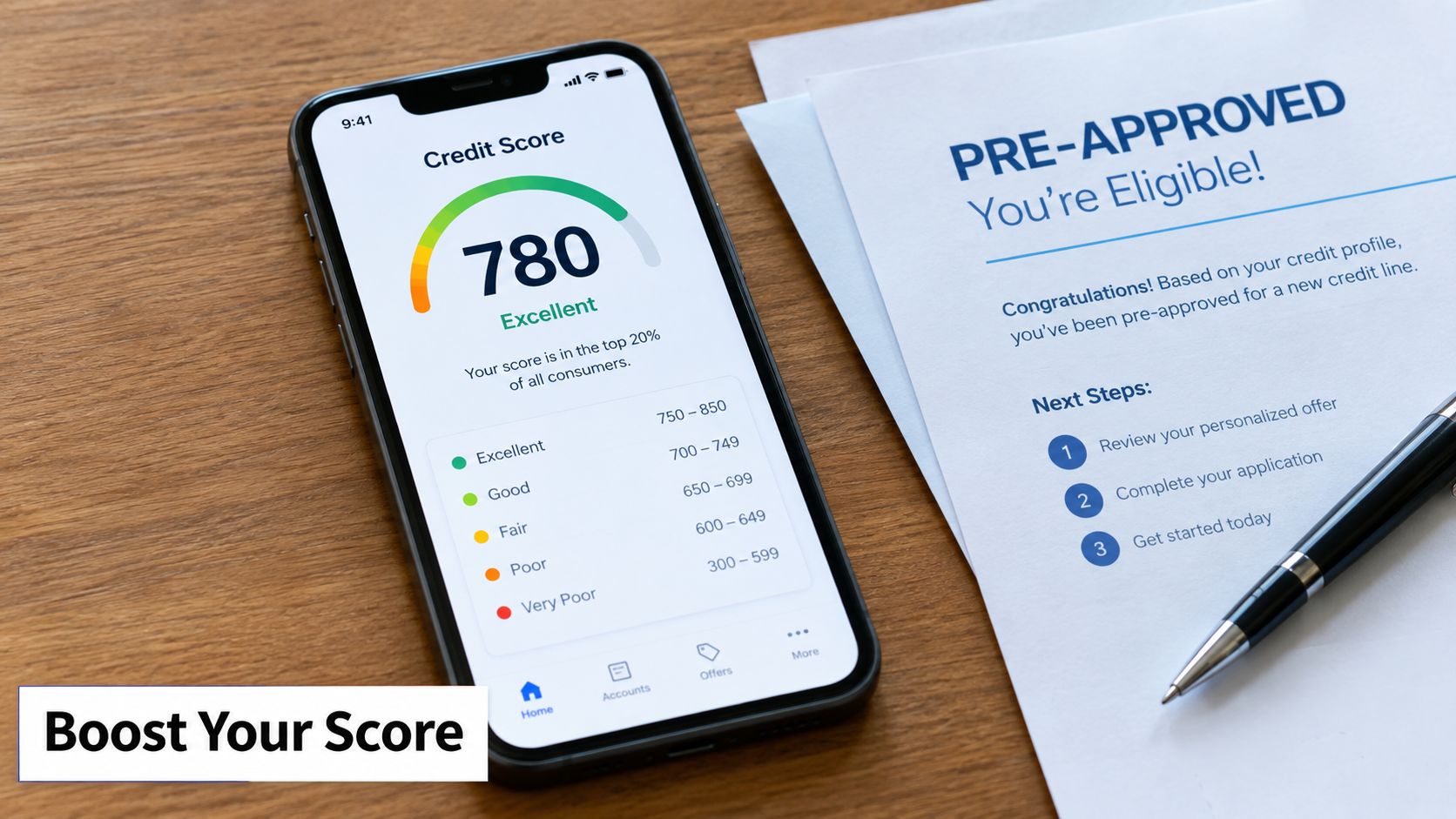
A pre-approval can look strong on paper, then change when the lender reviews the specific RV. Credit score affects more than whether you qualify. It can influence the APR, required down payment, maximum loan amount, and the lender's willingness to finance an older or less conventional RV.
Research and Markets places secured RV loan APRs at roughly 6% to 15%, while unsecured personal-loan-based RV financing can approach 36% for weaker credit profiles. The same Research and Markets' RV financing report indicates that some lenders look for a 660 credit score, with better pricing often available at 700 or higher.
Those figures are reference points, not a quote for your transaction. A lender may approve a borrower at one rate, then adjust the offer after reviewing the RV's age, condition, mileage, title status, and appraised value. This gap between pre-approval and final funding matters especially for used RV buyers in Utah, where inventory can vary and a lower-priced unit may still raise questions about collateral condition.
Secured financing often deserves attention before an unsecured personal loan. With a secured loan, the RV serves as collateral. The lender still evaluates your income, debts, credit history, and down payment, but the collateral can support different pricing and approval terms than a personal loan with no RV security.
Score ranges are not guarantees
Bankrate's RV loan guide explains that RV lenders commonly review credit score alongside steady income, debt-to-income ratio, and positive payment history. A score above a lender's preferred range can help, but it does not override concerns about the RV or the requested loan structure.
A strong score may still lead to revised terms if the loan is large, the down payment is small, or the RV falls outside the lender's collateral rules. For a used RV, an appraisal or inspection can expose issues that were not part of the initial application. The lender may reduce the amount financed, require more cash down, or decline that particular unit even when the buyer's credit is acceptable.
Improve the profile before applying
If the purchase is not urgent, use the preparation period to reduce avoidable risk:
- Lower revolving balances: Paying down credit cards can improve the debt picture shown to the lender.
- Avoid new accounts: Do not finance another vehicle, open several cards, or take on major debt before final underwriting.
- Protect payment history: A missed payment during the shopping process can change the lender's view.
- Check your reports: Review errors before submitting a full application. This guide to improving your credit score can help organize that work.
- Set a payment target: Use the RV loan calculator to compare terms without assuming the maximum approval is affordable.
Lenders also review debt-to-income ratios, available cash, and the payment's fit with your regular obligations. Leave room for Utah fuel costs, mountain driving, winter storage, repairs, and insurance rather than choosing a payment that uses every available dollar.
A strong pre-approval starts with a payment that still works after the campground reservation, fuel stop, and service bill. Final funding depends on both the borrower and the RV that secures the loan.
Required Documents and Common Approval Mistakes
A complete file moves faster than a file assembled one request at a time. Before applying, gather the records that show how you earn money, what you owe, what you plan to put down, and which RV you intend to buy.
Prepare this document checklist
- Income verification: Recent pay stubs, employment information, and tax returns when the lender requests them.
- Self-employment records: Business income documentation and tax filings if your household income comes from contract or business work.
- Liability details: Current housing payment, auto loans, credit cards, student loans, and other recurring debts.
- Identity information: Government identification and the personal details required for the credit application.
- Down payment evidence: Bank records or other documentation showing available funds.
- Trade-in information: Payoff details, registration, title information, and condition details for a trade.
- RV details: Purchase agreement, vehicle identification information, model year, mileage where applicable, stated condition, and seller information.
- Insurance information: A financed RV may require coverage before funding, so ask the lender what it needs.
Lenders use these details to estimate the loan amount, APR, and term while evaluating credit score, income stability, debt-to-income ratio, down payment, and loan-to-value. BCU describes this conditional process in its RV financing application guidance, including an approval that can remain valid for 90 days.
Mistakes that create trouble
Shopping first and budgeting later is the most common mistake. Buyers fall in love with a floorplan, add accessories, and then discover that the required payment doesn't fit their household cash flow. Decide what you can comfortably spend before you treat the approval amount as a shopping budget.
Ignoring age and condition rules causes particular problems with used RVs. A unit can look excellent on a dealer's lot and still fall outside a lender's model-year, value, title, or collateral policy. Ask about those rules before paying for inspections or planning a long drive to purchase.
Adding new debt during the approval window can change the final decision. New accounts, large card balances, missed payments, or a job change may prompt another review. Keep your financial profile stable until the lender has funded the transaction.
Forgetting the expiration date can force you to repeat paperwork or accept different terms. Rates, credit conditions, and lender policies can change while you wait, so don't assume an approval letter remains usable indefinitely.
Our team has worked with Utah families for more than 55 years, and the same practical pattern appears repeatedly. Buyers who prepare documents and ask about used-RV restrictions early have a much clearer path than buyers who start with a specific rig and try to make the financing fit afterward.
Bridging Pre-Approval to Final Funding
The pre-approval letter answers a budgeting question. Final funding answers a collateral and transaction question. Those are related, but they aren't identical.
After you select an RV, the lender may review the unit's age, value, condition, title status, and transaction documents. A credit union's RV financing explanation makes clear that final approval can change after the specific vehicle is selected. That distinction matters most with used RVs, where age and condition can determine whether the lender will accept the unit as collateral.
What can trigger a second review
A lender may ask additional questions when:
- The RV is older than the program allows. A pre-approval for an unspecified RV doesn't automatically cover every model year.
- The value doesn't support the loan. An appraisal or valuation may be lower than the negotiated purchase price.
- The condition raises concerns. Water intrusion, structural issues, major system problems, or incomplete repairs can affect collateral eligibility.
- The title or history is unclear. Missing documents, liens, branding, or ownership inconsistencies can delay funding.
- The final deal changes. A different price, trade value, cash down payment, add-on, or loan term may require revised approval.
- The borrower profile changes. New debt or a credit event can lead to another underwriting review.
Used RV buyers should ask these questions before becoming emotionally committed to a particular unit:
- Does the lender finance this model year?
- Does it require an appraisal or inspection?
- Is the loan based on the purchase price, appraised value, or the lower of the two?
- Which title and ownership documents must the seller provide?
- How long will the current approval remain valid?
- What could change the APR or approved amount before funding?
New inventory generally removes some age-related uncertainty, but it doesn't eliminate the need to verify value, documentation, borrower qualifications, and the final contract. A newer RV can also carry a larger balance, so the payment still needs to fit your actual travel plans.
Before you sign: Ask the finance representative to identify every condition that remains open. “Pre-approved” should never be treated as “funded.”
The safest shopping method is to keep a written record of the approved amount, estimated APR, term, required down payment, expiration date, and unit restrictions. Then compare each candidate RV against that list before negotiating accessories or making travel arrangements. This prevents a common Utah scenario, where a buyer drives across the state for a used fifth wheel and discovers that the lender won't accept its age or valuation.
Next Steps After Pre-Approval
Once the approval arrives, slow down enough to use it properly. Start with inventory that fits the approved payment range, then compare towability, floorplan, condition, and ownership costs rather than chasing the largest RV the lender will consider.
Families can browse new and used travel trailers, bunkhouse models, fifth wheels, toy haulers, and motorhomes at Motor Sportsland locations in Millcreek and Spanish Fork. Schedule a test drive and pay attention to details that affect real Utah use, including hitch setup, braking, turning clearance, storage capacity, generator access, and how the unit feels on grades near the Wasatch Mountains.
A trailer intended for high-altitude camping may need different equipment and maintenance planning than a seasonal unit parked near the Great Salt Lake. Add winter storage, plumbing winterization, battery care, insurance, registration, fuel, campground fees, and repairs to your ownership budget before you finalize the loan.
Use the approval as a negotiation tool
You don't need to disclose every detail of your financial profile to negotiate confidently. You do need to know your approved range, the required cash down, and the conditions that could change after the lender reviews the RV.
Ask for a complete written breakdown of:
- The amount financed
- APR and repayment term
- Required down payment
- Estimated payment
- Lender fees or documentation charges
- Prepayment conditions
- Insurance and funding requirements
- Approval expiration date
If the purchase takes longer than expected, contact the lender before the approval expires. Don't wait until the day of signing to discover that the rate or documentation must be refreshed.
The process from approval to keys is easier when the finance and sales teams communicate about the exact RV, trade-in, title, insurance, and final purchase agreement. This video offers another visual introduction to the buying process:
Our service team can also help you plan maintenance, upgrades, plumbing work, electrical repairs, parts, and winter preparation after purchase. Financing gets you to ownership, but dependable service keeps your RV ready for trips through Utah and the wider Mountain West.
Motor Sportsland offers online RV pre-qualification, full credit applications, new and used inventory, trade-in support, and service assistance for buyers comparing financing options. Visit Motor Sportsland to browse available RVs, then contact our Utah team or stop by the Millcreek or Spanish Fork location to review your pre-approval against a real unit.
Getting pre-approved is useful when you understand its limits. Compare lender offers, protect your credit profile, verify the RV's age and value before committing, and keep enough room in your budget for Utah's mountain driving and winter storage. The right financing plan should support the way your family travels, not just stretch you to the highest approval amount.
Motor Sportsland has served Utah RV buyers for more than 55 years, helping families compare travel trailers, fifth wheels, toy haulers, motorhomes, and other recreational vehicles. Bring your approval letter and questions to the showroom, and let the team help you move from a conditional budget to a properly funded RV.
RV Financing Pre Approval FAQs
How long does RV financing pre approval take?
With complete paperwork, the process can often move quickly, but timing depends on the lender, verification requirements, credit profile, and how soon you provide requested documents. Ask the lender when the approval expires and whether the rate remains available through that date.
Is RV pre-approval the same as final approval?
No. Pre-approval estimates the amount, APR, and term based on your financial profile. Final funding can change after the lender reviews the selected RV's age, value, condition, title status, and transaction documents.
What credit score do I need for an RV loan?
Requirements vary by lender. Some lenders look for at least 660, while other guidance identifies 670 or higher as a common benchmark. Borrowers with scores of 700 or higher may receive better pricing, but income, debt-to-income ratio, down payment, and the RV itself also matter.
How much should I put down on an RV?
The amount is lender-dependent. When a down payment is required, it commonly falls between 10% and 20% of the purchase price. First Citizens Bank gives a used-RV example requiring 20% down.
Can I finance an older used RV?
Possibly, but the lender may impose age, condition, value, title, or inspection requirements. Confirm the model-year rules before negotiating because pre-approval for an unspecified RV doesn't guarantee approval for an older unit.
Should I use a bank, credit union, or dealership financing?
Compare at least one direct bank or credit-union offer with a dealership-arranged option. Evaluate APR, total repayment cost, term, down payment, lender fees, collateral rules, and the level of help you want with the final RV documentation.
