
RV GPS Tracking Device Guide for Utah RV Owners

You're halfway through a Utah road trip when the motorhome starts acting up near the Wasatch Mountains. Or perhaps your travel trailer is sitting in winter storage while you're several hours away, and you suddenly wonder whether it's still there. An RV GPS tracking device can't prevent every theft, mechanical failure, or cellular dead zone, but it can show where your rig was last located, alert you to unexpected movement, and give you useful information when you need help.
The right tracker is more than a dot on a smartphone map. You'll need to understand GPS accuracy, cellular coverage, battery strategy, geofencing, installation, subscription costs, privacy, and the difference between a motorhome that supplies its own power and a trailer parked without hookups. Those details matter around Utah's mountain passes, desert roads, national parks, and seasonal storage lots.
This guide explains the technology in plain language, with practical buying advice for first-time owners and experienced RVers. It also highlights the questions many product pages skip, including what happens when your tracker loses cellular service and how to prepare it for a long winter near Salt Lake City, Bear Lake, or the Great Salt Lake.
Understanding What an RV GPS Tracking Device Is
You're winding through a canyon road outside Salt Lake City when a warning light appears on the dashboard. A passenger calls a campground host, while another checks the map and tries to describe your location. In a different situation, your trailer could be parked overnight at a storage lot when an unauthorized vehicle begins towing it away. An RV GPS tracking device gives you a separate location signal, so you're not relying only on memory, campground descriptions, or a nearby landmark.
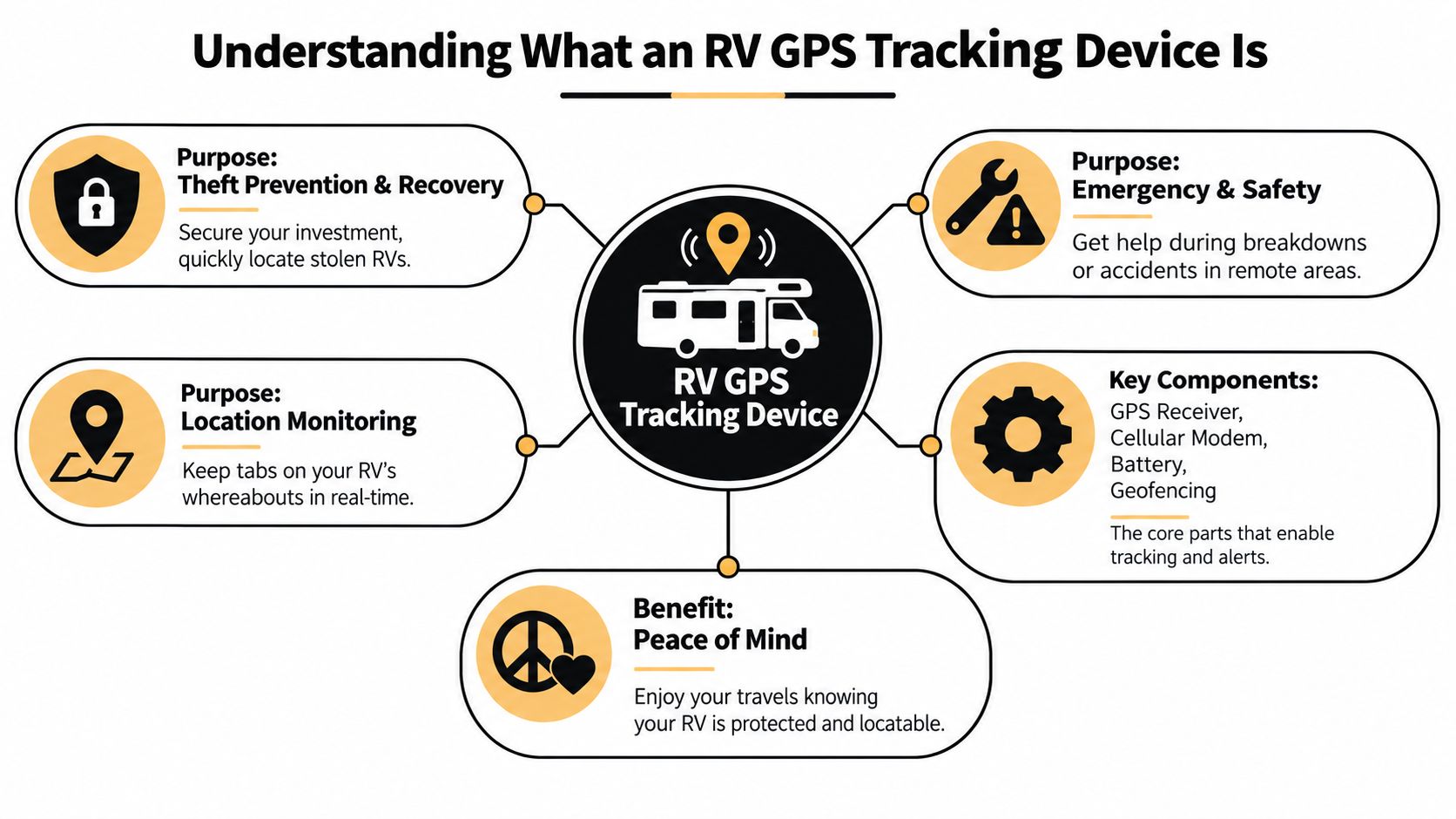
The device receives signals from navigation satellites, calculates the RV's position, and sends that information through a cellular connection to an app or web dashboard. Depending on the model and its settings, you might see a current location, a recent location, a route history, or an alert that the rig moved outside a defined boundary.
What the device can do
A tracker can help with several practical situations:
- Theft recovery: If someone moves your motorhome or towable without permission, an alert and location history can give you information to share with law enforcement.
- Emergency coordination: When you're stopped in a broad BLM camping area, a location pin can help a service provider or family member find the right access road.
- Storage monitoring: A movement alert can notify you when a trailer leaves a storage area during the off-season.
- Shared ownership: Families or co-owners can use approved account access to check a rig's location without repeatedly calling the driver.
GPS vehicle tracking has roots in the 1960s, when U.S. military and government agencies developed satellite-based navigation concepts. The first Block-I GPS developmental satellite launched in 1978, 10 more Block-I satellites were in orbit by 1985, and the system became fully operational in 1994 after the last of the original 24 satellites was launched, according to this history of vehicle GPS tracking. Civilian commercial airline use was authorized in 1983, and the end of selective availability in 2000 helped make GPS chips affordable enough for broader consumer products.
Practical rule: A tracker is a recovery and communication tool, not a replacement for a hitch lock, wheel chock, alarm, insurance, or sensible storage choice.
Theft-recovery data helps explain why owners use multiple layers. One 2023 report cited a 64% recovery rate for stolen RVs equipped with tracking devices, compared with 28% for those without, while UK analysis reported that 95% of stolen caravans fitted with trackers were recovered. You can also review broader advice on protecting your vehicle for physical security measures that work alongside electronic tracking.
How RV GPS Trackers Work with GPS and Cellular
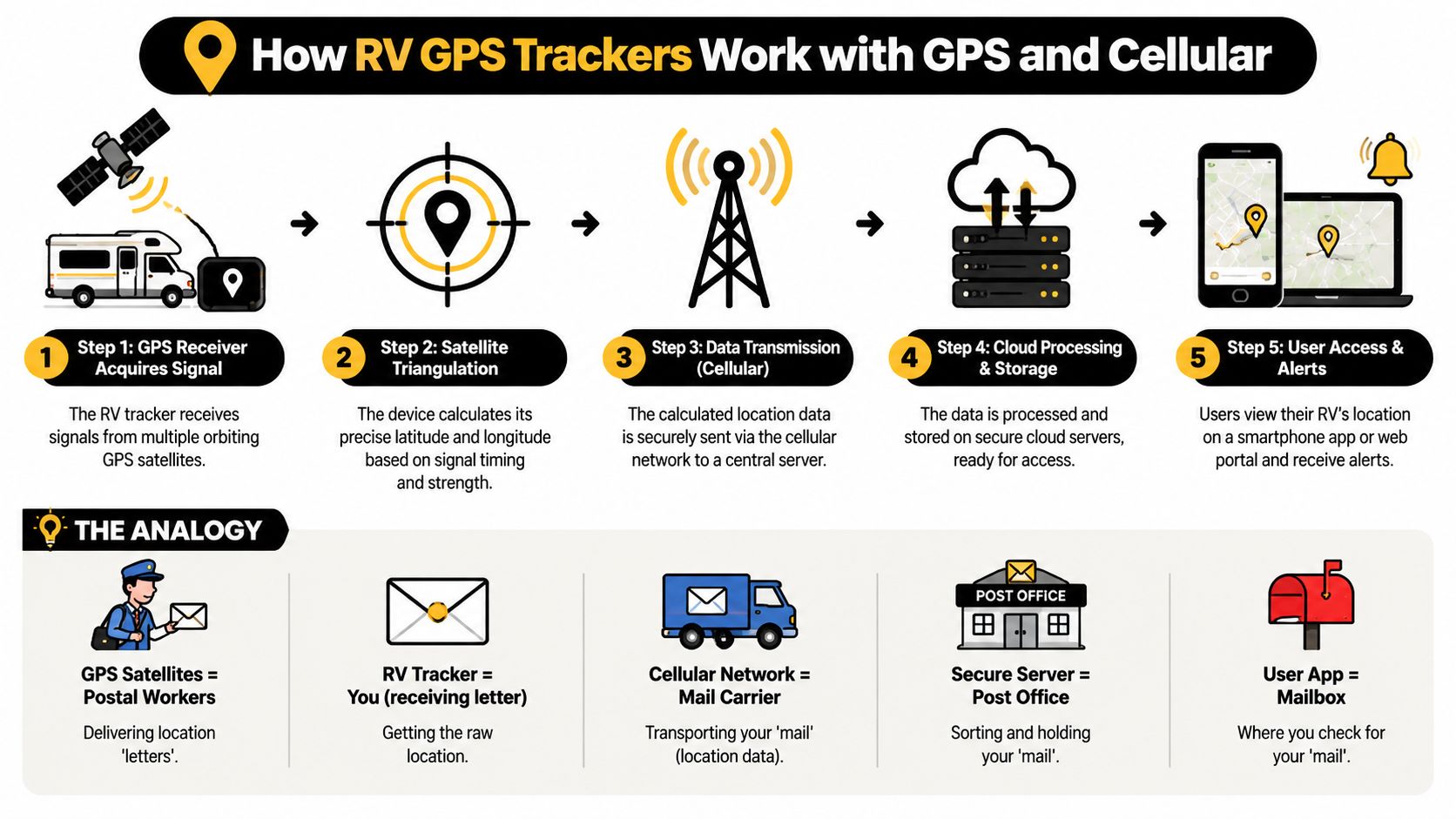
An RV tracker uses two separate communication paths, and confusing them causes many buying mistakes. GPS determines where the RV is. Cellular service sends that location to you. A tracker can know its position while being unable to upload it until it reaches a compatible network.
Think of the process like mailing a letter from a remote campground.
The location process in plain steps
- The GPS receiver listens. Signals arrive from orbiting navigation satellites. Trees, canyon walls, heavy structures, and the tracker's installation location can affect reception.
- The device calculates position. It uses signal timing to estimate latitude and longitude. Some advanced units support GPS, GLONASS, and SBAS.
- The cellular modem sends data. The tracker packages the position and transmits it through its supported cellular network.
- A server processes the update. The provider's platform stores the information and applies alert rules such as movement or geofence notifications.
- Your app displays the result. You see the latest available position through a phone or web portal.
GPS satellites are like postal workers delivering location information. The tracker receives the raw letter, the cellular network acts as the mail carrier, the secure server functions as the post office, and your app becomes the mailbox where you check the update.
A mountain canyon near Moab or a remote route in southern Utah can interrupt one part of the chain without interrupting the other. The device might calculate a location but hold the update until cellular coverage returns. That's why “live tracking” should always be read as live when the tracker has a compatible connection, not live under every trail, canyon, or storage condition.
A tracker specification sheet referenced by Mogo lists advanced units using LTE Cat 1 or NB-IoT, GPS/GLONASS, and SBAS support with approximately ±2.5 m CEP location accuracy. The same RV tracker specification sheet lists cold-start acquisition under 35 seconds, hot-start acquisition under 1 second, and low-power sleep modes below 2 mA average at 12V.
Cold start means the receiver needs more time to establish its satellite information, which can happen after power loss or a long inactive period. Hot start is faster because the receiver retains useful recent information. For a stored RV, those distinctions matter less than the complete system, including battery condition, installation, network access, and whether delayed updates are saved.
For a clearer look at RV power systems before choosing a hardwired installation, review this guide to demystifying your RV electrical system.
Key Features to Compare
A tracker's feature list can look impressive until you ask how it behaves on a Utah route. For example, a fast refresh interval has limited value if the device can't connect to a cellular network, while a modest update schedule may be perfectly suitable for a trailer sitting in a powered storage yard.
Remote coverage deserves special attention. Independent coverage notes that typical travel segments can include zero cellular service in about 6% of segments, while 5G availability in rural or wilderness areas can be as low as 18%, according to this remote RV connectivity analysis. LTE-M or Cat-M1 support, carrier roaming, and store-and-forward behavior may matter more than a flashy app interface.
| Feature | Benefit | Considerations |
|---|---|---|
| Location updates | Helps you see movement and investigate an unexpected trip | Ask how the device behaves when cellular service disappears |
| Geofencing | Creates a virtual boundary around a home, campground, or storage lot | Check whether alerts are included in the plan and how they're delivered |
| Battery strategy | Keeps a trailer monitored when it has no shore power | Compare sleep behavior, recharge needs, and low-battery alerts |
| Hardwired or plug-in power | Supports continuous operation in a motorhome | Confirm the outlet or electrical circuit remains powered while parked |
| Cellular plan | Connects the tracker to the app when coverage is available | Check carrier roaming, supported regions, cancellation terms, and cross-border use |
| Route history | Provides context after a trip or unauthorized movement | Review how much history the platform stores and who can access it |
Match features to the trip
A family traveling between Salt Lake City and established campgrounds may value geofence alerts and simple app access. Someone boondocking near Grand Staircase-Escalante needs a clear understanding of delayed updates and last-known-location behavior. A fifth wheel stored for the winter needs power planning before it needs faster refreshes.
The tracker should also match the RV itself. A drivable motorhome can often supply steady vehicle power, but a travel trailer or toy hauler may be disconnected from the tow vehicle for long periods. A hidden battery-powered unit can be useful in that setting, provided you can inspect and recharge it.
Don't treat “real-time” as a universal promise. Ask the seller four direct questions:
- Which cellular technologies does it use?
- Can it roam across carriers?
- Does it store locations during an outage?
- What alert arrives when service returns?
Those answers tell you more about Utah usability than a general claim about nationwide coverage.
Privacy and Legal Considerations for RV Owners
A tracking device records location information connected to a vehicle, so ownership and permission matter. The safest approach is to treat access to the tracker like access to keys. The person who owns or controls the RV should know who can view the account, receive alerts, change geofences, and download route history.
Utah privacy questions can become more complicated when an RV has multiple owners, employees, renters, or family members. A private owner monitoring an RV they own is different from secretly monitoring another adult's movements. If you rent out the RV or share it with co-owners, disclose the device and explain what it records before the trip begins.
A practical privacy checklist
- Tell authorized drivers: Explain that the RV has location monitoring and identify who receives alerts.
- Limit account permissions: Give additional users only the access they need, especially if the platform supports different roles.
- Protect login details: Use a unique password and remove former drivers or co-owners promptly.
- Review retention settings: Learn how long the provider stores route history and whether you can delete old records.
- Check cross-border rules: Confirm the provider's service and privacy terms before traveling outside the United States.
- Coordinate with law enforcement: During a theft, share current and historical location information through appropriate official channels.
Don't use a tracker to secretly monitor a spouse, renter, employee, or guest. The legal outcome can depend on consent, ownership, employment arrangements, the type of data collected, and where the monitoring occurs. For unusual situations involving suspected hidden surveillance or vehicle privacy, a resource on counter surveillance services London can explain how professional detection work differs from ordinary vehicle tracking.
An RV dealer or service provider should also clarify its role. If a technician installs a device, ask whether the business can access the account, whether it stores your credentials, and how service records are handled. A provider should not need unrestricted personal access merely to mount or wire the hardware.
Insurance and privacy belong in the same ownership conversation. Before relying on a tracker as part of your protection plan, compare your policy requirements in this Utah RV insurance cost guide. A tracker can support recovery, but it doesn't automatically change coverage, deductibles, or policy obligations.
Installation and Service Options from Motor Sportsland
Installation starts with the RV's power design, not the tracker's box. A plug-in unit is convenient when the vehicle has a suitable powered port and you can place the device where it receives dependable signals. A hardwired tracker is less visible and can remain connected to the RV's electrical system, but wiring must be protected from moisture, vibration, service access, and accidental disconnection.
Plug-in versus hardwired
Plug-in installation suits owners who want a reversible setup. It can work well for a motorhome used regularly, but the device may be easy to find or unplug. A visible cable can also be inconvenient around the driver's area.
Hardwired installation suits owners who want a discreet, permanent connection. The technician must select an appropriate circuit, protect the wiring, confirm the device's sleep behavior, and verify that the RV won't drain its battery during storage.
Trailer installation requires a separate power decision. A travel trailer may sit disconnected from the tow vehicle, so a tracker powered only through the towing connection won't monitor it while parked. An external battery kit may be necessary for storage without hookups.
Subscription and battery costs belong in the same budget. Tracker subscriptions can range from $8 to $25 per month, and trailer-friendly external battery kits can cost $100 to $200 for multi-year off-season storage without power hookups, according to this RV tracker ownership-cost guide.
What a professional installation should include
- Vehicle assessment: Identify the RV type, battery layout, storage routine, and likely installation location.
- Power planning: Decide between plug-in, hardwired, or independent battery operation.
- Signal check: Confirm that the proposed location allows the GPS receiver and cellular modem to work properly.
- Protected routing: Secure wiring away from heat, sharp edges, moving components, and wet compartments.
- Account activation: Pair the device with the app, set the owner and approved users, and configure alerts.
- Movement test: Confirm that the device reports a location and that the selected notifications arrive.
For wiring, diagnostics, electrical work, upgrades, and other RV needs, review the available RV service options. Ask for a written explanation of what the installation includes, what the tracker subscription covers, and what you should do before winter storage.
Selecting the Right Tracker for Utah RV Owners
The best tracker depends on how you use the RV, where you store it, and how quickly you need to respond to movement. A weekend travel trailer parked at home has different needs from a motorhome crossing mountain passes or a toy hauler left near a remote riding area.
Choose by ownership pattern
For a drivable motorhome, prioritize dependable vehicle power, discreet placement, movement alerts, and carrier flexibility. Motorhomes often travel through changing terrain, so the tracker should continue recording useful information when a canyon interrupts the cellular upload.
For a fifth wheel, focus on the hitch area, independent trailer power, storage monitoring, and multi-user access. The tow vehicle may leave the fifth wheel at a campground or storage lot, so the trailer needs its own monitoring plan.
For a toy hauler, consider how cargo loading, generator compartments, and powersports equipment affect placement. A tracker should be hidden without being buried behind materials that block signals or make battery service difficult.
For seasonal storage, prioritize low-power operation, battery alerts, and a clear plan for checking the unit before the first spring trip. Utah winters can bring freezing conditions and long periods without use, so a tracker that steadily consumes power may create a different problem.
The theft risk is meaningful enough to influence this decision. A 2023 report cited a 64% recovery rate for stolen RVs with tracking devices versus 28% without them, and UK analysis reported recovery of 95% of stolen tracked caravans, as detailed in the earlier theft source. Those figures don't guarantee recovery, but they support using tracking as one layer in a broader security plan.
Questions to ask before purchase
- Will it work with my trailer disconnected from the tow vehicle?
- Can it roam across available carriers in the places I travel?
- What happens during a cellular outage?
- Can my spouse or co-owner receive alerts without sharing my password?
- How often will I need to recharge it during storage?
- Does the plan include geofencing, history, and support?
- Can the installation be serviced without removing major interior panels?
A tracker should fit your real habits, not an imagined ideal trip. If you spend most weekends near Jordanelle, the priority may be quick alerts and easy account management. If your favorite destinations are remote desert camps or high-country routes, coverage behavior and delayed reporting deserve more attention than app polish.
Conclusion with Next Steps and CTA
An RV GPS tracking device can add a valuable layer of protection for Utah owners. It receives a satellite position, uses cellular service to transmit that information, and can support movement alerts, geofences, recovery efforts, and emergency coordination. Its limitations matter just as much. Remote routes may interrupt cellular reporting, trailers may need independent power, and every owner should understand who can access location history.
Choose the device around your RV type and storage routine. Check LTE-M or Cat-M1 support, carrier roaming, store-and-forward behavior, battery requirements, alert features, subscription terms, and installation quality. Don't assume that a “live” label means uninterrupted updates in a canyon or national park.
When you're ready to compare RV layouts, trade in an older rig, or prepare a new motorhome or trailer for Utah travel, visit the Motor Sportsland showroom in Millcreek or Spanish Fork. You can also browse the current RV inventory and ask the service team about a tracker installation that fits your electrical system and winter-storage plan.
Frequently Asked Questions
Will an RV tracker work inside a Utah national park?
It may calculate a location without being able to transmit it immediately. GPS reception and cellular transmission are separate, so canyon walls or a remote campground can interrupt uploads. Choose a device that records last-known locations or stores updates for later transmission, and tell family members that an old location may remain visible until service returns.
Can I transfer the tracker when I trade in my RV?
Usually, the hardware and account should be handled separately. Remove the old RV from the app, delete or transfer authorized users, and ask the provider whether the device can be reassigned. Before a trade-in, confirm that the next owner won't retain access to your route history or personal account.
Can alerts go to a family group chat?
Some platforms can send notifications by text, email, or app invitation, while others limit sharing to individual accounts. Check the provider's sharing features before purchase. A practical setup gives the primary owner administrative control and grants family members only the alerts they need.
Should I leave the tracker connected during winter storage?
That depends on the RV's power source, the tracker's sleep behavior, and the storage facility. A hardwired unit can draw from the RV battery, while a trailer without hookups may need an external battery kit. Test the setup before storage, confirm low-battery alerts, and inspect the RV periodically rather than assuming the tracker will run indefinitely.
What should I do after a theft alert?
Don't confront anyone or attempt a recovery yourself. Verify the alert, record the displayed location and time, contact law enforcement, and provide the tracker's account information and vehicle details. Keep physical security, insurance records, photographs, and identifying documents available so the report is easier to complete.
Motor Sportsland helps Utah RV owners compare motorhomes, travel trailers, fifth wheels, and toy haulers, then keep them road-ready with professional service and installation support. Visit Motor Sportsland to browse available RVs, contact our team, and plan a tracking setup suited to your next Utah adventure.
