
From RV Rentals to Owning in Utah: A Practical Guide

Two summers ago, a Salt Lake City family rented a travel trailer, hauled it to Moab, spent a few nights near Fishlake, and finished the season at Bear Lake. The next summer, they rented again, expecting the same setup to work. It didn't. The kids needed a better sleeping arrangement, the tow vehicle felt strained on mountain grades, and the family discovered that a large kitchen mattered less than storage, tank capacity, and a floorplan that could handle wet gear.
That's the point where many Utah renters start asking whether they should keep booking or buy their own RV. The answer depends on how often you travel, what you learned from renting, and whether you've priced ownership beyond the loan payment. This guide lays out a Utah-specific break-even method, practical floorplan advice, an inspection process for roof and tire problems, and a winterization plan suited to Wasatch winters. Our team sees renters cross from a reservation agreement to a title every weekend, and the buyers who do best are the ones who treat their rental history as research.
When Renting Becomes a Test Drive for Ownership
A rental gives you information a showroom walk-through can't. You learn how much space your family uses, whether everyone tolerates the tow vehicle, and which features still matter after several nights of cooking, sleeping, showering, and packing inside the RV.
That Salt Lake family initially wanted a larger trailer because the brochure listed more sleeping capacity. After two seasons, they realized the better purchase would be a manageable bunkhouse trailer with useful exterior storage and a layout that made campsite setup simple. Their rental experience showed them that usable space matters more than maximum sleeping capacity.
Utah also exposes weaknesses quickly. A trailer that feels easy on flat pavement can feel very different on I-15 grades, Highway 89, or roads leading toward the Uintas. A family that rents a motorhome may love the one-piece driving experience but dislike giving up a separate vehicle at camp. Another family may discover that a travel trailer lets them leave the RV at the campground and use the tow vehicle for groceries, trailheads, or a day in town.
Before you move from renting an RV in Utah to owning one, write down what each trip taught you:
- Sleeping reality: Count the beds people willingly used, not the advertised capacity.
- Towing comfort: Note sway, braking confidence, visibility, and how the rig handled climbs and descents.
- Campground fit: Record whether the length worked at state parks and older sites with tight back-ins.
- Feature value: Separate daily-use features, such as a good refrigerator or exterior shower, from features nobody touched.
- Maintenance tolerance: Decide whether you're comfortable checking tires, seals, batteries, propane, and water systems.
Our showroom rule: Don't buy the RV you enjoyed looking at. Buy the RV that solved the problems you noticed while renting.
Renting twice is especially valuable because one trip can be an outlier. A second season reveals patterns. If the same bathroom feels cramped, the same tow vehicle struggles, or the same storage compartment stays full, those are purchase requirements. If a feature went unused on both trips, stop paying for it in your imagination.
Why Utah Renters Make Smart First-Time Buyers
Rental fees aren't automatically wasted money. They can be paid research, especially in a state where destination demand can make short bookings expensive. Current Utah rental listings commonly show nightly rates around $85 to $250 or more, depending on the RV type, with travel trailers often around $85 to $110 per night and higher-end motorhomes around $195 to $250 or more, according to Utah RV rental listings.
The rental market also shows that Utah buyers have a practical way to test ownership before committing. In 2023, Salt Lake City was reported as the U.S. city renting the most RVs, while Utah had more than 700 owners listing nearly 900 RVs, producing about 112,000 rented nights and more than $15 million in annual owner earnings, as reported by TravelAwaits. That doesn't guarantee your future RV will rent well, but it confirms that a functioning local rental economy exists.
National sales history gives the ownership side context. The U.S. Census Bureau reported that the country's 2,667 RV dealers generated $25.9 billion in sales in 2017, compared with $14.2 billion in 2012, and RV retail sales reached 570,771 units in 2021 before easing to 447,718 in 2022. The same Census Bureau RV market overview reported record wholesale shipments of 600,240 units in 2021. Renting and owning have both become established ways to travel, not fringe choices.
What your rental history can tell you
Track these details after every trip:
- Trip frequency: How many weekends or longer journeys did you want?
- Actual occupancy: Did every sleeper use a bed, or did people migrate to the dinette?
- Route confidence: Did towing feel comfortable through mountain terrain?
- Storage behavior: Did bikes, coolers, camp chairs, and wet clothing overwhelm the compartments?
- Seasonal needs: Would heated tanks, stronger insulation, or better furnace performance extend your use?
| Cost Item | Utah Rental, per trip | Utah Ownership, per year |
|---|---|---|
| RV access | Nightly booking rate, often $85 to $250 or more depending on type, Utah rental listings | Loan payment, insurance, storage, maintenance, and depreciation |
| Availability | Subject to booking windows, minimum stays, and listing availability | You control the calendar |
| Maintenance | Usually handled by the owner or rental provider | Your responsibility, or a service-center expense |
| Storage | Included only during the booking period | Home storage, covered storage, or a storage lot |
| Depreciation | Not your asset | Reduces resale value over time |
| Flexibility | Easy to change RV types | Better long-term access to a familiar floorplan |
The best next step is to compare your records with a Utah buyer's complete guide to used RVs. Renters who track two seasons often know more about their needs than walk-in shoppers who have only toured three floorplans.
Running the Real Numbers From Rentals to Owning
Build a one-page worksheet before you shop. Start with every rental receipt from the last two seasons, then add charges that were easy to overlook. Include mileage overages, insurance add-ons, generator use, delivery or pickup costs, and any weekend you couldn't reserve the RV you wanted.
Next, create the ownership column. Include the purchase price, loan payment, full-coverage insurance, storage, winterization, propane, maintenance, registration, upgrades, and an allowance for depreciation. A useful ownership model should include purchase costs, carrying costs, improvements, incremental travel expenses, and residual value, rather than treating the monthly payment as the entire cost, as explained in this five-year RV ownership cost analysis.
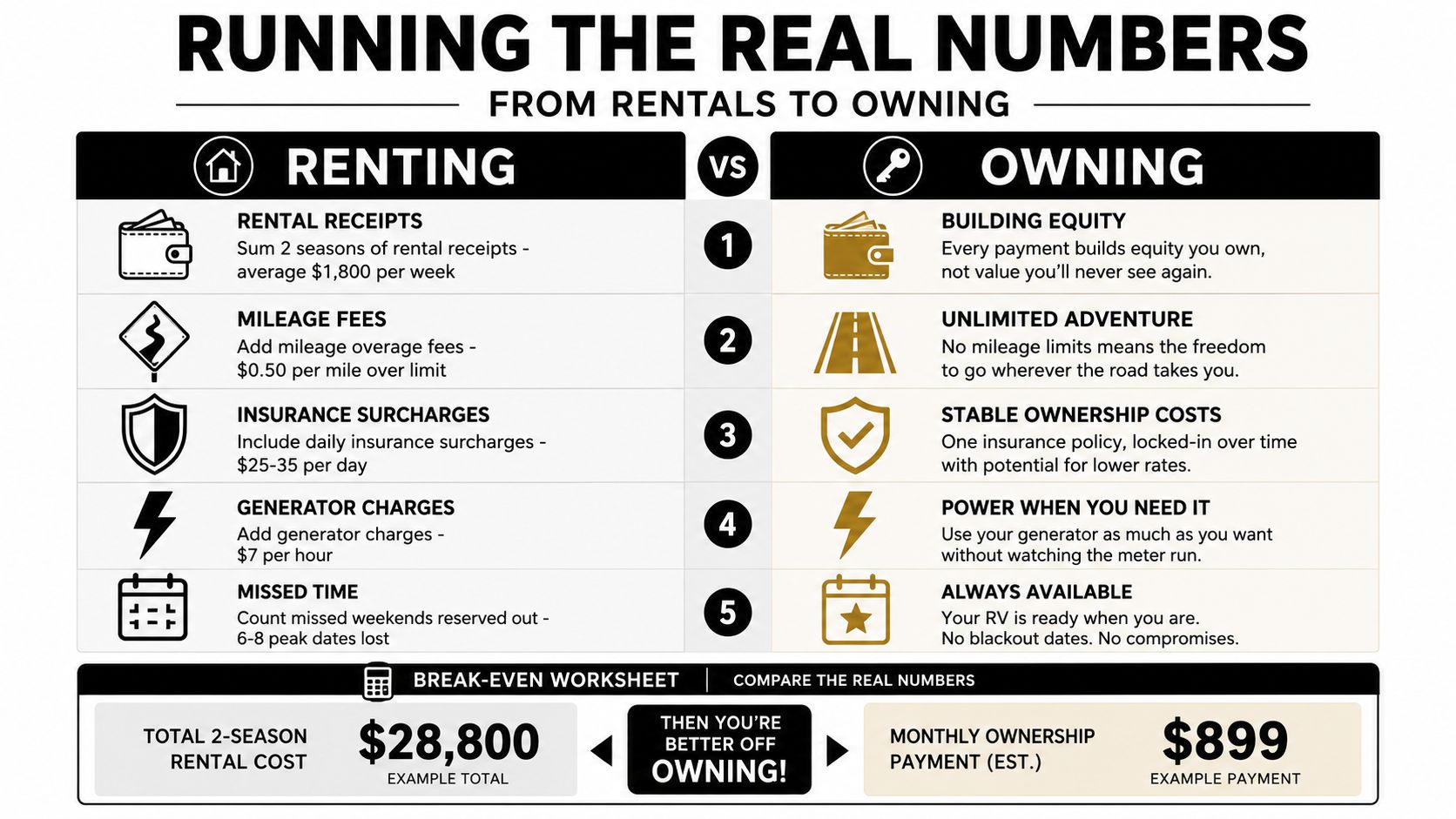
Build the worksheet in four passes
- Total the rental side. Add every booking receipt, fee, protection charge, mileage amount, and paid add-on. Use actual receipts, not memory.
- Separate ownership costs. Put loan, insurance, storage, service, winterization, propane, registration, and depreciation on separate lines.
- Model your use. Run the numbers for your likely trips, then test a busier season. Don't assume you'll travel every available weekend.
- Stress-test the decision. Remove rental income from the model unless you have a documented plan, realistic availability, and enough tolerance for cleaning, repairs, and customer coordination.
The supplied comparison example uses a $32,000 travel trailer and assumes three rental trips per summer. That scenario can reach ownership cost by the second year for a Utah family, with a fourth trip or peak-season holiday bookings moving the crossover sooner. Treat it as a planning example, not a promise. The same math can fail if the trailer sits unused or if repairs arrive during the season.
Industry cost analyses put occasional towable use as low as $4,000 to $7,000 annually when the tow vehicle is already owned, while a typical Class C used as a snowbird rig may run about $14,000 to $22,000 per year and a full-time Class A may run $25,000 to $40,000 per year, according to this RV ownership cost calculator. Those ranges show why RV type matters as much as trip count.
Practical rule: If you consistently rent more than four times a year, run an ownership worksheet before booking the next peak-season trip.
Use our RV loan calculator to test payment scenarios, then compare the result against your complete annual ownership column. A payment that looks comfortable can become expensive once storage, insurance, maintenance, and depreciation join it.
Picking the Right RV Type and Floorplan for Utah
Utah buyers usually choose between a towable and a motorhome, but the better question is how each option behaves on your routes. Travel trailers and fifth wheels work well for many state-park trips, yet they demand a properly matched tow vehicle and a driver who feels comfortable with mountain grades, crosswinds, braking, and backing.
Motorhomes simplify the driving and campsite arrival process. A Class C can be easier for a couple or small family to manage, while a larger Class A provides more living space at the cost of more demanding access, maintenance, and parking. A motorhome also means the whole campsite moves when you need groceries or want to explore a trailhead.
| RV Type | Best Party Size | Utah Strength | Watch-Out |
|---|---|---|---|
| Travel trailer | Couples to families | Broad campground flexibility and a separate tow vehicle at camp | Confirm tow ratings, payload, hitch setup, and mountain-grade confidence |
| Fifth wheel | Families and extended travelers | Residential space, stable towing, and strong storage | Requires a compatible pickup and more attention to length and site fit |
| Class B campervan | Solo travelers or couples | Easy access through towns, scenic roads, and smaller campsites | Limited interior storage and sleeping space |
| Class C motorhome | Couples or small families | Simple setup and an integrated driving-and-living arrangement | Engine service, fuel use, and the need to move the entire RV |
| Class A motorhome | Larger groups or long-haul travelers | Maximum interior room and amenities | Size can complicate narrow roads, older campgrounds, and parking |
Match the floorplan to the trip
A bunkhouse is usually the right answer for families who want children to have dedicated sleeping space. A rear-living layout makes more sense for couples who care about lounge comfort and longer stays. Toy haulers suit owners carrying powersports equipment, but measure the garage, check payload, and plan where the gear goes after unloading.
Don't ignore elevation and season. If you plan early spring or late fall trips above 7,000 feet, prioritize four-season insulation, heated tanks, and a furnace system designed for colder conditions. Storage length also matters. Older Utah campgrounds can have tight back-in sites, narrow approaches, or limited room for a long truck and trailer combination.
The right rental-to-ownership move is usually a correction, not an upgrade. If your rental was too large to maneuver, buy smaller. If it lacked beds, choose a bunkhouse. If you kept towing a car behind the motorhome, a trailer may fit your habits better.
Inspecting New and Used RVs Before You Sign
New and used RVs deserve the same disciplined inspection. New doesn't mean every seal, latch, appliance, and slide-out has been checked carefully, and used doesn't mean a cosmetic flaw is the main concern. In Utah, start with the parts exposed to sun, freezing temperatures, dust, and road vibration.
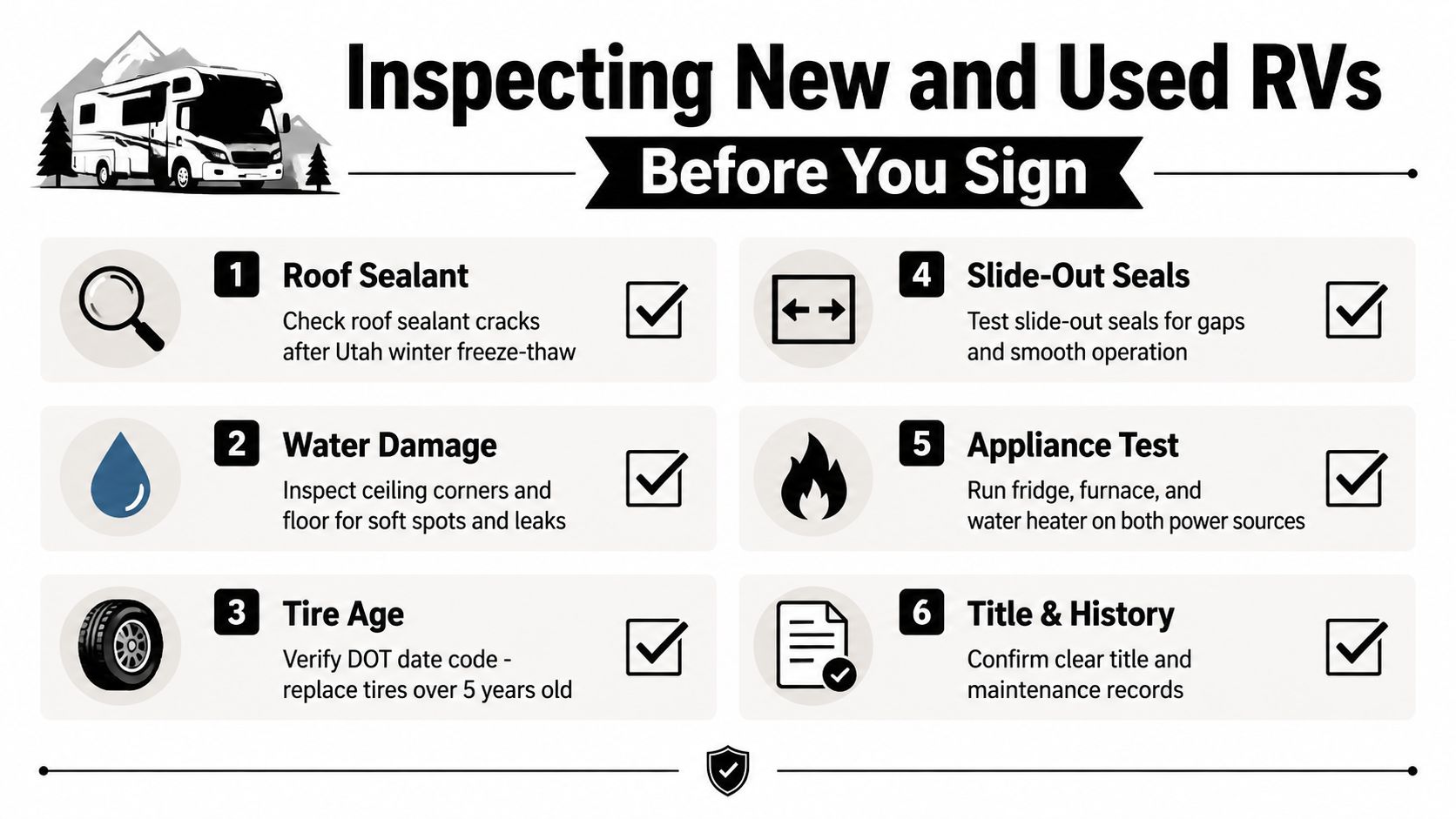
The lot checklist
- Roof sealant: Look for cracking, separation, soft areas, and poorly repaired penetrations. Freeze-thaw cycles can turn a minor seal problem into interior damage.
- Water intrusion: Inspect ceiling corners, window frames, roof vents, cabinets, and flooring. Push gently for soft spots and check for staining or musty odors.
- Tire condition: Read the DOT date code, inspect sidewalls for cracking, and ask how the RV was stored. Tires can age even when the tread looks usable.
- Slide-outs: Extend and retract every slide. Check seals, alignment, motor noise, floor movement, and water marks.
- Appliances: Run the refrigerator, furnace, water heater, air conditioner, lights, outlets, water pump, and generator where equipped. Test systems on available power sources.
- Undercarriage: Look for damaged underbelly material, exposed wiring, bent components, leaks, and evidence of rodents nesting near insulation.
- Paperwork: Verify the VIN, title status, maintenance records, manuals, recalls, and any lien information before signing.
For a new RV, ask for the complete pre-delivery inspection and put cosmetic concerns in writing before the transaction is complete. For a used unit, maintenance records matter more than a polished interior. A clean trailer with a neglected roof is a poor purchase.
Use this video as a visual supplement while you inspect, not as a substitute for testing the actual RV on the lot.
Bring a flashlight, phone camera, paper towels, and a checklist. Open every cabinet, operate every latch, look under every sink, and ask who will correct any issue and when. If the seller won't allow a careful inspection, walk away.
Financing, Trade-Ins, and Getting a Deal That Works
RV financing should fit the way you'll use the rig, not just produce an attractive monthly payment. Loan terms commonly range from five to twenty years, with unsecured loans often limited to five to seven years and secured RV loans sometimes extending to twenty years, according to ConsumerAffairs' RV loan term guide.
A longer term lowers the monthly payment but increases the total interest and can leave you owing more than the RV is worth after depreciation. For many Utah buyers, a 15-year term can be a reasonable middle ground when the payment remains comfortable and the buyer expects to keep the RV for years. It isn't automatically the right term. Compare total repayment, not just the monthly figure.
Prepare before applying
Bring identification, proof of income, insurance information, trade-in documents, the current title or payoff information, and a realistic down-payment plan. Lenders will evaluate credit history, income, the RV's age and condition, and the overall loan structure. A larger down payment can reduce the amount financed, but don't empty your emergency fund to make the deal appear affordable.
Trade-ins deserve their own negotiation. Get a market appraisal before discussing the replacement RV, clean the unit, repair obvious safety problems, gather service records, and confirm the payoff balance. If the loan payoff exceeds the trade value, that difference has to be handled in the transaction or paid separately.
Extended warranties can make sense for complicated systems, but read exclusions, deductibles, transfer rules, and repair authorization requirements. GAP coverage may be worth considering on a financed towable when the loan balance could exceed the unit's early resale value. Neither product replaces a careful inspection.
Ask one direct question: “What will this RV cost me in total if I keep the loan to maturity?”
If ownership doesn't fit, trading soon after purchase can be expensive because taxes, fees, depreciation, and loan balance work against you. Buy the right floorplan first, then protect your flexibility with a payment and term you can carry without relying on rental income.
Registration, Insurance, Storage, and Utah Winterization
Utah ownership costs begin before the first trip. Registration, title work, insurance, storage, seasonal service, and equipment all affect the first-year budget, and towables and motorhomes don't follow identical ownership routines.
Utah registration fees vary by vehicle age and weight class, and county rules can affect the final amount. A newly purchased untitled RV may also qualify for an optional 4,500-mile trip permit, depending on the transaction and vehicle circumstances. Motorhomes are titled and registered as motor vehicles, while towables follow a different process tied to the trailer. Confirm the details with the Utah DMV and your county rather than relying on a seller's estimate.
| Category | Towable RV | Motorhome |
|---|---|---|
| Registration | Trailer registration based on applicable Utah classification | Motor vehicle registration based on applicable age and weight rules |
| Insurance focus | Trailer liability, comprehensive coverage, contents, and tow-related risks | Vehicle liability, comprehensive and collision, roadside support, and personal-use coverage |
| Storage | May fit a storage lot, driveway, or covered facility if HOA rules allow | Usually needs a suitable lot or facility, especially for larger units |
| Winter care | Drain plumbing, protect tanks and lines, disconnect battery, and cover appropriately | Perform the same RV systems work, plus protect the engine, chassis, and house systems |
| Driving preparation | Hitch, weight distribution, brake controller, tires, and safety chains | Engine fluids, chassis, tires, brakes, generator, and house systems |
Insurance and storage decisions
Utah's required coverage is only the starting point. Ask an insurance professional about full protection, personal belongings, roadside assistance, seasonal use, full-time use, liability limits, and whether your policy covers the RV while stored. Buyers comparing policy structures can review ISU Insurance Services RV plans as one outside resource, then confirm that the policy fits Utah use and the actual RV.
Storage creates a separate practical problem. Some HOAs prohibit RV parking, and many driveways can't accommodate a large trailer or motorhome safely. Compare indoor, covered, and outdoor options near Salt Lake City, Provo, Ogden, and St. George, but get the current rate and access rules directly from each facility. A cheap location that makes every pre-trip inspection difficult may not be the economical choice.
Winterize before the first hard freeze
For Wasatch winters, don't wait until the forecast looks severe. A winter-storage guide recommends draining oil for storage longer than a month and disconnecting the battery to prevent drainage, while another Utah storage resource recommends a specialized RV cover or tarp for harsh weather. Follow the manufacturer's procedure for plumbing antifreeze, water heaters, filters, and appliances.
Our service checklist includes:
- Drain the water system: Empty fresh, gray, and black tanks, then follow the RV manufacturer's winterization instructions.
- Protect exposed plumbing: Inspect low points, valves, fittings, and underbelly insulation before freezing weather arrives.
- Disconnect and maintain batteries: Remove or maintain them according to the battery manufacturer's guidance.
- Seal entry points: Check vents, doors, storage compartments, and openings where rodents can enter.
- Cover carefully: Use a cover designed for RV storage and avoid trapping moisture against the roof or body.
- Inspect before storage: Look for roof sealant failures, tire cracking, leaks, and loose exterior trim.
Make the first 90 days count
Start with a preseason service appointment for a roof inspection or reseal, brake inspection, wheel-bearing service where applicable, propane-system check, battery test, and tire inspection. Take a short shake-out trip within two hours of home, such as East Canyon or Deer Creek, before committing to a long route through southern Utah. A nearby trip makes it easier to return for a warranty concern or missing part.
A proper delivery walkthrough should cover hookups, slide-outs, appliances, tanks, winterization, hitch setup, and emergency procedures. Accessory installation, orientation, repairs, plumbing, electrical work, upgrades, parts, and collision work may require different resources, so ask which work the dealership handles in-house and which work goes to a specialty provider. Motor Sportsland provides RV sales, rentals through a local partnership, financing, trade-in support, service, parts, and post-purchase assistance from Utah locations in Millcreek and Spanish Fork.
Schedule a walkthrough before your first major trip, request a trade-in estimate while your current RV is clean and documented, and ask about local owner events that can help you learn seasonal maintenance and trip preparation.
Questions Utah Buyers Ask Before They Switch
Is renting first a good idea before buying an RV?
Yes. Renting lets you test sleeping arrangements, towing comfort, storage, driving, and campground fit before you accept long-term ownership costs. Use the experience to create requirements, not just preferences.
How many trips justify buying?
There isn't one universal answer, but our practical rule is to run the numbers when you rent more than four times a year. Include insurance, storage, maintenance, winterization, depreciation, and financing instead of comparing bookings only with the loan payment.
Should I buy a travel trailer or motorhome in Utah?
Choose a travel trailer if you want a separate vehicle at camp and already have, or plan to buy, a properly rated tow vehicle. Choose a motorhome if integrated driving and living space matters more than engine maintenance, fuel use, and moving the entire rig for errands.
What should I inspect first on a used Utah RV?
Start with the roof, sealant, tires, windows, roof vents, ceiling corners, and floor. Water intrusion and aged tires can create more serious costs than ordinary cosmetic wear.
Do I need winter storage for a Utah RV?
Most owners need a winter plan, whether that means approved home storage, a covered lot, or indoor storage. Protect the plumbing, battery, roof, tires, and entry points, and follow the manufacturer's winterization instructions.
Can Motor Sportsland help after I buy?
Ask about the delivery walkthrough, service scheduling, parts, accessory installation, repairs, and seasonal preparation. The right support matters because an RV becomes easier to own when you know how its systems work and where to take it when they don't.
Motor Sportsland can help you compare new and used travel trailers, bunkhouses, fifth wheels, toy haulers, and motorhomes, then connect the purchase with financing, trade-in guidance, inspection, orientation, and service planning. Visit Motor Sportsland to browse current Utah inventory, schedule a walkthrough, and start your move from RV rentals to owning in Utah with a floorplan that fits your actual trips.
