
8 Smart Toy Hauler Bed Ideas for Utah Adventurers
More than a garage. That's the part a lot of buyers figure out after the first trip.
You spend the day out near Moab, unload the bikes or the RZR, and then everyone starts trying to claim sleeping space. Suddenly the same garage that felt huge in the morning feels tight, cluttered, and awkward at bedtime. That's where smart toy hauler bed ideas make or break the whole floorplan.
At Motor Sportsland, we've helped Utah families sort through this exact problem for decades. The best setup isn't always the fanciest one. It's the one that lets you haul what you want, sleep comfortably, and still move around camp without turning the trailer into a nightly puzzle. Toy haulers became much more mainstream once builders started blending garage cargo space with convertible sleeping setups like lift beds, sofa beds, and bunks instead of treating the rear area as a single-purpose box, as noted in RV Travel's look at a compact 2026 toy hauler layout.
That's also why a lot of bed solutions in toy haulers are modular. In one recent example, the overall layout measures 29 ft. 1 in. long, with a 24 ft. 4 in. exterior box, a 7 ft. 6 in. exterior width, and a garage clear width of about 87.5 in., which shows how tight the packaging can get in a modern rig. If you're also looking at adult-friendly compact sleeping upgrades, I'd glance at Florida Bunk Beds' adult solutions for ideas on comfort-minded space saving.
1. Murphy Bed with Storage Integration
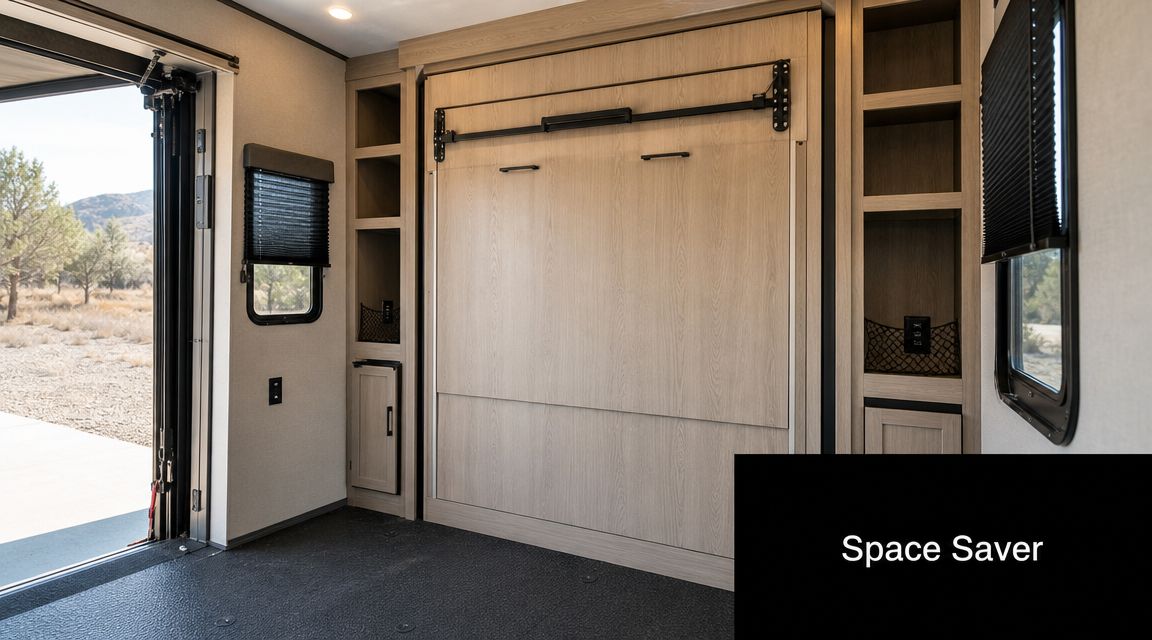
A Murphy bed works best for the owner who hates dead floor space.
If you use your toy hauler for mixed trips, one weekend hauling machines, the next weekend camping with family, a fold-up bed can be a very smart compromise. When it's stowed, you get open room for gear staging, changing clothes, pet space, or just a place to walk without banging into a bed platform.
What works in real use
The good Murphy setups don't just fold up. They give you useful storage around the bed cabinet so the wall still earns its keep during the day. We've seen owners use that space for helmets, soft bags, kids' bedding, and the random stuff that otherwise ends up on the floor.
This idea fits Utah camping well because weather changes fast. On a spring trip, your bed area may need to become a drying zone for jackets and boots by afternoon, then switch back to sleeping space at night. A fixed bed can't do that.
Practical rule: If the bed is hard to deploy, you won't use it the way you imagined on the lot.
Trade-offs to watch
Murphy beds sound simple, but the hardware matters. Cheap hinge systems get noisy, sloppy, or difficult to latch after repeated travel on rough roads. That's especially true if you're towing into washboard trailheads or bouncing through uneven campsites outside the Wasatch Front.
A few things we tell buyers to check before they commit:
- Ceiling clearance: Make sure the bed can fold cleanly without crowding lights, cabinets, or trim.
- Latch quality: A weak travel latch is a headache waiting to happen.
- Mattress thickness: Too thick, and the bed may not close properly.
- Access when deployed: Some Murphy layouts block storage or pinch the walkway more than buyers expect.
A Murphy bed is excellent for couples or smaller families who want flexibility. It's not my favorite for people who need a permanent made-up bed every night and don't want any setup at all.
2. Bunkhouse-Style Stacked Beds
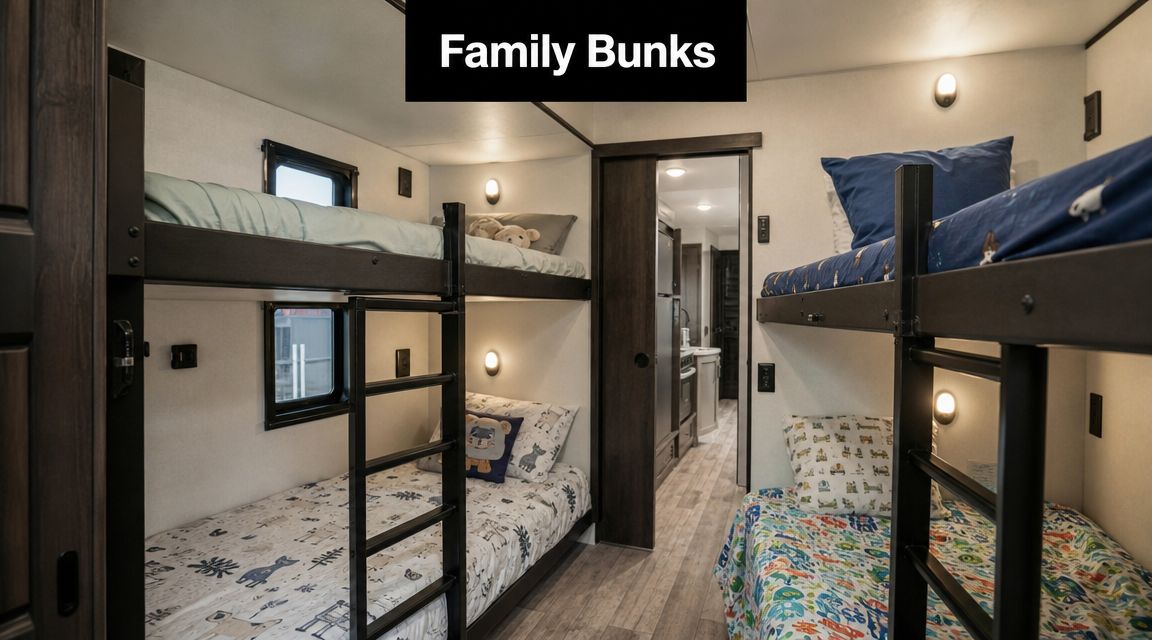
Families usually understand bunks immediately. Kids claim them in about ten seconds.
Bunkhouse-style stacked beds are still one of the easiest toy hauler bed ideas when your goal is simple sleeping capacity without eating up the main living area. The reason they've stayed relevant is practical, not trendy. The RV industry has shifted toward multi-use interiors, and buyer guidance often comes back to the balancing act between dry weight, GVWR, payload, and flexible sleeping systems, as explained in Cruiser RV's guide to maximizing RV sleeping arrangements.
Why bunks still make sense
For Utah families heading to Bear Lake, Jordanelle, or southern desert riding areas, bunks solve a common problem. Kids get a defined sleep zone, and the rest of the coach stays calmer after dark. That matters more than people think.
If you're comparing layouts that spread sleeping spots all over the trailer, also take a look at these 2 bedroom travel trailer floor plans to see how separation affects real livability.
Where bunks fall short
Bunks aren't automatically comfortable. A lot of content online focuses on building or adding bunks, but not nearly enough talks about mattress feel, headroom, ladder access, nighttime exits, or how adults sleep in them for several nights. That comfort gap is one reason some owners end up modifying the sleeping surface later.
A few practical upgrades usually help:
- Breathability under the mattress: Prevents trapped moisture and that stale smell that can build up in shoulder seasons.
- Reading lights and small organizers: Gives each bunk a little personal space.
- Blackout treatments: Useful when Utah sunrise hits early and bright.
- Better mattress support: If the factory bunk feels too firm or too thin, comfort drops fast.
For replacement sleep surfaces, Golden Dreams' bunk board mattress discussion is worth a look.
Bunks are excellent for families. They're less ideal when your main travelers are adults who want room to sit up, stretch out, and move easily.
3. Convertible Dinette Bed System
A dinette bed is the classic backup sleeper. Sometimes that's exactly what you need.
I like this setup most in smaller toy haulers where every zone has to do double duty. During the day, you get a place to eat, work, or play cards. At night, it turns into an extra berth for a kid, a teen, or an occasional guest.
Best use case for a dinette bed
This layout shines when you don't need the extra bed every night. Grandkids on one trip. A buddy on a hunting weekend. A rainy-day nap spot. That's where a convertible dinette earns its place.
It also helps keep the main garage free for its original job. If you're hauling a side-by-side or bikes and don't want to count on the rear cargo area for every sleeper, the dinette gives you one more option without changing the whole floorplan.
What owners usually get wrong
The weak point is the sleeping surface. Most dinette beds are built from cushions and a lowered table base, and that can create seams, dips, or a hard center gap. Adults feel that quickly.
Most dinette beds are acceptable. Very few are comfortable without some sort of topper or cushion fix.
A few things help a lot:
- Dedicated bedding bin: Keep sheets and blankets close so setup stays quick.
- Thin topper: Smooths the cushion joints and improves sleep.
- Non-slip layer under cushions: Keeps the bed from shifting during the night.
- Test the conversion in person: Some table systems are much easier than others.
If you're exploring similar compact sleep setups, space-saving sofa bed solutions can spark ideas about cushion support and quick conversions.
A dinette bed is practical, not luxurious. That's fine. It doesn't need to be your favorite bed in the trailer. It just needs to be easy, dependable, and good enough for the trips you take.
4. Slide-Out Bed Platform with Cargo Access
This one appeals to buyers who want clever engineering, and sometimes it's the right call.
A slide-out bed platform can preserve access to the cargo area better than a fixed sleeping setup, especially when the trailer has to keep working as a garage first. In principle, it's a strong idea. You don't permanently give up the bay, and you can still create a sleeping area without turning the whole rear space into a full-time bedroom.
Why this layout earns attention
The biggest benefit is separation of functions. If your day revolves around loading, unloading, securing gear, and then switching to camp mode later, a bed platform that moves independently can reduce a lot of hassle.
For owners trying to understand how these systems interact with the coach body, seals, and moving wall structures, our overview of camper slide-out basics gives useful context.
Before buying a floorplan with a moving bed platform, watch one in action:
The honest downside
Moving parts always demand more attention. Tracks collect grit. Motors can fail. Manual overrides matter. In Utah, dust from desert riding and road grime from shoulder-season travel can make any sliding mechanism less happy if maintenance gets skipped.
Here's where I'd be cautious:
- Debris in the tracks: Sand and grit can make operation rough.
- Manual access: You want to know how to move it if power fails.
- Clearance planning: Bedding, bags, or loose cargo can interfere with travel.
- Cold-weather use: Systems under stress tend to show weakness when temperatures drop.
This layout can work really well for owners who appreciate mechanical systems and will maintain them. If you want dead-simple camp setup with fewer things to inspect, fixed or lift-style beds are usually easier to live with.
5. Under-Cargo Sleeping Pods Gooseneck Mounted
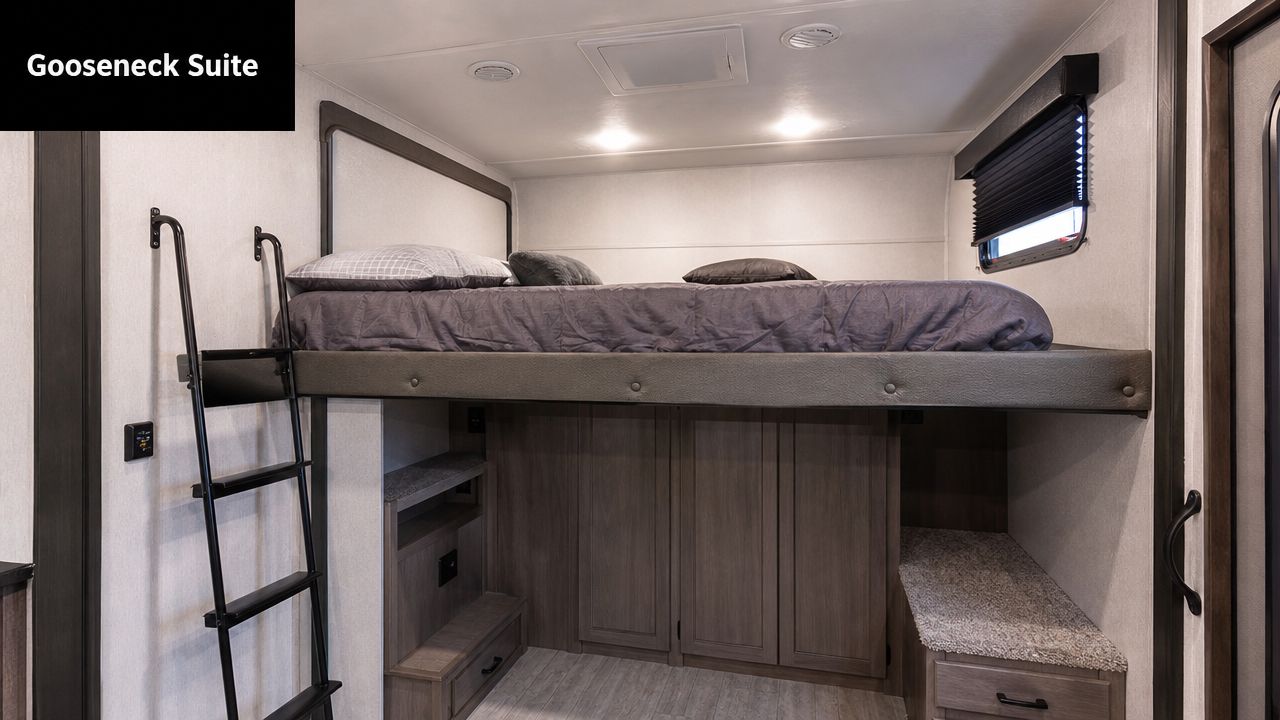
If you're shopping larger fifth wheel toy haulers, the gooseneck sleeping area is one of the best uses of space in the whole rig.
It gives you a dedicated bedroom away from the rear garage, which means you don't have to rebuild your sleep setup every night. For couples, that privacy matters. For families, it keeps parents from waiting until every rear sleeper is settled before they can turn in.
Why elevated bedroom space works
This is one of those layouts that feels more livable on longer trips. You keep the cargo bay available for toys, changing space, pet beds, or extra seating, while your main bed stays made and ready.
For Utah use, that separation is especially nice on cold mornings. One person can stay in bed while the rest of the group moves around the coach, starts coffee, or gets riding gear sorted.
A few things to test in person
The challenge isn't the idea. It's the access and ventilation.
Some raised bed areas are easy to climb into and have decent airflow. Others feel cramped, hot, or awkward to enter in the dark. Our team always tells buyers to physically climb in, sit up, turn around, and simulate a nighttime exit before deciding.
If you can't get in and out comfortably at the dealership, it won't get better at camp.
Check these details carefully:
- Headroom at the pillow end: Important for reading, dressing, and not feeling boxed in.
- Ladder or step design: Especially important for older travelers.
- Window placement and airflow: Helps with condensation and comfort.
- Night path to the bathroom: Tight turns matter more at 2 a.m. than at noon.
This is one of my favorite layouts for couples who still want a real garage, because it keeps the sleeping zone consistent without sacrificing the rear utility of the toy hauler.
6. Expandable Pop-Up or Tunnel Tent Bed System
This idea can be a win, but only for the right kind of camper.
Expandable tent-style sleeping systems create extra sleeping space without taking over the interior. If your family camps mainly in fair weather and wants more room without jumping into a much larger trailer, that's the appeal. You can keep the cargo area usable and still add sleeping capacity when you're parked.
Where it fits best in Utah
For summer trips around Bear Lake or mild-weather weekends, these systems can feel roomy and fun. Kids often love them. They also keep the main trailer less crowded, which helps when everyone's coming and going all day.
If you're looking specifically at hybrids in this category, our post on pop-up toy haulers is a helpful starting point.
Where it doesn't fit well
This is not my first recommendation for shoulder-season Utah camping. Wind, sudden storms, cold overnight temps, and condensation can turn a clever sleeping solution into the least popular bed in camp.
A few habits make them work better:
- Practice setup at home: Don't make the campsite your first attempt.
- Dry it fully before storage: Moisture causes problems fast.
- Use ground protection if applicable: Protects fabric and hardware.
- Watch weather closely: These systems are much better in stable conditions.
For fair-weather families, this can be a smart way to add room. For late-fall desert trips, mountain weather, or people who want the quietest and warmest sleep, a hard-sided bed area is usually the better bet.
7. Dual Queen Bedroom Suite Configuration
This is the comfort-first option. It's also the one that demands the most honesty about space use.
A dual queen setup can make a toy hauler feel much more residential, especially for larger families or groups who need true adult-sized sleeping surfaces. In bigger rigs, it can be a strong answer for owners who spend several nights at a time in one place rather than moving camp every day.
Comfort is real, but so is the compromise
Large beds improve sleep. No question. But they also consume interior volume that has to come from somewhere else. In current retail inventory, king-bed toy hauler layouts are already common enough to be considered a mainstream premium configuration. One listed toy hauler travel trailer pairs a king bed with a 31-foot length, 7,778 lbs dry weight, 1 slide, and sleeping capacity for 4, while also offering dual or triple A/C options, according to Funtown RV's king-bed toy hauler listings.
That's a useful reminder for dual queen thinking too. Bigger beds usually mean bigger trade-offs in weight, walking room, storage, or garage flexibility.
Who should consider it
This layout makes sense if your trips look like this:
- Longer stays: You value bedroom comfort more than rapid daily reconfiguration.
- Adult travelers: Full-size sleep surfaces matter more than squeezing in extra cargo.
- Destination camping: You set up once and stay put.
- Family privacy needs: Separate real beds reduce nightly shuffle.
The downside is simple. More bed can mean less open floor and less flexibility. If hauling space is the top priority, a dual queen concept often gives up too much of what makes a toy hauler useful in the first place.
8. Modular or Removable Bed Frame System
For owners who want one trailer to do several jobs well, modular bed systems are hard to beat.
This is one of the smartest toy hauler bed ideas for Utah riders and families because trip styles change so much. One weekend you're hauling machines into the mountains. The next weekend you're taking the family south and need more sleeping spots than cargo room. A removable or reconfigurable frame lets the same trailer adapt instead of forcing the same layout onto every trip.
Why modular setups match real ownership
Across RV and marine applications, electric bed lift systems stand out as one of the most versatile ways to convert cargo space into sleeping space without permanently giving up garage utility. Product guidance also points to lift-supported bed-and-sofa combinations as a common way to maximize dual-use toy hauler floorplans, as outlined in Dune Sport's overview of toy hauler bed options.
That same logic applies to modular systems in general. Flexibility matters most when you reconfigure the rig often.
Motor Sportsland also highlights toy hauler layouts that use a HappiJac bed with flip-down sofas, and our team likes those setups because they can switch from cargo mode to camp mode without a major rebuild.
What makes modular systems successful
The owners who love modular beds stay organized. The owners who get frustrated usually don't.
A good system needs labeled parts, secure attachment points, and a repeatable process. If assembling the sleep setup feels like unpacking a hardware store every evening, it stops being convenient.
- Store components in one dedicated place: Don't scatter brackets and supports around the trailer.
- Photograph the setup order: Saves time later.
- Inspect every mounting point: Loose hardware ruins confidence fast.
- Practice before the trip: First setup should happen at home, not after dark.
This is one of the best answers for owners who want true adaptability. It's less ideal for travelers who want a fixed bedroom and zero setup every night.
8-Option Toy Hauler Bed Comparison
| Sleeping Solution | 🔄 Implementation Complexity | ⚡ Resource Requirements | 📊 Expected Outcomes | 💡 Ideal Use Cases | ⭐ Key Advantages |
|---|---|---|---|---|---|
| Murphy Bed with Storage Integration | Moderate–High: professional install, hydraulic setup | Moderate: cabinetry, hinges, higher upfront cost ($2k–$5k+) | High space recovery; comfortable dedicated bed; limited headroom | Multi-use toy haulers needing cargo + comfortable occasional bed | Space-efficient; integrated storage; modern look |
| Bunkhouse-Style Stacked Beds | Low–Moderate: fixed framing, simple safety features | Low: basic materials, ladders, rails; affordable | High sleeping capacity in small footprint; can feel cramped | Families and rental units prioritizing maximum sleepers | Maximizes sleepers; cost-effective |
| Convertible Dinette Bed System | Low: simple mechanisms, manual conversion | Low: table/bench hardware; minimal cost | Moderate flexibility; quick conversion; lower comfort for long-term use | Budget buyers and compact trailers needing dual-purpose space | Dual-purpose use; under-seat storage |
| Slide-Out Bed Platform with Cargo Access | High: motorized/glide systems, complex install | High: motors/tracks, safety locks, professional service ($3k–$8k+) | High functionality: independent cargo access; mechanical risk exists | Serious powersports users who need frequent gear access | Independent cargo/sleep access; very convenient |
| Under-Cargo Sleeping Pods (Gooseneck Mounted) | Moderate–High: structural integration, access provisions | Moderate: enclosure, ventilation, added weight/cost ($2k–$6k+) | High privacy and separation; preserves main floor for cargo | Couples/retirees wanting a private master suite separate from cargo | Private suite feel; better ventilation; quieter |
| Expandable Pop-Up / Tunnel Tent Bed System | Low–Moderate: pop-up or add-on install; setup at site | Moderate: tent materials, frames, storage space ($1.5k–$4k) | Moderate capacity expansion without interior loss; weather-dependent | Outdoor enthusiasts who want extra sleeping and outdoor living | Adds sleeping without altering interior; relatively affordable |
| Dual Queen Bedroom Suite Configuration | High: large dedicated build, extensive floorplan changes | Very High: larger RV size, premium components, high purchase price ($50k+) | Very high comfort and amenities; reduced cargo capacity | Retirees and long-term travelers seeking luxury and privacy | Luxury accommodations; privacy; strong resale value |
| Modular / Removable Bed Frame System | Moderate: engineered mounting points, user assembly | Moderate: modular components and storage; upfront engineering cost | High adaptability: switch between cargo and sleeping modes | Adventurous users and rental operations needing flexible layouts | Ultimate flexibility; configurable for trip needs |
Your Perfect Toy Hauler Layout Awaits at Motor Sportsland
The right bed layout changes how a toy hauler feels in daily use. It's the difference between a garage that happens to have a mattress somewhere and a trailer that works effectively for sleeping, hauling, and relaxing after a long day outside. That matters even more in Utah, where one trip might mean hot desert dust, the next might mean chilly nights, mountain grades, and tight camp setups.
If you strip away the marketing language, most toy hauler bed ideas come down to one question. Do you want permanent comfort, or flexible space? Murphy beds, dinette beds, and modular systems lean toward flexibility. Bunks, gooseneck bedrooms, and larger dedicated suites lean toward comfort and separation.
Neither approach is automatically better. The right answer depends on what you haul, who sleeps in the trailer, how often you reconfigure camp, and whether your trips are quick weekend runs or longer stays. A family heading to Bear Lake has different needs than a couple hauling a RZR into central Utah, and both have different priorities than buyers using the trailer for mixed recreation and guest space.
At Motor Sportsland, we tell customers to focus on real nightly use. Can you get into bed without climbing over someone? Can the rear garage still do its job? Can you reach storage when the beds are down? Will the setup still feel manageable after a long day on the trail, in the wind, or in the cold? Those are the questions that save people from buying the wrong floorplan.
If you're still narrowing it down, seeing these layouts in person helps a lot. Bed height, headroom, ladder angle, walkway clearance, and garage usability are hard to judge from photos alone. Our team can walk you through how different toy hauler bed ideas function, including electric lift systems, HappiJac-style setups with flip-down sofas, and family-oriented floorplans that balance sleep space with cargo capacity.
Motor Sportsland has served Utah RV shoppers for over 55 years, with locations in Millcreek and Spanish Fork, and we help customers compare new and used toy haulers, service existing rigs, and sort through floorplan trade-offs before they buy. If you want a toy hauler that works for the way you camp, haul, and travel around Utah, that hands-on walkthrough matters.
If you're ready to compare toy hauler layouts in person, browse the current selection at Motor Sportsland, or stop by one of our Utah locations to talk through floorplans, bed systems, trade-ins, financing, or service needs with our team.
