
Anti Sway Hitch Guide for Utah RV Owners
A lot of Utah RV owners know the feeling. You're headed up the freeway with the family packed in, the trailer looks fine in the mirrors, then a gust rolls through near Parley's Canyon or a semi blows by on I-15 and suddenly the trailer gives a quick shove. The steering gets light. Your hands tighten on the wheel. For a few seconds, towing stops feeling fun and starts feeling like work.
That's usually the moment people start asking about an anti sway hitch.
The tricky part is that hitch talk gets muddy fast. Some people use “sway bar,” “weight distribution hitch,” and “anti sway hitch” like they all mean the same thing. They don't. And in Utah, where crosswinds, steep grades, and fast-changing weather are part of the trip, the right setup matters more than most first-time buyers expect.
We've had these counter conversations for years with folks getting ready for Bear Lake, Jordanelle, or a longer haul out past the Wasatch. The goal is simple. Help you understand what sway is, what an anti sway hitch does, and how to choose a setup that keeps towing calm instead of white-knuckle. While you're getting your rig dialed in, it also helps to sort the small stuff before a trip. A practical checklist of must-have items for your road trip can save you from the usual last-minute scramble.
Introduction Your Guide to Smoother Safer Towing
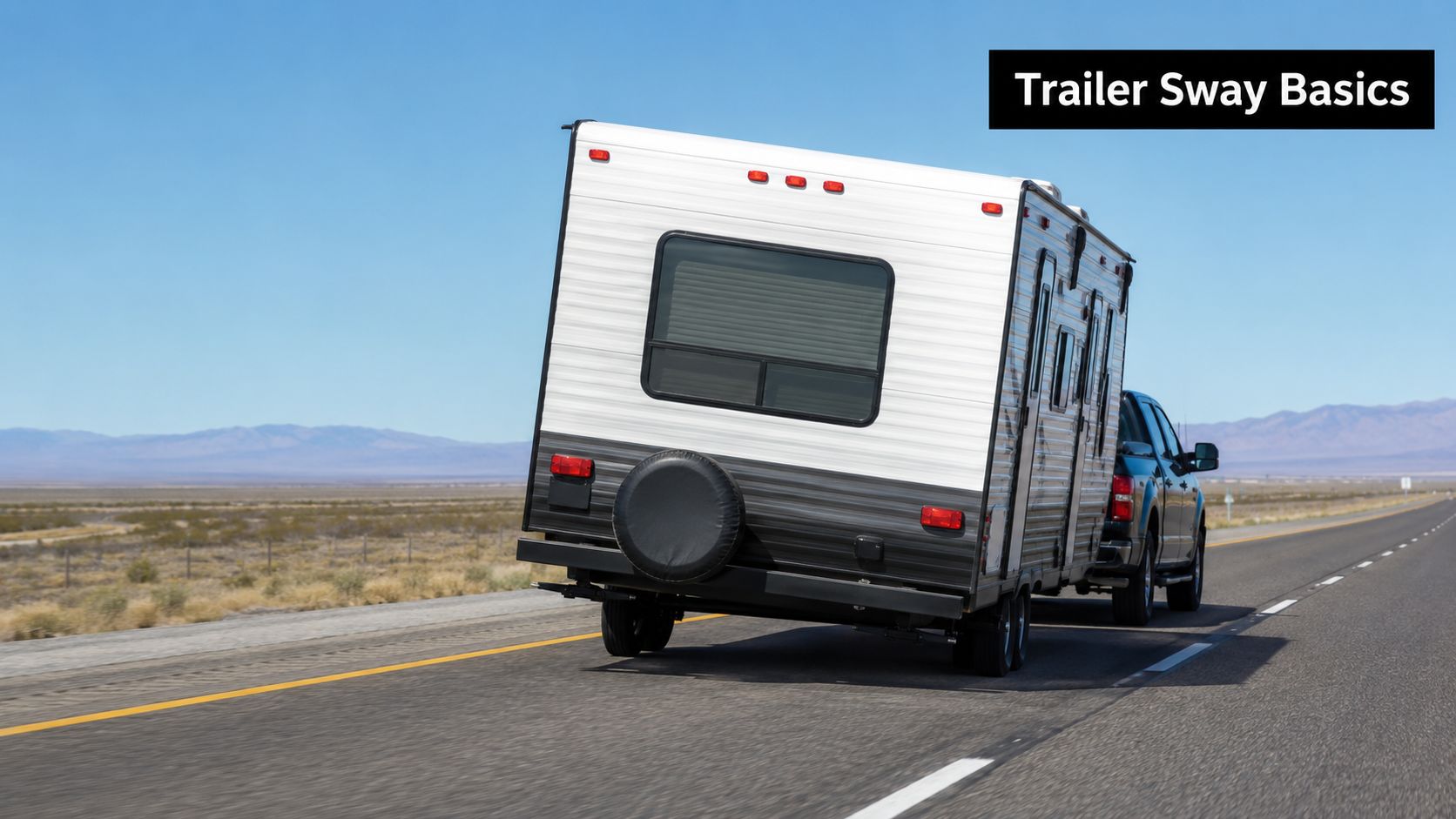
Trailer sway is the side-to-side motion of the trailer behind the tow vehicle. Think of a shopping cart with one wobbly wheel. At low speed it might only shimmy a little. Add speed or a bump, and that little wiggle can build into a hard pull that wants to steer the whole cart. A trailer can behave the same way.
On the road, sway usually starts with an outside force. A crosswind pushes the broad side of the trailer. A passing truck creates air pressure. A sudden steering correction shifts the trailer's path. Once that trailer starts moving side to side, the hitch becomes the pivot point, and the trailer can begin acting like a pendulum.
Why Utah roads make sway feel worse
Utah gives you a little of everything. Open interstate wind, canyon gusts, rough patches, and long grades where drivers make more steering and braking inputs than they realize. A trailer that felt acceptable on a flat back road can feel unsettled in the mountains.
The physics don't care whether you're a new tower or a seasoned one. Sway is not just “bad driving.” It's a stability issue caused by load balance, speed, wind, tire behavior, and hitch setup working together.
Practical rule: If your trailer ever feels like it's steering the tow vehicle instead of calmly following it, treat that as a setup problem, not just a stressful moment.
The role of tongue weight
One of the biggest pieces of the puzzle is tongue weight. Industry guidance for towing stability puts tongue weight at 10% to 15% of total trailer weight, with a strict minimum of over 10% to prevent sway characteristics from increasing, as explained in this essential utility trailer towing guide and supported by towing guidance from manufacturers and hitch makers. If the trailer is too light at the tongue, it gets tail-happy. That's when the pendulum effect really shows up.
You can dig deeper into that relationship in our guide to RV sway control. The short version is simple. A properly loaded trailer tracks straighter, responds better, and gives the anti sway hitch a fair chance to do its job.
What sway feels like before it gets serious
A lot of owners expect dramatic fishtailing as the warning sign. Usually it starts smaller:
- A light nudge in the steering wheel after wind hits the trailer
- A wiggle in the mirror where the trailer doesn't settle right away
- A push-pull sensation when a larger vehicle passes
- Extra correction from the driver to keep the rig centered in the lane
That's the moment to fix the cause. Waiting until sway becomes violent is like waiting for a roof leak to turn into ceiling damage.
Comparing Anti Sway Hitch Systems
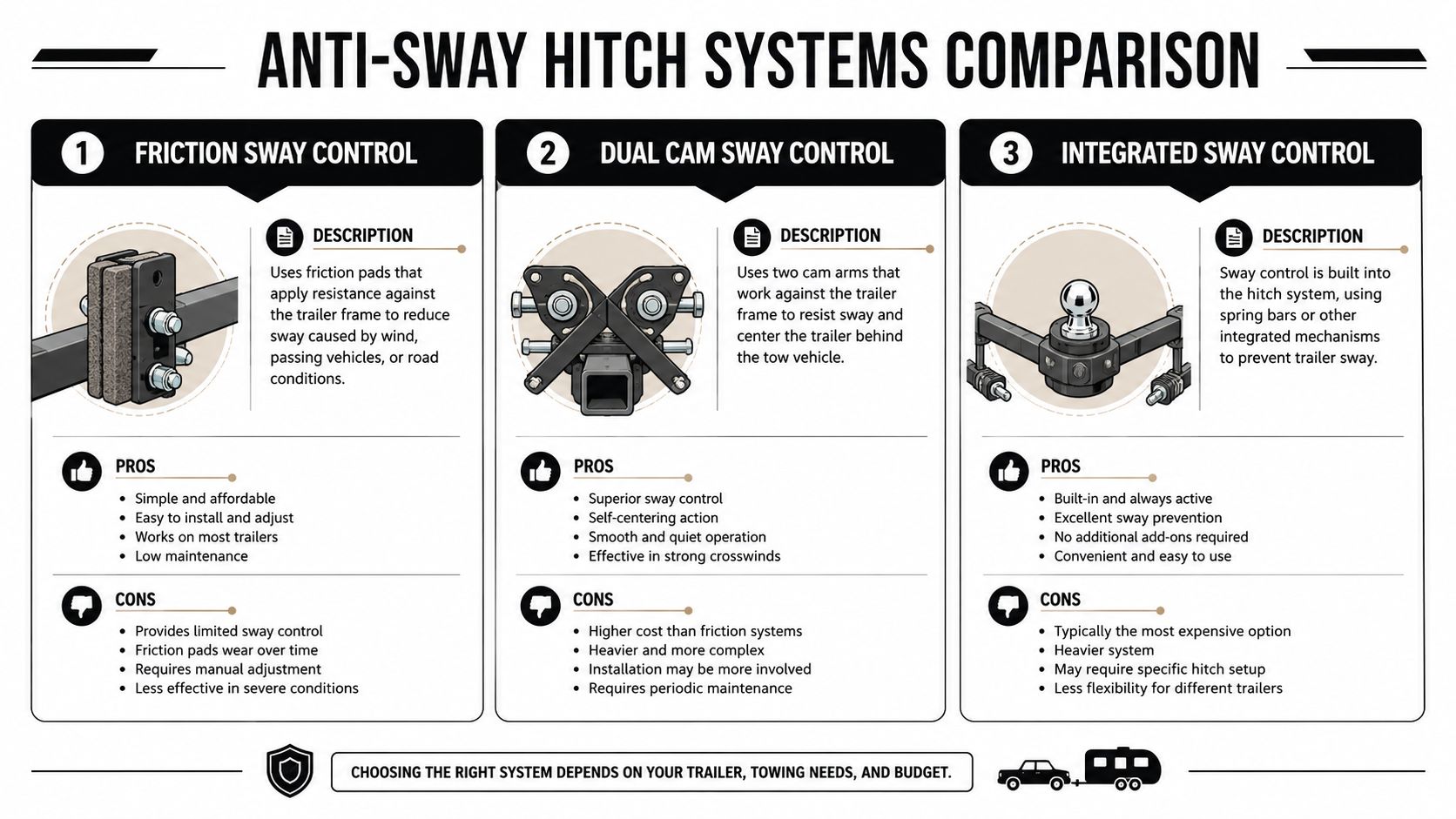
There isn't one single anti sway hitch design. There are a few main approaches, and buyers get confused because manufacturers package them differently. Some systems add sway control to an existing hitch. Others build sway control into the hitch itself. A few use a completely different geometry to stop sway before it starts building.
Anti-Sway Hitch Comparison
| Hitch Type | How It Works | Best For | Approx. Cost |
|---|---|---|---|
| Friction sway control bar | Uses friction to resist side-to-side trailer motion | Lighter trailers and occasional towing | Budget-friendly entry option |
| Integrated weight distribution hitch with sway control | Distributes load and resists sway in one system | Travel trailers, regular highway towing, mountain routes | Mid-range to premium |
| Dual-cam style sway control | Uses mechanical centering action to help keep trailer aligned | Larger trailers needing stronger active centering | Mid-range to premium |
| Pivot point projection anti sway hitch | Moves the trailer's virtual pivot point closer to the tow vehicle's rear axle | Heavier trailers and drivers wanting top-tier sway prevention | Premium |
Add-on versus integrated is where many people get lost
Many buyers don't realize the important distinction between integrated and add-on sway control. Some older chain-style weight distribution hitches need a separate friction plate add-on for sway, while modern designs like the Equal-i-zer build sway control into the hitch itself, as discussed in this owner discussion on integrated and add-on sway control.
That matters because a weight distribution hitch and sway control do different jobs. Weight distribution handles the up-and-down load transfer. Sway control handles the side-to-side motion. One doesn't automatically replace the other.
If you're comparing hitch styles, our team's breakdown of the E2 weight distribution hitch is a good example of how integrated systems are packaged and adjusted.
Friction sway control bars
This is the old familiar setup many people picture first. A friction bar adds resistance between the trailer and the tow vehicle. When the trailer tries to swing, the bar resists that motion.
These setups can help, especially on lighter trailers or for owners who tow shorter distances and want a simpler system. But they are still a resistance-based solution. They don't change the geometry of the rig. They try to slow the sway once it begins.
Pros
- Simple design that many owners understand quickly
- Lower buy-in cost than more advanced systems
- Useful upgrade path for some basic towing setups
Cons
- Less confidence in stronger wind or demanding mountain conditions
- Separate components can add setup complexity
- Performance depends heavily on correct loading and proper adjustment
Integrated weight distribution hitches with sway control
Many RV owners ultimately find their solution in integrated sway control hitches. These hitches combine weight distribution with built-in sway control. Systems like Equal-i-zer's 4-Point Integrated Sway Control® and CURT TruTrack are designed to level the tow vehicle and trailer while also resisting lateral movement.
That all-in-one approach is easier for many owners to live with. You're not bolting on a separate answer to a problem that probably should've been addressed in the main hitch setup from the start.
A weight distribution hitch shifts load from the rear axle to the front axle and trailer axles. Sway control manages horizontal instability. The safest setups often use both functions together in one system.
Dual-cam systems
Dual-cam systems are a step up in how they try to keep the trailer centered. Instead of only adding friction, they mechanically encourage the trailer to return to alignment. They can work very well on larger trailers when set up correctly, but they demand careful installation and adjustment.
They're a little less forgiving of sloppy setup. That's not a flaw. It just means they reward precision.
Pivot point projection hitches
This is the premium end of the conversation. Hitches using Pivot Point Projection™ technology, such as the ProPride 3P®, work differently from friction-based designs. They relocate the trailer's virtual pivot point forward toward the tow vehicle's rear axle, which changes the geometry of the combination and addresses sway by projection rather than just friction, as described by ProPride in its discussion of Pivot Point Projection technology.
In plain English, a friction system tries to rub sway down once it starts. A pivot point projection hitch changes where the trailer behaves as if it pivots. That's why many drivers describe these systems as feeling closer to a fifth-wheel style of stability.
Which system fits which driver
A quick counter-style way to visualize it:
- Weekend local towing and a smaller trailer often points people toward a simpler friction-based solution.
- Regular travel trailer use on interstates and mountain routes usually makes an integrated system the smart middle ground.
- Heavier trailers or drivers who hate sway with a passion often appreciate the confidence of a premium projection-style anti sway hitch.
The right answer depends on the trailer, the tow vehicle, where you drive, and how much margin you want when the weather turns ugly near the Wasatch.
Signs You Definitely Need an Anti Sway Hitch
Some towing upgrades are nice to have. An anti sway hitch often isn't in that category.
If your rig already feels calm on every highway, stays planted in gusty weather, and never asks for steering correction, that's great. But many begin looking for sway control because the trailer has already told them something.
Clear warning signs from the driver's seat
You should take a hard look at sway control if any of these sound familiar:
- The trailer wags in the mirror after a gust or lane change
- Passing trucks move your rig around more than you expected
- Braking feels unsettled because the trailer seems to push the tow vehicle
- Your steering feels light or you notice rear-end squat
- You dread windy days because towing becomes tense instead of routine
Those aren't personality quirks of your trailer. They're clues that your setup needs help.
The manufacturer line that matters
A key benchmark comes from vehicle manufacturers. The Chevy Traverse manual states that for any trailer over 5,000 lbs, both a weight distribution system and a separate sway control device are required, as summarized in this towing guidance from etrailer's weight distribution reference.
That matters for two reasons. First, it gives owners a real threshold instead of guesswork. Second, it shows that anti-sway equipment is often a safety requirement, not just a comfort add-on.
A quick self-check
Ask yourself these questions:
- Do you tow in crosswinds often? If you drive through open valley wind or canyon gusts, your setup needs more stability margin.
- Does your trailer feel busy behind the vehicle? A calm trailer should track. It shouldn't keep asking for correction.
- Are you near or above the heavier end of your vehicle's towing use? That's where small setup flaws become very noticeable.
- Do you already have a weight distribution hitch but still feel movement? You may have weight distribution without meaningful sway control.
If towing feels tiring after a short drive, the setup is usually talking to you.
For many Utah owners, the answer becomes obvious after one windy trip eastbound or one downhill run where the trailer starts nudging the vehicle. That's the point where an anti sway hitch stops being a maybe.
Sizing and Matching a Hitch to Your RV
Choosing an anti sway hitch isn't about grabbing the biggest one on the shelf. It's about matching the hitch to the trailer's loaded behavior and the tow vehicle's capabilities. Close enough doesn't cut it with towing gear.
Start with the trailer as it's actually used
The first mistake people make is sizing off an empty brochure number and forgetting water, batteries, propane, gear, food, and the random heavy stuff that always ends up in pass-through storage.
What matters is the trailer in travel trim. That's the condition the hitch has to control on I-80, not the version sitting empty on a dealer lot.
A helpful starting point is understanding hitch weight itself. Our guide on what hitch weight means breaks down why that number affects both handling and hitch selection.
Tongue weight is the make-or-break measurement
The 10% to 15% tongue weight rule is one of the most important numbers in towing. B and W explains that tongue weight should stay between 10% and 15% of total trailer weight, and it must stay over 10% because below that point the spring bars on a weight distribution hitch can't apply enough force to keep the rig level and stable. That's the key point in their explanation of the critical tongue weight range for sway prevention.
That's why some trailers sway even when owners think they bought a “good hitch.” The hitch can't rescue a badly balanced load.
A simple matching process
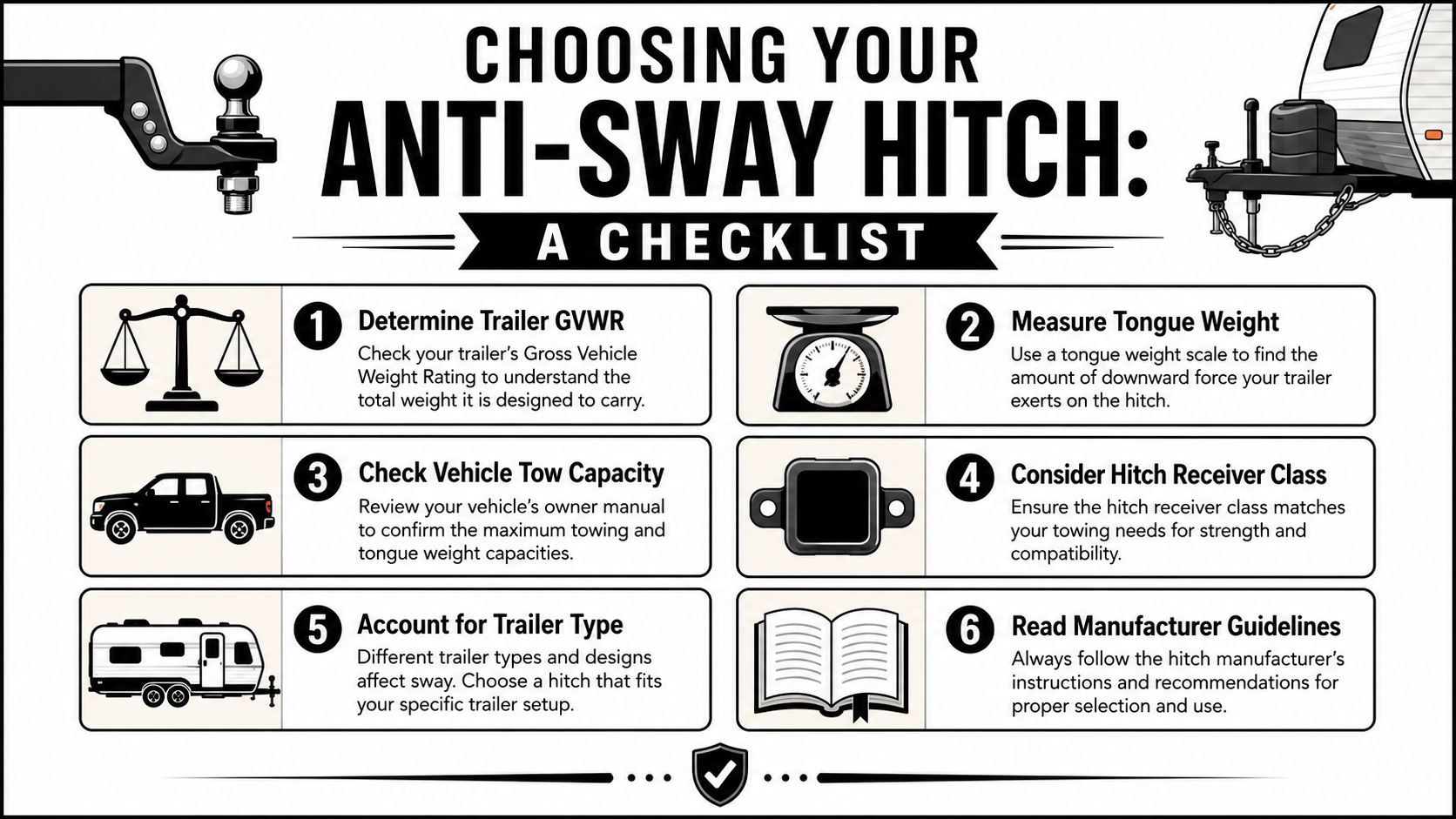
Use this checklist when you're sizing an anti sway hitch:
- Find the loaded trailer weight from a scale ticket or a realistic loaded estimate
- Measure actual tongue weight instead of guessing
- Check the tow vehicle's ratings for towing and tongue weight
- Match the hitch rating to the actual numbers so the spring bars and sway system are working in their intended range
- Read the trailer and vehicle manuals for any specific hitch requirements
What proper matching looks like in real life
Say you've got a family travel trailer loaded for a weekend at Bear Lake. Food is in the pantry, propane is full, bikes are packed, and the front storage compartment now carries more than it did on delivery day. If the tongue weight ends up too low because too much cargo moved rearward, the trailer gets loose. If the hitch is undersized or adjusted incorrectly, the tow vehicle sags and steering confidence drops.
A properly matched system feels different right away. The trailer sits more level. The tow vehicle settles correctly on its axles. Lane changes feel controlled instead of delayed. Wind still exists, but it doesn't get the same reaction from the rig.
Don't forget tires and the whole setup
Tire sidewall stiffness and tire condition also affect sway characteristics. That's easy to overlook because owners often focus only on the hitch hardware. But if the tires are underinflated or worn, even a solid anti sway hitch won't perform the way it should.
So the sizing conversation isn't just hitch head, bars, and brackets. It's the entire towing system working as one.
Professional Installation and DIY Maintenance
A good anti sway hitch can perform badly if it's installed carelessly. That's why setup matters just as much as product choice. Most towing complaints we hear trace back to one of three things. The wrong hitch rating, poor adjustment, or hardware that wasn't tightened and aligned correctly.
Why installation is not a casual bolt-on job
Precision is non-negotiable on integrated systems. For an Equal-i-zer setup, the main 3/4-inch shank bolts must be torqued to exactly 320 foot-pounds, as shown in this Equal-i-zer installation video reference. That level of torque isn't something most owners can reach accurately with a basic garage wrench.
The same installation guidance also shows hitch ball height being set carefully, often about one inch above the trailer coupler height so the geometry and tension start in the right place. Small setup errors there can ripple through the whole towing feel.
What a professional install usually catches
A proper service-bay installation typically includes more than bolting parts on:
- Ride-height check so the rig sits level under load
- Spring-bar tension adjustment so weight transfer is working correctly
- Bracket placement verification so the bars and sway points move as intended
- Torque confirmation on all critical fasteners
- Clearance check for turns, jackknife angles, and trailer-frame fitment
That's why many owners who struggled with towing say the rig felt different after a professional adjustment, even though they already owned the same hitch.
A hitch can be the right model and still be the wrong setup.
DIY maintenance that actually matters
If you're the kind of owner who likes to inspect your own rig before every trip, that's a good habit. You don't need to redo the full installation each time. You just need to catch wear and looseness before the road does it for you.
A smart pre-trip routine includes:
- Inspect the friction surfaces or sway points for abnormal wear
- Check all visible hardware for loosening or movement
- Look at the spring bars and brackets for bending, cracking, or fresh metal marks
- Confirm tire pressure and tread condition on both vehicle and trailer
- Listen during low-speed turns for changes that suggest something has shifted out of adjustment
Here's a useful walk-through if you want to see hitch setup and towing hardware in action:
When DIY is fine and when it isn't
Basic inspection and routine care are well within reach for most RV owners. Full initial setup is where people get into trouble, especially with integrated systems or larger trailers. If you're missing the right torque tools, don't feel bad about handing that job to a service department.
That's not about making things fancy. It's about making sure the anti sway hitch works on the first windy downhill instead of surprising you there.
Conclusion Tow with Confidence on Your Next Utah Adventure
A good anti sway hitch changes towing from reactive to controlled. The trailer still has weight. Wind still shows up. Mountain grades still demand attention. But the rig stops feeling loose and starts feeling planted.
The biggest takeaways are straightforward. Sway is a real mechanical problem, not just nerves. Different hitch systems solve it in different ways. Proper tongue weight, correct sizing, and careful installation matter as much as the brand name stamped on the hardware. That's especially true on Utah roads where crosswinds and grades can expose weak setups fast.
Before your next trip, it's smart to think beyond the hitch too. If cold-weather camping or storage is on your list, these complete freeze protection steps are worth reviewing so your plumbing doesn't become the next problem after towing.
Frequently Asked Questions About Anti Sway Hitches
Can I use an anti sway hitch with my half-ton truck
Usually, yes. The primary question is whether the truck, receiver, and trailer are matched correctly. A half-ton can tow very well when the loaded trailer weight, tongue weight, and hitch rating all line up. Problems start when owners size by hope instead of actual loaded numbers.
Is a weight distribution hitch the same as an anti sway hitch
No. A weight distribution hitch manages vertical load transfer. An anti sway hitch, or sway control system, manages side-to-side movement. Some hitches combine both functions in one integrated system, which is why the terms get mixed up so often.
Do I need to remove or disengage sway control when backing up
That depends on the design. Some traditional friction-style systems may need to be disengaged or removed for tight backing situations. Many integrated systems are designed to stay in place. Always follow the instructions for your specific hitch.
What if my trailer still sways after I install a hitch
Don't assume the hitch failed. Check loading, tongue weight, tire condition, and setup adjustment first. A trailer with poor balance or soft tires can still feel unstable even with good hardware.
Are heavier trailers the only ones that need sway control
No. Weight matters, but trailer shape, length, cargo placement, wind exposure, and road conditions all affect stability. Even a lighter trailer can feel nervous in crosswinds if it isn't loaded and matched well.
Does an anti sway hitch eliminate sway completely
Some premium designs aim to prevent sway from building through geometry, while friction-based systems mainly resist motion once it begins. In real-world towing, the best mindset is that the hitch improves control and stability, but proper loading and setup still matter every trip.
If you want help choosing the right anti sway hitch, comparing RVs that match your tow vehicle, or scheduling professional hitch setup and service, visit Motor Sportsland. You can browse inventory online, talk with our team about Utah towing conditions, or stop by our Salt Lake City area showroom for one-on-one help before your next trip.
