
Best RV for Family of 4
A lot of Utah families start in the same spot. You're thinking about Zion in spring, Bear Lake in summer, maybe a weekend up by Jordanelle when the weather finally breaks. You want the kids to have their own place to crash, you want a real kitchen, and you definitely don't want the trip to feel like four people stuffed into a hallway on wheels.
Then the shopping starts, and everything gets muddy fast. One dealer says bigger is better. Another says just get a bunkhouse. Online lists keep repeating the same advice, but they rarely deal with the stuff that matters for families around Salt Lake City, like steep grades, high-altitude camping, tight campground loops, winter storage, and whether your SUV can tow what you're looking at.
That's where a practical approach matters. The best RV for a family of 4 isn't the fanciest one or the longest one. It's the one that fits how your family travels, what your vehicle can safely handle, and whether you want hookups every night or you'd rather disappear into a quieter Utah campsite for a few days.
If you're also trying to keep travel costs in check, this guide to affordable family trips is worth a read. It pairs well with RV planning because the right rig can cut hotel and food costs when you use it well.
Your Family's Utah Adventure Starts Here
The families we talk to around Salt Lake City usually want the same core things. They want enough room for four people to relax without stepping on each other. They want sleeping arrangements that don't require a nightly furniture puzzle. They want a bathroom that works for kids, and they want a setup that won't turn every departure day into an argument.
What actually makes an RV family-friendly
For most families, the sweet spot is simple:
- Real sleeping space: Parents need their own bed, and kids need their own zone.
- A usable kitchen: If you cook most of your meals, layout matters more than glossy finishes.
- Easy campground fit: Utah trips often mean a mix of state parks, mountain roads, and older campgrounds.
- Storage that makes sense: Bikes, jackets, camp chairs, muddy shoes, and food add up fast.
Here's my opinion after years of helping people shop for their first family camper. Floorplan beats brand, and tow compatibility beats floorplan. If either of those is wrong, you'll regret the purchase no matter how nice the RV looks on delivery day.
Practical rule: Buy the RV your family can use comfortably and tow safely, not the one that looks impressive parked in a lot.
The size most families should start with
For a family of four, the most commonly recommended size is between 25 and 35 feet, because it balances living space with maneuverability and gives enough room for sleeping areas, a kitchen, and family-friendly essentials like a bathroom and dedicated refrigerator, according to industry guidance on campers for a family of four.
That range is popular for a reason. It's large enough to be practical and small enough to stay manageable on the road. But size alone doesn't decide the winner. The next decision is bigger than length.
First Big Decision Motorhome vs Towable Trailer
Before you compare bunkhouses, slide-outs, or brand names, settle this first. Do you want to drive your RV or tow your RV? That one choice narrows the field fast and saves you from chasing floorplans that don't fit your travel style.
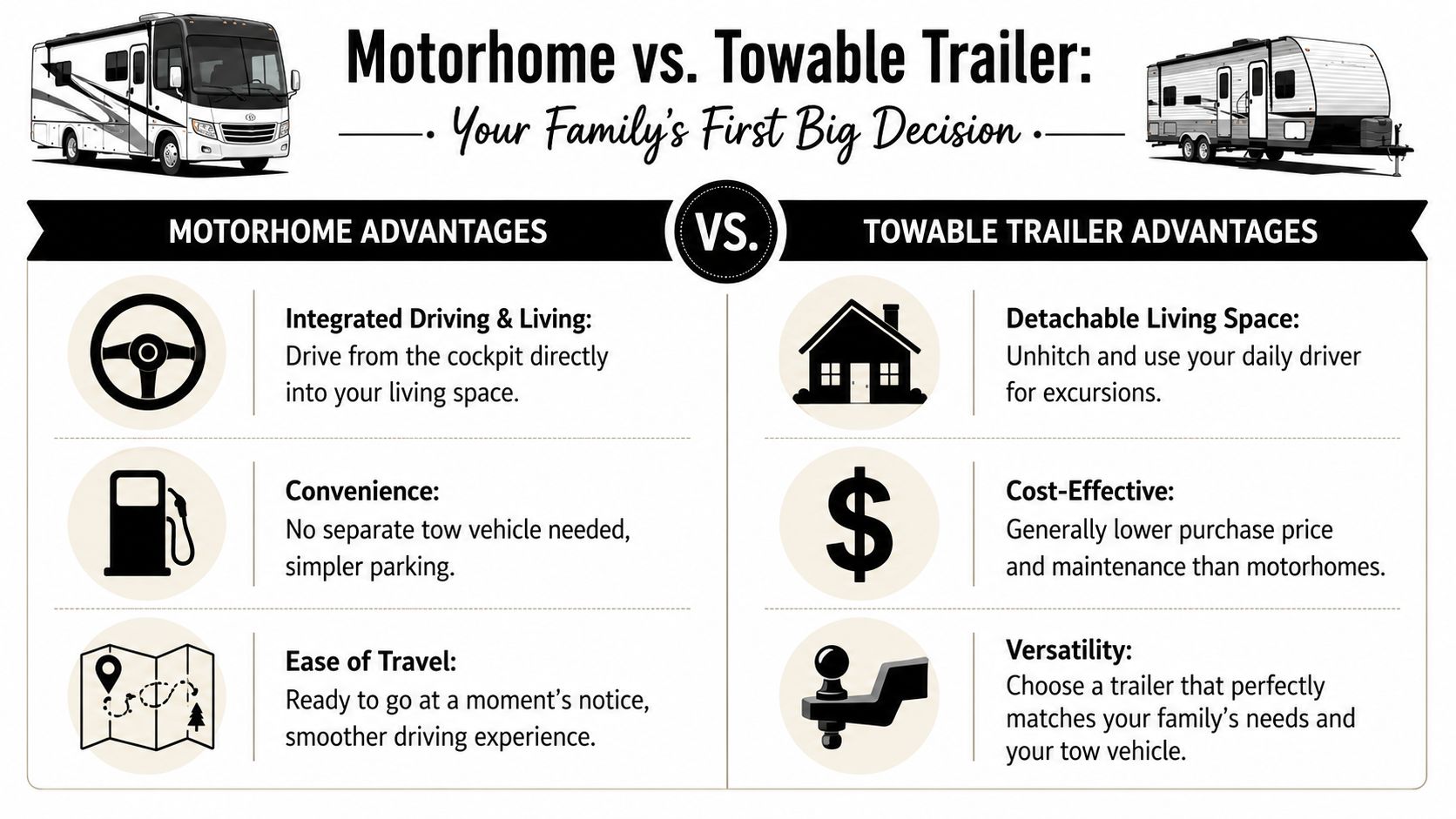
Quick family comparison
| RV type | Best for | Main strength | Main trade-off |
|---|---|---|---|
| Class C motorhome | Families who want an all-in-one road trip setup | Easier travel day flow, built-in living space | You need another plan for local transportation after parking |
| Travel trailer | Families who want flexibility and lower ownership complexity | Unhitch at camp and use your vehicle separately | Towing confidence and tow vehicle limits matter a lot |
| Fifth wheel | Families who want larger, more residential space | Comfort, storage, and separation of living zones | Requires the right truck and a bigger commitment |
Why some families choose a Class C
A Class C is the easiest way to make travel days feel smooth. Everyone gets in, buckles up, and you're on the road. Stops are easier, lunch breaks are simpler, and the whole experience feels built for road travel.
For a lot of families, that convenience is worth the higher ownership complexity. You're maintaining a motorized RV, and once you're parked, running into town isn't as simple unless you bring another vehicle or break camp.
Why many first-time buyers choose a trailer
Towables make sense for families who want a campsite basecamp. Once you unhitch, your truck or SUV handles grocery runs, lake days, and dinner in town. That flexibility is hard to beat.
They're also easier to shop by floorplan. If you want double bunks, a rear bath, or an outdoor kitchen, the trailer market gives you a lot of options.
A lot of shoppers end up comparing these two paths in more detail, and our guide on fifth wheel vs motorhome differences helps clarify which ownership style fits better.
My honest recommendation
If your family values road-trip ease and you don't want to think about towing, start with a Class C. If you want the best mix of flexibility, price range, and family floorplans, start with a travel trailer. If you already own the right truck and want more living space, look hard at a fifth wheel.
Most first-time Utah families don't buy the wrong RV class because of features. They buy the wrong one because they didn't think through what a normal trip day actually looks like.
Decoding the Best RV Classes for Families
Once you know whether you want to drive or tow, the shortlist gets cleaner. For most families shopping for the best RV for a family of 4, three classes deserve serious attention: travel trailers, fifth wheels, and Class C motorhomes.
Travel trailers for flexible family camping
Travel trailers are still the default recommendation for many first-time buyers, and that's fair. They offer the widest variety of family layouts, especially bunkhouse designs, and they let you unhitch once you arrive.
They're also the easiest category to shop by how your family camps. Weekend lake trips, soccer tournament overnights, longer summer loops through southern Utah, they can handle all of that well if the tow setup matches.
Travel trailers are usually the smartest fit for families who want:
- A wide range of bunkhouse floorplans
- A lower barrier to entry than a motorhome
- A separate vehicle for local driving after setup
- Options in the family-friendly size range discussed earlier
Fifth wheels for space and separation
If your family wants more residential comfort, fifth wheels deserve a serious look. They're especially attractive for longer trips because the layouts often separate parent and kid space better than standard trailers.
The catch is simple. They need the right truck, and not every family wants to commit to that. For some buyers, a fifth wheel is the dream upgrade after a few seasons in a travel trailer.
Class C motorhomes for all-in-one travel
Class C motorhomes are my favorite answer for families who care most about the road experience itself. Many Class C motorhomes sleep 5–7 people with 5–6 seatbelts installed, and they often include cab-over sleeping areas that are especially good for children, along with full bathrooms and full-size amenities for family comfort, as outlined in this Class C family RV guide.
That cab-over bed is a real advantage. Kids usually love it, and it frees up the rest of the coach so you're not converting your main seating area every night.
Which class I'd recommend by buyer type
| Your situation | Best fit |
|---|---|
| First RV, family road trips, budget-conscious | Travel trailer |
| Longer stays, bigger truck, want more room | Fifth wheel |
| Frequent road trips, hate towing, want simple travel days | Class C motorhome |
If your kids are young and you want the trip itself to feel easy, a Class C is hard to beat. If your budget and towing setup are the bigger priorities, a travel trailer usually wins.
One more note. Some families focus too much on sleeping capacity and not enough on how the rig feels at breakfast, bedtime, and rainy afternoons. That's where floorplans decide everything.
Essential Family Floorplans and Bunkhouse Layouts
A lot of shoppers say they want a bunkhouse, but “bunkhouse” is just the starting point. Some are fantastic for families. Others technically sleep four and still feel frustrating by the second night.
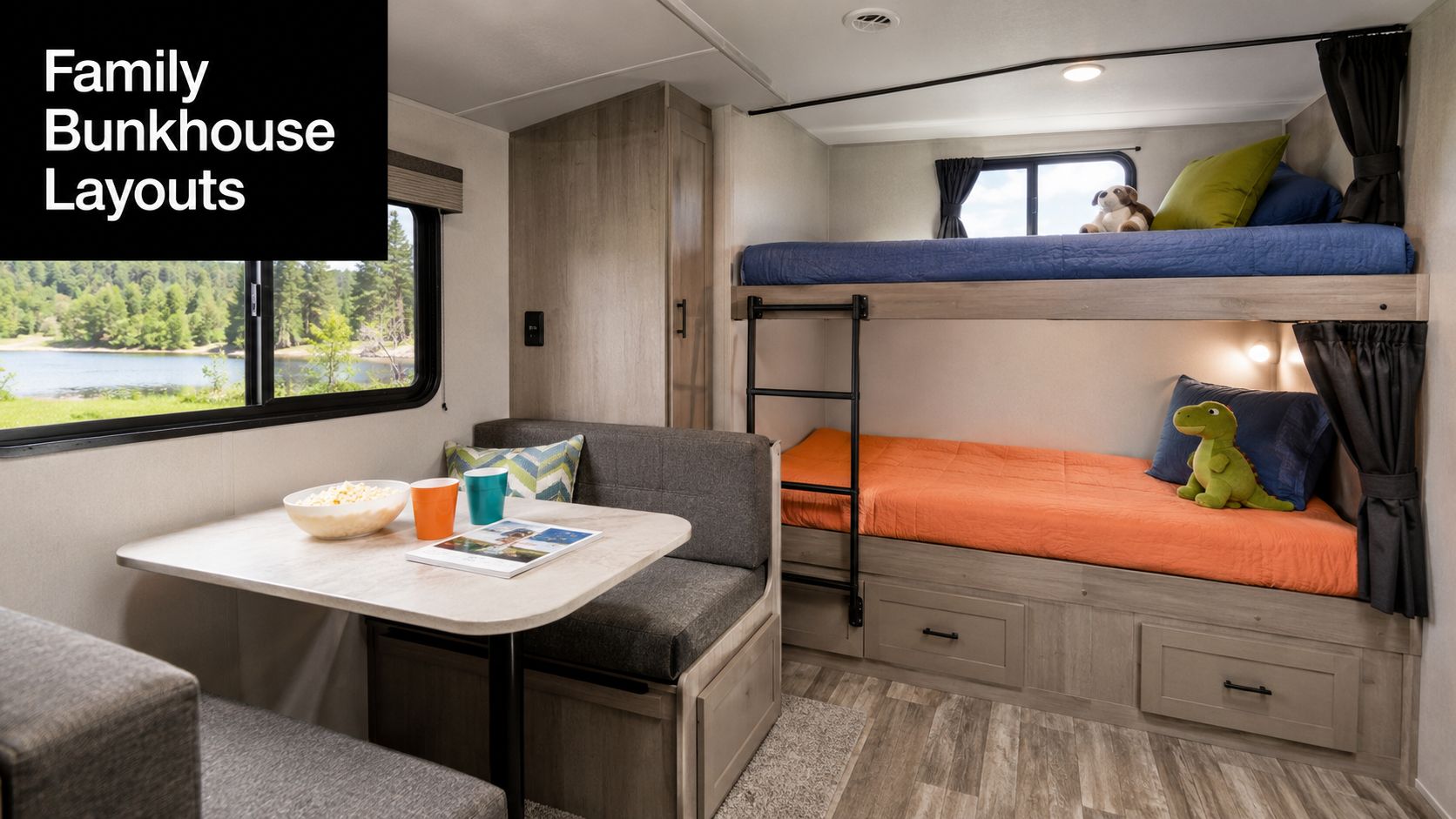
Floorplan features that matter every single day
Family-focused layouts should prioritize a private master bedroom with a closing door, a bathroom you can reach without walking through sleeping areas, outdoor kitchen options, and power stabilizer jacks, according to this family camper floorplan overview.
Those details sound small on the lot. They are not small at camp.
A real bedroom door means one parent can put younger kids to bed without ending the whole evening for everyone else. A bathroom you can reach directly means nobody is climbing over bunks at 2 a.m. Outdoor kitchens help a lot when you're cooking burgers, pancakes, or anything messy. Power stabilizers save tempers during setup.
The three family layouts I recommend most
Rear bunkhouse
This is the classic family layout. Parent bed up front, bunks in the back, main living area in the middle.
It works because everyone gets a zone. Kids can stash their blankets, books, and stuffed animals in the same place every trip. Parents get a little privacy. For a lot of first-time buyers, this is still the safest pick.
Mid-bunk or bonus room layout
This setup gives the kids a more flexible room, not just stacked bunks. Depending on the model, that space can work as sleeping area, toy zone, or rainy-day hideout.
These layouts shine on longer trips. The downside is that they usually push you into larger trailers or fifth wheels.
Convertible family layout with smart common space
Some smaller family trailers don't have a dedicated bunk room, but they still work if the layout is efficient. Think double bunks, a good dinette, solid pantry space, and enough walking room that the coach doesn't feel clogged.
That's usually the better answer for families who camp shorter trips and want to keep size manageable.
What to look for on a walkthrough
When you open a floorplan online or step into a unit, check these fast:
- Bedtime flow: Can the kids go to sleep without shutting down the entire RV?
- Bathroom access: Can someone reach it easily at night?
- Kitchen usability: Is there enough counter and fridge space for a real family meal?
- Storage placement: Are there places for shoes, jackets, snacks, and outdoor gear?
- Setup effort: Will this rig be easy enough that you'll want to use it often?
A lot of buyers shop these layouts online first. If you want examples of how separate sleeping zones work in real towables, our overview of 2 bedroom travel trailer floor plans is a useful next step.
The Towing Mistake Utah Families Cannot Afford to Make
This is the part most generic buying guides miss, and it's the part that matters most in Utah. A trailer can look perfect on paper and still be the wrong choice if your vehicle can't safely handle it up a grade, through crosswinds, or in stop-and-go traffic coming down the canyon.
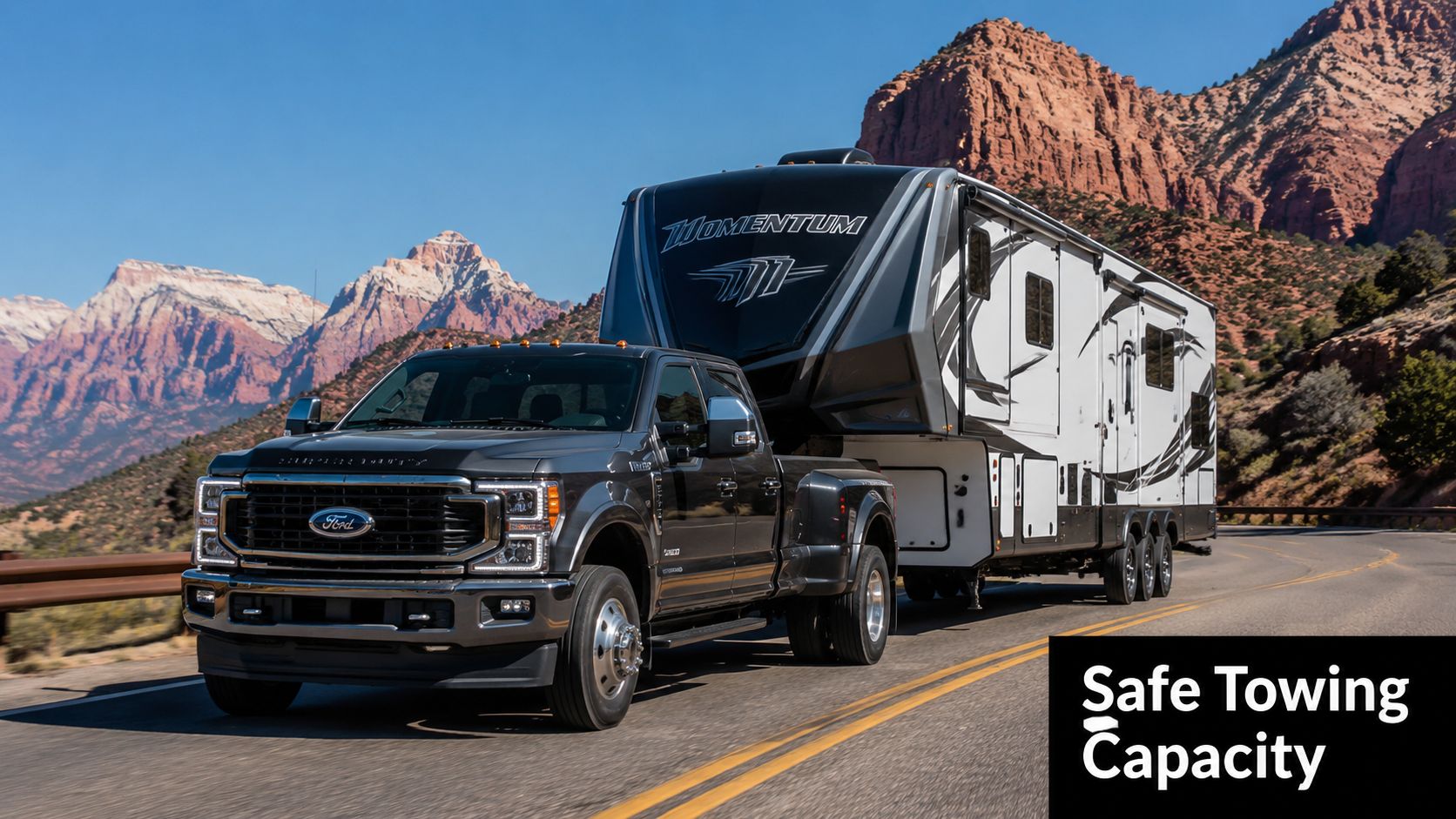
The mismatch nobody talks about enough
Most guides recommend 25 to 35-foot RVs for families of four, but many skip the towing reality. 68% of US households own vehicles rated to tow under 5,000 pounds, while typical 30-foot travel trailers weigh 7,000–9,000 pounds dry, according to this family RV towing analysis.
That gap is where bad purchases happen. A family sees a roomy trailer, hears that it's a great family size, and assumes their SUV or half-ton will make it work. Sometimes it won't. Sometimes it technically can, but only on flat roads with light loading and a lot more stress than is often expected.
Two numbers families need to understand
GVWR
Gross Vehicle Weight Rating is the maximum the fully loaded RV is allowed to weigh. Not the empty brochure weight. Not the optimistic “dry” figure people love to quote in sales conversations.
Payload
Payload is what your tow vehicle can carry in people, cargo, hitch weight, and accessories. Families often blow this limit before they even leave the driveway. Four people, a cooler, bikes, and hitch equipment can eat up payload fast.
Buy based on loaded reality, not empty-weight marketing.
If you're comparing towables, our guide on how much travel trailers weigh helps break down the weight terms buyers trip over most.
Why this matters more in Utah
Parley's Canyon, Sardine Canyon, and the mountain routes many families use for weekend trips expose weak tow setups fast. High altitude, long climbs, downhill braking, and summer heat don't care what the brochure said.
This video does a good job showing why tow ratings and setup details matter before you commit to a larger family trailer.
My direct advice
If you own a typical family SUV, don't assume a big family bunkhouse is in range. Verify every towing and payload number first. If the numbers are tight, either choose a lighter trailer or switch the plan to a motorhome.
That answer isn't glamorous, but it saves people from expensive mistakes and white-knuckle driving.
The 2026 Family RV Feature Checklist
Once the class and weight question are settled, features decide whether your RV feels easy or annoying. Often, families overspend on flashy trim and underspend on the things they'll use every day.
The features I'd put at the top of the list
Existing content often ignores off-grid family camping, but it's a real need for families who want more than crowded full-hookup weekends. Families looking to camp 7+ days without hookups should focus on 50+ gallon fresh water tanks and integrated solar setups, because standard 25–30-foot RVs with 35–45 gallon tanks often come up short for a family of four, as discussed in this off-grid travel trailer discussion for families.
That matters in Utah. A lot of beautiful camping isn't plug-and-play. If your dream is quieter public land, less crowded state park loops, or longer stays away from hookups, standard tank sizes can limit you faster than you expect.
My must-have list for a family of four
- Larger fresh water capacity: If off-grid trips are part of the plan, don't settle for a tank setup that forces you out early.
- Integrated solar or solar-ready package: It's one of the easiest ways to make dry camping more practical.
- Outdoor kitchen: This keeps grease, smells, and food mess outside where they belong.
- Power stabilizer jacks: Fast setup matters more with kids waiting on dinner, bikes, or bedtime.
- Good exterior storage: You need easy access to chairs, hoses, leveling gear, sports gear, and extra layers.
- Strong cooling setup: Families heading south in warm weather should pay attention to how the RV will handle hotter campgrounds.
Features I'd rank lower than most buyers do
Pretty lighting. Fancy entertainment extras. Decorative interior upgrades. Those are nice, but they won't save a cramped kitchen, weak storage, or a tank setup that cuts your trip short.
The best RV for a family of 4 should make camp easier, not just look nicer in photos.
Utah-specific feature advice
For local use, I'd prioritize three things above all else:
| Feature | Why it matters in Utah |
|---|---|
| Tank capacity | Better for longer stays away from hookups |
| Storage access | Jackets, hiking gear, and bulky camp items pile up fast |
| Simple setup equipment | Wind, heat, and late arrivals make easy setup a big deal |
If your family mostly stays at full-hookup RV parks, you can relax a bit on tank size. If you want flexibility, don't.
Start Your Search at Motor Sportsland
A lot of families hit this stage with a dozen tabs open, two or three floorplans they like, and one big problem. They still have not matched those RVs to how they camp in Utah.
That is the part I would get right first.
Utah families usually sort into three realistic paths. A lightweight travel trailer fits the family SUV they already own. A fifth wheel gives them better living space if they already have the truck for it. A Class C makes sense for families who want to skip towing and keep travel days simpler. Pick your lane early, or you waste time touring rigs that were never a fit.
How to shop smarter online
Use filters based on hard limits, not fun extras. Start with weight, length, and sleeping layout. Then check cargo space and tank capacity. That last one gets ignored all the time, and it matters a lot if your idea of camping includes more than a full-hookup pad for one night.
If you are shopping online, search with terms like:
- Bunkhouse
- Double bunks
- Private bedroom
- Outdoor kitchen
- Lightweight travel trailer
- Class C family motorhome
Motor Sportsland carries new and used RV inventory, plus financing, trade-in support, and service for Utah owners. That helps because your search should not stop at the floorplan. You also want to know where you will get questions answered after the sale, where you can service the rig, and whether the staff will tell you a trailer is too heavy for your SUV before you learn that the hard way.
What to bring before you visit the showroom
Come in with real-world details.
- Your tow vehicle info: Year, make, model, engine, and tow rating. If you guess here, you can end up shopping the wrong half of the lot.
- Your camping style: Full hookups at KOAs is one thing. Boondocking near Moab or long weekends away from services is another.
- Your family routine: Bedtime, rainy-day hangout space, where the kids drop shoes and backpacks, where the dog sleeps. Those details decide whether a layout works.
- Your gear list: Bikes, paddleboards, camp chairs, jackets, coolers, sports gear, and recovery gear take up more room than families expect.
Why an in-person walk-through still matters
Photos hide the problems that make owners frustrated by trip three. A bunk room can look great online and feel cramped in person. A kitchen can photograph well and still have no real counter space. A bathroom door can block the hallway, and a dinette can be too tight for four people to sit comfortably.
Walk through the finalists in person at our Salt Lake City showroom at 4001 South State Street, Salt Lake City, UT 84107. Open every cabinet. Stand in the shower. Have the kids climb into the bunks. Ask someone to show you where the hoses, chairs, and dirty shoes go.
That is how families stop shopping for an RV that looks good online and start choosing one that will work at Jordanelle, Bear Lake, or a windy, dusty campsite farther south.
Frequently Asked Questions From Families
A family of four usually asks better questions after they realize the brochure version of RV life leaves out the hard parts. Your SUV may not safely pull the trailer your kids love. The tanks on a nice-looking bunkhouse may be fine for a full-hookup park and frustrating for a long weekend off-grid in southern Utah.
What's a realistic budget for a new family travel trailer?
Start with the full cost, not just the sticker price. Payment, hitch setup, brake controller, registration, insurance, storage, and a few basic campsite items add up fast.
My advice is simple. Buy the right weight class and the right floorplan first. Skip the flashy trim package if it forces you into a trailer your vehicle struggles to tow or a layout with weak storage for four people.
Should we buy new or used for our first RV?
New is the better fit for families who want warranty coverage, current safety features, and fewer early surprises. Used is a smart move if your budget is tighter and you know how to inspect for water damage, worn seals, soft floors, appliance issues, and neglected maintenance.
For first-time buyers, I usually care less about new versus used than I do about fit. A clean used trailer with a smart bunkhouse layout beats a brand-new trailer that is too heavy for your SUV or too cramped for rainy afternoons.
How hard is it to winterize an RV in Utah?
Winterizing is straightforward if you do it on time. Wait too long in Utah, and frozen plumbing can turn a small job into an expensive repair.
If you do not want to handle it yourself, have a service department do it before the first real cold snap. That is a lot cheaper than fixing cracked lines, fittings, or a damaged water heater in January.
What are the best family-friendly campgrounds near Salt Lake City?
Jordanelle is one of the easiest wins for a quick weekend. Bear Lake is a summer favorite if your family wants water, beach time, and room to spread out.
The better question is what kind of camping you do. If you stay at developed campgrounds with hookups, tank size matters less. If you want to camp farther out near Moab, Capitol Reef, or other less-serviced spots, start paying close attention to fresh, gray, and black tank capacity before you buy.
Is a Class C better than a travel trailer for a family of four?
For plenty of families, no. A travel trailer is usually the better value. You get more layout choices, more bunkhouse options, and the freedom to unhitch at camp and use your vehicle for day trips.
A Class C makes sense if towing stresses you out and you want a simpler driving setup. Just be honest about budget, storage, and how you will get around once you are parked.
What's the biggest mistake first-time family buyers make?
They shop by sleeping capacity and ignore the two numbers that cause the most regret. Tow rating and tank size.
That mistake shows up all over Utah. A family buys a trailer that technically sleeps eight, then learns their SUV is the wrong match once it is loaded with kids, gear, and water. Or they plan off-grid trips and discover the standard tanks are built for short stays, not the kind of boondocking they had in mind. Sleeping space matters. Real-world fit matters more.
