
Class a Motorhome with Washer and Dryer: Your 2026 Guide

Nothing burns vacation time like hunting down a laundromat halfway through a trip. You've got damp towels from Bear Lake, dusty hiking clothes from southern Utah, and a pile of quarters you thought you packed but can't find. Meanwhile, your Class A is sitting at camp with all the comfort in the world except the one thing you suddenly wish it had most.
That's why a Class A motorhome with washer and dryer is such a big deal for the right buyer. It's not just a luxury feature. It changes how you pack, how long you stay out, and how often you lose a morning to campground chores. For full-timers, snowbirds, and families spending serious time on the road, onboard laundry can make RV life feel much more like home.
At the same time, our team in Salt Lake City sees people buy this feature for the wrong reasons all the time. A washer and dryer in a Class A brings convenience, but it also brings weight, water demands, utility requirements, and maintenance. If you camp off-grid near the Wasatch or spend weekends dry camping above Jordanelle, you need the full picture before you commit.
Introduction
A lot of shoppers come in after one specific kind of trip. They've done the campground laundry room thing. They've hauled baskets through gravel, waited on broken machines, and watched half a day disappear. Then they step into a larger coach and see a laundry closet. That's the moment the idea gets real.
A Class A motorhome with washer and dryer makes the biggest difference for travelers who stay out longer, move with kids, or live in their coach for weeks at a time. Clean clothes on your schedule is a real quality-of-life upgrade. So are fresh sheets before guests arrive, dry towels after a rainy day, and not packing half your wardrobe for a two-week loop through Utah and Idaho.
But this feature isn't automatic. Some floorplans are built for it. Some are only prepped for it. Some shouldn't have it added at all. The smart move is matching the laundry setup to how you camp, not how you imagine you might camp one day. If you're shopping in Salt Lake City and want a coach that works for both long highway miles and real campground use, that's where experienced guidance matters.
The Real Lifestyle Impact of RV Laundry
The biggest benefit is simple. You stop planning parts of your trip around laundry access. That changes more than people expect.
If you travel for a month at a time, onboard laundry means you can pack lighter, stay flexible, and avoid the “laundry day takes over camp day” problem. Families feel this first. Full-timers feel it even more. If you've ever had wet swimsuits, muddy socks, and a stack of bath towels build up in a hurry, you already understand the appeal.
What gets better on the road
A washer and dryer in your Class A gives you a few clear lifestyle wins:
- More flexibility: You can wash a small load when it makes sense instead of saving everything for one big laundromat run.
- Less packing pressure: You don't need to load the coach with as many clothes, towels, and extra bedding.
- Cleaner day-to-day living: Pet blankets, kitchen towels, and dusty layers from Utah trails don't sit around as long.
- Better long-stay comfort: If you winter in warmer states or spend weeks moving around the Mountain West, this feature earns its keep.
Practical rule: If you routinely travel long enough to need laundry mid-trip, an onboard unit starts making a lot more sense.
What people underestimate
It's time to be blunt. RV laundry is not residential laundry.
Vehicle-grade washer/dryer combos in Class A motorhomes typically use 12 to 18 gallons of water per load, and these units average about 100 pounds, according to real-world discussion of RV combo washer and dryer use. That water use and weight matter. They affect where you camp, how you manage tanks, and what else you can carry.
The tradeoffs usually look like this:
- You'll want full hookups: This isn't the appliance I recommend leaning on while boondocking.
- Loads are smaller: You wash more often, but less at once.
- Cycles take space and time: The machine is convenient, but it's not fast in the way a home laundry room is fast.
- You'll hear it: Vibration and noise are normal, especially in tighter floorplans.
Who should get one and who shouldn't
For me, this decision comes down to travel style.
A washer and dryer is usually a strong fit if you're:
- Full-timing
- Taking extended multi-week trips
- Traveling with kids
- Staying in full-hookup parks often
It's often overkill if you're:
- Taking short weekend trips
- Dry camping most of the time
- Trying to maximize storage over convenience
- Shopping a smaller coach where every cabinet matters
If your idea of a great Utah trip is bouncing between dry camps and remote trailheads, I'd rather see you keep the storage. If you spend long stretches in destination parks with utilities, I'd seriously consider laundry built into the coach.
Decoding Your Options Vented vs Non Vented and Stackable vs Combo
The words get thrown around loosely, so let's clean this up. You're choosing between two separate decisions. First, combo or stackable. Second, vented or non-vented.
This visual gives a quick overview before we get into the actual tradeoffs.
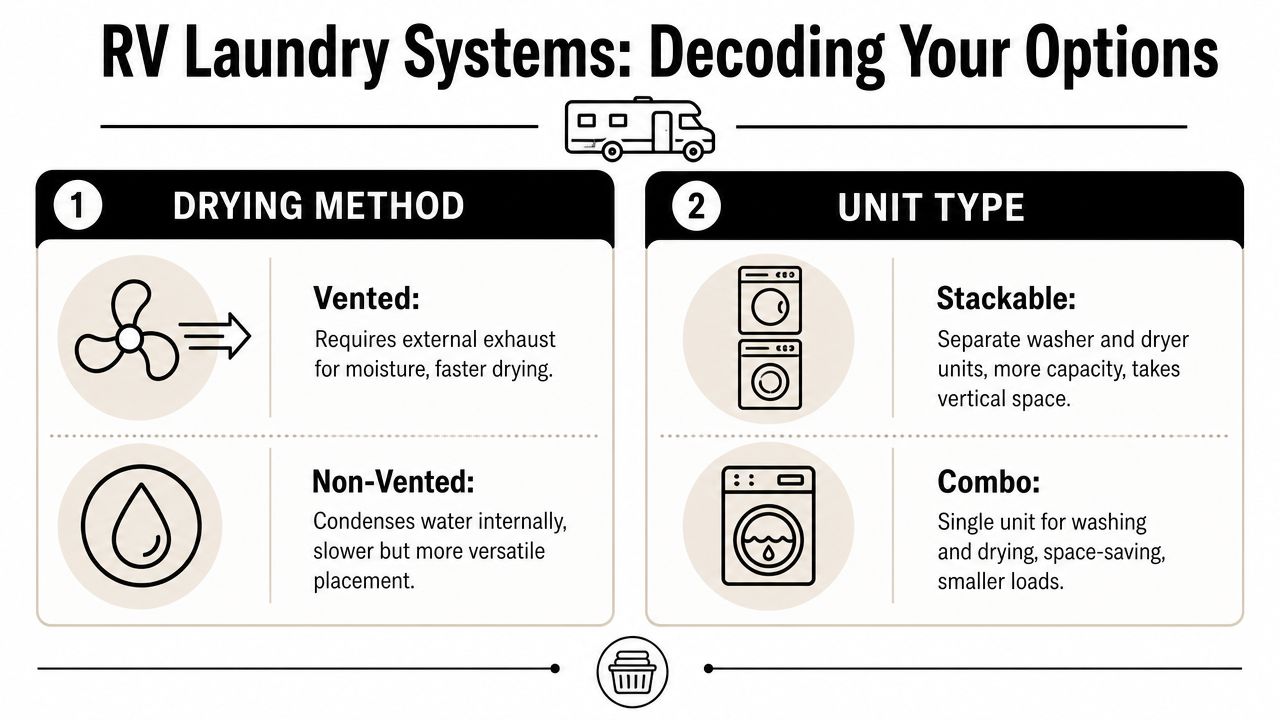
Combo versus stackable
A combo unit washes and dries in the same drum. It saves room, simplifies installation, and fits the way many Class A floorplans are designed. If you want onboard laundry without giving up a ton of cabinet or closet space, combo is often the answer.
A stackable setup uses separate washer and dryer units. It feels more residential in use, and many owners prefer the workflow because you can move laundry from one machine to the other instead of tying up one drum for the full process. The catch is obvious. It takes more room and usually belongs in a larger coach with a dedicated laundry closet.
Here's the comparison I use with shoppers:
| Feature | Combo Unit | Stackable Units | Vented Dryer | Non-Vented Dryer |
|---|---|---|---|---|
| Footprint | Smaller | Larger | Needs exterior vent path | More flexible placement |
| Ease of fit in Class A | Common | Usually larger coaches | Requires vent installation | Easier when venting is difficult |
| Laundry workflow | One drum does both jobs | Separate washer and dryer | Faster drying in many conditions | Slower drying in humidity |
| Best fit | Space-conscious buyers | Long-stay owners wanting a more residential setup | Buyers prioritizing dry times | Buyers prioritizing simpler routing and durability |
Vented versus non-vented
This part matters more than most buyers realize, especially once you leave Utah's dry air.
Recent full-timer data cited in this RV laundry discussion video says unvented condenser models dry 40% slower in high-humidity environments, while many owners also report better durability from condenser units because vented systems can have exhaust blockage issues. This constitutes the main tradeoff. Vented often dries faster. Non-vented is often easier to live with mechanically.
In Utah's dry climate, a vented unit can feel like a strong match. In damper mountain weather or more humid travel regions, the gap between theory and real-world drying gets wider.
If you camp mostly around Salt Lake City, St. George, or central Utah in the drier months, vented can work very well when installed correctly. If you're chasing shoulder seasons, crossing humid states, or you want fewer vent-related headaches, a non-vented model deserves serious consideration.
To see the basics in motion, this walkthrough is helpful:
My recommendation
I'd break it down this way:
- Choose combo if space efficiency matters more than maximum laundry throughput.
- Choose stackable if you're in a larger Class A and laundry is going to be part of your weekly routine.
- Choose vented if the coach is designed for it and you want shorter drying times.
- Choose non-vented if you value simpler placement and fewer vent hose concerns.
Most buyers don't need the fanciest setup. They need the one that matches their floorplan and camping style.
The Big Three Space Weight and Utilities
A laundry setup in a Class A only works when three things line up. Space. Weight. Utilities. If even one is off, the feature goes from convenient to annoying fast.
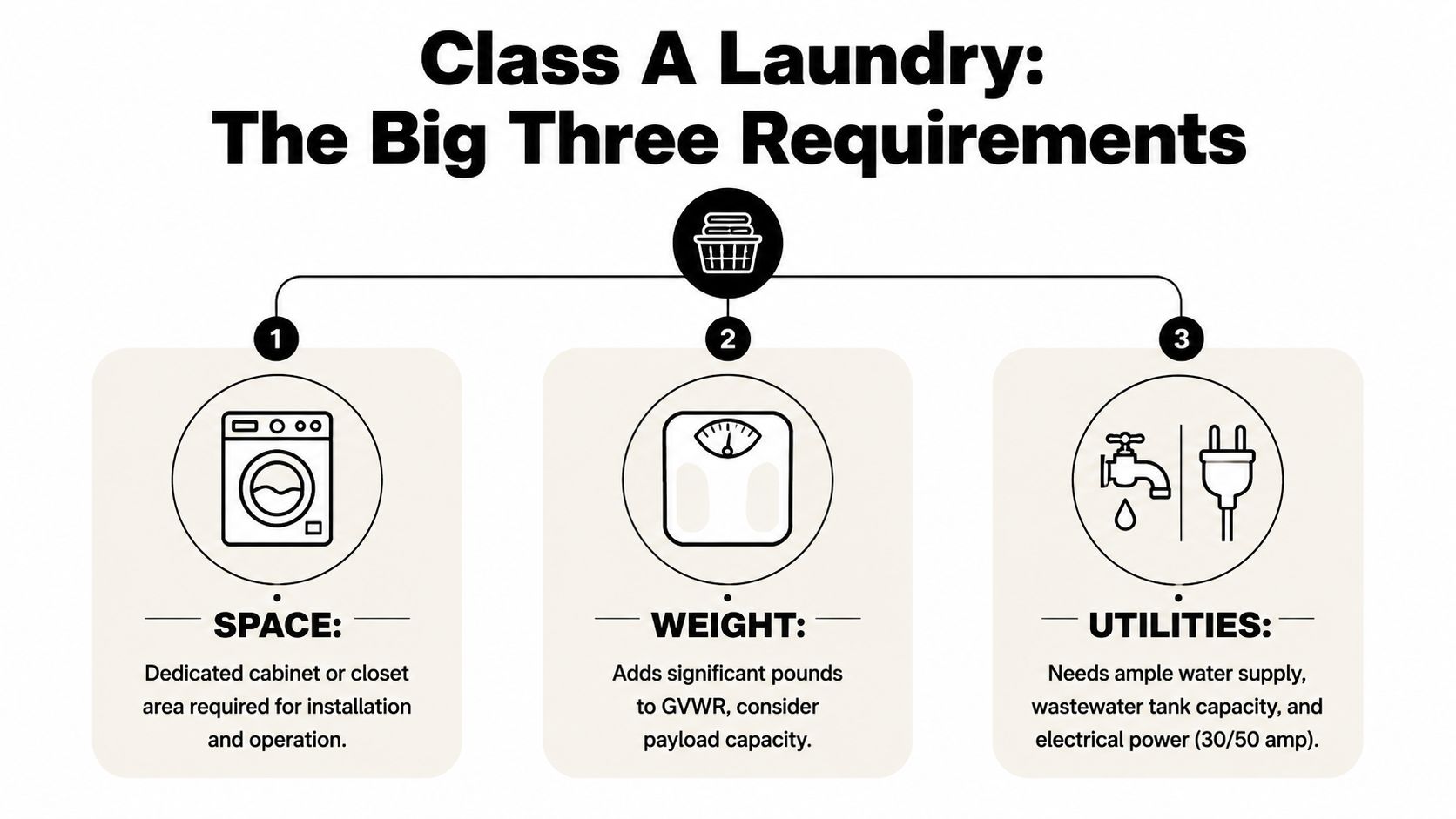
Space is the first gate
A washer and dryer can't just “kind of fit.” It needs a real cabinet, closet, or factory-designed enclosure that gives the machine room to operate and room for service access later. Practically speaking, that's why this feature tends to show up in larger Class A floorplans.
You're not only making room for the appliance itself. You're also giving up storage that could have gone to hanging clothes, pantry overflow, or bulky gear. In a coach that already feels tight for your travel style, I'd keep the closet and skip the machine.
Weight changes your carrying capacity
This is the part people often miss because they focus on floorplan first.
A vented RV washer and dryer combo adds about 150 pounds of payload, while a stackable set adds 200 to 300 pounds, according to this RV washer and dryer payload guide. That weight counts. It sits on top of everything else you already carry, including clothing, tools, food, water, and accessories.
If you're comparing coaches, take a few minutes to review how RV dry weight affects what you can safely carry. That number matters a lot more once laundry enters the picture.
The wrong way to shop is “Can I squeeze one in?” The right way is “Can this coach carry it, supply it, and drain it without compromise?”
Utilities decide whether the setup is practical
This feature needs more than a spare outlet.
A typical all-in-one Class A washer/dryer combo like the Splendide 2100XC draws 9 to 14 amps on 110V power and uses 10 to 15 gallons of water per full wash-and-dry cycle, according to this RV laundry buying guide. That's why these units make the most sense at full-hookup sites. If you're running off tank water and trying to preserve battery capacity, laundry becomes a bad use of resources in a hurry.
Here's the practical checklist:
- Electrical: You need the right power supply for the appliance installed.
- Water: Hot and cold feeds need to be in the right place and easy to service.
- Drainage: The machine has to drain correctly into the coach's system.
- Tank strategy: You need enough gray tank capacity to use the unit without creating a nuisance.
In other words, onboard laundry is an integrated part of the coach. It's not a casual add-on.
Finding New and Used Class A RVs with Laundry
Shopping for a Class A motorhome with washer and dryer gets easier once you know what you're looking for on a spec sheet. Some coaches include the appliance. Some include prep only. Some have the cabinet space, but not the full plumbing and electrical setup you'll need to finish the job.
Here's the first thing I tell buyers. Don't trust the phrase “washer/dryer ready” until you verify what that means in that exact RV.

What to look for in new inventory
On new coaches, check for these items during your walkthrough:
- Dedicated laundry closet: Not just a cabinet with the right width.
- Factory prep: Water lines, drain line, power, and vent path if needed.
- Clear access: Enough room for future service or replacement.
- Floorplan logic: The machine shouldn't steal the only useful bedroom storage.
Winnebago is one of the clearer examples here. According to this Winnebago washer and dryer model overview, washer/dryer options are standard on the Winnebago Adventurer, Winnebago Forza, and Winnebago Winnebago, and these models are typically 33 feet or longer. That lines up with what we see in the showroom. Laundry usually starts making sense once the coach is large enough to support the space and infrastructure.
What to inspect in used Class A coaches
Used units need a closer look because “has laundry” and “has good laundry installation” are not the same thing.
When I inspect a used coach with an onboard unit, I care about:
- Signs of moisture around the cabinet
- Condition of venting and exterior termination
- Noise, movement, and mounting security
- Evidence of leaks near plumbing connections
- Whether the closet was factory-designed or retrofitted poorly
If you're buying pre-owned, this is also where floorplan matters more than feature count. A poorly integrated washer/dryer setup can be more trouble than it's worth.
For buyers comparing age, condition, and value, this guide on how to buy a used RV near you is a useful starting point.
My shopping advice
If laundry is a must-have, don't treat it as an afterthought feature. Start your search there. Filter for larger Class A coaches, look for factory prep or factory-installed units, and pay close attention to closet placement. The right setup feels intentional. The wrong one feels like somebody forced an appliance into a space that should've stayed a wardrobe.
Installation and Upgrade Insights from Our Service Bay
A prepped coach is one thing. A non-prepped coach is a different project entirely.
When our service team looks at adding a washer and dryer, we start with infrastructure, not the appliance brand. The coach needs hot and cold water shutoffs with a winterization method, a dedicated drain line connected to the grey tank, and two separate electric feeds to power both the washer and dryer independently, as discussed in this iRV2 thread on adding washer and dryer hookups. If those pieces aren't there, the job gets more involved quickly.
What good installation actually includes
A proper install usually means checking all of the following:
- Mounting security: The unit has to stay put when the coach is moving, braking, and cornering.
- Drain routing: It must go to the gray tank, not the black tank and not some improvised shortcut.
- Vent planning: If it's a vented model, airflow needs to be clean and protected.
- Serviceability: Future maintenance shouldn't require tearing apart half the bathroom.
One issue we see often is vent routing that looks acceptable on day one but creates long-term moisture or lint problems. If you want a homeowner-style primer on outside vent hose concerns, Purified Air Duct Cleaning's dryer vent hose outside article is a useful reference for understanding why vent path quality matters so much.
Common DIY mistakes we fix
Some owners are handy. That helps. But RV laundry installs punish shortcuts.
The common problems include:
- Using a closet that lacks proper support
- Improper electrical connections that trip breakers
- Poor vent sealing
- Drain lines with bad routing or weak connections
- No winterization plan for the added plumbing
If the coach wasn't designed for laundry, you need to prove the structure and utilities can support it before you buy the machine.
If you're dealing with appliance troubleshooting or a suspected install issue, RV appliance repair guidance is worth reviewing before the problem gets worse.
My honest advice is simple. If the coach is factory-prepped, an experienced installer can usually make that project straightforward. If the coach is not prepped, treat it like a systems upgrade, not an accessory install.
Best Practices for Using Your RV Washer and Dryer
Owning the machine is one thing. Using it well is what keeps you from getting frustrated.
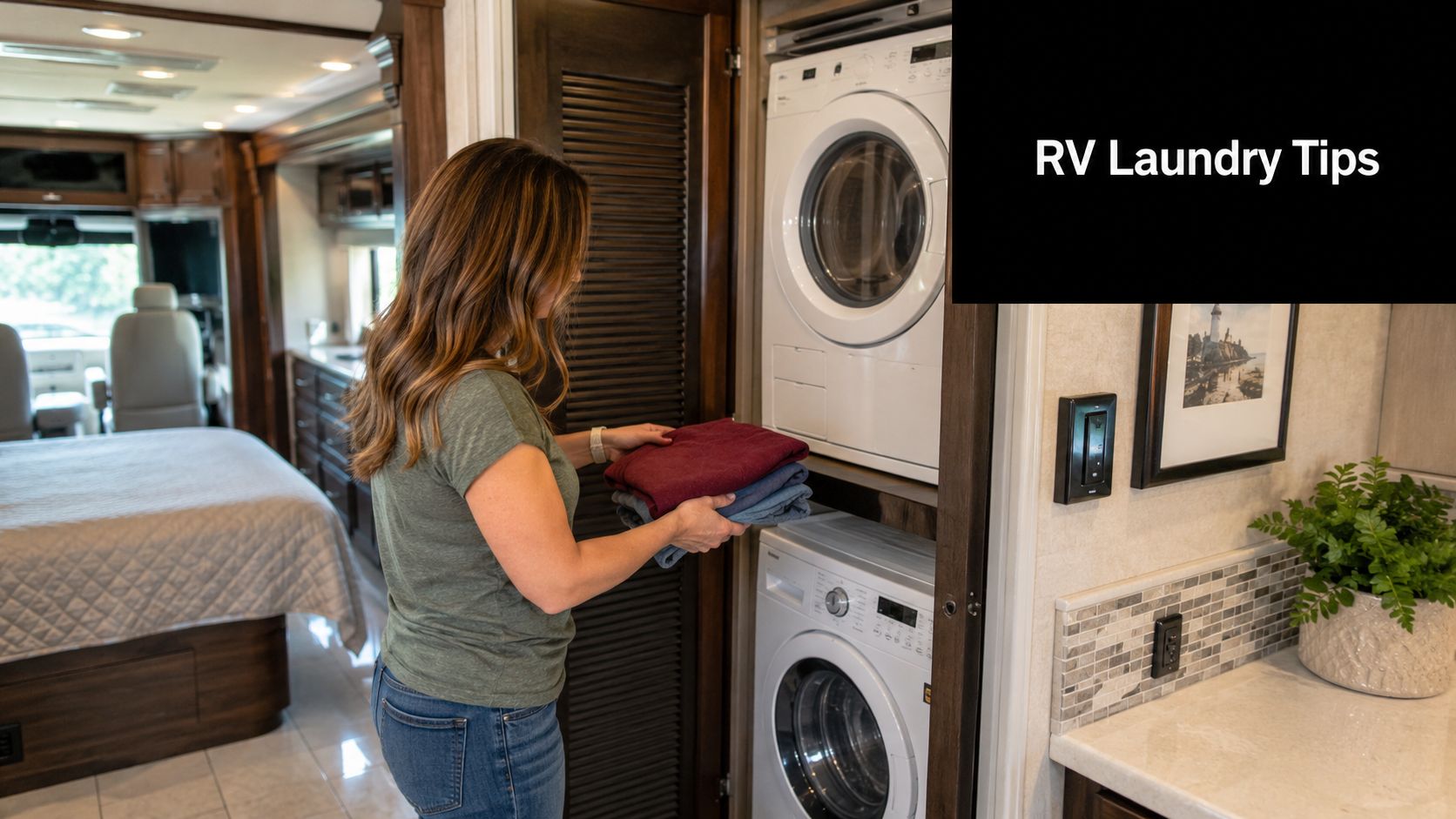
Simple habits that make a big difference
These are the habits I'd stick with from day one:
- Run smaller loads: RV machines reward patience. Overloading hurts wash quality and drying performance.
- Use HE liquid detergent: Suds are not your friend in a compact RV appliance.
- Clean lint and check seals: A few minutes of routine care prevents a lot of avoidable service calls.
- Do laundry on hookup days: That's the cleanest way to avoid stressing your water and tank setup.
For detergent choice, many owners also prefer phosphate-free laundry detergents from BacteriaFAQ.com because they're a good fit for people paying closer attention to what goes through their RV plumbing system.
Utah-specific use tips
Utah gives you a mixed bag. In dry summer air, drying can feel easier. In cold weather and shoulder-season mountain camping, you need to stay realistic.
A few local-use tips:
- Don't wait until freezing weather to think about laundry plumbing. Winterization matters.
- Expect some variation in dry times at elevation. Conditions change between Salt Lake Valley, mountain campgrounds, and longer regional trips.
- Use the machine steadily, not reactively. Small, regular loads are easier on the system than trying to catch up all at once.
One seasoned full-timer's setup that runs on a standard 120-volt outlet uses a 9-minute wash cycle with a 40-minute dry cycle for good results, shown in this RV laundry video walkthrough. That's a useful reminder that smaller, optimized loads usually outperform the “stuff it full and hope” approach.
Conclusion
If you're tired of laundromats, a Class A motorhome with washer and dryer can absolutely change the way you travel. For the right owner, it's one of the most useful comfort features in the coach. You pack lighter, stay out longer, and stop wasting trip time on chores that should be easy.
But I wouldn't treat it like a must-have for every buyer. You need the right floorplan, enough carrying capacity, and a camping style that supports the water and power demands. If you mostly dry camp, short-trip, or need every inch of storage, you may be happier without it. If you live on the road longer, stay at full-hookup parks, or travel with family, laundry onboard starts looking like money and space well spent.
That's especially true in Utah, where travel styles vary so much. A coach that feels ideal for long stays near full-service campgrounds may be the wrong coach for high-country weekends and winter storage realities. Buy for how you really camp. Not for the brochure version of your life.
Frequently Asked Questions
Is a washer and dryer only found in large Class A motorhomes
Mostly, yes. Built-in laundry is far more common in larger Class A coaches because they have the floorplan space, carrying capacity, and utility infrastructure to support it.
Is combo or stackable better in a Class A
It depends on the coach and your travel habits. Combo units make better use of space. Stackable units are more attractive for longer-term travelers with larger coaches and a dedicated laundry closet.
Do I need full hookups to use RV laundry
Practically speaking, yes if you want to use it comfortably and often. These appliances use enough water and power that they fit full-hookup camping much better than off-grid use.
Should I buy a Class A with washer dryer prep or one with the appliance already installed
Factory-installed is simpler because the setup has already been matched to the floorplan. Prep can still be a good option if the coach has the right plumbing, electrical, drainage, and vent path for the machine you want.
Are non-vented RV dryers a bad idea
No. They're slower in humid conditions, but some owners prefer them because they avoid vent hose issues. The right answer depends on your climate, travel regions, and tolerance for vent maintenance.
What should I inspect on a used Class A with laundry
Check for moisture signs, vent condition, secure mounting, plumbing quality, and whether the installation looks factory-designed or improvised. A sloppy retrofit can create more trouble than value.
If you want help narrowing down the right Class A floorplan for your travel style, browse current options at Motor Sportsland, then visit our Salt Lake City area showroom at 4001 South State Street in Millcreek or talk with our team about inventory, service, and upgrade questions before you buy.
