
Fifth Wheel Gooseneck Hitch: Pros, Cons, & Safety Guide

You bought the truck. You found the fifth wheel you can already see parked at Bear Lake or tucked into a pine loop above the Wasatch Front. Then the simple part ends.
A lot of first-time owners get stuck right here, staring at the gap between truck and trailer and realizing the whole setup depends on one decision. Do you need a fifth wheel hitch, a gooseneck hitch, or some kind of adapter in between? Online advice gets messy fast, especially when one person is hauling a luxury RV and another is towing livestock or equipment.
In Utah, the answer gets even more practical. You're not always hitching up on a perfectly level concrete pad. You may be backing into a sloped driveway in Millcreek, reconnecting at a campground near Jordanelle, or dealing with uneven gravel after a long day on mountain roads. The hitch that looks convenient on paper can become frustrating, or unsafe, when the ground isn't flat.
Before you compare hitch types, it helps to understand your truck's weight limits. A plain-English guide to GVWR vs GCWR is worth reading because many towing problems start with owners mixing up truck capacity, trailer weight, and actual loaded towing limits.
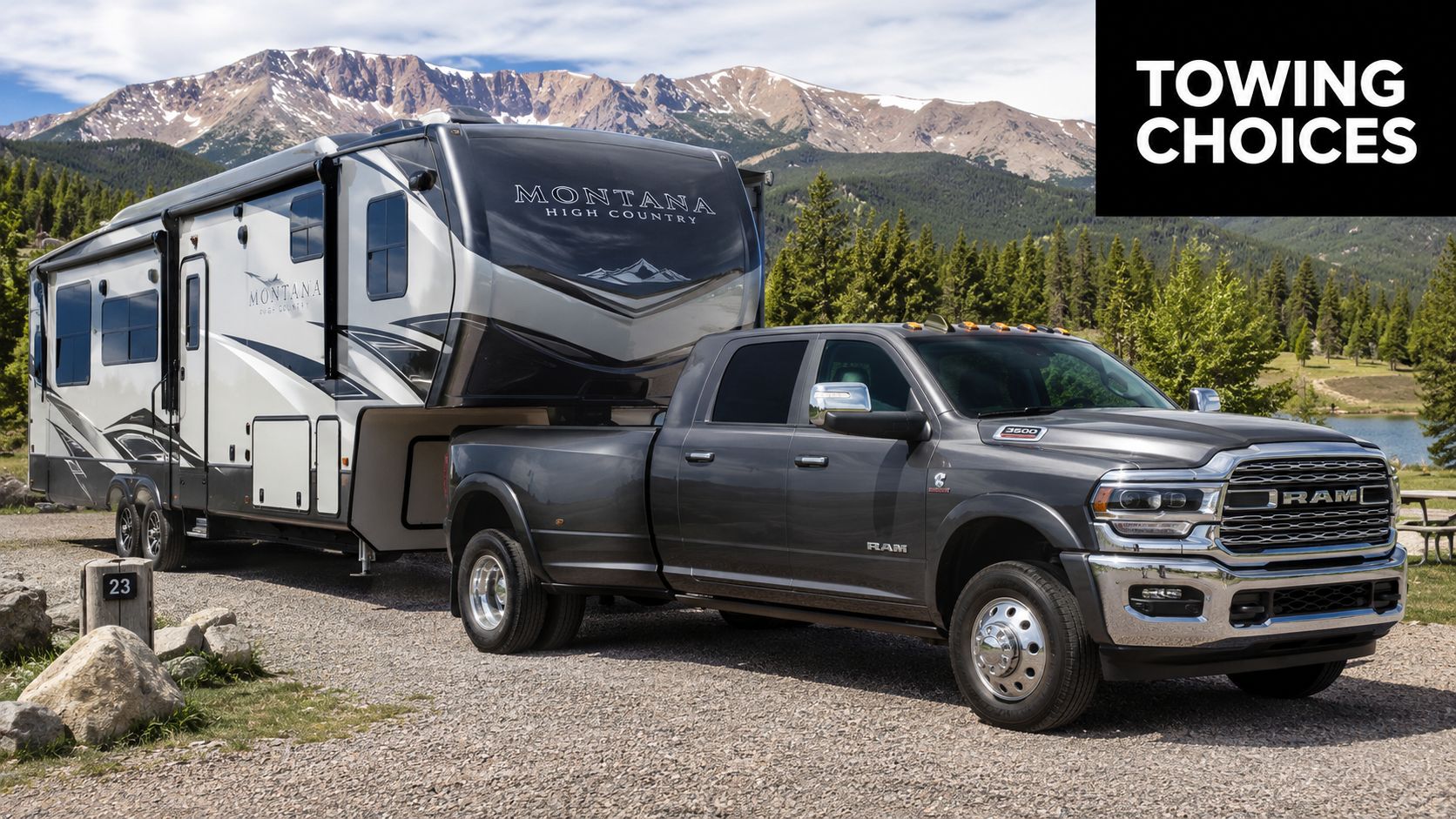
Your Truck Your Trailer and the Big Question in Between
A new truck owner usually asks the same thing in the service lane or on the lot. “Can't I just get whatever lets me tow this thing safely and still use my bed?”
That's a fair question. The confusion comes from the fact that all three terms get mixed together in casual conversation. A fifth wheel hitch is one system. A gooseneck hitch is another. A fifth wheel gooseneck hitch setup often means someone is trying to make one style work with the other, usually through an adapter or a conversion-style solution.
Where people get tripped up
The hitch choice affects more than towing.
- Ride quality: Some setups feel smoother on long highway pulls.
- Bed usability: Some let you reclaim your truck bed more easily when the trailer is disconnected.
- Hookup tolerance: Some are less forgiving when your truck and trailer aren't lined up on level ground.
- Long-term stress: Some shortcut solutions can create frame or warranty concerns that don't show up right away.
Most towing mistakes don't start at highway speed. They start in the driveway, at the campsite, or during a hurried hookup.
That's why it helps to slow the conversation down. Start with the trailer you own, the truck you drive, and where you'll use both. A dedicated RV traveler usually lands in a different place than someone who needs a flat truck bed during the week for work or ranch use.
The Fifth Wheel Hitch Explained
A fifth wheel hitch uses a jaw-and-pin connection mounted in the truck bed. If you've seen the coupling setup on a semi-truck, the idea is very similar. The trailer carries a king pin, and the hitch in the bed closes around it with locking jaws.
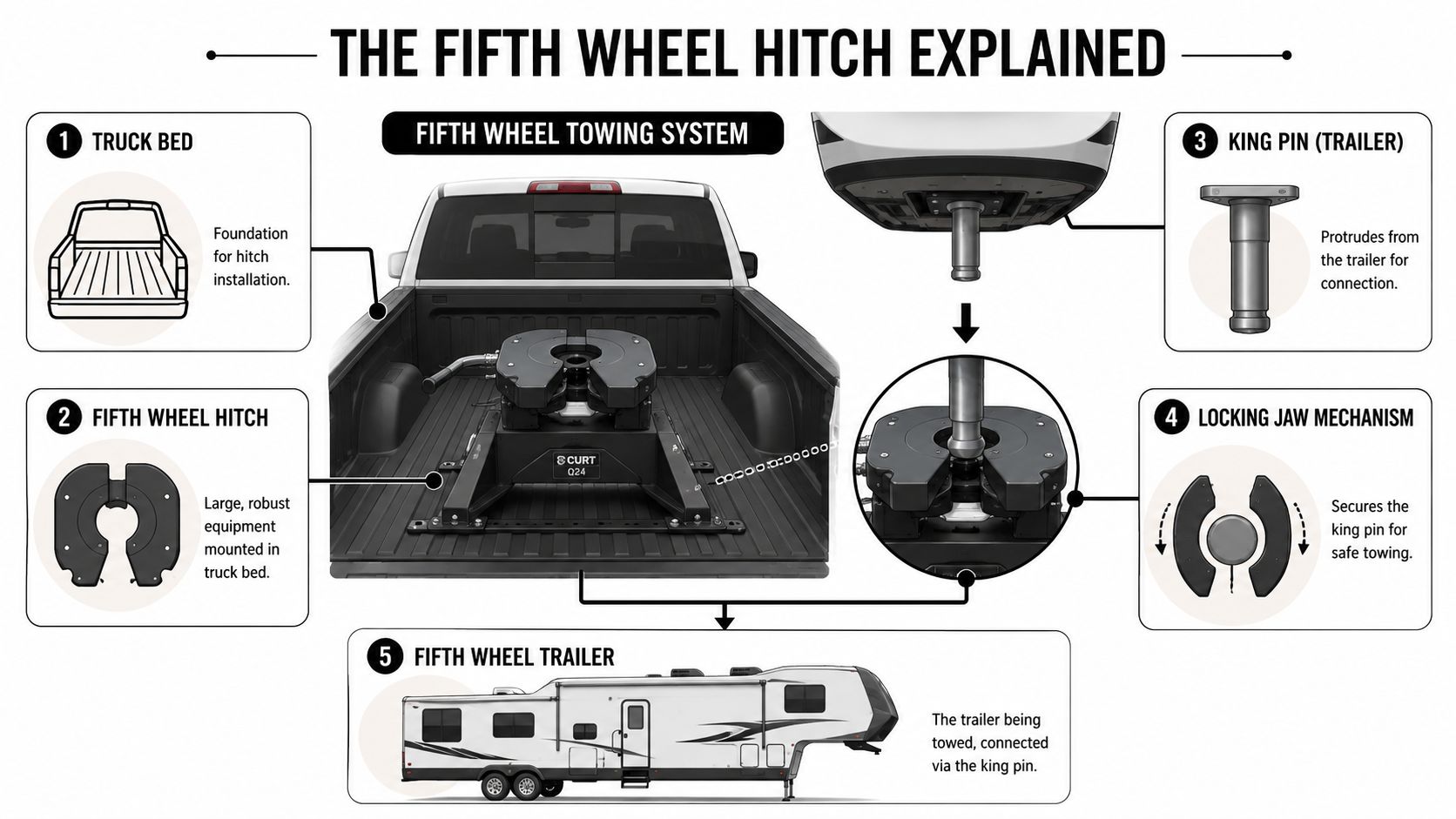
How the connection works
The hitch itself sits over the rear axle area in the truck bed. As you back under the trailer, the king pin slides into the hitch head and locks into the jaw mechanism. That wide contact area is a big reason many RV owners prefer this setup.
The design helps place trailer weight where the truck can control it better. For a large camper, that usually translates to steadier handling and a more settled ride than a basic ball-and-coupler arrangement.
If you want a visual primer on the components, this overview of what a fifth wheel hitch is gives a good foundation before you shop parts or schedule installation.
Why RV owners choose it
For big campers, this is the setup generally understood when the trailer is called “a fifth wheel.” It's the standard arrangement for towing large RVs because it improves stability and ride comfort, and published hitch guides commonly place fifth wheel towing capability in the 20,000–25,000 lb range, while gooseneck systems are often rated higher for heavier-duty work applications, according to Lippert's comparison of fifth wheel and gooseneck hitches.
That difference in purpose matters. A fifth wheel hitch is built around recreational travel. It's a strong fit for large RVs, campers, and toy haulers where smoother handling matters.
What owners often don't expect
A fifth wheel hitch takes up real space in the truck bed. It's not a small piece of hardware you forget is there. When you're towing often, that tradeoff is easy to live with. When you need the truck bed open all week, it starts to matter more.
For Utah drivers pulling through mountain grades, wind, and lane changes on busy stretches of I-15, the comfort and control of a traditional fifth wheel setup are often the reasons people accept that compromise.
Understanding the Gooseneck Hitch
A gooseneck hitch looks simpler because it is simpler. Instead of a large jaw assembly in the truck bed, the truck carries a ball mounted in or under the bed. The trailer has a coupler that drops over that ball and locks in place.
Why truck owners like it
The biggest everyday advantage is bed access. Many gooseneck setups let you remove, flip, or stow the ball so the bed is much more usable when you're not towing. If the truck has to handle building supplies, tools, hay, motorcycles, or weekend furniture runs, that clean bed matters.
That's why gooseneck systems are common with people who use one truck for several jobs.
Where it fits best
Gooseneck towing comes from the work side of the towing world. It has deep roots in agricultural, commercial, and livestock hauling, where payload and bed utility often matter more than ride smoothness.
Published guides commonly describe gooseneck systems as often rated above recreational fifth wheel setups, and in heavy-duty applications they can exceed 30,000 lb, as noted in the Lippert guidance cited earlier. That doesn't make a gooseneck automatically “better” for RV towing. It means it's aimed at a different kind of hauling.
The plain-language distinction
If you strip away the marketing language, the choice usually looks like this:
- Fifth wheel hitch: Better aligned with large RV travel and towing comfort.
- Gooseneck hitch: Better aligned with work-truck flexibility and heavy-duty commercial style use.
A lot of confusion starts when shoppers try to blend those two jobs into one setup. That's where the fifth wheel gooseneck hitch discussion usually begins. People want the open bed of a gooseneck and the trailer style of a fifth wheel. Sometimes that can be handled well. Sometimes it creates a compromise you feel every trip.
Head to Head Comparison for Utah RVers
Utah towing adds one layer many general articles skip. You're often connecting and disconnecting on uneven ground. Highway manners matter, but so does what happens when one side of the truck is lower than the other at the campground.
The comparison that matters in real life
Some fifth-wheel hitches are limited to as little as 6° of side-to-side tilt for coupling, which can make connection difficult on uneven ground, according to this etrailer discussion on hitch angle limits. That's the kind of detail owners usually discover after they've already bought equipment.
If your driveway slopes, or your campsite pad isn't level, a setup that feels excellent on the highway can still be frustrating during hookup.
Practical rule: Don't judge a hitch only by how it tows. Judge it by how it couples, uncouples, and behaves when the site is crooked.
For a broader side-by-side discussion, this fifth wheel vs gooseneck comparison is a useful companion if you're narrowing your options.
Fifth Wheel vs Gooseneck Hitch Comparison
| Feature | Fifth Wheel Hitch | Gooseneck Hitch |
|---|---|---|
| Primary use | Built around large RVs, campers, and toy haulers | Common in commercial, agricultural, and livestock hauling |
| Connection style | Jaw-and-pin connection in the truck bed | Ball-and-coupler connection in the truck bed |
| Ride feel | Usually smoother and more settled for RV travel | Often more utilitarian, with comfort taking a back seat to versatility |
| Truck bed space when not towing | Hitch assembly occupies bed space until removed | Bed is often easier to clear and use |
| Hookup on uneven ground | Can be less forgiving, especially with side tilt limits during coupling | Often feels more tolerant in imperfect alignment situations |
| Best fit for | Dedicated RV owners prioritizing comfort and stability | Owners who need truck-bed utility and tow non-RV trailers too |
| Main caution | Bed space and hitch bulk | Not all fifth wheel trailers should be adapted to this style |
How this plays out around Utah
If your camping involves paved RV resorts and level storage lots, a traditional fifth wheel setup is easier to love. If your routine includes sloped residential streets, uneven gravel lots, and quick hookups before daylight, convenience starts to matter more.
The trick is not to confuse forgiving hookup geometry with better overall RV towing. They aren't the same thing. A system can be easier to connect on uneven ground and still be the wrong long-term match for your trailer.
The Gooseneck Adapter Dilemma
Many owners try to split the difference. They already have a gooseneck ball in the truck, or they want the bed clear when the trailer is parked. Then they see an adapter that lets a fifth wheel trailer connect to that gooseneck system.
On the surface, it sounds smart. One truck. One bed. More flexibility.
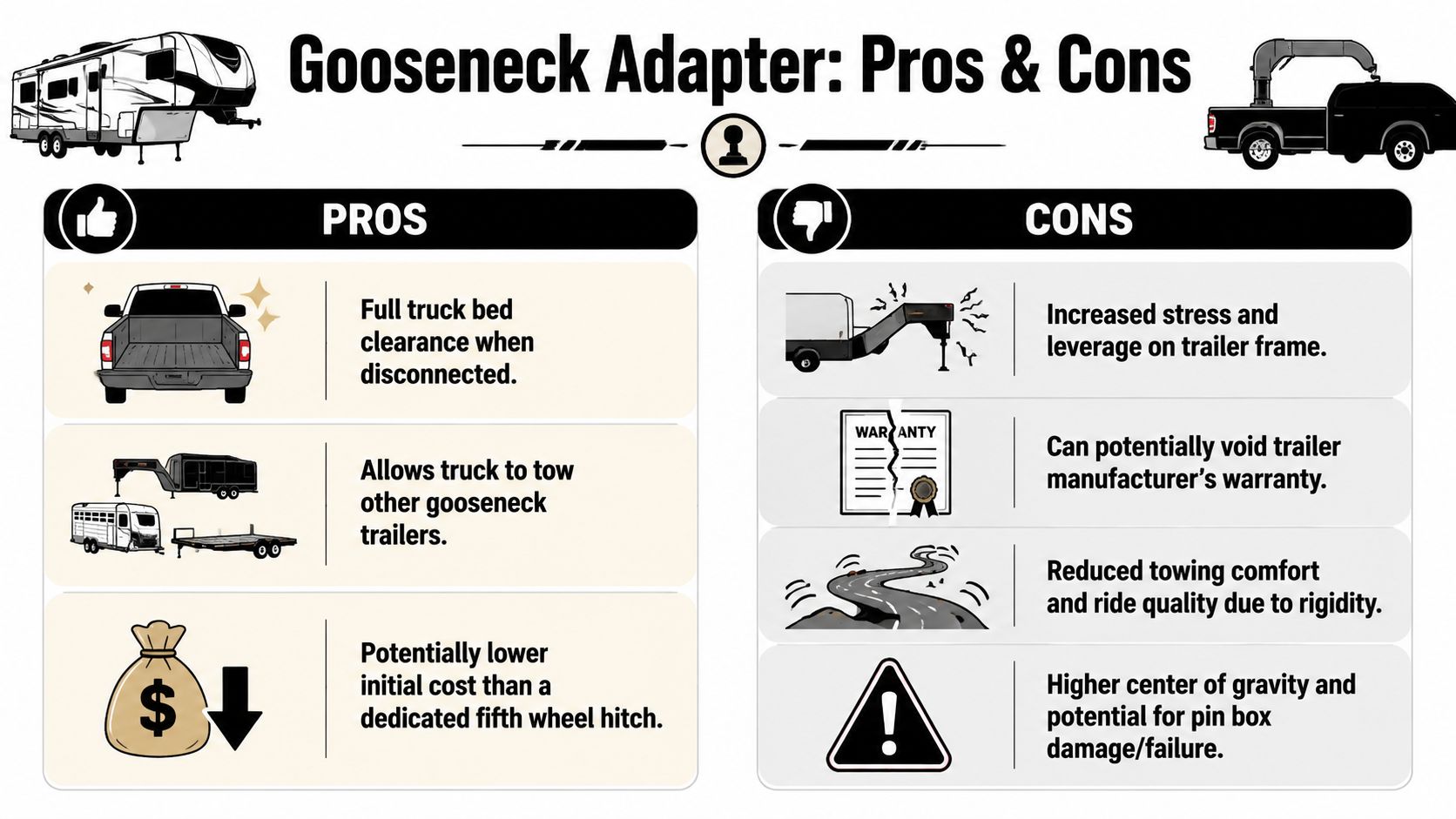
Why adapters make people nervous
A traditional fifth wheel hitch pulls closer to the trailer frame. A gooseneck adapter changes that load path. The force sits lower, and that changes how the force is applied to the pin box and trailer frame.
CURT's educational material notes that a fifth wheel can be pulled with a gooseneck hitch if the correct adapter and capacity are used, but it also warns that this setup can add stress to the trailer structure and may create warranty concerns, as explained in CURT's guide to gooseneck adapters for fifth wheel towing.
The real tradeoff
The appeal is easy to understand:
- Cleaner truck bed: You get more usable space when the trailer is disconnected.
- One-truck flexibility: The same truck may handle other gooseneck trailers too.
- Quick solution: It can look like the fastest path when truck and trailer don't already match.
But the downside is serious.
- Frame stress: The adapter can place added force on the pin box and surrounding structure.
- Warranty risk: Some RV manufacturers may void the frame warranty if an adapter is used.
- False confidence: A setup can “work” for a while and still be hard on the trailer over rough roads or repeated tight maneuvers.
If you're buying a used fifth wheel with an adapter already installed, don't assume that means the setup is approved by the trailer manufacturer.
When caution matters most
This issue comes up constantly in the used-RV market. A previous owner may have chosen convenience over long-term compatibility. The trailer may tow fine on a short test drive, yet the bigger question is whether the frame was designed for that load path in the first place.
That's why the fifth wheel gooseneck hitch conversation can't stop at “yes, you can do it.” The better question is whether you should keep doing it over time.
Professional Installation Safety and Maintenance
Once you've picked the right direction, installation becomes the next big safety decision. This isn't cosmetic accessory work. A hitch is a structural towing component fastened to your truck in a way that has to perform under braking, turning, road shock, and constant load.
Why DIY can get risky fast
A typical fifth wheel hitch can weigh 100 to 200+ lbs, and some lightweight or adapter-style systems can be much lighter, with one manufacturer citing a 37-lb component compared with traditional 150+ lb assemblies. Some premium hitches are also SAE J-2638 certified, and that matters because the standard is used for fifth-wheel and gooseneck hitch testing, according to Gen-Y Hitch's product and certification information.
The weight alone tells part of the story. Handling a large hitch body in a truck bed isn't a simple one-person garage job for most owners. The bigger issue is fit and torque. Rail placement, bracket alignment, hardware torque, and truck-specific mounting points all have to be right.
And even with a certified hitch, your real towing limit is still controlled by the lowest-rated component in the system.
What to inspect before every trip
A good pre-trip routine doesn't take long, but it needs to be consistent.
- Check the connection: Make sure the hitch jaws or coupler are fully engaged and secured.
- Inspect mounting hardware: Look for looseness, corrosion, or movement where the hitch attaches to the truck.
- Watch bed clearance: Confirm the trailer overhang and truck bed rails still have safe clearance in your loaded condition.
- Verify cables and lights: Breakaway cable, wiring, and trailer lights need a quick hands-on check, not just a glance.
If backing visibility is one of your weak spots, a guide to T1A Auto RV camera solutions can help you sort through camera styles that make hitching less stressful.
Maintenance that owners skip
A hitch doesn't ask for constant attention, but it does need regular attention.
- Clean contact points: Dirt, rust, and dried grease can interfere with proper coupling.
- Lubricate where required: Follow the hitch manufacturer's instructions for jaws, plates, or ball contact surfaces.
- Retorque after initial use: New installs should be checked after early trips because hardware can settle.
- Pay attention to handling changes: If towing feel changes, investigate it. Don't assume it's just wind or road surface.
If you've dealt with movement or instability before, this article on RV sway control helps explain how hitch setup and trailer behavior can interact on the road.
Your Next Steps with Motor Sportsland
By the time most owners sort through all this, the choice usually becomes clearer.
If you're towing a large RV regularly and want the setup designed around recreational travel, a traditional fifth wheel hitch is usually the cleaner answer. If your truck has to stay useful for work, ranch tasks, or other trailers when the RV is parked, a gooseneck-centered setup may fit your lifestyle better. If you're considering an adapter, slow down and verify trailer compatibility before you treat convenience as a long-term plan.

A simple buyer profile check
- You're a dedicated RVer: Prioritize towing comfort, stable manners, and trailer compatibility.
- You use the truck for multiple jobs: Prioritize bed access, but be realistic about trailer design and adapter limits.
- You camp on uneven sites often: Don't ignore hitching geometry. That issue matters more in daily use than many articles admit.
The safest hitch is the one that matches the trailer, the truck, and the way you actually camp. Not the one that sounds most convenient in a forum post.
Motor Sportsland has served Utah RV owners for over 55 years from Millcreek and Spanish Fork. If you want help comparing fifth wheels, checking truck compatibility, or scheduling hitch installation and service, you can browse inventory by floorplan and weight, visit our Salt Lake City area showroom, or talk with our service team about the right setup for your truck and trailer.
Ready to sort out your hitch setup with real, truck-and-trailer-specific advice? Visit Motor Sportsland to browse fifth wheels, explore current inventory, or schedule service with a team that works with Utah RV owners every day.
FAQ
What is the difference between a fifth wheel hitch and a gooseneck hitch
A fifth wheel hitch uses a jaw-and-pin connection in the truck bed and is commonly used for large RVs. A gooseneck hitch uses a ball-and-coupler connection and is more common in commercial, agricultural, and livestock hauling.
Is a fifth wheel or gooseneck better for RV towing
For most large RVs, a traditional fifth wheel hitch is the standard choice because it's built around stability and ride comfort. A gooseneck may fit better if truck bed usability is a top priority, but trailer compatibility matters.
Can I tow a fifth wheel with a gooseneck adapter
Sometimes, yes. But adapter use can add stress to the pin box and trailer frame, and some manufacturers may void the frame warranty. Always verify trailer approval before using one long-term.
Why is hitching on uneven ground such a big deal
Because coupling limits aren't the same as towing limits. Some fifth-wheel hitches have limited side-to-side tilt during hookup, which can make connecting difficult on sloped driveways or uneven campground pads.
Does hitch weight matter
Yes. Hitch weight affects installation, removal, and truck bed usability. It also matters for safe handling during installation. Capacity and certification matter too, but the whole tow chain must be evaluated together.
What does SAE J-2638 mean on a hitch
It means the hitch has been tested to a recognized standard used for fifth-wheel and gooseneck hitch testing. That's a good signal, but your safe towing setup is still limited by the lowest-rated component in the system.
