
How Much Do Travel Trailers Weigh? a Utah Buyer's Guide
Most travel trailers weigh between 3,000 and 8,000 pounds on average when you're shopping the mainstream market, but that number is only the starting point. What matters for safe towing in Utah is the trailer's real loaded weight, its tongue weight, and whether your SUV or truck can handle those numbers on steep grades, high-altitude roads, and windy stretches around the Wasatch Front.
A lot of first-time buyers come to our Salt Lake City area showroom thinking the hard part is choosing the floorplan. Then they step into a bunkhouse with a slide, everyone picks a favorite bed, and the question that decides everything comes next. What are you towing with?
That's not a buzzkill question. It's the question that keeps your first trip to Jordanelle, Bear Lake, or down to southern Utah fun instead of stressful. A trailer that feels roomy and comfortable on the lot can be the wrong fit if your vehicle is already close to its limits before you add people, coolers, bikes, propane, and campground gear.
We've helped Utah families sort through this for a long time, and the same pattern shows up again and again. Buyers who understand weight early make better choices, tow more confidently, and enjoy their RV more. The goal isn't to buy the lightest trailer on the lot. It's to buy the right one for your vehicle, your camping style, and the roads you drive.
Your Dream Trailer Is Waiting But Can Your Truck Handle It
A family walks in on a Saturday, looking for their first trailer. They've done some homework, they know they want bunks, and they've got a summer trip in mind. Then they find the one. It has the big dinette, a roomy kitchen, and a slide-out that makes the whole living area open up. The kids are already claiming beds before the parents have even stepped back outside.
That's usually when one of us asks about the tow vehicle.
It changes the conversation fast, but in a good way. A trailer can feel perfect inside and still be a poor match outside. Utah makes that mismatch show up quickly. A setup that seems fine on a flat test drive can feel very different heading up Parley's Canyon or pulling through mountain wind on the way to Bear Lake.
The trailer buying process gets easier once you stop asking only, “Do we like this layout?” and start asking, “How will this feel behind our vehicle for three hours?”
That's why weight matters so much. It affects acceleration, braking, stability, hitch setup, and driver confidence. It also affects where you shop. If your vehicle has modest towing capacity, your search should stay focused on lighter single-axle and smaller tandem-axle models. If you have a heavier-duty tow vehicle, your options widen, but payload and hitch setup still matter.
The good news is this isn't guesswork. Once you understand the main weight terms and know where to find the actual numbers, shopping gets much simpler.
Decoding RV Weight Lingo A Simple Guide
RV weight terms sound technical at first, but they get much easier once you sort them into a few simple buckets. At the dealership, this is usually the point where first-time buyers realize they have been looking at only one number, usually dry weight, when they really need to understand how several numbers work together.
A good way to organize it is this. Start with what the trailer weighs empty. Then look at how much weight you add. Then check what your vehicle must carry at the hitch. That order clears up a lot of confusion.
Start with the trailer empty
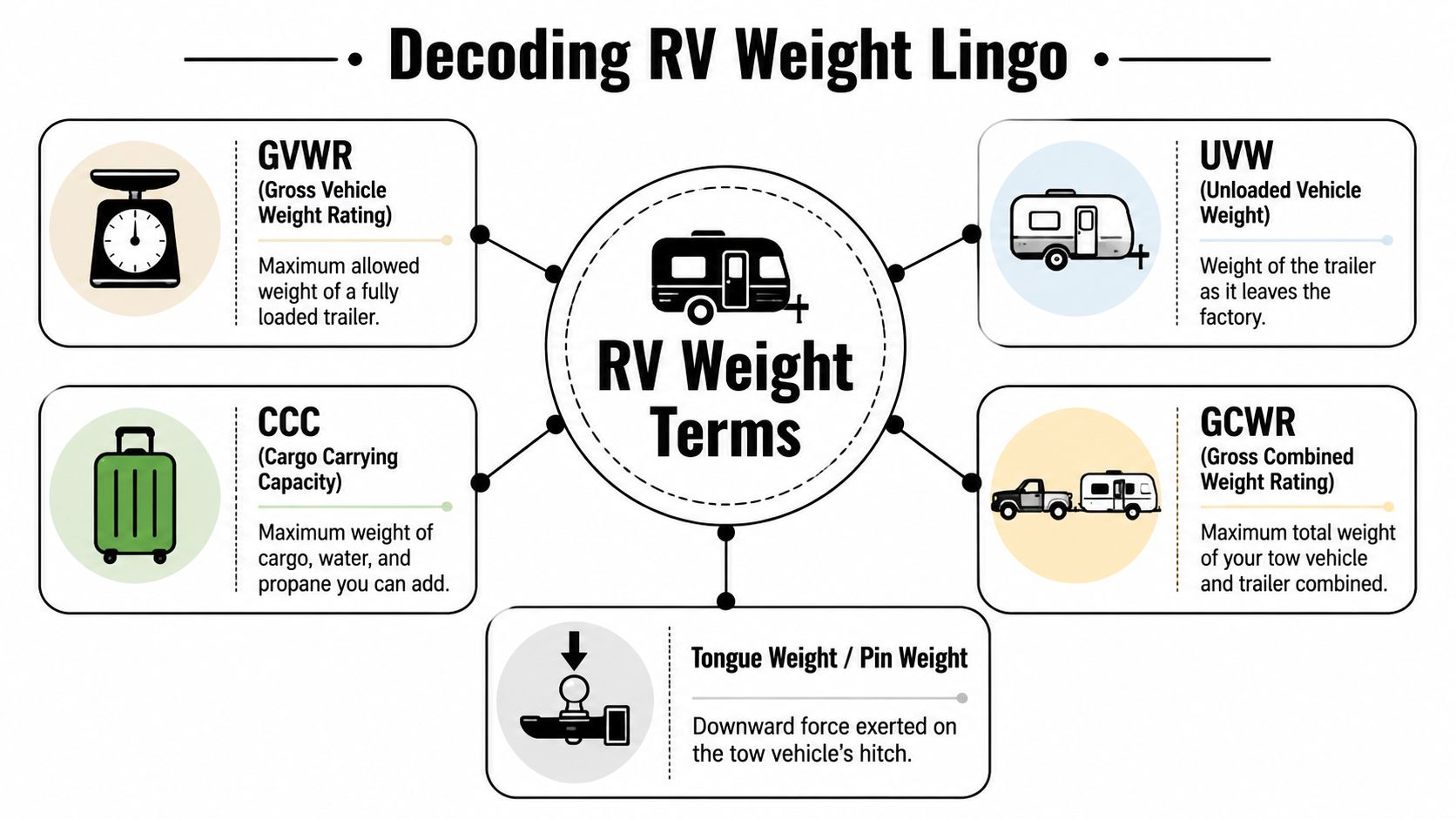
UVW, often called dry weight or unloaded vehicle weight, is the trailer as it leaves the factory. It is a baseline, not a camping-ready number. Factory options, dealer-installed equipment, propane, batteries, water, food, and gear can all change what the trailer weighs by the time you head out of Salt Lake City for a weekend in the mountains.
If you want a closer look at that label, our guide to RV dry weight and what it really means gives more detail.
Add what goes into real camping
CCC, or cargo carrying capacity, is how much weight you can safely add to the trailer. That includes clothing, cookware, chairs, tools, food, water, propane, and all the small items that seem harmless until they add up.
GVWR, or gross vehicle weight rating, is the maximum the fully loaded trailer can weigh. Once your trailer reaches that limit, you are out of room on the trailer side, even if your truck still has towing capacity left on paper.
That distinction matters in Utah. A trailer that feels acceptable on flat roads can feel heavier climbing long grades at altitude, especially when it is loaded with water, bikes, and a full family's gear.
The combined number
GCWR, or gross combined weight rating, applies to the tow vehicle and trailer together. This tells you the maximum allowed weight of the whole rig rolling down the road.
For a first-time buyer, GCWR helps answer a simple question. After you load passengers, cargo in the truck, the hitch, and the trailer itself, is the entire setup still within the vehicle maker's limits?
The number buyers miss most often
Tongue weight is the downward force the trailer puts on the hitch ball. Your tow vehicle does not just pull that weight. It also carries part of it.
That is why a half-ton truck or SUV can look fine by tow rating and still run into trouble with payload. Add two adults, kids, a cooler, camping supplies in the bed, and hitch hardware, and the remaining payload can disappear faster than expected. Around here, we see this most often with shoppers comparing lightweight bunkhouses to midsize SUVs or family-loaded half-tons.
Tongue weight typically falls between 10% and 15% of the total trailer weight according to this camper trailer size guide discussing tongue weight and towing stability.
Practical rule: A trailer can sit under the published tow rating and still be the wrong match if hitch weight, passengers, and cargo push the vehicle beyond its payload or axle limits.
Here is the plain-English version:
- UVW or dry weight: The trailer's starting weight before your camping gear goes in.
- CCC: How much weight you can add to the trailer.
- GVWR: The trailer's maximum allowed loaded weight.
- GCWR: The maximum allowed weight of the vehicle and trailer together.
- Tongue weight: The share of trailer weight pressing down on the hitch.
Once you know what each number is measuring, the sticker starts reading less like alphabet soup and more like a checklist for a safe match.
Typical Travel Trailer Weights by Type and Floorplan
The answer to how much do travel trailers weigh depends heavily on size, layout, and equipment. A small couple's trailer and a family bunkhouse may both be called travel trailers, but they live in very different weight classes.
One broad guide comes from CURT's trailer weight reference, which notes that travel trailers can range from 1,200 pounds for compact small-unit models to nearly 9,000 pounds for large, fully equipped luxury units, with the average dry weight for a large travel trailer settling at 6,700 pounds in that category of trailer sizes in their travel trailer weight guide.
What floorplans usually mean for weight
A short, simple trailer usually stays lighter because it has less structure, fewer cabinets, and often fewer tanks and appliances. Add a slide-out, larger kitchen, bigger holding tanks, heavier furniture, or dual axles, and weight climbs quickly.
That's why the same shopper can compare two trailers of similar length and still see a meaningful difference on the sticker. Features matter. Axles matter. Construction choices matter.
Here's a practical shopping table for first-pass comparisons.
| Trailer Type | Typical Length | Average Dry Weight (lbs) | Example Model Type |
|---|---|---|---|
| Compact single-axle trailer | Small footprint | 1,200 to 3,900 | Couples camper or simple rear-bed model |
| Lightweight small trailer | 22 feet or less | 2,800 | Small family or couple-friendly trailer |
| Mainstream travel trailer | Mid-size range | 3,000 to 8,000 | Rear living, bunkhouse, or slide model |
| Large travel trailer | Approximately 20 feet or longer | 6,700 | Larger family trailer with more features |
| Fully equipped luxury travel trailer | Large floorplan | Nearly 9,000 | Premium bunkhouse or residential-style model |
A few common categories shoppers compare
- Lightweight trailers: These work well for many midsize SUVs and lighter trucks, but you still need to check payload and hitch weight.
- Bunkhouse models: Popular with families because they pack in more sleeping capacity. They also tend to add weight with extra cabinetry, larger dinettes, and bigger refrigerators.
- Toy-hauler style trailers: These can change dramatically once cargo is loaded. If you bring motorcycles, side-by-sides, or other heavy equipment, the trailer's empty weight is only part of the story.
- Luxury travel trailers: Full kitchens, larger tanks, and slide-outs make camping comfortable, but they move you firmly into heavier towing territory.
Shoppers often focus on length because it's easy to picture in a campsite. Weight matters more when you're choosing the tow vehicle match.
If you're browsing online, filters are useful. Looking by floorplan alone can lead you into trailers your vehicle shouldn't tow comfortably. Looking by weight first usually saves time and frustration.
How to Find a Trailers True Loaded Weight
You find a trailer that looks perfect on the lot. Then you load two propane tanks, a battery, fresh water, camp chairs, food, bedding, and the kids' bikes. By the time you head up Parleys Canyon or toward Logan, you are towing a very different number than the one printed in the brochure.
The brochure weight is only a starting point. Your real towing decision should be based on the trailer's weight loaded the way you camp.
Read the sticker before you read the sales sheet
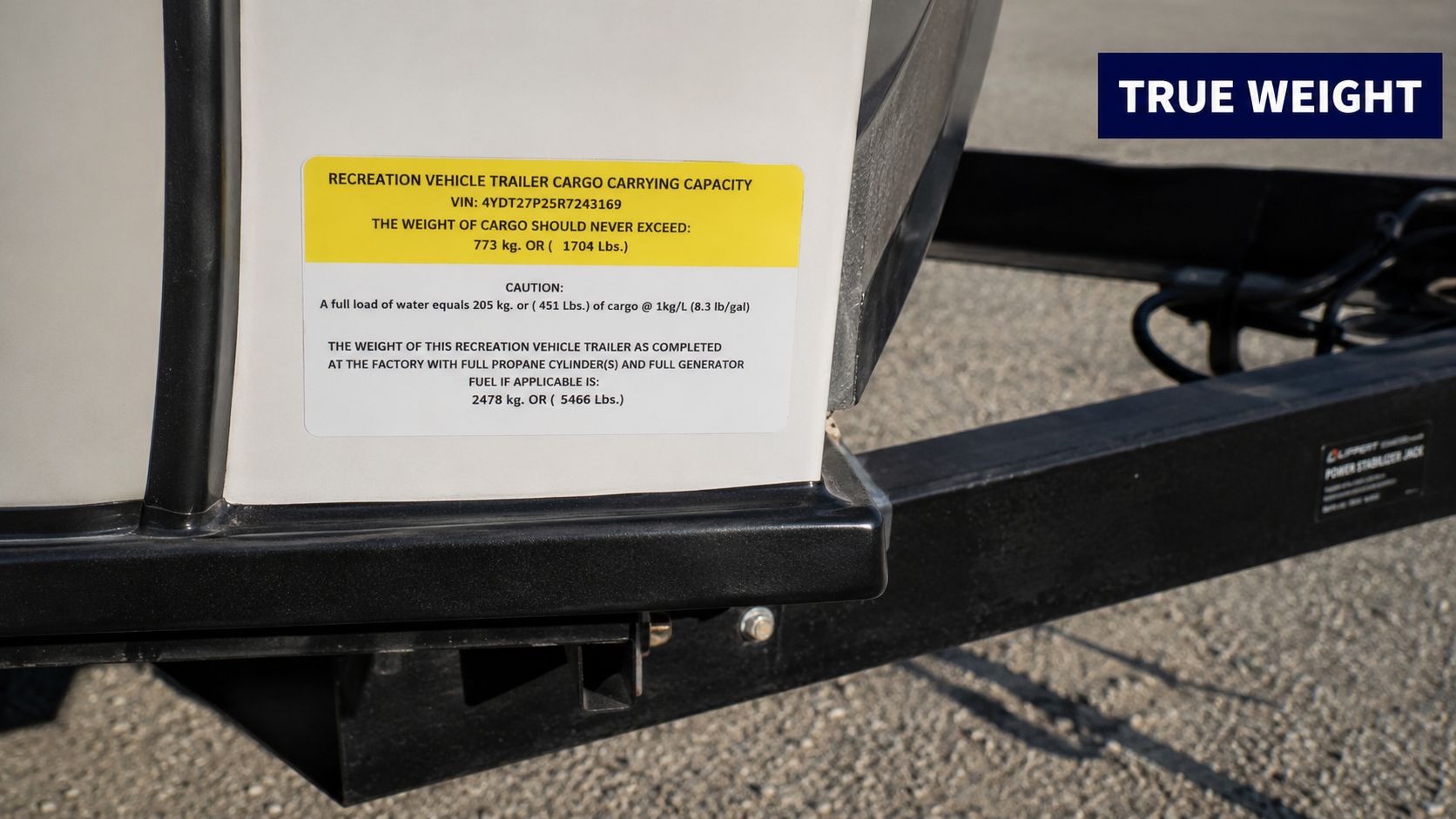
The factory label on the trailer usually gives you the best baseline because it reflects that specific unit as built, not a generic model description. Start there. Look for UVW and cargo capacity, then add the items that tend to show up on every real camping trip.
That list grows fast. Batteries, propane, hoses, wheel chocks, leveling blocks, tools, cookware, bedding, and groceries all add weight. Dealer-installed accessories can change the number too.
New buyers also miss how that loaded trailer affects the vehicle through the coupler. If that part still feels fuzzy, our guide on what hitch weight means for trailer owners connects trailer weight to what your truck or SUV is carrying.
Use a scale if you want the real number
The clearest answer comes from weighing the trailer after you have packed it for a normal trip. That means the same propane, the same gear, and the same water you would carry on a weekend in Moab or a longer haul through Utah's mountain passes. Real towing happens at altitude, on grades, and in crosswinds. Loaded weight matters more there than it does on paper.
A public truck scale makes this pretty simple. Pull on, follow the attendant's instructions, and keep the printout. Many first-time owners are surprised by how easy the process is once they do it once.
A practical routine looks like this:
- Load for a normal trip: Pack food, clothing, chairs, tools, propane, and the gear you always bring.
- Decide how much water you travel with: A full or partial fresh tank can change your weight more than you expect.
- Bring the tow vehicle in trip form too: Passengers, coolers, and cargo in the truck or SUV affect the full setup.
- Weigh and save the ticket: That printout gives you a real baseline you can use the next time you add gear or change your setup.
A short visual can help if you've never used a scale before.
Why this matters so much
Dry weight is a little like weighing an empty suitcase before a trip. It tells you something, but not the number that matters at the airport. Your trailer works the same way.
That difference shows up quickly in Utah. A setup that feels acceptable on flat roads can feel strained on a long climb or require more attention on the way back down. At our Salt Lake City dealership, this is one of the first reality checks we walk through with buyers. We match trailers to how they will be used, with the family, gear, and terrain they will really tow in, not just the headline rating on a spec sheet.
A scale ticket turns guesswork into a real plan. That is a much better place to start.
Matching Your Trailer to Your Tow Vehicle Safely
You find a trailer your family loves. The bunks work, the layout feels right, and you can already picture weekends at Jordanelle or a longer run down to Moab. Then the hard question shows up. Will your truck tow it with enough margin to feel stable on a climb through Parley's Canyon or a windy stretch of I-80?
That question trips up a lot of first-time buyers because the answer is rarely sitting in one bold number on the brochure.
Why the tow rating is only part of the story
Max tow rating gets the attention, but payload often decides whether the match works in real life. Payload is the weight your vehicle carries on itself. That includes passengers, cargo in the cab or bed, aftermarket accessories, and the trailer's tongue weight pressing down on the hitch.
A simple way to look at it is this. Towing capacity tells you what the vehicle can pull. Payload tells you what the vehicle can hold up.
Here's a common first-buyer example. A travel trailer that weighs around 5,000 pounds when loaded can put several hundred pounds of tongue weight onto the hitch, depending on how it is packed and balanced. Add two adults, a couple of kids, a cooler, camping gear, and maybe bikes in the truck bed, and a half-ton truck or SUV can run short on payload sooner than expected.
A better way to check the match
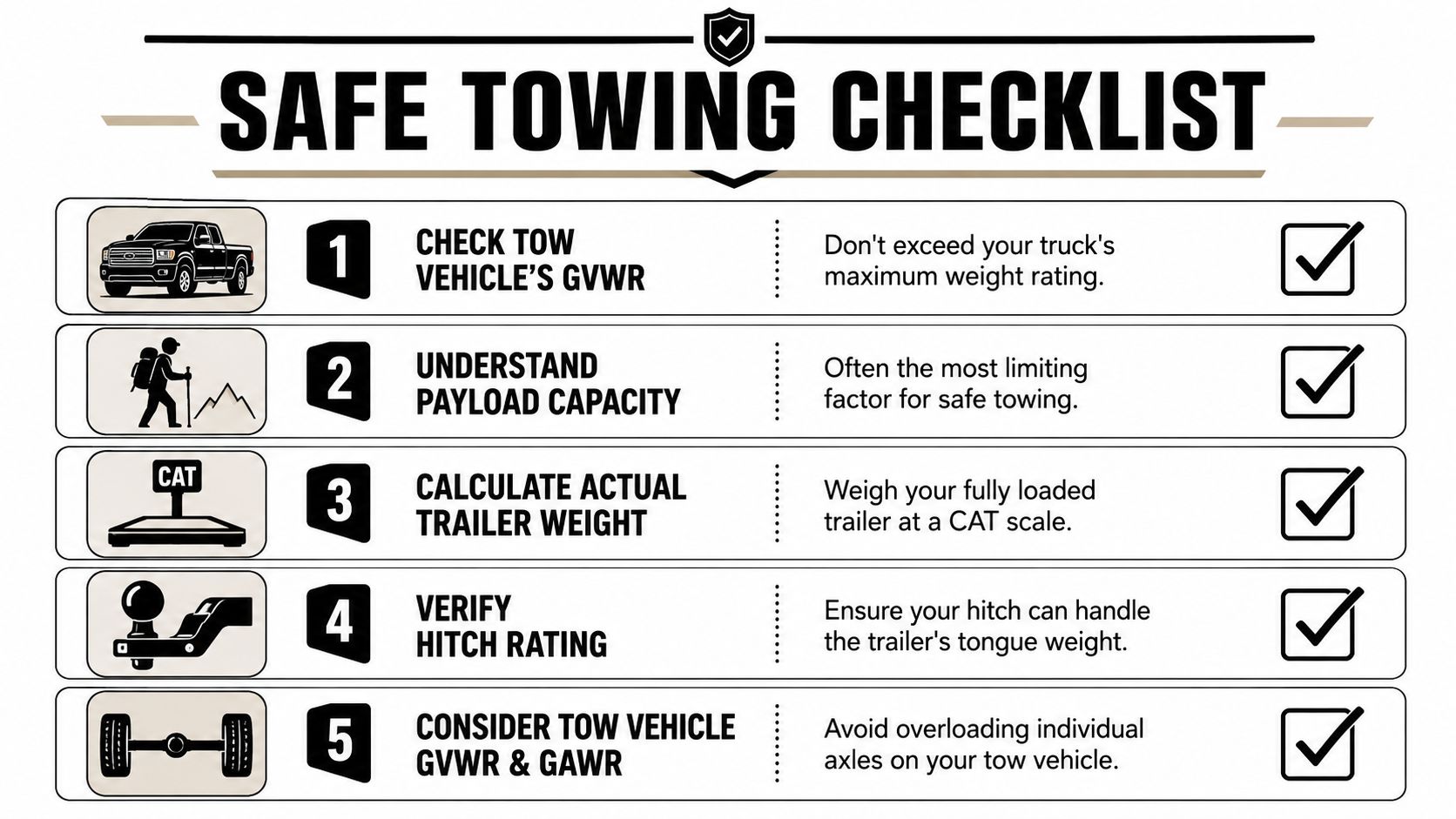
Start with the yellow payload sticker on the driver's door jamb. That sticker matters more than a generic online tow chart because it applies to your actual vehicle as equipped from the factory.
Then work through the setup in this order:
- Count people first: Every passenger uses payload.
- Add cargo in the vehicle: Coolers, tools, firewood, generators, and bed storage all count.
- Estimate loaded tongue weight: A trailer's hitch weight changes once propane, battery, food, and gear are on board.
- Check the hitch and receiver ratings: They need to support the load, not just the brochure number.
- Leave room for the kind of towing you do: Utah grades, altitude, heat, and crosswinds reward a setup with margin.
That last point matters more here than it does in flatter parts of the country. At higher elevation, your tow vehicle works harder and has less power in reserve. On a long climb, a pairing that looked fine on paper can start hunting for gears, running hotter, or feeling strained. On the way down, weight balance and trailer braking become a bigger part of driver confidence.
If you are still comparing vehicle choices, this guide to the best truck features to look for when towing an RV gives a practical framework beyond headline ratings.
What we check with buyers at the dealership
At our Salt Lake City dealership, we usually slow the conversation down and ask a few plain questions. Who is riding in the vehicle? What do you normally pack? Are you towing mostly around the valley, or do your trips include mountain passes and canyon roads?
Those answers change the recommendation.
A truck that can tow a trailer on paper may still be a poor match for a family of five with a full cargo area and regular mountain travel. A slightly lighter trailer, or a floorplan with less front storage, can produce a combination that feels calmer and easier to live with over a full season of camping.
Equipment that improves control
A few pieces of towing equipment make a noticeable difference:
- Weight distribution hitch: Helps transfer load more evenly and keeps the rig level.
- Brake controller: Lets the trailer brakes do their share of the stopping.
- Sway control: Helpful for longer trailers and windy travel days.
- Correct tire pressure: Important for both the tow vehicle and the trailer.
The goal is not to build a setup that barely passes a spec check. The goal is to build one that feels settled, predictable, and comfortable for the roads you drive.
That is the standard we use with first-time buyers. Match the trailer to your actual vehicle, your actual passengers, and your actual trip, and you start with a much safer combination.
Local Insights from Your Utah RV Experts
Utah towing has its own personality. A trailer that feels easy around the valley can feel very different once you point the hood toward the mountains.
What changes in the Mountain West
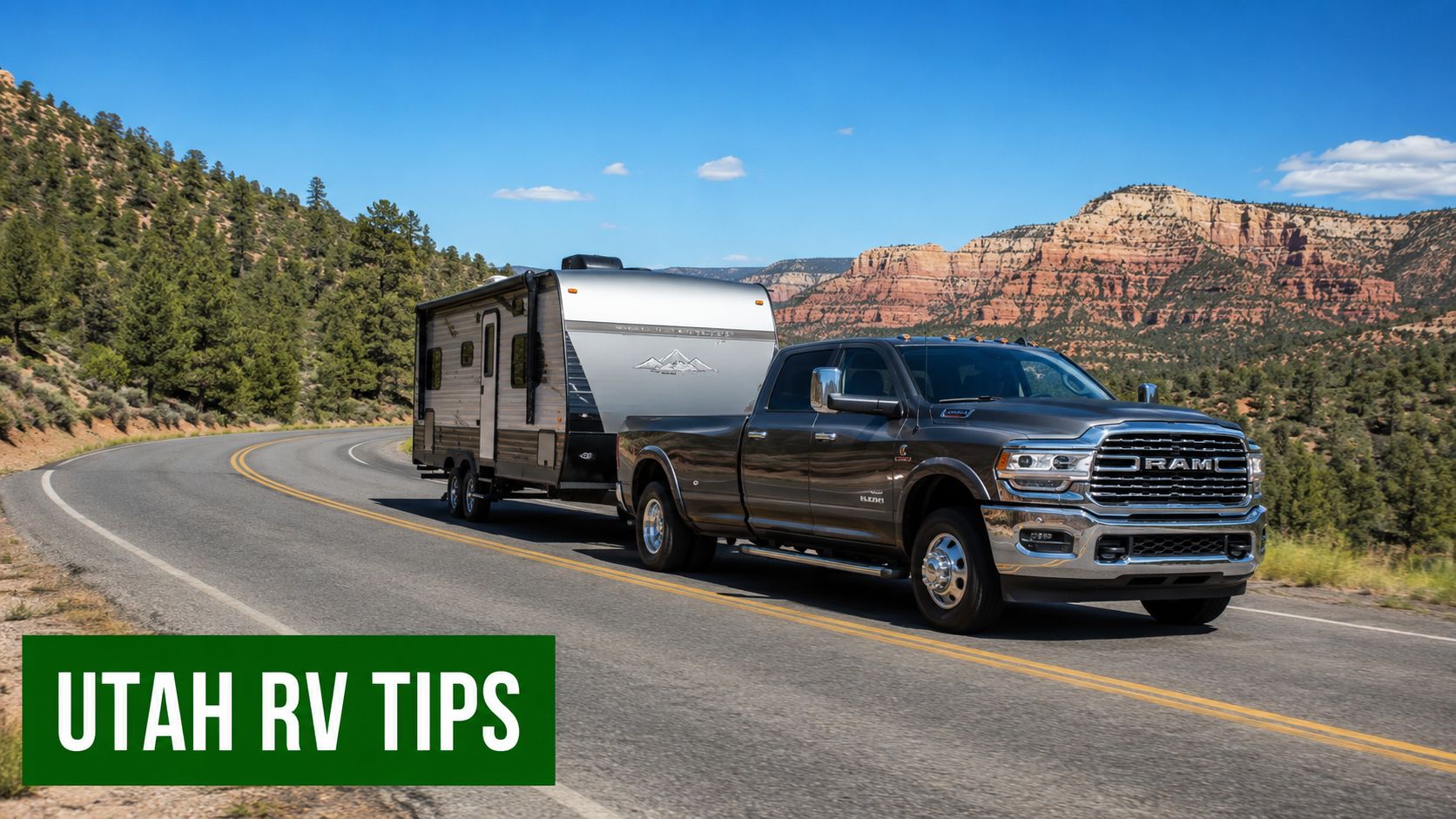
Higher elevation, sustained climbs, and longer descents all put more strain on the tow vehicle and make trailer balance more noticeable. A setup that feels relaxed on flat roads can start hunting for gears on a climb or feel more demanding under braking on the way down.
That's why we tell first-time buyers to think about where they camp, not just what they camp in. Trips to Bear Lake, Jordanelle, or up toward Sundance ask different things from your tow rig than a short haul on flatter ground.
Dealer-floor advice that holds up in real use
A few habits tend to serve Utah owners well:
- Leave yourself a comfort margin: Especially if you expect mountain driving, heat, or fully packed family trips.
- Pack deliberately: Don't let all the heavy gear collect in the wrong spot.
- Test the rig before the big vacation: A shorter local trip tells you a lot.
- Have the trailer checked before peak season: Brakes, tires, seals, and battery condition matter more after winter storage.
Mountain towing rewards conservative choices. The setup that feels a little overbuilt in the city often feels exactly right on a grade.
Owners who camp in Utah also deal with long storage stretches, cold-weather effects on batteries and seals, and early-season trips where systems haven't been used in months. That's another reason to get the weight and hitch setup right from the start. It removes one big variable from an already demanding environment.
Find Your Perfectly Matched Trailer Today
The families who enjoy their first season the most usually have one thing in common. They didn't chase the biggest trailer they could possibly tow. They chose the one that fit their real vehicle, real cargo, and real travel plans.
We've seen how that plays out. A first-time buyer starts with a long wishlist, narrows it to a realistic weight range, and picks a trailer that leaves breathing room in the tow setup. Their first trip goes smoothly. They arrive less tense, set up faster, and come back excited instead of wondering whether they bought too much trailer.
What to do next
If you're shopping now, take these steps before you commit:
- Check your vehicle sticker: Know your payload and tow limits from the actual vehicle, not a general brochure.
- Decide how you really camp: Weekend couple trips, full family camping, or toy-hauler cargo use all change what you need.
- Shop by weight first, floorplan second: This keeps your search grounded.
- Ask for the actual trailer sticker information: Don't rely only on broad category averages.
- Plan to weigh the rig after purchase: That gives you confidence before longer trips.
Good trailer shopping feels calmer
When the numbers work, the rest of the process gets more fun. You can focus on bunks, storage, kitchen layout, and camp-ready features without wondering whether your truck will hate you halfway to the campground.
If you want to keep researching before visiting, browsing current travel trailer inventory, used options, financing tools, and service resources can help you narrow the field before you're standing on the lot comparing floorplans. If you'd rather talk it through in person, bring your tow vehicle details and we can help you sanity-check the match before you make a decision.
A well-matched trailer doesn't just tow better. It changes the whole ownership experience.
Frequently Asked Questions About Trailer Weight
How much do travel trailers weigh on average
A typical travel trailer can land anywhere from lightweight single-axle models to much heavier family bunkhouses, so there is no single “normal” number that fits every shopper. The National Highway Traffic Safety Administration explains the weight ratings and loading limits that shape what a trailer really weighs in use, not just on paper, in its trailer safety guidance.
What is the lightest kind of travel trailer
Small teardrops, micro campers, and stripped-down couples trailers are usually the lightest options. The lightest models are popular with SUV owners, but Utah buyers still need to leave room for passengers, cargo, and the power loss that comes with towing at higher elevation. Camping World's guide to lightweight campers shows how these smaller categories differ.
Is dry weight enough to know if I can tow a trailer
Dry weight is a starting estimate. It leaves out batteries, propane, dealer-installed accessories, water, food, tools, and all the gear that somehow finds its way into every cabinet before a trip.
A better question is, “What will this trailer weigh on Saturday morning when we pull out of the driveway?”
How much can a loaded trailer weigh compared with dry weight
Loaded weight varies by how you camp. A couple heading to Bear Lake for a weekend usually adds less than a family packing bikes, chairs, a generator, extra water, and cold-weather gear for the Uintas.
The Federal Motor Carrier Safety Administration's cargo securement and weight safety resources are a useful reminder that added cargo changes more than the scale number. It also affects balance and handling. The safest approach is to estimate conservatively, then confirm on a public scale.
Does trailer length help estimate weight
Length can give you a rough clue, but it is a poor substitute for the sticker and the scale. Two trailers that are the same length can tow very differently if one has a slide-out, larger tanks, thicker construction, or heavier furniture.
Length works like shoe size. It tells you something, but not enough to guarantee a fit.
Why does the same size trailer sometimes weigh much more than another one
Construction and equipment explain most of the difference. Aluminum framing, tank capacity, slide rooms, axle size, countertops, appliances, insulation, and cargo capacity all affect total weight.
This matters a lot in Utah. Pulling through Parley's Canyon or climbing toward the mountains puts more strain on the tow vehicle than flatland driving, so a trailer that looks “close enough” on a spec sheet can feel much heavier on the road.
What should I do before my first big towing trip
Set the trailer up exactly the way you plan to camp, then weigh it. Check your truck's door-jamb payload sticker, confirm your hitch setup, and make sure tongue weight is not overloading the rear axle.
If you are unsure, bring your vehicle details to Motor Sportsland. Our Utah team can help you compare specific trailer numbers with your actual SUV or truck, which is usually much more useful than relying on a brochure alone.
