
Pop Up Camper vs Travel Trailer: Your 2026 Buying Guide

If you're staring at your driveway, your SUV, and a map of Utah campsites trying to decide between a pop-up camper and a travel trailer, you're asking the right question. This choice affects everything. Towing up Parley's Canyon, squeezing into storage in the Salt Lake Valley, sleeping comfortably near Bear Lake, and dealing with shoulder-season cold in the mountains all feel very different depending on which one you buy.
The short version is simple. A pop-up camper folds down small, tows lighter, and stores easier. A travel trailer gives you a fully enclosed RV with more comfort, better weather protection, and a much easier daily camping routine. Neither is automatically better. One is just a better match for your vehicle, budget, and Utah camping style.
We've helped a lot of local buyers sort through this exact decision. Some need something light enough for a family SUV and a tight side yard in Millcreek. Others want a hard-sided trailer that feels comfortable from spring through fall, with fewer compromises once they get to camp. If you're comparing pop up camper vs travel trailer, start with towing and storage. That's where the right answer usually shows up fast.
Introduction
A pop-up camper is a specific kind of travel trailer. It folds down into a compact box for towing, then expands at camp with collapsible walls. A travel trailer is the broader hard-sided category typically pictured when one thinks of a towable RV. That design split matters more in Utah than it does in flatter, milder places.
Here's my direct take. If you have a smaller tow vehicle, limited storage, and you mostly camp in fair weather, a pop-up deserves serious consideration. If you want comfort, quicker setup, better insulation, and a longer camping season, a travel trailer is the smarter buy.
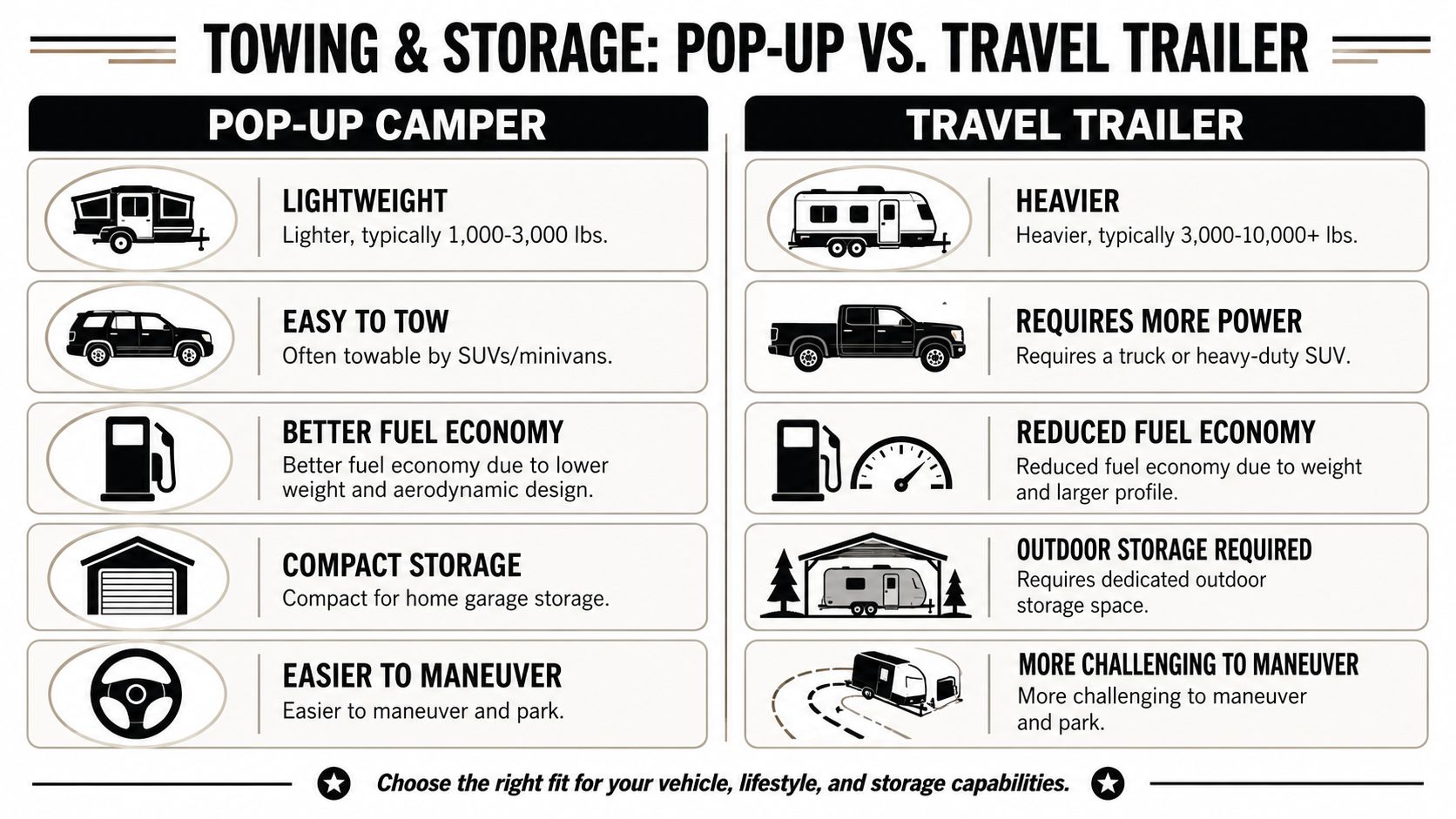
The difference in towing range explains a lot. Pop-up campers are often listed as needing less than 3,000 pounds of towing capacity, while travel trailers run from about 1,000 to over 10,000 pounds depending on size and equipment, according to RVshare's comparison of pop-up campers and travel trailers. That gap is why first-time buyers often start with a pop-up, then move into a travel trailer when they want more room and fewer tradeoffs.
Towing and Storing Your Camper in Utah
The first question isn't floorplan. It's whether your current vehicle and your current home setup can handle what you buy.
| Comparison point | Pop-up camper | Travel trailer |
|---|---|---|
| Basic design | Folding trailer with collapsible walls | Fully enclosed hard-sided towable RV |
| Towing demand | Often lighter-duty | Runs from lightweight to heavy-duty |
| Storage footprint | Compact when folded | Larger, full-size footprint all the time |
| Road profile | Lower and easier to see around | Taller, broader, and more affected by wind |
| Best fit | Smaller tow vehicles and tighter storage situations | Buyers who prioritize comfort and enclosed living space |
Why Utah towing changes the decision
Utah driving isn't gentle on tow setups. You've got canyon grades, crosswinds, elevation changes, and plenty of campgrounds that require backing into tighter spaces than buyers expect. A lightweight folding camper usually feels less intimidating for a first-time tower, especially when you're learning lane position, braking distance, and backing technique.
In practical terms, pop-up campers are often listed as requiring less than 3,000 pounds of towing capacity, while travel trailers can range from about 1,000 to over 10,000 pounds depending on size and equipment, as noted in this pop-up camper towing weight guide. That means a pop-up is often the safer conversation for households that already own an SUV or minivan and don't want to change vehicles just to start camping.
Practical rule: If buying the camper would force you to upgrade your tow vehicle too, the “cheaper” RV often stops being the cheaper decision.
A travel trailer can still be the right fit. But in Utah, it pays to be brutally honest about where you'll tow it. Pulling a hard-sided trailer through the Wasatch Front and into higher-elevation campgrounds asks more from your engine, transmission, brakes, and your own comfort behind the wheel.
Storage matters more in Salt Lake City than most buyers expect
A pop-up wins this category clearly. Folded down, it's easier to fit behind a fence, beside a garage, or into a tighter storage plan. For buyers dealing with HOA rules, narrow driveways, or city-lot space limits, that can be the deciding factor.
A travel trailer takes commitment. It needs dedicated outdoor space or paid storage in many cases. You also need room to maneuver it. That sounds obvious until you're trying to angle one into a side yard after sunset.
Here's the simple Utah reality:
- Choose a pop-up if home storage is tight and you don't want your camper dominating your property.
- Choose a travel trailer if you already have a storage solution and you're willing to trade space at home for comfort at camp.
- Pause the purchase if your tow vehicle, hitch setup, or storage plan still feels fuzzy. That uncertainty gets expensive fast.
Campsite Experience Setup and Living Space
What happens after you arrive matters just as much as the drive. The pop up camper vs travel trailer decision then becomes personal.
At-a-Glance Comparison Pop-Up vs Travel Trailer
| Feature | Pop-Up Camper | Travel Trailer |
|---|---|---|
| Arrival routine | Requires unfolding and setup | Mostly leveling and hookups |
| Interior feel | Open, airy, closer to tent camping | Enclosed, private, more residential |
| Kitchen space | Usually basic | Often more complete and easier to use |
| Bathroom options | Often limited or simplified | More likely to include a full bathroom |
| Storage inside | Modest | Better cabinets, pantry, and gear storage |
| Privacy | Lower | Higher |
| Comfort in bad weather | More exposed | Better protected |
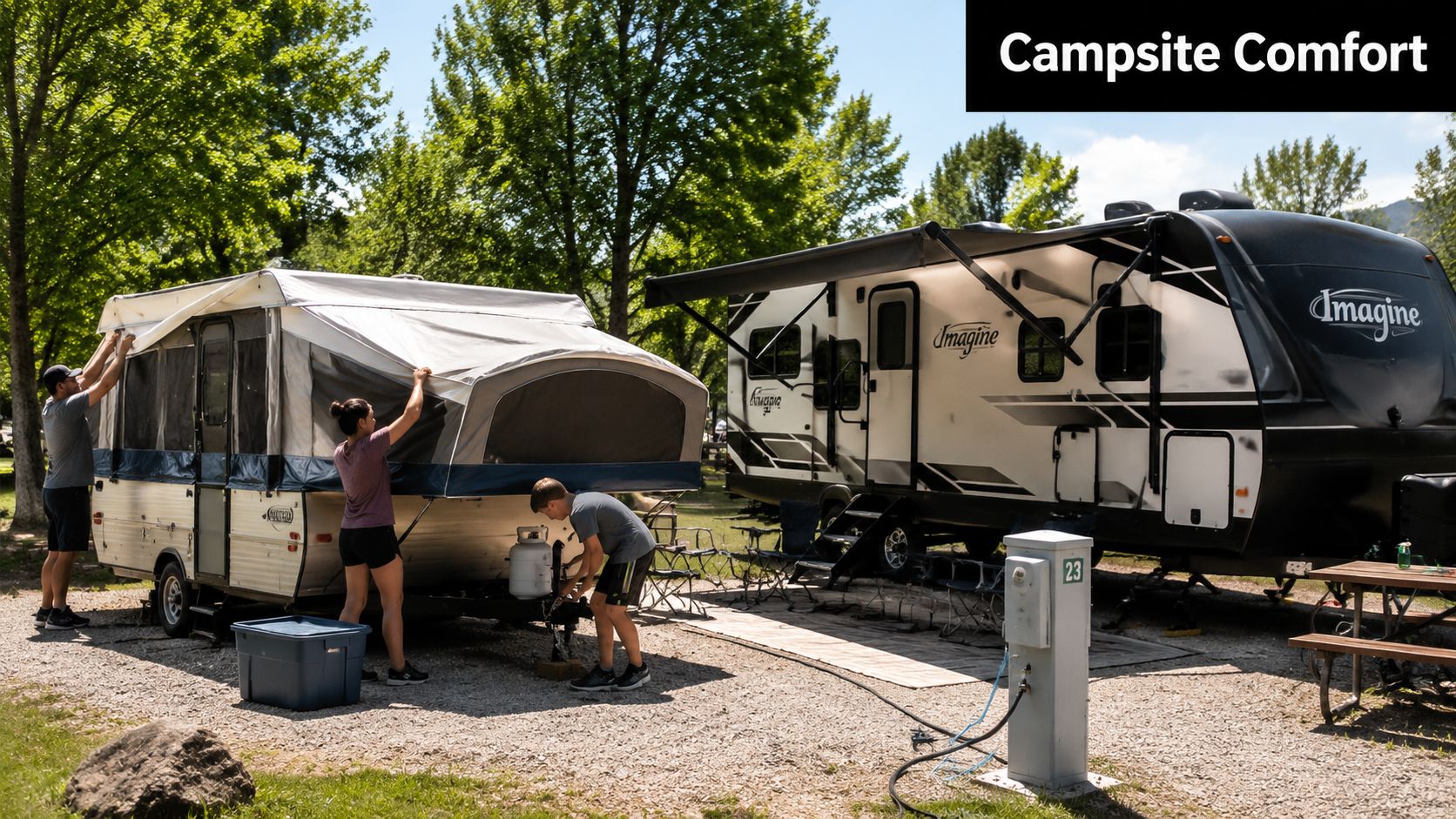
A pop-up gives you that classic camping feel with a little upgrade. You hear more outside noise. You feel more connected to the campsite. Many people love that. If your favorite trips are fair-weather weekends around southern Utah or quick escapes out of the city, that lighter, simpler feel can be exactly the point.
A travel trailer feels more like bringing a small apartment with you. You pull in, level, hook up, and start camping. The structure is ready. You're not cranking up sections and making beds out of folded components before dinner.
Setup effort is not a minor detail
Buyers often underestimate setup fatigue. A pop-up usually asks more of you every time you arrive and every time you leave. If you're young, flexible, and treating camping like a hands-on outdoor routine, that's fine. If you're arriving late, camping with tired kids, or stopping often, it gets old faster than people expect.
A trailer you enjoy on day one can annoy you by trip five if setup feels like a chore.
Travel trailers win on convenience. They also win on everyday livability once you're parked. More cabinets, better separation between sleeping and cooking spaces, and more privacy all matter on longer trips.
If you care a lot about hot water systems, indoor utility access, and a more traditional RV setup, this complete guide for caravan owners is a useful general read. It's not Utah-specific, but it helps explain why enclosed trailers tend to support a more self-contained camping experience.
For buyers comparing layouts, it helps to look at real examples instead of vague descriptions. Browse different travel trailer floor plans and you'll see quickly how much the hard-sided category opens up in kitchen design, sleeping arrangements, and bathroom placement.
My honest recommendation on campsite comfort
If you camp alone or as a couple and want simplicity, a pop-up can be fun. If you camp with kids, deal with unpredictable weather, or want to stay comfortable for more than a quick weekend, a travel trailer usually makes more sense.
That's especially true around Bear Lake and other popular family destinations where the day can be beautiful and the nighttime temperature swing can catch people off guard. More enclosed space, easier meal prep, and a proper bathroom setup remove a lot of friction from the trip.
Upfront Costs and Long-Term Value
If you're shopping by budget, the pop-up usually gets your attention first. That makes sense. It's the lighter, simpler entry point. But don't stop at purchase price. Ownership costs in Utah are shaped by towing, storage, maintenance habits, and how often you'll use the RV.
Where a pop-up saves money
The most obvious advantage is efficiency. One RV industry source says towing a pop-up camper can save up to 30% in fuel-related costs or operating expense compared with an RV, according to AA Trailer's discussion of pop-up camper advantages. That kind of savings is one reason folding campers still appeal to budget-conscious buyers.
That lighter profile can also reduce the pressure to buy a larger tow vehicle. For many households, that matters more than almost anything else. Keeping the vehicle you already own can be the biggest financial win in the whole decision.
Where a travel trailer earns its price
A travel trailer costs more in practical terms because it usually asks more from your tow setup, your storage plan, and your maintenance routine. But it can still be the better value if you camp often and want fewer compromises every trip.
Here's how I look at it:
- Buy a pop-up if you want a lower-cost way into RVing and you're comfortable with a more manual camping routine.
- Buy a travel trailer if convenience and weather protection will make you camp more often.
- Avoid false savings by buying the cheaper RV if it doesn't fit how you travel. A low purchase price doesn't help if the camper sits unused.
Utah durability changes the value equation
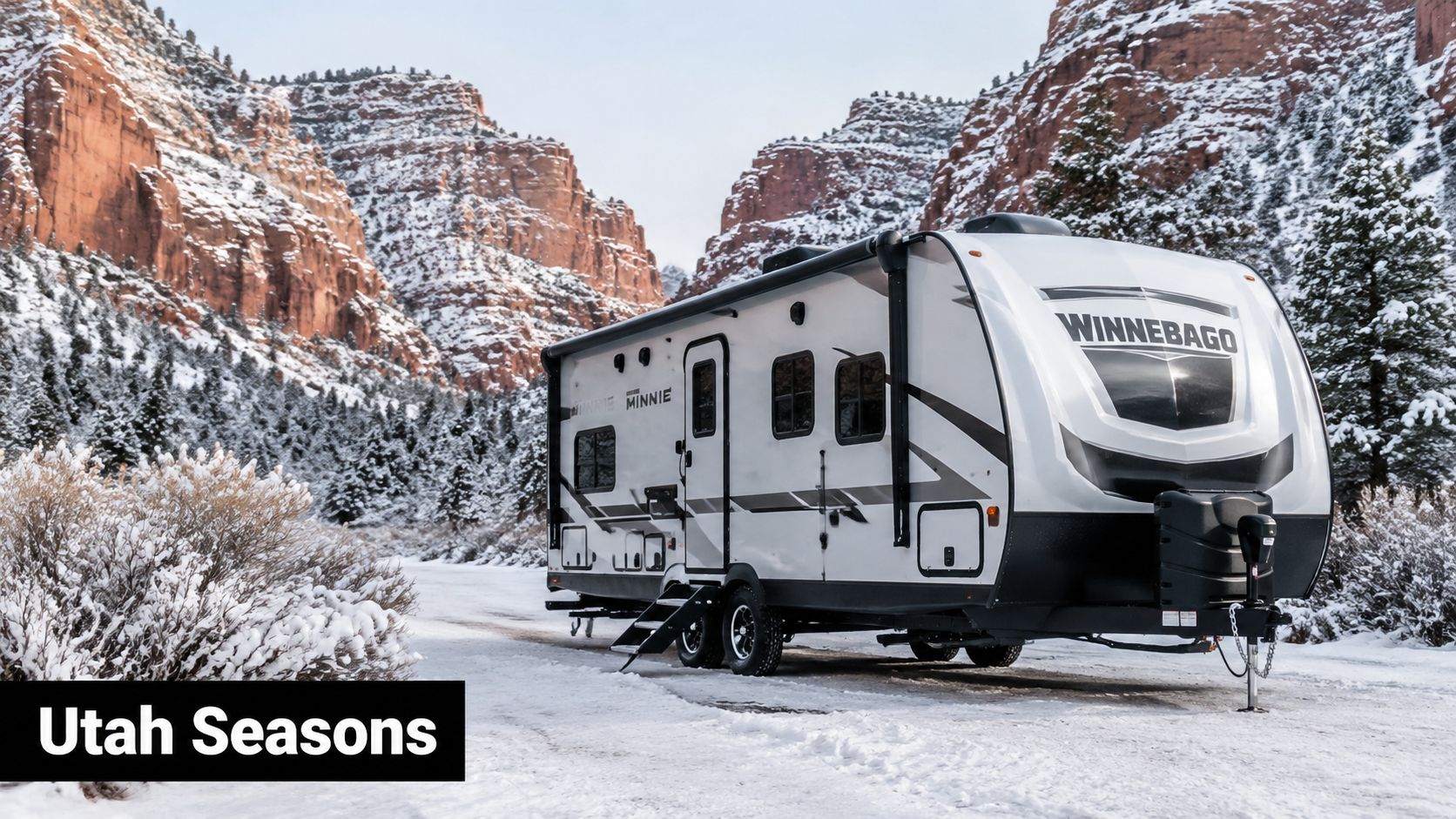
To be clear, in Utah, hard sides matter. Dry heat, afternoon wind, spring cold snaps, and shoulder-season nights all put pressure on lighter camping setups. If you plan to camp beyond the easiest summer weekends, durability and insulation are not optional luxuries. They're value drivers.
A pop-up can absolutely make sense for the right buyer. But if you already know you want more season flexibility, more enclosed comfort, and less setup hassle, buying a travel trailer first can save you from trading up too soon.
For timing, shopping cycles matter. If you're trying to stretch your budget, our advice is to watch market timing and compare inventory carefully. This guide on the best time to buy an RV can help you think through that part of the purchase.
Durability and Four-Season Camping in Utah
Utah exposes weak camping setups fast. A warm afternoon in the valley can turn into a cold, windy night in the mountains. That's where the biggest difference between these RV types shows up.
Soft walls limit your season
Pop-up campers typically use canvas sidewalls, which provide less insulation and are more prone to condensation and heat loss than hard-sided travel trailers, as explained in Camping Kiddos' look at pop-up campers versus travel trailers. That means the same family can have two very different camping seasons depending on which RV they choose.
This matters a lot near higher-elevation destinations. A pop-up that feels great on a sunny June weekend can feel drafty and damp once the temperature drops after sunset. In the Salt Lake area, that difference matters in spring and fall. Near mountain lakes and exposed campgrounds, it matters even more.
Three Utah buyer profiles
A young family from the Wasatch Front wants quick summer trips, mostly fair weather, and easy storage at home. They'll probably be happy in a pop-up if they accept the setup routine and keep their trips seasonal.
A couple planning shoulder-season weekends and longer stays wants warmth, privacy, and less work after arriving at camp. That couple should skip the compromise and buy a travel trailer.
A retired pair who value comfort, a real bathroom, and easier overnight stops shouldn't overthink this. The enclosed trailer is the better fit.
Hard-sided trailers widen your comfortable camping window. Soft-sided campers narrow it.
Wind, condensation, and real-world comfort
People often focus only on towing weight. They should also think about sleeping quality. Canvas walls breathe differently, hold heat differently, and react differently to overnight moisture. In Utah, where weather swings can be sharp, that affects how rested you feel and how much work you do in the morning managing damp bedding and interior airflow.
A travel trailer gives you a stronger shell, better separation from wind, and a much calmer interior when conditions turn. That doesn't make pop-ups bad. It makes them specialized. They shine when your priorities are lightweight towing, lower storage demands, and a more outdoorsy experience. They struggle when your priority is broad-season comfort.
Who Is Each Camper For Finding Your Match
You're planning a Friday escape from Salt Lake, the garage is already tight, and your next trip could be a windy weekend at Bear Lake or a dry run down to Moab. At that point, the right answer is less about specs and more about how you camp.
The first-time family
A pop-up makes sense for young families on the Wasatch Front who want affordable summer camping, lighter towing, and a camper that fits at home. If your trips are mostly reservoir weekends, state parks, and fair-weather nights, it gives you a simple way to start without buying a bigger tow vehicle first.
I recommend a pop-up for this buyer only if your family is fine with setup, teardown, and a shorter Utah camping season.
The adventure couple
Travel trailers fit couples who want to cover more ground and camp more often. If your plans include spring in Moab, cool nights near Bear Lake, or mountain campgrounds above the valley where weather changes fast, the hard-sided trailer is the better tool.
You get faster arrivals, better privacy, and a camper you will still like after the novelty wears off.
The comfort-focused retiree
Buy the travel trailer.
If you want a real bathroom, better sleep, easier overnight stops, and less physical work at camp, a pop-up will get old fast. Travel trailers are easier to live with, especially for longer stays and shoulder-season trips around Utah.
The buyer with city storage problems
This is the strongest case for a pop-up. In Salt Lake City, South Salt Lake, Millcreek, and older neighborhoods along the Wasatch Front, storage space can make the decision for you before floorplans even matter.
A folding camper is easier to tuck into a side yard or driveway. That matters in the valley, where winter storage is part of ownership, not an afterthought. If you already spend time preventing winter car damage, you already understand the kind of seasonal prep Utah demands.
My honest recommendation
Choose a pop-up if compact storage, lower entry cost, and lighter towing matter most.
Choose a travel trailer if you want to camp more months of the year, sleep better in rougher conditions, and avoid outgrowing your RV after one or two seasons.
Buy for your normal Utah trip, not your ideal one. If most of your camping is quick summer weekends close to home, a pop-up can be a smart buy. If you picture regular trips to Bear Lake, mountain campgrounds, or longer runs across the state, get the travel trailer and be done with it.
Your Next Steps at Motor Sportsland
Once you've narrowed the decision, the next move is seeing both types in person. Photos don't show towing height, bed access, bathroom size, or how cramped a space feels when the whole family is inside. Walk-throughs do.
Start by browsing live inventory online and filtering by trailer style, length, and weight. If you're trying to stay within a specific tow setup, that step saves time fast. Then visit a showroom and step into both a folding camper and a hard-sided trailer on the same day. For a lot of buyers, the decision becomes obvious within minutes.
A few smart next steps:
- Check your tow vehicle first. Bring the exact year, make, model, and trim when you shop.
- Think about storage before signing. If the trailer doesn't fit your property or budget for storage, it's the wrong trailer.
- Walk through setup mentally. Ask yourself what arrival at camp looks like after a long drive.
- Plan for ownership, not just purchase. Service, winterization, and parts access matter once the excitement wears off.
If you already own an RV and you're thinking about a trade, get a valuation before assuming what your current unit is worth. If you're buying your first camper, talk through financing and service at the same time. A smooth ownership experience usually starts with better planning on day one.
Conclusion
The pop up camper vs travel trailer decision comes down to one tradeoff. A pop-up camper gives you lighter towing, easier storage, and a lower barrier to entry. A travel trailer gives you more comfort, more privacy, better weather protection, and a broader camping season in Utah.
My honest advice is this. Buy the pop-up if your vehicle and storage limitations are driving the decision, and you're happy camping mostly in mild conditions. Buy the travel trailer if you want a more comfortable, more flexible RV that handles Utah's weather and elevation swings with fewer compromises.
The right camper is the one you'll use often, tow confidently, and enjoy once you arrive. If you want help sorting that out, visit our Salt Lake City team and compare both in person before you commit.
Frequently Asked Questions
Is a pop-up camper easier to tow in Utah?
Usually, yes. A pop-up's smaller folded profile and lower weight make it less intimidating for newer towers, especially on local roads and tighter campground approaches. That doesn't mean every travel trailer is hard to tow. It means a pop-up is often the easier starting point.
Is a travel trailer better for Bear Lake and mountain camping?
For comfort, yes. Bear Lake and mountain campgrounds can bring colder nights and stronger weather swings than people expect. A hard-sided trailer usually provides a much better overnight experience in those conditions.
Can a family use a pop-up camper comfortably?
Yes, if the family is comfortable with a more basic camping setup. Pop-ups can work well for short trips and fair-weather travel. The big question isn't just sleeping space. It's whether your family is okay with less privacy, more setup, and fewer enclosed amenities.
Which one is better for Salt Lake City storage?
A pop-up camper. Its folded design is the big advantage. If driveway space, side-yard access, or neighborhood restrictions are a concern, that smaller footprint can make ownership much easier.
Does a travel trailer always require a truck?
Not always. Travel trailers cover a wide range, so some are lighter than others. What matters is matching the exact trailer to the exact tow vehicle and not shopping by assumptions.
Which one is better for first-time buyers?
If the priority is low stress towing and easier storage, a pop-up is often the better beginner choice. If the priority is comfort, bathroom access, and a simpler camping routine once parked, a travel trailer is usually the better beginner choice. First-time buyer doesn't automatically mean pop-up. It depends on what feels harder to you: towing or camping with fewer comforts.
Should I buy based on price alone?
No. That's one of the most common mistakes. The cheaper RV on paper can become the more frustrating one to own if it doesn't fit your weather, towing, or storage reality. Buy for your actual habits, not the version of camping you think you might become.
If you're ready to compare campers in person, browse current inventory, or talk through towing, storage, financing, or service, contact Motor Sportsland. We can help you narrow the choice between a pop-up camper and a travel trailer based on how you really camp in Utah.
