
RV Dry Weight Explained for Utah Buyers in 2026
When you’re shopping for a new RV, one of the first numbers you'll see is the RV dry weight. Think of it as the trailer's "birth weight"—what it weighed the moment it rolled off the factory floor. It's the unit completely empty, before a drop of water, a pound of propane, or a single piece of your gear has been added.
This number is also the single biggest source of confusion for new and even experienced RV owners. It’s a starting point, but it's not the real-world weight you'll be towing. Here at Motor Sportsland, our team in Salt Lake City has helped thousands of Utah families understand the difference between a brochure number and a safe, road-ready weight. Our goal is to make sure you have the knowledge to tow with confidence.
Why Your RV's Dry Weight Is Only Half the Story
Picture this: you’ve found the perfect travel trailer for weekend escapes to Jordanelle Reservoir. The listed dry weight looks great and is well within your truck's limits. You hook it up, start loading your camping chairs, coolers, and kids' bikes, and suddenly realize you’re pushing the boundaries of what your truck can safely handle.
This exact scenario plays out all the time. Here at Motor Sportsland in Salt Lake City, we see folks come in, excited about a trailer's low dry weight on the sticker, only to get a reality check when they start adding up the actual weight.
Understanding the Starting Point
As RV shopping moved online, dry weight became the go-to number for quick comparisons. Unfortunately, it’s a misleading metric on its own. Safety experts and seasoned RVers will tell you the same thing: the dry weight is just a baseline. It doesn't account for your cargo, water, propane, or any dealer-installed options.
Think of it like this: The dry weight is an empty house. It’s your family, your furniture, and all your belongings that make it a home—and also make it much heavier.
Even a simple upgrade can make a big difference. For instance, adding a solar power setup using a guide to off-grid RV power for landowners will add pounds that you absolutely must count toward your total weight.
Getting a firm grasp on what dry weight really means is the first step toward safe and stress-free travels along the Wasatch Front. Our goal is to help you look past that brochure number and understand what your RV will actually weigh when it hits the road.
What Do All Those Other RV Weight Acronyms Mean?
When you’re looking at an RV spec sheet, it can feel like you’re staring at a foreign language. You’ll see a confusing jumble of acronyms like UVW, GVWR, and GCWR scattered across brochures and the trailer’s weight sticker. Here in our Salt Lake City showroom, our team spends a lot of time helping folks translate these numbers into real-world towing confidence.
While RV dry weight gives you a baseline, these other ratings tell the rest of the story—the non-negotiable safety and legal limits you have to follow. Getting this wrong is one of the most common and dangerous mistakes we see, especially with the steep grades on Utah's mountain roads.
From the Factory Floor to Your Campsite
Think of these different weights as building blocks. Each number adds a new layer, taking you from an empty trailer just off the assembly line to a fully loaded rig ready for a weekend at Bear Lake.
Unloaded Vehicle Weight (UVW): This is your most realistic starting point. It’s the true weight of a specific RV as it rolled out of the factory, including all the standard equipment and any factory-installed options. It’s often very close to the dry weight, but the UVW listed on the yellow sticker inside the RV door is the actual "as-built" weight for that specific unit.
Gross Vehicle Weight Rating (GVWR): This is the most important number to remember. The GVWR is the absolute maximum weight the fully loaded RV is allowed to be. This total includes the trailer's base weight (UVW) plus all your cargo—water, propane, batteries, food, clothing, and all your gear. You can never safely or legally exceed this weight.
Tongue Weight (or Hitch Weight): This isn't about the trailer's total weight, but the downward force its tongue puts on your tow vehicle's hitch. Getting this right is crucial for stable, safe towing. The target is typically 10-15% of the trailer's total loaded weight.
Gross Combined Weight Rating (GCWR): This is the maximum weight for the entire moving system. It’s the total combined weight of your tow vehicle and the attached trailer, both fully loaded. This accounts for your truck, its fuel, all passengers, the packed RV, and everything in between.
As you can see, the weight on the brochure is just the beginning.
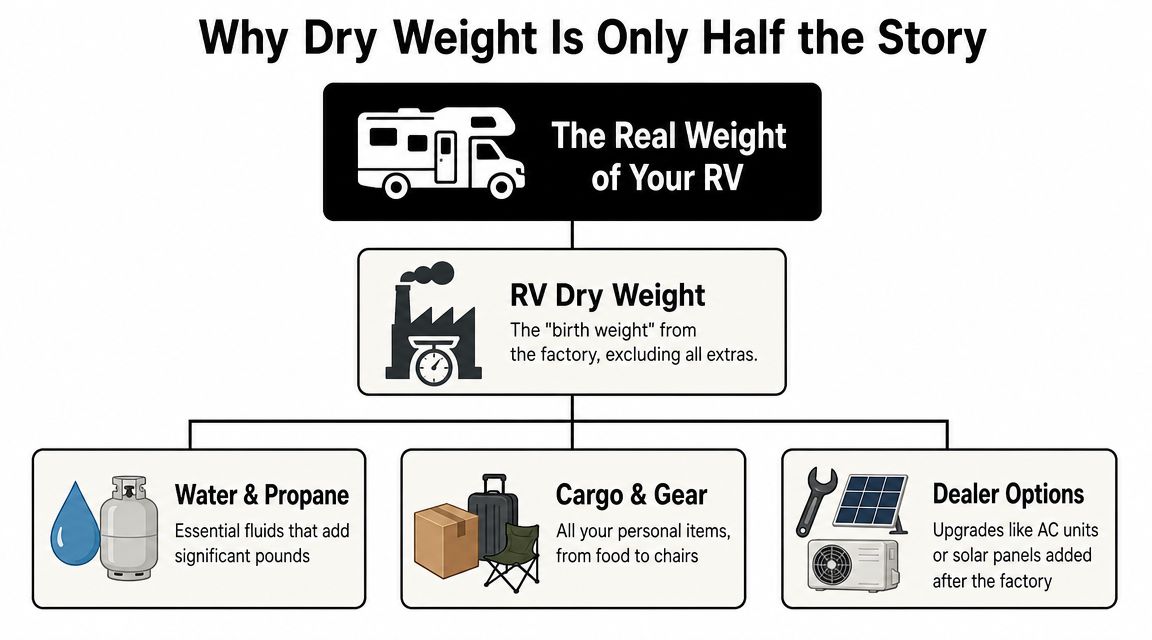
This diagram shows it perfectly: the factory weight is just the foundation. The true weight you’ll be towing comes from everything you decide to bring along for the ride.
To help you keep these terms straight when you're comparing models, here’s a quick-reference table.
RV Weight Terms at a Glance
| Weight Term | What It Includes | Why It's Important for Your Trip |
|---|---|---|
| Unloaded Vehicle Weight (UVW) | The specific trailer's weight from the factory with standard features and options. | This is your true starting weight before you add anything. |
| Gross Vehicle Weight Rating (GVWR) | The UVW plus all cargo (water, propane, gear, food). | This is the MAXIMUM your trailer can legally and safely weigh. |
| Tongue Weight | The downward pressure the trailer tongue exerts on your truck's hitch. | Critical for towing stability; keeps the trailer from swaying. |
| Gross Combined Weight Rating (GCWR) | The maximum allowed weight of your tow vehicle and trailer combined. | This ensures your truck's engine and brakes can handle the entire load. |
Think of these ratings as a set of rules designed to keep you, your family, and everyone else on the road safe.
Putting It All Together
Understanding how these numbers work together is the key. For instance, the difference between a trailer’s GVWR and its UVW tells you your payload capacity—the total weight of all the "stuff" you're allowed to add.
We’ll get into the exact calculations for payload later on. For now, just remember that these ratings are not suggestions; they are safety requirements. If you're looking at smaller, lighter options, you might find our guide on how much pop-up campers weigh useful to see these principles in action.
Our Team's Advice: Always, always use the GVWR—not the dry weight—when matching a trailer to your truck. It automatically gives you a realistic margin of safety for everything you'll pack for your adventures across Utah and beyond.
When it comes to RV weights, forget what you see in the sales brochure or on a generic website. The only numbers that count for safety and legal towing are the ones certified by the factory, and they're attached right to the RV itself.
Finding the Official Weight Sticker
Every single motorhome and trailer is required to have a specific white and yellow sticker. Think of it as the RV's official birth certificate for weight. You'll typically find it on the driver's side—often near the front corner on a travel trailer or inside the driver's door jamb on a motorhome.
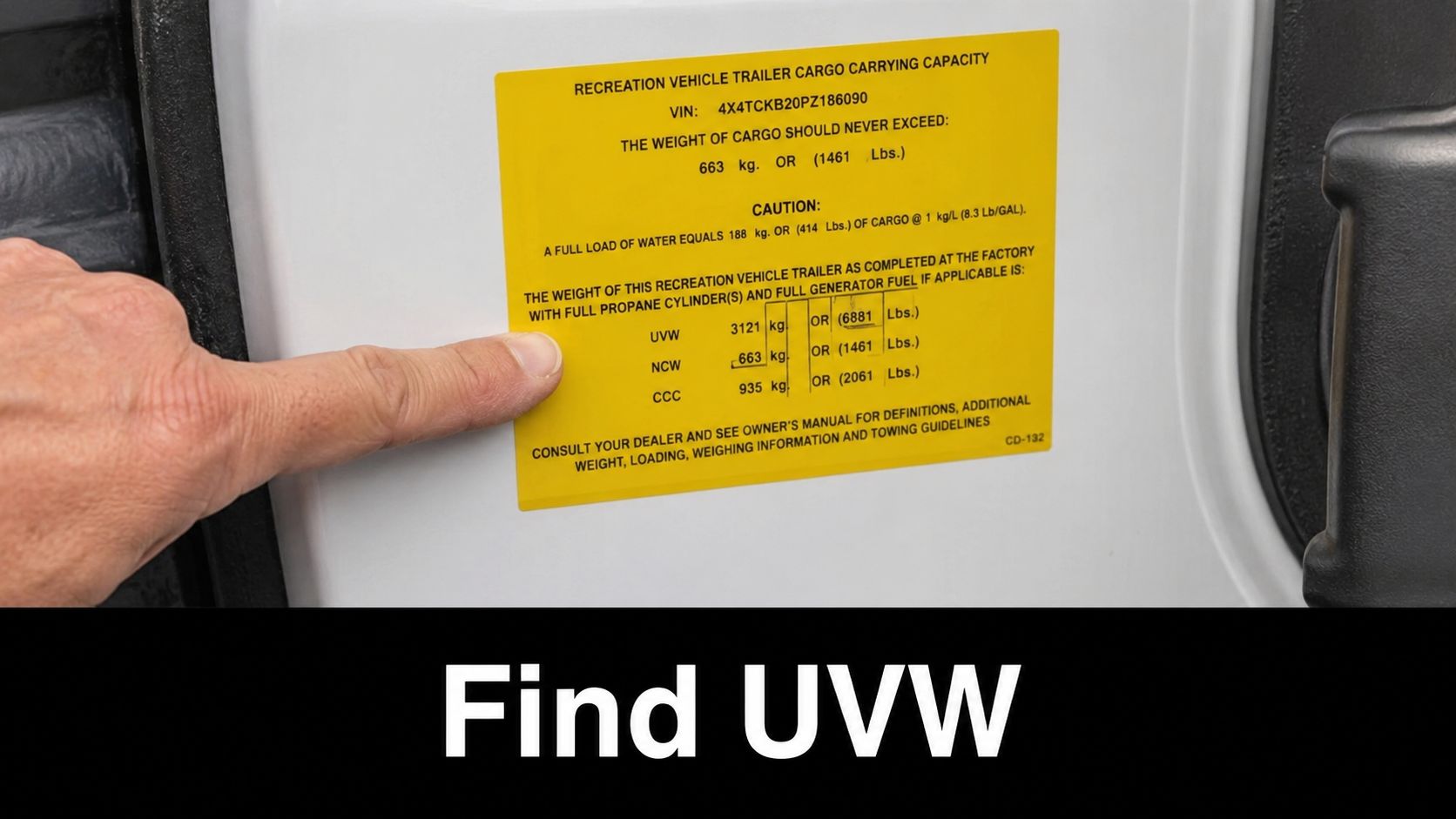
This little label is your source of truth. It gives you the most precise weight information for that specific unit as it rolled off the assembly line. Here’s what you’ll find:
- Unloaded Vehicle Weight (UVW): This is the RV's actual weight from the factory, including any factory-installed options. It’s far more accurate than the generic RV dry weight listed in brochures.
- Gross Vehicle Weight Rating (GVWR): This is the absolute, non-negotiable maximum the RV is allowed to weigh once you’ve loaded it up with all your stuff.
- Cargo Carrying Capacity (CCC): This number tells you exactly how many pounds of water, propane, food, and gear you can safely add before hitting the GVWR.
Our Team's Pro Tip: When you're browsing inventory on motorsportsland.com and find a trailer you love, like a popular Keystone or Jayco model, your next step should be to find its specific UVW on the sticker. This is the number you should use for all your calculations.
Don't Forget About Dealer Add-Ons
One critical thing to remember is that the factory sticker doesn’t know about anything added after the RV left the factory. We always remind our customers that dealer-installed options add real weight that isn't reflected on that yellow label.
For example, that second A/C unit you need for those hot Utah summers or the upgraded battery bank for off-grid camping near Moab will eat into your available cargo capacity. You have to manually subtract the weight of these add-ons from the CCC on the sticker to know your true, updated payload.
Getting these numbers right is crucial. For comprehensive support, professional RV services can provide valuable assistance and peace of mind. While there are great resources like expert RV care in Central Texas that can help, our own service team is always here and ready to guide you through the process.
Calculating Your Real-World Payload for a Utah Adventure
Alright, this is where the rubber meets the road. We're moving past the brochure numbers like RV dry weight and getting into what you can actually bring on your trip. The basic math is pretty straightforward: your trailer's GVWR minus its UVW equals your Payload Capacity. But what does that number really mean when you’re packing for a trip to Bear Lake or a long weekend up in the Wasatch?
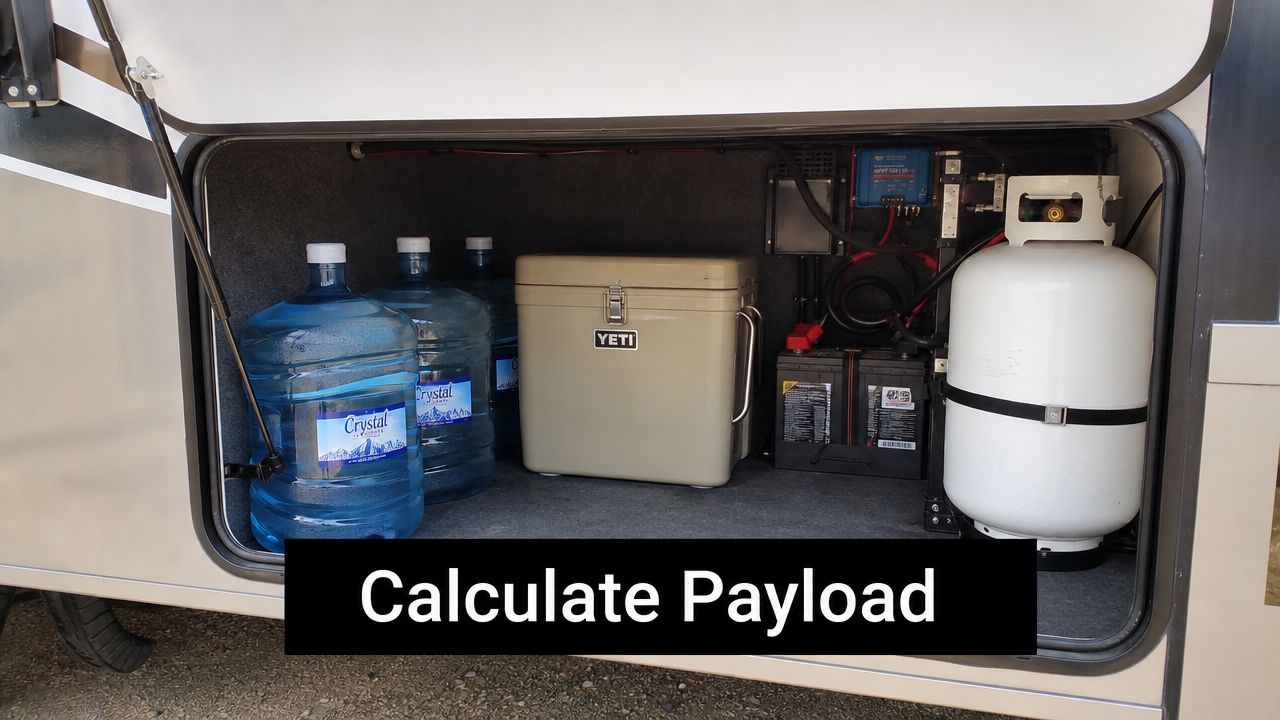
Think of payload capacity as the total weight of everything you put in or on your RV after it rolls off the factory floor. We’re not just talking about your clothes and a few camp chairs. This includes all the essentials that add up surprisingly fast.
The Numbers Don't Lie: A Real-World Payload Calculation
Let's get practical. Imagine you’re getting your trailer ready for a family trip. That payload number you saw on the sticker can shrink in a hurry. As many seasoned RVers have discovered, a trailer with a 7,000-pound GVWR and a 4,250-pound dry weight might seem to have a massive 2,750-pound payload. But once you start adding the necessities, you’ll see that space disappear.
Here’s a breakdown for a typical family of four heading out for a few days:
- Full Fresh Water Tank: A standard 50-gallon tank adds a hefty 415 lbs (water weighs about 8.3 lbs per gallon).
- Two Full 30-lb Propane Tanks: You'll need these for your fridge and heat. That’s another 112 lbs.
- Two 12V Batteries: Essential for off-grid power, these can easily add 130 lbs.
- Food & Drinks: A cooler packed with enough food, drinks, and ice for the family can easily hit 150 lbs.
- Camping Gear & Personal Items: Throw in your chairs, firewood, tools, clothes, and kids' toys, and you've quickly added 400 lbs or more.
Just with these basics, you’ve already loaded 1,207 lbs into your camper. That’s over half your available payload before you’ve even thought about strapping on bikes, a generator for dry camping near Moab, or extra water jugs.
Don't Forget the Utah Mountain Safety Buffer
Running these numbers is often the "aha!" moment for our customers. It’s when you truly understand why a super-low dry weight can be misleading if the GVWR doesn't give you enough payload to actually live and travel in your RV.
Our Team's Advice: We always tell our customers to leave a safety buffer of at least 15% of their total payload capacity. This isn't just a suggestion—it's critical for safely towing in Utah. When you're pulling a heavy load up a steep grade like Parley’s Canyon, that buffer gives you peace of mind and ensures you aren't maxing out your trailer's suspension and brakes.
And of course, your tow vehicle's capacity is the other half of this critical equation. To make sure your truck is up to the task, check out our comprehensive Dodge Ram tow capacity guide, which has great information that applies no matter what brand you drive.
Top 4 RV Weight Mistakes We See in Utah (and How to Avoid Them)
After 55 years in the RV business right here in Salt Lake City, our team at Motor Sportsland has pretty much seen it all. We’ve celebrated with families buying their first camper and helped seasoned pros upgrade to their dream rigs. We've also seen the same handful of costly—and frankly, dangerous—weight mistakes trip up new buyers time and time again.
Think of this as our friendly warning, the kind of advice we give folks on our lot every day. Getting these numbers right isn't just about avoiding a ticket; it's about keeping your family and everyone else on Utah's beautiful roads safe.
Mistake 1: Matching Dry Weight to Tow Rating
This one is, without a doubt, the most common blunder we see. A customer comes in, excited because their truck is rated to tow 7,000 pounds, and they've found a great trailer with an RV dry weight of 3,969 pounds. On paper, it looks like a perfect match with tons of wiggle room.
But that "dry" weight is a fantasy number. It’s the trailer, completely empty from the factory, with no water, no propane, no batteries, and none of your gear.
Our Advice: Forget the dry weight for matching purposes. Instead, look at the trailer's Gross Vehicle Weight Rating (GVWR). If a trailer's GVWR is 6,500 pounds, that’s the number you should compare against your truck's tow capacity. It represents the maximum the trailer can weigh when fully loaded, and it's your only true safety benchmark.
Mistake 2: Forgetting Your Truck's Payload
So, you’ve confirmed your truck can pull the trailer's GVWR. Great! But what about what your truck can carry? This is the one that surprises everyone. Your truck's payload capacity is the total weight it can handle in its cab and bed. That includes you, your family, the dog, a cooler full of drinks, and—most importantly—the downward pressure from the trailer's tongue.
It's incredibly common for a truck to run out of payload capacity long before it ever approaches its maximum towing limit.
A Critical Reminder from Our Team: Your truck's payload capacity is often the first and most important limit you will hit. Overloading it makes your truck unstable and puts immense strain on your suspension, brakes, and tires. That’s a risk you don’t want to take, especially coming down one of the steep grades out of the Wasatch Mountains.
Mistake 3: Underestimating Water Weight
Planning on doing some boondocking near Moab? You'll be bringing your own water, and lots of it. Here’s a little RV math for you: water weighs about 8.3 pounds per gallon. So, that 80-gallon fresh water tank in your new rig adds a whopping 664 pounds when full.
That’s a huge chunk of your carrying capacity, all before you’ve packed a single camp chair, piece of firewood, or can of food.
Mistake 4: Ignoring Utah's Altitude
Living and playing in the Mountain West means we have to account for something coastal RVers never think about: altitude. As you climb, the air gets thinner, and your engine starts to feel it. A good rule of thumb is that a gasoline or diesel engine loses about 3% of its horsepower for every 1,000 feet you climb above sea level.
So, when you're towing up to a campsite at 8,000 feet, your engine isn't just working harder—it's doing it with about 24% less power than it has back in the valley. That puts a serious strain on your entire drivetrain, and it’s why having a properly matched truck and trailer is non-negotiable here.
Motor Sportsland Is Your Partner in Safe Towing
Wrestling with all the different RV weight numbers—from RV dry weight to GVWR—can feel like a full-time job. It’s a lot to take in, but you don’t have to go it alone. Here at Motor Sportsland, we see ourselves as more than just a dealership; we're your partners in making sure every trip you take is a safe and memorable one.
That philosophy is at the core of how we do business. When you walk into our Salt Lake City showroom, our team acts as your personal towing consultant. Their job isn’t just to sell you an RV. It's to help you find the perfect match for the truck you already own, keeping a sharp focus on real-world safety and performance right here on Utah's roads.
More Than Just a Sale
Our support for you extends far beyond the day you pull off the lot. We’re committed to being a resource for you throughout your entire ownership experience.
- Expert Installations: Our technicians in our state-of-the-art Service Center are pros at installing the right weight distribution hitch for your specific truck and trailer. For a deeper dive on this, you can read our complete guide to E2 weight distribution hitches.
- Hands-On Help: We’ve walked countless first-timers through a trip to the CAT scale. There’s no better way to get the true, loaded weight of your setup and gain some serious peace of mind.
- Safety First: Towing safely means getting all the little details right. Essential gear like reliable caravan and trailer safety cables are a crucial part of the equation, and we can advise on and install the best options.
Feeling unsure about your current setup or a potential purchase? That’s what we’re here for. We want you to tow with complete confidence, from your driveway all the way to your favorite campsite.
Don't let weight calculations become a roadblock to your next adventure. Swing by our showroom in Salt Lake City or just give our team a call. Let's talk it through and get you ready for the road.
Your RV Weight Questions, Answered
On the showroom floor, we hear a lot of the same questions about RV weights. It can be a confusing topic, but understanding these numbers is absolutely critical for choosing the right RV and towing it safely. Let's walk through some of the most common questions we get.
What Is the Difference Between Dry Weight and UVW?
This is a big one. You can think of RV Dry Weight as a starting point—it's the theoretical weight of a base model with zero options. The number you really need is the UVW (Unloaded Vehicle Weight).
The UVW is the actual weight of a specific RV as it rolled off the assembly line, including all factory-installed options. Always look for the yellow sticker on the side of the trailer you're considering; that UVW is your true starting number for any calculation.
Does RV Dry Weight Include Batteries or Propane?
Almost never. These are considered essential gear, but they're typically installed at the dealership after the RV arrives. A single 12-volt battery and a full 30-pound propane tank can add 100-150 pounds right off the bat, and that weight comes directly out of your cargo-carrying capacity.
How Much Weight Should I Budget for Gear?
It adds up faster than you think. For a family heading out for a weekend, we find it’s wise to plan for at least 1,000 to 1,500 pounds of cargo. This isn't just clothes and food; it’s your freshwater, camp chairs, coolers, tools, and everything else you bring along.
It's always better to overestimate how much your gear weighs. This ensures you have a healthy safety margin, especially for trips in the mountains.
Can I Tow a Trailer if My Truck's Tow Rating Equals the Trailer's GVWR?
We strongly advise against this. Maxing out your truck’s tow rating leaves zero margin for safety and puts incredible strain on your engine, transmission, and brakes.
As a solid rule of thumb, make sure your trailer's GVWR is no more than 80-85% of your tow vehicle's maximum tow rating. This buffer zone is why safety experts consistently advise you to "Always use the GVWR rather than the dry weight” when matching a truck and trailer. If you want to dig deeper, you can learn more about how different RV types vary in weight and see why this is so important.
At Motor Sportsland, our main goal is to give you the confidence that comes from knowing you’ve made a safe choice. If you have more questions or want to run the numbers on a specific model, just stop by our Salt Lake City showroom. We're here to help.
