
RV Loan Calculator Guide for Utah Buyers
You're looking at a bunkhouse trailer or toy hauler in Utah, and the online payment looks manageable. Then the full numbers arrive: taxes, registration, insurance, storage, a trade-in payoff, and the possibility that the RV loses value faster than you reduce the loan balance. That's how a payment that seemed comfortable can put pressure on a family budget.
An RV loan calculator is still an excellent starting point. It estimates payments from the RV price, down payment, trade-in allowance, interest rate, and loan term, while helping you compare different travel trailers, motorhomes, and fifth wheels. But it's only a financing estimate, not a complete ownership budget. The right approach is to use the calculator first, then test the result against the costs you'll face around Salt Lake City, the Wasatch Mountains, Jordanelle, Bear Lake, and beyond.
Understanding RV Loan Calculator Inputs
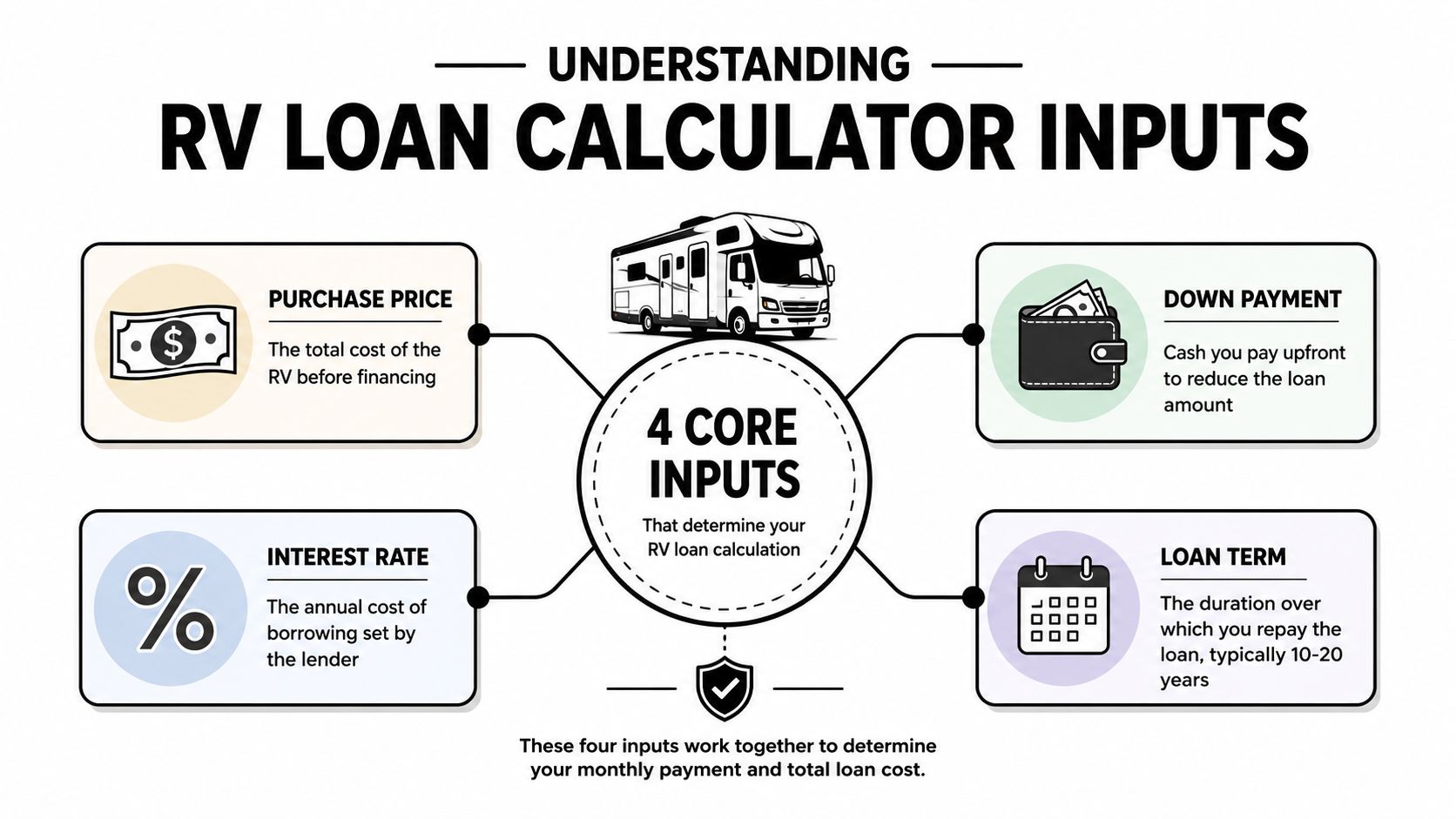
A lower payment can hide a larger balance, more interest, or an unaffordable ownership budget. Before comparing RVs, learn which figures control the calculator and which costs sit outside it. An RV loan calculator typically uses the RV price, down payment, trade-in allowance, interest rate, and loan term, then estimates the monthly payment and total interest. Credit Karma's RV loan calculator follows this basic process and offers term choices from 5 to 20 years.
Start with the amount financed
Enter the actual selling price of the bunkhouse trailer, toy hauler, fifth wheel, or motorhome. A rounded search-page price can understate the amount you will finance. Subtract your cash down payment, then account for the trade separately.
A trade-in has two figures:
- Trade allowance: What the dealer offers for your current RV.
- Trade payoff: What you still owe the lender.
The allowance reduces the purchase cost only after the payoff is addressed. If the payoff exceeds the allowance, the shortfall can increase the new loan. Leaving that payoff out creates a payment estimate the contract will not match.
Your down payment reduces the amount borrowed, monthly payment, and total interest. Keep enough cash for insurance, registration, maintenance, winter preparation, and immediate repairs. A smaller calculator payment is a poor result if it leaves your Utah family without an emergency reserve.
Treat the interest rate as a range
Lenders set the rate using your credit history, income, loan amount, collateral, and whether the RV is new or used. CamperCalc's RV loan rate guide shows that RV APRs can vary from roughly 6% to well over 17%, depending on the borrower, lender, and unit.
Run several rate scenarios instead of accepting the most attractive figure on the screen. Two Utah families buying the same Keystone travel trailer may receive different offers because their credit profiles and lender choices differ. An unconfirmed rate is a planning assumption, not a quote.
Choose the term deliberately
Terms commonly run from 5 to 20 years. Some credit unions offer 144- to 180-month financing for new campers and RVs, as shown by Summit Federal Credit Union's RV loan information. Longer terms reduce the required payment, yet they increase total interest and slow principal reduction. That combination can leave you owing more than the RV is worth after depreciation.
Gather the listing price, cash available, trade allowance, exact payoff, and a realistic rate range before calculating. Compare payment and interest across terms with our guide to RV financing length. If another household debt is already limiting your budget, use a resource to start paying off debt faster before adding a recreational loan.
Working Through a Real Payment Example
A Utah family can receive a calculator payment that fits the screen but fails in the driveway. Consider a hypothetical Keystone travel trailer. The exact price, rate, down payment, trade equity, and term must come from the listing and lender offer, so publishing a made-up payment would give you false confidence.
Start with verified deal figures
Enter these figures separately:
- Exact purchase price, taken from the current listing rather than a rounded search result.
- Cash down payment, excluding money reserved for registration, insurance, and immediate repairs.
- Trade allowance and payoff, so the calculator shows whether your trade creates equity or adds unpaid debt.
- Lender APR, along with higher and lower comparison scenarios.
- Selected term, including a shorter and longer option for the same RV.
The calculator should show estimated payment and total interest. Use both to judge affordability. Do not treat the result as an underwriting approval. The final contract may include taxes, fees, lender requirements, and deal-specific charges that a basic calculator leaves out. For the financing steps behind those figures, review this guide to how to finance an RV.
Read amortization as an equity report
An amortization schedule divides each payment between principal and interest. Early payments on a long loan usually reduce the balance slowly because interest applies to a larger outstanding amount. At the same time, an RV can depreciate, creating a gap between what you owe and what the unit could sell for.
The required year-by-year breakdown needs exact loan inputs. No verified Keystone price or rate was provided, so use the lender's schedule instead of invented principal, interest, or balance figures:
| Year | Principal Paid | Interest Paid | Remaining Balance |
|---|---|---|---|
| Year 1 | Enter lender schedule | Enter lender schedule | Enter lender schedule |
| Year 2 | Enter lender schedule | Enter lender schedule | Enter lender schedule |
| Year 3 | Enter lender schedule | Enter lender schedule | Enter lender schedule |
| Year 4 | Enter lender schedule | Enter lender schedule | Enter lender schedule |
| Year 5 | Enter lender schedule | Enter lender schedule | Enter lender schedule |
Compare that schedule with how long you expect to own the RV. If you trade before the balance drops meaningfully, the lower monthly payment may leave you with little equity, or with a payoff greater than the RV's resale value. Include that possible payoff gap in your purchase decision, not after the trade is already on the table.
The Hidden Costs Most Calculators Ignore
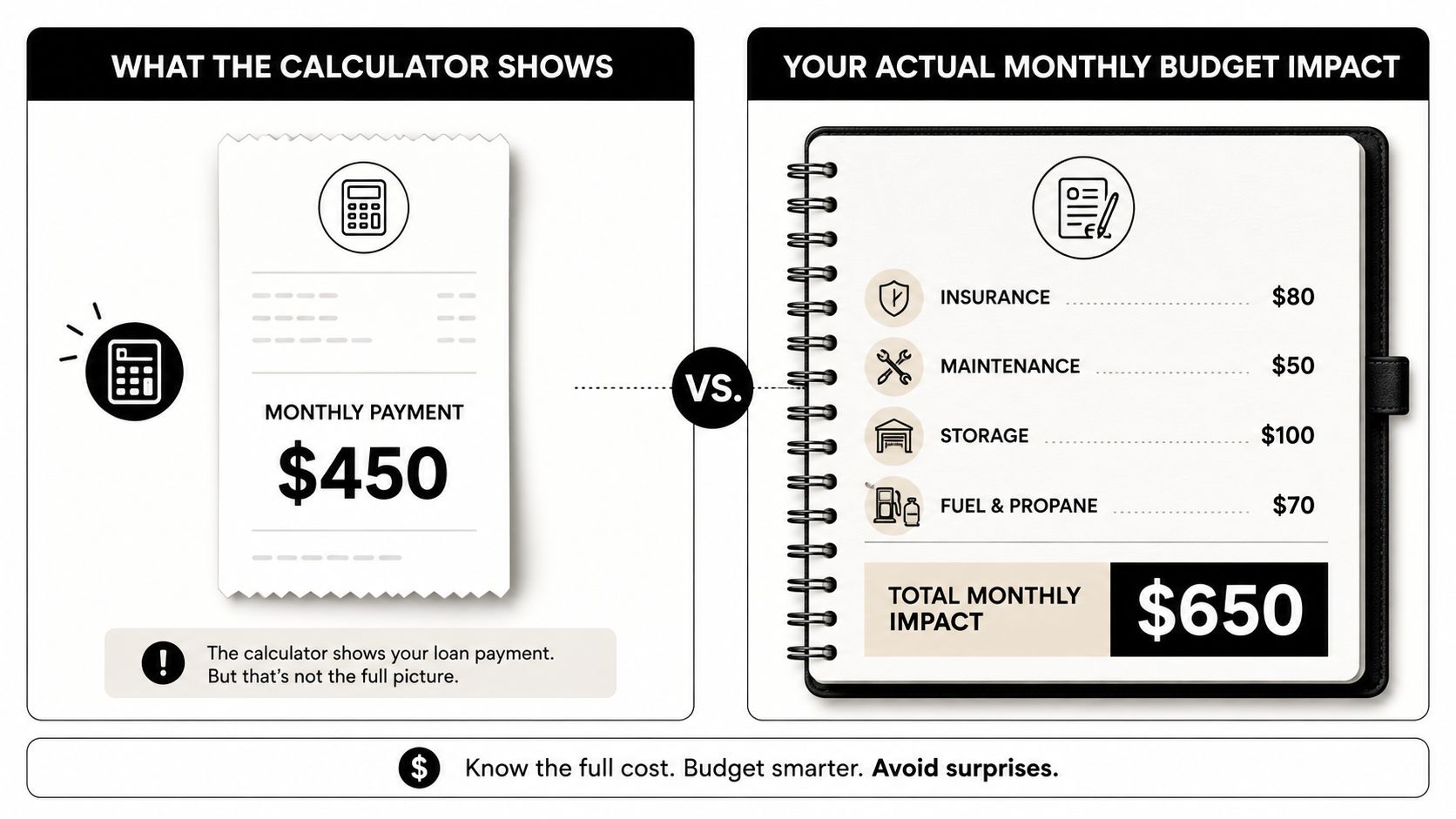
The headline payment is not the monthly cost of owning an RV. A basic calculator may focus on price, down payment, rate, and term, while your household budget also absorbs taxes, registration, insurance, storage, fuel, propane, and maintenance.
Utah families should ask for a complete out-the-door figure before deciding whether an RV fits. Sales tax can vary by county, and registration and title charges depend on the transaction and vehicle. Those amounts belong in your purchase budget even when they aren't included in the first calculator result.
Build a complete ownership worksheet
Use a second worksheet beside the RV loan calculator:
- Payment: Use the lender's estimated or approved payment.
- Taxes and registration: Confirm the actual charges for your Utah transaction and county.
- Insurance: Ask for a quote for the exact RV class, year, value, and intended use. If you're comparing coverage, you can browse RV insurance options.
- Storage: Include off-site storage if your driveway can't accommodate the unit, especially during Utah winter conditions.
- Maintenance: Budget for inspections, tires, plumbing, appliances, batteries, and seasonal servicing.
- Fuel and propane: Mountain grades, towing weight, generator use, and cold-weather camping can all affect consumption.
- Campground costs: Separate trip spending from fixed ownership costs so you know what the RV requires even when it's parked.
The most dangerous omission is depreciation. A new or used RV can lose value, and that loss can be steep during the first year. If you owe close to the RV's market value, an unexpected sale, trade, or repair problem can create a cash shortfall.
Practical rule: Don't ask only whether you can make the payment. Ask whether you can keep the RV insured, stored, maintained, and usable through a slow travel season.
Before signing, compare the projected balance with likely resale risk using our RV resale value guide. Your payment is one line in the budget. The ownership total is the decision.
Why Longer Loan Terms Create Equity Traps
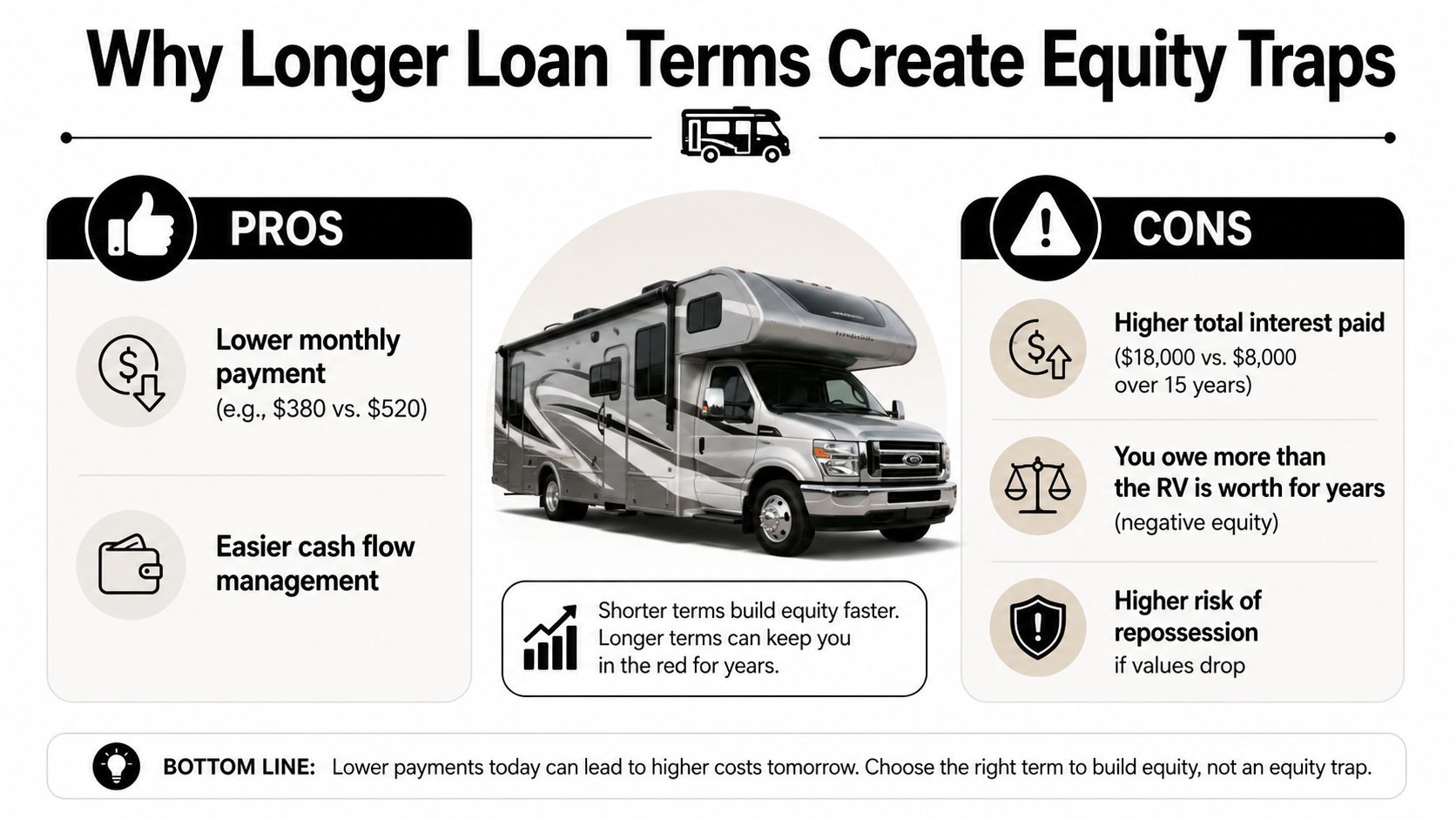
A payment that fits today's budget can still create financial strain after the purchase. Longer RV terms reduce the required payment, but they also slow principal repayment while depreciation continues. For Utah buyers, that gap matters if taxes, trade-in payoff, or dealer fees increase the amount financed before the RV even leaves the lot.
The RV's value changes with age, condition, demand, floorplan, mileage, upgrades, and market conditions. Your loan balance follows the amortization schedule instead. If depreciation outpaces principal reduction, you can owe more than the RV is worth when you want to sell or trade.
Compare terms by risk, not comfort
| Term choice | Payment effect | Interest effect | Equity concern |
|---|---|---|---|
| Shorter term | Usually higher required payment | Usually less interest overall | Faster principal reduction |
| Mid-length term | More moderate payment | More interest than a shorter term | Requires a careful resale check |
| Longer term | Lower required payment | More interest over the loan | Greater chance of negative equity |
A 10-year term can make more sense than a 15-year or 20-year term when your budget supports the higher payment. You build equity sooner and reduce the balance before depreciation has as much influence. Choose a longer term only when you plan to keep the RV for many years and maintain strong cash reserves, not to reach a preferred monthly payment.
Rate differences also affect the result. Run the RV loan calculator with the actual offered APR for each available term, then compare total interest and the projected balance. A lower payment can conceal a much higher ownership cost. This car loan payoff guide from Peaceful Mindful provides a useful framework for evaluating repayment beyond the minimum due.
Use this video to see how loan structure changes the ownership decision:
Practical Strategies to Lower Your Payment
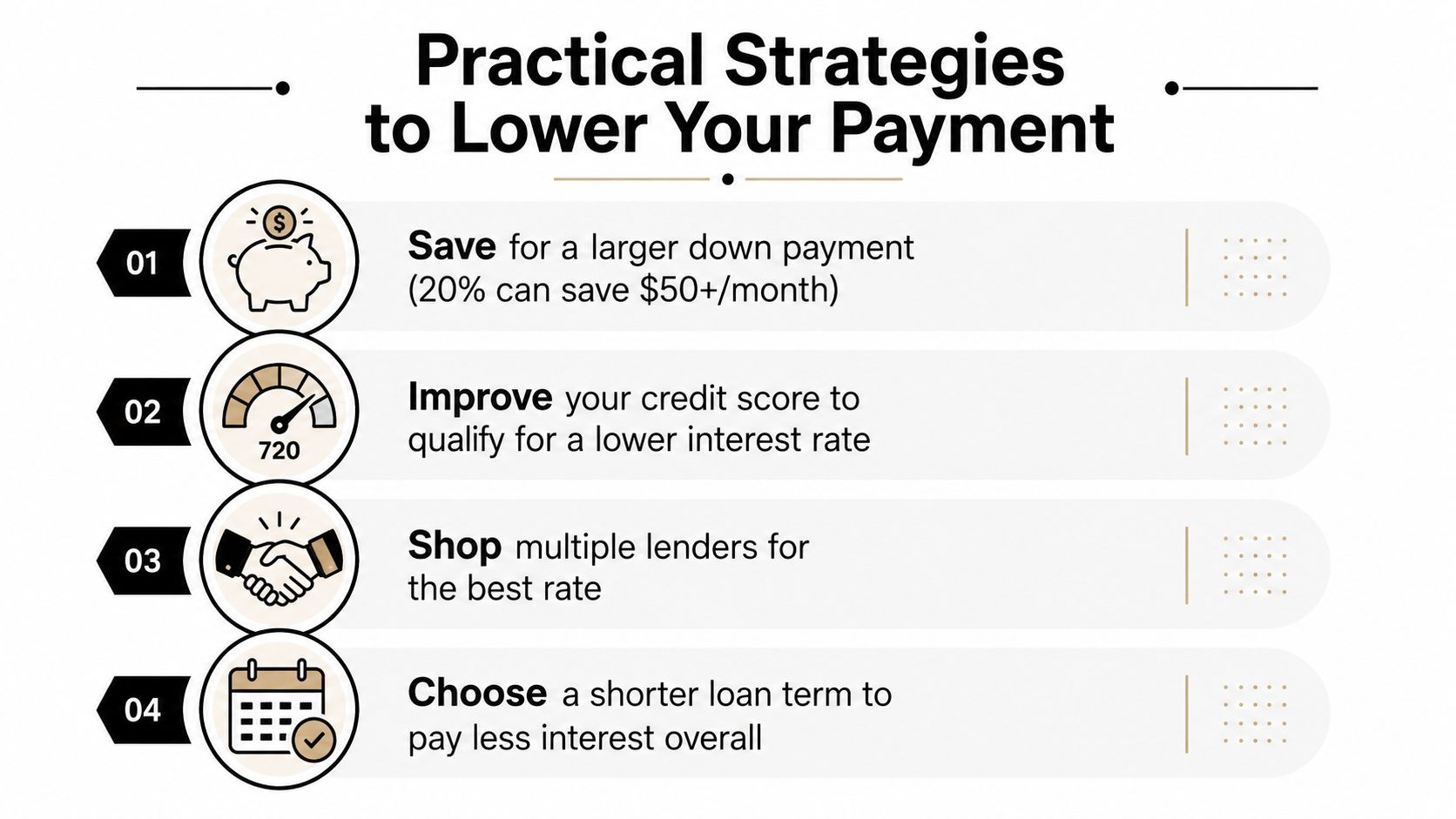
If the RV loan calculator produces a payment above your comfort level, don't jump straight to the longest term. Lower the amount borrowed, improve the rate, or choose a transaction that better matches your use.
Put cash in the right place
A larger down payment reduces the principal you finance. It can also strengthen the overall loan profile, but only use funds that won't leave you unable to handle repairs, insurance, or household emergencies.
Your trade-in deserves the same attention. Get a realistic value and payoff figure before shopping, then decide whether selling privately, waiting, or trading now produces the stronger starting position. Negative equity can follow you into the replacement RV if you don't address it directly.
Improve the rate before changing the RV
Check your credit reports for errors, reduce revolving balances where practical, and avoid opening unnecessary accounts before applying. A stronger credit profile may help you qualify for a better rate tier, although no lender can promise a particular result without reviewing the complete application.
Shop multiple lenders, including local credit unions and dealer-arranged financing. Compare APR, term, total interest, fees, prepayment rules, and collateral requirements. The lowest payment isn't automatically the least expensive loan.
Use inventory timing intelligently
Compare new and used units, last-year inventory, and floorplans that deliver the features you need. A less expensive bunkhouse that sleeps your family comfortably may be a better purchase than a larger trailer whose extra space creates unnecessary debt.
Choose a shorter term if the payment remains sustainable. Paying less interest overall is valuable, but not if the required payment forces you to skip insurance or maintenance. The right structure balances payment, reserves, equity, and intended ownership length.
Getting Pre-Qualified with Motor Sportsland
An RV loan calculator gives you a planning range. Pre-qualification gives you a more useful shopping boundary because it considers your actual credit application and lender criteria. You'll know which inventory prices deserve attention before you spend time comparing floorplans or arranging a tow vehicle.
Start by gathering income information, housing details, current loan obligations, identification, and your trade-in payoff. Submit the financing application, then ask what rate and term options are available for the RV type you're considering. Pre-qualification terms can vary, so confirm whether the process involves a soft or hard credit inquiry and ask when final approval occurs.
Use the approval amount strategically
Don't treat the maximum approval as a target. Treat it as a ceiling. Build your own limit after adding insurance, storage, registration, maintenance, fuel, propane, and a reserve for repairs.
Ask the finance team to structure the figures transparently:
- Selling price: Confirm the actual RV price.
- Trade details: Separate allowance from payoff.
- Cash down: Keep the amount consistent with your reserves.
- Taxes and fees: Request the complete out-the-door total.
- APR and term: Compare more than one structure.
- Estimated balance: Discuss how the loan may interact with resale or a future trade.
Motor Sportsland provides an online financing application and payment tools on inventory listings, while its team serves buyers from Millcreek and Spanish Fork. Those tools can turn a rough RV loan calculator estimate into a transaction-specific discussion, but the final lender approval and contract control the actual obligation.
Salt Lake City buyers should also plan for the local realities of RV ownership. Ask about winter storage, battery care, plumbing protection, tire condition, and service scheduling before heading into the Wasatch Mountains. If you're buying a toy hauler, confirm that the garage, payload, and towing setup match your powersports equipment. If you're choosing a motorhome, include chassis service and generator maintenance in the ownership plan.
Motor Sportsland can help you compare new and used RV inventory, evaluate trade-ins, review financing structures, and plan service for Utah travel conditions. Visit Motor Sportsland to browse current RVs and start a financing conversation based on the payment and ownership budget that works for you.
RV Loan Calculator FAQs
What does an RV loan calculator estimate?
It estimates a payment from the RV price, down payment, trade-in allowance, interest rate, and loan term. Many calculators also show total interest, which helps compare affordability across travel trailers, motorhomes, and fifth wheels. (Credit Karma's RV loan calculator describes these standard inputs and outputs.)
What loan terms are available for RVs?
Common RV financing choices span 5 to 20 years, and some lenders offer 144- to 180-month terms for qualifying new campers and RVs. (Summit Federal Credit Union's RV loan information provides examples of extended terms.)
Why can two buyers receive different payments for the same RV?
Lenders evaluate factors such as credit profile, income, loan structure, lender policy, and whether the RV is new or used. RV APRs can range from roughly 6% to well over 17%, so the same purchase can produce very different results. (CamperCalc's RV loan rate guide documents this market range.)
Does a calculator include taxes and ownership costs?
Not always. Confirm whether the tool includes taxes, registration, title charges, lender fees, insurance, storage, maintenance, fuel, propane, and depreciation. If it doesn't, create a separate ownership worksheet.
Is a longer RV loan term a good idea?
Choose a longer term only when it supports a long ownership plan and leaves room in your budget for the full cost of ownership. A lower payment can come with more interest and slower equity growth, increasing the risk of owing more than the RV is worth.
What should I do after using an RV loan calculator?
Gather your trade payoff, cash-down amount, preferred RV type, and realistic payment limit. Then seek pre-qualification, compare lender offers, and request a complete out-the-door breakdown before choosing the RV.
