
RV Repair Utah: A Local Owner’s Guide for 2026
Friday afternoon, you're loading chairs and groceries for a Bear Lake weekend when the slide-out stops halfway. Then you notice the soft spot near the bedroom bed, followed by a damp mark on the ceiling. The trip hasn't started, but the repair bill may already be growing.
That's the frustrating side of owning an RV in Utah. Freeze cycles can damage plumbing, strong sun can break down roof sealants, and mountain routes place extra demand on brakes, tires, engines, and cooling systems. Good RV repair in Utah isn't just about replacing a failed part. It's about finding the cause early, matching the repair to the way you use the coach, and explaining what needs attention now versus what can wait.
This guide covers the repairs Utah owners encounter, what a professional service process looks like, how winterization should be performed, why some jobs take longer than others, and what collision customers should ask about insurance and parts. Motor Sportsland's Utah service operation provides a useful local reference point, but the decision-making principles apply to any shop you call.
When Your Utah Trip Stops Before It Starts
The owner headed toward Jordanelle had already checked the hitch, filled the refrigerator, and charged the house batteries. The slide-out failure appeared during the final room check. It wasn't making the usual motor noise, and one side sat slightly lower than the other. A quick look underneath found a loose mounting point, but that didn't explain everything. Slide systems can fail because of power loss, motor or gearbox trouble, alignment, wiring, or structural movement around the opening.
That distinction matters. A shop that replaces a motor without checking alignment may return an RV that fails again. A careful technician checks the symptom, tests the system under load, examines the seals and supports, and documents the condition before recommending parts.
Utah owners also face repairs that don't announce themselves until the damage is established. Water trapped in a plumbing line can freeze overnight. A roof penetration can leak behind a ceiling panel before you see a stain. Brake and tire problems may only become obvious after a long descent through the Wasatch Mountains.
Service-desk advice: If an RV problem affects water, propane, brakes, tires, slide movement, or structural support, don't wait for the trip to expose it.
The practical questions are straightforward. What should a proper shop inspect? Which repairs can happen at a storage lot or driveway, and which require a bay? Why does diagnosis cost money before parts are installed? The answers below will help you compare estimates, plan around seasonal demand, and recognize incomplete work before you pick up the keys.
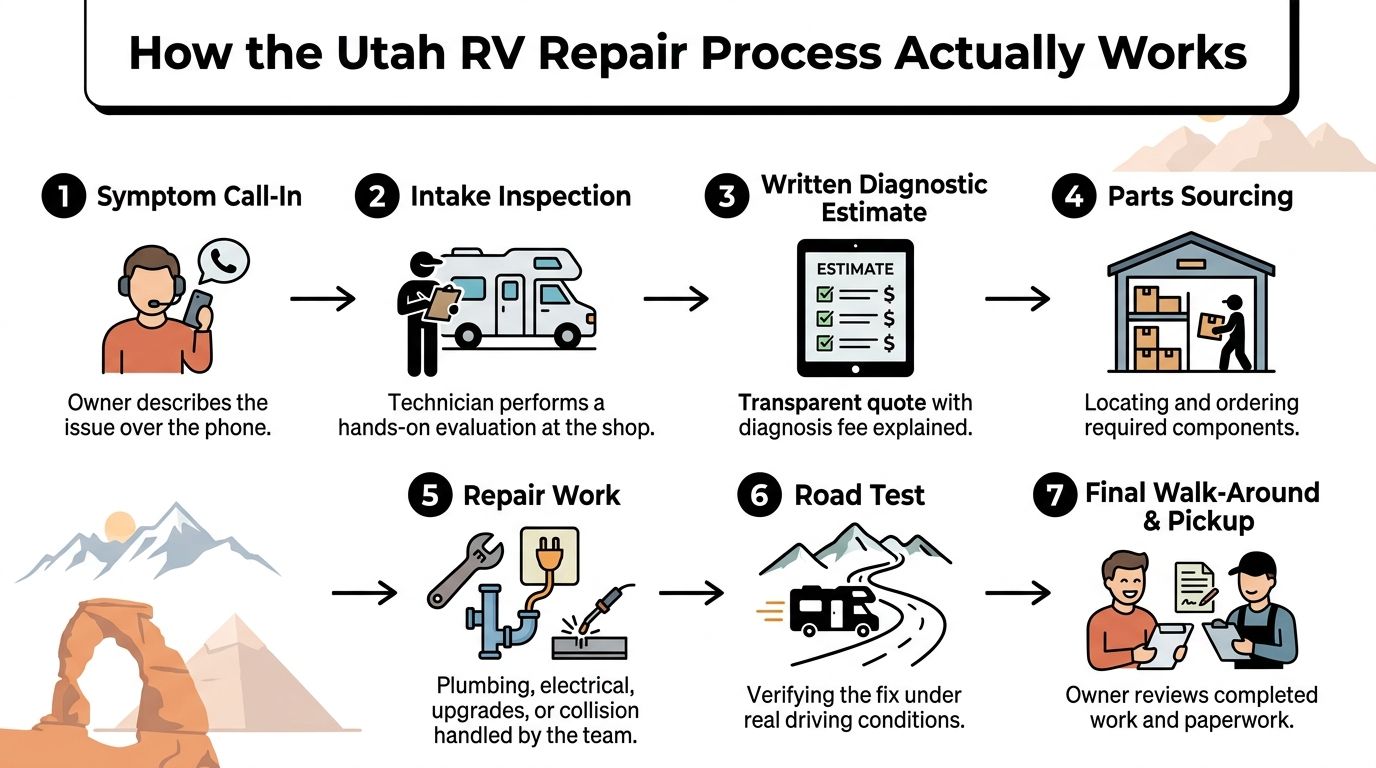
How the Utah RV Repair Process Actually Works
A professional repair usually follows a sequence. The exact timing depends on the problem, the coach, parts availability, and the shop's current workload, but skipping steps creates confusion and repeat visits.
From symptom to written estimate
Symptom call-in: Describe what happened, when it started, and what changed. “The slide is stuck” is useful, but “it moves two inches, clicks, and the passenger side drops” gives the service writer a better starting point.
Intake inspection: The technician confirms the complaint in person. They'll look for related damage, unsafe conditions, water intrusion, wiring problems, or modifications that affect the repair.
Diagnostic estimate: Testing takes time and equipment. A written estimate should identify the diagnostic charge, recommended repair, parts, labor, and any assumptions. You should know what happens if the technician finds additional damage.
Parts sourcing: RVs use components from different suppliers, and an apparently simple repair may require a specific control board, seal profile, appliance component, or body material. The service advisor should explain whether the part is in stock, ordered, backordered, or subject to an approved alternative.
Repair, verification, and paperwork
After authorization, the team performs the work, documents any changed conditions, and tests the repair. A slide-out should cycle correctly. Plumbing should hold pressure. Electrical work should be checked for proper operation and safe connections. Collision repairs need a more extensive review of body alignment, affected systems, and the insurer's scope.
Mobile service makes sense for accessible diagnostics, appliance issues, minor plumbing, electrical troubleshooting, inspections, and certain installations. A shop visit is usually more appropriate for structural repairs, extensive fiberglass or body work, roof work requiring safe access, complex slide mechanisms, collision damage, or jobs that need specialized equipment.
For another perspective on the kinds of systems included in professional motorhome service, the Class A RV Repairs service page is a useful reference when you're identifying the right repair category.
Registration and insurance can become part of the same conversation after a collision. Utah requires vehicle-mounted campers to be currently registered, and campers from model year 2015 onward require a title to be issued under Utah DMV camper guidance. Certain travel, camping, and fifth-wheel trailers weighing more than 750 pounds empty must also be registered. A service center may need registration, ownership, insurance, and claim information before collision work proceeds.
Repairs Utah RV Owners Actually Need Most
Utah's climate creates a recognizable repair pattern. The same RV that spends summer near the Great Salt Lake or in southern Utah may face freezing storage conditions months later. Each system needs a repair approach that addresses the cause, not just the visible symptom.
The common service categories
Winterization and freeze damage start with water left in lines, traps, pumps, or appliances. A proper service drains the system, bypasses the water heater, protects the plumbing with RV antifreeze where appropriate, and checks for damage before spring use. Inadequate winterization can leave cracked fittings and failed fixtures that only reveal themselves when the system is pressurized.
Roof resealing deserves attention in Utah's high-UV environment. Roof sealants and exterior caulking deteriorate under solar exposure, particularly around vents, skylights, antennas, plumbing penetrations, and other openings. Repair guidance places a typical reseal at about $500 to $1,200, depending on roof size and the number of penetrations, as described in this UV damage and RV roof reseal guide. The right repair removes failed material, prepares the surface, applies a compatible sealant, and checks adjacent areas for moisture.
Brakes and tires need special attention before mountain travel. Long grades turn a marginal brake adjustment, worn component, or aging tire into a safety concern. A technician should inspect tread, sidewalls, pressure, bearings where applicable, brake operation, and related running gear rather than treating a tire replacement as the entire solution.
Slide-out failures may involve motors, gears, rails, wiring, seals, alignment, or floor and wall movement. Forcing the room can turn a control problem into structural damage. Water heaters and furnaces also receive heavy seasonal use, while batteries, converters, inverters, and corroded connections can create electrical faults after cold storage.
Motor Sportsland's service capabilities cover maintenance, plumbing, electrical work, installations, upgrades, parts, and collision repair, which is important because many RV complaints cross system boundaries. A water leak can become a wall repair. A collision can involve cabinetry, appliances, wiring, and body panels. You can also review the practical discussion of RV roof leak repair cost before approving exterior work.
A short video can help owners recognize why a symptom-based inspection matters before a repair is authorized.
A Real Utah Winterization Done Right
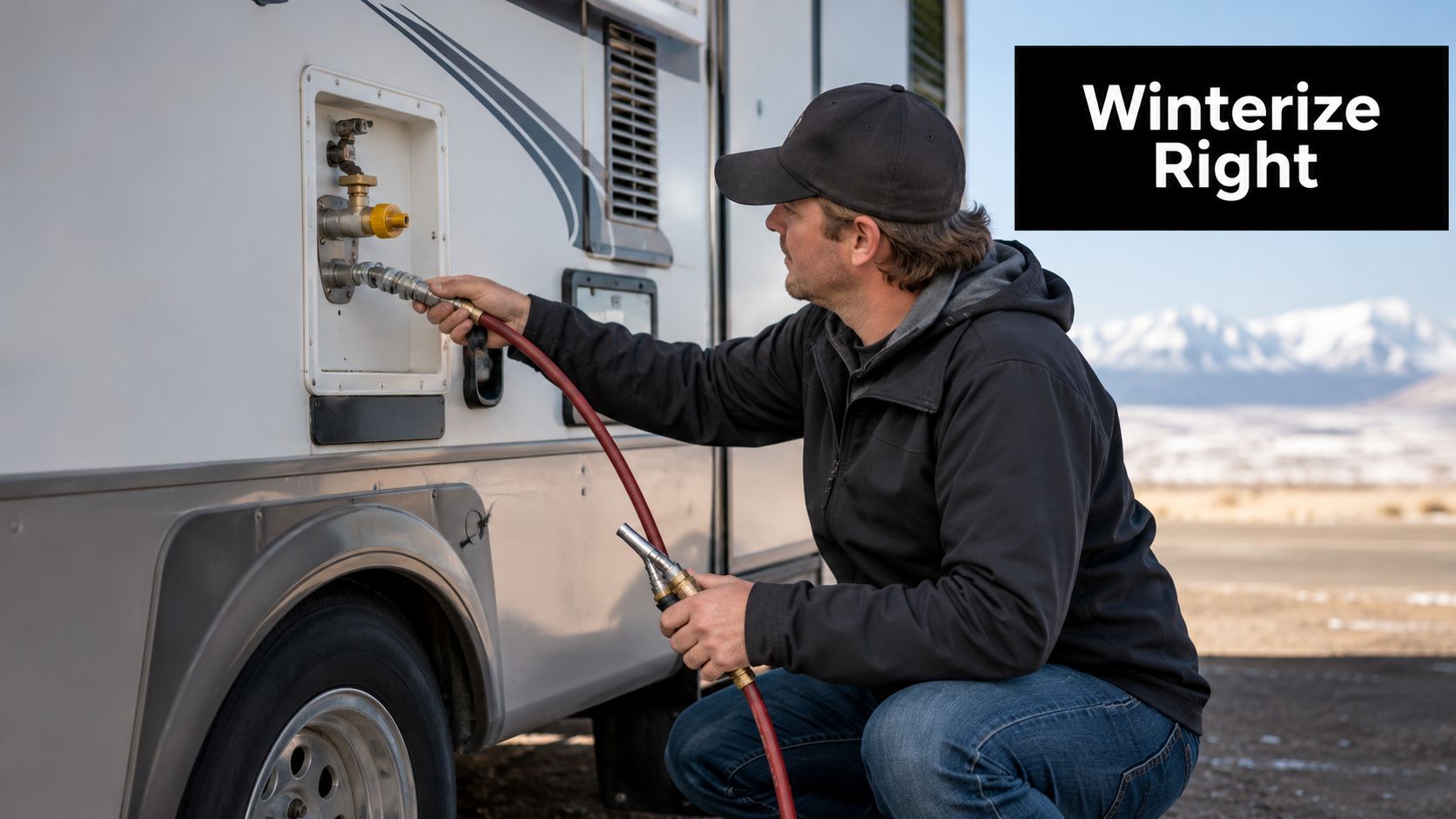
Winterization is one of the clearest tests of service quality because the work happens out of sight. A technician should begin by draining the fresh-water tank and water heater, then use compressed air to clear the water lines where that method fits the RV's system. The water-heater bypass must be used so antifreeze doesn't unnecessarily fill the heater tank.
Next, the technician protects the P-traps and pumps RV antifreeze through the water lines. P-traps are easy to overlook, but residual water there can freeze and damage plumbing. The service should also account for faucets, the toilet valve, outdoor shower, low-point drains, filters, and any appliance or accessory connected to the water system.
A basic winterization listed by a Utah RV service network costs $109.99, while a complete winterization is listed at $159.99. The Utah service listing describes the complete package as draining the fresh tank and water heater, blowing out lines with compressed air, filling P-traps with antifreeze, and pumping antifreeze through the water lines with a water-heater bypass already installed.
Those prices give you a useful comparison point, not a universal quote. A larger coach, unusual plumbing layout, missing bypass, damaged fittings, or an inaccessible storage location can change the labor involved. A cheap service that leaves water in the traps or fails to verify the system isn't a bargain if spring startup produces a leak.
Before de-winterizing, inspect visible plumbing and open valves gradually. After the system is filled, pressure-test it and run each fixture. The SwiftNet Wifi winter guide offers another owner-friendly checklist, while this guide to de-winterizing your camper can help you organize the spring startup.
How to Choose a Reliable Utah RV Service Center
A trustworthy shop makes its process visible. You should be able to ask who will diagnose the RV, what qualifications apply to propane work, whether the facility handles fiberglass and collision repairs, and how the estimate changes if hidden damage appears.
Questions worth asking before drop-off
- Technician qualifications: Ask whether the person working on propane, electrical, chassis, or body systems has the relevant training and certification.
- Parts access: Find out whether common components are stocked locally or ordered after diagnosis. Ask how the shop handles discontinued or substituted parts.
- Written scope: Request a written diagnostic estimate before authorizing repair work, including what the diagnostic charge covers.
- Facility capability: Confirm whether the shop can perform structural, roof, fiberglass, collision, and appliance work in-house or coordinates those jobs elsewhere.
- Lead-time communication: Ask when the RV will be inspected, when parts will be ordered, and who contacts you if the scope changes.
Utah's technician market affects scheduling. A 2026 mobile RV repair posting offered $55 per hour and required previous RV experience plus state propane certification within 30 days, while a Utah body and fiberglass posting listed $29 to $37 per hour. Those listings don't establish a universal shop rate, but they do show why qualified technicians for propane, fiberglass, and mobile work can be difficult to staff. Hard-to-fill specialties may carry longer waits or higher labor pricing.
A good estimate explains uncertainty instead of hiding it. “We need to inspect the slide mechanism before quoting the motor” is more useful than a low number based on a guess.
Owners comparing providers can also review this guide to RV dealers in Salt Lake City and use the same questions with every service department. Motor Sportsland's full-service model includes maintenance, parts, plumbing, electrical work, upgrades, installations, and collision repair, so customers can ask how each repair will be diagnosed and completed before moving the RV.
What Motor Sportsland Brings to Utah RV Owners
Motor Sportsland operates locations in Millcreek and Spanish Fork, giving Utah owners two service points to consider when a coach needs maintenance, repair, parts, or an upgrade. The dealership has served the area for over 55 years and works with new and used Class A, Class B, and Class C motorhomes, travel trailers, fifth wheels, toy haulers, folding campers, and destination trailers.
The service center handles more than routine warranty items. Its listed capabilities include maintenance checks, repairs, installations, plumbing and electrical work, upgrades, RV parts, and collision repair. That range matters when one problem affects several systems, such as a roof leak that reaches cabinetry, a collision that damages wiring, or a slide-out problem involving both controls and structure.
The sales and service connection can also reduce diagnostic friction when the same team knows the unit's floorplan, equipment, prior work, or installed accessories. That doesn't eliminate inspection. It gives the service writer more context before the technician begins testing.
Owners shopping for replacement units or planning an upgrade can compare Forest River, Keystone, Jayco, KZ, EAST TO WEST, Redwood, and Heartland products alongside service needs. Inventory changes, and rotating Deals of the Week may affect the purchase decision, but the practical point remains the same: choose an RV that the local service network can support over its ownership life.
Utah-Specific Maintenance Habits That Prevent Repairs
Utah maintenance works best when it follows the calendar rather than waiting for a failure. A pre-trip check before a mountain route should cover tire condition and pressure, wheel and brake components, lights, hitch connections, fluids, and battery condition. A rig that feels fine on flat roads may expose weaknesses on Wasatch grades.
Elevation changes fuel planning, too. Good Sam notes that being 3,000 feet higher than the starting point brings higher fuel consumption, so owners heading toward high-country campgrounds should allow for increased fuel use and avoid treating a flat-route estimate as a mountain-route promise. The Good Sam RV fuel-consumption article provides the relevant altitude reminder.
A practical Utah service calendar
- Before the first mountain trip: Check brakes, tires, wheel hardware, lights, hitch equipment, cooling, and fluid levels. Have a shop investigate pulling, vibration, heat, or unusual braking sounds.
- At de-winterization: Fill the system slowly, inspect for leaks, test appliances, check batteries, and schedule the annual inspection. A Utah inspection service recommends an inspection every 12 months, ideally around storage or de-winterization, covering the roof, seals, slide-outs, batteries, tires, and appliance startup checks. See the Utah RV inspection guidance.
- Before the wet season: Examine roof seams, vents, skylights, slide-out seals, and exterior caulking. Repair failed sealant before moisture reaches insulation or wall assemblies.
- After a hard cold snap: Test house batteries, converter operation, furnace performance, and plumbing. Cold can expose weak batteries and previously damaged fittings.
- Before storage: Drain and winterize the water system, clean the interior, protect tires as appropriate, and record any defects for spring service.
Scheduling these items together can reduce repeat trips. It also gives the technician a clearer picture of whether a complaint is isolated or part of broader seasonal wear.
Utah RV Repair FAQs and Local Answers
Do I need a diagnosis before I receive a repair price?
Usually, yes. A slide-out, water leak, electrical fault, or appliance failure can have several causes, so a responsible shop should not promise a final price from a brief phone description. Ask what the diagnosis covers and whether the fee applies toward approved repair work.
Which repairs can be done mobile?
Mobile service works well for inspections, accessible plumbing and electrical repairs, appliance troubleshooting, winterization, battery installation, and minor fixes. A shop is usually better for collision damage, fiberglass, structural problems, major roof work, complex slide mechanisms, or repairs requiring specialized equipment and a controlled workspace.
Why might a Utah repair take longer than expected?
Parts availability and technician specialization affect the schedule. Propane systems, fiberglass, body work, and complicated electrical faults require specific skills. The shop may also be waiting for an approved component or insurer authorization. Ask for milestone updates, such as diagnosis, parts arrival, supplement approval, and repair completion, instead of relying on one completion promise.
What should collision owners ask about the 2026 Utah bill?
A 2026 Utah automotive repair bill would address insurer treatment of aftermarket crash parts, equivalent-quality standards, and a method for calculating diminished value after a crash, according to the Utah legislative bill document. Ask whether the estimate identifies original and aftermarket parts, how equivalent quality is established, who approves supplements, and how post-accident value loss is handled. Its practical effect depends on legal status and implementation, so confirm current requirements with the insurer and repair professional.
How do registration and titling affect major repairs?
Utah registration and title rules can matter when a camper or trailer changes ownership, enters a collision claim, or needs documentation. Vehicle-mounted campers must be currently registered, and Utah requires a title for campers model year 2015 and newer. Registration paperwork may accompany a repair file, but the DMV and insurer remain responsible for their respective requirements.
Does altitude affect towing?
Yes. Wasatch mountain travel can reduce fuel economy and increase demands on the tow vehicle, cooling system, and brakes. Check the rig before departure, allow more margin on climbs and descents, and do not judge performance only from flat-road driving.
| Repair | Typical Utah Cost | Why It Matters Here |
|---|---|---|
| Basic winterization | $109.99 | Protects the water system before freezing conditions. |
| Complete winterization | $159.99 | Adds line blowout, P-trap protection, and antifreeze through the water lines. |
| Roof reseal | About $500 to $1,200 | UV exposure can break down sealant around roof penetrations. |
| Brakes, tires, appliances, slides, and electrical work | Quote after diagnosis | The cause and access vary widely, especially on older or modified RVs. |
A service advisor can separate an urgent safety or water-intrusion repair from a cosmetic item that can wait. Motor Sportsland's Millcreek and Spanish Fork locations provide maintenance, plumbing, electrical, parts, upgrades, installations, and collision support for Utah RV owners.
Visit Motor Sportsland to compare current RV inventory, ask about parts and service for an existing coach, or schedule a conversation with the team at either location. Bring symptoms, photos, repair records, and upcoming travel plans. That information helps the service staff identify what needs attention before the next Utah trip.
