
The Best Travel Trailers for Full Time Living: 2026 Guide

Trading a house for a trailer sounds simple when you're standing in a campground at sunset. Then crucial questions show up. Which travel trailer can reliably handle daily life, Utah winters, mountain towing, remote work, and all the stuff you own when “weekend camping” turns into “this is home now”?
That's where a lot of first-time full-timers get stuck. The market is crowded, the brochures all sound confident, and a lot of trailers look great on the lot but aren't built for constant use. Since 2020, the RV market has shifted much more toward year-round residential use, and independent 2025 rankings show brands like Grand Design, Jayco, and Winnebago being judged on full-time livability rather than just vacation convenience, which tells you this isn't a niche concern anymore (independent 2025 RV brand ranking discussion).
If you're shopping for the best travel trailers for full time living, the right question isn't “Which one has the prettiest interior?” It's “Which one will still work for me after months of real use?”
In Utah, that matters even more. A trailer that feels fine in a mild climate can struggle fast when you're dealing with Wasatch cold, high-altitude nights, summer heat, and steep grades. The advice below comes from the way experienced RV people evaluate trailers in practical use, not just the way they're marketed.
Introduction From Dream to Driveway
A lot of buyers start in the same place. They want to simplify life, travel more, lower housing costs, or finally use Utah as it's meant to be used. Bear Lake one month, the red rock country the next, maybe a seasonal setup near the Wasatch Front while working remotely.
Then they start shopping and hit the wall.
Every trailer promises comfort. Half of them say “extended season” or “four-season.” Plenty have big TVs, fireplaces, and trendy interiors. None of that tells you whether the trailer is suited for full-time living. Daily use exposes weak points fast. Doors loosen, storage runs out, insulation matters, and payload becomes a serious issue instead of a line on a spec sheet.
The buyers who end up happiest usually make one shift early. They stop shopping like campers and start shopping like homeowners who need a towable structure.
That's the lens to use throughout this guide. The best travel trailers for full time living are usually the ones with better bones, smarter layouts, stronger storage, and systems that can handle constant occupancy. Utah adds another filter. If you're going to live this way here, you need to think beyond floorplan photos and ask how the trailer will behave in snow, heat, wind, elevation, and on long grades.
Beyond the Brochure What Full-Time Rated Really Means
“Full-time rated” sounds official. It isn't.
There's no universal industry standard that cleanly defines what counts as a full-time travel trailer. That's why experienced buyers learn to treat the phrase as a starting point, not a conclusion. The important question is whether the trailer is built for constant use, changing weather, and heavier loading.

Many “best of” lists still favor floorplans and easy towing, but long-term living usually pushes buyers toward heavier, more durable rigs. Independent guidance aimed at full-timers notes that real comfort and maneuverability often land in the 30 to 40 foot range, because that's where you start getting residential function and stronger-feeling layouts instead of cramped compromises (full-time RV guidance from Bent's RV).
What matters more than the label
A trailer built for a handful of summer weekends can look nearly identical to one meant for daily occupancy. The difference shows up in the less glamorous parts:
- Frame and running gear matter because full-time living means more weight, more miles, and more wear.
- Wall, floor, and roof construction matter because Utah weather will test them.
- Cabinet attachment, hardware, and furniture quality matter because you'll use them every day, not a few times a season.
- Window quality and sealing matter because drafts and condensation become part of your life if they're poor.
- Serviceability matters because every trailer eventually needs attention.
A flashy island kitchen doesn't offset weak structure. A decorative fireplace doesn't help if the underbelly isn't protected.
Practical rule: If a trailer impresses you most with finishes and not with construction details, keep looking.
The signs of a trailer that may not hold up
Some travel trailers are sold into full-time dreams even though they're better suited to occasional use. Common warning signs include light-duty feel, limited storage, minimal underbelly protection, and a layout that only works when the slides are fully out and the weather is pleasant.
You can get a deeper look at the day-to-day realities in this guide to living full-time in a travel trailer, especially if you're still deciding whether this lifestyle fits your routine.
A brochure can help you narrow the field. It can't tell you how a unit feels after a winter, a long towing day through Parley's Canyon, or a month of cooking, showering, working, and storing your life inside it. That part comes from evaluating the trailer like a house on wheels.
The Non-Negotiable Features for Full-Time Living
When buyers ask what separates a decent camper from one of the best travel trailers for full time living, the answer usually comes down to systems and structure. Full-time comfort is built from practical features, not showroom sparkle.
Start with the systems you can't fake later
Insulation matters in every season. A trailer with weak wall, roof, floor, or slide insulation may still be usable, but it's harder to heat, harder to cool, and less comfortable to live in every day. In Utah, that gap shows up quickly between a sunny afternoon and a cold overnight at elevation.
An enclosed and heated underbelly is another major checkpoint. If tanks and plumbing are exposed or only lightly protected, winter camping becomes a gamble. Even shoulder seasons can punish a trailer with weak tank and line protection.
Tank size and usability matter too. If you plan to move often between hookups, state parks, boondocking areas, or overnight stops, larger fresh, gray, and black tanks make life easier. Small tanks can work for weekend trips. Full-time living asks more from them.
Cargo carrying capacity is a make-or-break spec
A lot of first-time buyers underestimate how quickly a “home” adds weight. Full-time capable trailers often list cargo carrying capacity in the 3,000 to 8,300 lb range, because owners carry water, clothing, food, tools, dishes, office gear, and daily-use items that weekend campers often leave at home (full-time RV cargo capacity discussion).
That one number changes how you should shop.
If a trailer has a beautiful interior but limited carrying capacity, it may not stay practical once you load batteries, propane, bedding, kitchen gear, seasonal clothing, hoses, cords, and the little things that pile up. For full-time use, payload isn't a side note. It's one of the main specs.
A trailer can run out of carrying capacity before it runs out of cabinets.
The checklist we'd use on the lot
Look for these features before you fall in love with decor:
- High-capacity storage: Interior wardrobes, pantry space, under-bed storage, and usable pass-through compartments matter more than accent lighting.
- Residential kitchen function: Enough counter space, a realistic pantry, and a refrigerator suited to daily food shopping make the trailer live larger.
- Electrical headroom: Solar readiness, battery space, and room for upgrades matter if you expect to spend time off-grid or work remotely.
- Durable windows and seals: These affect comfort, condensation, and long-term weather resistance.
- Cabinet and furniture quality: Open drawers, check hinges, and look at how pieces are secured.
Here's a simple way to evaluate priorities:
| Feature | Why it matters full-time | What happens if it's weak |
|---|---|---|
| Insulation | Helps manage Utah cold and heat | Constant HVAC strain and discomfort |
| Underbelly protection | Protects tanks and plumbing | Freeze risk and seasonal limits |
| Storage | Supports actual daily living | Clutter and hard compromises |
| Payload | Carries real household gear | Overloading and towing issues |
| Electrical capacity | Supports off-grid use and work | Constant power limitations |
Comfort upgrades that earn their keep
Hot water is one of those daily-life issues people underestimate until they're living in the trailer. If you're comparing systems, this look at an instant hot water heater for RV use is helpful because hot water consistency affects showers, dishes, and winter livability more than many first-time buyers expect.
The strongest full-time trailers usually don't win on one single feature. They win because they avoid obvious weak links.
Choosing the Right Floorplan for Your Lifestyle
A good floorplan on paper can be a bad home in practice. The best travel trailers for full time living aren't defined by how many people they can sleep on a brochure. They're defined by whether the layout works on an ordinary Tuesday when someone's cooking, someone's working, and everybody still needs a place to sit, move, and put things away.

For long-term comfort, length matters. Guidance for travel trailer sizing notes that models over 30 feet usually provide the room needed for private bedrooms and more residential layouts, but buyers still need to match trailer size to tow-vehicle capability because travel trailers can reach up to 35 feet and 8,000 pounds in common size ranges (travel trailer sizing guide).
Floorplans that work for different kinds of full-timers
Rear living layouts are popular with couples for a reason. Big windows, a defined lounge area, and a sense of separation from the bedroom make the trailer feel less cramped. The downside is that some rear living layouts sacrifice desk space or pantry space.
Mid-bunk or office-style floorplans can be excellent for remote work or families. That flex room can serve as an office, guest room, kid zone, or storage room. The trade-off is that the main living area can feel tighter if the extra room steals too much square footage.
Front kitchen trailers often appeal to people who cook. They tend to offer better prep space and stronger kitchen storage. The compromise is that some of them feel more segmented and less open.
Toy hauler-style layouts work well for buyers who need a workshop, bike storage, or flexible cargo space. For some full-timers, that garage becomes an office or bonus room. For others, it feels less insulated and less residential than a traditional living area.
A quick comparison
| Floorplan | Works well for | Watch out for |
|---|---|---|
| Rear living | Couples, hosting, scenic camping | Limited work zone in some layouts |
| Mid-bunk or office | Families, remote workers | Reduced main lounge space |
| Front kitchen | Serious cooks, longer stays | Less open living feel |
| Toy hauler | Gear-heavy lifestyle, flexible use | Garage comfort can vary |
If you want to compare layouts in more detail, this guide to travel trailer floor plans helps narrow down what works for families, couples, and buyers who need multi-use space.
The right floorplan gives each person a job-free place to exist. That matters more after month three than it does on day one.
In Utah, length also affects where you're comfortable towing and parking. A longer trailer can feel much better to live in near Jordanelle or Bear Lake for extended stays, but it may limit flexibility in tighter campgrounds and older park sites. Daily livability and travel convenience always pull against each other. Good buying decisions accept that trade-off instead of pretending it doesn't exist.
Built for Utah Preparing for Four Seasons on the Road
Utah is where a lot of national RV advice stops being enough. A trailer that feels “all-season” in a mild state may feel exposed here.
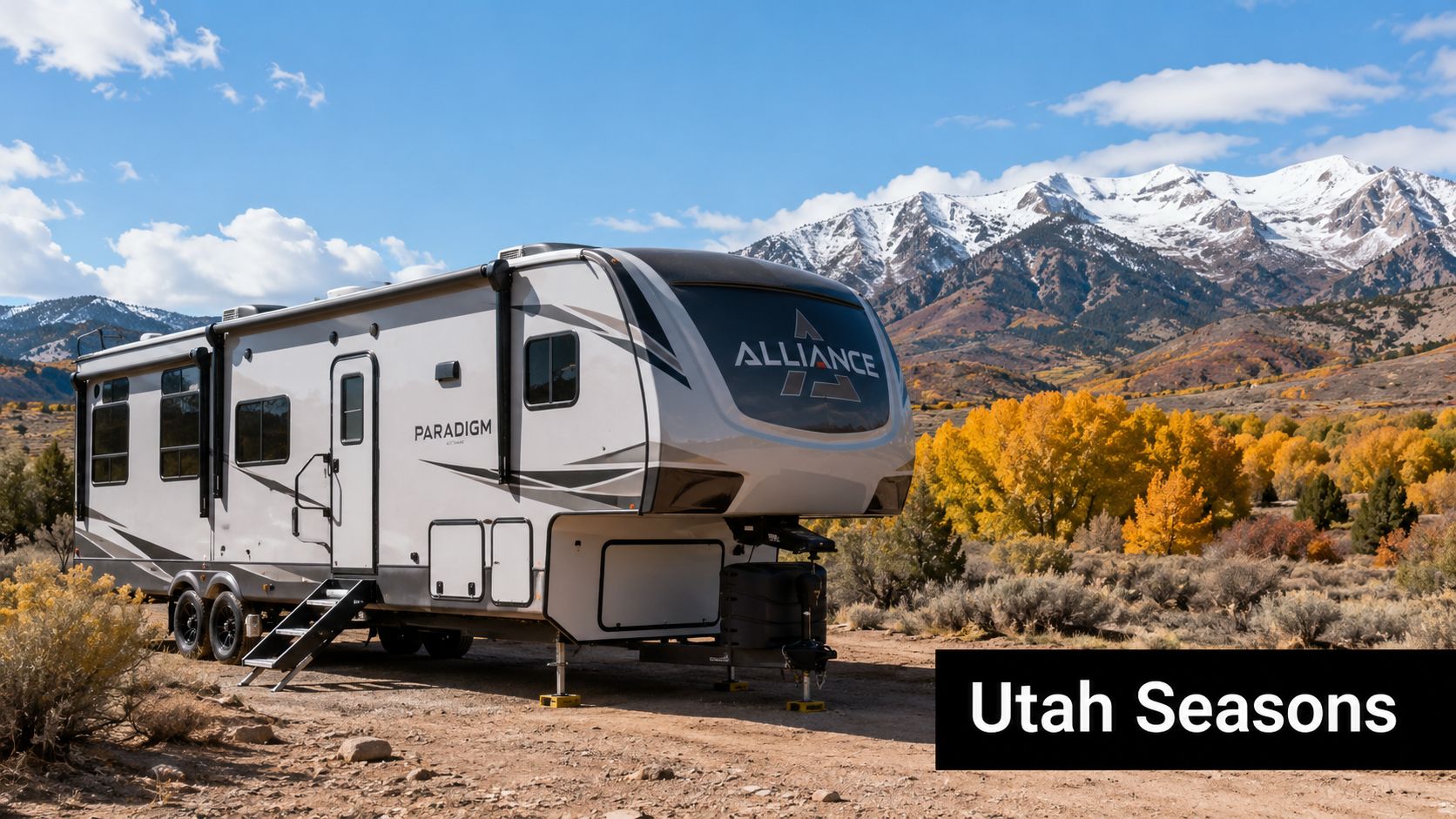
Owner communities keep returning to the same point. Seasonal survivability is one of the biggest gaps in mainstream buying guides, and full-time buyers care more about build quality and climate resilience than many general rankings admit, especially in states with large temperature swings like Utah (four-season travel trailer overview).
Winter along the Wasatch Front
A cold spell near Salt Lake City is one test. Staying at elevation is another. If you're parked near the Wasatch Front in winter or spending time in colder areas around Bear Lake, weak windows and poor insulation show up fast. You'll feel drafts, furnace cycling, cold floors, and more condensation around the bed and windows.
Dual-pane windows, stronger insulation, enclosed underbellies, and protected plumbing aren't luxury features for this kind of use. They're what keep the trailer functional and more comfortable.
Practical winter habits matter too:
- Vent moisture daily: Cooking, breathing, and showering add moisture fast.
- Watch your storage bays: Cold corners can freeze before the main cabin feels that cold.
- Manage water hookups carefully: In freezing weather, many full-timers adjust how they handle hoses and tank usage.
Summer in Moab and southern Utah
Now flip the calendar. You head south and the issue changes completely. Heat buildup, sun exposure, and cooling efficiency become the problem. Trailers with weak insulation often struggle in both directions. They lose heat when it's cold and gain it too quickly when it's hot.
A good full-time trailer in Utah should help you do both of these things well:
- Hold conditioned air once you've cooled or heated the cabin
- Protect vulnerable systems when outside temperatures swing hard between day and night
Here's a useful walkthrough if you want to see broader RV living considerations in action:
The Utah-specific questions to ask before you buy
When evaluating a trailer for year-round use here, ask direct questions:
- How are tanks and lines protected?
- How well are the windows built?
- How much usable insulation is present in real-world cold and heat?
- Will this layout still work when bad weather keeps you inside all day?
A lot of buyers focus on whether a trailer can survive one cold weekend. Full-time buyers need to think about surviving a Utah year.
Budgeting Towing and Owning Your Full-Time Trailer
The purchase price is only the first layer.
Owning a full-time travel trailer also means budgeting for registration, insurance, maintenance, repairs, site fees, power solutions, seasonal upgrades, and the basic tools that make daily RV life work. Even when buyers are trying to simplify, they still need a reserve for tires, brakes, seals, batteries, roof maintenance, plumbing fixes, and the normal wear that comes with using a trailer as a home.
That doesn't mean full-time RVing can't make financial sense. It means you should budget like an owner, not like a vacationer.
Towing is where mistakes get expensive
This is the part many first-time buyers get wrong. They shop for the trailer first, then try to make the truck fit. In Utah, that can become a safety problem quickly. Mountain grades, canyon winds, and long descents don't forgive an under-matched setup.
When you evaluate towing, focus on the full loaded reality, not the optimistic empty number. Your truck has to handle the trailer, your cargo, passengers, hitch weight, and mountain conditions. If you're planning regular travel over steep routes, you want margin, not just technical legality.
Buy enough truck for the life you'll actually live, not the brochure version of the trailer.
A practical ownership checklist
Before signing papers, work through these costs and questions:
- Insurance fit: Make sure your policy matches full-time use, not occasional recreation.
- Maintenance access: Know where you'll get service and routine inspections.
- Seasonal setup costs: Skirting, battery upgrades, hoses, surge protection, and climate-related accessories add up.
- Campground strategy: Nightly travel patterns cost differently than monthly or seasonal stays.
- Emergency reserve: Full-time RV life is smoother when repairs don't turn into crises.
Financing should support the plan, not stretch it
A healthy deal leaves room in the budget for ownership, not just the monthly payment. If the trailer payment only works by ignoring maintenance, insurance, and towing realities, the trailer is too much trailer.
For a first-time full-timer, the smartest budget usually lands on a combination of three things: enough structural quality to avoid obvious disappointment, enough livable space to support daily routine, and enough tow margin to stay safe in Utah terrain.
Motor Sportsland Your Local Partner in Full-Time RVing
A buyer trying to sort through all of this usually needs more than inventory photos. They need someone to walk the trailer with them and point out what's cosmetic, what's structural, and what's going to matter six months from now.
That's where a local dealership process helps. Motor Sportsland has been serving Utah for over 55 years from Millcreek and Spanish Fork, and the useful part for a full-time buyer is straightforward. You can compare new and used RV inventory by weight, length, floorplan, and features, and you can also line that search up with service, parts, financing, trade-in, and repair support through one business if that's the route you want to take.
What to evaluate in person
On the lot, don't just stand in the kitchen and admire the finish. Open the storage. Look at pass-through space. Sit where you'd work. Check the pantry. Step into the bathroom and close the door. Ask how the tanks and underbelly are protected. Ask what upgrades owners commonly add for colder-weather camping.
A useful walk-through should help you answer questions like these:
- Can this trailer hold what I own?
- Can I live in this layout during bad weather?
- Can my tow vehicle handle this safely in Utah?
- Will service and parts be straightforward when something needs attention?
Support after the sale matters more for full-timers
Weekend campers can tolerate downtime more easily than full-timers can. If the RV is your house, service scheduling, repairs, parts availability, and routine maintenance become much more important.
That's why a full-time buyer should think about the whole support chain:
| Need | Why it matters full-time |
|---|---|
| Service center access | Daily living can't pause long for repairs |
| Parts availability | Small failures can become major disruptions |
| Upgrade options | Four-season and electrical improvements may be needed |
| Trade-in path | Needs change after real-world use |
A trailer is only part of the decision. The other part is how you'll keep it functional once the trip becomes ordinary life.
Your Next Steps and Frequently Asked Questions
If you remember three things, remember these.
First, the best travel trailers for full time living usually win on construction, capacity, and systems, not on showroom flash. Second, Utah makes four-season readiness a real issue, not a marketing phrase. Third, your tow vehicle and loaded trailer need to match accurately if you want safe, low-stress travel through the mountains.
If you're also preparing to leave a traditional house, downsizing becomes part of the project. A good planning resource outside the RV world is this comprehensive UK downsizing guide. It's useful for thinking through what to keep, what to store, and what you use often enough to justify carrying.
Frequently asked questions
Is a travel trailer a good choice for full-time living?
Yes, if the trailer has the right structure, storage, payload, and climate protection for your lifestyle. Some buyers are better served by a fifth wheel or destination-style unit, but many travel trailers work well when chosen carefully.
What's the biggest mistake first-time full-timers make?
Buying for appearance and floorplan alone. Daily livability depends just as much on payload, storage, insulation, and serviceability.
Do I need a four-season trailer in Utah?
If you expect to live in it through cold weather or major temperature swings, you should shop with four-season performance in mind and verify the actual build details.
How long should a full-time travel trailer be?
Many buyers find that longer layouts support better residential comfort, especially when they need a private bedroom, workspace, or family zones. The right length still has to fit your truck and travel habits.
Can I work remotely from a travel trailer full-time?
Yes, but the floorplan matters. Dedicated desk space, usable dinette seating, power planning, storage, and weather comfort all affect how realistic remote work feels.
Should I buy new or used for full-time RV living?
Either can work. New may offer current features and warranty coverage. Used can offer value if the build quality is strong and the condition has been evaluated carefully.
Ready to compare real options in person? Browse current RV inventory, talk through towing and full-time use, or schedule service support with Motor Sportsland.
