
Used RV Values: A Utah Buyer's Guide for 2026
You found a used travel trailer online that looks perfect for weekends at Bear Lake. The photos are clean, the floorplan fits your family, and the asking price seems reasonable until you check an online value tool and get a very different number. That's where a lot of first-time buyers get stuck.
Used RV values don't work like a simple sticker price. A guidebook might say one thing, a seller might ask something else, and a dealer appraisal can land in a third spot entirely. On our lots in the Salt Lake Valley, we see that confusion every day. A bunkhouse trailer that looks like a steal in photos can turn into a poor buy once you spot soft floor, old tires, and missing service history. On the other hand, a higher-priced used fifth wheel with clean maintenance records can be the smarter purchase.
That's why pricing a used RV is part data, part inspection, and part local market reality. Utah adds its own twist too. Mountain towing, winter storage, sun exposure at elevation, and strong demand for family-friendly layouts all affect what a rig is really worth. If you're still deciding whether pre-owned is the right route, our guide on whether a used RV is right for you is a helpful place to start.
An Introduction to Used RV Values
Used RV values are really about one question. What would a willing buyer pay for this specific RV, in this condition, in this market, right now?
That sounds simple, but it rarely is. Two travel trailers with the same year, brand, and floorplan can land far apart in value once you look past the listing headline. One may have been stored under cover, serviced on schedule, and kept sealed against Utah winters. The other may have spent years outside with cracked roof sealant and water intrusion starting behind a wall panel.
Our team sees first-time shoppers focus too much on the number they found in a calculator and not enough on the story the RV tells in person. We also see sellers anchor on what they still owe, what they paid during the high-price market, or what a neighbor says their RV is worth. None of those numbers decide market value.
Used RV values make more sense when you stop asking, “What's the book say?” and start asking, “What condition is this unit in, and what are similar rigs actually bringing right now?”
That shift matters whether you're buying, selling, or trading. The right valuation process protects you from overpaying, helps you negotiate with confidence, and keeps you from being blindsided by repair costs after the sale.
What Used RV Value Really Means
When people say “value,” they're often talking about three different numbers. If you don't separate them, the whole shopping process gets muddy fast.
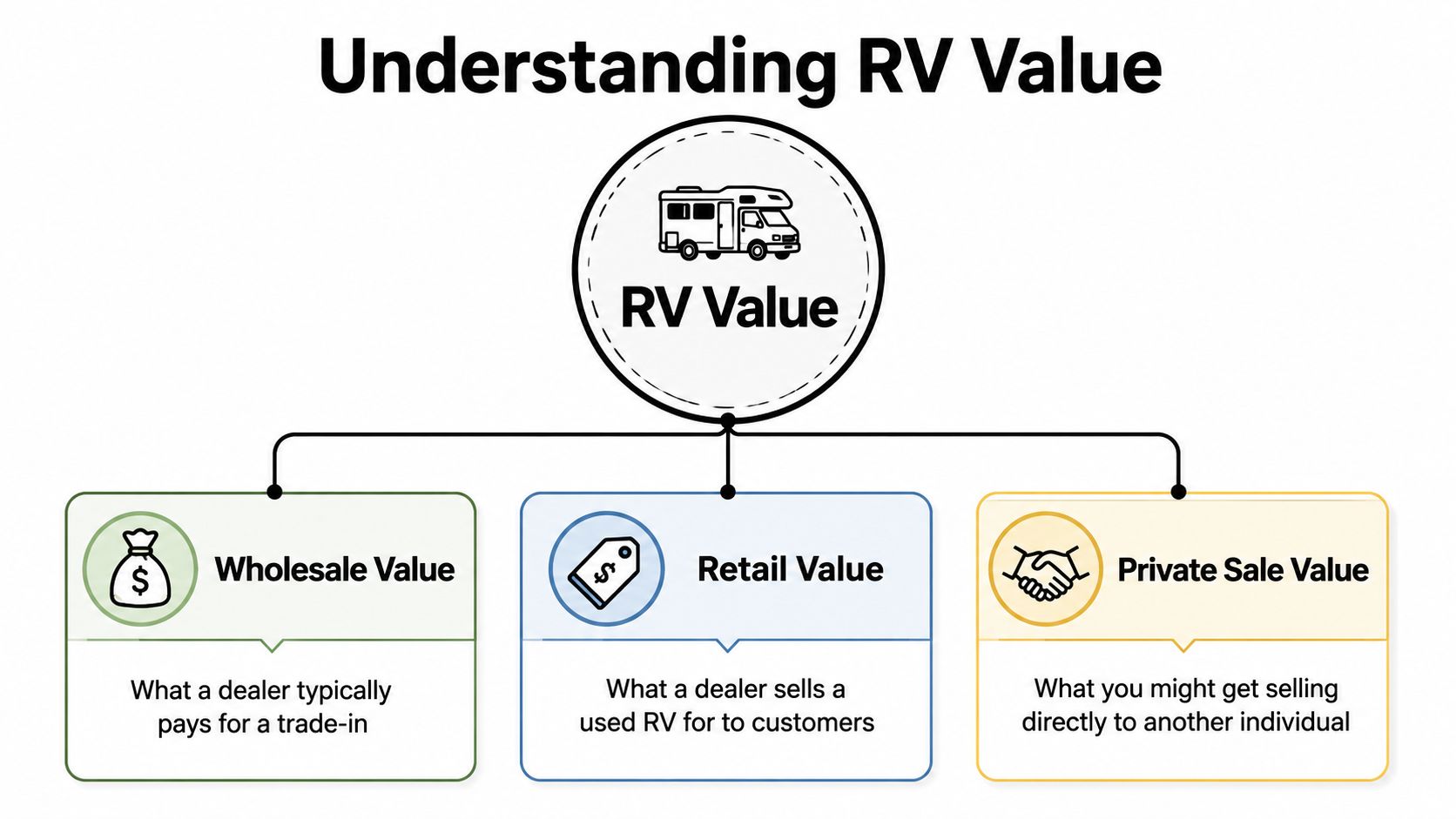
Wholesale value
This is usually what a dealer might pay on trade, assuming that unit still needs inspection, cleanup, service work, and some risk built into the number. Wholesale value isn't an insult. It reflects what happens between trade-in and resale.
A traded unit may need tires, batteries, resealing, appliance work, brake service, or cosmetic cleanup before it's ready for the front line. Buyers often compare this number to a retail asking price and think the spread is unfair. In reality, those are two different stages of the same RV.
Retail value
Retail value is what you see on a dealership lot or inventory page after the RV has been evaluated and prepared for sale. That number usually includes the cost of getting the RV ready and the convenience of buying from a business that handles title, financing options, and basic sale structure.
If you've ever compared used truck prices from a private seller to a dealership, it's the same basic idea. You're not only paying for the unit. You're paying for how sale-ready it is.
Private-party value
This is the number that gets negotiated between individuals. Sometimes it falls between wholesale and retail. Sometimes it doesn't. The trouble is that private listings often reflect hope more than market reality.
That's where guidebooks confuse people. Public valuation tools are useful as a starting point, but they don't always line up with what older RVs are selling for. As RVshare's breakdown of RV values notes, dealerships often use a proprietary JD Power version that is 10–15% lower than the public NADA guide, and platforms like RV Trader reveal sellers asking $25k for units JD Power values at $12k, indicating guidebooks systematically overstate value for older rigs. That gap is one reason buyers and sellers end up talking past each other.
A helpful way to think about pricing is the same logic used in insurance disputes and vehicle settlements. The Total Loss Northwest fair market value guide does a good job explaining how “fair market value” depends on actual market evidence, not just a printed book estimate.
The 6 Key Factors That Drive RV Value
A guidebook gives you a starting line. These factors decide where the actual number ends up.
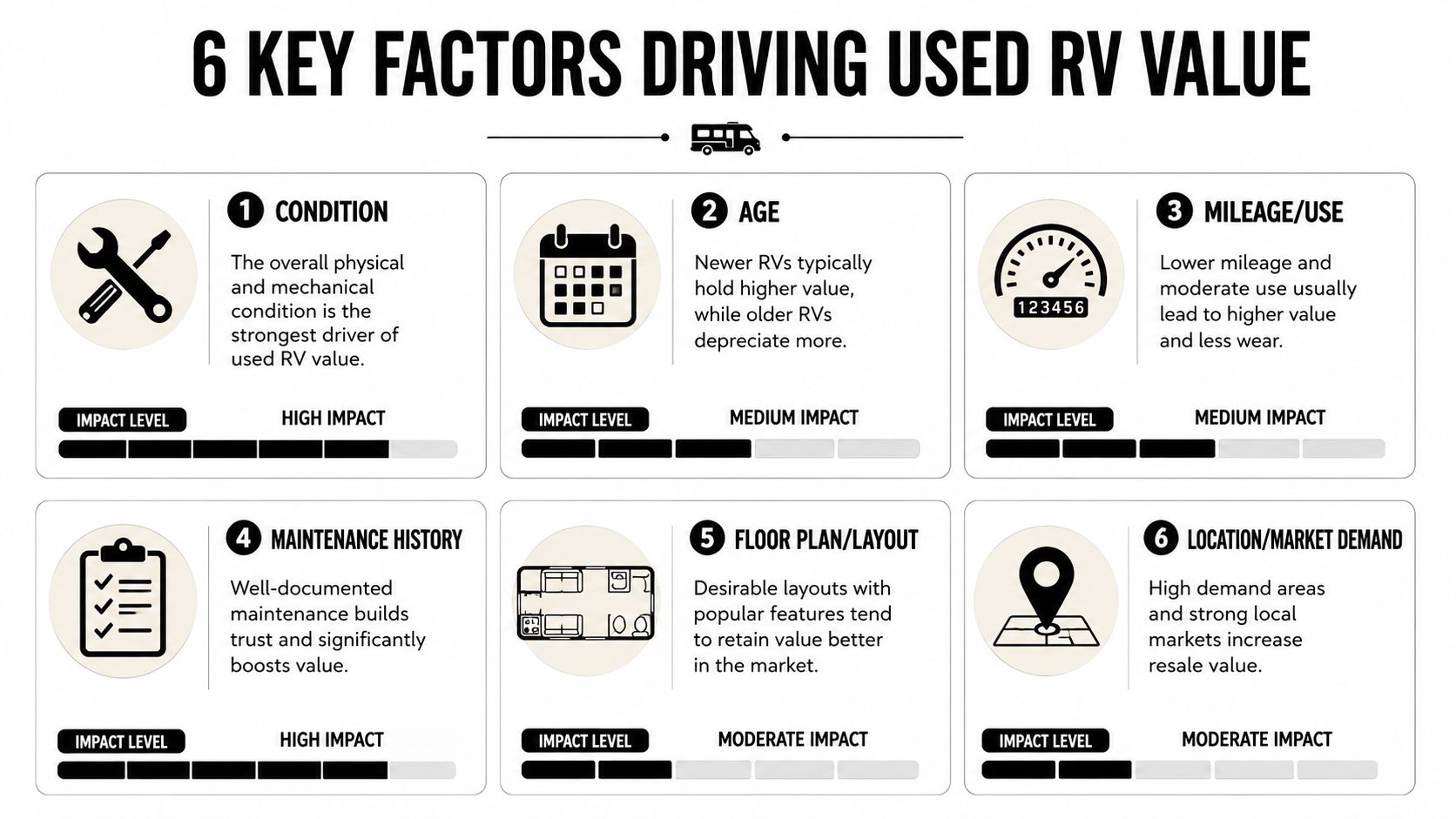
Age and depreciation
The first hit in value comes early. According to Outdoorsy's RV depreciation analysis, Class A motorhomes depreciate 30% after three years, Class C models lose 38% after five years, and fifth wheels drop 45% in five years. This confirms depreciation is front-loaded, with 20–30% of value lost immediately upon purchase.
That's why many shoppers get better value in a rig that's already a few model years old. The first owner absorbed the steepest part of the curve.
Mileage and engine hours
Motorhomes add another layer because the chassis matters. Lower mileage can help, but it's not the whole story. A coach that sat too much can still have issues with tires, seals, fuel systems, or neglected maintenance. Generator hours also matter. So does how the coach was used.
For towables, there's no odometer, so condition and care matter even more.
Condition
This is the biggest factor on the lot. Clean roof lines, dry walls, solid floors, working appliances, healthy batteries, and good tires all support value. Water damage does the opposite fast.
Buyers sometimes overpay for a shiny interior and miss the expensive stuff. Soft corners, bubbling wall panels, delaminated sidewalls, and poorly patched roof seams can erase value in a hurry.
Maintenance history
Service records change the conversation. A folder with inspections, reseals, bearing service, appliance repairs, and winterization receipts gives confidence. Missing records force the next buyer to assume more risk.
If you want a useful outside reference on presentation and upkeep, Lionheart Detailing's RV guide is a solid reminder that cleanliness and surface care don't just help appearance. They also signal how seriously an owner treated the unit.
Floorplan and brand appeal
Some layouts move faster than others. Family bunkhouse trailers are popular in Utah because they fit the way local families camp. Toy haulers attract buyers heading toward the desert and trail systems. Rear living fifth wheels often appeal to couples who want longer stays.
Brand matters too, but not in a vacuum. A respected brand with poor upkeep won't beat a lesser-known model that's been cared for correctly.
Regional demand
Location changes value. A toy hauler that gets strong attention along the Wasatch Front may not perform the same way in another market. Features that help with shoulder-season camping in the mountains, such as insulated underbellies or larger holding tanks, can also make a difference.
| Factor | High Positive Impact | High Negative Impact |
|---|---|---|
| Age | Past the steepest early depreciation with clean history | Very old unit with dated systems and weak demand |
| Mileage or use | Reasonable use with evidence of routine service | Heavy use with unclear maintenance |
| Overall condition | Dry, clean, solid structure and working systems | Water damage, soft floor, delamination, neglected tires |
| Maintenance history | Detailed records and documented repairs | No records, deferred maintenance |
| Floorplan and brand | Popular layouts and broadly trusted brands | Niche layout with limited local demand |
| Location and market demand | Matches what buyers want in Utah | Mismatch for local camping habits |
Practical rule: If the RV's condition and maintenance history are weak, the rest of the value conversation doesn't matter much.
How to Get an Accurate Used RV Value Step by Step
When our sales and service teams appraise a unit, we don't start by guessing. We build the number in layers. That same process works for first-time buyers.
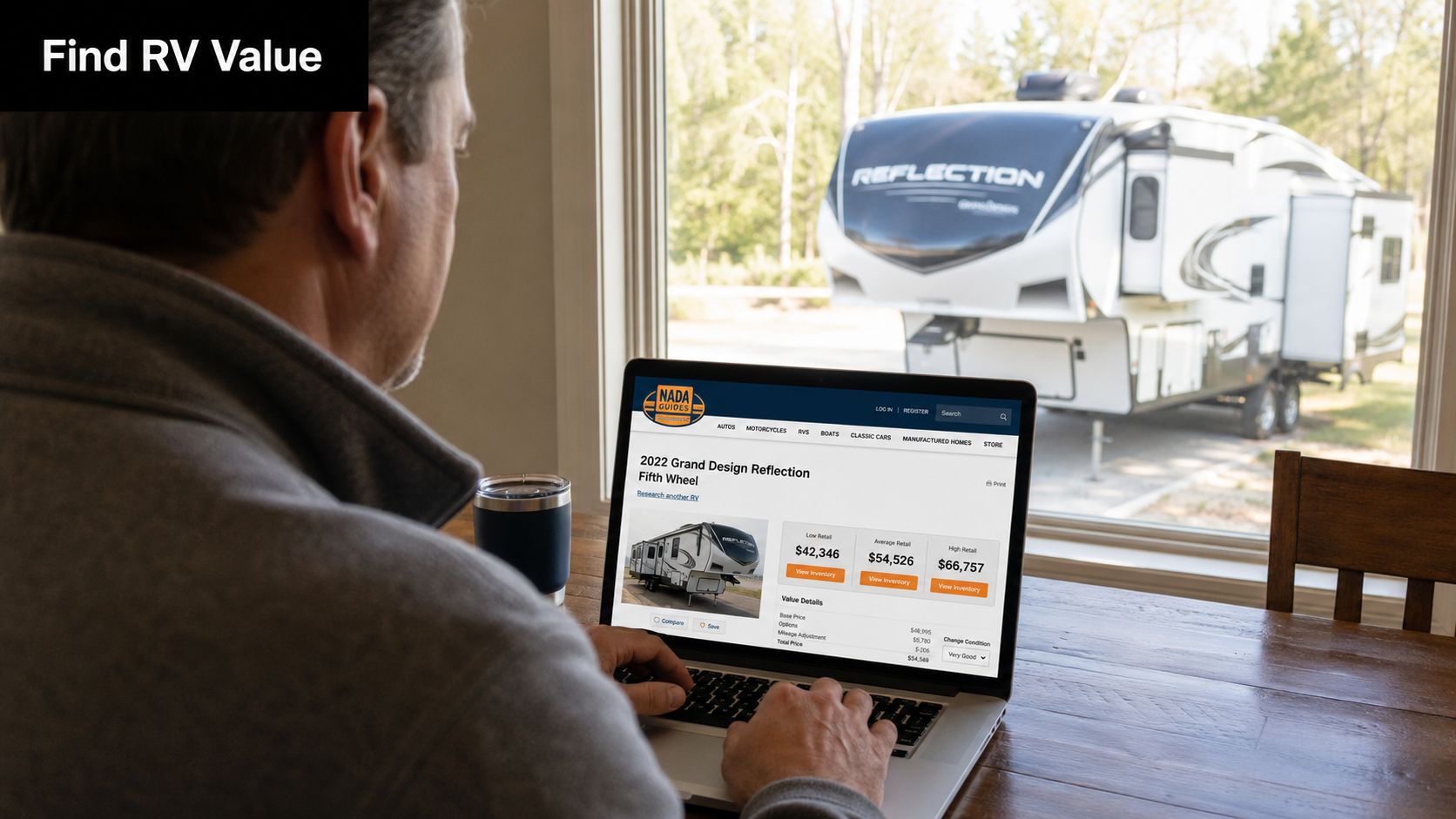
Step 1. Pull a baseline value
Start with a public guidebook value to create a rough range. Make sure you choose the correct year, model, trim, and factory options. Don't add value for aftermarket upgrades the same way you would add factory equipment. Solar, suspension upgrades, new mattresses, and similar extras may help a sale, but they usually don't return dollar-for-dollar.
The guidebook number is not your final number. It's your baseline.
Step 2. Inspect the RV like a technician would
Most pricing mistakes happen because buyers skip the inspection or do it too casually. You want to evaluate the RV as if you'll own every problem you miss. Because you will.
Check these areas carefully:
- Roof and sealants: Look for dried, cracked, lifted, or patchy sealant around vents, skylights, ladder mounts, and edges.
- Walls and floor: Press around corners, slide openings, and near plumbing fixtures. Soft spots matter.
- Tires and date codes: Good tread doesn't automatically mean healthy tires. Age and sidewall condition matter.
- Appliances and systems: Test the fridge, furnace, air conditioner, water heater, lights, pump, jacks, awning, and slide operation.
- Undercarriage: Look for rust, bent components, hanging wiring, and signs of leaks.
- Paperwork: Compare VIN, title status, manuals, and service records.
A clean walkaround isn't enough. Open every compartment. Run every system you can.
Step 3. Look for real-world comparable units
Used RV values become practical for comparison. Search listings for the same or similar year, model, and layout. Focus on units with similar condition. If one trailer has newer tires, documented maintenance, and clean interior surfaces while another has worn upholstery and obvious exterior fading, they aren't true comps.
This step works best when you compare several data points instead of chasing a single “perfect match.” You can also look at dealership inventory and sale-ready listings to understand where the market is today. If you're shopping locally, our used RV buying guide for nearby shoppers can help you think through local inventory and what to compare.
Step 4. Decide whether private sale or trade-in fits your situation
The highest asking price doesn't always create the best outcome. Private sale can work if you have time, patience, documentation, and comfort dealing with strangers, title transfer, and negotiation. Trade-in usually wins on convenience, speed, and certainty.
There's also a market reality to keep in mind. As noted in this motorhome market video discussing 2026 auction conditions, RVs can lose up to 50% of their value within five years, with auction prices for motorhomes in 2026 down 40% to 70% from their peak pandemic values, making predictable dealer trade-ins an attractive alternative to a volatile private market.
That volatility shows up in real conversations. Sellers see one ambitious online listing and expect top dollar. Buyers see softening prices and expect a steal. A trade-in cuts through some of that uncertainty because the number is immediate and the transaction is controlled.
A quick visual walkthrough can help if you want to understand how experienced shoppers think through used pricing and condition checks.
The best valuation process is boring on purpose. It uses book data, inspection notes, and comparable units. It doesn't use hope.
Utah Market Insights and Negotiation Tips for 2026
Utah buyers shop differently than buyers in a lot of other states. Our customers think about mountain grades, long summer weekends, shoulder-season cold, and family camping patterns. That changes what gets attention.
Bunkhouse travel trailers usually draw steady interest because they fit family trips to places like Jordanelle and Bear Lake. Toy haulers also make sense here because so many owners want room for side-by-sides, bikes, or gear heading south toward the desert. A floorplan that works beautifully for local use will usually hold buyer attention better than one that doesn't.
National demand gives some context too. According to Rapidious coverage of January 2026 used RV trends, online search traffic for “travel trailers near me” surged 14% year-over-year nationally, signaling heightened consumer interest in local markets like Utah, even as dealer inventory has grown. That combination matters. More shoppers are looking, but they're also seeing more inventory, which puts prepared buyers in a stronger position.
Negotiation tips for buyers
- Bring inspection notes: If you found aged tires, soft sealant, non-working appliances, or battery issues, show the seller exactly what you found.
- Use comparable units: Don't argue from opinion. Argue from similar listings and actual condition.
- Stay focused on total ownership: A cheaper rig that needs immediate work may cost more than a cleaner unit with records.
Negotiation tips for sellers
- Lead with documentation: Service records, roof reseal receipts, appliance repair paperwork, and clean title status reduce buyer hesitation.
- Price the actual unit, not your memory of the market: Peak-era prices still shape expectations, but shoppers have more choices now.
- Clean and fix obvious issues first: Dead batteries, torn vinyl, broken latches, and dirty roofs tell buyers to discount hard.
If you want a broader look at how local ownership decisions affect future pricing, our RV resale value article is worth reading before you buy or list.
Your Next Step with Motor Sportsland
A first-time buyer in Utah often walks in with a NADA number on their phone, then stops cold when the actual coach on the lot is priced differently. That gap is real. Book values give you a starting point, but they do not account for local demand, service history, upgrades, storage habits, or how a specific floorplan sells here along the Wasatch Front.
That is where an in-person appraisal helps. At our stores, we look at the RV the same way a serious buyer will. Roof condition, tire age, appliance operation, water intrusion, title status, and overall cleanliness all affect what the unit is worth in this market. A clean trade with records and working systems usually lands closer to asking price. A similar model with soft spots, old tires, or missing paperwork can fall well below the book number.
If you are selling or trading, come prepared. Bring the title information, service records, appliance notes, and a short list of what works and what does not. Bring the RV in clean and dry if you can. It saves time and leads to a more accurate appraisal because our team can inspect compartments, seals, and major systems without guessing.
If you are buying, slow down long enough to judge the RV beyond the price sheet. Sit at the dinette. Stand in the shower. Open every cabinet and exterior compartment. On our lot, I have seen buyers pass on a cheaper trailer because the storage was wrong for fishing gear, skis, or family bedding, then end up happier with the slightly higher-priced unit that fit how they camp.
Motor Sportsland lets you start that process online with inventory browsing and a Value My Trade estimate, then finish it with a real appraisal at the showroom at 4988 South State Street in Salt Lake City or at the Millcreek and Spanish Fork locations. That combination helps close the gap between generic book values and what a fair Utah deal looks like.
Conclusion Your Guide to Smart RV Ownership
Used RV values come into focus when you stop chasing a single number and start evaluating the whole unit. Book values help. They just don't tell the full story. Condition, maintenance records, local demand, and realistic comparable units all matter more than most first-time buyers expect.
That's especially true in Utah, where weather, storage habits, mountain travel, and popular floorplans can push two similar RVs in very different directions. The buyers who do well are the ones who inspect carefully, compare fairly, and stay grounded in current market conditions.
A fair deal usually looks less dramatic than people expect. It's a clean RV, a transparent history, a price supported by real evidence, and a purchase that still feels right after the excitement wears off. That's the kind of ownership decision that holds up over time.
Frequently Asked Questions About Used RV Values
How much does water damage affect an RV's value
Severely. Water damage can change an otherwise desirable RV into a problem unit very quickly. What makes it tricky is that early signs are easy to hide from casual buyers. Stained trim, bubbling wall panels, soft flooring near a slide, or a musty smell can point to much bigger structural issues behind the surface. If you suspect a leak, slow down and inspect more thoroughly before you agree on price.
Why is trade-in value lower than retail value
Trade-in value reflects the RV before it's made sale-ready. A dealer has to inspect it, service it, clean it, advertise it, and take on the risk that hidden issues show up later. Retail pricing reflects the RV after that process. Those numbers aren't supposed to match because they cover different stages of the vehicle.
Do RVs hold their value better than cars
Generally, no. RVs are still depreciating assets. What surprises many buyers is that the steepest drop often happens early, and then values can settle into a more stable range if the RV is maintained well and remains a desirable layout.
What age used RV is the smartest buy
For many first-time shoppers, the sweet spot is often just past the steepest early depreciation. According to Bankston Motor Homes' used-versus-new RV pricing overview, a used RV from three to four years old can cost 30% to 50% less than a comparable new model, making the 3–5 year old bracket a “sweet spot” for buyers looking to avoid the steepest depreciation.
Should I trust NADA or the asking price more
Trust neither by itself. A guidebook gives you a baseline. An asking price tells you what a seller hopes to get. The useful number sits somewhere in between, shaped by inspection results, maintenance history, and current comparable units in your market.
Is a clean interior enough to justify a higher price
Not by itself. Clean upholstery and shiny counters are nice, but they don't prove the roof is sound, the tires are healthy, or the appliances work correctly. Cosmetic appeal helps a sale. Structural condition decides real value.
If you want help sorting through used RV values, comparing trade-in options, or finding a trailer or motorhome that fits how you camp in Utah, browse Motor Sportsland or stop by and talk with our team in person.
