
What Is Hitch Weight? a Utah RVer’s Safety Guide

Getting ready for your first trailer trip in Utah feels exciting right up until you start reading the weight stickers. A family loads up for Bear Lake, fills the fridge, clips in the bikes, and suddenly the simple question becomes a stressful one. Can this setup tow safely over steep grades, canyon winds, and crowded holiday traffic?
One of the most important numbers in that whole towing conversation is hitch weight. It doesn't sound dramatic, but it affects how your tow vehicle steers, brakes, and stays stable when the road gets rough. If that number is off, a trailer can feel unsettled fast. On mountain roads around Salt Lake City, that matters.
At our service counter, we see this confusion all the time with first-time buyers. Brochure specs look clean and simple. Real camping setups don't. Propane, batteries, water, food, gear, and cargo placement all change what the tow vehicle is carrying. That's why understanding hitch weight is less about memorizing one definition and more about learning how your trailer behaves when it's loaded for a real trip.
What Exactly Is Hitch Weight and Tongue Weight
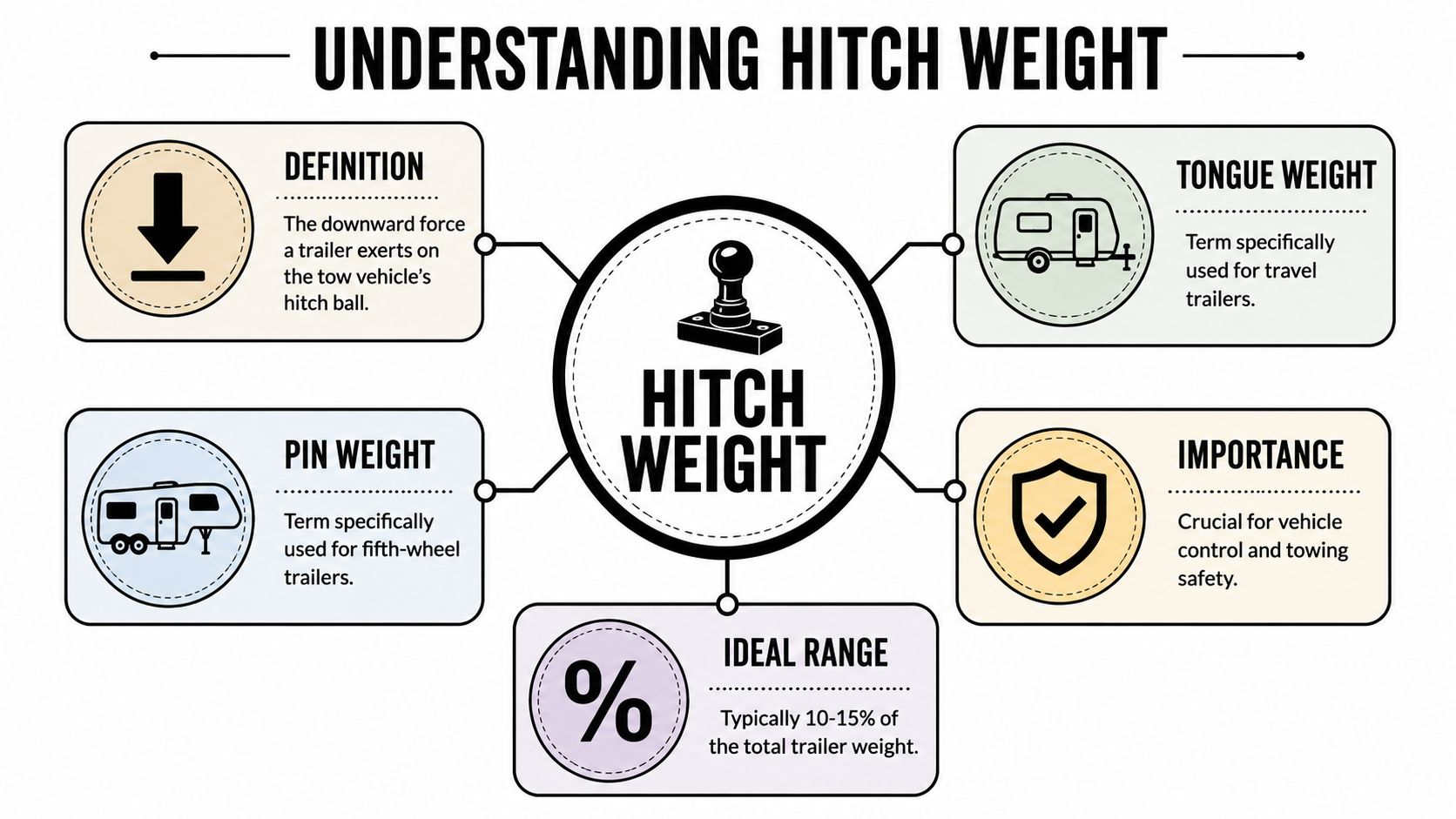
Hitch weight is the downward force a trailer places on the tow vehicle's hitch. In travel trailer language, people often call it tongue weight. If you're towing a fifth wheel, you'll usually hear pin weight instead.
The easiest way to think about it is a wheelbarrow. When the wheelbarrow is loaded, part of that load sits on the wheel, and part of it presses down into your hands through the handles. Hitch weight is the trailer version of that pressure in your hands. It's the share of the trailer's weight that presses down on the connection point.
For travel trailers, towing guidance commonly targets 10 to 15 percent of Gross Trailer Weight to help preserve stability, and if that share is too low, sway risk rises, while too much tongue load can reduce available payload on the rear axle and overload the hitch or rear axle rating, as explained by Weigh Safe's tongue weight guide.
The terms people mix together
A lot of buyers get tripped up because the terms sound similar.
- Hitch weight means the downward load at the hitch.
- Tongue weight usually means that same idea on a bumper-pull or ball-hitch trailer.
- Pin weight refers to the downward load from a fifth wheel into the bed-mounted hitch.
They all describe load transfer at the connection point. The name changes with trailer type.
Why this number feels bigger than it sounds
Many people assume the main towing number is just the trailer's total weight. That matters, but hitch weight is the part your vehicle physically has to carry on its own structure and axles. A trailer can be within tow rating and still create problems if the hitch load isn't balanced correctly.
Practical rule: If you only remember one thing, remember this. Safe towing depends on how the trailer is loaded, not just what the brochure said when it was empty.
Why Hitch Weight Is Your Most Important Towing Number
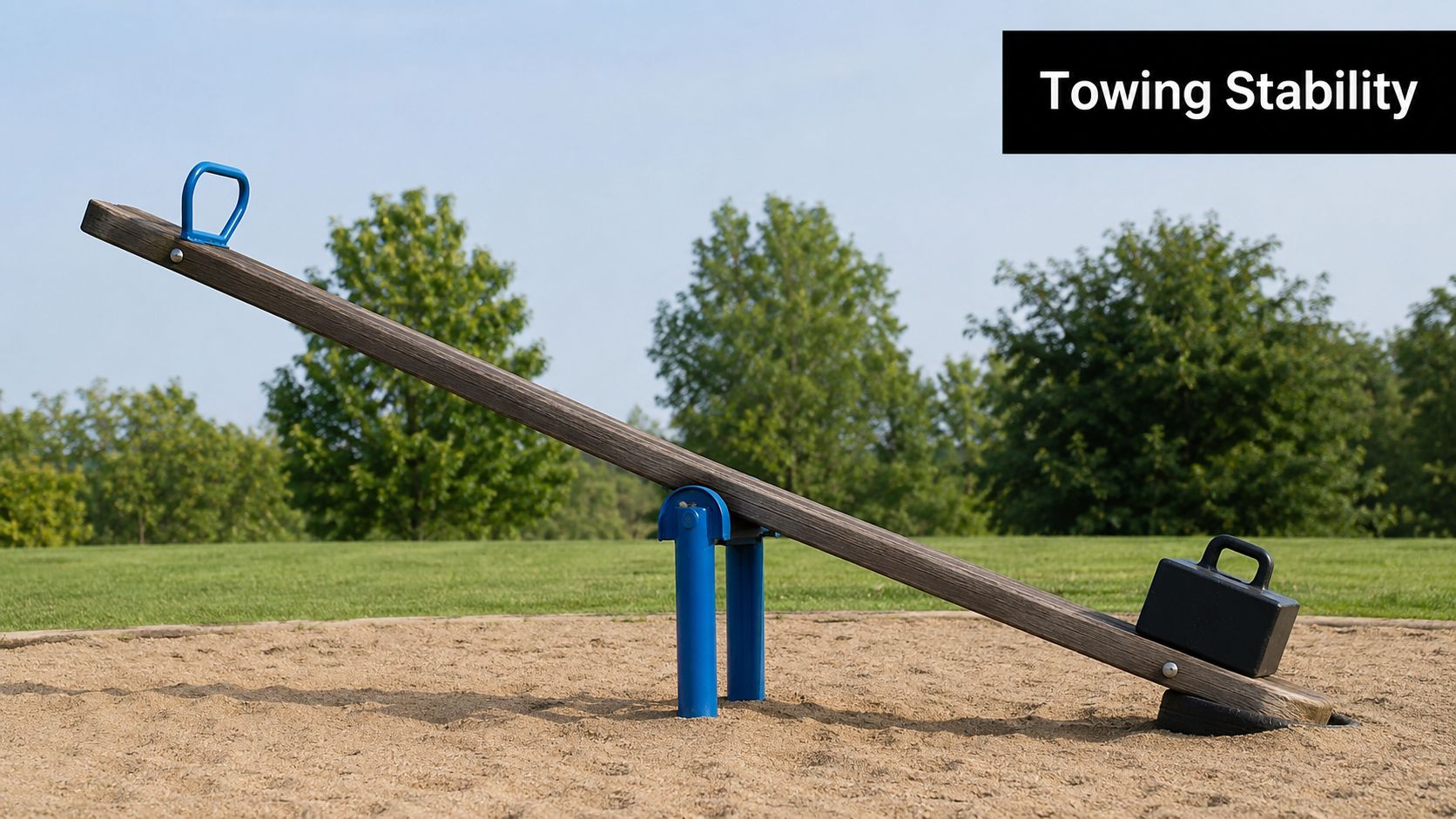
A trailer and tow vehicle act like a seesaw. Move too much weight away from the hitch, and the trailer gets light at the front. Put too much forward, and the rear of the tow vehicle gets pushed down harder than it should. Neither one feels good behind the wheel.
Too little hitch weight
When the trailer's front is too light, the trailer can start to wander. That's sway. You'll feel it first as a little wiggle. Then a passing truck, a downhill curve, or canyon crosswind can turn that wiggle into something much more serious.
On Utah roads, this shows up quickly in places where wind and speed combine. Open stretches, downhill sections, and canyon routes don't give you much time to correct a poorly balanced trailer.
Too much hitch weight
The opposite problem is just as real. If too much of the load presses onto the hitch, the rear of the tow vehicle squats and the front can get light. Steering response gets duller. Braking balance changes. Headlights aim higher. The whole rig feels less composed.
That's especially important on long descents where you need confident steering and predictable braking. A setup that feels acceptable around town can feel very different coming down a grade.
Why mountain driving exposes bad setups
Flat roads hide mistakes. Utah mountain roads don't.
A trailer that's loaded poorly may seem fine pulling away from home, then start showing bad habits when you hit:
- Steep climbs that strain the powertrain
- Long descents that expose weak braking balance
- Crosswinds near canyon mouths and open valleys
- Curves and lane changes where instability shows up fast
A stable trailer should feel planted, not busy. If the steering feels vague or the trailer feels like it's steering the truck, something needs attention before the next trip.
Understanding the Alphabet Soup of RV Weights
Once buyers start looking at truck stickers, hitch labels, and trailer decals, the abbreviations pile up fast. The key is to stop treating each one like a separate puzzle. They work together.
The ratings you'll run into
Here's the plain-English version:
- GTW is the actual loaded weight of the trailer.
- GVWR is the maximum allowed weight of a vehicle or trailer when loaded.
- GCWR is the maximum combined weight of the tow vehicle and trailer together.
- GAWR is the maximum weight allowed on a specific axle.
Hitch weight threads through all of them because that downward load doesn't disappear. Your tow vehicle has to carry it, usually with a big effect on the rear axle and available payload.
Why the lowest rating wins
Many first-time RV buyers get caught. They focus on the advertised tow rating and assume they're safe. But towing safety is limited by the lowest applicable rating in the whole setup.
That could be:
- the receiver on the vehicle
- the hitch assembly
- the rear axle rating
- the truck's payload
- the trailer coupler
- even the tires
Manufacturers publish very different hitch limits. Examples cited by Patriot Hitches range from about 200 pounds of tongue weight on light-duty hitches up to 2,000 pounds on heavy-duty setups, with corresponding gross trailer weight ratings from 2,000 pounds to 20,000 pounds, which is why matching the entire combination matters so much, as outlined in Patriot Hitches' guide to hitch weight ratings.
Dry weight adds confusion
A lot of brochure language sounds helpful until you're trying to match a truck and trailer. That's one reason many shoppers spend time learning the difference between brochure numbers and real ready-to-camp numbers. If you want a clearer breakdown of that topic, this guide on RV dry weight and what it really means is a useful starting point.
The safest way to read towing specs is as a system, not a single number. If one part of the system is overloaded, the whole combination is compromised.
How to Measure Your Hitch Weight at Home or on the Road
Guessing doesn't work. Eyeballing doesn't work. If you want to know whether your trailer is loaded safely, measure it.
For ball-hitch trailers, a common rule of thumb is 10% to 15%. In practical terms, a 5,000-pound trailer often puts about 500 to 750 pounds on the hitch, and a 10,000-pound trailer commonly places about 700 to 1,500 pounds on the tow vehicle depending on trailer type and load distribution, according to GM of Rochester's weight distribution hitch guide.
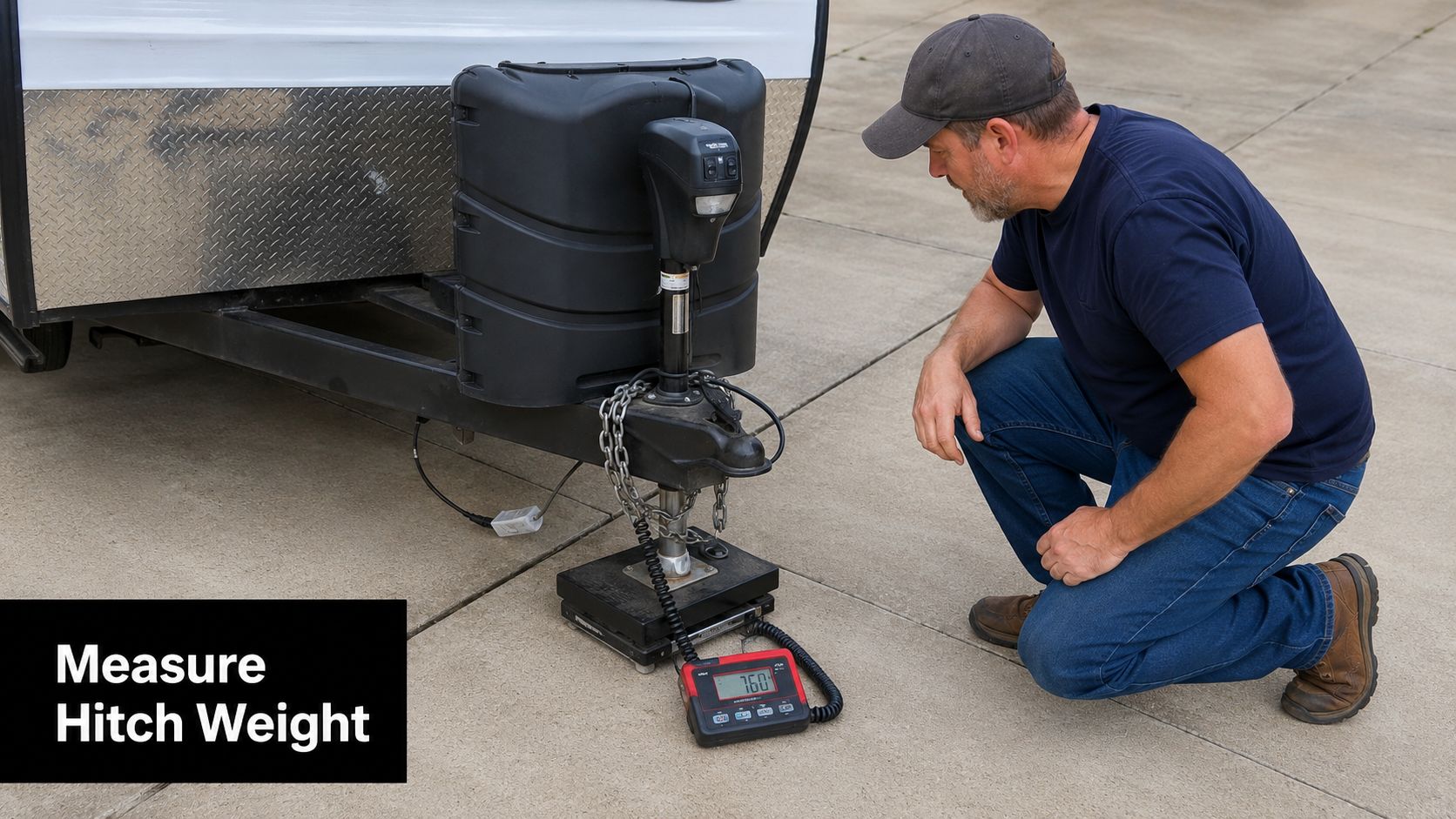
Use a tongue weight scale
This is the most direct method for many travel trailer owners. You place the loaded trailer jack or coupler onto a scale designed for that purpose and get a reading.
A few reminders matter:
- Load the trailer for a real trip. Include propane, batteries, food, camp gear, and anything else you normally carry.
- Park on level ground. Slopes can throw off the reading.
- Keep the trailer in normal towing attitude. The nose shouldn't be unusually high or low.
This method is simple and fast, especially if you check your setup regularly.
Use a public vehicle scale
A truck scale gives a broader look at the whole setup. That's helpful because hitch weight affects more than one number.
A practical process looks like this:
- Weigh the tow vehicle by itself in trip-ready condition.
- Hook up the trailer and weigh again with the full setup loaded.
- Compare the axle loads and overall readings.
That approach helps you see not just hitch load, but also whether the rear axle and total vehicle weight are getting pushed too far. It's one of the better ways to confirm that the setup works as a package.
This video gives a helpful visual overview of the weighing process:
Use a lever-style home method for smaller trailers
For lighter trailers, some owners use a bathroom-scale-and-lever setup with blocks and pipe. It can work as a rough check when done carefully, but it takes patience and correct setup. If the trailer is larger, heavier, or close to any rating, skip the improvised method and use a proper scale.
When to re-check your numbers
Measure again if you change anything meaningful.
- Added gear: generators, bikes, tools, or storage boxes
- Water changes: traveling with more or less fresh water than usual
- Accessory installs: batteries, propane changes, cargo racks, aftermarket equipment
- Seasonal packing: winter and summer gear can shift balance more than people expect
If you'd rather have a technician verify the setup, a service visit for weighing and hitch adjustment is a reasonable option alongside doing it yourself.
Acceptable Hitch Weight Ranges by RV Type
Not every RV carries hitch load the same way. Travel trailers, fifth wheels, and toy haulers behave differently because their layouts and hitch locations are different.
The table below is a good way to think about typical targets. It's a starting point, not permission to skip weighing.
| RV Type | Recommended Percentage of GTW | Notes |
|---|---|---|
| Travel trailer | 10% to 15% | Common ball-hitch target used to help preserve stability on conventional trailers |
| Boat or some motor-trailer combinations | 7% to 12% | Some towing guidance uses a lower range depending on trailer type and loading distribution |
| Fifth wheel | Qualitatively higher than a typical travel trailer | Pin weight is carried in the bed and behaves differently than a rear receiver hitch |
| Toy hauler | Varies with cargo placement | Rear garage loading can shift balance significantly, so weighing loaded is especially important |
Why toy haulers deserve extra caution
Toy haulers can change character dramatically between an empty garage and a trip-ready garage. Load a UTV or motorcycles behind the axles and the balance point moves. That can change hitch load enough to affect how the whole combination feels.
For Utah riders heading toward the desert or mountain trail systems, this is one of the most important reasons to weigh the trailer in the same condition you use it.
Published numbers aren't the whole story
Even when the trailer sticker gives you a hitch number, that number usually reflects a factory configuration. Real owners add cargo, dealer-installed options, personal gear, and fluids. That's why trailer type matters, but actual loaded weight matters more.
How to Adjust Your Hitch Weight for a Safer Ride
If the trailer doesn't weigh out correctly, don't panic. Most of the time, the fix comes down to loading changes, equipment setup, or both.
Start with cargo placement
The fastest way to change hitch weight is to change where the load sits. Think of the trailer axles as the balance point.
Try these adjustments:
- Move heavy gear forward carefully if the hitch is too light and the trailer feels loose.
- Shift weight away from the very front if the tongue load is too heavy.
- Keep dense items low to help the trailer stay settled.
- Avoid loading the extreme rear to chase a target number. That often makes sway worse, not better.
Small changes can matter. A tool box, cooler, generator, or stack of firewood placed in the wrong spot can affect how the trailer tracks behind you.
Use the right hitch equipment
A weight distribution hitch helps spread load more evenly across the tow vehicle and trailer axles. It does not raise the vehicle's ratings or magically create extra capacity. What it can do is restore a more level stance and improve steering feel when the setup is appropriate for one.
Some systems also include sway control, which can add another layer of confidence for conventional trailer towing. If you want a straightforward explanation of how one common setup works, this breakdown of the e2 weight distribution hitch is worth reading.
A weight distribution hitch is a tuning tool, not a loophole. If the rig is overloaded, the answer is to reduce load or change the combination.
Make one change at a time
When owners chase handling problems, they sometimes move cargo, tighten hitch bars, add accessories, and change tire pressure all at once. Then they don't know what proved helpful.
A better approach is simple:
- Load the trailer normally.
- Measure the setup.
- Change one factor.
- Measure again.
- Test drive carefully.
That process is slower, but it gives you a result you can trust.
Common Hitch Weight Mistakes and How to Avoid Them
The mistake we see most often is trusting the brochure more than the actual loaded trailer. That's how people end up surprised by rear sag, vague steering, or sway on the road.
A frequently missed issue is the gap between published hitch weight and actual loaded tongue weight. Real-world towing safety depends on the fully loaded trailer and the lowest applicable rating across the hitch, vehicle, and receiver, which is especially important for first-time buyers comparing bunkhouse trailers, toy haulers, and used RVs, as explained in this discussion of hitch weight versus towing capacity.
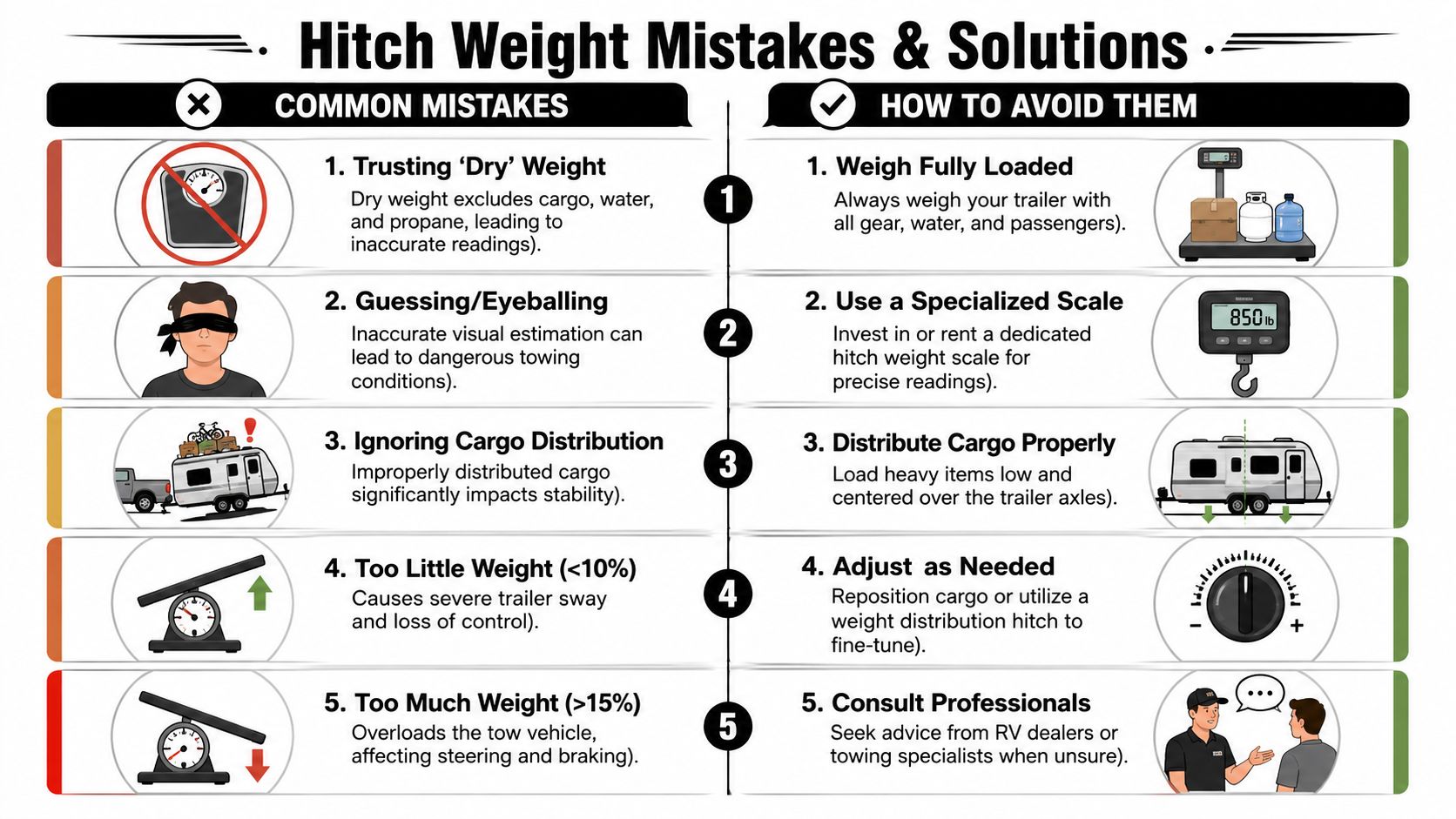
The mistakes that create trouble
- Trusting dry hitch weight: Factory numbers usually don't reflect propane, batteries, water, food, and camping gear.
- Loading heavy cargo at the rear: This often reduces front trailer load and encourages sway.
- Ignoring truck-bed cargo: Coolers, firewood, generators, and passengers all affect available payload.
- Skipping a re-weigh after changes: A new battery setup, bike rack, or storage box can change balance.
- Trying to solve sway with guesswork: If the trailer feels unstable, measure first.
A smarter habit
Before any longer trip, especially if you've changed gear or packing style, weigh the setup again. That's even more important if you're learning how RV sway control works in real conditions, because sway symptoms often begin with loading and hitch balance problems.
The brochure gets you shopping. The scale gets you home safely.
Conclusion Your Partner for Safe Utah Adventures
A lot of first-time RV owners learn this lesson on the first real trip, not in the dealership lot. The trailer looked fine on paper, the truck seemed up to the job, and then a climb through Parley's Canyon or a windy stretch near Evanston made the combination feel busier than expected. In many cases, the gap was not the trailer itself. It was the difference between brochure hitch weight and the heavier, trip-ready hitch weight the truck was carrying.
That is the number to respect.
Dry hitch weight helps you compare models, but it does not represent a weekend loaded with propane, batteries, water, food, chairs, tools, and the gear that always seems to find its way into the front storage compartment. A trailer headed for Bear Lake or Jordanelle usually reaches the road with a very different balance than the one printed on the spec sheet.
Safe towing starts with the setup as it will be used. Match the trailer to the truck, load it with some discipline, measure the hitch weight after packing, and make small adjustments before a handling problem shows up on the highway. On Utah grades, canyon crosswinds, and long downhill stretches, that extra care can mean steadier steering, better braking feel, and a lot less stress behind the wheel.
If you are comparing RVs or trying to sort out a current towing setup, Motor Sportsland can help you look at the combination as a whole, trailer, truck, cargo, and hitch setup included. That kind of practical check matters a lot more than guessing from a brochure.
Frequently Asked Questions About Hitch Weight
Is hitch weight the same as towing capacity
No. Towing capacity is the broader limit for how much trailer a vehicle can pull. Hitch weight is the downward load placed on the hitch itself. A vehicle can reach a hitch, payload, or axle limit before it reaches the advertised tow rating.
Why does my trailer feel fine empty but unstable when packed
Because loading changes balance. Food, tools, water, batteries, propane, and cargo position all affect how much weight presses onto the hitch and how the trailer tracks behind the vehicle.
Does a weight distribution hitch increase my tow rating
No. It helps distribute load more effectively across the axles of the tow vehicle and trailer. It can improve stance and handling when used correctly, but it doesn't change the manufacturer's ratings.
Should I trust the hitch weight in the brochure
Treat it as a starting reference only. Real towing decisions should be based on the trailer in actual trip-ready condition.
How often should I measure hitch weight
Check it whenever the trailer's loading changes in a meaningful way. New accessories, different water levels, seasonal gear, or changes in how you pack can all affect hitch load.
What's the biggest warning sign that my hitch weight may be wrong
Sway, rear sag, vague steering, and a combination that feels unsettled are all clues. Those symptoms don't automatically prove hitch weight is the problem, but they're good reasons to measure the setup and inspect it carefully.
If you want help choosing a towable RV or checking your current setup before the next Utah trip, visit Motor Sportsland to browse inventory, compare floorplans, or connect with a service team member for practical towing guidance.
