
Used Motorhome Value Guide for Utah Buyers and Sellers

A Park City couple can do everything right and still get three very different answers for the same motorhome. They may see a national guide estimate, find an optimistic classified listing, and receive a much lower trade-in offer from a dealer. None of those figures is automatically the “real” value.
That's why a useful used motorhome value guide has to look beyond year, make, model, and mileage. Class A diesel pushers, gas Class A coaches, Class C motorhomes, and Class B vans follow different resale patterns. Utah adds its own variables, including mountain driving, winter storage, high-desert sun, and demand from travelers heading toward Jordanelle, Bear Lake, the Wasatch Mountains, and the state's national parks.
The process below follows the questions an experienced Salt Lake City appraisal desk asks before putting a defensible number on a coach. It can help you price a private sale, evaluate a trade-in, or decide whether a used motorhome is fairly priced before you take it toward a mountain campground.
Why Used Motorhome Values Are Harder Than They Look
A Park City couple once brought in a 2017 gas Class A they had purchased new for $145,000. After five seasons, they expected to recover at least $80,000, especially because the coach looked clean from the curb and the mileage seemed reasonable for a motorhome.
The first surprise came from a national guide that returned $62,000. The second came from an online classified advertisement showing a similar coach listed at $89,000. Then a Salt Lake dealer offered $48,000 as a trade allowance. Those numbers weren't contradictory by accident. They represented different markets, different risk assumptions, and different definitions of value.
Why the numbers separate
An online listing is an asking price, not proof of a completed sale. The owner may have priced around emotional attachment, original purchase cost, or the amount needed to fund the next RV. A dealer trade offer has to account for inspection time, reconditioning, financing exposure, lot space, negotiation, and the possibility that the coach will sit through more than one camping season.
National guides provide a useful baseline, but they can flatten regional differences. A coach that appeals to Utah families planning ski weekends and southern Utah trips may attract a different buyer pool from the same coach in a flat, warm-weather market. Conversely, mountain use can reveal wear that a low odometer reading doesn't show.
The questions an appraisal desk asks
- What sold nearby? Active listings help define competition, but closed transactions and dealer experience provide better context.
- How was the coach used? Seasonal mileage, towing, steep grades, and repeated elevation changes can affect brakes, suspension, cooling systems, and drivetrain wear.
- Where was it stored? A motorhome kept indoors has a different risk profile from one exposed to winter moisture, freezing temperatures, and high-desert ultraviolet light.
- What can a buyer verify? Complete service records, clean title history, and documented repairs reduce uncertainty. Missing records make buyers price in risk.
Practical rule: Treat every published figure as a starting point. The number worth acting on is the one supported by comparable coaches, verified condition, and a realistic selling channel.
The Four Building Blocks of Any Used Motorhome Valuation
A reliable valuation combines four inputs. Remove one, and the result becomes fragile. A guide can tell you where to start, but it can't inspect a roof, interpret a service history, or judge whether a floorplan fits current Utah demand.
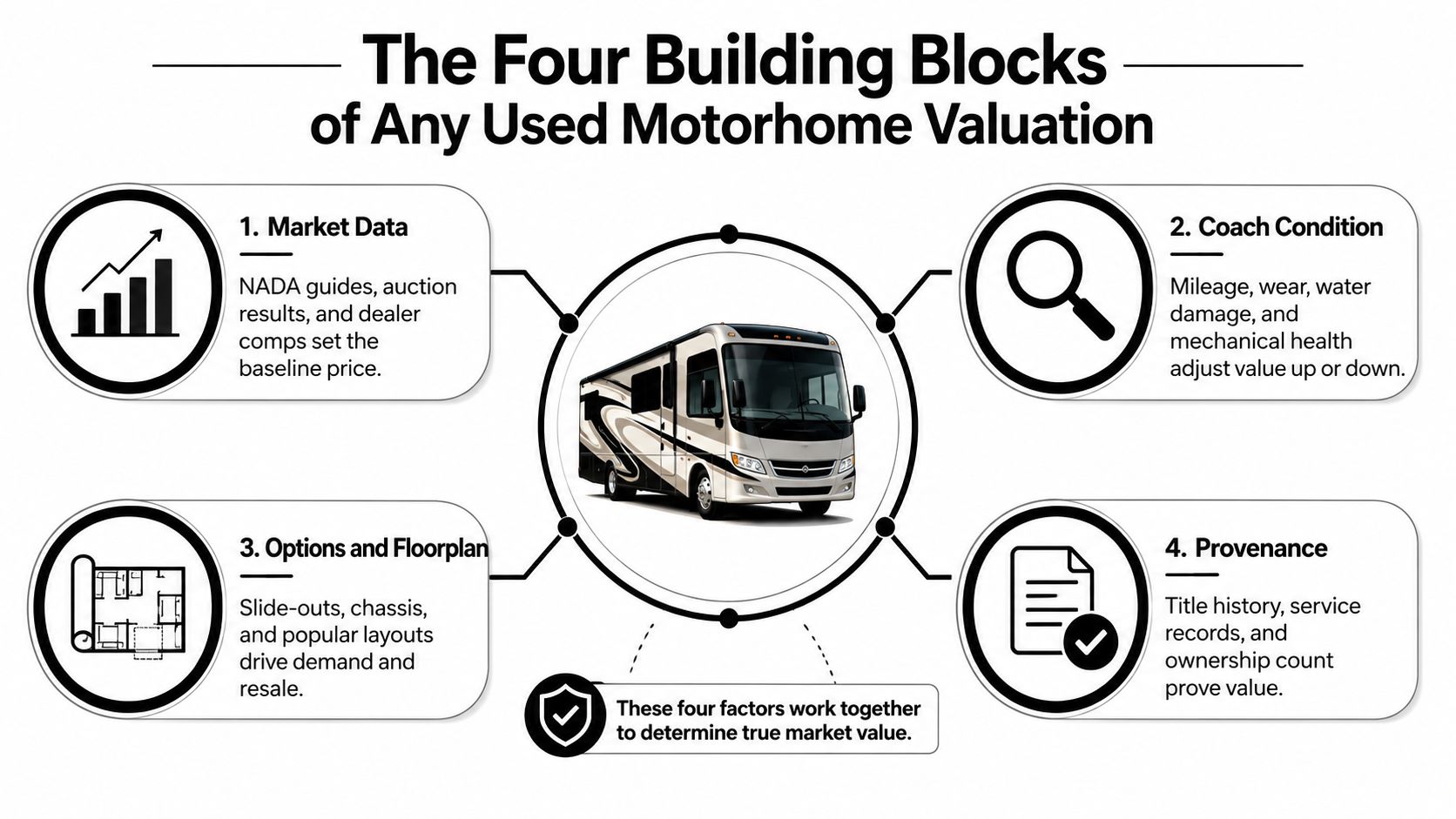
Market data establishes the baseline
Start with a national guide, auction references, active listings, and local dealer inventory. A valuation tool commonly requires the exact year, make, model, and mileage, while some workflows also use ZIP code and optional equipment to reflect local and configuration differences, as described in this used RV valuation workflow.
Don't compare a short Class C with a diesel pusher because both have the same model year. Filter for the same floorplan, chassis family, fuel type, slide configuration, and a similar mileage pattern before drawing conclusions.
Condition creates the largest adjustment
Inspect the roof membrane and sealant, sidewalls, fiberglass, windows, storage bays, slide mechanisms, flooring, upholstery, appliances, generator, house batteries, engine, transmission, tires, and brakes. Water intrusion deserves special attention because it can affect structure behind walls and cabinetry while remaining difficult to see in photographs.
Condition isn't just “clean” or “rough.” A coach with dated fabrics but excellent mechanical records may be more dependable than a newer unit with neglected seals and incomplete maintenance.
Options and floorplan affect buyer demand
Two identical model years can price differently when one has a king bed, residential refrigerator, theater seating, solar equipment, and a practical storage layout, while the other has basic equipment. A family may pay more for a bunkhouse. A couple preparing for long-haul travel may prioritize a larger refrigerator, comfortable seating, and usable holding-tank capacity.
Features only add value when buyers in that segment want them. An expensive modification doesn't automatically return its original cost.
Provenance supports or weakens the number
Verify the VIN, title status, ownership history, accident records, service invoices, warranty information, and aftermarket work. Storage habits matter too. A coach kept indoors in St. George has faced different environmental exposure from one stored outside in Heber through repeated freeze and thaw cycles.
A clean title and a complete service folder don't make a coach valuable by themselves. They make the advertised condition believable.
Depreciation Curves by Motorhome Class and Age
Depreciation is front-loaded, not linear. Multiple market guides place the typical first-year loss for motorhomes around 20% to 30%, with Class A coaches often estimated at 25% to 30% in the first year and Class C coaches commonly estimated at 20% to 25%, according to the RV depreciation and used-value guide from True RVs.
Historical guides use age bands because the curve changes shape. One summary places a Class A motorhome at roughly 30% to 45% depreciation after three years and approximately 65% after five years, while broader market summaries put motorhomes near 60% depreciation by ten years, with slower losses later, as outlined in this motorhome depreciation guide.
| Motorhome Class | Year 1 | Year 3 | Year 5 | Year 7 | Year 10 |
|---|---|---|---|---|---|
| Class A diesel pusher | 20% to 30% loss | Varies by coach and market | Often retains more than comparable gas coaches | Curve commonly begins flattening | Later-life value depends heavily on condition |
| Gas Class A | 25% to 30% loss commonly cited | 30% to 45% loss in some Class A guides | Roughly 50% to 60% loss in published Class A ranges | Market and condition become more influential | Often loses value more gradually |
| Class C | 20% to 25% loss commonly cited | Front-loaded decline | About 45% to 55% loss in common estimates | Demand and layout drive the spread | Older units can follow a flatter curve |
| Class B van | Usually affected by the same early drop | Segment-specific | Often retains more than Class A in benchmark models | Conversion quality becomes central | Condition, layout, and chassis support resale |
The table is a framework, not an appraisal. A separate benchmark models Class A units at approximately 45% to 55% retained value by year five, compared with roughly 60% to 70% for Class B units, while noting that water damage, accident history, or missing service records can create severe value penalties, as shown in this RV depreciation calculator.
How Utah changes the curve
A diesel pusher may attract buyers who value its long-distance comfort and highway capability, but that doesn't erase the cost of neglected maintenance. Gas Class A coaches often compete on purchase accessibility and floorplan space, so dated interiors, roof exposure, and high mileage can weigh heavily.
Class C models benefit from family-friendly layouts, while Class B vans appeal to buyers who want easier city driving and simpler parking. In Utah, a van used around Salt Lake City may be judged differently from a coach that has repeatedly climbed toward ski resorts, crossed elevation passes, or towed powersports equipment.
Mountain mileage doesn't automatically make a motorhome a poor purchase. It does make inspection more important. Look closely at brakes, suspension components, cooling performance, transmission behavior, and tire condition rather than trusting the odometer alone.
A Step-by-Step Used Motorhome Appraisal Checklist
A driveway inspection should produce evidence, not a vague impression. Bring a flashlight, tire-pressure gauge, outlet tester, notebook, and the VIN. Ask the owner or salesperson to demonstrate every system, including those that seem too ordinary to fail.
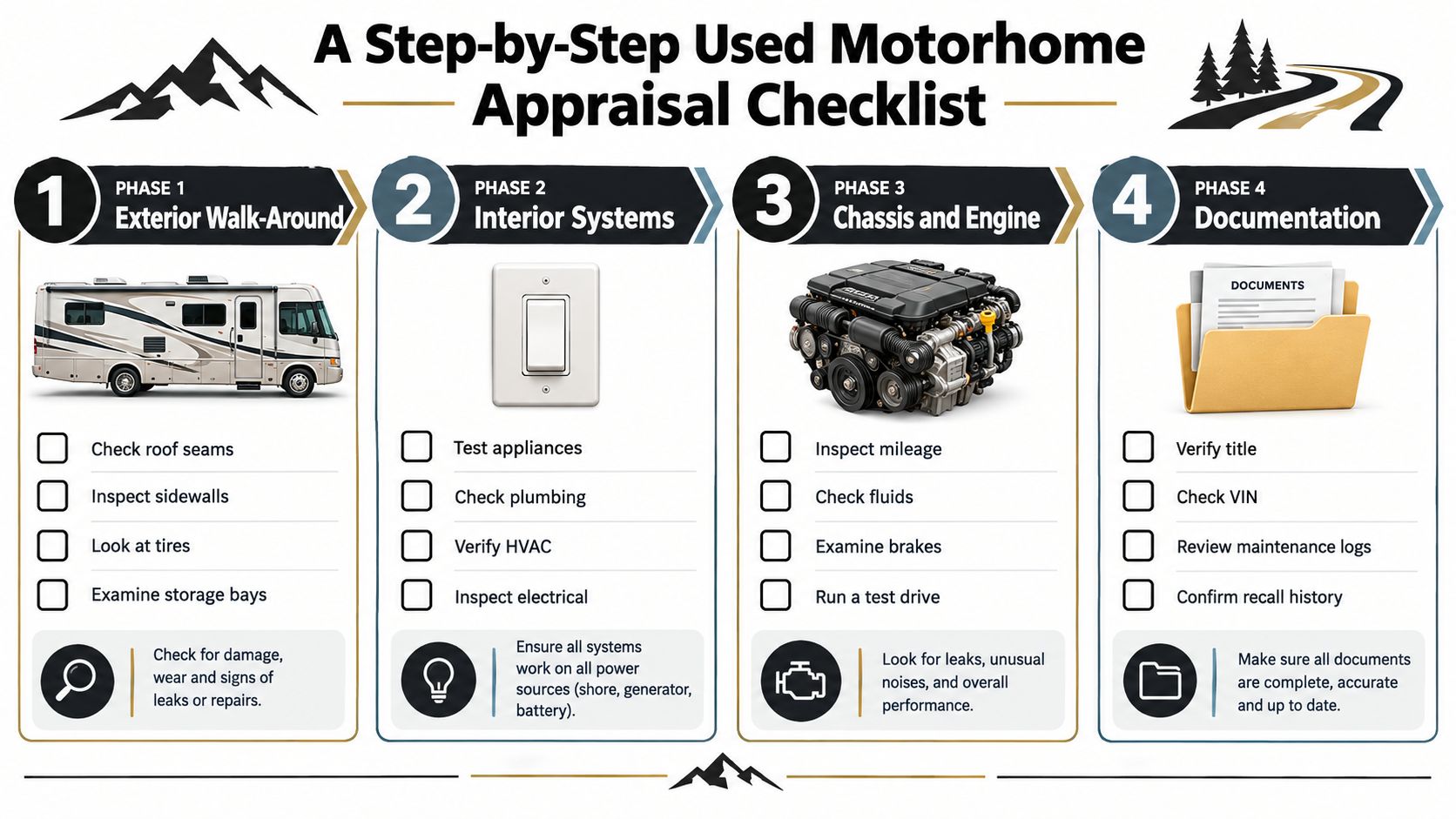
Phase one covers the exterior
Walk the roofline, seams, vents, skylights, slide toppers, windows, awning mounts, and sidewalls. Look for soft spots, staining, bubbling, delamination, cracked sealant, and uneven panels. Check tire date codes and sidewall cracking, not just tread depth.
Utah's high-desert UV exposure can age roof air-conditioning covers, decals, caulking, and exterior plastics. If the coach spent winters outside near Heber or along mountain routes, inspect the underbody for salt and moisture corrosion.
Phase two tests the living systems
Run the 12-volt and 120-volt electrical systems separately. Test every outlet, light, control panel, refrigerator mode, water pump, faucets, toilet, water heater, furnace, air conditioner, microwave, and generator.
A refrigerator that cools on shore power but fails on another source needs a different repair conversation from a unit that works across all available modes. Test plumbing underneath cabinets and around the water heater, where small leaks can cause long-term damage.
Phase three evaluates the chassis
Review engine and transmission service records before starting the motorhome cold. Watch for diagnostic codes, unusual exhaust color, delayed transmission engagement, fluid leaks, uneven braking, steering wander, suspension noise, and abnormal vibration on the test drive.
After winter storage, look beneath the coach for corrosion, rodent damage, cracked hoses, and fluid residue. Mountain travel makes brake and suspension inspection especially important, even when the recorded mileage looks modest.
Phase four verifies the paperwork
Match the VIN on the coach to the title and records. Confirm recall history, ownership changes, warranty status, accident disclosures, generator hours, maintenance intervals, and aftermarket modifications.
Use a simple grade:
- Pass: The item works, looks sound, and has supporting records.
- Minor: The issue is cosmetic, limited, or inexpensive to verify and address.
- Fail: The item is nonfunctional, structurally questionable, undocumented, or unsafe.
Record the result for each area. A defensible condition grade is more useful than saying a motorhome is “pretty clean.”
The video below adds a practical visual reference for the inspection process.
Where to Find Real Comps in Utah and Online
No single comp source answers the question. Each channel shows a different slice of the market, so the strongest target price comes from blending them.
| Source | Strength | Weakness | Best For |
|---|---|---|---|
| NADA Guides and J.D. Power | Consistent baseline inputs | Can miss local condition and demand | Initial book-value reference |
| RV Trader and RVT.com | Broad view of active inventory | Asking prices aren't completed sales | Identifying direct competition |
| KSL Classifieds and Utah Facebook groups | Local owner behavior and regional layouts | Descriptions and inspections vary | Private-party comparisons |
| Utah dealer inventory | Shows professional preparation and retail positioning | Retail price includes selling costs and risk | Trade and retail context |
Start with the same model year and floorplan within a practical radius of your buyer pool. Normalize for mileage, chassis, fuel type, slide-outs, generator condition, solar equipment, four-season features, and whether the coach has been stored indoors or lived in outdoors.
Don't treat a private listing at the top of the range as proof that your coach is worth the same amount. Don't dismiss a dealer listing because the retail price is higher. Ask what preparation, warranty support, financing structure, and carrying risk sit behind that figure.
You can also compare current used RV inventory in Utah with private listings to see how professional presentation and verified condition affect positioning.
A practical blending method
Create a small comp sheet with three groups:
- Book baseline: Enter the applicable national guide figure using exact equipment and mileage.
- Active competition: Record comparable asking prices, then remove obvious outliers and stale listings.
- Local reality: Give the most attention to nearby coaches with similar condition, storage history, and floorplan demand.
Set a target range rather than pretending one number is precise. For a private sale, anchor near the strongest defensible retail comparison. For a trade, expect the offer to reflect dealer risk and reconditioning. The final figure should be explainable line by line.
Trade-In, Consignment, or Private Sale
The right selling route depends on whether you value speed, control, or maximum gross proceeds. A trade-in is often the cleanest choice for an owner upgrading soon, particularly when the replacement motorhome is already selected.
| Selling Route | Likely Advantage | Main Trade-Off | Best Fit |
|---|---|---|---|
| Trade-in | Fast transaction and one point of coordination | Offer reflects dealer risk and reconditioning | Owner upgrading within a short timeline |
| Consignment | Dealer manages marketing, showings, and paperwork | Fees, storage terms, and a longer selling window | Patient seller with a presentable late-model coach |
| Private sale | Direct control over price and buyer conversations | Screening, payment, title work, and test drives | Motivated owner willing to manage the process |
In many states, a trade can also provide sales-tax treatment on the difference between the purchase and trade amounts, but confirm the current Utah rules with the dealership or a tax professional. Trade allowances commonly land below private-party value because the dealer must prepare, market, finance, and stand behind the unit. One practical guide places trade-in returns around 70% to 85% of private-party value, though the exact result depends on condition and the transaction, as explained in this Utah RV selling guide.
Consignment can preserve a higher asking position while removing much of the stranger-contact burden. Read the agreement carefully for storage charges, inspection obligations, advertising, commission, insurance, and the time allowed before a price review.
A private sale may produce the highest gross number, but owners often underestimate the time involved. You'll need a safe process for payment, a written bill of sale, title transfer, lien release, buyer verification, and supervised test drives.
Sample Valuation Scenarios From Our Utah Appraisal Desk
These examples show how the same used motorhome value guide can produce different outcomes after local evidence and condition are applied. The figures below are editorial scenario anchors, not promises of current market value or claims about completed transactions.
Scenario one involves a high-mileage gas Class A
A 2017 Class A gas coach on a Ford F-53 chassis with 78,000 miles arrived from outdoor storage in Park City. The mechanical inspection was clean, but faded decals, dated cabinetry, mountain-use wear, and exposed storage reduced its appeal compared with cleaner low-mileage examples.
The comp set included similar Class A listings and a national guide baseline. The adjustment wasn't for one dramatic failure. It reflected the combined cost and buyer concern around cosmetic renewal, evidence of elevation travel, and outdoor storage. The defensible anchor was below the guide's retail figure, with an offer or asking strategy built around transparent disclosure.
Scenario two is a low-mileage Class C
A 2020 Class C on a Mercedes Sprinter with 24,000 miles, garage-kept in St. George, presented differently. The coach had recent solar upgrades, a clean interior, and a layout that appealed to southern Utah buyers looking for trips toward Zion, Bryce Canyon, and nearby public lands.
Here, the local private-party target could reasonably sit above the published book baseline because the condition, storage, equipment, and buyer demand supported a premium. The seller still needed comparable listings and invoices to justify that position rather than adding the solar installation cost back dollar for dollar.
Scenario three is an older converted Class B
A 2015 Class B camper van on a Ram ProMaster with 41,000 miles had a popular 4x4 conversion. Age limited the book comparison, but the conversion created a narrower and more engaged buyer pool. The valuation desk kept comps tight, verified the conversion quality, and treated the premium as dependent on documentation, workmanship, drivetrain condition, and usability.
| Coach | Year and Class | Mileage | Condition Notes | Final Price |
|---|---|---|---|---|
| Ford F-53 gas Class A | 2017 Class A | 78,000 | Outdoor Park City storage, faded decals, dated cabinetry, clean mechanical inspection | Below national retail baseline |
| Mercedes Sprinter Class C | 2020 Class C | 24,000 | Garage-kept in St. George, solar upgrades, strong southern Utah layout demand | Above published book baseline |
| Ram ProMaster converted van | 2015 Class B | 41,000 | Popular 4x4 conversion, tight comps, premium dependent on documentation | Anchored to verified conversion quality and condition |
The lesson is simple. Adjustments must follow evidence, not enthusiasm or fear. Every increase or reduction should connect to a comp, a verified feature, a condition finding, or a clear buyer objection.
Negotiation Tips and Your Next Step With Motor Sportsland
Begin with a blended range, not one NADA or J.D. Power number. Bring the comp sheet, service invoices, tire information, generator records, and a written list of known defects. Buyers can negotiate confidently when they can explain the repair or risk. Sellers can defend their price when they can prove maintenance and storage quality.
Use the inspection strategically:
- Roof and seals: Don't minimize soft spots, cracked sealant, or delamination.
- Cold start: Ask to see the engine start cold and review diagnostic information before a test drive.
- Dealer add-ons: Separate accessories and transaction products from the motorhome's actual appraisal value.
- Walk-away conditions: If the inspection reveals structural water damage or unsafe chassis issues, pause the deal.
- Timing: Coordinate financing and trade-in timing so you know the net cost, not just the advertised allowance. A RV loan calculator can help organize that comparison.
Motor Sportsland offers in-person appraisals at its Salt Lake City lot, and the team can review live Utah comparisons during a walk-around. For a pre-owned coach, ask for the offer and the supporting condition adjustments in writing so both sides understand what drives the number.
Motor Sportsland can help you compare live Utah comps, inspect your coach, and evaluate trade-in or purchase options using the same practical framework in this used motorhome value guide. Visit Motor Sportsland to browse inventory, request an appraisal, or start planning your next trip from Salt Lake City.
Used Motorhome Value Guide FAQs
How accurate is a national used motorhome value guide?
A national guide provides a useful baseline, but it can't fully reflect Utah condition, storage, floorplan demand, or recent local competition. Use it with comparable listings and an inspection.
Does mileage matter on a motorhome?
Yes, but the odometer is only one input. Mountain driving, towing, service intervals, generator use, tire age, and documented maintenance can explain why two coaches with similar mileage command different prices.
Which motorhome class usually holds value better?
Class B benchmark models often retain more value than Class A units by the same age, while diesel pushers can behave differently from gas Class A coaches. Condition, conversion quality, chassis, layout, and demand still control the final result.
Should I use an asking price as a comparable?
Use it to measure competition, not as proof of market value. An asking price may be aspirational, stale, or based on a different condition level.
Is a trade-in always worth less than a private sale?
A trade-in often produces a lower gross figure because the dealer assumes inspection, reconditioning, marketing, and inventory risk. It can still make sense when speed, convenience, and applicable tax treatment matter more than maximum gross proceeds.
What should I do before requesting an appraisal?
Clean the coach, gather title and service records, verify the VIN, disclose known issues, and test every major system. A transparent file makes it easier to separate genuine value from uncertainty.
