
1 2 Ton Towable 5th Wheel: A Utah Buyer's Guide

You came in looking for a 1/2 ton towable 5th wheel that'll let your family camp at Jordanelle on Friday and still handle the drive home over Parleys Canyon on Sunday. We hear that plan every week in Salt Lake City, and it's a good one. The catch is that the label on the trailer doesn't tell you whether your specific truck can carry it comfortably. Your door-jamb sticker does.
What "1/2 Ton Towable" Actually Means on a Utah Lot
A Salt Lake City family stopped by our Millcreek lot last spring after driving down from the Wasatch foothills. They'd spotted a sleek fifth wheel with a big slide and a bunk area, and they'd already pictured it at Bear Lake. Their half-ton pickup had a strong engine and a tow package, so they figured the match was settled.
Then we walked out to the truck and opened the driver's door. That's where the conversation started, because payload, not pulling power alone, decides whether a fifth wheel belongs behind a half-ton truck.
A useful label, not a promise
"Half-ton towable" is a marketing shortcut, not a certification that fits every F-150, Silverado 1500, Sierra 1500, or Ram 1500. One truck can roll off the lot with a very different payload rating than an almost identical truck with a different cab, bed, trim, or option package. A trailer that works for a properly equipped full-size pickup can overload another truck with a similar engine, as shown by the wide spread in published examples of lightweight fifth wheels and their dry weights.
Think of the phrase this way. It's an invitation to check the math, not the answer to the math.
Start with your truck's yellow door-jamb sticker, then shop for the trailer. Shopping in the other order is how families fall in love with a floorplan their pickup can't carry.
Three lessons will guide everything that follows. First, pin weight lives in your truck bed, not back on the trailer axles. Second, your family, gear, and hitch spend the same payload dollars as that pin weight. Third, Utah's mountain grades, altitude, and summer crosswinds reward a safety margin.
So what's our working definition of a 1/2 ton towable 5th wheel? It's a fifth wheel whose loaded pin weight, plus everyone and everything else in your truck, stays inside your truck's payload, axle, and combined-weight limits with room to spare. If a trailer meets that test for your exact truck, the label means something. If it doesn't, the label is just paint.
GVWR, Payload, and Pin Weight Explained Without Jargon
Spec sheets throw three big terms at you right away. Let's translate them before any brand name enters the picture, because these are the numbers that'll decide your purchase.
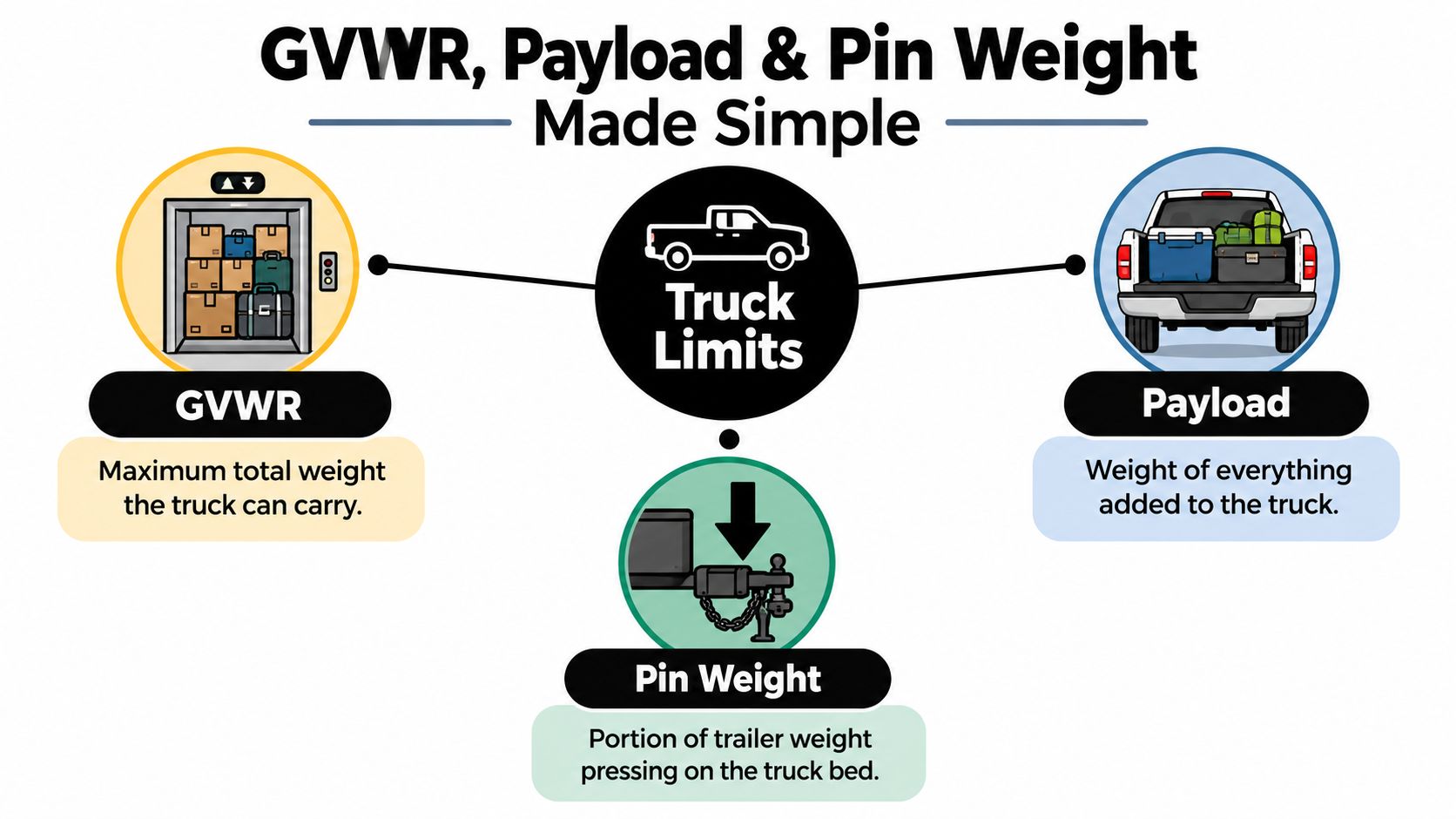
GVWR is the elevator limit
Gross vehicle weight rating, or GVWR, works like the maximum capacity posted in a packed elevator. It's the most a vehicle is allowed to weigh when it's fully loaded, people and cargo included. Your truck has its own GVWR, and the trailer has a separate one stamped on its VIN plate.
Exceed that limit and you're asking brakes, tires, axles, and the frame to do work they weren't rated to do. It doesn't matter how confident the truck feels on a flat test drive around Millcreek.
Payload is everyone already in the elevator
Payload is the weight your truck can carry on top of its own empty weight. That's you, your passengers, your dog, your cooler, your fuel, your bed cargo, and the fifth wheel hitch itself.
You'll find your truck's payload on the door-jamb payload sticker inside the driver's door. That yellow sticker reflects your exact truck as it left the factory. It's more trustworthy than any brochure, configurator, or window sticker for a different trim.
Pin weight is the heavy backpack in the bed
Pin weight is the share of the trailer's loaded weight that presses down through the kingpin into your truck bed. Picture a very heavy backpack set right over your rear axle. It doesn't disappear just because the trailer has wheels of its own.
- Where it sits: In the bed, over or just ahead of the rear axle, which is why placement matters for steering and stability.
- What it spends: Your truck's payload, alongside passengers and gear, as explained in NHTSA guidance stating fifth-wheel hitch weight should typically equal 15 to 20 percent of gross trailer weight.
- Why it surprises buyers: It grows when you load water, propane, food, and camping equipment, so brochure dry weight understates it.
If you're still getting oriented, our walkthrough of how a fifth wheel hitch works and what to check before towing covers the hardware that carries this load. For now, remember the chain. The trailer's loaded weight creates pin weight, pin weight spends payload, and payload runs out long before most buyers expect.
Why Your Truck's Tow Rating Is the Wrong Number to Trust
Tow rating gets all the advertising attention. It's the big number in commercials, and it answers only one narrow question about pulling a load. It doesn't tell you how much weight your truck can carry while pulling.
A worked example with real math
Take a fifth wheel that weighs 9,000 lb loaded for a trip. Using the 15 to 25 percent pin-weight range described in guidance on matching a tow vehicle to an RV by payload rather than headline tow rating, that trailer could place roughly 1,350 to 2,250 lb in the truck bed before you add a hitch, passengers, or a single camp chair.
Now add the rest of a normal Utah weekend.
- Fifth wheel hitch: It rides in the bed full time and spends payload before you ever hook up.
- Passengers and pets: Two adults are one number. Four people and a dog are a very different number.
- Bed cargo: Firewood, a generator, tools, bikes, and a cooler all compete with pin weight.
- Trailer cargo: Water, propane, batteries, and food raise both gross trailer weight and pin weight.
That's why a truck can look fine on tow rating and still fail on payload. In fact, an analysis summarized in towing and RV statistics on real-world truck configurations notes that in 10 of 14 truck configurations, towing at the rated trailer capacity leaves less than 600 lb for people and cargo. Read that again slowly. That's your whole family budget on some trucks.
Run your own worksheet
Use your sticker, not a stranger's truck from a forum. The table below shows the order of operations with a single loaded trailer example so you can drop in your own numbers at home.
Sample Payload Worksheet for a 9,000-lb Loaded Fifth Wheel
| Truck | Door-Jamb Payload | Pin Weight at 18 percent | Family and Gear | Remaining Margin |
|---|---|---|---|---|
| Your truck from the yellow sticker | Write your exact sticker number | 1,620 lb | Weigh everyone and everything you carry | Sticker minus pin, hitch, people, and gear |
| Same truck packed light for two adults | Write your exact sticker number | 1,620 lb | Count two occupants, hitch, and minimal bed cargo | Keep a cushion instead of spending it all |
| Same truck packed for a family trip | Write your exact sticker number | 1,620 lb | Count all occupants, pets, hitch, bikes, and tools | If this goes negative, the trailer is too big |
If you'd like the step-by-step version, our guide on how to calculate towing capacity using your truck's actual ratings walks through each sticker and plate. Do this math on paper before a test tow. A worksheet is cheaper than discovering the problem halfway up Parleys Canyon.
Dealer rule we use: If the worksheet only works when the water tanks stay empty and the kids stay home, the trailer doesn't actually work for your family.
Half-Ton, 3/4-Ton, or Bigger How to Choose the Right Truck
Most Utah buyers who visit us are choosing among three truck profiles. None of them is automatically right, and the honest answer depends on the trailer you want and how your family travels.
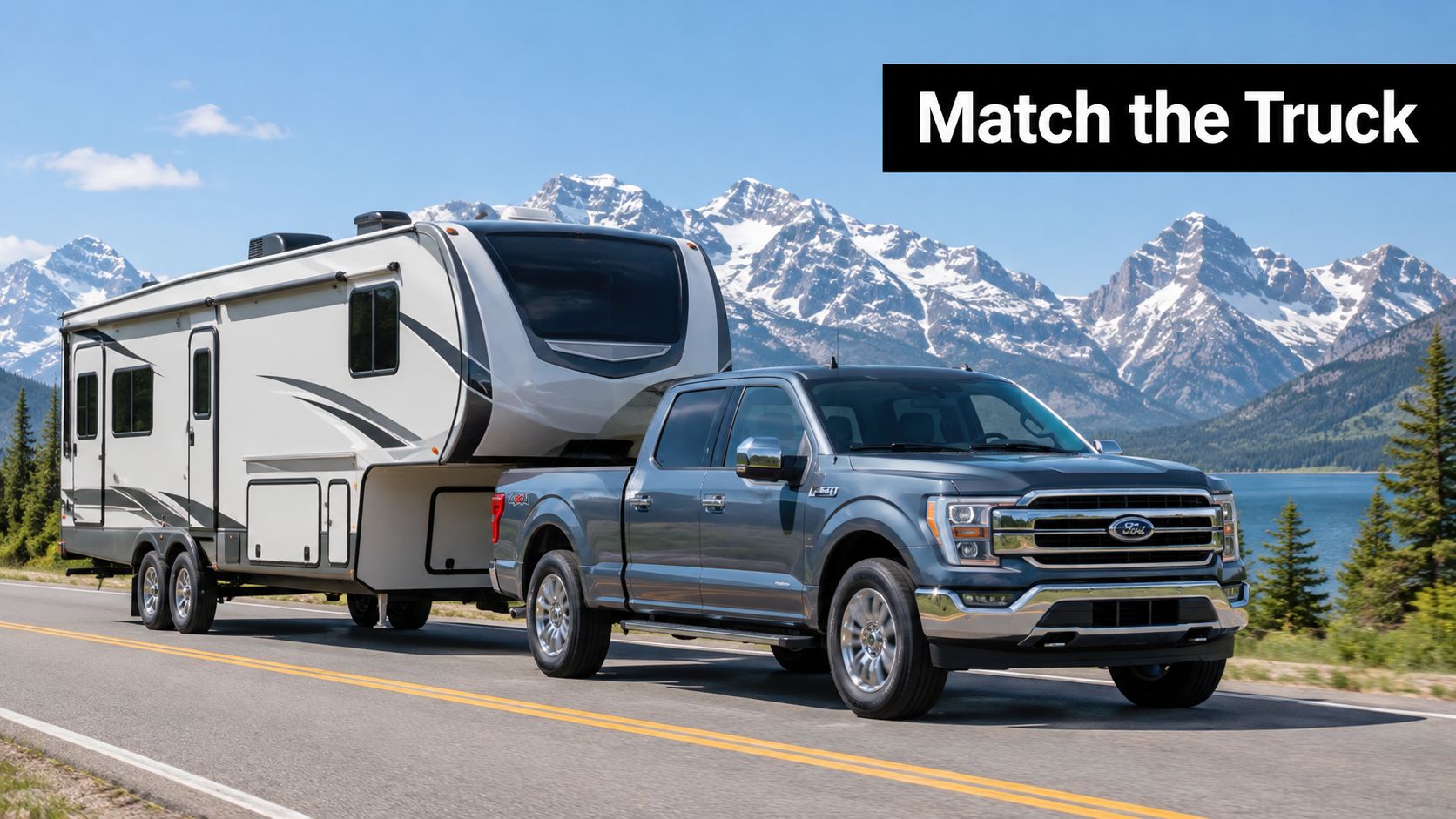
Here's the kind of pairing shoppers picture first, a modern half-ton pulling a fifth wheel on a mountain road.
The half-ton with a tow package
A properly equipped half-ton can be a fine match for the lightest end of the fifth wheel market, especially for two adults who pack with discipline and make shorter trips. You'll need to favor shorter, lighter floorplans and watch bed cargo closely. Turning clearance with a short bed also deserves attention before you buy a hitch.
Ford's planning guidance uses about 15 percent of total loaded trailer weight as the conventional figure for fifth-wheel and gooseneck pin load, per Ford's 2025 towing guide for pin-load planning. Treat that as a starting estimate, not a guarantee, because loading changes the actual number.
The 3/4-ton single rear wheel truck
This is the profile that opens up most of the half-ton towable catalog while still driving like a normal daily pickup around Salt Lake City. You gain meaningful payload and rear-axle headroom, which makes family cargo far less stressful. For many buyers, that margin matters more than any single feature inside the trailer.
Watch a properly matched combination work through a grade and you'll notice how calm everything looks when there's margin in reserve.
The one-ton single rear wheel truck
A one-ton single rear wheel pickup gives you the most flexibility if you think you'll trade up to a larger fifth wheel later. It's more truck than the lightest trailers require, so daily parking, ride comfort, and cost become the tradeoffs. Buy it for your five-year plan, not just for this summer.
If you're still comparing platforms, our rundown of the best trucks for towing an RV in Utah looks at daily driving and mountain towing together. Bring your door-jamb sticker photo when you shop. It'll narrow the field faster than any other single piece of information.
How to Weigh the Combination Before the First Trip
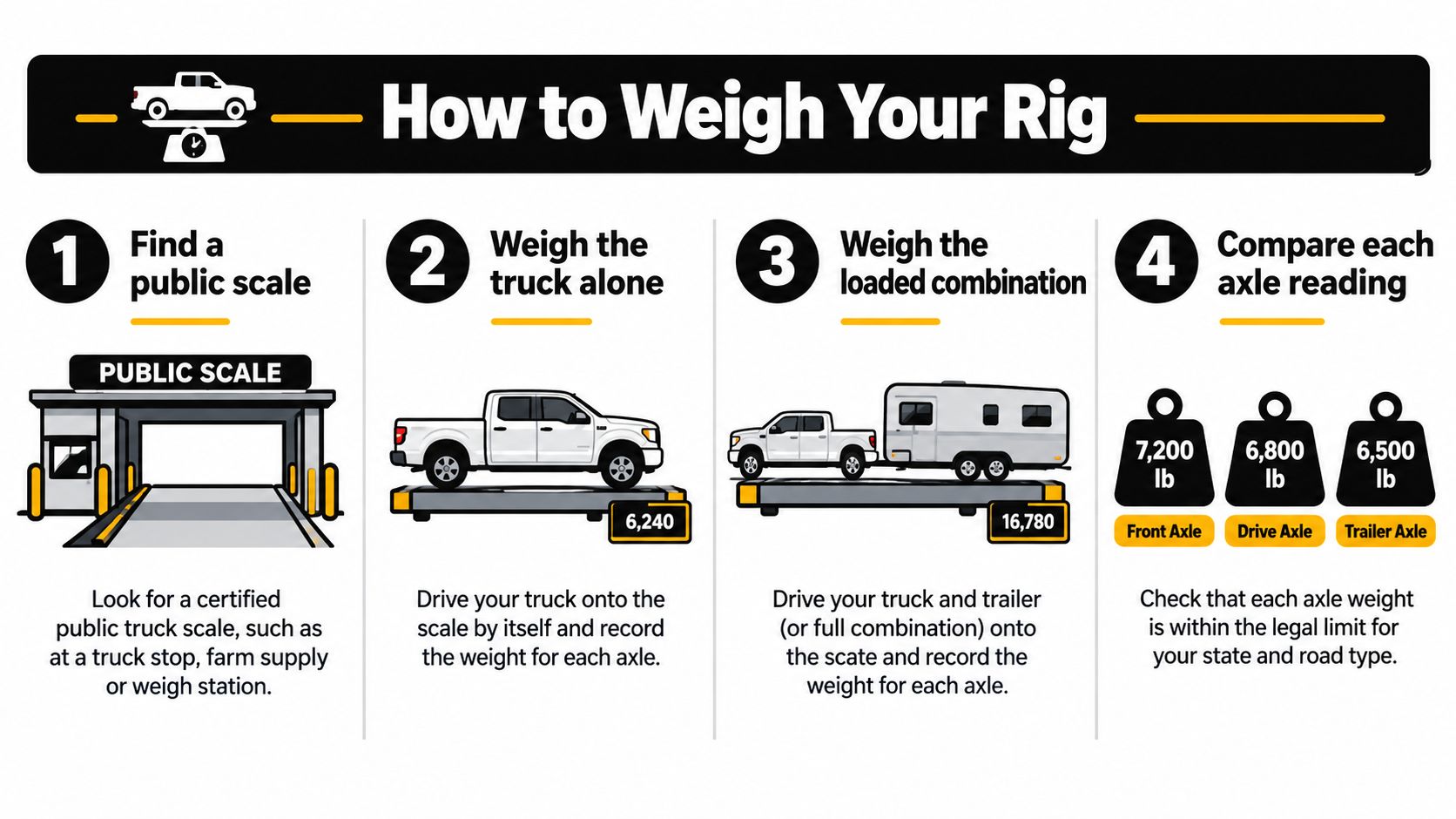
Paper math gets you close. A public scale tells you the truth, and our service team wishes every buyer made this trip before the first real camping weekend.
Four passes that answer the big questions
- Weigh the truck alone: Load it the way you'll travel, with fuel, hitch, passengers, and bed cargo in place. Record front axle, rear axle, and total weight.
- Weigh the truck and trailer together: Hook up the loaded 1/2 ton towable 5th wheel with water, propane, food, and gear aboard, then record steer, drive, and trailer axle weights.
- Weigh the trailer by itself if the scale allows: This confirms gross trailer weight and helps you calculate actual pin weight instead of estimating a percentage.
- Compare every reading to its limit: Check front axle, rear axle, trailer axles, truck GVWR, trailer GVWR, and gross combined weight rating against the plates and stickers.
This process matches the advice in NHTSA service guidance on verifying axle weights, GVWR, and GCWR at a public scale, which also identifies a 15 to 30 percent range for fifth-wheel or gooseneck tongue weight. Your trailer manufacturer's loading design sets the right target inside that range. Don't chase a percentage at the expense of an axle limit.
What a good scale ticket looks like
A comfortable setup has margin under every rating at the same time, not just under one headline number. If the rear axle is near its limit while everything else looks fine, you still have a marginal combination. Move cargo rearward in the trailer only within the manufacturer's guidance, remove bed cargo, or choose a lighter trailer.
Keep the ticket in your glove box. When you add a generator, a bike rack, or a second battery later, you'll know exactly how much room you had. Weigh again after any major change in how you pack.
Utah-Specific Loads That Quietly Shrink Your Payload
Let's run a real loop. You leave Millcreek on a Friday afternoon, climb Parleys Canyon toward Jordanelle, and then continue to Bear Lake for the weekend. The brochure never packed for that trip. You will.
What a Utah family actually brings
- People first: Four passengers and a dog spend payload before the trailer moves an inch, and growing kids make that number larger every year.
- Fresh water and propane: Many Wasatch and high-country sites reward arriving self-contained, and that weight raises both trailer weight and pin weight, as NHTSA towing safety guidance on using fully loaded trailer weight explains.
- Outdoor gear: Bikes, paddleboards, fishing tackle, camp chairs, and a grill tend to migrate into the truck bed and the trailer's front storage, both of which affect pin weight.
- Power and tools: A generator, extra batteries, leveling blocks, and a tool kit are smart to carry and easy to forget on paper.
None of these items is a mistake. They're the reason you bought an RV in Utah. They belong in the worksheet from the start, not as surprises at the scale.
Grades, altitude, and weather raise the stakes
Sustained climbs on I-80 and US-89 work engines, cooling systems, transmissions, and brakes harder than flat highway miles. High altitude makes naturally aspirated engines feel less responsive, and long descents punish a combination that's already near its braking limits. Afternoon winds across open valleys and near the Great Salt Lake can push a tall fifth wheel around, especially if pin loading is too light.
Winter adds its own twist along the Wasatch corridor. Batteries, propane, and stored gear don't vanish in January, and a spring shakedown trip often starts with more aboard than owners remember. Leave margin for the trip you'll take in August with a full truck, not just the optimistic trip you planned in the showroom.
The Honest Match A Smaller Fifth Wheel or a Different Trailer Altogether
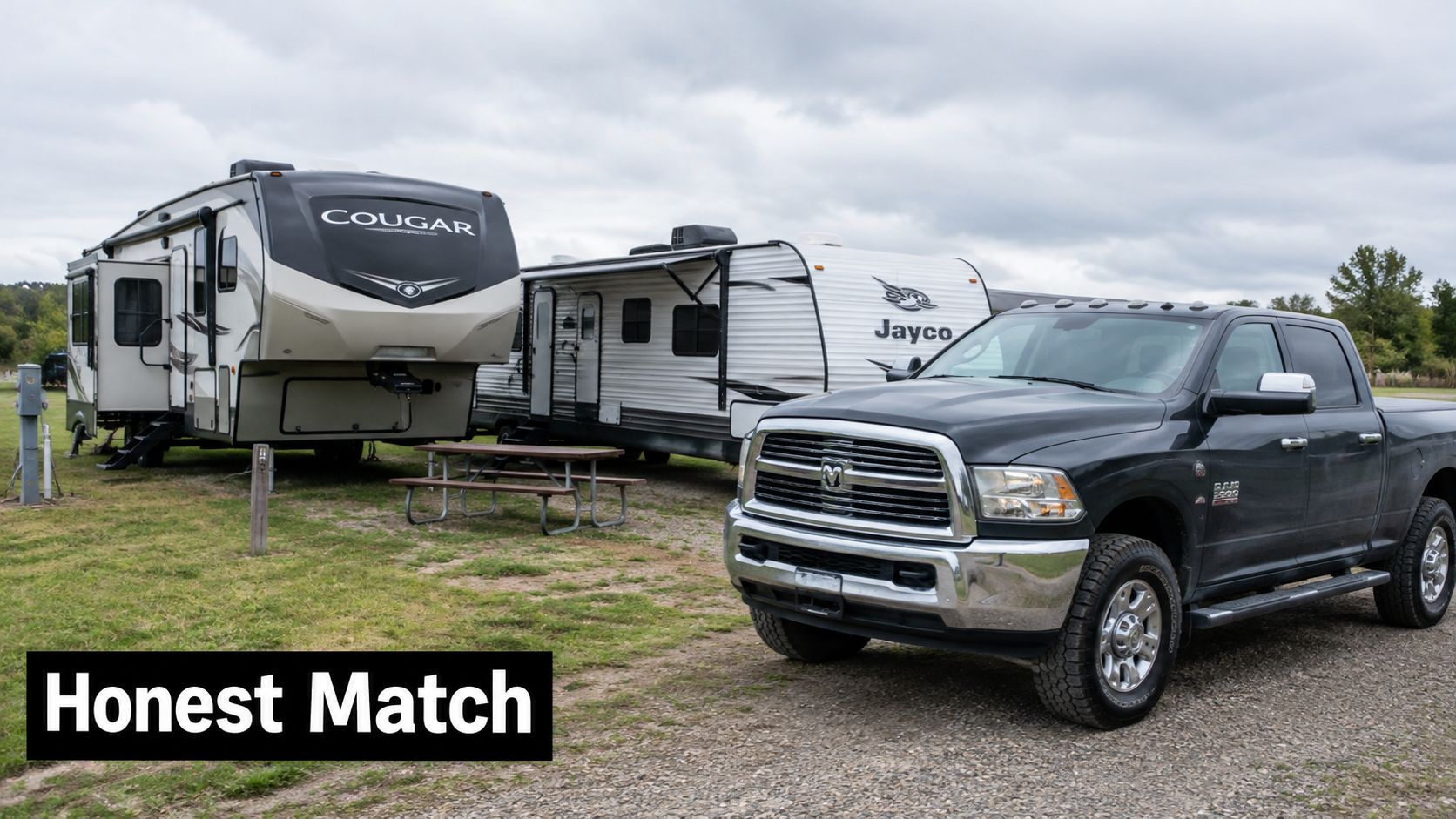
Sometimes the right answer is a smaller fifth wheel. Sometimes it's a 3/4-ton truck. Sometimes it's a conventional travel trailer, and we'd rather tell you that on the lot than let you discover it on a mountain pass.
A simple decision framework
- Two adults, light packing, shorter trips: The lightest fifth wheels can fit a well-equipped half-ton, provided your worksheet and scale ticket both pass.
- Family of four with bikes and full gear: Favor the smallest bunk floorplan that sleeps everyone, budget for a 3/4-ton truck, or compare bunkhouse travel trailers that spread tongue weight differently.
- Extended trips with water and powersports equipment: A larger truck or a toy hauler matched to that truck usually serves you better than stretching a half-ton fifth wheel past its comfort zone.
- Truck is nonnegotiable: Let the door-jamb sticker set a hard pin-weight ceiling, then shop only trailers whose loaded pin weight fits under it.
A quick reality check helps here. A 10,000 lb loaded fifth wheel at a 20 percent pin-weight ratio places about 2,000 lb on the truck before hitch, occupants, or cargo, according to an explanation of why tow rating alone doesn't determine how much RV you can tow. If that single number already strains your sticker, no floorplan feature will fix it.
On our lot, Motor Sportsland stocks lightweight fifth wheels, travel trailers, and toy haulers from brands like Forest River, Keystone, Jayco, and EAST TO WEST, and you can filter that inventory by weight, length, and floorplan. Bring your sticker, tell our team how you camp, and let us help with hitch installation, brake controller setup, and a first scale trip. The honest match is the one you'll still enjoy towing in year three.
Half-Ton Fifth Wheel FAQ
Can a Utah family of four realistically use a 1/2 ton towable 5th wheel? Yes, but only at the lightest end of the market and only if your worksheet leaves margin after all four passengers, the hitch, and your usual gear. Families who pack bikes, a generator, and full water often find a 3/4-ton truck or a bunkhouse travel trailer more comfortable.
How do altitude and mountain grades change the math? They don't change your ratings, but they shrink your comfort zone. Long Wasatch grades stress cooling and braking, and high altitude reduces engine response, so a combination that feels merely adequate near Salt Lake City can feel strained on the way to Bear Lake. Preserve margin rather than towing at the limit.
What should a dealer check before delivery? Ask for hitch placement and bed clearance, brake controller setup, tire condition and pressure, lighting and breakaway checks, and a loaded shakedown conversation about pin weight. Then get your own scale ticket packed for travel, since no delivery checklist replaces axle weights.
What ownership costs should I plan for beyond the purchase? Budget qualitatively for tires, brake service, roof and seal inspections, hitch maintenance, winterization, and storage through Utah winters. Cold Wasatch nights are hard on plumbing and batteries, so proper winterizing and covered storage protect a 1/2 ton towable 5th wheel season after season. Browse current inventory and rotating deals before you visit, then bring your door-jamb numbers with you.
Bring a photo of your truck's door-jamb payload sticker and tell us how your family packs for Jordanelle, Bear Lake, or the high country, and we'll run the pin-weight worksheet with you before you fall for a floorplan. You can filter lightweight fifth wheels, travel trailers, and toy haulers by weight and length, schedule hitch and brake controller work, or stop by for an honest truck and trailer match at Motor Sportsland.
