
How to Calculate Towing Capacity the Right Way

A couple from Salt Lake City arrived at our lot with a familiar question: could their 2022 midsize SUV safely tow a 26-foot travel trailer? One salesperson mentioned 5,000 pounds, while the brochure they had found advertised 7,500 pounds. Both figures sounded authoritative, but neither answered the question that matters: what can this specific, loaded SUV and trailer combination handle safely on Utah roads?
Learning how to calculate towing capacity means looking beyond one headline number. GCWR, GVWR, payload, axle ratings, hitch capacity, tongue weight, trailer brakes, passengers, fuel, and camping gear all compete for the same margin. A trip to Jordanelle or Bear Lake adds real-world weight, while climbs through the Wasatch Mountains add heat and demand to the engine, transmission, brakes, and tires.
This guide follows the same process our team uses with RV buyers. You'll learn where each rating comes from, how to identify the limiting factor, and when a scale ticket or service inspection is more useful than a brochure. If you're comparing a trailer with your current vehicle, a practical resource such as this golf cart towing capacity guide also illustrates why the load being carried matters as much as the vehicle doing the pulling.
Why Towing Capacity Is Not One Number
The Salt Lake City couple's first assumption was understandable. They saw a trailer that appeared to fit within the SUV's advertised maximum and expected the answer to be simple. But the salesperson's 5,000-pound figure and the brochure's 7,500-pound claim likely referred to different configurations, equipment packages, or rating conditions.
A vehicle's usable towing capacity is a chain of limits. The chain can include:
- GCWR, the maximum combined weight of the vehicle and trailer.
- GVWR, the maximum loaded weight of the tow vehicle.
- Payload, including people, cargo, hitch equipment, and trailer tongue weight.
- GAWR, the maximum load allowed on each axle.
- Hitch and receiver limits, including the rated ball mount and weight-distribution equipment.
- Trailer weight and braking capacity, including the trailer's loaded weight and braking system.
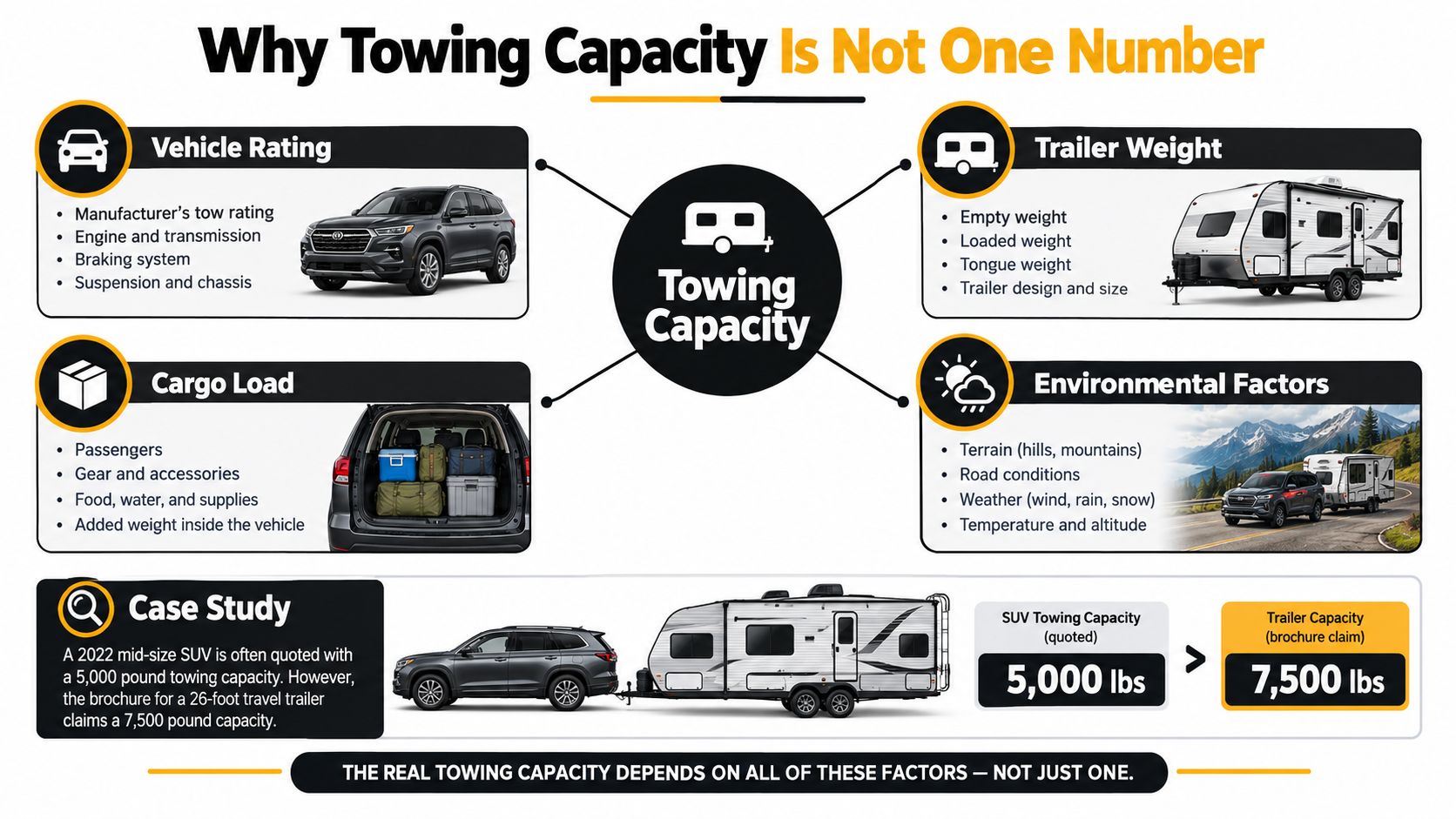
The number in a manufacturer table is useful, but it isn't a permission slip to load the vehicle without checking the actual configuration. Authoritative towing guidance points owners to the owner's manual, door-jamb sticker, and VIN-specific manufacturer data, rather than a generic tow rating (AAA's towing-capacity guidance). A loaded vehicle can also lose practical towing margin because passengers, tools, water, food, and recreational equipment consume payload.
A truck may be able to pull a trailer on level pavement and still exceed its rear axle, tire, hitch, or combined-weight limit. That distinction matters on I-80 through Parleys Canyon, on US-6 over Soldier Summit, and on any descent where braking and cooling capacity become more important than getting the trailer moving.
Practical rule: Find the lowest applicable rating before you buy the trailer. Don't wait until the first mountain trip to discover which link is weakest.
The Ratings Behind the Tow Rating
Start with the labels, not the sales language. A 2023 half-ton truck paired with a 7,500-pound travel trailer makes the difference between the ratings easier to see.
Curb weight is the vehicle's weight in its specified empty condition. It isn't the same as the truck's actual travel weight, because your family, fuel, tools, hitch, and cargo still need to be added. Payload is the amount the truck can carry, and the door-jamb sticker is the vehicle-specific place to find it.
GVWR applies separately to the truck and trailer. The truck's GVWR includes the truck, passengers, cargo, options, and the trailer's tongue weight. The trailer's GVWR is the maximum allowed loaded trailer weight. Ford explains the relationship directly: payload is derived from GVWR minus curb weight, so loading the truck reduces the remaining margin (Ford's towing calculator guidance).
GAWR is the maximum permitted load on each axle. A rig can be under its overall truck GVWR while still placing too much weight on the rear axle, especially when tongue weight and bed cargo sit behind the cab. GCWR is the maximum allowable combined weight of the tow vehicle and trailer, including cargo, passengers, and fluids in both (Blue Ox's GCWR explanation).
What the hitch and trailer add
Tongue weight is the downward load placed on the receiver. Fifth-wheel pin weight performs a similar function in the bed. Both count against the tow vehicle's payload.
Hitch classes provide another ceiling. Class I is intended for light-duty towing, followed by Class II, Class III, Class IV, and Class V for progressively heavier applications. The receiver, ball mount, coupler, safety chains, wiring connector, and brake controller must all support the setup. A Class IV receiver doesn't raise the truck's manufacturer tow rating, and the hitch brand can't override the vehicle's axle or payload limits.
| Rating | What It Measures | Sample Value |
|---|---|---|
| Curb weight | Empty vehicle weight before travel cargo and occupants | Vehicle-specific |
| Payload | People, cargo, hitch equipment, and tongue weight carried by the truck | Door-jamb rating |
| Truck GVWR | Maximum loaded weight of the tow vehicle | VIN-specific |
| Trailer GVWR | Maximum loaded weight of the trailer | Trailer certification plate |
| GAWR | Maximum load on each axle | Front and rear ratings |
| GCWR | Maximum combined weight of vehicle and trailer | Owner's manual |
| Hitch rating | Maximum load supported by the receiver and equipment | Receiver-specific |
For a deeper explanation of the load transferred to the receiver, review our hitch-weight safety guide for Utah RV owners. Stack these ratings beside the actual loaded weights. The smallest permitted figure controls.
The Manufacturer Towing Formula in Practice
A common manufacturer-based starting formula is:
Towing capacity = GCWR minus curb weight minus payload
Kelley Blue Book describes this approach and emphasizes that people, cargo, fluids, and other carried items belong in the calculation (KBB's towing capacity guide). For a truck with a 15,000-pound GCWR, a 5,800-pound curb weight, and a 1,700-pound payload, the arithmetic is:
15,000 − 5,800 − 1,700 = 7,500 pounds
That produces a 7,500-pound starting tow figure. It doesn't mean every trailer at that weight will be a suitable match, because the remaining ratings still need to be checked.
Where the inputs come from
- GCWR: Use the owner's manual or the manufacturer's towing guide for the exact engine, drivetrain, axle ratio, and equipment.
- Payload: Read the yellow and white door-jamb certification sticker on the actual truck.
- Curb weight: Use a certified scale if the truck's real travel configuration matters.
- Trailer weight: Use the trailer's loaded weight, or plan conservatively from its certification information until you can weigh it.
The formula becomes more useful when you account for the items owners commonly forget. In this example, a 350-pound family of four, 200 pounds of camping gear in the bed, fuel from a 38-gallon tank, and a 100-pound weight-distribution hitch all affect the truck's loaded weight or available payload. Those figures aren't invisible. They occupy capacity that the brochure's empty configuration didn't use.
| Step | Item | Pounds |
|---|---|---|
| 1 | GCWR | 15,000 |
| 2 | Less curb weight | 5,800 |
| 3 | Less listed payload | 1,700 |
| 4 | Starting tow figure | 7,500 |
| 5 | Add actual family, gear, fuel, and hitch weight | Vehicle-specific |
| 6 | Recheck loaded truck, axle, hitch, and trailer limits | Vehicle-specific |
The formula is a starting point, not the final answer. Hitch class, axle ratings, tires, tongue weight, trailer GVWR, and trailer brakes can constrain the rig below the mathematical result.
Why the Lowest Number Wins
Two towing figures can disagree because they answer different questions. A manufacturer may publish a maximum tow rating for a specific, lightly equipped configuration, while the door-jamb sticker describes what the particular truck can carry after its options and equipment are accounted for.
Consider a truck advertised to tow 11,500 pounds. If its available payload is 1,500 pounds, the trailer allowance can fall near 7,000 pounds once the loaded vehicle, passengers, hitch, and tongue weight consume the available margin. The calculation isn't just about what the engine can pull. It also asks whether the truck can carry the load applied to its frame, suspension, axle, and tires.
A 2022 F-150 with a maximum tow package, a 9,000-pound travel trailer, four passengers, and mountain bikes shows why the chain breaks in practice. The trailer may fit under a brochure number, but the bikes and passengers occupy payload, while tongue weight transfers additional load to the truck. If the rear axle, tires, or receiver reaches its limit first, the higher headline rating no longer controls.
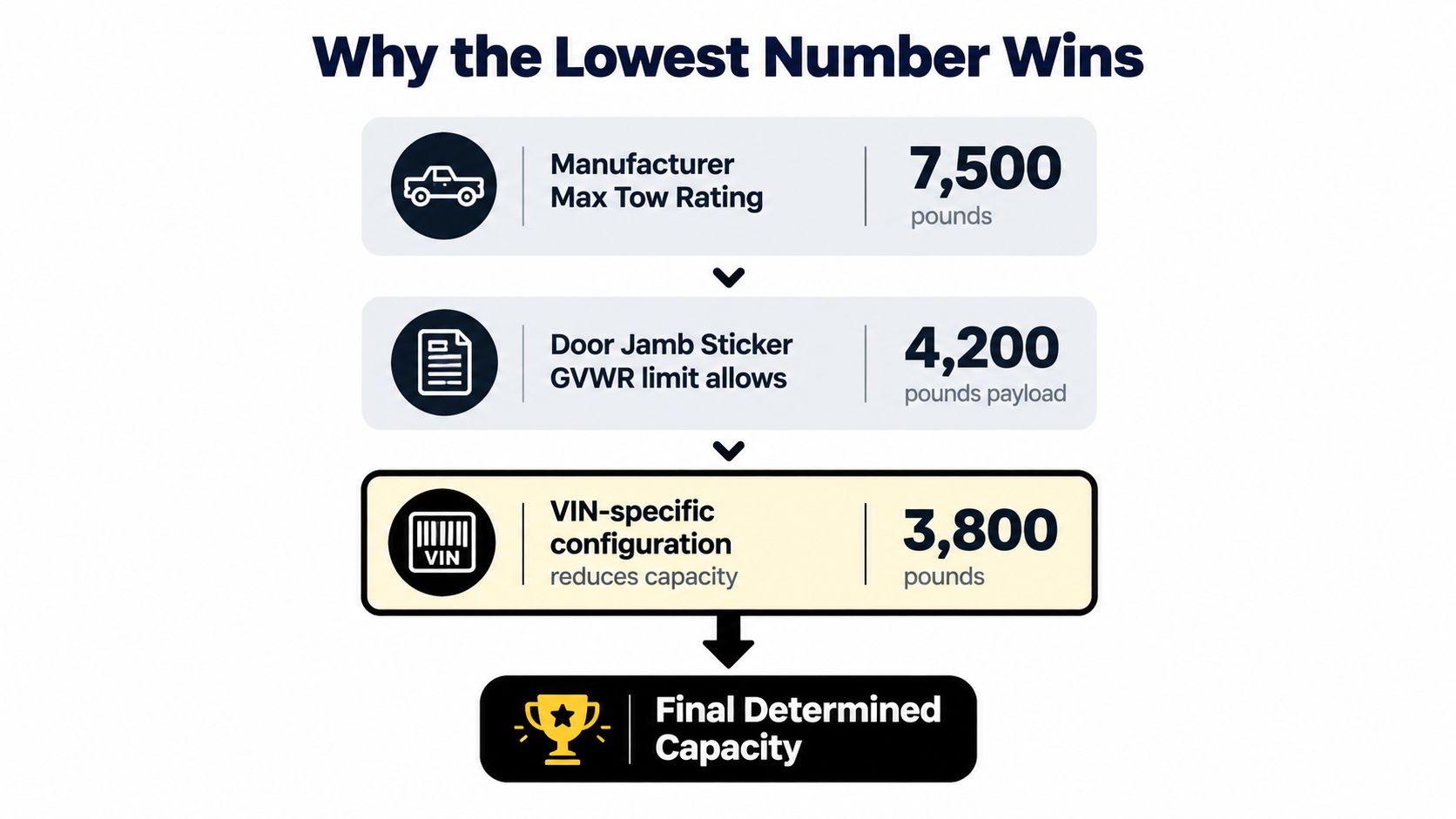
The final capacity is the lowest verified limit, not the most attractive number in a brochure.
Door-jamb payload information and VIN-coded axle ratios can override a generic configuration claim. Use the VIN to confirm axle and brake-package information, then compare it with the truck's stickers and manual. Ignoring those limits can leave the vehicle outside its designed operating conditions and complicate warranty discussions after a frame, brake, or transmission event.
Half-ton trucks often run out of payload, rear-axle capacity, or hitch margin before they reach the advertised tow rating. Three-quarter-ton trucks generally offer more carrying capacity, but they still have limits. Larger equipment doesn't eliminate the need to verify every number.
Matching Common Utah Setups to Hitch Class
Utah buyers often choose between a half-ton travel-trailer setup, a three-quarter-ton fifth-wheel setup, or an SUV and smaller camper. Each combination has a different load path and different equipment requirements.
A half-ton truck with a 6,000 to 8,000-pound travel trailer typically needs a properly rated Class IV receiver, a compatible ball mount, trailer wiring, and weight-distribution equipment when the setup requires it. A three-quarter-ton truck towing a 10,000 to 15,000-pound fifth wheel needs a bed-mounted fifth-wheel or gooseneck system rated for the trailer, plus sufficient pin-weight capacity. An SUV pulling a 4,000-pound popup or Airstream Bambi may use a Class III receiver, but it still needs trailer brakes and a compatible brake controller.
| Vehicle | Trailer Type | Typical Trailer Weight | Hitch Class | Tongue/Pin Weight Rule |
|---|---|---|---|---|
| Half-ton truck | Travel trailer | 6,000 to 8,000 pounds | Class IV | Plan for 10 to 15 percent tongue weight and verify with a scale |
| Three-quarter-ton truck | Fifth wheel | 10,000 to 15,000 pounds | Class V or rated fifth-wheel/gooseneck system | Plan for 20 to 25 percent pin weight and verify payload |
| SUV such as Tahoe or 4Runner | Popup or small Airstream | 4,000 pounds | Class III | Confirm receiver, ball mount, wiring, and brake controller ratings |
The percentages in this setup guide are planning ranges, not substitutes for weighing. Weight-distribution bars above 5,000 pounds of trailer weight may be appropriate when the vehicle and hitch manufacturer allow them, but the equipment must match the receiver and trailer. Our Utah guide to travel-trailer weights helps buyers compare trailer size with the vehicle they already own.
If you're also carrying an electric utility vehicle or farm equipment, a resource such as this Campus EV buyer's guide can help you think through cargo weight before adding it to a toy hauler or truck bed.
High altitude on I-80 and I-70 can reduce cooling performance and make downshifting more important. State-park access roads may also restrict trailer length, so a legal weight match isn't the only fit question.
Real Mistakes We See in Our Service Bay
A Utah County family once brought in a half-ton truck and a 7,800-pound trailer after towing without a weight-distribution hitch. The trailer developed sway on Sardine Summit, and the truck arrived with bent spring packs. The family had focused on the tow rating but hadn't measured loaded tongue weight or accounted for how the hitch load affected the rear suspension.
The check is simple: weigh the loaded tongue, verify that it fits the vehicle's payload and receiver limits, and use weight-distribution bars when the vehicle, trailer, and hitch manufacturers permit them. Don't assume a heavy trailer will remain stable because it tracks well on a flat road.
Another customer experienced brake fade while towing a fifth wheel through Parleys Canyon. The integrated trailer brake controller was set to only 30 percent gain, so the trailer wasn't contributing enough braking force on the descent and began pushing the truck.
Set brake gain with a low-speed test stop on a flat, empty road before each trip. The trailer brakes should contribute smoothly without locking or causing the truck to jerk. Before a long descent, downshift early rather than relying on continuous pedal pressure, especially on grades longer than two miles.
Service-bay lesson: Sway and brake fade usually become visible after the numbers, loading, or setup were left unverified.
The same process catches frame stress, overloaded tires, and worn suspension components before they become roadside repairs. If a rig feels unstable, pulls under braking, or needs constant correction, stop treating the symptom as normal towing behavior.
Pre-Trip and Mountain Driving Checklist
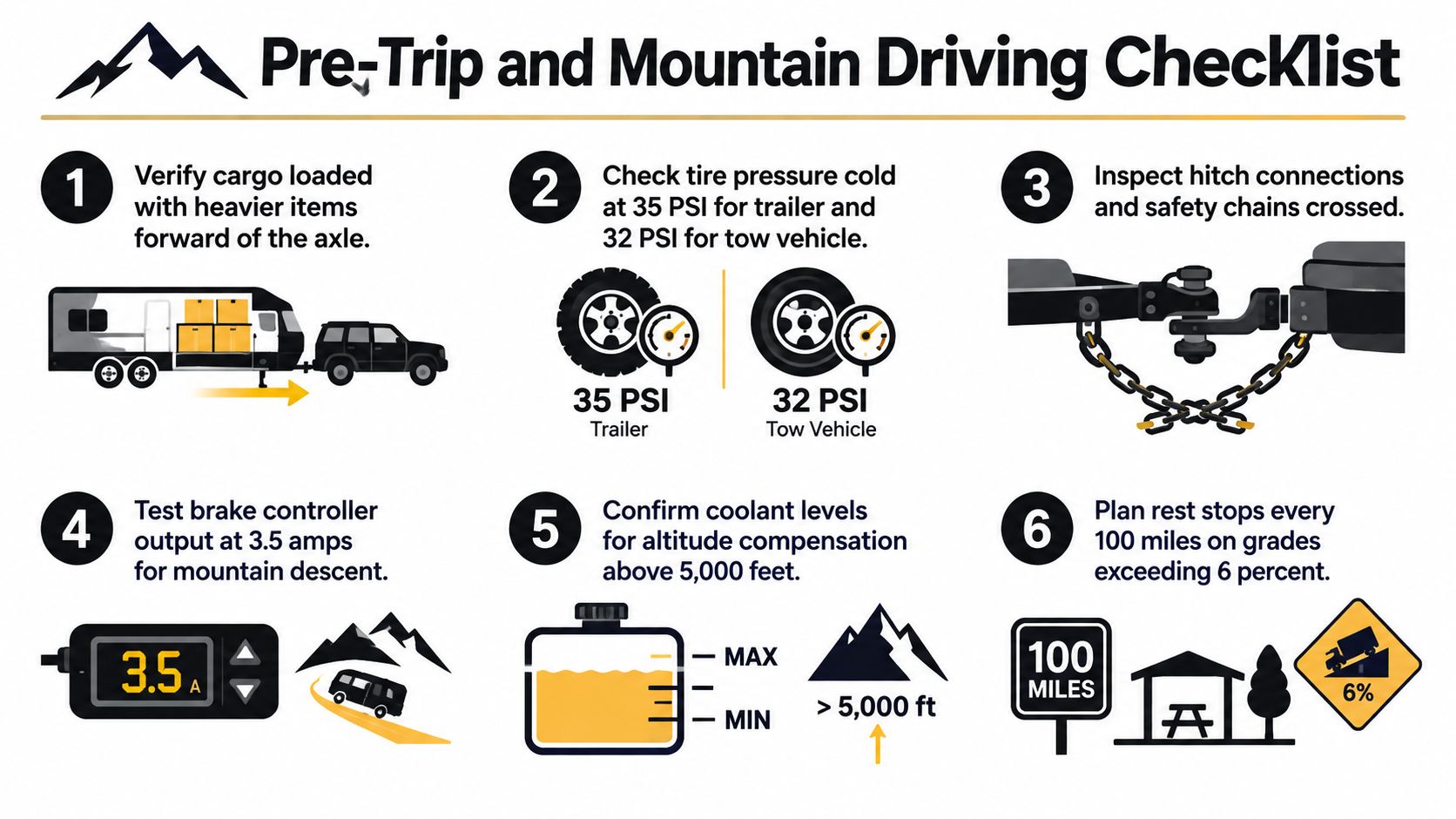
Safe towing begins before the key turns. Load the trailer in a way that keeps weight forward of the axle without putting excessive load on the coupler, then check every rating against the condition in which you will travel.
Load the trailer and tow vehicle deliberately
Place heavier items forward of the trailer axle and secure anything that can shift. Aim for 10 to 15 percent tongue weight of the loaded trailer for a bumper-pull setup, then confirm the result with a scale rather than trusting the location of a water tank or generator.
Keep loose items out of the tow vehicle's cab. Coolers, tools, bikes, food, and recovery equipment all affect payload, even when they aren't inside the trailer.
- Start with the trailer plate: Record the trailer GVWR and compare it with the loaded weight you expect.
- Check the tow vehicle sticker: Use the door-jamb payload figure for that exact vehicle.
- Include the hitch: Count the ball mount, weight-distribution equipment, or fifth-wheel hardware.
- Secure the connection: Inspect the coupler, pin, safety chains, breakaway cable, and wiring connector.
Set tires and brakes before the road
Check tire pressure cold. Use the trailer-towing placard and the tire manufacturer's load guidance for the trailer, rather than automatically copying the tow vehicle's door-jamb number. Inspect tread, sidewalls, wheel torque, and valve stems on both the truck and trailer.
Set the brake controller with a low-speed test stop on a flat, empty road. Adjust gain until the trailer brakes contribute firmly and progressively without locking the wheels or pulling the combination sideways. A brake controller setting that worked on the last trip may not suit a different load.
Engage transmission tow/haul mode before climbing or descending. Check coolant and engine-oil levels, and inspect for leaks. Elevations above 6,000 feet change air density and can affect engine and transmission temperatures under load.
Prepare for Utah passes
On I-80 through Parleys Canyon or US-6 over Soldier Summit, downshift before the descent begins. Keep speed 5 to 10 mph below posted limits when conditions and traffic allow, and use intermittent brake pressure rather than riding the pedal continuously on long grades.
Leave room for the trailer to track through curves and expect slower acceleration at altitude. Wind near the Great Salt Lake, heat on exposed approaches, and steep campground access roads can all expose a marginal setup. Check your route for trailer-length restrictions before leaving for Jordanelle, Bear Lake, or another state-park destination.
Apply the chain before purchase
Use this order:
- Identify the vehicle's payload and GVWR from the door-jamb sticker.
- Find GCWR and the exact tow rating in the owner's manual or manufacturer towing guide.
- Confirm axle, tire, and brake-package information through the VIN and vehicle labels.
- Read the trailer GVWR and estimate loaded trailer weight from the trailer plate and a scale.
- Calculate the remaining tow figure after curb weight, passengers, cargo, fuel, and hitch equipment.
- Compare the result with receiver, ball mount, tongue-weight, and trailer-brake limits.
- Take the lowest resulting figure and confirm it clears the trailer's loaded weight by at least 10 percent.
That last margin is a planning rule for this guide, not a replacement for the manufacturer's ratings or a scale measurement. Apply the running example this way: begin with the truck's verified GCWR, subtract its actual loaded weight, check the trailer's loaded weight against the result, then separately verify payload, axles, hitch, tires, and braking.
Glove-box summary: Verify GVWR, GCWR, payload, hitch rating, and trailer GVWR, subtract the actual loaded vehicle weight, then let the lowest verified limit control.
A CAT Scale ticket is worthwhile when the numbers are close, the trailer has been modified, or the family has added bikes, batteries, water, or a generator. A dealership service write-up is appropriate when you need the hitch, brake controller, wiring, suspension, tires, or cooling system inspected together. For sway-control equipment and setup decisions, our anti-sway hitch guide for Utah RV owners provides another practical reference.
Motor Sportsland helps Utah RV buyers compare trailers by weight, length, floorplan, and features, while our service team handles hitch installations, brake-controller work, inspections, repairs, and upgrades. Visit Motor Sportsland to review current inventory, then contact our Salt Lake City area team before you purchase so we can help verify the vehicle and trailer match.
Frequently asked questions about towing capacity
How do I calculate towing capacity?
Start with GCWR minus curb weight minus payload, using the vehicle's exact manufacturer data. Then verify GVWR, GAWR, hitch capacity, tire limits, trailer GVWR, tongue weight, and trailer brakes. The lowest verified limit controls.
Where can I find my vehicle's payload rating?
Look for the vehicle-specific payload information on the door-jamb sticker. Don't substitute a brochure figure from another trim, engine, axle ratio, or drivetrain.
Does tongue weight count as payload?
Yes. Tongue weight rests on the tow vehicle, so it consumes payload along with passengers, fuel, cargo, and hitch equipment.
Is the advertised tow rating enough?
No. The advertised tow rating is only one input. A loaded vehicle can reach its payload, axle, hitch, tire, or combined-weight limit first.
Should I weigh my trailer?
Weighing is the most reliable way to replace assumptions with the actual loaded trailer weight. A CAT Scale ticket is especially useful when your setup is close to any rating or you've added substantial equipment.
Why does mountain towing feel different?
Altitude, grades, heat, wind, and descents increase demands on the engine, transmission, cooling system, and brakes. Downshift before descents, use tow/haul mode, and monitor the rig instead of relying only on the flat-road experience.
When should I ask a service department for help?
Ask for an inspection when you need a receiver, weight-distribution hitch, brake controller, wiring, tires, suspension, or cooling system checked. Professional setup is also sensible when the calculated margin is tight or the trailer has developed sway, brake fade, or unusual handling.
