
Best Travel Trailer for Couples in Utah

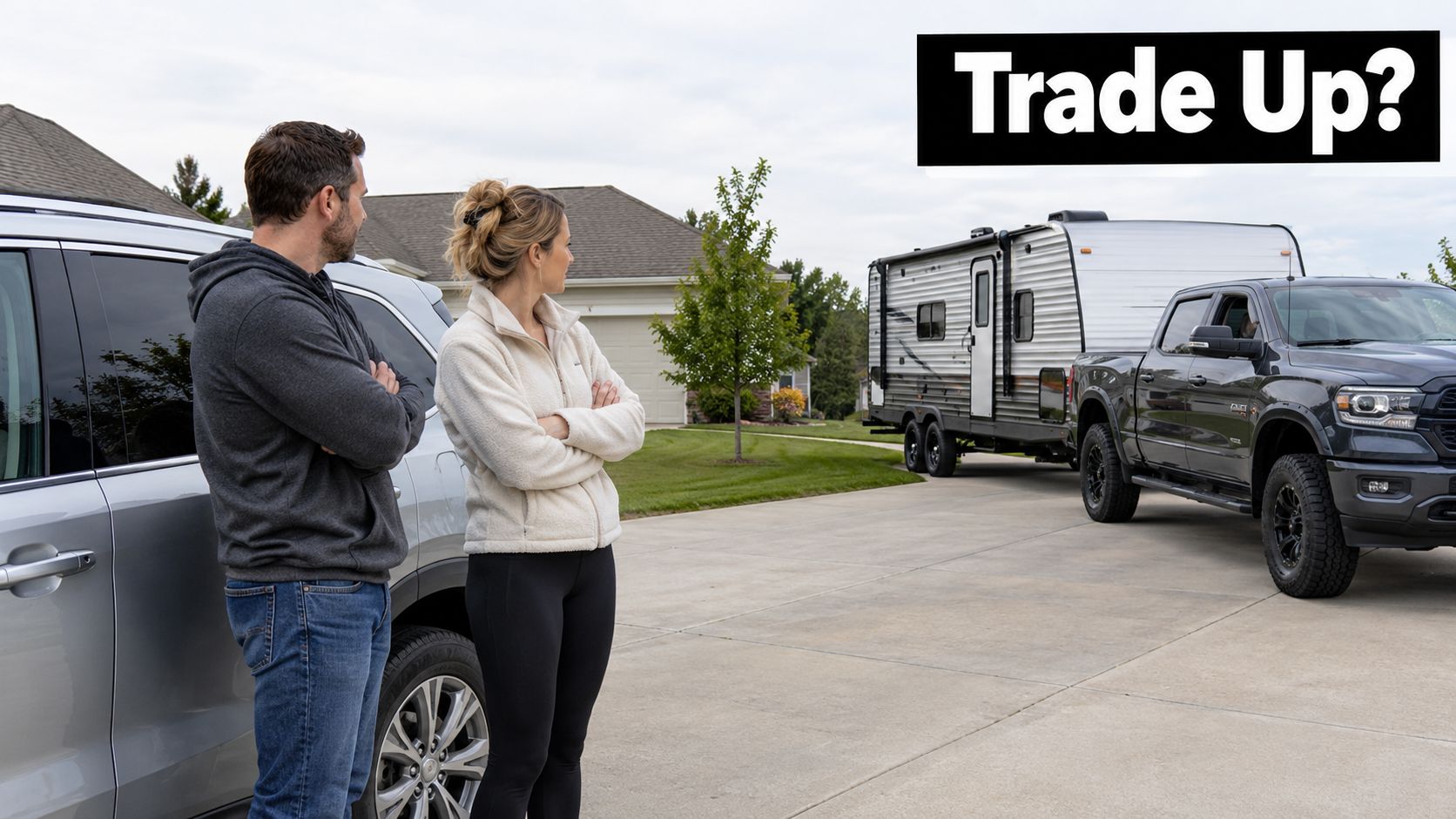
You're standing in a Millcreek driveway with a tape measure in one hand and your SUV's tow-rating page open on your phone. A travel trailer that looks roomy in the showroom could be a poor fit once you add water, camping gear, and the weight pressing down on the hitch. Go smaller, and you may spend every trip wishing you had a fixed bed or a more private bathroom.
For couples, the best travel trailer isn't automatically the longest, lightest, or most luxurious one. It's the trailer that suits your actual Utah trips, fits your tow vehicle with room to spare, and gets used often enough to make its ownership cost worthwhile. At Motor Sportsland, we'd start with those questions, then compare layouts. Here's how to sort out the trade-offs before you commit to a trailer or a different tow vehicle.
Why Couples Buy Differently Than Families
The couple in that Millcreek driveway isn't shopping for bunk beds. They're asking a different question: can they get a comfortable, private living space without replacing a vehicle that already works for daily life? A family bunkhouse solves a sleeping-capacity problem. A couples trailer usually has to balance a fixed bed, an easy-to-use bathroom, living-room comfort, and the weight and length the couple can manage.
That balance gets personal fast. One pair may spend most weekends at established campgrounds, where a compact trailer is easier to park and set up. Another may head to Bear Lake for longer stays and want a separate bedroom, more food storage, and a roomy place to sit when the weather turns. Those aren't the same purchase, even if both buyers use the phrase “couples camper.”
Start with the trip, not the showroom
A long trailer can feel like the obvious upgrade indoors. On the road, every added foot can affect tow-vehicle demands, turning room, campsite access, and where you can store the trailer at home. A floorplan that suits a couple's routine matters more than a long equipment list.
The history of the travel trailer helps explain why practical layouts remain central. Pierce-Arrow's Touring Landau debuted at Madison Square Garden in 1910, while camping trailers from Los Angeles Trailer Works and Auto-Kamp Trailers also entered production that year. The Conklin family's approximately 25-foot Gypsy Van then traveled from New York to San Francisco in 1915, showing how a towable vehicle could support a long trip with more comfort than a tent. The Smithsonian's history of the RV offers useful context for the compact towability and efficient living space couples still look for.
A sensible decision starts with four filters: use case, tow math, cost per usable night, and floorplan type. The Millcreek couple should first decide how often they'll camp and where, then identify what their vehicle can safely handle. After that, they can compare sleeping and bathroom layouts against ownership costs. That order keeps a good-looking trailer from becoming a poor match.
The Five Filters Every Couple Should Apply First
Before you browse floorplans, write down what a normal camping season looks like. A couple taking occasional weekend trips may value quick setup and easy towing more than a large lounge. If your calendar includes extended stays, prioritize sleeping comfort, storage, and a kitchen you'll be happy to use day after day.
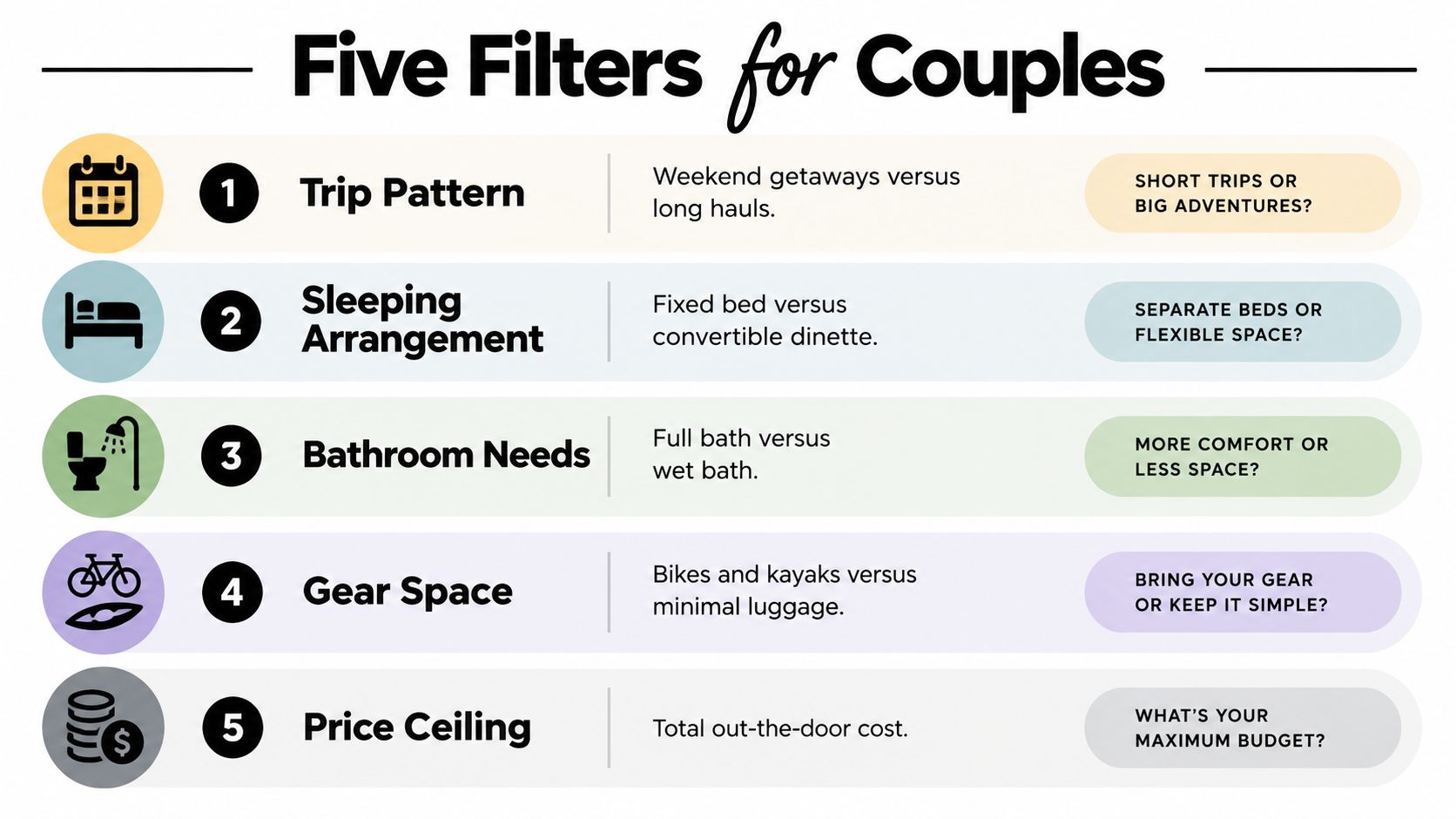
Five questions to settle at home
- Trip pattern: Are you mostly taking short weekends, or planning longer journeys with longer periods on the road? A trailer that works for a quick stay near Jordanelle may feel cramped during a full-season trip.
- Sleeping arrangement: Decide whether you want a fixed bed or are comfortable converting a dinette each night. A convertible setup can make better use of a compact interior, but it asks you to reset the living area every morning and evening.
- Bathroom needs: Think about privacy and convenience. A full bathroom suits buyers who want a more residential setup, while a wet bath saves space but combines shower and toilet in one area.
- Gear space: List what travels with you. Bikes, camp chairs, cooking equipment, and outdoor gear need somewhere to go, and “we'll pack light” won't help if the storage layout doesn't fit your routine.
- Price ceiling: Include the total ownership picture, not just the trailer's purchase price. Storage, service, insurance, and financing can all affect whether the purchase fits your household budget.
These filters can eliminate floorplans that don't match your life before you spend a Saturday walking through trailers. For example, a couple who wants a fixed bed, private bathroom, and room for outdoor gear may rule out a very compact convertible layout. If they also want to keep their current vehicle, they should focus on options that leave tow-vehicle capacity available rather than starting with the biggest interior.
A useful at-home screen is simple: name your usual trip, choose your sleeping arrangement, define your bathroom preference, inventory your gear, and set a realistic ownership budget. If you can't agree on those basics, wait before choosing a model. A showroom walk-through is more productive once you know which trade-offs you're willing to accept.
Comparing the Four Couples Floorplan Archetypes
Couples shopping in Utah tend to gravitate toward a few broad layouts. The table is a starting point, not a promise that every trailer in a length range has the same weight or equipment. Check the specific unit's certification label and loaded specifications before deciding it fits your vehicle.
| Archetype | Typical Length | Loaded GVWR Range | Bed Type | Bathroom | Best Fit |
|---|---|---|---|---|---|
| Compact tag-along | 16–20 ft | Varies by model; confirm the unit label | Fixed or convertible | Compact rear bath, often a wet bath | Short trips, limited storage, and easier maneuvering |
| Mid couples coach | 21–24 ft | Commonly about 5,000–6,500 lb | Fixed bed | Full bathroom on many layouts | Weekend travel with a dedicated sleeping area |
| Rear-lounge trailer | 24–26 ft | Varies by model; confirm the unit label | Fixed bed, layout-dependent | Full bathroom on many layouts | Couples who prioritize seating and campsite views |
| Front-bedroom trailer with slide | 24–26 ft | Varies by model; confirm the unit label | Private fixed bed | Often a more separated bathroom layout | Longer stays and more residential living space |
| Couples fifth-wheel alternative | 26–28 ft | Varies by model; confirm the unit label | Fixed bed, often in a raised bedroom | More residential bath options | Buyers with a compatible tow vehicle seeking a distinct living area |
Match the layout to how you live
A compact tag-along keeps the footprint down. It can make sense for quick trips and tighter sites, but storage and interior circulation are limited. If the bed converts from seating, decide whether that daily setup is a fair trade for a trailer that's easier to manage.
A mid couples coach often hits a useful balance. A fixed bed and workable bathroom make it comfortable for two, without requiring the interior volume of a longer coach. But the trailer's loaded weight still matters more than the floorplan name, and a compact-looking exterior doesn't guarantee your SUV has enough payload.
The rear lounge gives you a place to sit together after a day outside, while a front-bedroom trailer with a slide can add room to the living area and keep the bed separate. Both can be appealing for longer stays, but slides add setup and maintenance considerations, and extra interior space can mean more weight and length.
A couples fifth wheel may provide a more distinct bedroom and living area, but it requires a suitable truck and compatible hitch setup. It isn't a shortcut to more comfort without towing consequences. For a closer look at layout differences, compare travel trailer floorplans and layouts.
The right archetype is the one that fits your tow vehicle with margin, not the one with the most square feet.
True Cost Per Usable Night for Two
A trailer's price tag doesn't tell you whether ownership makes sense. Ask instead: How much does each night you use it cost? Recent ownership estimates put annual carrying costs at roughly $4,935 before campground fees, assuming the owner already has a suitable tow vehicle. At 30 nights of use, that's about $165 per night; at 75 nights, it's roughly $66 per night. Those estimates come from a travel trailer ownership-cost analysis.
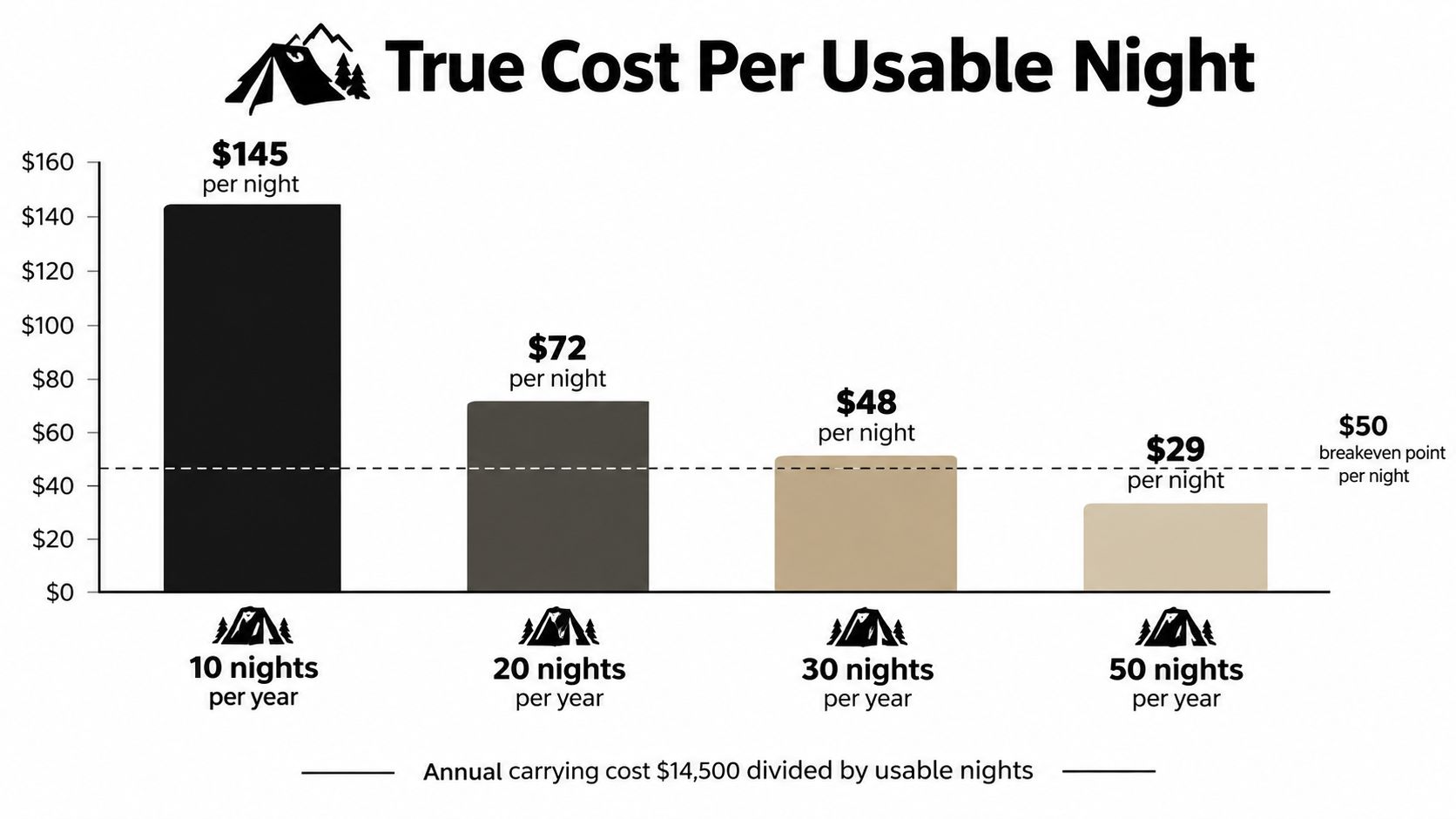
The estimate is a benchmark, not a quote for your household. Storage, maintenance, insurance, registration, depreciation, financing, and fuel all affect the result. Utah adds practical wrinkles: a Salt Lake City storage arrangement, winterization before freezing weather, and the fuel demands of towing through the Wasatch Mountains can change your personal total. Campground fees at Jordanelle or Bear Lake sit on top of the carrying cost.
Use your nights, not a generic ownership claim
For a consistent comparison, divide the annual carrying-cost estimate by the nights you expect to use the trailer. The resulting figures below use the stated annual estimate, rounded to whole dollars.
| Usable nights per year | Approximate carrying cost per night |
|---|---|
| 10 | $494 |
| 30 | $165 |
| 55 | $90 |
| 75 | $66 |
The 10-night case is a warning: a trailer used only for a handful of outings can cost a lot per night before campsite fees. Renting may be more sensible if your use is rare, particularly if buying would also mean financing a new tow vehicle. A paid-off used trailer can change the calculation, but it still carries storage, service, insurance, and depreciation costs. A financed new trailer adds payments and interest, so don't assume the benchmark captures your exact ownership expense.
If the numbers are close, compare the actual trips you'll take with the kinds of trips you'd rent for. If you want help working through financing assumptions, use the RV loan calculator. The best trailer financially is the one you'll use often enough to justify owning, not the one with the lowest sticker.
Tow Vehicle Math Couples Should Run Before Signing
The number on an advertisement that matters least is often the dry weight. It doesn't include the load you'll add for camping. Start with the trailer's GVWR, check the vehicle's payload and axle ratings, then confirm receiver and hitch limits. A trailer can fall within a tow rating while still exceeding the tow vehicle's available payload once passengers and hitch equipment are counted.
Here's the useful sequence:
- Find the trailer's GVWR and cargo capacity. GVWR is the maximum permitted loaded trailer weight. Cargo capacity is the room available for water, food, propane, batteries, clothing, and gear.
- Account for water. Fresh water weighs about 8.34 pounds per gallon. A full 40-gallon tank adds approximately 334 pounds before any other camping supplies are loaded.
- Estimate loaded tongue weight. Conventional trailers typically put about 10–15% of their loaded weight on the hitch. A 6,500-pound GVWR trailer can require roughly 650–975 pounds of tow-vehicle payload for tongue weight, before occupants or gear are counted. Couples-trailer towing guidance explains why that hitch load belongs in the calculation.
- Check every vehicle limit. Allow for the two of you, cab and bed cargo, hitch hardware, and loaded tongue weight. Verify payload, axle ratings, tires, receiver capacity, and manufacturer tow guidance.
Don't let cargo placement undermine stability
NHTSA advises buyers to determine the trailer's tongue weight when it's fully loaded and compare it with the tow vehicle's gross axle weight ratings. Too little tongue weight can contribute to sway, while too much can reduce load on the tow vehicle's front wheels and affect handling. NHTSA's towing-safety interpretation makes clear why an empty-weight figure alone isn't enough.
Load the trailer as you expect to travel, including water, bicycles, outdoor chairs, and cooking supplies, then get the combination weighed using an appropriate method. Keep heavy cargo secured and avoid loading it behind the axles in a way that makes the trailer rear-heavy. Use this towing-capacity calculation guide as a starting point, then confirm the actual vehicle and trailer limits.
Before a mountain trip, inspect tires, brakes, hitch connections, and safety chains. For broader trip-planning reminders, use this truck-and-trailer towing walkthrough.
Matching the Trailer to the Utah Trip You Actually Take
A trailer that feels just right in a dealership lot still has to work on your route and at your campsite. Campspot reported that 73.4% of campers booking through its marketplace in 2025 selected a campground they hadn't visited before. That makes flexibility useful, especially for couples who like exploring unfamiliar destinations rather than returning to the same site every trip. Campspot's year-in-review provides the context.
Four Utah trips, four different priorities
Weekend at Jordanelle: A compact trailer or mid couples coach may be the easiest match if you value straightforward towing and a fixed bed. If you want a larger lounge for evenings inside, a rear-lounge layout may be worth the added length. Decide based on your vehicle and preferred campsite setup, not the showroom's most open-looking floorplan.
Two weeks at Bear Lake: A front-bedroom layout or a roomier mid couples coach can make extended stays more comfortable, particularly if you want a dedicated bed and more usable kitchen and storage space. Before choosing additional room, make sure you have somewhere to store the trailer at home and that the loaded combination suits your vehicle.
Dispersed camping near Moab: Favor a trailer that matches the access route, your setup experience, and your actual gear. A compact option can be easier to maneuver, but don't assume a site will accommodate the whole combination just because the trailer itself appears short enough. The National Park Service explains that listed limits refer to what the site can easily accommodate, and access roads or turning space may be part of the problem. Its campground length guidance illustrates why the tow vehicle and any accessories matter too.
Winter at home in Salt Lake City: If your driveway or storage spot is tight, measure the parking area and think about winterization before settling on a longer layout. A seasonal trailer needs a storage plan, not just a campsite plan. Ask a service professional what needs to be protected before temperatures drop.
Wind exposure on I-15 and sustained grades through the Wasatch Mountains also make loaded weight and tow-vehicle margin practical concerns. Before a trip, check route and campground restrictions, then plan food and small comforts ahead of time. This camping coffee guide for 2026 can help you pack a simple brew setup without hauling a bulky kitchen kit.
Quick match: Short weekends and tight storage favor compact layouts. Longer stays favor a fixed bedroom and more living space. Unfamiliar or remote sites reward a manageable combination and a careful check of access limits.
Putting It Together and Next Steps at Motor Sportsland
There isn't one best travel trailer for couples. There are several good answers, depending on the trips you take, the tow vehicle you already own, and how often you'll use the trailer. Make your decision in this order: confirm tow-vehicle margin, test the cost per usable night, match a floorplan to your most common Utah trip, then choose the bed and bathroom arrangement you'll be happiest using.
If you're still weighing storage and packing, a practical guide to clothing for life lived offline can help you think about travel-ready layers without overpacking. For RV-specific decisions, Motor Sportsland has new and used travel trailers to compare, along with financing options, trade-ins, and a service center for maintenance and repairs.
Browse current travel trailer inventory with your target length and tow limits in mind. If you'd rather talk through your vehicle and likely trips first, visit the Millcreek or Spanish Fork showroom and bring your tow-vehicle payload information. A useful consultation starts with the numbers and your travel plans, not a sales pitch.
Couples Trailer Questions We Hear at the Showroom
Should a couple buy new or used for a first trailer?
Buy the trailer that fits your tow vehicle, budget, and expected use, whether it's new or pre-owned. With a used trailer, inspect the roof, seals, floor, appliances, plumbing, and electrical systems before you commit. New can offer a different warranty and condition profile, but it doesn't make a poor floorplan or overloaded tow combination a good choice.
How should we winterize in Salt Lake City?
Protect the plumbing before freezing weather arrives, and ask a service professional to explain the steps for your specific trailer. Off-season storage can be worthwhile if your home setup leaves the trailer exposed or crowded, but storage doesn't replace winterization. Motor Sportsland's service team can help with maintenance and repairs.
When should we trade in a trailer we've outgrown?
Trade when your regular trips have changed and the current trailer no longer fits, or when you're repeatedly working around limits in sleeping space, storage, or layout. Before shopping, reassess your tow vehicle and likely use. A larger replacement only makes sense if the whole combination works.
What should we expect from a first-year service plan?
Ask for a walkthrough of the systems you'll use and a clear list of what the plan covers. Learn how to check seals, tires, brakes, plumbing, and electrical components, and keep records of service. Your owner's manual and trailer manufacturer should guide maintenance intervals.
Visit Motor Sportsland to compare travel trailers, discuss tow-vehicle fit, and ask our team about service, trade-ins, and financing. Bring your vehicle's ratings and a rough outline of your Utah camping plans so we can help narrow the options to trailers that make sense for you.
