
Fifth Wheel Hitch Installation Cost in 2026: What to Expect

A realistic fifth wheel hitch installation cost runs about $450 to $1,650 for a drop-in hitch on factory puck mounts, $600 to $1,600 for a fixed hitch on universal above-bed rails, and $1,200 to $3,300 or more for a sliding hitch. Your pickup's existing bed mounting system, not the retail tag on the hitch head, decides where your final invoice lands.
Most truck owners run into sticker shock because they price the hitch head online and assume installation works like bolting a receiver onto a rear bumper. Fifth-wheel hardware has carried a much heavier structural job since its earliest days. As documented in The Trucker's history of the fifth wheel, the coupling evolved from nineteenth-century horse-drawn carriage turntables to motorized trucks when Charles H. Martin introduced the Martin Rocking Fifth Wheel in 1915, bringing lateral movement to handle uneven roads. Modern pickups still rely on structural frame brackets, bed mounts, kingpin jaws, and dedicated wiring to hold thousands of pounds of trailer pin weight safely over the rear axle.
When our service advisors sit down with Utah drivers preparing for grades along the Wasatch Front, we treat the hitch head as only one line on the estimate. Knowing what already sits beneath your truck bed, how many labor hours the job takes, and which add-ons belong on an itemized quote keeps you from paying twice for hardware or discovering a clearance issue at the campground.
Fifth Wheel Hitch Installation Cost by Setup
Say a Utah family finds a fifth wheel hitch advertised online for a few hundred dollars and budgets for a quick afternoon install. Once a technician measures the truck bed and discovers there are no factory puck mounts underneath the liner, the quote jumps to more than double that retail sticker because the job now requires bed rails, frame brackets, drilling, and several hours of bay time.
Comparing quotes starts with knowing which hardware setup matches your truck. According to On-Site RV Repair's fifth-wheel hitch installation cost guide, a drop-in hitch using factory pucks can take as little as 15 to 45 minutes to fit, while above-bed rails take 2 to 5 hours and manual or automatic sliding hitches generally run 3 to 6 hours. Because published shop benchmarks differ on puck installation time, planning around the wider range below gives you an honest starting point.
| Setup | Labor time | Installed cost |
|---|---|---|
| Drop-in hitch on factory puck mounts | 15 minutes to 2 hours | $450 to $1,650 |
| Fixed hitch on universal above-bed rails | 2 to 5 hours | $600 to $1,600 |
| Sliding hitch, manual or automatic | 3 to 6 hours | $1,200 to $3,300 or more |
Notice how the lowest row isn't a bargain-basement hitch head. It reflects a pickup that already left the factory with structural mounting points built into the frame. If your truck has a smooth bed floor with no factory prep package, a fixed rail system is your realistic baseline, and a short-bed pickup needing extra cab clearance moves you into the sliding hitch tier.
Reading a Shop Quote Against Each Setup
When an estimate lands well above the row for your configuration, don't assume the shop is overcharging until you look at every line item. Retail hitch pricing rarely includes truck-specific mounting brackets, bed drilling, alignment checks, electrical wiring, or brand adapters. If you're still deciding which hitch design fits your trailer weight and driving style, our guide to how a fifth wheel hitch works breaks down head capacities, jaw styles, and pivot mechanics before you commit to parts.
Service desk rule: Always check your written estimate against the setup row first, then circle any charge that sits outside the base hitch head and mounting kit.
Two other variables move the final figure even within the same row. Local shop labor rates shift substantially between small independent garages and specialized RV service centers, and heavier fifth wheels demand higher-capacity hitches with beefier brackets and stricter torque work. Ask the shop to confirm both the hitch's gross trailer weight rating and whether mounting hardware is bundled or billed separately before you compare numbers.
Why Your Truck's Mounting System Sets the Price
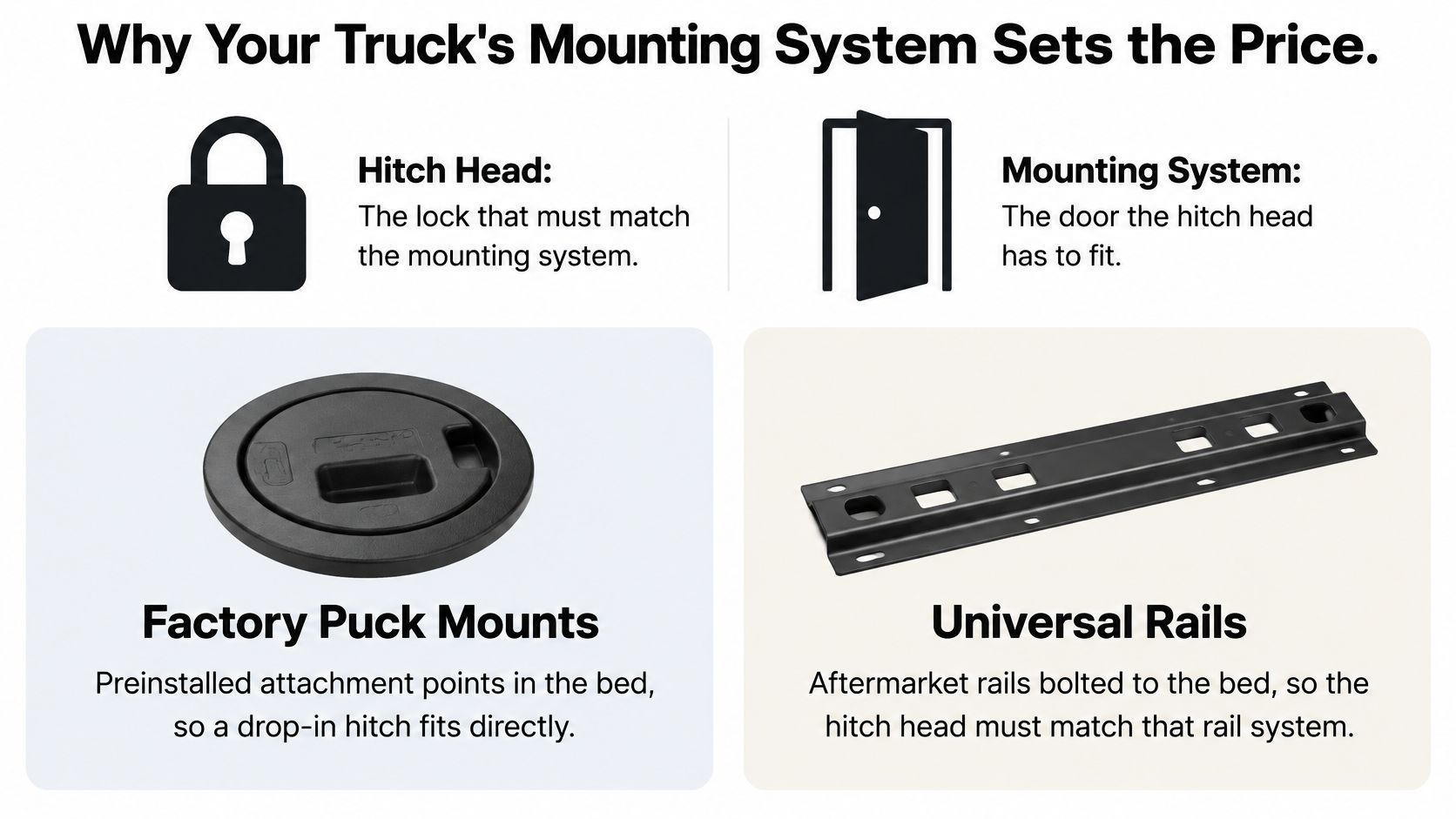
Think of the hitch head as the lock and your truck's mounting system as the door it has to fit. You can't choose a lock off the shelf without knowing how the door is framed, and the same rule governs every fifth wheel install.
Factory OEM puck mounts are preinstalled under-bed attachment points built into the truck's frame at the assembly plant. A compatible drop-in hitch seats directly into those four pucks and secures with quarter-turn handles, avoiding bed drilling altogether. By contrast, a universal above-bed rail system requires the technician to measure exact axle placement, drill through the pickup bed floor, work around exhaust and fuel lines to reach the frame, bolt up vehicle-specific brackets, and torque every fastener to spec.
Data from Torklift Central's fifth-wheel hitch installation overview illustrates how sharply that mounting interface separates shop labor. Installing a hitch into existing OEM puck mounts typically takes 1 to 2 hours and runs roughly $100 to $200 in labor before parts. Installing a universal rail kit stretches to 3 to 5 hours and roughly $300 to $400 in labor before parts, purely because of the structural fabrication and frame access required.
Seeing both mounting layouts side by side makes it easy to spot why two neighbors towing identical trailers can receive completely different installation bills.
Quick Checks to Run in Your Truck Bed
For Utah buyers, confirming factory puck preparation before requesting a quote can save hundreds in labor and keep unnecessary drill holes out of a clean bed floor. Run four fast checks before calling any service counter:
- Pull back the bed liner: Drop-in plastic liners and rubber mats frequently hide factory puck plugs. Lift the mat near the wheel wells to look for four symmetrical mounting cutouts and a center gooseneck port.
- Verify your truck specs and ratings: Write down the exact model year, cab style, bed length, and axle ratio, then confirm your pickup's payload ceiling using our truck tow rating guide so you don't buy more hitch than your frame can legally carry.
- Inspect a used pickup underneath: Crawl under the rear axle with a flashlight to spot patched drill holes, aftermarket frame brackets, or mismatched rail patterns left behind by a previous owner.
- Put the mounting system on the quote: Ask the service advisor to write "OEM puck" or "above-bed rail" directly on the estimate before booking bay time, so a miscommunication doesn't turn into surprise drilling.
Add-Ons and Labor Rates That Raise the Total
Even after you nail down the base mounting kit, a few common additions quickly change the final invoice. The most frequent omission on early quotes is an in-bed seven-way electrical socket. Running a dedicated seven-way plug into the left bed wall keeps your trailer's power cord from draping over the tailgate, where sharp turns can pinch or yank the cable loose, and it typically adds 1 to 2 hours of labor along with parts.
Hourly shop rates amplify every extra task on the ticket. Suppose a fixed rail installation requires two to five hours of technician time and adding an in-bed seven-way socket takes another one to two hours, putting the combined job at three to seven hours. At typical shop labor rates of $100 to $200 per hour, the labor portion alone lands anywhere between $300 and $1,400 before you pay for the hitch head, rails, or wiring harness.
Line Items That Often Show Up Separately
Several truck-dependent components rarely carry a flat national sticker price, so shops price them only after checking your VIN and trailer setup. The table below outlines the add-ons and labor benchmarks that most often move a quote past the base install.
| Item | Typical cost | Notes |
|---|---|---|
| In-bed seven-way electrical socket | $200 to $450 with parts and labor | Adds about 1 to 2 labor hours |
| Shop labor rate | $100 to $200 per hour | Set by local market and technician specialization |
| Brake controller integration | Quoted per truck | Confirm whether factory integration exists or an aftermarket unit is required |
| Frame brackets | Quoted by chassis fit | Often billed as a separate line item based on truck frame design |
| Truck-specific adapters | Quoted by rail pattern | Required for certain puck-to-rail or brand conversions; verify before booking |
| Professional labor, general guides | $300 to $800 | Common benchmark for base installation before parts |
Factory tow packages can eliminate some of these charges completely. Many late-model heavy-duty pickups ship with an integrated trailer brake controller in the dash and a pre-wired seven-way plug already mounted inside the bed wall. Older trucks or lower trim levels often need an aftermarket proportional brake controller wired beneath the steering column plus a custom chassis bracket kit.
Trailer hardware plays a role here, too. Certain rotating or cushioned pin boxes require a specific lock-out wedge or adapter plate to pair safely with your hitch jaws, and our complete guide to the fifth wheel pin box walks through those compatibility details before parts get ordered.
Ask every service writer to list labor hours beside each line item instead of handing you a single lump sum, because hours are the only way to compare two shops fairly.
Sliding Hitch Clearance and When It Costs More
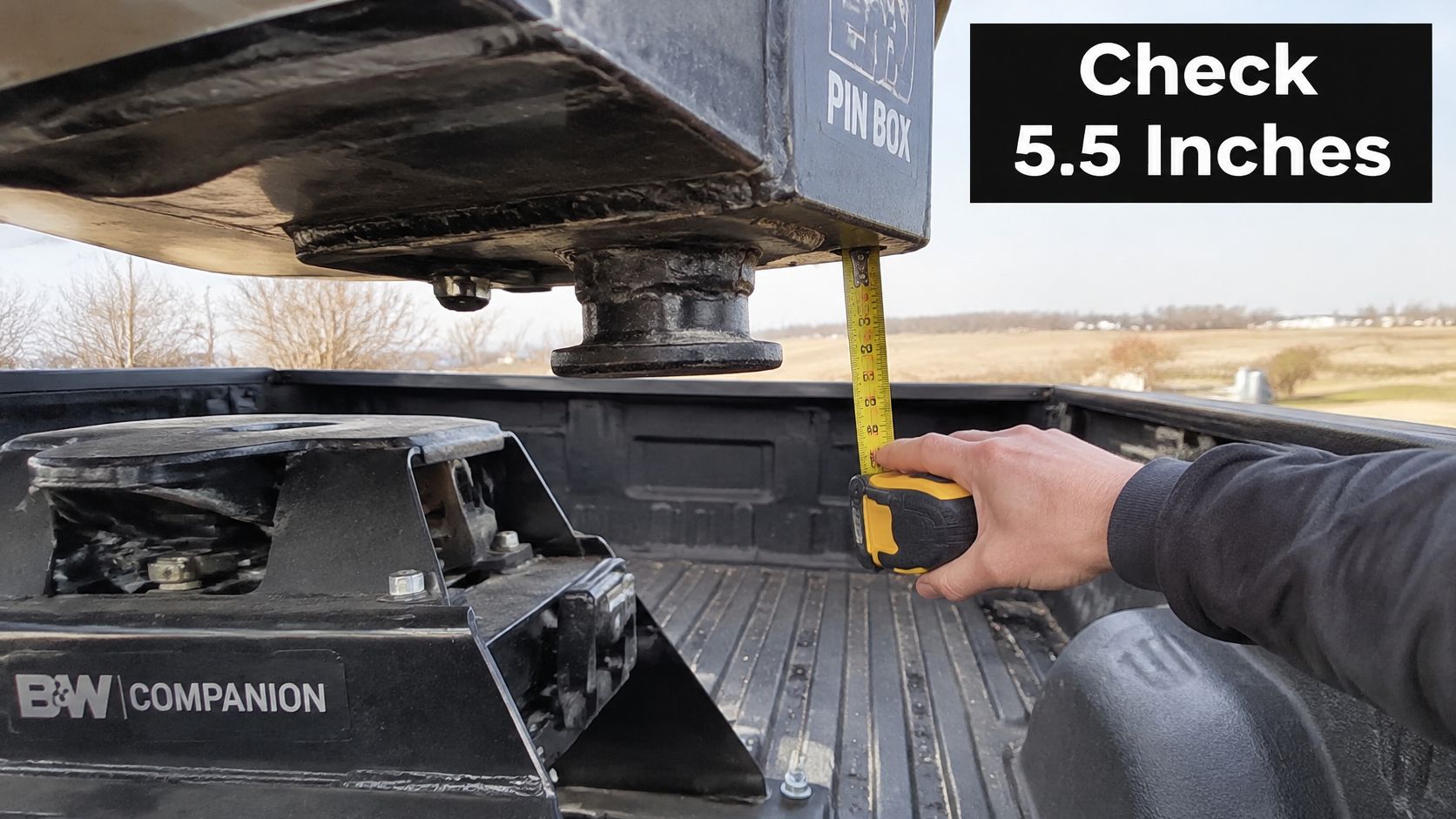
A hitch bolted to factory torque specs can still cause thousands in body damage if the truck and trailer don't have enough room to articulate. Clearance has two dimensions: vertical separation over the truck bed walls and horizontal turning room between the trailer's front cap and your pickup cab.
As detailed in CURT Manufacturing's fifth-wheel bracket guide, installers must verify a minimum height difference of 5.5 inches between the top of the truck bed walls and the underside of the trailer overhang. Technicians also check hitch placement over the axle, clean kingpin engagement, and cab clearance through sharp turns before signing off on the rig.
Measuring that vertical gap before adjusting hitch legs or buying brackets saves you from crushing a bed rail on your first uneven driveway.
Short-Bed Pickups on Utah Campgrounds and Grades
Horizontal cab clearance is where sliding hitches earn their higher price tag and longer install time. On a short-bed pickup, the rear axle sits close to the back of the cab, leaving tight margins when you jackknife the trailer at low speeds. A manual slider lets you pull a lever to shift the hitch rearward before maneuvering, while an automatic slider tracks the turn without you stepping out of the cab.
Say you're backing a mid-size fifth wheel into a narrow, tree-lined pad along Bear Lake, or making a tight switchback turnaround off a mountain grade near Jordanelle. Those steep angles and tight turns are exactly where a fixed hitch on a short bed puts a trailer corner through the rear cab window. Still, don't buy a sliding hitch automatically just because you drive a short bed. Contoured front caps and extended pin boxes sometimes allow a fixed hitch to clear safely, and Motor Sportsland publishes towing guides to help truck owners check weight ratings and setup requirements before spending extra money on moving hardware.
Watch how a sliding mechanism shifts the trailer pivot point during tight backing maneuvers so you can judge whether your bed length needs that extra travel.
Before committing to a sliding unit, hand your installer six exact specs: your pickup's year, make, model, bed length, factory-puck status, and your exact trailer model. Real measurements against the actual trailer beat generic rules of thumb every time.
When DIY Installation Saves Money and When It Does Not
Bolting in your own hitch sounds like an obvious way to trim the budget. When complete professionally installed setups can reach $2,700 or more depending on equipment and complexity, as outlined in RV Upgrade Store's installation cost breakdown, plenty of handy truck owners figure they can order a kit online and save the labor bill in a weekend.
That quick spreadsheet math leaves out the safety-critical checks that don't bend for a home garage. Federal regulations summarized in that same guide require every fifth-wheel assembly to be structurally adequate, securely mounted, protected against shifting, and equipped with a locking mechanism that prevents separation without deliberate manual release. Hitting that bar yourself requires vehicle-specific mounting instructions, a lifting plan for heavy steel components, a calibrated high-capacity torque wrench, and the confidence to verify frame attachment, kingpin lockup, wiring circuits, and loaded weight distribution.
Where Self-Installation Makes Sense and Where It Backfires
Instead of asking whether DIY is cheaper on paper, ask where self-installation stops being economical. The answer comes down to what sits beneath your bed floor:
- Clean factory puck setups: If your pickup came with OEM puck mounts and an in-bed seven-way plug already wired at the factory, assembling a drop-in hitch head and verifying lock handles in your driveway is straightforward and carries low risk.
- Frame brackets and bed drilling: The moment a job demands measuring over-axle centers, drilling through painted sheet metal, fishing bolts past brake lines or exhaust shields, and running new trailer wiring, a small alignment mistake turns into hours of rework.
- Used pickups with unknown history: Pre-owned work trucks frequently hide wallowed-out drill holes, rusted bolts, bent bed ribs, or mismatched universal rails. Paying a technician to inspect the frame before bolting on a heavy trailer prevents catastrophic hardware failure on the highway.
Utah winters add one more layer that national DIY guides rarely mention. Road salt along I-15 and canyon highways speeds up corrosion on under-bed frame brackets, Grade 8 fasteners, and seven-way wiring splices. Whether you install the hitch yourself or use a shop, crawl underneath every spring after winter driving to inspect for rust scale and verify that every frame bolt holds factory torque.
The DIY tipping point: Once an installation calls for drilling the truck bed, fitting chassis brackets, or wiring a new seven-way plug, the labor dollars you save are usually smaller than the cost of correcting a misaligned rail or chasing a brake circuit fault.
Building an Itemized Quote Before You Book
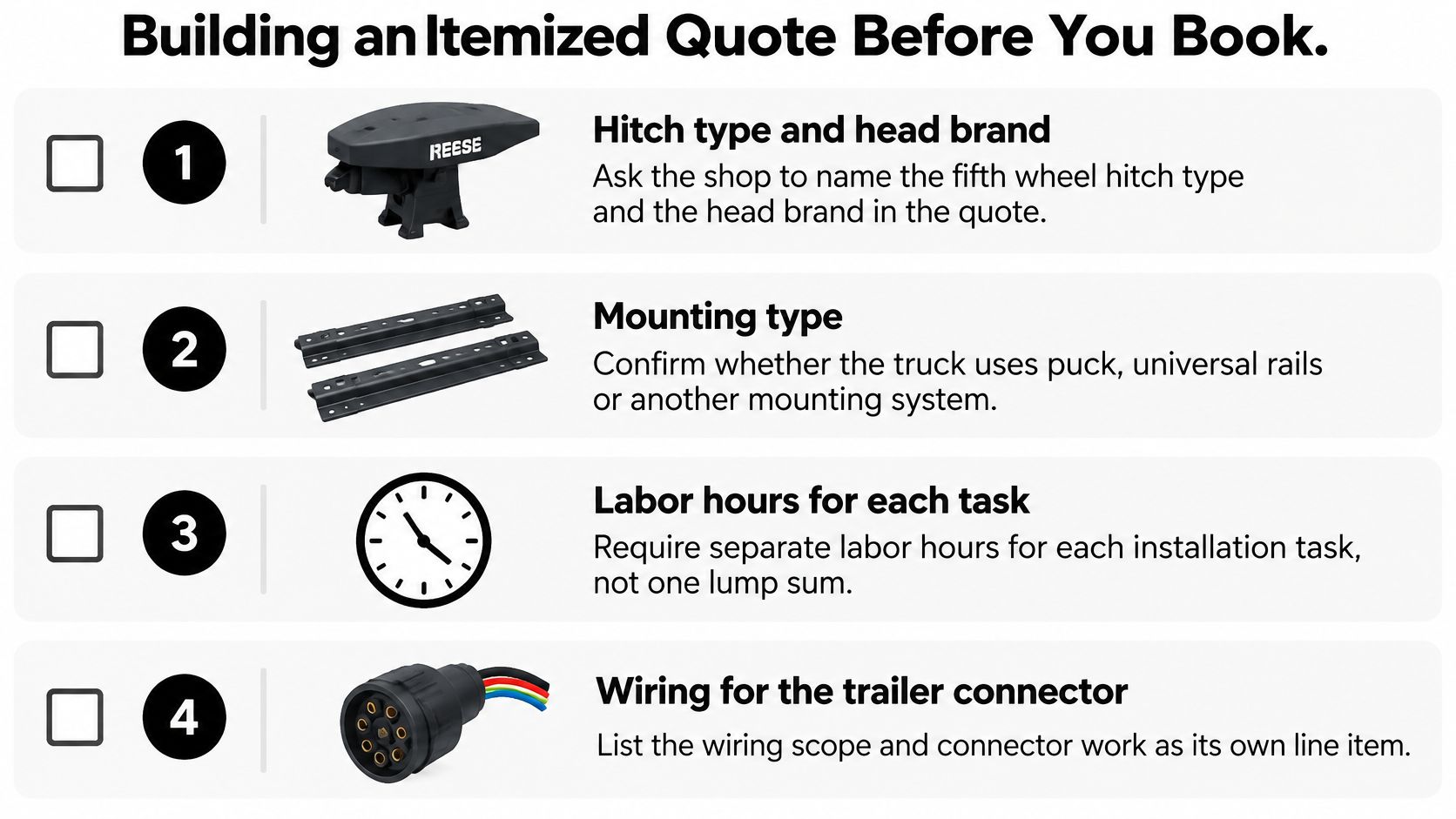
A single handwritten number on a business card tells you almost nothing about what you're buying. Requesting a full itemized quote forces every shop to show its work, prevents surprise shop supplies or adapter fees at pickup, and lets you compare two service departments on equal terms.
Use this checklist when emailing or calling shops so every estimate covers the same scope from top to bottom.
Ten Line Items to Request on Every Estimate
- Hitch type and head brand: Have the advisor list whether the quote covers a fixed or sliding unit along with the exact manufacturer and weight rating.
- Mounting system: Confirm in writing whether your truck is being fitted for OEM pucks, universal above-bed rails, or a custom under-bed rail kit.
- Labor hours by task: Separate hours for hitch assembly, bracket mounting, and electrical work keep padded flat-rate totals off your bill.
- Seven-way wiring and brake controller work: List the in-bed connector and any cab brake controller installation as distinct lines so you don't show up on pick-up day without trailer brakes.
- Frame brackets and conversion adapters: Vehicle-specific chassis brackets and puck adapters should appear with exact part numbers.
- Alignment and torque verification: Ask the shop to confirm that over-axle placement and manufacturer fastener torque checks are included in the base labor.
- Kingpin engagement test: A thorough shop tests jaw closure and safety-lock operation before releasing the truck.
- Parts and labor split: Separating hardware pricing from technician time shows immediately whether a higher quote reflects upgraded parts or steeper shop rates.
- Posted hourly rate: Knowing the shop's hourly labor rate upfront protects you if rusted bolts or prior aftermarket brackets require extra time.
- Installation warranty: Confirm in writing how long the service department covers its mounting workmanship and wiring connections.
What to Bring So the Quote Holds Up
Even the best service writer can only guess without full specs. Bring six details to the counter: your truck's year, make, model, bed length, factory puck status, and the exact trailer model you plan to haul. Your trailer's dry weight, gross vehicle weight rating, and front-cap profile dictate both the hitch capacity and the height setting needed for level towing.
Because Motor Sportsland sells travel trailers, fifth wheels, fifth wheel toy haulers, travel trailer toy haulers, popup trailers, and destination trailers, buyers who are still choosing a floorplan can match the truck, hitch, and trailer in one visit. Our Service Center handles fifth wheel hitch installations alongside trailer setup, and we don't charge for Prep, Detail, Orientation, Destination, or freight on our RVs. Wherever you choose to book, insist on labor hours in writing and compare at least two itemized estimates before handing over your keys.
Set Your Installation Budget Before You Buy
Lock in your fifth wheel hitch installation cost before you sign for a trailer, because the hardware already built into your truck bed determines whether your setup stays budget-friendly or requires heavier brackets, wiring, and cab-clearance upgrades. A pickup with factory puck mounts keeps shop time brief and totals near the bottom of the scale, while above-bed rail systems, sliding mechanisms, in-bed seven-way sockets, and regional labor rates push the bill upward.
Work through four steps in order before ordering parts or scheduling bay time:
- Confirm your mounting interface: Lift the bed liner and check underneath the frame so you know whether you have OEM pucks, universal rails, or a bare bed floor.
- Measure bed length and trailer clearance: Check vertical bed-wall separation and cab-to-overhang turning room against your specific fifth wheel before deciding between a fixed or sliding hitch.
- Gather two itemized estimates: Ask each shop for separate parts, wiring, bracket, and labor-hour line items using the ten-point checklist.
- Benchmark every line: Stack each quote against the setup and add-on tables in this guide so extra adapters or electrical charges don't catch you off guard.
Bring your pickup details and written quote questions to our team at the Millcreek or Spanish Fork location, or reach out to our Service Center before your next trip. Matching the right hitch to your truck upfront makes pulling up Wasatch grades and backing into tight Utah campsites calm, predictable, and safe season after season.
Ready to pair your pickup with the right fifth wheel, fifth wheel toy hauler, and professionally installed hitch setup? Our Service Center team in Millcreek and Spanish Fork can build a transparent, itemized hitch installation quote while you compare new and used RVs stocked for mountain travel across Utah. Explore current inventory, towing guides, and service scheduling online at Motor Sportsland.
