
Tow Rating Guide: Payload and Tongue Weight Explained

The trailer brochure says 5,900 pounds dry. The door sticker on your truck says 9,200 pounds of tow rating. The gap looks comfortable, so you start picking bunkhouse floorplans and planning a June weekend at Jordanelle. Then you load four people, a full fresh water tank, two propane bottles, a cooler, and a pair of bikes, and that comfortable gap is gone.
The advertised tow rating is the last number to check, not the first. What decides whether a rig is safe is payload and tongue weight, the two figures most comparison pages skip because they don't fit neatly in a headline. Buyers routinely fall for a floorplan first and then work backwards to a truck that can't legally carry it, and that conversation is always harder than starting with the numbers.
This tow rating guide walks the six limits that all have to pass at once, how to calculate your real payload with a scale instead of a brochure, what tongue weight should look like fully loaded, and where Utah terrain eats into the margin you thought you had. Motor Sportsland has helped Utah families match trucks to trailers for more than 55 years, and every one of those conversations starts in the same place: the driver door jamb.
The Six Tow Limits and Where to Find Each
A couple finds a bunkhouse travel trailer whose dry weight sits well under the truck's tow number and assumes the match is settled. It isn't. A tow rating is one of six separate limits, and the trailer has to pass all six at the same time, fully loaded, with the whole family aboard.
Here's the reference sheet I'd hand any shopper before they compare a single floorplan.
| Limit | What it measures | Where to find it |
|---|---|---|
| Maximum trailer weight (tow rating) | Heaviest trailer the vehicle may tow under its rating | Owner's manual or tow rating chart |
| GVWR | Maximum loaded weight of the tow vehicle itself | Certification label on the driver door jamb |
| Rear GAWR | Maximum load the rear axle may carry | Certification label on the driver door jamb |
| GCWR | Maximum combined weight of the tow vehicle plus loaded trailer | Owner's manual or manufacturer specifications |
| Payload | Weight the vehicle can carry, including passengers, cargo and tongue weight | Door sticker, or GVWR minus ready-to-travel weight |
| Hitch and tongue-weight rating | Maximum tongue weight the hitch and trailer allow | Hitch label and trailer spec sheet |
Where tongue weight lands in the math
Tongue weight never disappears because it's carried at the hitch. It becomes part of the tow vehicle's load, stacked on top of passengers, cargo, accessories and hitch hardware, as NHTSA's guidance on tongue weight and axle ratings makes clear. The agency advises owners to get the trailer manufacturer's fully loaded tongue-weight figure and compare it with the axle ratings printed on the certification label on the door or door post, and it warns directly that overloading a truck-trailer combination creates safety hazards.
That single fact breaks more truck-and-trailer matches than any other. A vehicle can sit comfortably under its maximum trailer rating and still be over on payload or over on the rear axle.
The practical rule: a rig is legal and safe only when it clears the lowest of every limit involved, not the average.
NHTSA's trailer loading materials go further, stating that operators must not exceed the hitch tow rating, the tongue-weight rating or the overall towing capacity, and that the loaded combination must stay inside GVWR, rear GAWR and GCWR. The same document notes that overloading can damage the suspension, engine and drivetrain, not just handling.
A real example of why dry weight misleads: our 2026 Keystone Walkabout 22MAX lists a dry weight of 6,365 pounds against a GVWR of 8,600 pounds. That's more than a ton of capacity between the brochure number and the number that counts.
Before you shop, pull all six figures off the truck and the trailer and write them on one page. Then browse our current travel trailer inventory with that page in hand, not after.
Why a Tow Rating Depends on Its Test Conditions
You pull into a Utah canyon under the brochure tow number, and the transmission temperature still climbs on a long grade. That figure was earned on a defined test, with defined equipment, not on the truck in your driveway.
A tow rating works like a fuel-economy number. The lab cycle rarely matches the commute, and a trailer-weight rating only holds under the equipment and performance conditions used to set it.
The method behind most modern ratings is SAE J2807, a standardized engineering method for determining a vehicle's trailer-weight rating (TWR) and gross combination weight rating (GCWR). SAE first issued the recommended practice in April 2008 so ratings would rest on minimum performance criteria rather than manufacturer judgment alone, and the current edition was published November 21, 2024, covering vehicles up to 14,000 pounds GVWR, according to the SAE J2807 standard.
I check the advertised tow rating last. Payload left after people and gear, and tongue weight on the hitch, usually decide whether the rig is safe. The test assumed a specific build, which may not be the truck on the lot.
Manufacturers may publish separate maximums for braked and unbraked trailers, and the permitted weight for a braked trailer is often higher. Check the owner's manual for both. The rating often assumes a factory tow package and only the extra equipment the manufacturer and the test procedure permit. A taller axle ratio or four-wheel drive changes what the truck can pull. Transmission and engine coolers are part of the tested configuration. A weight-distributing hitch is sometimes required to reach the published number.
The rating can also vary by model year and equipment package. The footnote beside the tow chart matters as much as the chart. Read it, confirm which equipment the number assumes, and write that condition next to the number before you compare a single trailer.
How to Calculate Real Payload Before You Shop
Payload is the room left for tongue weight once people and gear are aboard, and it's the limit most half-ton owners hit first without realizing it. The sticker number is a starting point, not an answer. Here's the order I'd work in.
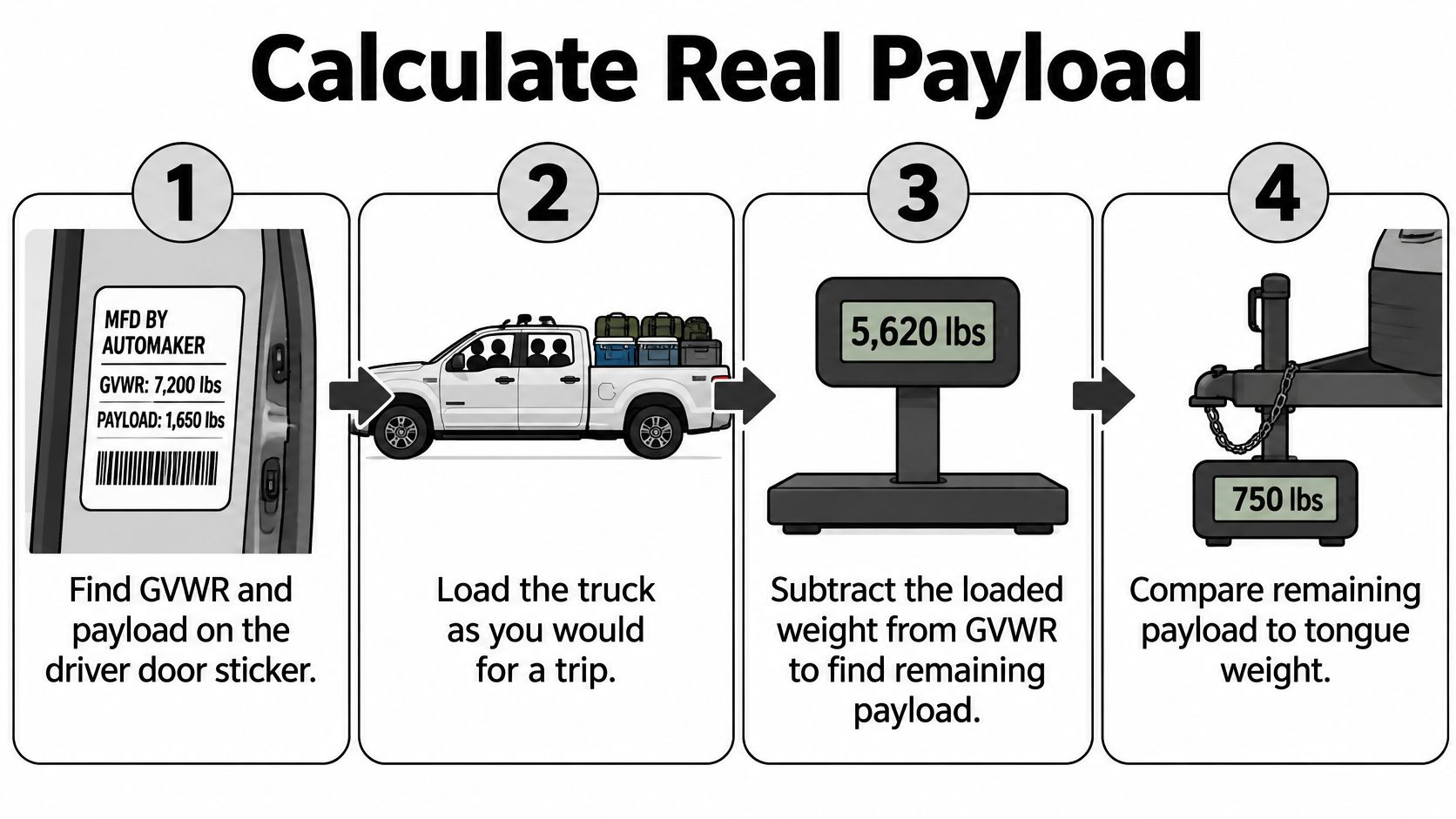
- Read GVWR and payload off the driver door sticker. That payload figure belongs to your specific truck as it left the factory, so a bed liner, a heavier bumper or a set of oversized tires has already come out of it.
- Load the truck the way you travel. Full fuel, every passenger, the hitch head, the weight-distribution bars, the cooler in the back seat. Then weigh it at a certified public scale to get a real ready-to-travel weight.
- Subtract that weight from GVWR. What's left is your true payload allowance, and it's often several hundred pounds below the sticker. NHTSA's payload guidance frames it the same way, with available payload as GVWR minus actual ready-to-travel vehicle weight.
- Take out the people and cargo. A family of four at about 160 pounds each consumes 640 pounds before a single bag is packed.
- Subtract estimated tongue weight. A 7,000-pound loaded trailer at 12 percent puts 840 pounds on the ball.
- Check GCWR last. Add the weighed truck to the loaded trailer and compare that total with the combined rating.
A worked example with real margins
Take illustrative figures: a truck with a 9,000-pound GVWR that weighs 7,400 pounds loaded for a trip. That leaves 1,600 pounds of payload. Subtract 640 pounds of people and you have 960. Subtract 840 pounds of tongue weight and you're down to 120 pounds.
That's not a margin. That's a Bear Lake weekend with coolers, bikes and a full water tank blowing straight through the number before you leave the driveway.
Run this with your own figures before you compare floorplans, and if you're shopping a half-ton, start with our guide to half-ton towable travel trailers to see what fits inside that remainder.
Tongue Weight Targets and How Loading Changes Them
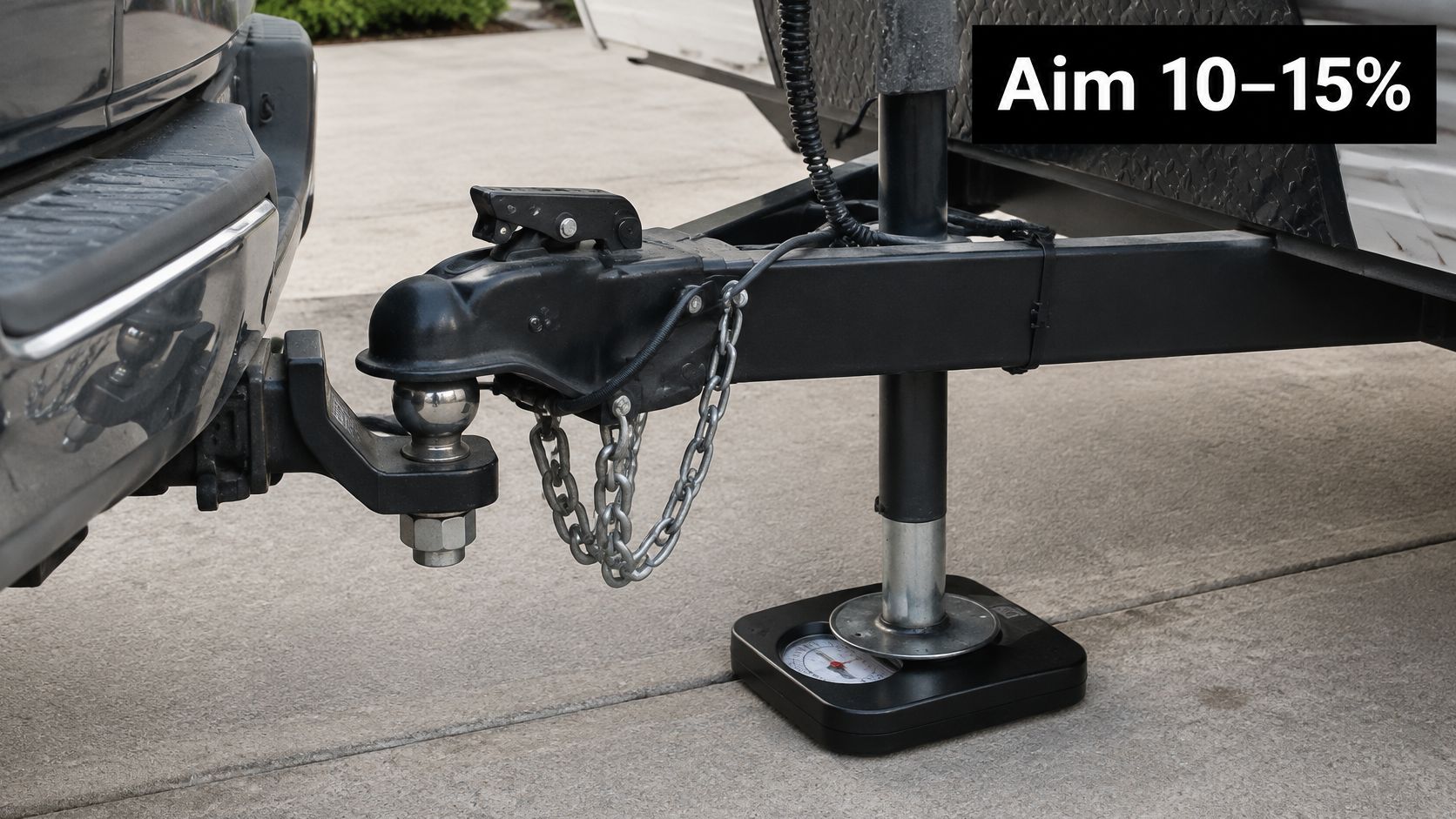
Conventional trailer tongue weight commonly lands at roughly 10 to 15 percent of total loaded trailer weight. GM's 2026 towing supplement gives that range explicitly and warns never to exceed the vehicle, hitch or trailer ratings, per GM's trailer towing supplement.
Ten percent is a loaded trailer target. It isn't a substitute for checking the hitch, the rear axle, GVWR or the trailer manufacturer's own limits.
| Loaded trailer weight | 10% tongue weight | 15% tongue weight |
|---|---|---|
| 5,000 lb | 500 lb | 750 lb |
| 7,500 lb | 750 lb | 1,125 lb |
| 10,000 lb | 1,000 lb | 1,500 lb |
Why both ends of the range matter
Too much tongue weight impairs braking and handling. Too little reduces stability and invites sway. NHTSA's material describes exactly that mechanism and advises positioning heavy cargo over the trailer axle or axles while preserving enough load on the hitch for control.
That balance point shifts constantly. A toy hauler with two dirt bikes in the rear garage moves weight rearward and unloads the tongue. A family trailer with a full fresh water tank and two full propane bottles gains weight forward of the axles between the driveway and the campground. Fuel, tools and a generator in the truck bed don't help either, because every one of those pounds comes out of payload before the tongue load gets counted.
More tongue weight is not automatically safer. Stability needs a controlled range, and the rear axle has to survive the load you put on it.
Verification takes three habits. Weigh the trailer loaded for departure, not empty. Measure tongue weight with a tongue scale or a certified scale and a little arithmetic. Recheck after you move cargo, especially after the first trip teaches you what you use. Our walkthrough on how to measure tongue weight covers the scale setup step by step.
Travel Trailers, Fifth Wheels and Toy Haulers Compared
Every RV type pushes a different limit hardest. Comparing floorplans before you know which limit your rig stresses most is how buyers end up with a beautiful trailer and a truck that can't carry it safely.
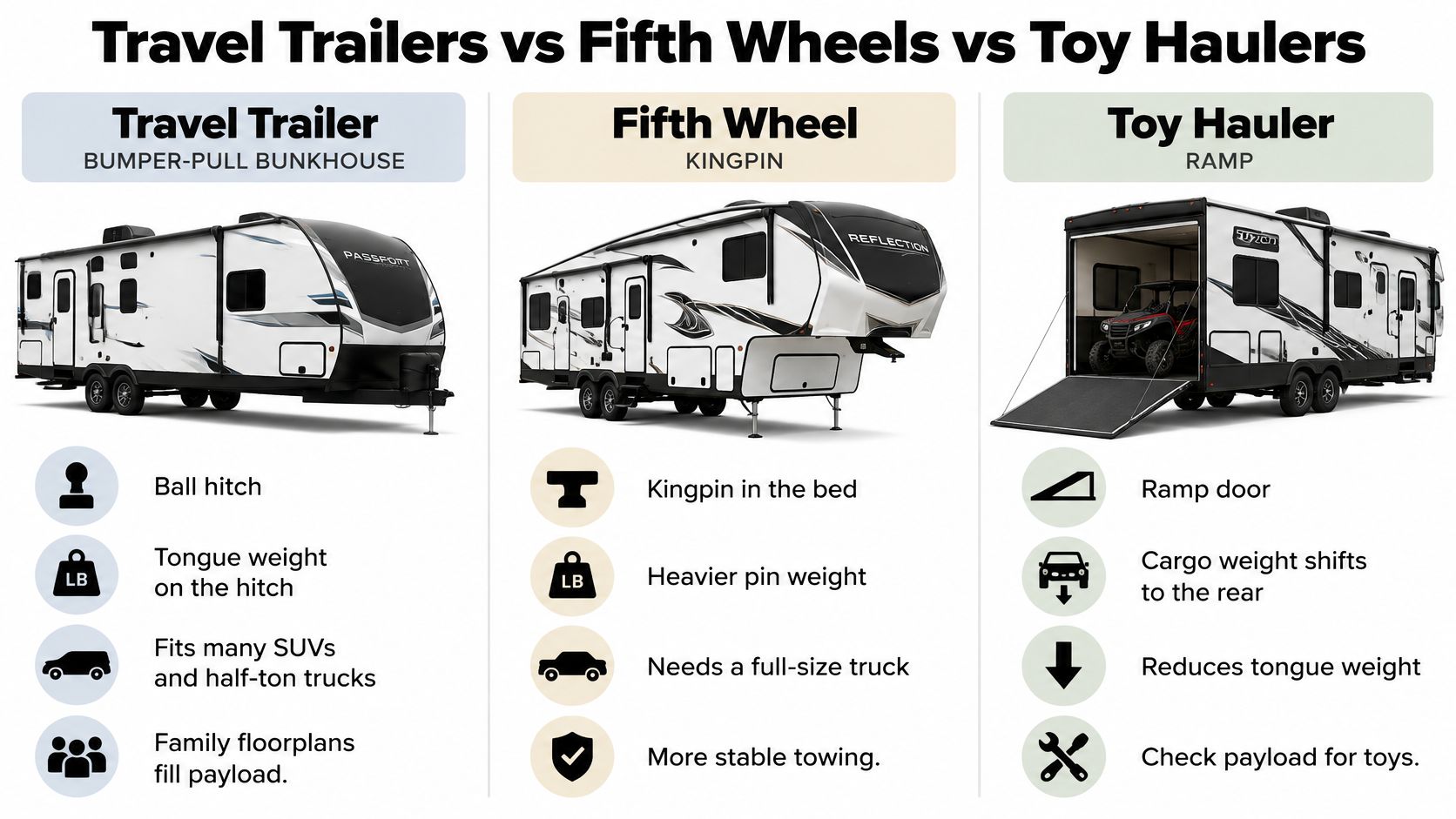
Bumper-pull travel trailers put their tongue weight on a ball hitch, which is why they pair with so many SUVs and half-ton trucks. A 26-foot bunkhouse with a slide-out and a decent pantry is a realistic half-ton trailer, right up until the family of four, the propane and the camping gear finish with the payload.
Fifth wheels carry their pin weight in the truck bed, usually a larger share of the trailer's weight than a bumper pull, so they want a pickup with a prepared bed and a payload that absorbs the pin load without complaint.
| RV type | Limit it stresses most | What to add to the math |
|---|---|---|
| Bumper-pull travel trailer | Payload | Ball-hitch tongue weight plus family load |
| Fifth wheel | Rear GAWR and payload | Pin weight over the truck bed |
| Toy hauler | Payload and tongue weight | Motorcycles, ATVs and side-by-sides in the rear garage |
| Motorhome towing a dinghy | GCWR | Towed car weight counts against the combined limit |
Toy haulers deserve their own warning. A 25-foot toy hauler loaded with two dirt bikes, a generator and water needs its tongue weight checked before anyone adds luggage, because a few hundred pounds moving around in the garage changes how the rig tracks at 65 mph.
Motorhomes towing a car bring a different figure into play. The motorhome's own GCWR governs, and the towed car's weight counts against it. NHTSA's towing limit guidance is blunt about the consequence: exceeding any one of GVWR, rear GAWR or GCWR creates a mismatch even when the trailer looks fine on paper, and overloading affects handling, durability and fuel economy.
Here's how that comparison looks in practice when a family is choosing between a bunkhouse and a toy hauler.
Mountain Grades, Altitude and Utah Weather
A trailer that felt settled in a flat driveway can run hot climbing I-80 through Parleys Canyon, then dump that same momentum into the brakes on the way down. US-6 over Soldier Summit asks the same thing of engine and brakes, and it asks more than most out-of-state miles ever will.
The advertised tow rating is the last number I check on a grade, not the first. Payload and tongue weight already decided whether the truck had spare capacity. A climb spends what is left: engine and transmission temperature rise with the load, and the descent puts the rig's weight into the brakes. Drop a gear and let engine braking do the work. Riding the pedal until it fades is how a thin margin turns into a long, hot stop.
Altitude stacks another penalty on the same load. Jordanelle State Park and Bear Lake sit higher than the Salt Lake valley, so the engine makes less of the power the brochure assumed. A summer campout at the Great Salt Lake can load the air conditioner and the battery together in real heat. Read the owner's manual for the maker's notes on grades and high-altitude operation. Many publish cautions for both.
Where margins disappear: long descents, sustained heat, a headwind on the return leg, and a water tank filled at the last stop. Any two of those together will find a rig that was already at its limit.
Winter changes the picture again. Cold cuts battery capacity, trailer brakes and tire condition matter more, and a rig loaded in the fall often leaves months later with a different cargo list than the one you weighed. Towing a camping trailer through that swing in weather is a weight problem first.
A set of Ford truck bedside 4x4 decals changes how the truck looks and nothing about how it stops. Keep a clear margin under GVWR, GCWR and the rear GAWR so grades and weather never push you past a limit, and have brakes, wheel bearings and the cooling system checked before the first big climb of the year. Motor Sportsland's service department handles maintenance checks and repairs.
Common Tow Limit Mistakes and Your Next Step
A shopper stops at the brochure tow rating and treats it as permission to buy. I check payload and tongue weight first. The advertised rating is the last number on the sheet, and it only matters after those two still have room.
These are the mistakes that cause the most trouble, each with a fix that holds up on a scale.
- Shopping from brochure dry weight. Weigh the loaded trailer as it will leave the driveway, water and propane included.
- Leaving out water, batteries and accessories. Add each one to trailer weight before you compare anything. A full fresh tank is a real number, not a rounding error.
- Treating the maximum trailer rating as the target. Check payload and GCWR first, then see how much trailer still fits inside them.
- Assuming a tow package adds room. Confirm which equipment the rating assumes, including trailer brakes and any weight-distribution hitch.
- Skipping the recheck after changing cargo. Reweigh after every major change, especially the first trip with a new toy in the garage.
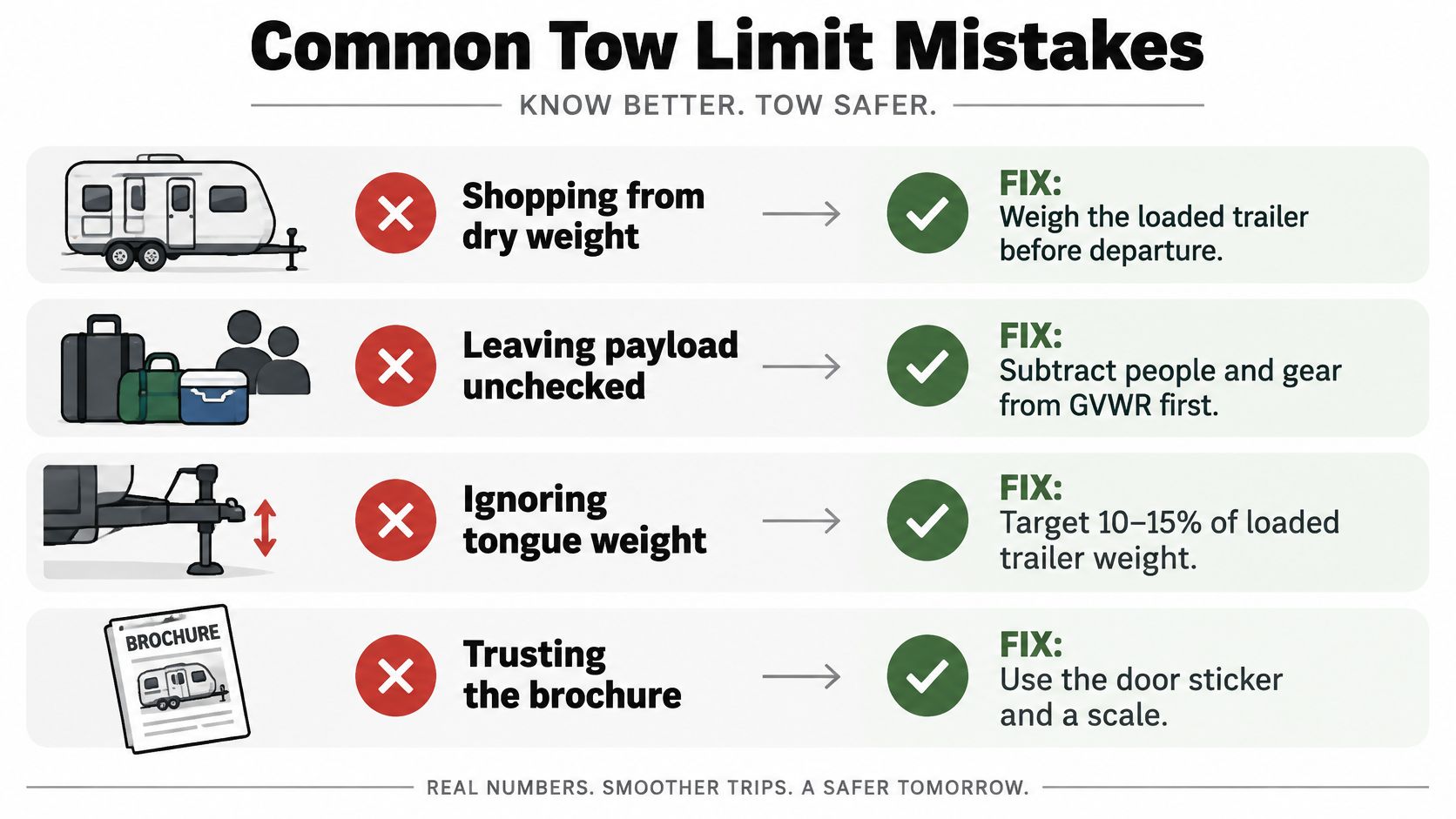
These errors persist because disclosure is uneven. NHTSA's interpretation on towing capability disclosure notes that manufacturers aren't required to establish or disclose towing capabilities in a uniform way, and that adding a trailer can reduce a vehicle's available load-carrying capacity rather than using the hitch's stated tongue-weight limit. When the rules vary that much, the door sticker and a scale are the references that stay honest.
Your next step at the showroom
Bring four things to our Millcreek or Spanish Fork locations: the six numbers off the door label and the owner's manual, your weighed payload result, the tongue weight you measured, and the floorplan you want. Staff can walk the limits for your specific trip and show you around any trailer on the lot while those figures are still in front of you. Motor Sportsland publishes towing guides so the math gets checked before the paperwork does.
If the truck needs a hitch, a seven-pin connector, or a brake controller first, the service department handles maintenance checks, repairs, installations, plumbing, and electrical work. Booking is simple. Describe the RV, pick the services you need, choose a time, and the service team confirms the appointment.
Motor Sportsland has spent more than 55 years helping Utah families match trucks to trailers. Stop by Motor Sportsland in Millcreek or Spanish Fork with your door-sticker numbers and your trailer's GVWR. The team will walk the limits with you, show floorplans that fit the truck, and set up hitch, brake, or electrical work before you leave.
Frequently Asked Questions About Tow Ratings
What is the difference between towing capacity and payload?
Towing capacity is the maximum trailer weight the vehicle may pull under its rating. Payload is what the vehicle itself can carry, including passengers, cargo and tongue weight, and it's usually the limit a family rig reaches first.
How much tongue weight should a travel trailer have?
Aim for roughly 10 to 15 percent of loaded trailer weight, then confirm the hitch, rear axle and GVWR limits. Measure it loaded for departure, not empty.
Does the tow rating include passengers and gear?
No. Passengers and gear count against payload and GCWR, which is why the rating alone doesn't tell you what you can safely pull.
Do I need trailer brakes?
Check the owner's manual, since braked and unbraked ratings can differ substantially, and many manufacturers require brakes above a set trailer weight.
Where do I find GVWR and rear GAWR?
On the certification label on the driver door jamb, on the same label that carries your payload figure.
