
RV Breaker Keeps Tripping: Causes and Safe Fixes

The campsite is quiet, the air conditioner has stopped, and the microwave display is dark. You reset a breaker, power returns, and then everything shuts off again just as you settle back into your chair. Whether you're camping near Bear Lake or getting ready to leave Salt Lake City for the Wasatch Mountains, that's a problem worth sorting out before another reset.
When your RV breaker keeps tripping, the most useful question isn't which appliance uses too much power. It's which protective device opened, and when did it happen? A campground breaker, an RV branch breaker, a GFCI outlet, and an electrical monitor don't all respond to the same conditions.
At Motor Sportsland, we recommend starting with observations you can collect safely: the device's label, the hookup type, the appliances running, and any fault message. Those details help separate manageable power demand from a cord, appliance, moisture, or wiring problem. You don't need to remove a panel cover or probe a campground power box to make useful progress. You do need a clear stopping point when the evidence suggests an electrical fault.
Identify Which Device Is Tripping
Start where power disappeared. If the air conditioner stopped but other equipment still works, look for a branch-circuit interruption. If the entire shore-powered system went dead, check the incoming supply and main protection before blaming an individual outlet.
Follow the power path using only accessible switches, labels, and displays. You may find a campground pedestal breaker, an RV main breaker, labeled branch breakers, GFCI outlets, and an electrical monitor. Their physical arrangement differs between RVs. The main breaker may be in an interior distribution panel rather than directly beside the shore-power inlet, and a portable monitor may sit outside at the pedestal.
Breakers and GFCIs protect against different problems
A conventional breaker responds primarily to excessive current, including overloads and short circuits. A GFCI compares current leaving on the hot conductor with current returning on neutral; an imbalance indicates an unintended leakage path, potentially through wet equipment or a person, as DoItYourselfRV's troubleshooting guide explains.
A GFCI can also disconnect downstream receptacles. That means a dead kitchen outlet might trace back to a bathroom GFCI rather than a tripped kitchen breaker.
Protective devices and their first checks
| Device | Where it sits | What it responds to | First check |
|---|---|---|---|
| Campground pedestal breaker | Power box at the campsite | Overload or fault on the whole supply | Ask whether neighboring sites sharing the supply are also off |
| RV main breaker | Interior distribution panel, downstream of the shore-power entry | Total draw and faults affecting the incoming RV supply | Turn off large appliances; consider a single reset only if no warning signs exist |
| RV branch breaker | Load center, labeled by circuit | Overcurrent on that circuit | Unplug loads on the labeled circuit |
| GFCI outlet | Bathroom, kitchen, or exterior receptacle locations | Small current leakage, often involving moisture | Unplug connected equipment before a single reset |
| Electrical monitor | Between shore power and the RV system | Voltage and wiring faults; available protections differ by model | Read and record the fault code |
Practical rule: Record the device's name and position before touching RESET. A photo of an accessible label or display is more useful than remembering that something electrical tripped.
A breaker handle may stop between ON and OFF. Don't force a handle that won't latch, and don't assume an electrical monitor's disconnection means a breaker failed. Read its display and operating instructions first.
Power Limits for 30-Amp and 50-Amp Hookups
Say you're using a 30-amp site near Jordanelle in July. The air conditioner is running, someone starts lunch in the microwave, and the electric water heater is still switched on. That combination can exceed the hookup's capacity even though every appliance works properly by itself.
Use the hookup configuration, not the size of the RV, to establish your available power.
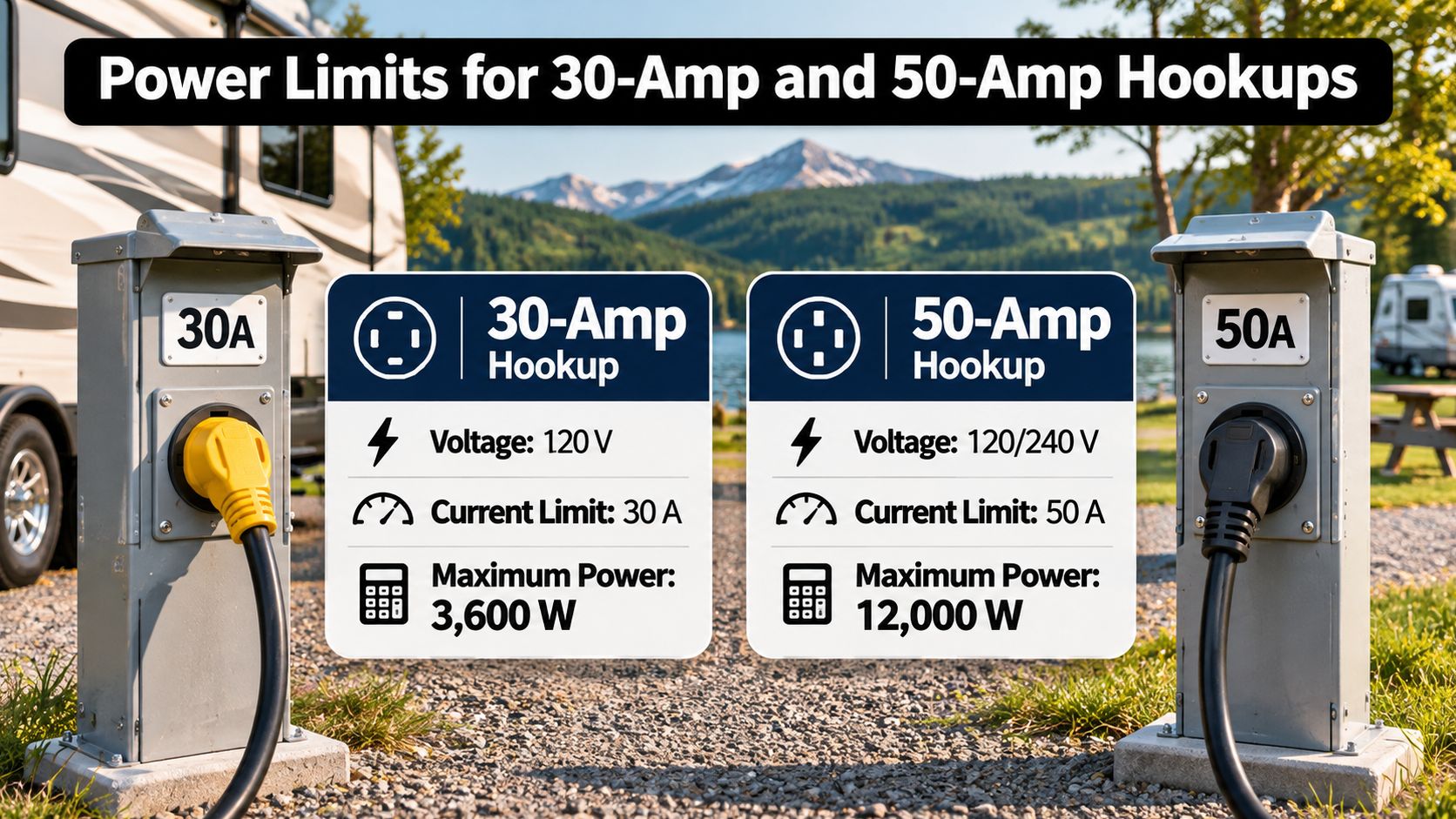
A 30-amp TT-30 connection has a three-prong plug with one 120-volt hot conductor, neutral, and ground, while a 50-amp connection has four prongs with two hot legs, neutral, and ground, according to Great American RV's electrical-system guide. Multiplying voltage by available current gives the approximate capacities below; those are supply calculations, not permission to operate every appliance simultaneously.
Hookup types and approximate capacity
| Service | Hot legs | Approximate capacity | Typical trip trigger |
|---|---|---|---|
| 30-amp TT-30 | One 120-volt leg | About 3,600 W total | Air conditioner plus microwave or electric water heater |
| 50-amp four-prong | Two 120-volt legs | About 12,000 W total when both legs are available | An overloaded branch circuit; a loose inlet is a separate connection hazard |
| 50-to-30-amp adapter on a 50-amp rig | One incoming 120-volt leg through the adapter | Limited to the 30-amp supply | Routine appliance combinations exceeding the reduced supply |
An adapter changes compatibility, not available power
Connecting a larger-service RV to a smaller supply doesn't preserve its normal operating capacity. Our guide to RV power adapters explains the connection choices, but the practical habit is straightforward: manage loads for the supply you're using.
Turn off the electric water heater while using the microwave if your available capacity requires it. Check appliance labels instead of guessing, and remember equipment that operates automatically, including the refrigerator and converter.
For a visual explanation of RV electrical hookups, use this video alongside your RV's documentation.
More incoming capacity doesn't increase the rating of an individual outlet circuit. A space heater and another high-demand appliance can still overload a shared branch circuit in a larger-service RV.
How to Isolate the Fault Step by Step
Only attempt owner-level checks when the cord, inlet, and outlets show no heat damage, burning smell, unusual noise, or visible deterioration. Stay with normal controls and accessible plugs. Don't remove electrical covers or work on exposed conductors.
The Illinois Department of Public Health's electrical-safety guidance says a campsite GFCI that trips when an RV is connected warrants suspicion of the RV wiring or power cord. It identifies moisture, damaged conductors, loose or open wires, and unintended neutral-to-ground connections as issues requiring attention.
Separate connected equipment from the electrical system
Record the starting conditions. Note the device that opened, the time, the campsite, and everything operating. Include equipment that may have started automatically, because an incomplete load list can send the diagnosis in the wrong direction.
Switch off appliances and unplug portable equipment. Use normal appliance controls and labeled circuit controls where appropriate. Unplugging separates portable loads from the circuit, but switching appliances off doesn't prove all wiring is electrically isolated.
Attempt a single reset if conditions are safe. Follow the device's instructions, with accessible loads disconnected. If it opens again immediately, stop; this isn't a reason to keep trying until it holds.
If it holds, restore loads individually. Test a major load such as the air conditioner by itself, then allow operation to settle before adding another appliance. Respect the air conditioner manufacturer's restart delay rather than rapidly cycling its compressor.
Identify combinations that cause trouble. If equipment works individually but the supply opens when you combine loads, stagger their use. That's a practical solution to excessive combined demand, not a repair for a defective appliance.
Leave a suspect appliance disconnected. A trip associated with a particular appliance narrows the investigation but doesn't prove the appliance alone is defective. Its receptacle, wiring, and supply conditions may also need testing.
Check a suspect GFCI with a known-good lamp only if it resets and no damage is present. Keep other accessible loads unplugged. If it trips again, leave the circuit unused rather than bypassing GFCI protection.
Save the results for diagnosis. Note which tests held and which caused another interruption. Don't repeat a failed test to obtain another photo or confirm what you already observed.
Use this process as an observation checklist, not permission to continue through a recurring fault.
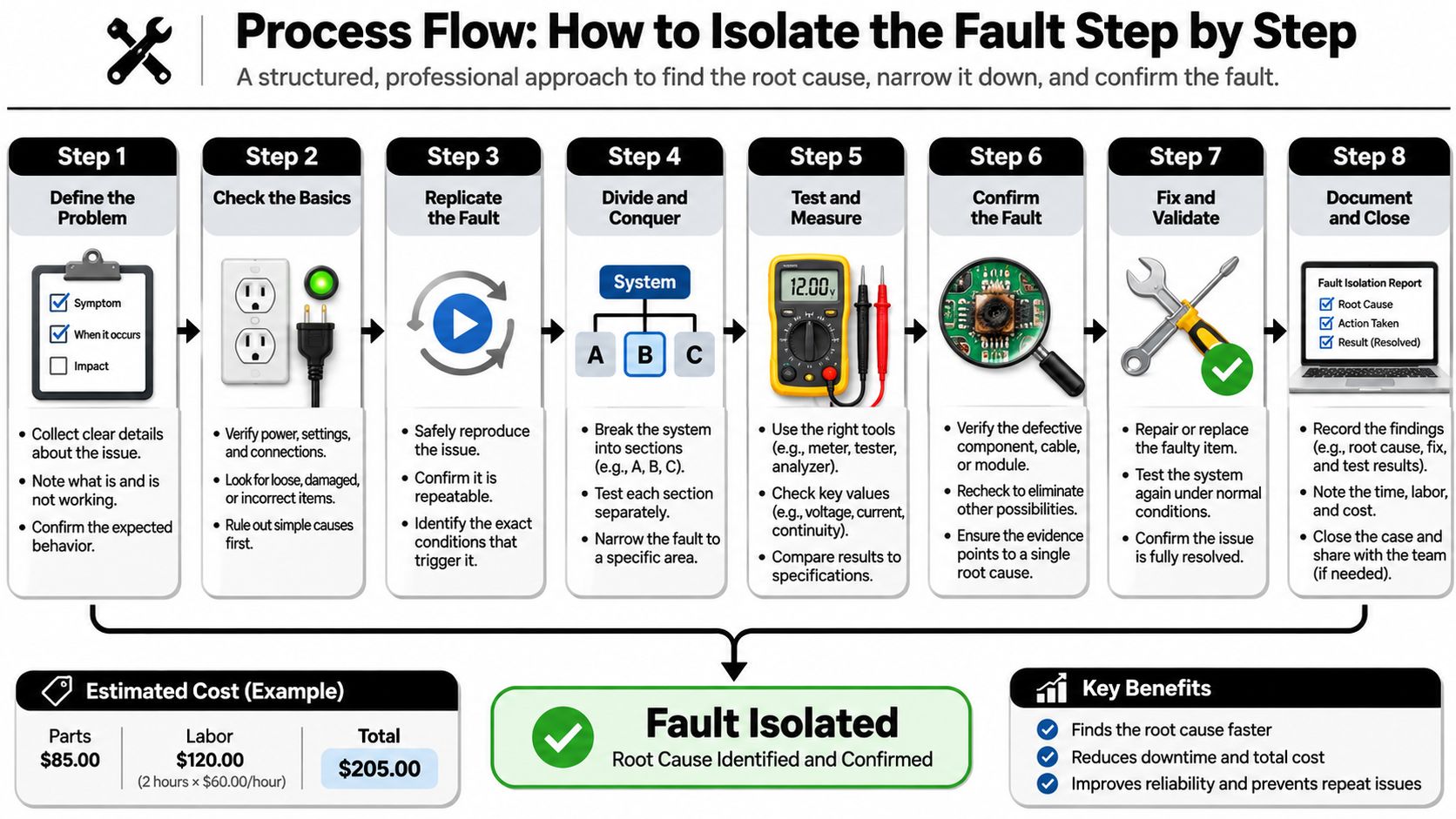
Never open an energized campground pedestal, bypass a protective device, or continue resetting protection that opens with accessible loads disconnected.
If the air conditioner remains powered but stops cooling, that's a different symptom. Our RV air conditioner troubleshooting guide can help you describe that problem without assuming every cooling failure is a breaker issue.
What the Timing of Each Trip Tells You
An immediate trip on connection deserves more caution than an interruption after a busy evening of appliance use. Don't treat those patterns as interchangeable.
An immediate trip is more consistent with a short circuit, ground fault, damaged cord, water intrusion, or faulty connected appliance than a slowly developing overload, according to RV Shield's breaker troubleshooting guidance. A trip after several appliances have operated can instead point toward combined demand or heat buildup, but timing alone doesn't establish a diagnosis.
Trip timing, likely cause and next move
| Trip timing | Likely cause | Next move |
|---|---|---|
| Immediately on plug-in | Cord, inlet, appliance fault, or water intrusion | Stop shore-power use and arrange inspection; visually check only after safe disconnection |
| Only when one appliance starts | Appliance, startup demand, or its circuit | If no warning signs exist, isolate other loads for a single controlled test; stop if it repeats |
| Only when several appliances run | Combined demand above available capacity | Stagger air conditioner, microwave, and electric water heater |
| Only after rain or humid nights | Possible moisture in outlets or cord ends | Disconnect safely; have affected connections dried and checked for corrosion before reuse |
| Same site, same hour each day | Possible campground supply or pedestal issue | Ask campground staff to inspect and arrange a known-good alternative supply |
| Repeats with accessible loads switched off | Wiring, leakage, inlet fault, or an unidentified connected load | Stop resetting and book electrical diagnosis |
A campsite pattern is evidence, not proof
If the interruption happens only at a particular campground, record the pedestal identification and any monitor code. Ask campground staff whether they've identified a supply problem. Moving to another receptacle on the same pedestal may leave you on the same upstream supply, so it isn't a conclusive test.
Rain-related trips also need restraint. Don't dry a plug and immediately reconnect if there's corrosion, cracking, or evidence that water entered the assembly.
For intermittent problems, keep the log simple: time, device, site, weather, hookup, and operating equipment. If a trip follows your RV between locations, that makes inspection of the RV particularly important. If reducing demand doesn't resolve it, stop treating load management as the answer.
Warning Signs of Wiring and Inlet Damage
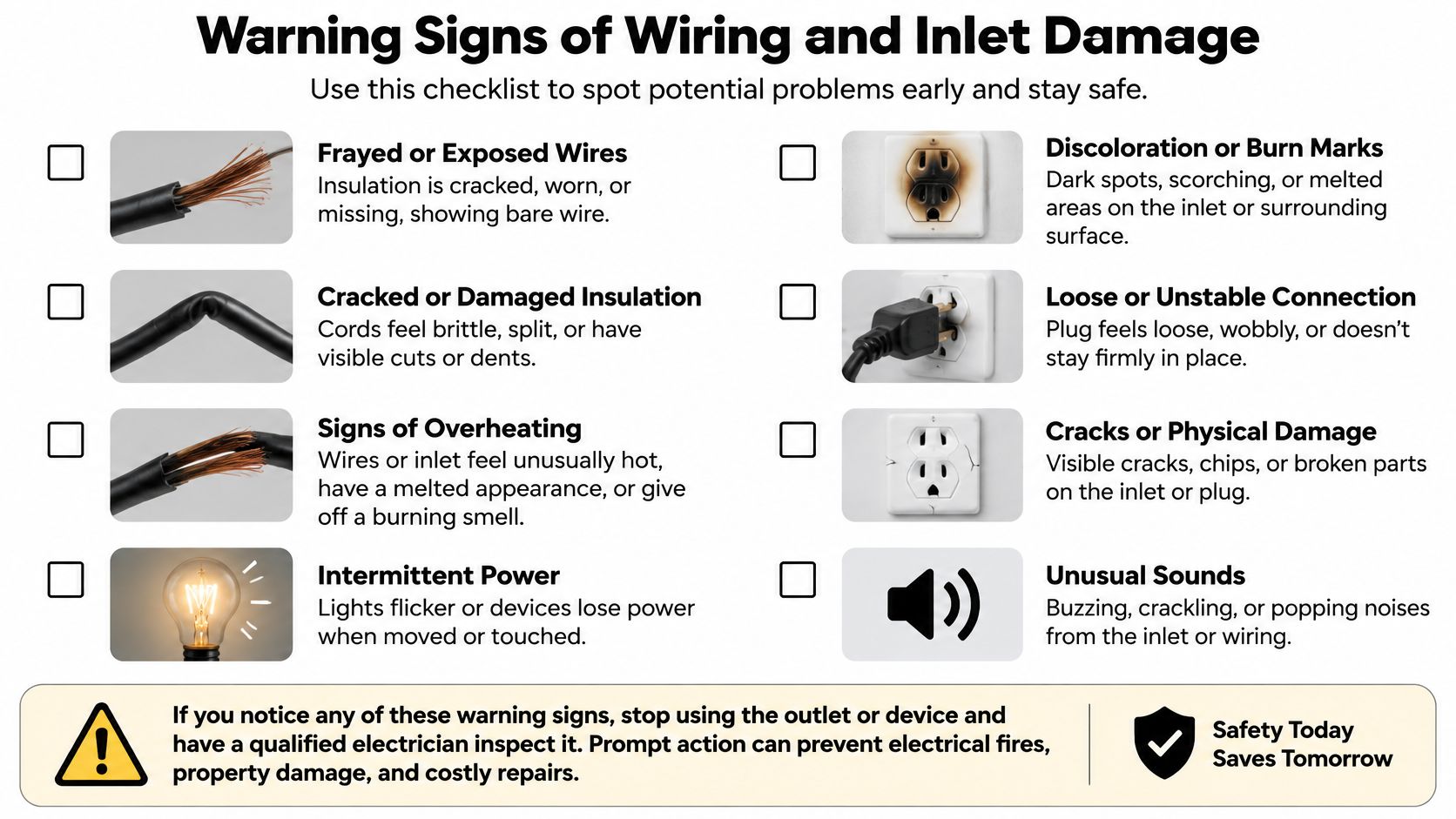
Stop using the shore-power connection when you notice any of these conditions. Don't touch a suspect connection to judge how hot it is, and don't pull apart a plug that's arcing. If there's smoke or active fire, move away and call emergency services.
- Abnormal heat: Heat at the plug, inlet, or cord that suggests a failing connection.
- Discoloration: Browned plastic, scorch marks, melted areas, or darkened terminals.
- Unusual sounds: Buzzing or crackling at an inlet, plug, outlet, or electrical enclosure.
- Burning odor: A hot-plastic or electrical smell.
- Visible damage: Cracked housings, exposed conductors, damaged insulation, or loose-fitting connections.
- Repeated immediate trips: Protection that opens again as soon as power is restored.
Use this checklist when inspecting accessible exterior components with the supply safely disconnected.
Light demand doesn't rule out a serious fault
Small leakage paths from electronics and damp connections can accumulate even when no large appliance is operating. RV Electricity's discussion of GFCI trips describes Class-A GFCI operation at about 5 mA of imbalance and reports 2025 NHTSA recalls involving inconsistently stripped wiring at 30-amp or 50-amp inlets, with arcing and fire risk, and another improperly tightened inlet that could overheat.
That's a reason to investigate the connection, not assume your particular RV is recalled. Ask your RV manufacturer to check your vehicle identification number for applicable recalls, including inlet-related campaigns. Have the inlet's make and identifying information available if requested.
A dry, correctly wired garage supply can help a technician compare operating conditions, especially with suspect appliances disconnected. It's not a justification to move a damaged RV connection indoors and keep testing. Never run an engine or generator inside a garage.
Don't install a larger breaker to stop the trips. A breaker must match the wiring and equipment it protects. Increasing its rating can leave conductors inadequately protected.
For Utah winter storage, inspect for snow, water, and condensation around plug ends before reconnecting. Keep grounding and GFCI protection intact; removing either to make the power stay on is not a repair.
When to Call a Technician Before Your Next Trip
Book a qualified technician when the protection trips with accessible loads off, warning signs appear, the problem follows the RV between campsites, or cord checks don't resolve it. The Illinois public-health safety publication explains that apparently undamaged cords may still require specialized leakage or insulation testing, including megohmmeter testing.
A technician can evaluate the cord, inlet, transfer switch, converter, inverter, and branch circuits without relying on replacement guesses. Bring your trip log, monitor messages, and hookup details. Our Utah RV electrical repair guide provides additional context for planning service.
Our service department provides maintenance checks, repairs, installations, plumbing work, and electrical work. To request an appointment, describe your RV, select the needed service, and choose a time; our team confirms the appointment. Customer Rick reported that Colton listened to his RV issues and fit him into the repair schedule during a road trip. That account doesn't establish an inlet diagnosis or guarantee availability.
Frequently Asked Questions
Why does my RV breaker keep tripping with nothing running?
Automatic or hardwired equipment may still be connected. Wiring faults, leakage, moisture, and connection damage also need consideration, so stop resetting and arrange testing.
Does an air conditioner trip mean the compressor has failed?
No. The appliance, circuit, combined demand, and incoming supply all need consideration before replacing equipment.
Can a GFCI shut off other outlets?
Yes. A GFCI can protect downstream receptacles, so the dead outlet may not contain the reset button.
Should I replace the breaker first?
Not without diagnosis. Replacement won't correct a damaged inlet, excessive demand, or wiring fault, and the replacement must be approved for the panel and circuit.
Motor Sportsland offers electrical diagnosis, repairs, and installations to help resolve recurring shore-power interruptions before your next Utah trip. If your RV breaker keeps tripping, bring your device details, hookup information, and trip log to the appointment. Visit Motor Sportsland to request service and have our team confirm your appointment.
