
RV Financing with Fair Credit: Your 2026 Guide

You're at the finance desk in Salt Lake City, comparing two RVs that look close enough on the lot. One is newer and carries a lower advertised rate. The other is slightly older, costs less to finance, but comes with a higher APR because your credit falls into the fair range. The payment difference looks manageable on the worksheet. The total cost tells a different story.
That's the trap with RV financing with fair credit. Approval may be available, but approval alone doesn't prove the deal is safe. Your credit score affects the rate, while the RV's age, loan-to-value ratio, income, existing debts, down payment, and intended use affect whether the lender is comfortable with the entire application.
We help Utah buyers think beyond “Can I get approved?” The better question is, “What will this RV cost me after interest, insurance, storage, maintenance, and the occasional repair?” The sections below show how to compare offers, prepare your application, and decide whether a newer RV at a lower rate or an older RV with a smaller balance makes more sense for your household.
What Fair Credit Really Means at the RV Lot
At the RV desk, a buyer with a fair score can still present a workable application. Lenders treat fair credit as a pricing tier, and the borrower's full balance sheet decides the rest. LendingTree defines fair credit in its RV financing comparison as a FICO-style score from 640 to 679. Good credit runs from 680 to 719, while excellent credit ranges from 720 to 850 (LendingTree's RV financing comparison).
That fair-credit range covers a meaningful spread of borrowers. Someone near the lower end may receive different pricing from a buyer near the upper end, even though both use the same label. Underwriters also examine income stability, debt-to-income ratio, housing payment, down payment, trade-in equity, requested loan-to-value, RV age, and payment history.
Your score opens the file. The rest of the application shapes the offer.
Why RV lenders look beyond the score
An RV serves as recreational property and secured collateral. The lender must assess your ability to make the payment and the RV's likely value if the loan defaults. Travel trailers, fifth wheels, toy haulers, and motorhomes carry different collateral considerations. An older unit can raise more underwriting questions because condition, marketability, and resale value may be harder to assess.
Two buyers with similar scores can therefore receive different decisions. One may show stable income, modest debts, and a substantial down payment. Another may carry a large housing payment, high revolving balances, or negative equity from a trade-in. The score starts the review, while the balance sheet often determines the final structure.
The practical reframe: Measure the total cost before you celebrate an approval. Compare the amount financed, APR, term, fees, and total of payments, then add insurance, storage, maintenance, and likely repairs to the ownership budget.
A newer RV with a lower rate can still cost more if its balance is substantially higher. An older RV may carry a higher rate while requiring less financing. Put both written offers side by side and compare total payments, not just the monthly figure.
For lower-priced used units, research the purchase market before applying. A resource such as find cheap RV homes can help you distinguish an affordable RV from an expensive loan attached to a unit that stretches your budget.
My recommendation is direct: structure the deal before choosing the RV. Bring documentation for your income and down payment, keep the requested amount reasonable, and compare lenders familiar with RV collateral. A lower balance, cleaner application, and suitable unit can improve the offer as much as a modest score improvement.
How Credit Score Bands Affect Your RV Loan Rate
A fair-credit buyer can get approved and still receive an expensive loan. At an RV dealership, the rate premium often matters more than a modest discount on the unit. As noted earlier, fair-credit APRs generally sit above good-credit pricing, while poor-credit offers can rise further. Excellent credit receives the strongest pricing, but the score band is only the starting point.
Your lender will also price the deal around the RV, loan-to-value ratio, term, income, debt-to-income ratio, payment history, and down payment. Two buyers with the same score can receive different offers because their applications and collateral present different levels of risk.
Compare the pricing relationship
The table below shows how lenders commonly position each credit band. Use the written offer, not the table alone, to calculate the total of payments.
| Credit Score Band | Typical Pricing Position | What to Note |
|---|---|---|
| Excellent, 720 to 850 | Lowest average pricing | A stronger rate can reduce borrowing cost, but compare the full balance and repayment schedule. |
| Good, 680 to 719 | Competitive pricing below fair credit | A small rate advantage may matter over a long term, especially on a higher financed balance. |
| Fair, 640 to 679 | Higher pricing than good or excellent credit | Improve the structure with a reasonable amount financed, solid income documentation, and a suitable down payment. |
| Poor, below 640 | Highest pricing among these bands | Expect the lender to scrutinize collateral, loan-to-value, repayment capacity, and compensating factors. |
A lower rate does not automatically make the newer RV the cheaper choice. Compare a newer unit with a lower APR against an older unit with a higher APR. The newer RV may still cost more overall because you borrow substantially more. The older RV may carry a rate premium but require a smaller balance.
Put every written offer side by side. Compare the amount financed, APR, term, fees, and total of payments. Monthly payment alone can hide a longer term and a much higher borrowing cost.
Negotiate the RV price and shop the financing structure with equal seriousness, because the APR affects every payment. A seller concession changes the balance once. The interest rate influences the cost across the entire loan.
Secured loans versus personal loans
A secured RV loan uses the RV as collateral. An unsecured personal loan gives the lender no claim against the RV, so its pricing, term, fees, and approval standards may differ. Compare both options by APR, amount financed, total payments, repayment term, and prepayment terms. A personal loan is not automatically simpler or cheaper.
Borrowers reviewing credit tiers can also read these insights on fair credit scores and use that background to ask precise questions about the lender's rate sheet. Ask which credit bureau and score the lender used, whether the rate changes with the term or loan-to-value ratio, and what fees are included in the quoted payment.
My recommendation is straightforward: choose the financing structure only after you stress-test the total cost. A lower balance can outweigh a modest rate improvement, and the cheapest monthly payment may be the most expensive offer overall.
What to Prepare Before You Apply
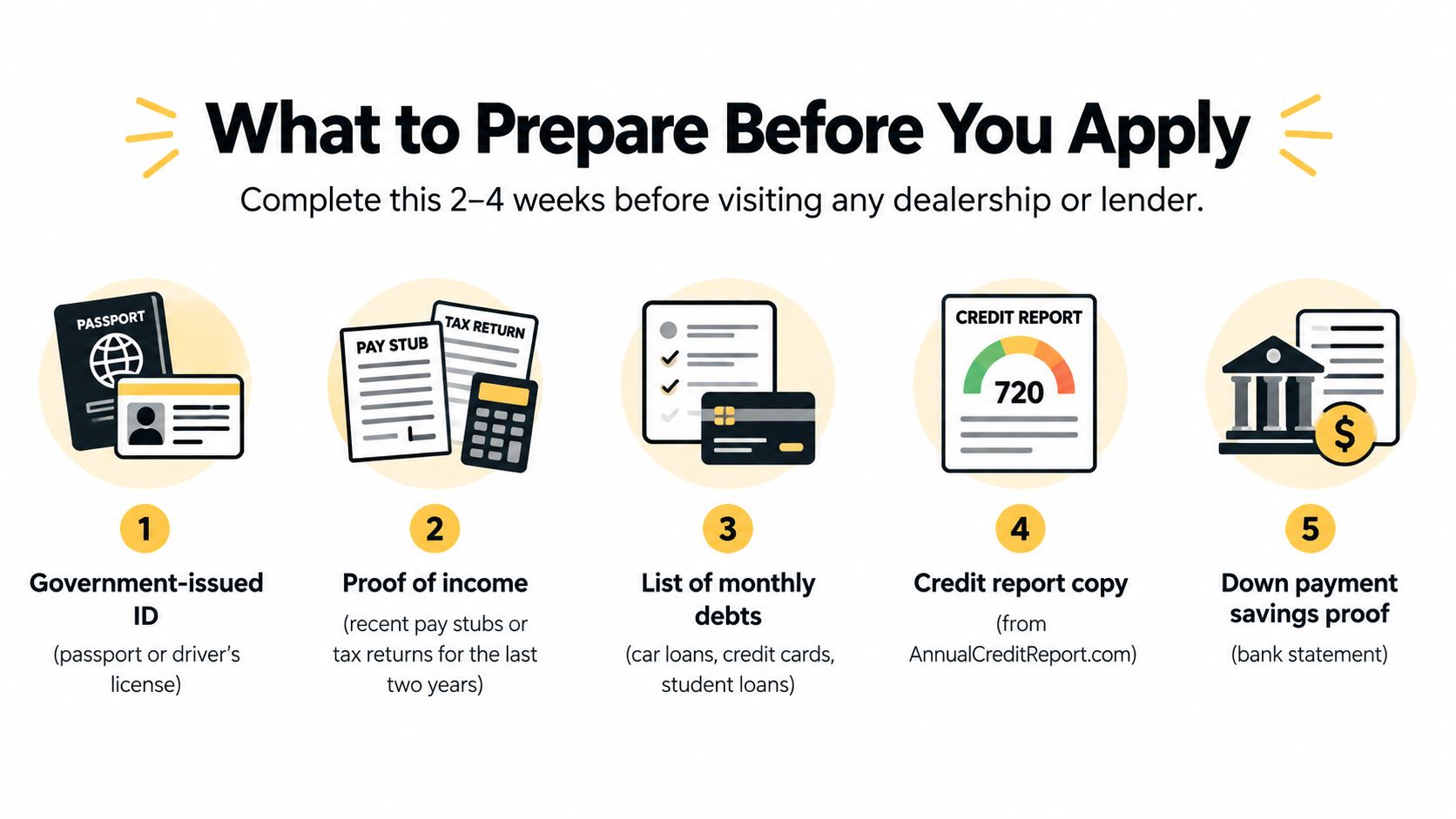
Preparation gives a fair-credit application a cleaner presentation. Before you visit a dealership or submit a full application, gather the information that lets an underwriter verify income, residence, existing obligations, and the source of your down payment.
Build the file before the application
Have a government-issued ID, recent pay stubs, tax returns or W-2s, bank statements, and proof of residence ready. Self-employed buyers should organize income documentation in a way that clearly shows consistency. If your income includes commissions, overtime, seasonal work, or contract earnings, explain the pattern before an underwriter has to guess.
Pull your credit reports from all three bureaus through AnnualCreditReport.com. Look for incorrect balances, accounts that don't belong to you, outdated payment information, and duplicate debts. Don't assume an error will be caught automatically during the loan process. Dispute problems early and keep documentation showing what you challenged.
Your application should also include a realistic debt-to-income calculation. Start with required monthly debts, then add the proposed RV payment. After that, account for insurance, storage, maintenance, registration, fuel, campground use, and seasonal expenses. A lender may focus on the loan payment, but your household budget has to absorb the entire ownership stack.
Make the down payment easy to verify
A down payment is more persuasive when the funds are clearly documented. Keep bank statements showing where the money came from, and avoid unexplained last-minute transfers. If the funds come from a trade-in, sale, gift, or another account, document that source so the lender can understand the transaction.
Experian's comparable vehicle-finance benchmark places near-prime or fair credit at a 601 to 660 score, with average APRs of 9.59% for new vehicles and 14.46% for used vehicles. It reports average terms of approximately 74.3 months for new vehicles and 68.1 months for used vehicles, but those figures are directional benchmarks, not RV quotes (Experian's fair-credit vehicle loan guidance).
The point is not to memorize a benchmark. The point is to arrive with a complete file, know your obligations, and ask for prequalification before authorizing a full application. Good preparation can reduce avoidable delays and keep you from applying blindly with lenders whose requirements don't fit your profile.
Comparing Bank, Credit Union, and Dealer Financing
Fair-credit borrowers should compare the financing channel, not just the advertised rate. A bank may offer familiarity and a clear process. A credit union may have strong pricing but membership requirements or a slower review. An online RV lender may specialize in recreational collateral. Dealer-arranged financing may submit your application to multiple lending institutions through one finance office.
| Channel | Typical Rate Range for Fair Credit | Approval Speed | Best Fit For |
|---|---|---|---|
| Traditional bank | Varies by credit profile, collateral, and relationship | Can be structured but may require detailed review | Buyers with established banking history |
| Credit union | Often competitive when the borrower meets membership and underwriting requirements | May take longer than an automated lender | Buyers willing to provide complete documentation |
| Online RV lender | Varies by RV type, age, score, and loan structure | Often convenient for prequalification | Buyers who want an RV-focused comparison |
| Dealer-arranged financing | Varies by participating lender and final contract | Convenient when the dealer can coordinate multiple offers | Buyers who want one application path and vehicle-specific financing |
What to ask every channel
Ask whether the rate is a fixed APR, whether the lender permits prepayment without a penalty, how the lender treats used RVs, and whether the loan can be refinanced later. Confirm the maximum RV age, acceptable title status, intended-use restrictions, and loan-to-value rules before you fall in love with a particular unit.
Dealer-arranged financing isn't automatically expensive, and a bank isn't automatically cheaper. The only reliable comparison is a written offer showing the same amount financed, the same RV, and comparable terms. Ask for the finance charge, total payments, payment count, late-fee terms, and every optional product included in the contract.
If a prior bankruptcy or other major credit event affects your application, general guidance such as how to get a car loan after bankruptcy can help you prepare questions. It doesn't replace a lender's decision, but it can help you organize the timeline and documentation lenders may request.
For Utah-specific planning, review our guide to RV financing options in Utah before submitting applications. The useful comparison isn't “Which lender advertises the lowest number?” It's “Which lender offers a workable structure for this RV, this borrower, and this ownership plan?”
The Right Way to Prequalify and Compare Offers
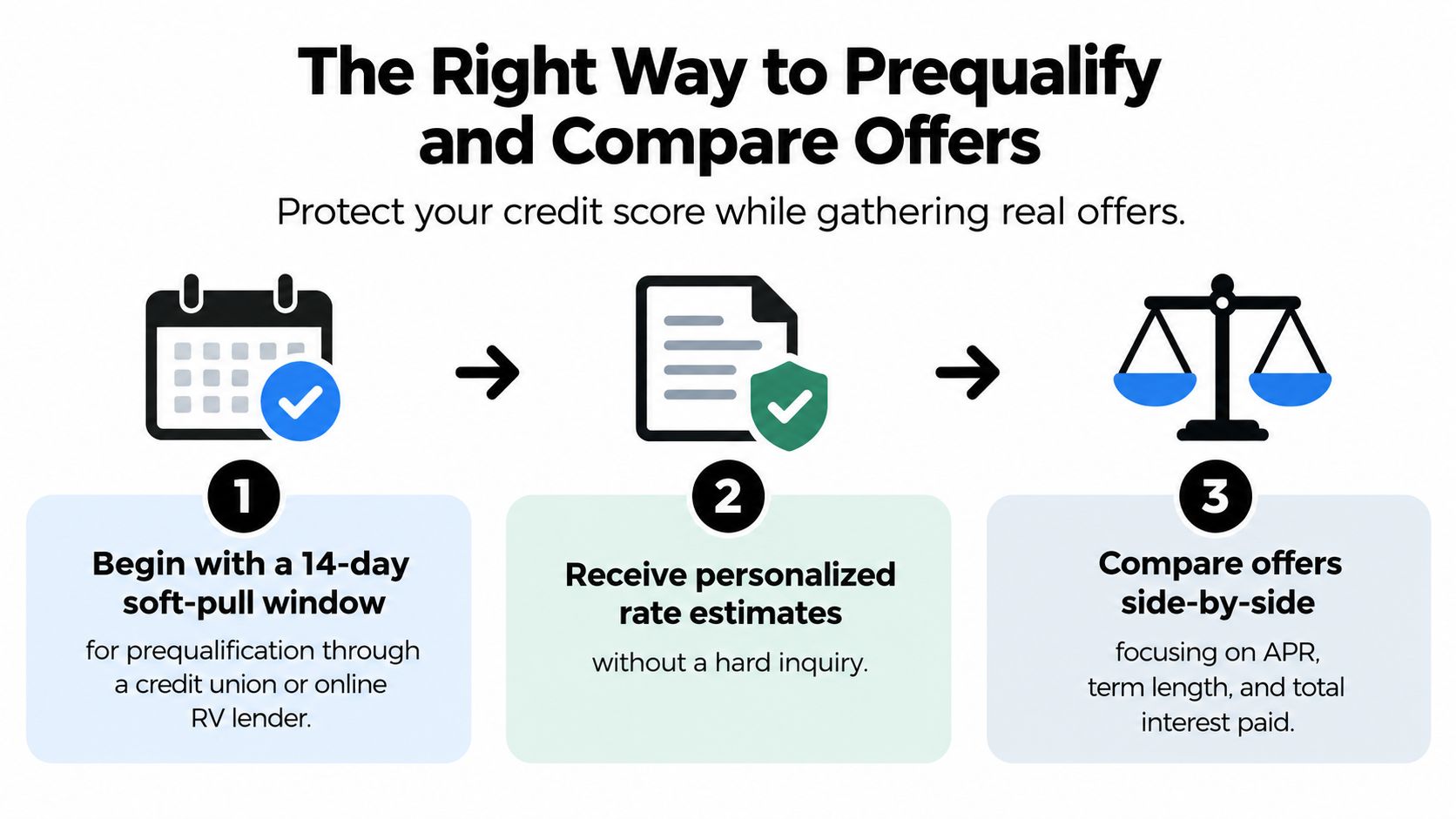
Prequalification should create options without turning your credit file into a guessing game. Start by asking each lender whether its process uses a soft inquiry and whether the quoted terms are conditional on a later full application. A soft-pull estimate isn't a final approval, but it gives you a reasonable starting point.
Use one consistent deal structure
Give every lender the same information. That includes the RV price, down payment, trade-in equity, employment status, housing payment, existing debts, and whether the RV will be used seasonally or as a full-time residence. If one lender sees a larger down payment or a smaller trade balance, its offer won't be comparable to the others.
Collect the written prequalification results and put them side by side. Record:
- APR: Confirm whether the quoted rate is fixed and whether it is conditional.
- Amount financed: Check whether taxes, freight, service contracts, GAP coverage, accessories, or other products are included.
- Term: A longer term can reduce the required payment while increasing the period during which interest accrues.
- Total payments: This is the number that exposes the lifetime borrowing cost.
- Fees and protections: Review origination charges, late fees, prepayment provisions, and optional products.
The CFPB explains that APR includes interest plus certain fees, while Truth in Lending disclosures identify the finance charge, amount financed, total payments, payment count, and late-fee terms (CFPB guidance on dealer-arranged and bank financing). Read those disclosures instead of comparing monthly payments from different terms.
A dealership finance office can be useful when it submits the same application to participating lenders, but ask how the final rate was determined and whether any dealer markup is included. Before you move from prequalification to a formal application, use our RV financing pre-approval resource to organize the information you'll need.
Here's a short explanation of why the comparison matters:
Don't authorize multiple full applications without understanding the lender's rate-shopping treatment. Ask whether related applications are treated as a single shopping event, and keep the process focused rather than sending your information everywhere.
Ways to Improve Your Approval Odds
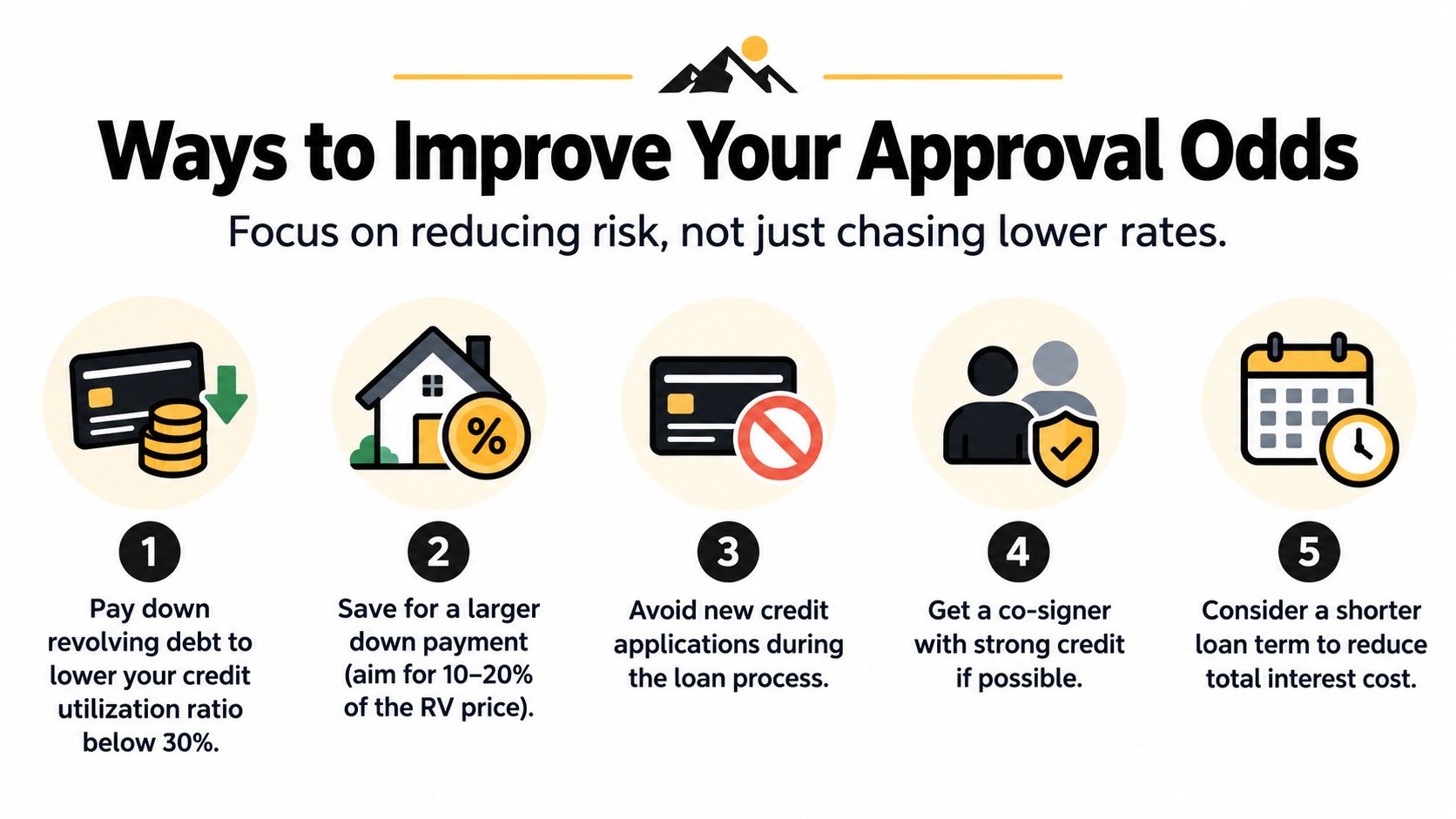
The strongest approval strategy usually reduces lender risk instead of chasing a tiny change in the advertised APR. A smaller balance, cleaner credit utilization, documented income, and suitable collateral can improve the application more directly than waiting for a score change you can't control.
Lower the amount financed first
A larger down payment reduces the lender's exposure and can help when the lender's loan-to-value limit is restrictive. Paying down revolving balances before applying can also improve utilization and reduce required monthly obligations. Don't drain every cash reserve to make the down payment, though. An RV without emergency funds is not an affordable RV.
A qualified co-borrower may strengthen an application, but that person becomes responsible for the debt. Discuss the liability openly, and compare the co-borrower's income, credit, and financial exposure before adding them to the contract.
Choose the collateral carefully
An older, lower-priced travel trailer may create a smaller loan balance than a newer unit, even if the older unit receives a higher APR. That can be the safer structure when the buyer has enough cash for inspection, maintenance, and repairs. A newer RV with a lower rate may still cost more overall if the principal balance is substantially larger.
Use the following checklist before applying:
- Revolving balances: Reduce balances where doing so improves the application without eliminating your cash reserve.
- Down payment: Document the funds and confirm how the lender calculates loan-to-value.
- Co-borrower: Compare the benefit against the co-borrower's legal responsibility.
- Loan term: Review total interest, not just the required payment.
- RV selection: Consider price, age, condition, resale value, inspection results, and expected repairs together.
A lender may also look more favorably on a straightforward application with stable employment and residence than on an application that leaves gaps unexplained. Be candid about employment changes, trade-in balances, and intended RV use. Clear information gives the underwriter something solid to evaluate.
Stress-Testing the Deal So the Payment Stays Affordable
Approval isn't the same as affordability. The Federal Reserve reported that auto-loan delinquency rates were above pre-pandemic levels by the end of 2023, with the increase concentrated largely in loans originated since 2022. It also found that higher monthly payments were driven mainly by larger loan sizes rather than rate increases, and noted that delinquency was particularly high among lower-score borrowers (Federal Reserve analysis of rising auto-loan delinquencies and monthly payments).
RV loans aren't identical to auto loans, but the warning applies. A fair-credit buyer can receive an approval that works on paper and fails when insurance, storage, repairs, fuel, registration, and campground expenses arrive.
Build the full ownership budget
Start with the fully amortizing loan payment. Then add the costs that the finance worksheet may not emphasize:
| Cost Component | Seasonal Use | Year-Round Travel | Full-Timer |
|---|---|---|---|
| Loan payment | Include the complete payment from the written offer | Include the complete payment and avoid relying on a minimum-payment view | Include the complete payment plus a larger cash reserve |
| Insurance | Confirm coverage for storage and occasional trips | Confirm coverage for frequent travel and changing locations | Confirm full-time, liability, personal-property, and residency requirements |
| Storage | Account for winter storage near your Utah home | Include storage between trips if you won't travel continuously | Include site, parking, or long-term placement costs |
| Maintenance | Reserve cash for seasonal checks, tires, plumbing, and winterization | Budget for more frequent inspections and repairs | Budget for continuous-use wear and service interruptions |
| Travel and camping | Estimate fuel, campground stays, and mountain-route costs | Include longer trips, campground availability, and high-altitude driving | Include recurring campground, propane, utility, and relocation costs |
| Emergency reserve | Keep cash available for a repair before the next trip | Protect funds for roadside and mechanical problems | Maintain a reserve that doesn't depend on the RV being usable |
The Motor Sportsland RV loan calculator can help you compare payment scenarios, but don't stop at the calculator's loan payment. Add the recurring ownership costs yourself, then test the budget against a temporary income reduction, an emergency repair, and a higher insurance or maintenance bill.
The Federal Reserve reported that auto-loan delinquency rates rose again in the second and third quarters of 2025 after being roughly stable or lower year over year in the first quarter, showing that repayment stress remained relevant even as broader delinquency conditions improved (Federal Reserve analysis of recent consumer delinquency dynamics). Your personal stress test matters more than a lender's maximum approval.
Compare the newer RV with the older RV
Suppose a newer motorhome has a more attractive APR but requires a much larger balance. An older travel trailer may carry less favorable pricing yet leave you with a smaller principal, lower insurance exposure, and more cash available for an independent inspection or repairs. Neither option wins automatically.
Compare both offers using:
- Amount financed, including every capitalized product.
- Total of payments, not just the monthly figure.
- Expected depreciation and resale value.
- Warranty coverage and repair exposure.
- Cash remaining after the down payment.
- Insurance, storage, maintenance, and travel costs.
Longer repayment periods deserve special attention. A Federal Reserve publication defines prime auto borrowers as those with a credit score of 660 or higher and reports average maturities of 63 months for prime borrowers and 67 months for subprime borrowers. RV loans are a different product, but the broader pattern is relevant: weaker-credit borrowers may accept longer terms to make the payment fit, while interest accrues for longer (Federal Reserve consumer credit publication).
A practical 30-day preparation plan
Use the month before shopping to improve the quality of every offer:
- Early in the month: Pull your credit reports, identify errors, and confirm the score information each lender will use.
- During the preparation period: Reduce revolving balances where practical, collect income and residence documents, and document the down payment.
- Before visiting a lot: Seek soft-pull prequalification from a credit union, bank, or online RV lender, and record each offer's APR, term, amount financed, fees, and total payments.
- Before choosing inventory: Compare specific RVs by condition, age, price, loan structure, insurance, storage, maintenance, and expected use.
- At the dealership: Bring the written offers, request a trade-in appraisal, and compare the same RV across financing options.
- Before signing: Verify the lender accepts the RV's age, mileage, title status, and intended use. Review every optional product and confirm the total amount financed.
For Utah families, the ownership plan should also account for Wasatch Mountain routes, winter storage, high-altitude camping, and trips to places such as Jordanelle or Bear Lake. A travel trailer that works for summer weekends near the Great Salt Lake may need different maintenance and storage planning before a winter trip or mountain outing.
Walk-away rule: If the complete ownership budget leaves no room for repairs, seasonal costs, or an income disruption, the RV is too expensive even if a lender approves it.
Fair-credit buyers don't need a perfect score to make a responsible purchase. They do need a smaller-risk structure, clear documentation, several written offers, and enough cash flow to enjoy the RV after the contract is signed.
Motor Sportsland offers RV financing through multiple lending institutions, along with new and used travel trailers, fifth wheels, motorhomes, and other recreational vehicles to compare against your budget. Visit Motor Sportsland to review inventory, begin the financing process, and speak with our team before you commit to a payment that hasn't been stress-tested.
Frequently Asked Questions
Can I get RV financing with fair credit?
Yes, approval may be available, but the lender will evaluate more than your score. Income stability, debt-to-income ratio, loan-to-value, down payment, RV age, payment history, and collateral condition all affect the decision.
What credit score is considered fair for an RV loan?
LendingTree's RV-loan comparison defines fair credit as a FICO-style score from 640 to 679. Lenders may use different scoring models or classifications, so ask which score and bureau they use.
Should I choose a newer RV with a lower APR?
Not automatically. Compare the newer RV's larger principal against the older unit's rate, total payments, depreciation, repair exposure, warranty coverage, insurance, and available cash reserves.
Is the monthly payment enough to compare RV loans?
No. Compare APR, finance charge, amount financed, fees, payment count, total payments, and prepayment terms. A lower payment can result from a longer term and a higher lifetime borrowing cost.
Should I use a co-borrower?
A qualified co-borrower may strengthen an application, but they share responsibility for the debt. Discuss the legal and financial exposure before adding anyone to the loan.
What should I do before applying?
Review your credit reports, correct errors, gather income and residence documents, document your down payment, calculate all existing debts, and obtain prequalification where available before submitting a full application.
