
Travel Trailer Tire Pressure: The Utah RV Owner’s Guide

You're loading the family into the truck in Salt Lake City, the water tank is full, bikes are secured in the rear garage, and the route climbs from the valley toward the Wasatch Mountains. Before you pull away, one question matters more than many owners realize: what is the correct travel trailer tire pressure for this load, this weather, and this trailer?
The answer isn't automatically the number molded into the tire sidewall. It isn't the tow vehicle's door-placard pressure, either. Safe inflation starts with the trailer manufacturer's cold-pressure recommendation, then becomes more precise when you account for actual axle and wheel-position loads, Utah's temperature swings, and the way heavy bunkhouse or toy-hauler cargo is distributed.
This guide explains how to read the placard, weigh a loaded trailer, set pressure cold, use a TPMS without misreading normal heat rise, and recognize the mistakes that lead to tire damage. Whether you're headed to Jordanelle, Bear Lake, the Great Salt Lake region, or a longer Mountain West trip, these habits will help you leave with a more reliable setup.
Understanding Your Travel Trailer Tire Pressure Placard
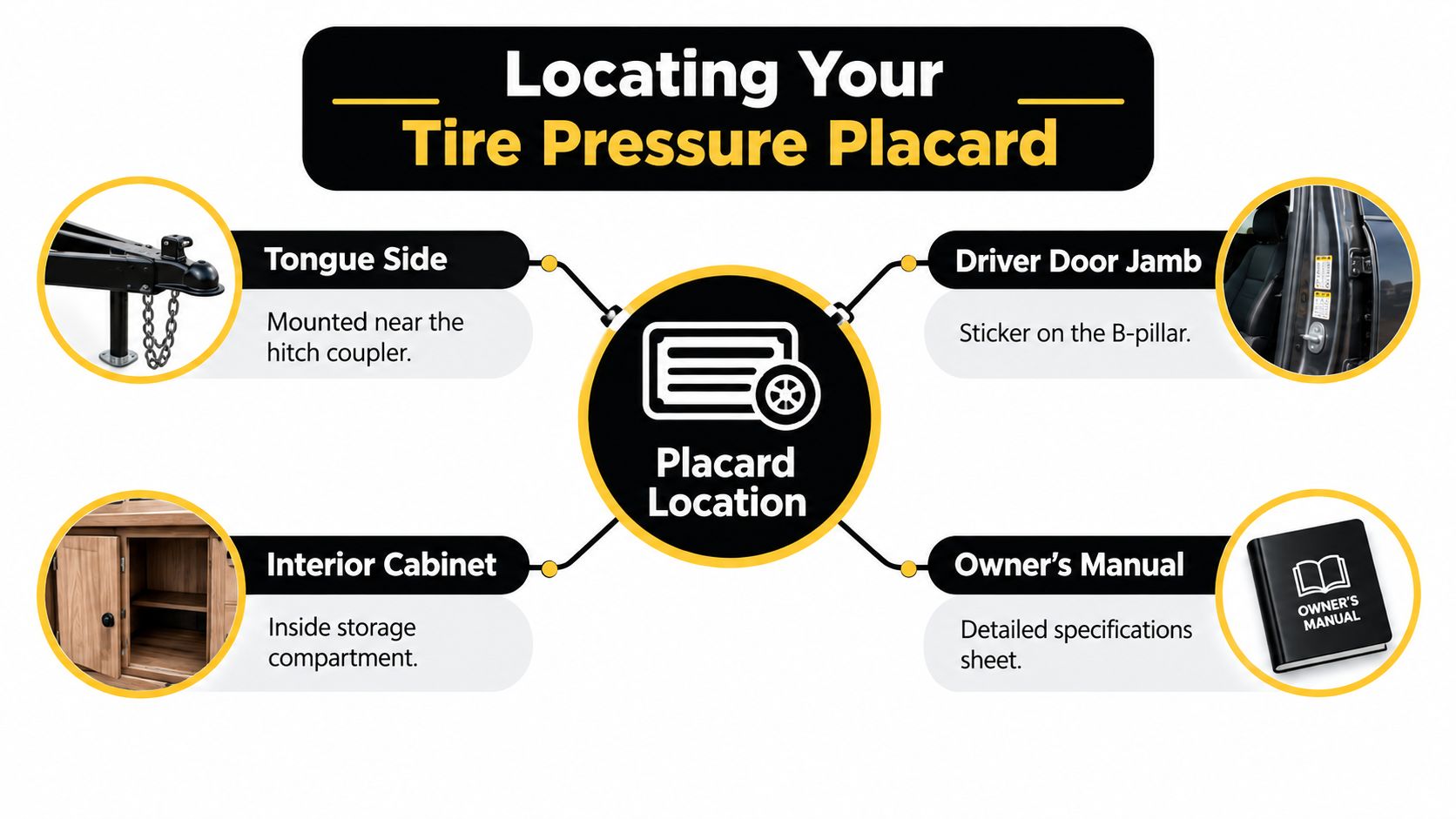
A travel trailer's correct starting pressure is printed on the trailer, not guessed from the rubber. Before adjusting anything, find the certification label, tire placard, owner's manual, and tire-and-loading information for your specific trailer.
Common placard locations include:
- Near the trailer tongue or hitch coupler
- On the driver-side front area
- Inside an interior cabinet or storage compartment
- In the owner's manual or specifications packet
Read the numbers in the right order
The certification label normally identifies the trailer's GVWR, axle information, tire size, and recommended cold inflation pressure. That recommendation is designed around the trailer's rated axle loads and approved tire-and-wheel combination.
The number molded into the tire sidewall means something different. It's the maximum permissible cold pressure for that tire, usually paired with the tire's maximum load rating. It's a limit, not automatically the pressure your trailer needs. NHTSA guidance directs owners to use the cold pressure on the vehicle certification label or in the owner's manual, rather than automatically using the tire's maximum marking. NHTSA's tire safety material also connects safe tire selection with tire load rating and gross axle weight rating.
Your tow vehicle has its own pressure specification on the driver-door placard. That number applies to the truck or SUV's tires, not the trailer's tires. The two vehicles carry different loads and use different tire-and-wheel combinations.
Practical rule: Don't inflate a trailer tire to the truck's door-placard pressure, and don't default to the tire sidewall maximum unless the trailer documentation and load-inflation information call for it.
If the placard is missing or unreadable, stop guessing. Use the owner's manual, contact the trailer manufacturer, or have a qualified RV service professional verify the approved tire size, load range, wheel rating, and cold-pressure target.
Weighing Your Loaded Trailer for Accurate Setup
A placard gives you the correct baseline, but a scale tells you what your trailer is carrying. A fully loaded travel trailer can be much different from the unit described in a brochure, especially after adding propane, batteries, water, food, tools, camping equipment, and exterior cargo.
For background on trailer weights and Utah towing considerations, use this guide to how much travel trailers weigh. The important point is that total weight alone doesn't reveal how much load each tire is supporting.
Weigh the trailer as you travel
Load the trailer for a normal trip. Include the water and gear you plan to carry, because weighing an empty trailer can produce a reassuring number that doesn't apply on departure morning.
A commercial truck scale can provide axle-group weights. Individual wheel-position weighing is better because cargo rarely distributes itself evenly. A battery bank, propane cylinders, generator, water tank, slide components, motorcycles, or storage bins may put more load on one side.
Use this process:
- Load the trailer normally. Include all realistic trip cargo and make sure the tow vehicle is loaded as well.
- Record the trailer axle weights. A truck scale can identify the load carried by each axle group.
- Seek wheel-position measurements when possible. The heaviest wheel position on an axle determines the pressure requirement for that axle.
- Check the GAWR and GVWR. The combined tire capacity on each axle must meet or exceed the applicable axle rating, and the trailer must remain within its overall rating.
- Read the tire manufacturer's load-inflation table. Match the heaviest wheel position to the required cold pressure for that exact tire size and configuration.
- Set every tire on the same axle to the pressure required by the heavier side. Don't let a lightly loaded tire hide an overloaded tire on the opposite side.
Cargo placement matters as much as cargo total
A toy hauler may carry a motorcycle, generator, tools, and fuel-related equipment toward the rear. A bunkhouse trailer may collect batteries, propane, food, and outdoor equipment toward one side. Those choices can change wheel-position loads even when the trailer's total weight appears acceptable.
The solution isn't just adding more air. Higher pressure can't correct an overloaded axle, an overloaded wheel position, an unsuitable tire, or a wheel that has a lower pressure rating. Correct the loading problem first, then select pressure from the approved table while staying within the tire and rim limits.
Cold Inflation and Temperature Management
Before a family trip from the Salt Lake Valley into the Wasatch Mountains, set the trailer's tire pressure while every tire is cold. Early morning is usually best, before driving or direct sunlight warms one side of the trailer. This reading provides the consistent baseline you can compare with the placard and the tire manufacturer's load-inflation table.
The U.S. Tire Manufacturers Association states that pressure changes by approximately 1 to 2 psi for every 10°F change in temperature. Its tire safety fact sheet explains why a reading taken on a cool Utah morning can differ materially from one taken later on hot pavement. A 50°F swing from a cold morning to a hot afternoon can therefore shift readings by 5 to 10 psi before driving heat is added.
What to do before a mountain departure
Use this sequence before heading from Salt Lake City toward a Wasatch pass:
- Park the trailer out of direct sunlight when possible.
- Measure each tire with the same accurate gauge.
- Compare every reading with the approved cold target for that axle.
- Adjust pressure only while the tires are cold.
- Inspect the tread, sidewalls, valve stems, and spare.
- Record unusual differences and investigate them before departure.
Temperature changes can be especially noticeable on heavy bunkhouse and toy-hauler trailers. A cool valley departure, colder mountain air, and hot campground pavement can produce different readings throughout the day. Set the pressure cold before driving, then recheck it after substantial weather changes, extended storage, or a significant change in cargo or water load.
Altitude also affects the trip environment, but temperature is usually the more practical variable for routine checks. Do not bleed air from a warm tire just because its reading is higher than the cold target.
If a hot tire reads higher than its cold target, don't release air just to force the warm reading back to the morning number. After cooling, that tire may be underinflated.
Underinflation lets a tire flex more, build additional heat, and carry less load safely. Overinflation reduces impact absorption and can make the tire more sensitive to road hazards. The correct target is the cold pressure matched to the trailer, tire, wheel, and actual loaded condition. A pressure adjustment cannot compensate for an overloaded wheel position or an unsuitable tire.
Using TPMS and Gauges for Safe Maintenance
A TPMS gives you information while the trailer is moving, but it doesn't replace a good gauge and a walk-around inspection. The strongest setup uses both tools: set a verified cold baseline manually, then monitor each tire for changes during the drive.
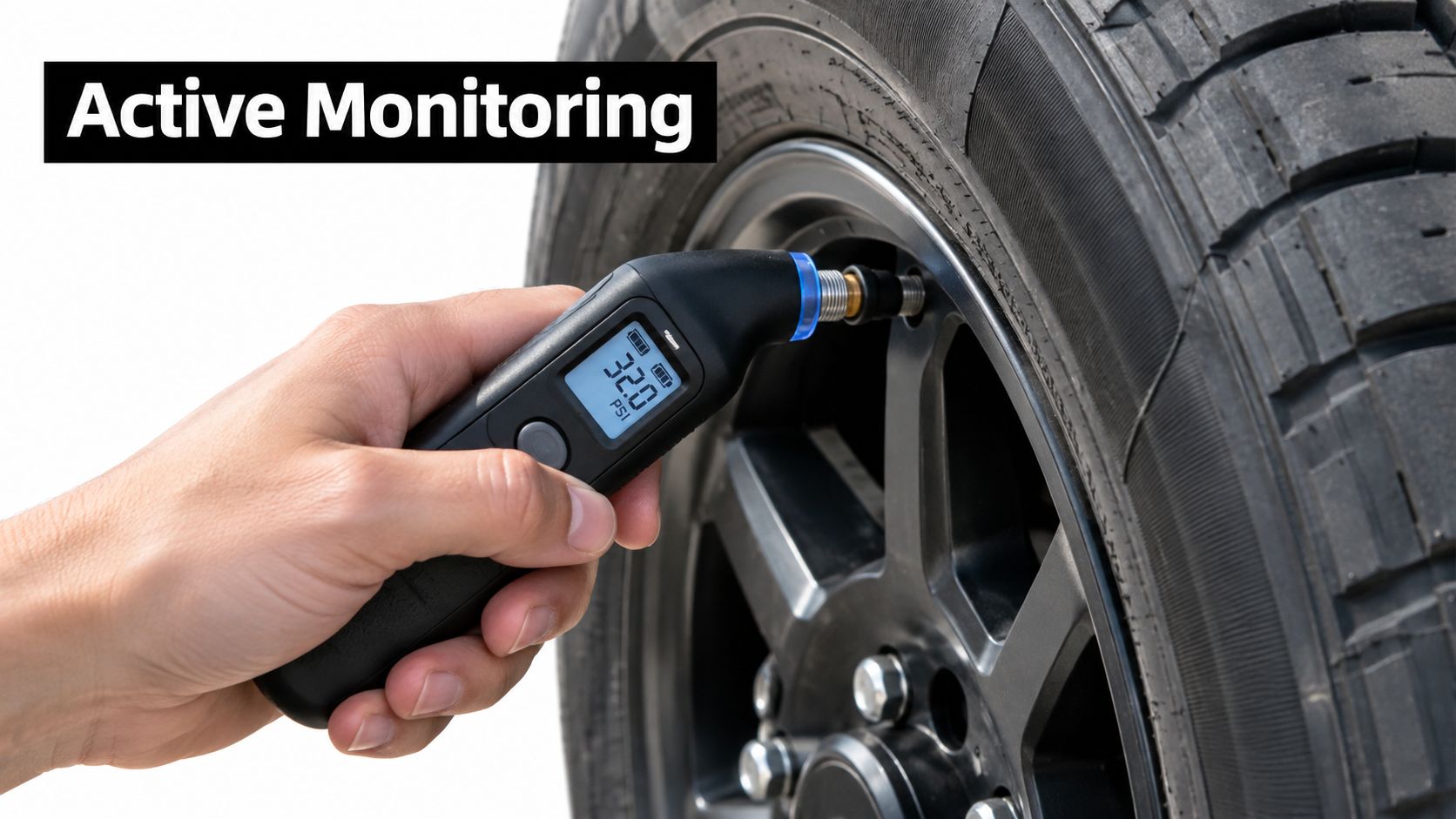
A quality digital gauge can reveal an overnight loss before you hitch up. The TPMS can then show whether one tire is losing pressure, running hotter than its axle mate, or experiencing a problem during a long grade.
Reading changes without chasing false alarms
Normal driving raises tire pressure and temperature. That rise by itself isn't a failure. A persistent difference between tires, a rapid pressure drop, or one tire running noticeably hotter than its companion deserves attention.
Possible causes include:
- A puncture or leaking valve
- Uneven cargo distribution
- Underinflation
- A dragging brake
- A wheel-bearing problem
- Sun exposure affecting one side
- A damaged tire or wheel
Program the TPMS around the verified cold pressure for your trailer. Don't reset the baseline around a tire that's already low, because that can hide the problem. Make sure the sensors support the trailer's pressure range and that any external sensor is compatible with the valve stems.
These RV tire maintenance practices work best when TPMS readings are treated as an early warning, not as permission to skip physical checks.
The RV Industry Association approved a program in April 2026 requiring TPMS on towable RVs under 26,000 pounds GVWR beginning with model-year 2028 production, ahead of a proposed NFPA 1192 update, as described in NHTSA's tire safety material. That development reinforces the value of monitoring, but current owners still need to select, install, and maintain a system suited to their trailer.
Use this sequence if the monitor alerts:
- Ease off the throttle and avoid abrupt steering.
- Find a safe place to stop.
- Confirm the pressure with your gauge.
- Inspect the tire, valve, wheel, brake area, and hub.
- Don't continue on a damaged or rapidly losing tire.
Common Tire Pressure Mistakes to Avoid
Most tire-pressure failures begin with a reasonable-sounding shortcut. The problem is that the shortcut ignores how the trailer is built or loaded.
Mistake one, using the sidewall maximum automatically
The sidewall maximum tells you what the tire can safely hold at its maximum rated load. It doesn't automatically account for the trailer manufacturer's approved pressure, wheel limit, axle rating, or actual loading.
For some trailer combinations, the placard pressure may be close to the sidewall maximum. For others, it may not be. Read the trailer documentation and load-inflation table instead of assuming every tire should be filled to the largest molded number.
Mistake two, using the tow vehicle's pressure
Your truck may call for one cold pressure while the trailer needs another. The trailer tires support the trailer's axle loads, while the truck tires support the tow vehicle and part of the tongue load. Substituting one vehicle's placard for the other can leave the trailer improperly inflated.
Mistake three, correcting a hot reading
Driving generates heat, and heat raises pressure. Releasing air from a warm tire can leave it underinflated after it cools. Set pressure cold, then let normal operating changes remain within the tire's design range.
Mistake four, trusting appearance
A tire can look normal while carrying too little air. Underinflation increases flexing and heat buildup, which can contribute to handling problems, tread damage, premature wear, and blowouts. GAO reporting on NHTSA research found that more than one-quarter of automobiles and approximately one-third of light trucks were operating with at least one tire underinflated by 8 psi or more below the manufacturer's recommendation. The Government Accountability Office report is not travel-trailer-specific, but it shows why visual inspection alone isn't enough.
A gauge, a cold-pressure record, a loaded-weight check, and a TPMS create a much stronger maintenance routine than any single shortcut. Inspect for cuts, bulges, cracking, valve leaks, tread separation, and unusual wear every time you check pressure.
When to Check Your Tire Pressure Schedule
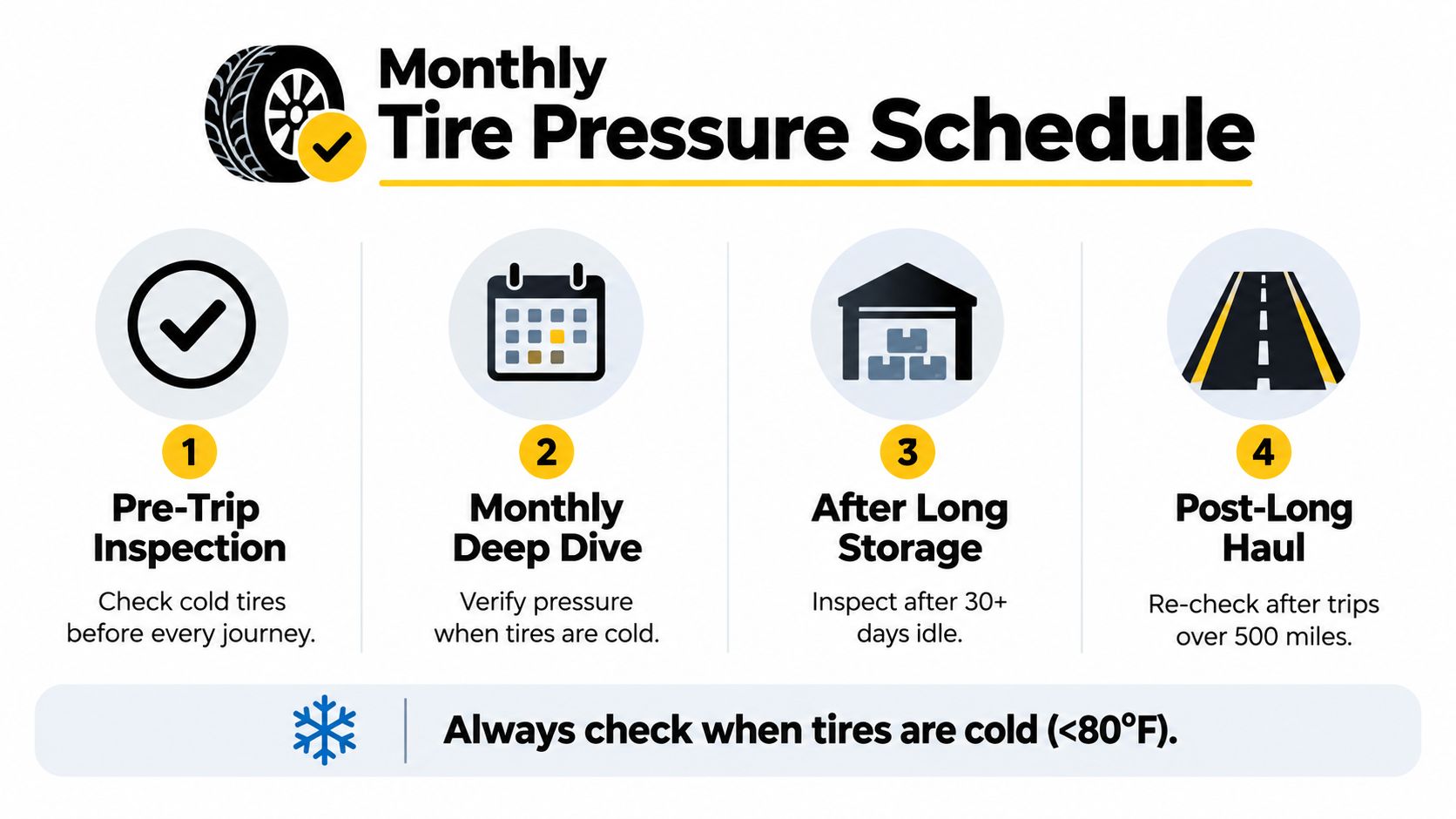
A reliable check schedule follows how a trailer sits, travels, heats, cools, and gains or loses cargo. Pressure should never be checked only after a tire appears low at a fuel stop.
| Situation | What to do | Why it matters |
|---|---|---|
| Before every travel day | Check every tire cold, including the spare | Establishes a reliable starting point |
| After a major temperature change | Recheck when tires are cold | Ambient temperature changes the reading |
| After loading or unloading | Verify pressure and cargo distribution | Weight changes can alter axle and tire demands |
| After storage | Inspect pressure, cracking, valves, and tread | Sitting doesn't prevent aging or leaks |
| After an alert or unusual wear | Stop, measure, and investigate | A pressure difference may signal damage or a mechanical issue |
A practical Utah routine
Before a weekend trip to Jordanelle or Bear Lake, check every tire cold at home. Utah's overnight temperature swings can change the reading by morning, so check again before driving if the trailer has sat through a significant change. After a long run, inspect for uneven wear, tread damage, valve leaks, sidewall cracking, and heat-related signs, especially after mountain climbs.
Winter storage also requires attention. Cold, sunlight, moisture, and gradual air loss can affect tires even while the trailer remains in the driveway. Tire covers reduce sun exposure, but they do not replace pressure checks or a condition inspection.
The same routine applies to a new trailer. Verify its loaded setup after adding batteries, water, camping gear, a generator, or powersports equipment. A bunkhouse or toy-hauler load can shift axle demands quickly. The trailer is ready when its tires, wheels, axles, cargo, and pressure remain within their ratings.
A TPMS adds an early warning during travel, but it does not replace a cold-pressure check before departure. NHTSA's historical research found that direct TPMS systems were 55.6% effective at reducing severe underinflation, defined as more than 25% below the recommended pressure. NHTSA's TPMS research provides the primary source for that finding. Use the system to spot pressure loss on the road, then stop safely and investigate rather than relying on the alert alone.
Expert Support from Motor Sportsland
Correct travel trailer tire pressure comes down to a repeatable process. Find the trailer placard, load the trailer as you travel, weigh it when possible, use the tire load-inflation table, set pressure cold, and inspect every tire before departure.
That process matters even more for Utah travel, where a cool valley morning can become a hot highway run, a steep mountain climb, or a remote stretch with limited roadside help. If you're reviewing your broader trip protection, you can also find the right RV policy through Select Insurance Group, Inc., then keep your tire and maintenance records with the trailer documents.
Motor Sportsland serves Utah RV owners from locations in Millcreek and Spanish Fork, with sales, parts, maintenance, mounting, balancing, repairs, installations, and upgrades for travel trailers, toy haulers, fifth wheels, and motorhomes. A service inspection can help identify pressure-related concerns before your next trip across the Wasatch Mountains or the broader Mountain West.
Motor Sportsland can help you match your RV, tires, wheels, and service needs to the way your family travels, whether you're shopping for a bunkhouse or preparing a loaded toy hauler. Visit Motor Sportsland to browse inventory, explore service support, or connect with the Utah team before your next departure.
Travel trailer tire pressure FAQ
What pressure should I use in my travel trailer tires?
Start with the cold pressure listed on the trailer certification label or in the owner's manual. If the trailer is loaded differently from its rated configuration, weigh it and use the tire manufacturer's load-inflation table, while staying within the tire and wheel limits.
Should I inflate trailer tires to the maximum sidewall PSI?
Not automatically. The sidewall number is the tire's maximum permissible pressure, not necessarily the trailer's recommended operating pressure. Follow the trailer placard and approved load-inflation information.
Can I use the tow vehicle's door-placard pressure?
No. The tow vehicle and trailer have separate pressure specifications because they carry different loads and use different tire-and-wheel combinations.
Should I release air from a hot tire?
No. Driving raises pressure naturally. Check and adjust when the tire is cold, because releasing air from a hot tire can leave it underinflated after cooling.
Do I need a TPMS on a travel trailer?
A TPMS can provide valuable warnings about pressure loss and unusual heat, especially on long Utah drives. It supplements, rather than replaces, cold-pressure checks, visual inspections, proper loading, and accurate weighing.
How often should I check travel trailer tire pressure?
Check every tire, including the spare, before each trip or travel day. Recheck after substantial temperature changes, loading changes, extended storage, and any TPMS alert or unusual wear pattern.
