
Bunkhouse Travel Trailer for Families: Buy Smart in Utah

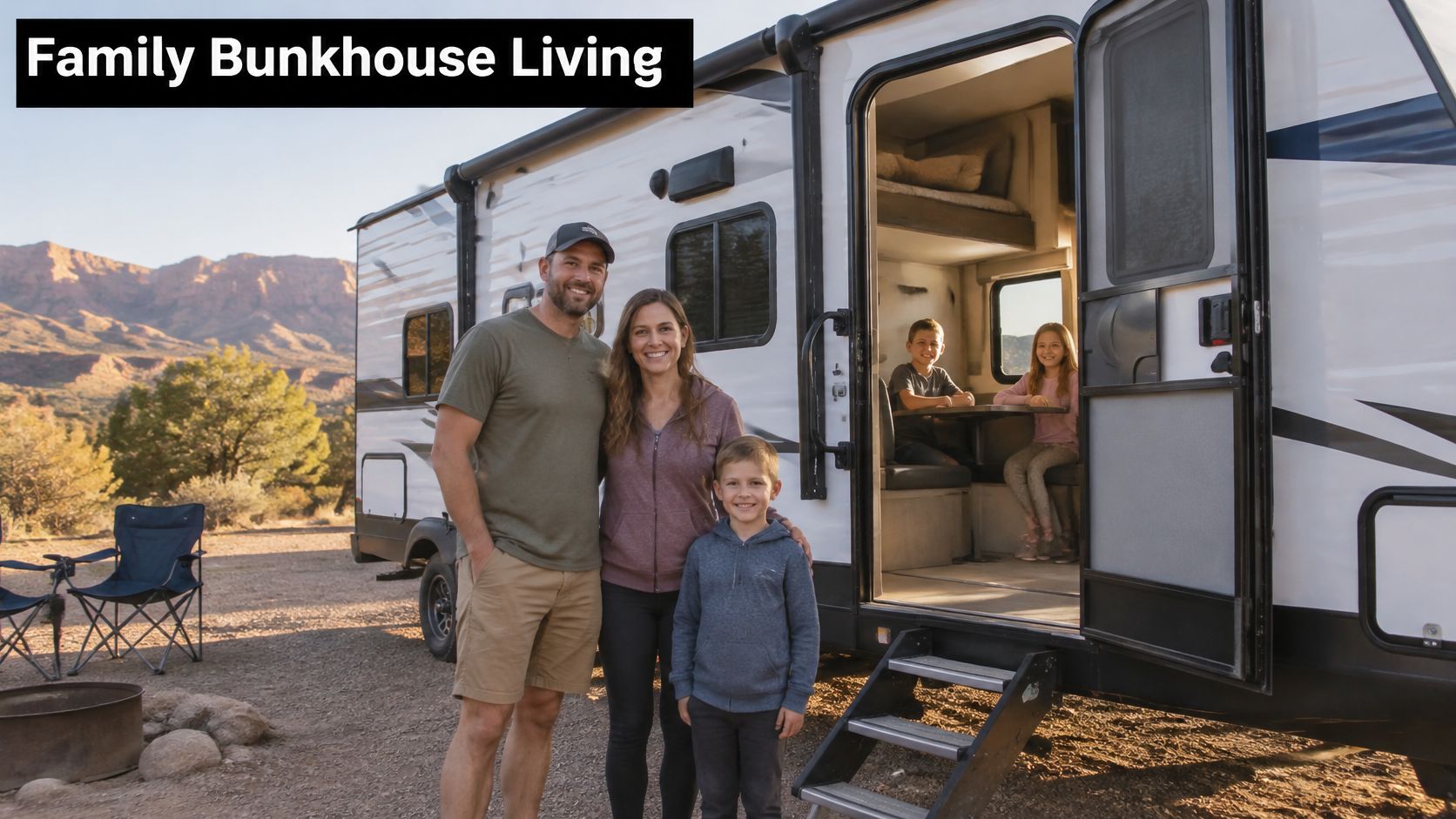
It's 9:30 on a school night in a 26-foot trailer near Jordanelle, and the two kids are still talking over the dinette bed while you try to read with the lights down. The living space is also the bedroom, so nobody gets a door. A bunkhouse travel trailer for families fixes that split without jumping to a motorhome.
A bunkhouse is a towable with a dedicated sleeping room, usually at the rear behind a door or partition. Kids can sleep while you keep the main living area lit for cooking and conversation. Think of a studio apartment next to a two-bedroom condo. They share a building, but only the second gives the kids a door to close.
A travel trailer hitches to a standard ball and stays lighter than a fifth wheel, which needs a pin box in the truck bed. A motorhome carries its own engine, so the whole family rides in one vehicle and you don't keep a separate daily driver for campground errands.
What a Bunkhouse Travel Trailer Is and Why Families Choose It
A bunkhouse gives children a dedicated place to sleep, while parents keep the main living area available for reading, cooking, or talking after bedtime. For families who share a trailer, that separation can make evenings easier.
The Recreational Vehicle Industry Association demographic profile reports that conventional travel trailers were owned by 38% of U.S. RV owners, making them the most commonly owned towable in the study. It also found that 27% of travel-trailer owners traveled with children under 18, while 87% traveled with a spouse. Summer and fall are the main seasons for RV use, a natural fit for Utah school breaks and warm-weather trips to Bear Lake or the Wasatch.
A separate bunk room has trade-offs. It adds length and loaded weight, and may reduce rear storage. The value is the sleeping space and separation, but those features matter only if the trailer's loaded weight works with your tow vehicle and the added length fits the campsites you want.
Start with what you can tow loaded and the payload left after passengers and gear. Use the length bands to narrow the choices, then compare floorplans and extras. From there, weigh the budget, new or used options, dealer support, and campsite fit. Motor Sportsland's Millcreek and Spanish Fork teams can help Utah families work through that sequence, starting with the tow vehicle they already own.
Campground connectivity is another practical consideration. For advice on staying connected while RVing, see RV connectivity tips from SwiftNet Wifi.
Length, Loaded Weight and Tow Vehicle Class by Size
A longer bunkhouse can add sleeping space, but it also adds loaded weight and can rule out some campsites. Use the length bands to shortlist layouts first. Then check what your family can tow loaded, how much payload remains after passengers and gear, and whether the trailer fits the places you plan to camp.
| Length band | Typical tongue weight | Tow vehicle class |
|---|---|---|
| 22–26 ft | About 10% of loaded weight, e.g. about 700 lb at 7,000 lb loaded | Half-ton pickup or midsize SUV rated for that loaded trailer |
| 32–36 ft | About 10% of loaded weight; confirm the exact figure for the trailer | Three-quarter-ton pickup; confirm receiver and axle ratings |
| 37 ft and longer | 1,000 lb or more | Three-quarter-ton or heavier; confirm on the certification label |
GVWR on the trailer's certification label is the maximum allowed loaded weight, not the brochure's dry weight. Dry weight leaves out water, propane, batteries, food, and the bikes that often come along. Compare the trailer's GVWR with your tow vehicle's ratings, then account for the people and cargo already using its payload.
A common rule of thumb puts tongue weight at roughly 10% of loaded trailer weight. At 7,000 pounds loaded, that is about 700 pounds on the coupler. Confirm the exact tongue-weight figure for the specific trailer before buying. Too much can load the rear axle and unload the front, dulling steering. Too little can promote sway. Bikes or a cooler carried at the rear can lift the tongue and make the trailer wander.
Why the tow column names a class
The tow-vehicle column names a class rather than a specific model because receiver and rear-axle ratings, along with transmission or four-wheel-drive equipment, can change a vehicle's tow rating. Treat these bands as a starting point. Before choosing a floorplan, compare the trailer's certification label with the vehicle's door-jamb label and check the receiver and axle ratings.
A 31-foot bunkhouse loaded to 8,000 pounds calls for more power margin on I-80 over Parleys Summit than on flat highway. Grades, wind, and a full fresh tank can all affect the climb. Length also matters at camp: check the site's size limits and available space before settling on a larger trailer.
Practical rule: Choose the shortest length band that sleeps your family, then confirm the loaded trailer fits your vehicle's ratings and your intended campsites.
Keep dense cargo low and close to the axles, with moderate weight slightly forward of the axle group. Recheck tongue weight after adding water. Use a weight-distribution hitch only if both the tow vehicle and receiver are rated for it.
Floorplans That Sleep a Family and What Each Trades Away
Match the sleeping arrangement to your household before you compare outdoor kitchens and decor packages.
| Layout | Typical sleeping | Best fit | Main trade-off |
|---|---|---|---|
| Rear bunk room with door | One bunk per child behind a door | Kids who need a closing door | Rear-heavy loading and less rear storage |
| Bunk ends with slide-out | Often 3–4 bunks, one per child | Families with three or more kids | Slide needs wider, clear campsite space |
| Front bunks over a dinette | Sleeps 4–6 | Families of four who share a room | Shared open space and less privacy |
| Two-bath bunkhouse | Parents' bed plus bunks on the floorplan | Parents and kids on different schedules | Added length, weight and price |
Rear bunk room with a door. This is the layout for kids old enough to want privacy. Weight sits toward the back, and the pass-through storage shrinks because the bunks occupy that corner. Pack the heavy gear forward of the axles so the tongue stays planted.
Bunk ends with a slide-out. A slide buys floor space when three or more kids need beds that aren't the dinette. The slide also needs clear campsite width. Trees, picnic tables, and a neighbor's awning can block it on tight Utah state-park pads.
Front bunks over a dinette. This is the budget way to sleep four in a shared space. You give up the closing door. It works for younger kids on short weekends and gets old on a week at Bear Lake.
Two-bath bunkhouse. Parents and kids on different schedules stop queueing at one door. You pay for that in length, weight, and price, which can push you into the next tow class.
What to check on the floor
- Bunk count: Match each bunk to a child or an adult. A "sleeps 8" sticker often counts a dinette and a sofa.
- Bunk room air: Look for a window and a fan. Rear rooms get warm on desert afternoons.
- Bathroom access: One bath is fine if the bunk room can reach it without crossing the parents' bed.
- Gear: An outdoor kitchen and a real bike bay matter more than a second TV.
The Outdoorsy U.S. RV Family Travel Report, covered by RV Pro, found that in 2024 83% of surveyed families preferred RV campgrounds with amenities such as showers, pools, biking paths, and pickleball courts. Pick a floorplan you can realistically park at those parks, not only the one with the most bunks.
Don't buy four kids' bunks when two adults will sleep in the rear bed and the "extra" bunks become a closet. Floorplan filters on motorsportsland.com let you sort bunk counts before you drive to the lot.
Worked Payload Example for a Family of Four
A mid-size bunkhouse can fit a half-ton's advertised tow rating and still exceed its payload once the family climbs in. Start with the truck's door-jamb payload label, then account for the trailer's loaded tongue weight, passengers, and cargo.
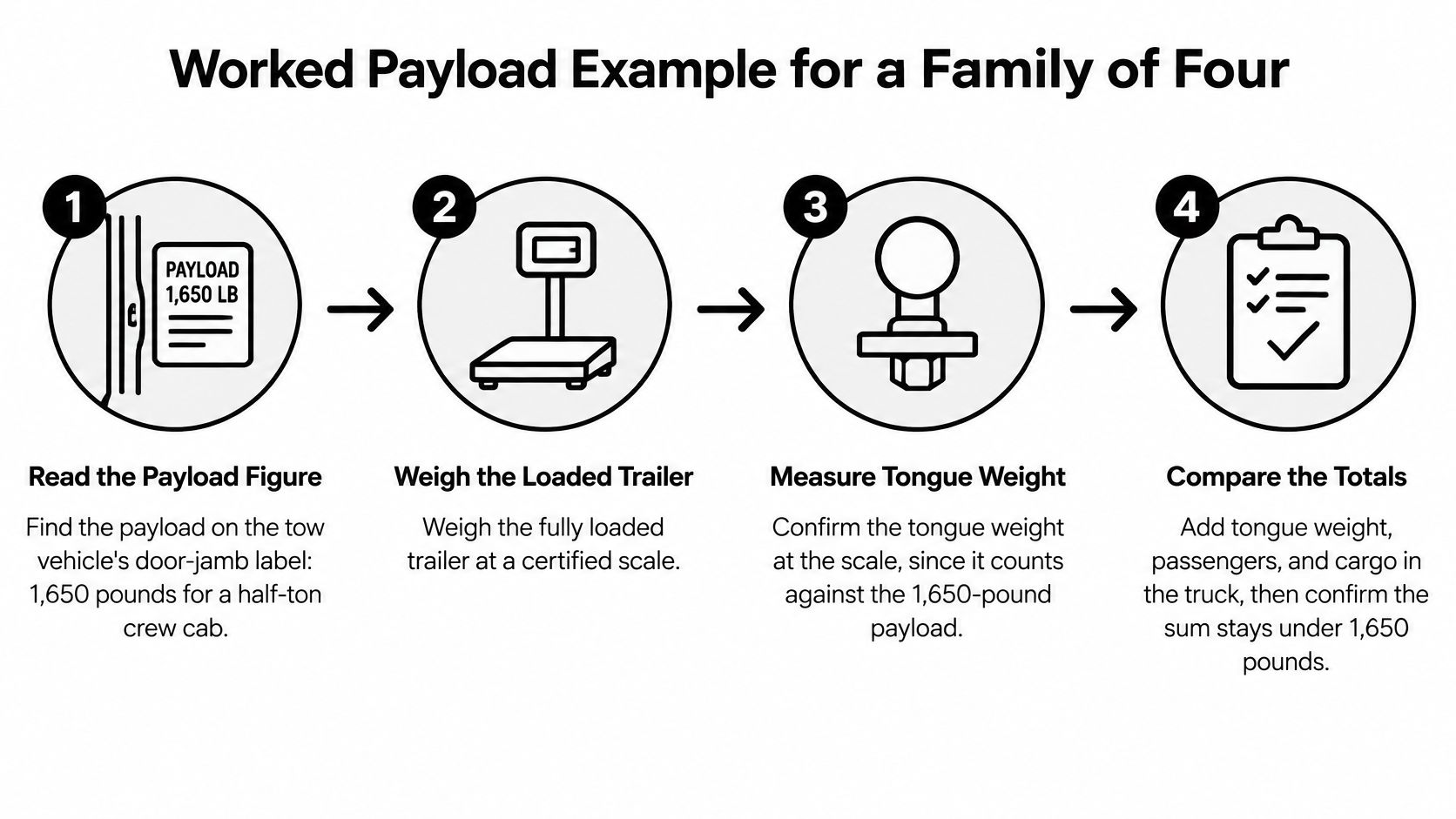
Consider a half-ton crew cab and a mid-size bunkhouse packed for a long weekend. Follow the guide to calculating towing capacity and work through these figures before choosing a trailer:
- Read the payload figure on the tow vehicle's door-jamb label. For this example, the half-ton crew cab is rated for 1,650 pounds of payload. Options and a tonneau can reduce the capacity available on the specific truck.
- Weigh the loaded trailer at a certified scale. Here, water, propane, and gear bring it to 8,000 pounds. The brochure's dry weight does not include that load.
- Estimate tongue weight at 10 percent. That puts 800 pounds on the hitch, counting against the truck's payload.
- Add passengers. Four people averaging 170 pounds add 680 pounds in the cab, including car seats if that is how your family travels.
- Include cargo carried in the truck, such as bikes, camp chairs, and a cooler. In this example, that adds about 140 pounds.
- Add the loads: 800 + 680 + 140 = 1,620 pounds. Against the 1,650-pound payload rating, just 30 pounds remain. Even a small extra load can use up that margin.
- Check GCWR, rear-axle rating, receiver rating, and hitch-ball rating as well. A passing payload calculation does not make a receiver rated below the tongue weight safe.
- Keep most trailer weight over or just ahead of the axles, then weigh again. Recheck the setup after changing the gear load or filling the fresh tank.
Why paper tow ratings fail families
Bunks, slides, and an outdoor kitchen can add loaded weight even when the dry figure looks manageable. A shorter length band or lighter packing may solve the problem; a bigger truck is not an automatic answer. Its payload, axle, and receiver ratings must still suit the combination.
Federal fuel tests assume a passenger-and-cargo load far below this packed cab and its 800-pound tongue weight. On a Wasatch climb, the example's 30-pound payload margin leaves little room for error. Unload or step down in trailer size if the figures measured on the road do not leave a workable margin, and repeat the scale check when you add bikes, water, or another cooler.
Budget, Financing and Running Costs for Families
Price is only the first line. A realistic first-year stack includes purchase price, sales tax and fees, insurance, a tow-capable hitch and brake controller, storage, tires, and an annual service budget. Skip any one of those and the monthly payment lies to you.
RV Business, citing 2025 market data, reported that travel trailers priced below $25,000 recorded a 2% increase in registrations across nearly all income and age groups. That pull toward a lower sticker often pairs with an older or smaller tow vehicle. Payload, not the advertised tow rating, becomes the limit that matters most.
Fuel on mountain miles
FuelEconomy.gov states that towing a trailer or carrying excessive weight decreases fuel economy, and that its testing assumes only 300 pounds of passengers and cargo. A bunkhouse trip adds the trailer, people, water, propane, food, bedding, and bikes. Don't treat the unladen EPA number as your towing mileage. Budget fuel high, and mark longer gaps between stations on routes through the Wasatch or out toward the Great Salt Lake.
A payment you can still repair
Compare loan term and monthly payment, run a pre-qualification before you visit, and set a down payment you can afford without emptying the trip fund. Motor Sportsland's quick credit application, pre-qualification tools, and trade-in options are built for that conversation before you pick a floorplan.
Use a simple monthly picture:
Payment + insurance + fuel per trip + campsite nights + a service reserve.
Stretching the term to squeeze a payment leaves less margin for tires, bearings, and a seal repair in years two and three.
A cheaper trailer on a truck that can't carry the tongue weight is not a savings. It's a return trip to the scale.
New or Used Bunkhouse Trailers Side by Side
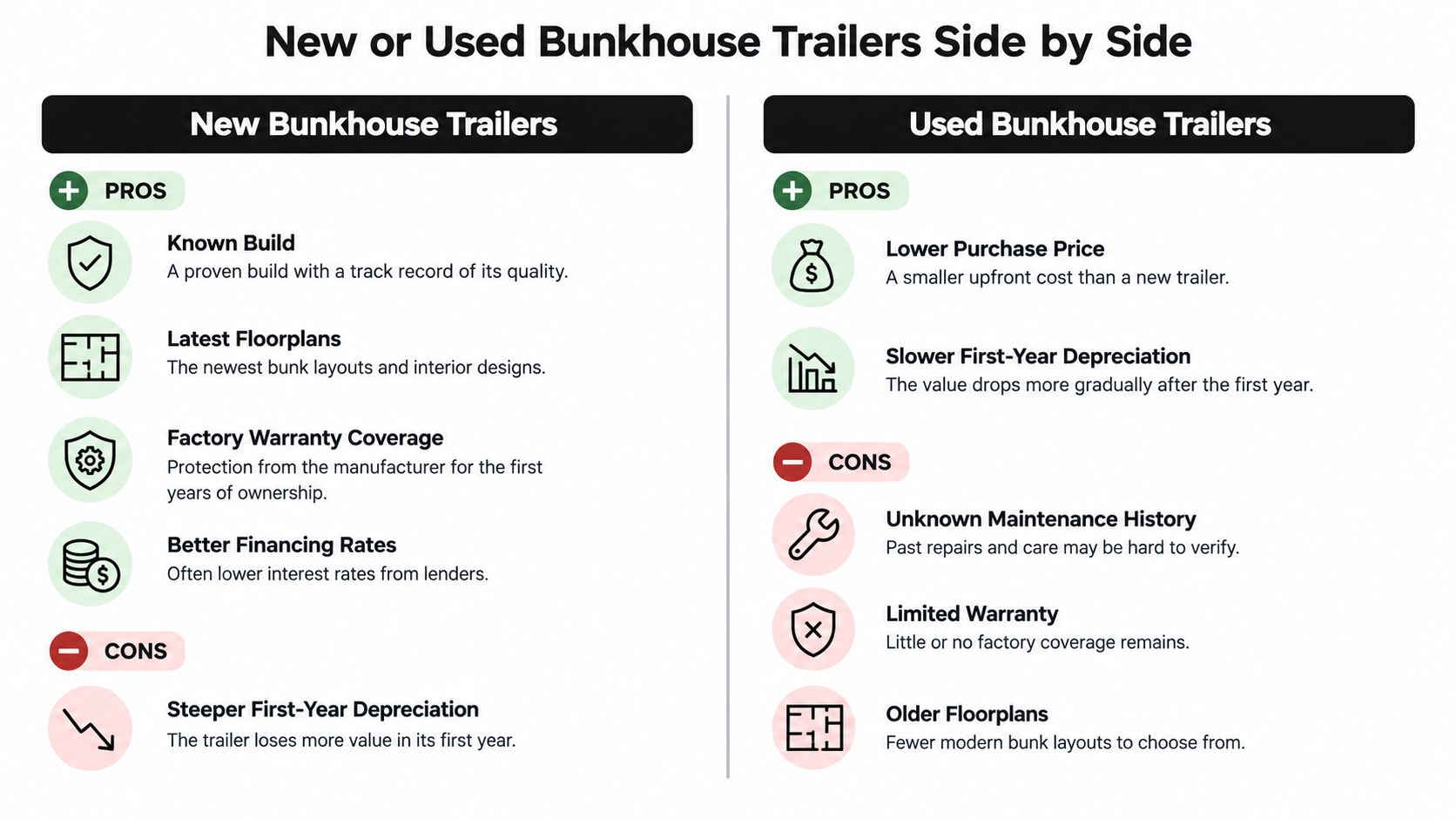
New gives you a known build, current bunk layouts, factory warranty coverage, and often better financing rates. The hit is steeper first-year depreciation. You're paying for the first owner to be you.
Used lowers the entry price, and an earlier owner has already tested the layout on real trips. You inherit more to inspect. Kids' gear scuffs bunk ladders, cabinet faces, and entry steps faster than a couple's trailer, so storage bays and bunk rails deserve a close look.
Used inspection, in the order that finds problems
Our used RV inspection checklist walks the same points. On the lot, I would start with the roof and the floor, not the furniture.
- Soft spots and stains: Press the floor near windows and under roof seams. A soft patch means water has already been inside.
- Slide seals: Run a hand along the rubber. Cracked gaskets leak on the first Wasatch rain.
- Water system: Fire the pump and the water heater. Listen for a pump that never shuts off.
- Axles and brakes: Look for leaking seals and uneven pad wear before you talk price.
- Tire date codes: Replace tires older than about six years even if the tread looks fine. Age, not miles, ends most trailer tires.
- Records: Ask for maintenance notes. A blank folder is a finding, not a neutral.
Motor Sportsland carries new and used inventory, Owner's Picks, and Deals of the Week, and the store takes trade-ins if your current trailer is the wrong length for the truck.
New fits families planning long trips who want warranty coverage on slides and appliances. Used fits families who want to test a layout or need a lower payment. Either way, get a pre-purchase inspection. A pretty bunk room doesn't tell you the roof's history.
Dealer Questions and Service Planning Before You Sign
Ask these before you sign, and write the answers on the spec sheet for that exact unit.
- Loaded numbers: What are the loaded weight, tongue weight, and GVWR, and can you see the certification label?
- Warranty: Which warranty applies, and what does it cover on slides, axles, and appliances?
- Pre-delivery inspection: Has this unit had one, and what did the tech check?
- Service scope: Does the shop handle plumbing, electrical, parts, installations, and collision repair for this brand?
- Timing: How long are typical appointments in May, when everyone wants the same bearing pack?
- Downtime: Is there a trade-in path or a rental if the unit is down before a booked week?
A Utah service year
Start with an annual inspection before the first trip. Check tire age and cold pressure, then bearings and brakes on the axle maker's schedule, not after a hot smell on Parleys.
Winterize before freezing nights on the Wasatch Front and at higher campgrounds. Blow the lines, drain the tanks, and don't trust a "we'll get to it in November" plan after the first hard frost.
Road salt on mountain routes and dust off the dry Great Salt Lake flats both chew at the underside. Rinse the undercarriage after those trips. The Motor Sportsland Service Center covers maintenance, repairs, and upgrades, and parts plus collision work stay with one shop if you'd rather not chase three vendors.
Skipping the first seasonal inspection, ignoring tire age, and waiting for a slide seal to drip are the mistakes that turn a cheap weekend into a missed reservation.
Confirm Campsite Fit and Next Steps
A bunkhouse you can't reserve is a driveway ornament. In a 2025 RV-travel survey from RV Trader, campground availability was a concern for 45% of respondents, and 45% planned trips less than two months ahead. Crowded campgrounds affected 59% once people were traveling. Spontaneous family weekends and tight Utah sites don't mix.
Reservation-fit checklist
- Loaded length: Trailer plus hitch, not the brochure body length.
- Tow vehicle length: Some pads count the truck in the site.
- Slide clearance: Both sides, with the awning out.
- Electrical service: 30-amp versus 50-amp before you book a two-air-conditioner floorplan.
- Road grade: The pull into the pad, not just the highway.
- Second vehicle: Whether the site allows the car that meets you Friday.
Utah's Yuba State Park states that a single campsite reservation includes one vehicle and one towing unit or tent, but not both or more. An additional vehicle may be allowed if space permits for $25 per night. North Beaches Campgrounds allow no extra vehicles. Sites 1 and 2 prohibit trailers. Read the exact loop, not the park name.
A smaller bunkhouse that fits more pads will get you out more often than a longer model few campgrounds can host. Keep a backup list, and confirm site dimensions with the campground. Peak-season pads at Jordanelle and Bear Lake fill early.
Loaded length in the right band, payload that covers your real family load, and a floorplan that matches who sleeps where: that's the buy. Visit the showroom, call for a consultation, browse inventory on motorsportsland.com, or start pre-qualification before the next school break.
Bunkhouse Travel Trailer Buyer FAQ
Can a half-ton truck tow a bunkhouse travel trailer?
Sometimes. Check payload on the door-jamb label, not just the tow rating. In the family-of-four example, a half-ton crew cab had only 30 pounds of margin once tongue weight, people, and cargo were added.
How much tongue weight should a bunkhouse trailer carry?
Plan for about 10 percent of loaded weight. A 7,000-pound trailer puts roughly 700 pounds on the hitch. Weigh it. Don't guess from the brochure.
Which length band should a family start with?
Start with the shortest band that sleeps your family, then confirm the tow vehicle in full. Extra feet you can't park don't help.
Do bunkhouse trailers reduce campsite options?
Often. Run the reservation-fit checklist, including slide clearance and a second vehicle, before you book.
Does towing lower fuel economy?
Yes, substantially. Federal test figures assume only 300 pounds of passengers and cargo, which is well under a packed family truck.
Is a used bunkhouse a safe buy?
It can be, with a pre-purchase inspection, tire date codes, and maintenance records. Pretty bunks don't prove the roof is dry.
Motor Sportsland helps Utah families match a bunkhouse travel trailer to a real tow vehicle, a floorplan that sleeps the kids behind a door, and campsites you can reliably reserve. Browse current inventory, ask about trade-ins and pre-qualification, or book service before the season starts. Visit Motor Sportsland in Millcreek or Spanish Fork and bring your door-jamb payload number.
