
Bunkhouse Travel Trailer Lightweight

Friday night usually exposes the truth about a family RV purchase. The bikes are by the garage, the coolers are already full, sleeping bags are stacked by the door, and someone still needs space for a dog crate. Your kids want separate beds, you want a private front bedroom, and your SUV or half-ton truck has a tow rating that looks promising. Then you check the trailer brochure and discover that the dry weight tells only part of the story.
A bunkhouse travel trailer lightweight model can be an excellent fit for Utah families, but only when you judge it as a loaded towing system. The right choice depends on real cargo capacity, loaded tongue weight, floorplan usability, mountain performance, and how often your family will use the trailer. The comparison below shows why two compact bunkhouses can feel very different behind the same tow vehicle.
| Representative compact bunkhouse | Dry weight | GVWR | Hitch weight | Cargo capacity | Length |
|---|---|---|---|---|---|
| Compact bunkhouse example | 2,540 lbs | 3,830 lbs | 330 lbs | 1,290 lbs | 17 ft 10 in |
| Compact 18-ft bunkhouse example | 2,615 lbs | 3,540 lbs | 250 lbs | 925 lbs | 18 ft |
These representative specifications come from a small bunkhouse trailer buyer's guide. The message is simple: the trailer with the lower dry weight isn't automatically the better family trailer.
Why Families Are Searching for a Lightweight Bunkhouse Travel Trailer
A family of four can fill a tow vehicle quickly. Two bikes go on the rack, the cooler takes up the remaining cargo space, and sleeping bags, camp chairs, food, clothes, tools, and a dog crate somehow need to fit around the passengers. At the campsite, the children still want their own bunks instead of sharing a converted dinette.
That's the shopping problem behind the phrase bunkhouse travel trailer lightweight. Parents want dedicated sleeping space without moving to a large fifth wheel or motorhome. They want a front bedroom, fixed bunks, a usable kitchen, and a bathroom, but they also want a trailer that fits the driveway and works with the vehicle already in the garage.
Modern small travel trailers commonly fall within an approximate 2,000 to 5,000-pound GVWR range, according to the history of small travel trailers from the RV Industry Association. A family bunkhouse builds on that compact platform by adding dedicated sleeping capacity. The result can make weekend camping practical for buyers who don't own a heavy-duty tow vehicle.
Why smaller can fit Utah family life
A lightweight trailer is easier to store, maneuver into a driveway, and position at a campground. It can also make short trips to places such as Jordanelle or Bear Lake less intimidating for a first-time owner. That matters when the trailer will be used for repeated weekends rather than one long annual vacation.
The trade-off is that lightweight construction usually means less room for water, cargo, and bulky equipment. A narrow bunkhouse may sleep the family comfortably while leaving little space for bikes, coolers, recovery gear, or outdoor cooking equipment. The floorplan has to match the way your family packs, not just the number of beds printed on the brochure.
The best lightweight bunkhouse isn't the smallest trailer your vehicle can move. It's the trailer your family can load without eliminating its safety margin.
How the Lightweight Travel Trailer Category Came to Exist
The lightweight trailer category began with a practical limit: families needed camping space, but their cars could not tow a heavy coach. During the 1920s, many trailers were built from wood and canvas, and builders kept them light because Ford Model T automobiles had limited towing power. During the 1930s, aluminum-bodied trailers, including aerodynamic teardrop designs, reduced structural weight and improved airflow while preserving usable interior space. The RV Industry Association's trailer history documents the design principle that still shapes compact bunkhouses.
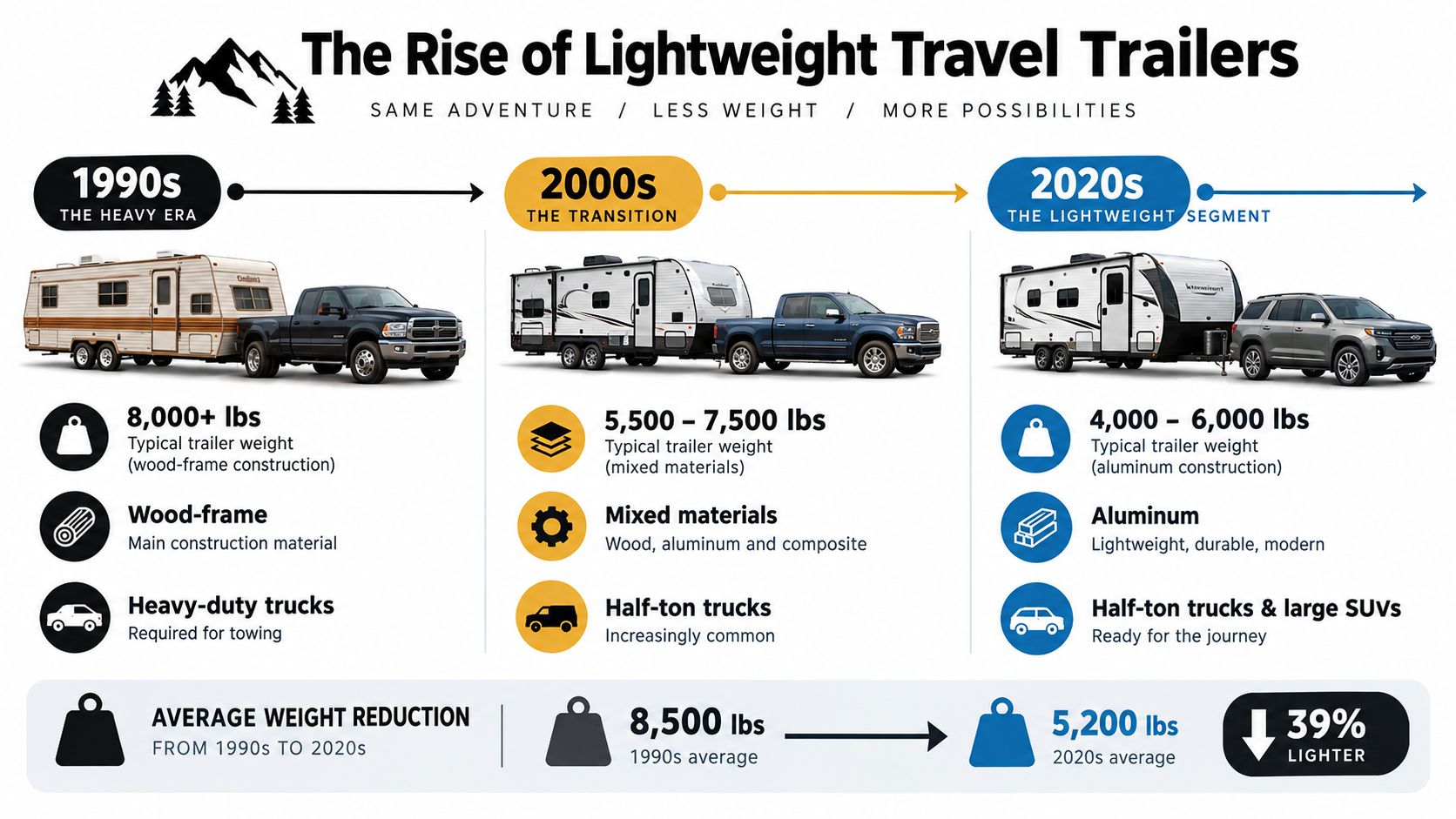
Today's manufacturers control weight with aluminum framing, laminated walls, composite panels, lighter roofing, and compact suspension systems. Those choices reduce mass, but they do not remove maintenance. Roof seals, water intrusion, axle loading, and fasteners still deserve regular inspection, especially before Utah's winter storage and mountain trips.
Floorplans changed along with materials
Lightweight construction changed the floorplan as much as the materials. Instead of giving most of the trailer to a large rear living room, a bunkhouse may use a front bedroom, rear bunks, a compact dinette, and a small slide. That arrangement gives children dedicated beds while keeping the trailer short enough for more driveways, SUVs, and half-ton trucks.
The trade-offs show up quickly at a campsite. Bunks can be narrow, the bathroom can feel tight, and pantry or exterior storage may leave little room for bikes, coolers, winter clothing, or recovery equipment. Inspect the battery, propane, fresh-water tank, and storage-compartment locations. Their placement affects tongue weight, and family gear can shift the trailer's handling on grades, wind, and snow-covered roads.
A lightweight bunkhouse is a purpose-built towing compromise. Choose one that leaves payload room for the people and equipment your family carries, rather than one that only looks light on its brochure.
Dry Weight vs Loaded Weight and the Hitch Rule Buyers Miss
Dry weight is the trailer's advertised weight before your family adds normal camping equipment. GVWR is the maximum allowed loaded weight, including the trailer, factory options, fresh water, holding-tank contents, personal belongings, and other cargo. Cargo-carrying capacity, or CCC, is the allowance left for those additions.
The yellow certification label deserves more attention than the brochure headline. Two compact bunkhouses can show similar dry weights yet leave very different room for water, batteries, food, clothing, and outdoor equipment, as shown in the earlier specifications table. Compare the label on the actual trailer, not a generic model description.
Lightweight bunkhouse weight math example
| Weight term | Definition | Example number | Why it matters |
|---|---|---|---|
| Dry weight | Trailer weight before normal trip cargo | 2,540 lbs | Useful for comparison, not a travel estimate |
| GVWR | Maximum loaded trailer weight | 3,830 lbs | Sets the upper limit for trailer loading |
| Cargo capacity | Available allowance for cargo and equipment | 1,290 lbs | Must cover water, propane, batteries, food, and gear |
| Hitch weight | Downward force placed on the tow vehicle | 330 lbs listed | Must fit within payload and receiver limits |
| Loaded trailer weight | Actual trailer weight on the road | Must be weighed | Determines whether the combination is properly matched |
Families burn through cargo capacity quickly. Water, propane, batteries, food, bedding, bicycles, firewood, and outdoor equipment all count. A bunkhouse also invites heavier loading because several travelers bring clothing, recreation gear, and supplies. Weigh the trailer after loading it for a real trip.
For stable towing, aim for approximately 10% of loaded trailer weight on the hitch. Ford's towing guidance for conventional trailers explains that too little tongue load can contribute to sway or jackknifing. Excessive tongue load can reduce front-wheel traction, steering response, and braking. A loaded 5,000-pound trailer therefore implies roughly 500 pounds of tongue load, before adding hitch hardware, passengers, and cargo carried in the tow vehicle.
Utah grades, crosswinds, and winter roads expose weak weight planning quickly. A trailer that feels acceptable on level pavement can become difficult when the vehicle is near its payload limit and the trailer is loaded unevenly.
Read the RV dry weight guide for Utah buyers before comparing models. Record the trailer GVWR, expected loaded weight, listed hitch weight, estimated loaded tongue weight, tow vehicle payload, and receiver rating. If any figure is missing, stop the purchase review until the dealer provides it.
Common Lightweight Bunkhouse Floorplans Compared
The number of beds doesn't tell you whether a bunkhouse will work on a Friday-night departure. Families need to examine access, storage, bed size, bathroom usability, and how often the dinette must become a bed.
| Floorplan | Sleeps | Bunk configuration | Best for | Trade-off |
|---|---|---|---|---|
| Rear-bunk double | Family-oriented capacity | Two fixed bunks, often stacked | Repeated weekend trips | Rear storage and bathroom space can be tight |
| Front-bunk with rear dinette | Flexible sleeping arrangement | Bunks concentrated at one end | Families needing convertible living space | The dinette may need nightly conversion |
| Triple-bunk with outside kitchen | Higher sleeping capacity | Multiple stacked bunks | Families carrying cooking gear outdoors | Taller bunks can reduce storage and ventilation flexibility |
| Single-bunk with slide | Lower dedicated bunk capacity | One or two compact bunks with slide-out living area | Small families wanting more daytime room | Less private sleeping space for children |
The Utah bunkhouse floorplan guide offers useful layout context, but the lot inspection is where the decision gets made. Lie on the bunks. Check whether a child can climb down without stepping on another sleeper. Stand in the kitchen with the bathroom door open. Ask whether one adult can prepare breakfast while the children move through the trailer.
Match the floorplan to trip cadence
A rear-bunk double often makes sense for families taking short trips because the beds stay ready. A front-bunk layout with a rear dinette may offer better shared living space, but it asks more of the family at bedtime. A triple-bunk model may solve sleeping capacity while creating taller, less accessible bunks and a greater need for thoughtful loading.
Slides add floor space, but they also add mechanisms, weight, and setup steps. A no-slide layout can be easier to level and maintain, while a slide may make rainy afternoons more comfortable. Check whether the refrigerator, bathroom, and bunks remain reachable with the slide closed. That detail matters during fuel stops and roadside breaks.
A family that carries bikes, coolers, generators, or powersports equipment should prioritize exterior storage and usable cargo capacity over one more sleeping position. Sleeping capacity is only valuable if the family can bring the equipment that makes the trip enjoyable.
Matching the Trailer to Your Tow Vehicle the Right Way
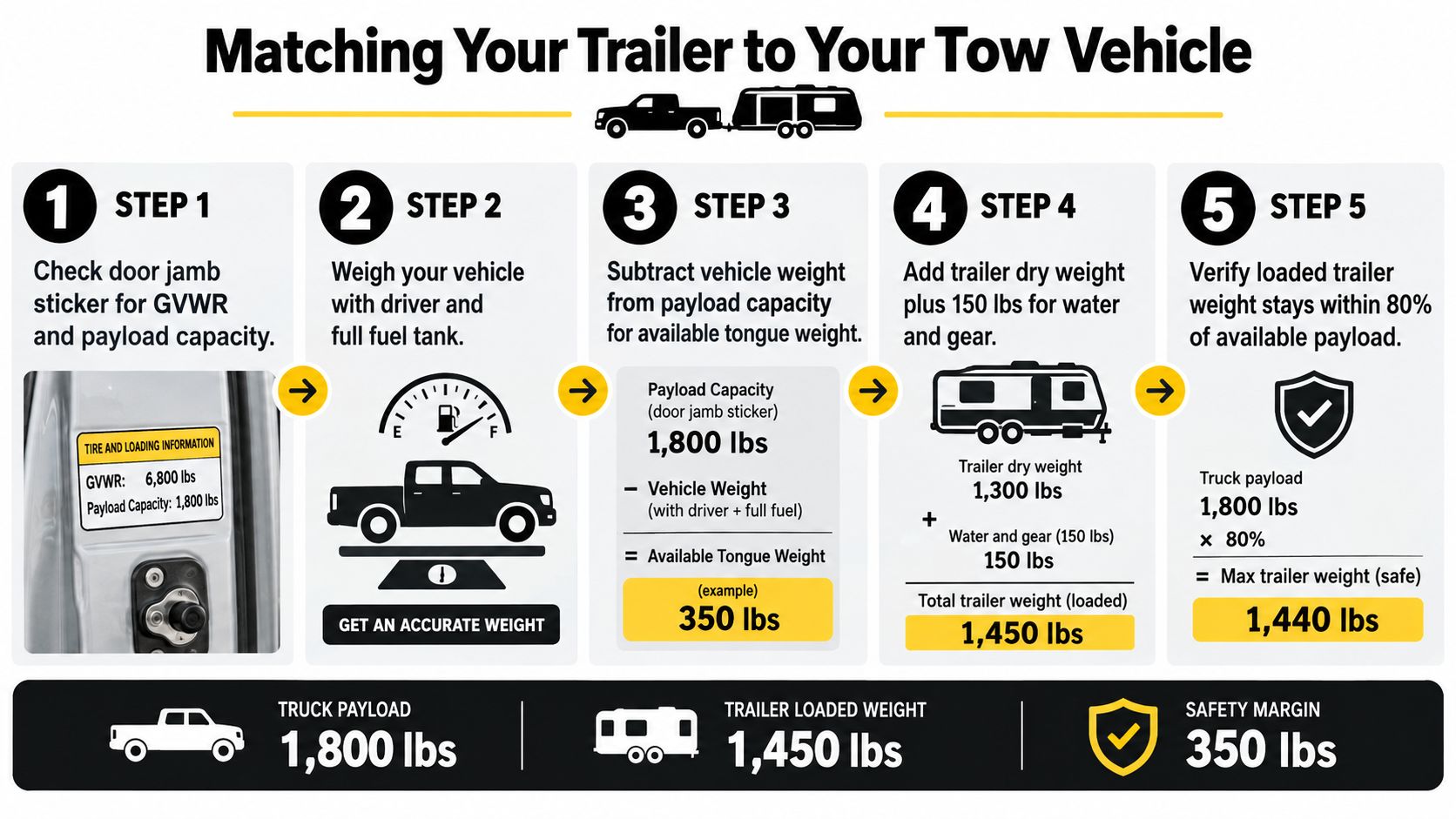
Start with the tow vehicle's door-jamb payload label, not the headline maximum trailer rating. Payload includes passengers, cargo, accessories, hitch equipment, and the trailer's tongue load. The owner's manual supplies the exact tow rating, maximum tongue weight, axle ratings, and other limits for that vehicle.
Use this worksheet before visiting a dealership:
- Record the vehicle payload. Copy the number from the door-jamb label.
- Subtract the people. Include the driver, passengers, and any regular travel companion.
- Subtract vehicle cargo. Count tools, coolers, pets, recovery equipment, and aftermarket accessories.
- Reserve capacity for the hitch load. Use the expected loaded tongue weight, not the brochure hitch weight.
- Check every rating. Confirm the vehicle GVWR, GCWR, GAWR, tire limits, receiver rating, and the trailer's loaded GVWR.
- Weigh the finished combination. A public scale is the most reliable way to confirm the match.
A vehicle can remain below its maximum tow rating while exceeding its payload or axle rating. The towing safety rules and rating guide reinforces the need to compare the loaded trailer with the door-label payload and the vehicle's complete rating set.
Three numbers belong on your worksheet
Write down the loaded trailer weight, loaded tongue weight, and remaining tow vehicle payload. If the trailer's rear bunks hold heavy equipment, recheck the tongue weight after loading. Concentrating cargo at the rear can reduce effective tongue weight and make sway more likely.
For a second perspective on vehicle limits, review these Lounge Wagon towing tips. Use that resource as a supplement, not a substitute for the tow vehicle manual, door label, trailer certification label, and scale reading.
A weight-distribution hitch may improve control when the trailer and tow vehicle permit its use. It doesn't increase the vehicle's legal payload or tow rating.
The guide to calculating towing capacity can help organize the numbers. Don't rely on a label such as “SUV-towable” until the loaded family combination has been checked.
Why the Best Lightweight Bunkhouse Is the One With Payload to Spare
The lowest dry weight is often the least useful number on the sales sheet. A bunkhouse listed at 4,200 pounds dry can reach about 5,400 pounds loaded, according to the verified buyer guidance for lightweight bunkhouses. That difference comes from water, food, bedding, batteries, propane, bikes, and personal gear, and it all affects the tow vehicle's frame, axles, tires, brakes, and drivetrain.
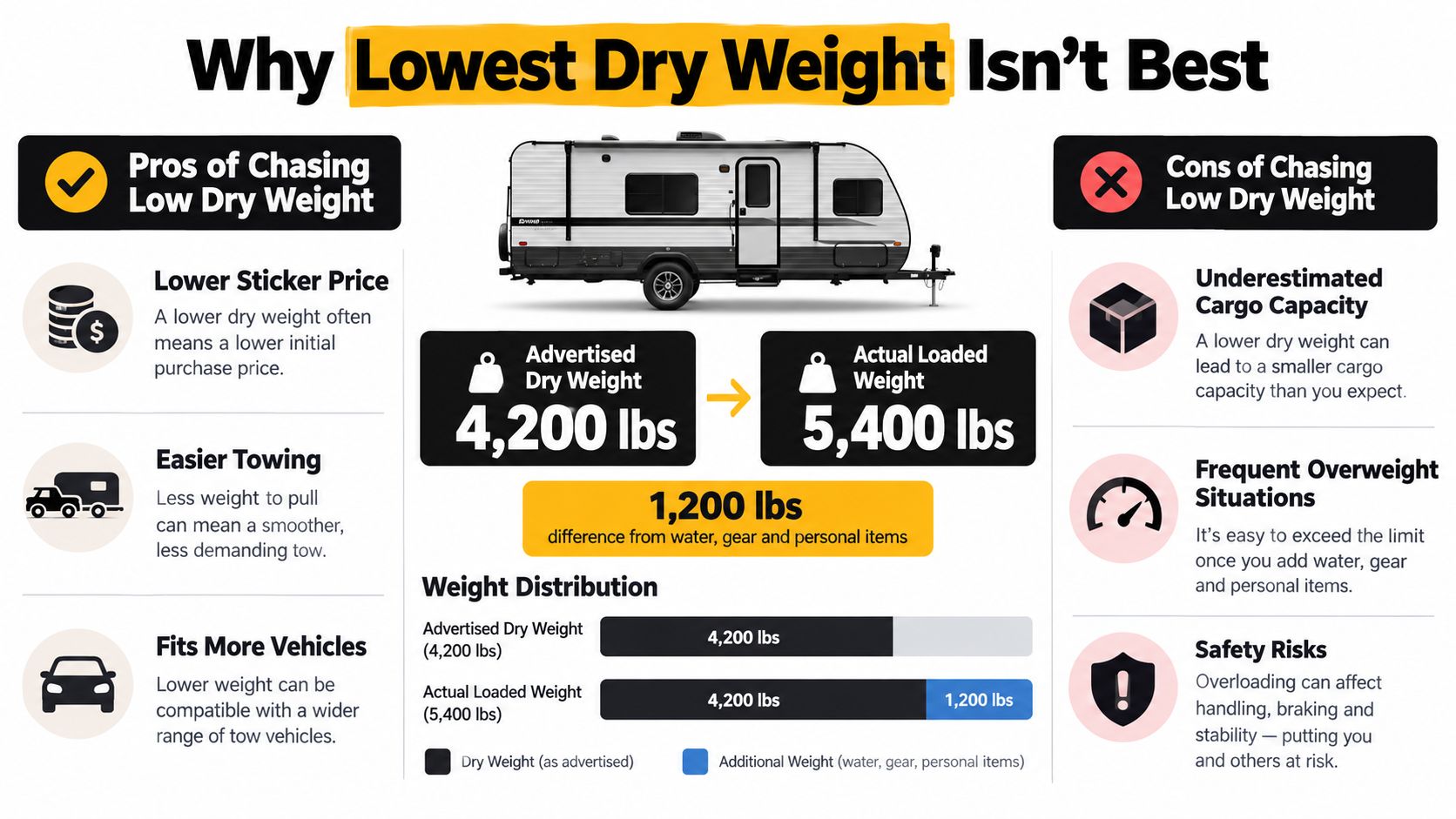
A better buying rule is to choose the trailer that leaves real-world payload margin after loading, not the one with the most attractive unloaded figure. That margin gives you flexibility for an extra cooler, wet clothing, sports equipment, or a last-minute grocery stop. It also reduces the temptation to leave essential equipment behind every time you travel.
Payload margin changes the ownership experience
A properly matched combination typically feels more settled under braking and less strained on grades. A poorly matched combination may hunt through gears, feel light at the front axle, or require constant correction in crosswinds. Those symptoms deserve attention before a family commits to mountain travel.
Before signing paperwork, ask for:
- The trailer's yellow weight label, not only the brochure dry weight.
- The loaded hitch estimate, including propane, batteries, and expected front storage.
- The tow vehicle's remaining payload after passengers and cargo.
- A scale plan for checking the combination once it's packed for a real trip.
- The trailer's axle and tire ratings, especially if the family carries heavy equipment.
A lightweight bunkhouse should make camping easier, not force the family to ration every item. If your normal gear consumes nearly all available capacity, step down in equipment or choose a trailer with a larger margin. The slightly heavier trailer that carries your actual lifestyle can be the safer, calmer choice.
Utah Mountain, Winter, and Highway Realities for Towing
Utah roads expose weak towing matches quickly. A trailer that feels acceptable on a flat road near the Great Salt Lake can demand more braking, cooling, and gear management on a mountain route. The trailer's lower scale weight doesn't make it handle like an unloaded SUV.
On grades, select a gear that keeps the tow vehicle controlled without constant brake application. Descents require early braking and a functional trailer brake system. Before leaving Salt Lake City for a mountain campground, inspect the trailer tires, wheel bearings, brake wiring, brake magnets, and breakaway battery.
| Utah condition | Loaded weight adjustment | Tire and brake setting | Practical move |
|---|---|---|---|
| Mountain climbs | Stay within the loaded ratings with clear reserve | Use a lower gear and monitor temperature | Plan for slower climbs rather than forcing speed |
| Long descents | Avoid adding unplanned cargo | Apply trailer brakes smoothly and early | Test brake response before the grade |
| Crosswinds on exposed highways | Keep heavy cargo low and centered | Confirm tire pressure when cold | Reduce speed and avoid abrupt steering |
| Snow and ice | Travel with only necessary fluids and gear | Maintain tires and trailer brakes | Check road and traction conditions before departure |
| Freezing shoulder-season camping | Keep vulnerable water systems protected | Use equipment appropriate for the forecast | Drain or winterize as conditions require |
Utah transportation guidance advises drivers on snow and ice to reduce speed and brake early, slowly, and correctly. In severe conditions, traction devices such as chains or snow socks may be required, while Three-Peak Mountain Snowflake tires on all wheels are identified as an acceptable traction option under applicable guidance. Review UDOT winter traction and road information before departure.
Loading matters more on exposed routes
Place dense cargo low and close to the trailer axles, while maintaining appropriate hitch weight. Don't fill rear bunks with the heaviest equipment just because the space is convenient. Secure bikes, coolers, and batteries so they can't shift during braking or a sudden lane change.
For winter travel, keep fresh water and waste tanks empty when freezing temperatures are forecast unless the trailer is properly equipped and prepared for those conditions. Check seals, furnace operation, battery condition, and tire age before storing the trailer or heading toward the Wasatch Mountains.
Choosing Your Lightweight Bunkhouse and Next Steps With Motor Sportsland
Treat the dealership visit as a verification appointment, not a casual browsing trip. Bring your tow vehicle payload number, passenger weights, normal cargo list, trailer GVWR, listed hitch weight, and the route you expect to drive. A salesperson who skips those details isn't helping you make a sound purchase.
Use this final checklist:
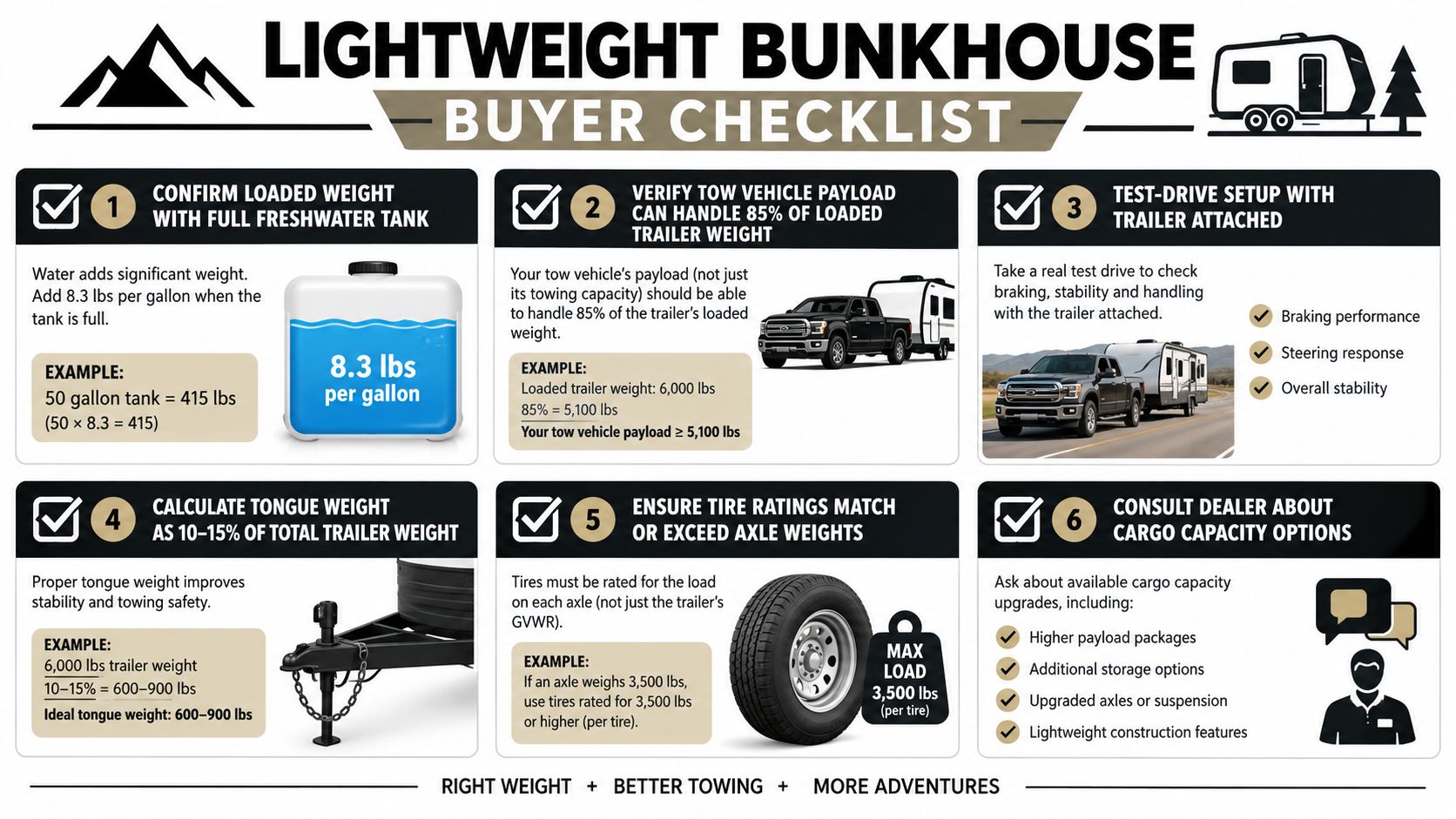
- Confirm loaded weight. Start with the trailer's certification label and account for normal camping equipment.
- Verify tow vehicle payload. Include the driver, passengers, hitch, accessories, and expected tongue load.
- Inspect the actual floorplan. Check bunks, bathroom access, kitchen movement, storage, and slide operation.
- Evaluate the hitch load. Keep the loaded tongue weight appropriate for stable conventional towing.
- Inspect tires and brakes. Check tire age codes, tread, inflation, brake wiring, and brake magnet wear.
- Plan a scale visit. Weigh the loaded combination after your first realistic packing job.
- Ask about service access. Confirm how routine maintenance, plumbing, electrical work, and brake repairs will be handled.
Motor Sportsland serves Utah buyers from locations in Millcreek and Spanish Fork, with new and used RV inventory, service, parts, repairs, installations, financing, and trade-in options. The team can help compare lightweight bunkhouse layouts and review the towing numbers before delivery, but you should still confirm all ratings in the vehicle and trailer documentation.
Lightweight bunkhouse questions buyers ask
Can a 5,000-pound bunkhouse be towed by most half-ton trucks?
Not automatically. Compare the trailer's loaded GVWR and expected tongue weight with the truck's payload, axle ratings, receiver rating, tire limits, and owner's-manual tow rating. Passengers, accessories, and cargo can make payload the limiting factor even when the trailer appears to fit the headline tow rating.
How often should I reweigh a loaded trailer?
Weigh it after the first realistic loading session, then recheck after major changes such as adding batteries, carrying bikes, changing water habits, or moving heavy equipment to the rear bunks. A public scale provides better information than guessing from dry weight.
What warranty items should I check before delivery?
Run every appliance, inspect plumbing for leaks, test lights and brake wiring, confirm slide operation, examine roof and exterior seals, check tire condition, and verify that the brake controller responds correctly. Ask the service department to document unresolved issues before you leave.
Should I choose a slide-out in a lightweight bunkhouse?
Choose a slide if the added living space improves your regular trips and the loaded ratings still leave useful payload margin. Choose a no-slide layout if you value simpler setup, lower complexity, and easier access during roadside stops.
What should Utah buyers inspect before winter storage?
Protect the plumbing, check battery condition, inspect roof and body seals, maintain tires, and follow the manufacturer's winterization procedure. Don't assume a lightweight trailer is immune to freeze damage or mountain weather.
Our team can compare lightweight bunkhouse floorplans, check the towing numbers against your family's actual gear, and arrange a service inspection before delivery. Visit Motor Sportsland to browse current inventory and schedule an in-person walkthrough for your Utah trips.
