
Class C Campers with Bunk Beds: 2026 Floorplan Guide

You're loading bikes in Salt Lake City on a Friday afternoon, planning a Wasatch loop to Jordanelle and then Bear Lake, and your kids are already arguing about who sleeps where. That argument is exactly why families shop for Class C campers with bunk beds. The promise is simple. Each child gets a fixed bed, you get a private queen, and nobody has to rebuild the dinette at 10 p.m. in the rain.
Don't buy on that promise alone. The advertised sleeping count is the least useful number on the window sticker. The numbers that decide whether a bunkhouse works are safe belted seats, remaining cargo payload, and cost per night at the nights you'll realistically use it. Our team walks Utah families through those three checks before we talk about colors, slideouts, or outdoor kitchens.
Class C Bunkhouse Models Compared by Size and Price
Class C units have gained a larger share of motorhome sales, even as towable RVs dominate overall sales. In RV.com's history of the rise of the Class C, Class C's share of motorhome sales is reported to have risen from 42% in 2015 to 60% in 2025. For a family choosing a bunkhouse, that growth is less important than matching the floorplan and weight to the way you travel.
A family of five leaving Salt Lake City for Bear Lake might prefer a compact unit that parks more easily at a state park and feels more manageable on the road. A full-size bunkhouse can give an older child a fixed bed instead of a sofa, but adds weight behind the rear axle on Logan Canyon grades. Judge length, sleeping layout, and weight together.
Class C Bunkhouse Size Tiers at a Glance
| Size tier | Typical length | Sleeps | Chassis reference |
|---|---|---|---|
| Compact bunk Class C | 22-25 ft | 4-6 | Ford E-Series cutaway, lower GVWR tier |
| Mid-size bunkhouse | 27-29 ft | 6 | Ford E-Series cutaway, mid GVWR tier |
| Full-size bunkhouse (31H-style) | 31 ft | up to 8 | 14,500 lb GVWR, 22,000 lb GCWR |
Use the ranges as a starting point, not a buying decision. The compact tier often combines an over-cab bunk with a convertible dinette or sofa to reach its sleeping count. The mid-size tier adds fixed bunks without a full rear bedroom suite. A full-size 31H-style tier may combine a private queen bed, dual bunk beds, and three convertible sleeping areas. Its advertised capacity of eight describes potential sleeping places, not how many people can ride safely or travel comfortably with their gear.
Price varies with chassis, slideouts, and options, so check the specific unit against current inventory. Used bunkhouses typically cost less than comparable new units, but a low purchase price can disappear quickly if the tires are worn, the batteries are old, or service records are missing. Inspect condition and records before treating a used unit as a bargain.
Length alone does not tell you how usable the beds are. One brand may count a short dinette as two sleeping places, while another counts it as one. Measure the bunk, sit up in it, and check whether bedding stays in place when the slide comes in.
Dealership rule: When a salesperson says it sleeps eight, ask how many belted seats it has and how much cargo capacity remains. Those answers matter more than the floorplan's headline count.
Pros and Cons Worth Weighing
- Dedicated beds for children: Kids can keep pillows, books, and chargers in place instead of clearing the dinette twice a day.
- Single integrated cab and living space: Pull into a Great Salt Lake shoreline site, level, and make dinner without unhitching.
- Drivable layout: Many first-time buyers find a Class C easier to learn than backing a long trailer into a tight Bear Lake site.
- Higher rear-axle weight: Bunks, pantry stock, and passengers can add weight behind or over the rear axle.
- Fewer belted seats than beds: Sleeping capacity and riding capacity are different counts.
- Fixed costs favor frequent use: Insurance, registration, and maintenance continue whether you camp or not. For trips lasting only a few weeks a year, compare those ongoing costs with how often the family will in practice use the RV.
Bunk Layouts and Where Each Sleeper Actually Sits
Bunk placement decides bedtime friction, bathroom access, and who wakes up when someone climbs down at 2 a.m. Walk each layout with your actual kids if you can. A bunk that looks generous in a photo can feel tight once a ten-year-old tries to roll over with a sleeping bag.
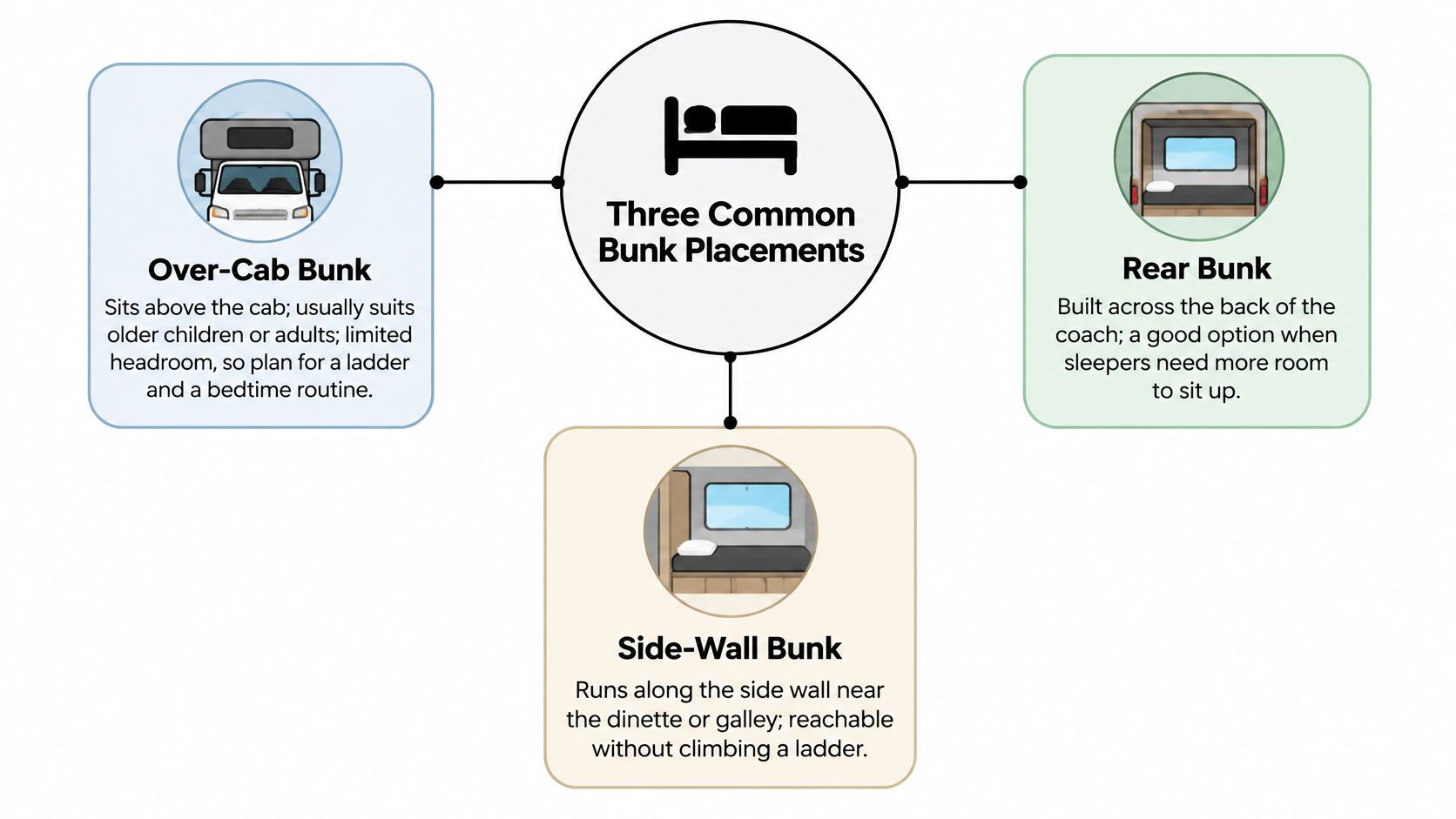
The diagram below maps the three placements you'll see most often on our lot.
Over-Cab Bunks
The over-cab bunk sits above the driver and passenger seats. It's the defining Class C sleeping zone and it usually suits older children or a single adult best. Headroom is limited, ventilation can be poor on hot Moab nights, and there's no quick exit without a ladder.
Check the ladder hooks, weight rating, and where the ladder stores while driving. If your child can't climb down half asleep without stepping on the dinette cushion, you've found a nightly problem. Some families use this space for storage on couples trips, which is fine, but don't count it as a child's bed until the child proves it works.
Rear and Side Bunks
Rear bunks sit at the back of the coach, often stacked along a wall or across a corner. They're the most private option, especially with a curtain or door, and they double as gear storage when kids aren't along. The tradeoff is weight and access. A rear bunk can block a closet, narrow the bathroom door swing, or load the rear axle when you fill under-bunk storage with tools and camp chairs.
Side or dinette-convertible bunks save permanent floor space. They also cost you setup time every night, commonly ten to twenty minutes once you add bedding, and they eliminate your seating while someone sleeps. For a family of four, two fixed bunks often beat a dinette that technically sleeps two more. Fixed beds mean earlier bedtimes, less argument, and a table that stays a table.
In larger floorplans, a private queen plus dual bunks lets parents close a door. If a king bed matters more than fixed bunks, compare that tradeoff in our guide to choosing a Class C layout with a larger primary bed before you decide which room gets the space.
Bring a tape measure. For a child ten or older, check bunk length, width, sit-up height, outlet access, and reading light position. Sit on each bunk yourself, climb the ladder, open every nearby door, and convert the dinette while someone stands in the aisle. If the aisle disappears during conversion, bedtime will frustrate you every trip.
Counting Safe Seats Before Counting Beds
A bunkhouse may sleep six at a campsite and still be the wrong coach for a family of six on the road. Beds tell you how many people can sleep inside. The number of safe, usable belted seats tells you how many can travel together. Check both before comparing floorplans.
The American Academy of Pediatrics guidance summarized by HealthyChildren.org on safe RV travel with children recommends that every passenger ride in a forward-facing vehicle seat equipped with a seat belt. It advises against using side-facing and rear-facing benches while the motorhome is moving. The guidance also says car seats and booster seats are approved only for forward-facing vehicle seats using a seat belt or an approved lower-anchor attachment.
A visible belt on a jackknife sofa does not automatically make that spot suitable for a child. Check the seat's direction, belt fit, and attachment points. Rear dinette and sofa structures are often built cabinetry, so ask what each belt anchors to before you trust it.
Why Rear Seats Need More Scrutiny
The driver and passenger seats are easy to identify. Rear dinette and sofa positions take more checking because the belt alone does not tell you whether the seat is approved for travel or suitable for your child's restraint.
Ask the dealer to show you the manufacturer's seating documentation and identify each designated travel position. Check the child-restraint manufacturer's instructions, too. If the salesperson cannot show documentation for a position, do not count it as a usable seat.
A bunk is never a riding position. If it is flat for sleeping, it is off limits while the coach is moving.
Five Checks for Every Walkthrough
- Count forward-facing belted seats. Write the total on the floorplan sheet before discussing sleeping capacity.
- Check belt orientation on each dinette and sofa. Forward-facing, rear-facing, and side-facing positions are not interchangeable.
- Ask for manufacturer seating documentation. Confirm designated travel positions in writing.
- Test your actual child seat. Bring it along, install it, check the belt path and tether availability, and make sure the child can sit without the table edge in the way.
- Mark sleep-only positions. Treat over-cab bunks, rear bunks, and converted dinettes as parked-only spaces.
Then compare safe seats with your number of travelers. If safe seats are fewer than travelers, choose a floorplan with enough approved positions or plan for someone to ride in a separate passenger vehicle. A sleeping position does not fill a seat-count gap, and a side-facing sofa with a lap belt is not a substitute for a forward-facing travel seat.
A coach advertised to sleep eight may still be a poor fit for a family of six if it cannot carry all six in approved travel positions. Count the seats first, then decide whether the bunkhouse fits your family.
Weight, Towing and Mountain Driving Limits
Cargo capacity ends more bunkhouse plans than floorplan size does. Start with the ratings table, then run the payload math for your family, water, food, and trailer.
| Rating | What it limits | Where to find it | Common mistake |
|---|---|---|---|
| GVWR | Maximum loaded weight of the coach | Certification label and door jamb | Using the brochure dry weight instead |
| Front and rear GAWR | Weight each axle can carry | Door jamb sticker | Ignoring rear loading from bunks and pantry |
| GCWR | Coach plus trailer combined weight | Specification sheet | Subtracting empty weight rather than loaded weight |
| Cargo capacity (31H reference, about 2,200 lb) | Passengers, gear, water, propane and options | Calculated from loaded weight | Forgetting fresh water and bedding |
| Hitch and tongue weight limit | Vertical load on the hitch | Hitch label and trailer specs | Overloading the rear of the trailer |
| Trailer tow rating | Maximum trailer weight | Manufacturer towing guide | Assuming the advertised maximum with a full family aboard |
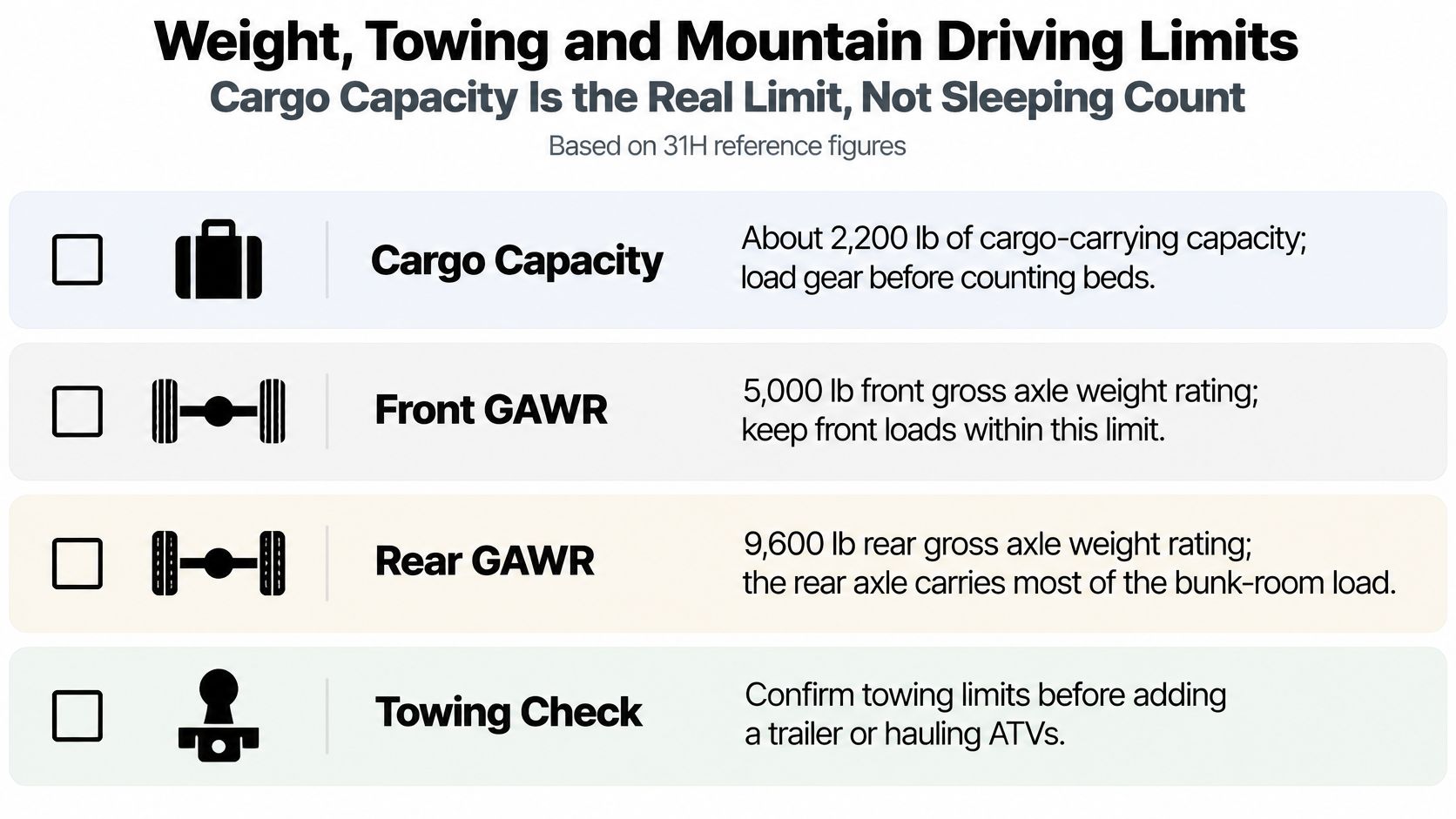
The checklist below puts the 31H reference numbers in one place for a scale visit.
Run the 31H Payload Math
In the published 31H-style specifications in the Freelander Class C brochure, the Ford-based chassis lists a 14,500 lb GVWR, 9,600 lb rear-axle rating, and 22,000 lb GCWR, with approximate cargo-carrying capacity of about 2,200 lb. The same specification set lists a 5,000 lb front GAWR.
That 2,200 lb covers passengers, clothing, food, options, propane, fresh water, bedding, tools, and hitch load. A full 44-gallon freshwater tank adds roughly 367 lb before anyone packs a suitcase. Add four passengers, a stocked pantry, bunk bedding, camp chairs, bikes on a rack, and a trailer tongue pressing down behind the rear axle. You'll see why rear GAWR matters more in bunk models than in a short couples coach.
Weigh the loaded coach at a certified scale. Compare total weight and each axle against the door-jamb sticker. Confirm whether the advertised cargo figure assumed full fuel, propane, and installed options. Guessing from a brochure dry weight is how families discover they're overloaded at the worst moment, usually with a full tank heading up a Wasatch grade.
Towing Behind a Loaded Bunkhouse
GCWR is the controlling benchmark. Loaded coach plus loaded trailer must stay under it, and the hitch vertical-load limit still applies separately. The 2026 Ford E-Series Towing Guide defines maximum trailer weight as GCWR minus vehicle gross weight, or 10,000 pounds, whichever is less, and Ford's stated maximum assumes a 150-pound driver and a 150-pound passenger.
Your family load will exceed that assumption. That's normal, but it reduces available trailer weight pound for pound. Our deeper walkthrough of Class C towing ratings and loaded weight math is worth reading before you promise to haul a boat to Bear Lake.
Trailer balance matters just as much. The 2025 Ford E-Series Towing Guide identifies an 82-square-foot maximum trailer frontal area for E-Series cutaway combinations and recommends placing approximately 60% of allowable cargo weight in the front half of the trailer and 40% in the rear. Load ATVs and coolers low and forward, measure tongue weight, and don't let a rear-heavy trailer wag a long-overhang coach through crosswinds near the Great Salt Lake.
Before Parley's Canyon, check tire pressures cold, brake controller gain if you're towing, and coolant condition. Our service team can verify hitch ratings and inspect brakes, belts, and tires during a pre-trip visit.
What a Bunkhouse Class C Costs Per Night
A bunkhouse can sleep a crowd and still cost too much per trip. Judge the purchase by the nights you will use it, then check whether your family can ride in its belted seats and carry its gear within the coach's payload. Beds set the sleeping count. They do not make the ownership math work.
A 2025 analysis in the Charlotte Observer citing RV Industry Association owner-profile data found that Class C owners used their motorhomes for a median of 21 nights per year. Estimated annual ownership costs were about $9,840 for a Class C stored at home, or about $469 per night before fuel and campground fees.
Fixed Costs Versus Trip Costs
Fixed costs include financing, insurance, storage if you cannot park at home, registration, depreciation, tires aging out, batteries, roof sealing, and routine chassis maintenance. Most remain even when the coach sits beside your house all winter.
Trip costs include fuel, campground fees, propane, dump fees, food, and mileage-driven wear. Add both categories before comparing ownership with renting or a towable. A low fuel budget cannot offset fixed costs when the coach gets little use.
| Option | Nights per year | Per-night cost basis |
|---|---|---|
| Owned Class C, stored at home, industry median | 21 | About $9,840 fixed costs ÷ 21 nights = about $469 per night, before fuel and campgrounds |
| Owned Class C, heavier use | 40 | About $9,840 fixed costs ÷ 40 nights = about $246 per night, before fuel and campgrounds |
| Rented RV, family of four, one-week trip | 7 | Your quoted rental total ÷ 7 nights, plus fuel, campgrounds, and other trip costs |
| Hotel rooms for four, one-week trip | 7 | Your quoted room total ÷ 7 nights, plus a separate vehicle and meals |
| Towable trailer with existing truck, comparison case | 21 | Your quoted annual trailer fixed costs ÷ 21 nights, plus trip costs; excludes the already-owned truck |
Use actual quotes for your travel dates. Divide the rental total and hotel room total for a one-week trip by 7 nights to get each per-night figure. For a towable, divide the annual trailer costs you expect to pay by 21 nights for this comparison, then add trip costs. Holiday dates and quieter travel days can produce very different quotes.
For the owned Class C, divide annual fixed costs by your realistic nights of use, then add fuel, campsites, and propane per night. Compare the result with rental and towable quotes for the same trip. Run the hotel comparison for two, four, and six travelers; six may require two rooms. Also confirm that every traveler has a safe belted seat and that the remaining cargo payload covers your family's gear.
Break-even rule: Ownership makes financial sense against renting when its per-night cost, including fixed and trip costs, falls below the rental quote for comparable travel. If it does not, rent or compare a towable before signing.
Choose a bunkhouse when frequent multi-night trips, youth sports, family reunions, or national park loops will give it regular use, and its seats and payload suit your family. Renting often fits one big trip a year. A towable may suit you if you already own a capable truck and can handle towing and hitching. Used inventory, a trade-in, and warranty coverage can improve the ownership numbers, but they cannot make a coach that sits most of the year inexpensive per night.
Matching a Bunk Floorplan to Your Family's Trips
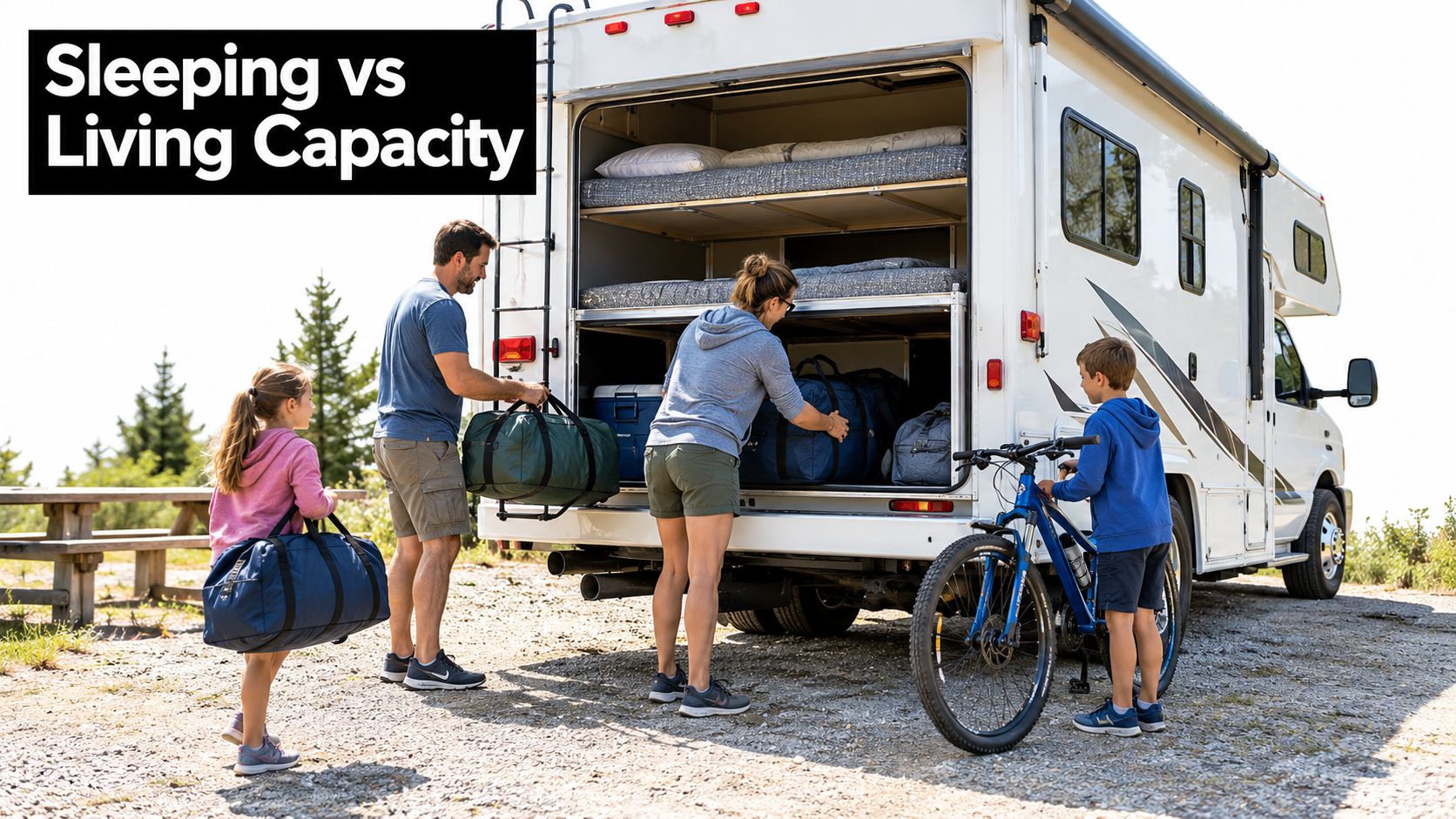
Run a sleeping capacity versus living capacity test. Living capacity means seats, storage, tank space, aisle room, and places for wet boots. A coach can pass the bed test and fail the living test by Friday night.
Class C ownership already skews toward first-time buyers. The RV Industry Association's 2021 Go RVing profile summarized in the Missouri state parks RV-industry report found Class C units represented the choice of 39% of first-time RV owners, 22% of young families, and 30% of millennial and Generation Z buyers. Recent young-family data in RVIA's young families and RV lifestyle report shows families use RVs a median of 30 days annually, take about seven trips per year, and 25% also bring ATVs, while bicycles are brought by 44%.
The photo below shows the part brochures skip. Exterior storage has to swallow the gear that made you buy bunks in the first place.
Match the Layout to the Trip
- First-time family of four, Jordanelle and Deer Creek weekends: Prioritize two fixed bunks and a usable dinette. Check bike storage and exterior compartments first. Watch freshwater weight if you'll dry camp.
- Grandparents with two grandchildren, Bear Lake and Logan Canyon for a week: Prioritize rear bunks with privacy and easy bathroom access. Check pantry volume and refrigerator size. Watch ladder safety for younger kids.
- Family hauling ATVs to Moab or the San Rafael: Prioritize payload and GCWR margin over extra convertible beds. Check hitch rating and trailer balance. Watch rear-axle load with fuel, water, and gear.
- Family of six on national-park trips: Prioritize forward-facing belted seats for every rider. Check black and gray tank routines and bunk dimensions for teens. Watch campsite length limits.
For short Great Salt Lake shoreline trips, a compact unit often suffices because you're outside most of the day and home in two nights. For a week with strollers, ski gear, or powersports equipment, storage becomes the floorplan.
If cargo is your main need, compare a bunk layout against a toy hauler before you commit. Our comparison of driving a Class C versus towing a travel trailer helps if your truck, storage, and campsite style point the other way.
The walkthrough video below is useful for spotting aisle pinch points and storage you'll miss in still photos.
Confirm Your Floorplan at Motor Sportsland
Bring three checks to any lot, including ours. First, count safe belted seats and test your child seats. Second, confirm payload and axle margins from the door-jamb sticker and plan a loaded scale weight. Third, run cost per night at your expected nights, not at the nights you hope for in a perfect summer.
Visit our Millcreek or Spanish Fork showroom, browse current bunkhouse inventory, Owner's Picks, and Deals of the Week on motorsportsland.com, or call our team for a personalized consultation. Ask us to show the seating documentation, cargo label, tire dates, and service records on any unit you're serious about. Financing and pre-qualification are available, and our Service Center handles pre-trip inspections, hitch checks, installations, and winter storage preparation.
For shoppers comparing dealer networks and repair access before a long Mountain West season, dealer support from Class A RV Repairs is another resource to review alongside local service options.
Don't rush the walkthrough. Convert the dinette, climb the ladder, sit in every belted seat, and open every exterior bay with your own gear list in hand.
Common Questions About Class C Bunkhouse Campers
How Many People Can Ride Safely in a Bunkhouse Class C
Count forward-facing belted seats, not bunks. If safe seats are fewer than travelers, someone rides separately or you pick another floorplan. Bring child seats and test the exact positions.
What Is the Cargo Capacity of a 31H-Style Bunkhouse
The reference figure is about 2,200 lb, shared by passengers, water, propane, bedding, food, and hitch load. A full fresh tank alone uses a meaningful share. Weigh the coach loaded and compare both axles to the sticker.
Does a Bunkhouse Class C Cost Less Per Night Than a Hotel
Only at high use. At low annual nights, fixed ownership costs spread poorly and renting can win. At frequent multi-night use, especially for larger families needing multiple rooms, ownership can pull ahead.
Which Bunk Position Suits Children Best
Rear bunks suit most children because they're more private and easier to reach. Over-cab bunks suit older kids or adults who can handle a ladder and limited headroom safely at night.
Can a Class C Tow a Boat or ATV Trailer
Yes, within GCWR, tow rating, hitch limits, and axle ratings after your family and gear are aboard. Load trailer cargo low and forward, respect the 60/40 front-to-rear guidance, and measure tongue weight.
Is a Class C Practical for Utah Winters and Mountain Passes
Yes, if you maintain it for the conditions. Weigh it loaded before Parley's Canyon, keep tires and brakes current, winterize plumbing before hard freezes, and schedule service before ski or early spring trips.
Bring your gear list, child seats, and honest estimate of camping nights to Motor Sportsland, and our team will test bunkhouse floorplans against belted seats, door-jamb payload, and cost per night before you buy. Visit us in Millcreek or Spanish Fork, browse current Class C campers with bunk beds online, or call for a consultation that starts with how your family travels.
