
Class C RV vs Travel Trailer Guide for Utah Families

A family walks into the Motor Sportsland showroom in Millcreek with a familiar Utah question: should we drive the RV itself, or tow a trailer behind the truck we already own? They picture a weekend at Jordanelle, a longer trip toward Bear Lake, and mountain grades that can turn a relaxed vacation into a white-knuckle drive when the rig isn't matched correctly.
That's the Class C RV vs travel trailer decision. It isn't just a contest between a motorhome and a less expensive camper. The right answer depends on your tow vehicle, how often you move campsites, how many people need a bed, and whether you want to leave camp assembled while exploring the Wasatch Mountains. The wrong choice can create towing stress, unexpected ownership costs, or a floorplan that feels cramped after the first few trips.
Our team has spent more than 55 years helping Mountain West travelers compare RVs. This guide focuses on the details buyers often miss, including dimensions, ownership costs, mountain drivability, layouts, Utah storage, service, and a practical decision framework. When you're ready, you can browse current RV inventory or visit the showroom for a hands-on walkthrough.
Introduction: Why This Choice Matters for Utah RV Shoppers
A Utah family choosing between a Class C and a travel trailer should start with the tow vehicle, not the floorplan. Can the SUV or truck handle a loaded trailer on mountain grades? If you choose a Class C, do you want to drive the RV for every errand, or tow a small vehicle behind it?
Those answers shape daily ownership. A travel trailer fits buyers who already have a properly equipped tow vehicle and want to disconnect at camp for trailheads, restaurants, or supplies. A Class C suits retirees, families making frequent stops, and travelers who prefer direct cab access in one integrated vehicle.
Utah roads expose poor matches quickly. Parleys Canyon, high-altitude routes, crosswinds across open stretches, and rough dispersed-camping roads demand the right combination of engine, brakes, wheelbase, hitch setup, and loaded weight. A trailer that feels stable on a dealer lot can behave differently after gear, water, passengers, and camping supplies are added.
Your campsite routine matters, too. Frequent moves favor a self-propelled RV because you do not hitch and unhitch at every stop. Staying several nights in one campground favors a trailer, since the tow vehicle remains available while camp stays set up.
Towables made up 90% of the U.S. RV market by 2024. Class C rigs represented about 6% of all new RV shipments in 2025, up from about 4% in 2011, according to RV.com's overview of Class C market history. Popularity should not decide your purchase. Your tow vehicle, Utah routes, campsite habits, and total ownership costs should.
Understanding What You Are Comparing
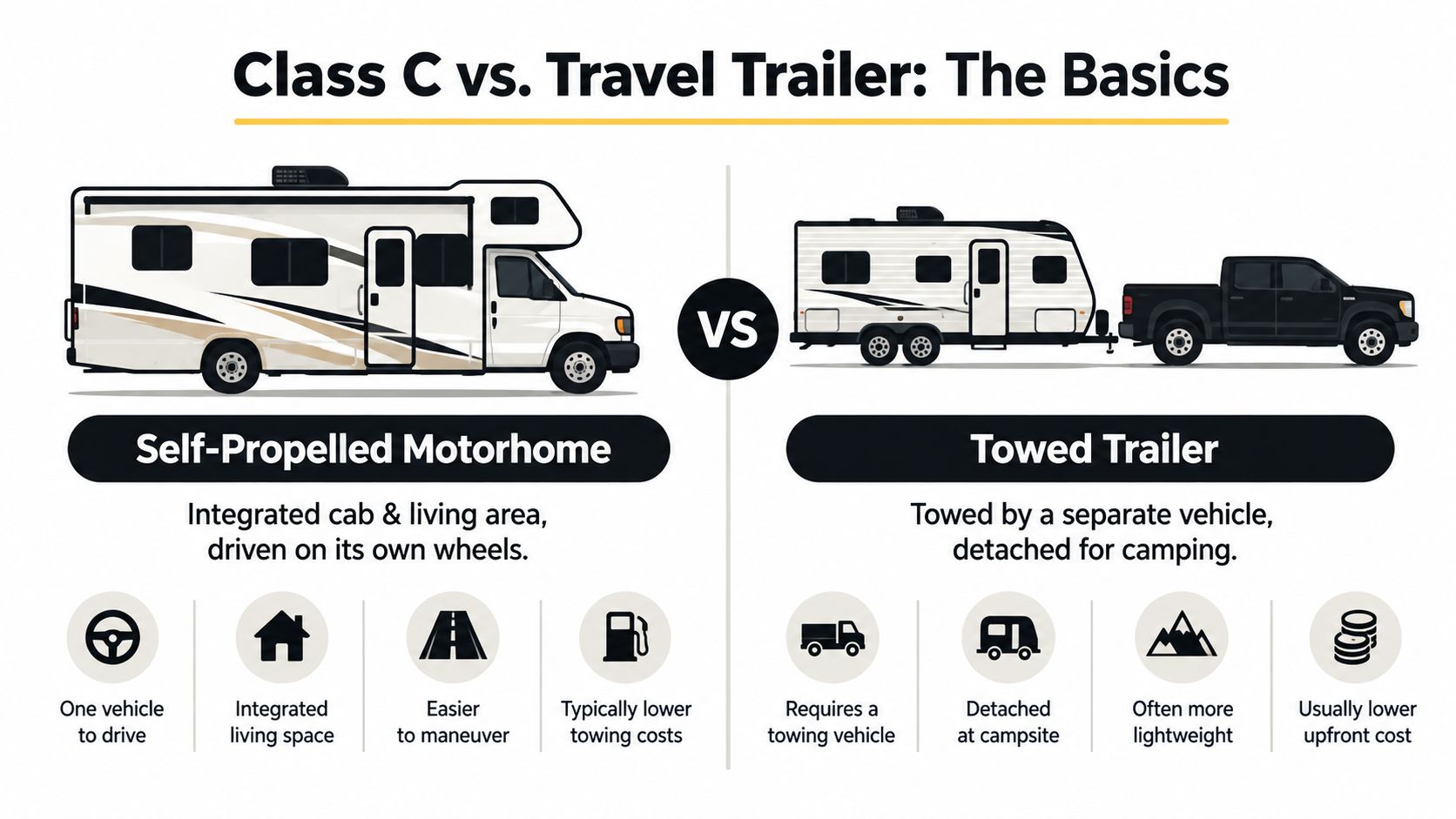
A Class C motorhome is a self-propelled RV built on a cutaway van or truck chassis. Its cab and drivetrain connect directly to the living area, while the raised section above the cab commonly holds a bed or storage. Passengers can move between the cab and the living space without going outside when the vehicle is parked safely.
A travel trailer has no engine or driving cab. It relies on a separate tow vehicle, typically attached through a rear hitch. After setup, you can disconnect it and use the truck or SUV for errands, trail access, or a day around Bear Lake.
Size affects both campsite fit and mountain-road confidence. Common Class C specifications run about 20 to 35 feet long, 8 to 8.5 feet wide, 10 to 12 feet tall, and roughly 10,000 to 15,000 pounds, with interior space often cited at 250 to 400 square feet. Travel trailers typically run about 14 to 40 feet long and roughly 1,000 to 10,000 pounds dry. Bunkhouse layouts can sleep up to about 10 people, according to this RV dimensions comparison.
The daily-use difference
Class C buyers choose motorized convenience. You start the engine, check your mirrors, and travel with the living area attached to the vehicle. That setup works well for families or couples who change campsites often and want fewer hitching steps.
Travel trailer buyers choose towability and flexibility. The trailer can provide more floorplan choices, while the tow vehicle remains available after setup. That matters near Jordanelle, the Great Salt Lake, and other Utah destinations where you may want to leave camp for supplies, trail access, or sightseeing.
The practical comparison is straightforward:
- Class C: One vehicle, built-in cab access, an onboard drivetrain, and quick departures between stops.
- Travel trailer: A separate tow vehicle, greater floorplan variety, a detachable campsite, and no engine inside the trailer.
Your tow vehicle sets the limit for a trailer choice. Check its payload, tow rating, hitch capacity, brakes, and loaded trailer weight, not just the advertised dry weight. A shorter trailer behind an undersized truck can be harder to control than a similarly sized Class C. A larger trailer may still be the better fit when your family needs dedicated beds and storage. Rescue the decision from the floorplan alone, and match the RV to your Utah routes and tow vehicle.
True Cost of Ownership Beyond the Sticker Price
A family leaving Salt Lake City for a week near Moab, Bear Lake, or the Uintas can discover the full cost before the first campsite night. A travel trailer may have the lower sticker price, yet it also requires a suitable tow vehicle, hitch equipment, brake components, and enough payload capacity. A Class C combines the engine and living quarters, which simplifies the vehicle match but adds motorized maintenance and fuel costs.
Resale deserves attention, especially if your Utah travel plans may change. Towable RV values have softened, so a lower purchase price does not automatically produce a better ownership outcome. Treat resale as one part of the calculation, alongside how often you will travel, what you already own, and how much mountain driving your setup will handle.
Class C vs Travel Trailer Ownership Cost Snapshot
| Cost Factor | Class C Motorhome | Travel Trailer |
|---|---|---|
| Main vehicle structure | Engine, cab, chassis, and living area in one unit | Living area depends on a separate tow vehicle |
| Fuel exposure | The RV itself uses fuel whenever you drive it | Fuel economy depends on the tow vehicle and trailer drag |
| Mechanical service | Motorized chassis plus house systems | Trailer brakes, tires, hitch, axles, and house systems |
| Insurance planning | Covers an integrated motorized vehicle and living space | Covers the trailer, while the tow vehicle has its own policy |
| Storage | Requires space for a tall, motorized vehicle | Requires trailer storage and a separate tow vehicle |
| Resale question | Depends on chassis condition and coach condition | Depends on trailer condition, layout, and towable market conditions |
| Best cost test | Frequent travel that uses the motorhome often | Existing tow vehicle and regular campsite-based trips |
The tow vehicle can decide the economics. If you already own a capable truck, a trailer may avoid the cost of buying another engine. If you need to purchase or upgrade that truck, include its payment, insurance, fuel, tires, maintenance, and hitch equipment in the comparison. A Class C may cost more upfront while costing less than a new truck and trailer combination.
Fuel matters for Utah travelers who cover long distances between campgrounds. Independent RV guidance commonly places modern gas Class C models around 10 to 14 MPG highway and diesel Class C models around 15 to 20 MPG. Class C motorhomes generally do not carry official EPA MPG ratings because their chassis exceed EPA testing limits, as explained by El Monte RV's fuel-efficiency guide. Trailer fuel use depends on the truck, engine, trailer profile, cargo, wind, and grades.
House systems add another ownership cost. Battery capacity, charging equipment, and appliance demand matter if you camp away from hookups in Utah's dispersed or remote areas. Use the SwiftNet Wifi buyer's guide when comparing trailer battery requirements and off-grid plans.
Run the financing numbers with the Motor Sportsland RV loan calculator, then add storage, winterization, service, tires, fuel, and likely upgrades. Motor Sportsland's Deals of the Week can help you review current inventory. Choose the setup that fits your tow vehicle and routes, not just the deal with the lowest payment.
Towing and Driveability on Utah Roads and Mountain Grades
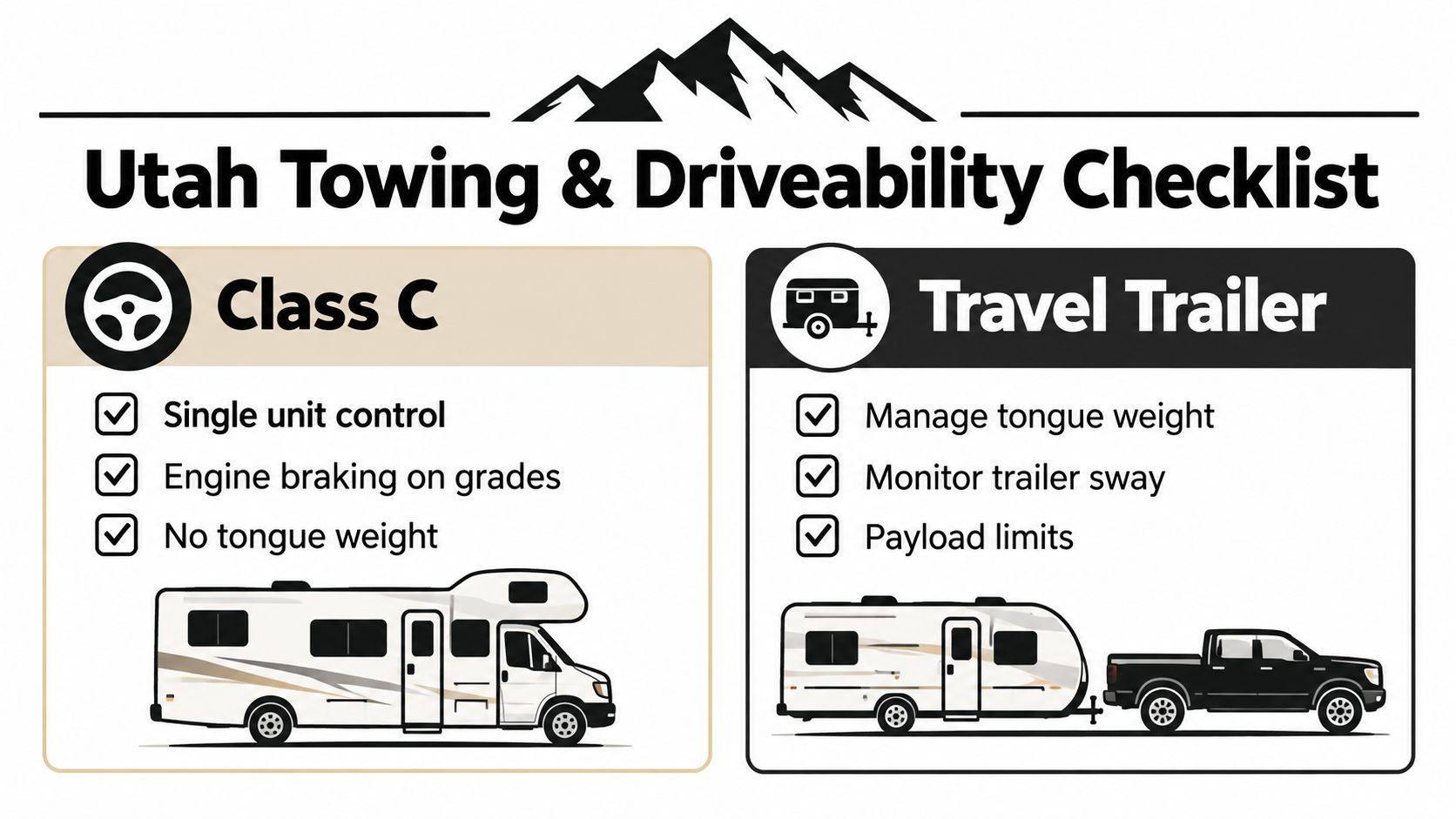
A family leaving Salt Lake City for Park City, Moab, or the Wasatch backcountry faces a practical question before choosing a floorplan: does the tow vehicle match the trip? A Class C puts the engine, cab, living area, and braking systems in one motorized unit. A travel trailer gives you a separate vehicle at camp, but every mountain grade begins with the truck handling the trailer, passengers, cargo, fluids, tongue weight, and wind together.
A Class C often feels simpler on routes such as I-80 and Parleys Canyon. Many models include a receiver hitch for a small car or trailer, so you can bring a second vehicle without managing a separate trailer connection. That advantage does not make every Class C easy to drive. Its length, height, weight, and braking distance still matter on steep grades and tight turns.
Many mainstream Class C models have receiver hitches rated in the several-thousand-pound range. Some larger units list ratings around 7,500 pounds, according to RV safety guidance on Class C towing. Smaller Class C motorhomes can commonly tow an additional 3,500 to 5,000 pounds, but the rating varies by model. Check the chassis documentation before planning to tow a vehicle, as explained in this Class C towing guide.
A travel trailer earns its strongest point after arrival. Unhitch it, then use the truck for a trailhead, grocery run, or scenic overlook. The trade-off is more work and responsibility on the road. The truck must remain within its ratings while handling the loaded trailer, braking demands, crosswinds, and Utah's elevation changes.
The numbers that protect your setup
Keep the trailer at or below about 80% of the tow vehicle's rated capacity, and plan for tongue weight near 10% to 15% of trailer weight, following the guidance in the towing section above. These limits leave operating room for grades, wind, passengers, and gear.
Travel trailer dry weights commonly range from about 2,500 to 8,000 or more pounds. Loaded planning should allow another 1,500 to 2,500 pounds for cargo and fluids. Tongue weight often represents 10% to 15% of trailer weight and counts against the truck's payload, according to this travel trailer weight guide.
Use this checklist before signing:
- Check loaded numbers: Compare expected loaded weight, not only dry weight.
- Protect payload: Count passengers, fuel, cargo, hitch equipment, and tongue weight.
- Review the route: Grades, wind, elevation, and tight turns reduce comfortable margin.
- Control speed: Trailer height and headwinds can increase fuel use and reduce stability.
- Practice reversing: Use mirrors deliberately and have a spotter in a safe position.
- Match towing equipment: Weight-distribution hardware and sway control must suit the trailer and truck.
Safety rule: Never choose a trailer because its dry weight fits on paper. Match loaded trailer weight, tongue weight, passengers, and cargo to the tow vehicle's actual ratings, then leave a meaningful safety margin.
For route-specific planning, review our travel trailer advice for Utah mountain trips. Choose a Class C for multi-stop travel and living space during breaks. Choose a travel trailer when you want to establish camp, disconnect, and explore Utah with the tow vehicle.
Living Space Sleeping Capacity and Everyday Comfort
Floorplan is where many buyers change their minds. A Class C's cab-over bed can give a family a dedicated sleeping area without using the dinette, while a slide-out can open the central living space. The cab also creates a convenient transition between driving and camping, especially when the family needs a quick bathroom break or a snack during a travel day.
Travel trailers often offer more specialized layouts. A bunkhouse can give children their own sleeping zone, a rear living model can suit couples who want lounge space, and a toy hauler can carry motorcycles, bikes, or other powersports equipment. The trailer's broader floorplan range is one of its strongest advantages.
Match the layout to the trip
A weekend near the Great Salt Lake may favor a compact setup with quick departure and simple meals. A week near the Wasatch Mountains may justify a bunkhouse, larger refrigerator, extra storage, and a comfortable indoor seating area for weather changes.
Class C advantages include:
- Fast travel-day access: The cab connects directly to the living area.
- Cab-over sleeping: Children can have a dedicated bed while the dinette remains available.
- Simple campsite rhythm: There's no trailer to hitch and unhitch at every stop.
- Convenient multi-stop travel: The whole unit moves when your itinerary changes.
Travel trailer advantages include:
- Bunkhouse flexibility: Families can prioritize separate sleeping areas.
- Broader floorplans: Rear living, bunkhouse, and toy hauler designs serve different groups.
- Detached exploration: Leave the trailer set up while using the truck locally.
- Potentially lower trailer weight: Smaller options may fit an existing tow vehicle when loaded responsibly.
The main comfort compromise is setup. A Class C can make short overnight stops easier, but you still drive the entire living space when you go out for the day unless you tow a vehicle. A travel trailer asks more of the arrival process, yet rewards you with a dedicated daily driver once camp is established.
For larger families, don't count beds without checking where everyone sits, stores clothing, and moves during poor weather. For retirees, focus on mattress access, bathroom usability, kitchen workflow, and whether the interior remains comfortable during a longer stay. A floorplan that looks spacious with slides extended should also be evaluated with the slides closed.
Utah Ownership Realities Maintenance Storage and Service
Utah ownership rewards preparation. Dry air, elevation, summer heat, dust, and freezing winter temperatures all put pressure on seals, tires, batteries, plumbing, and exterior finishes. A motorhome adds engine, transmission, chassis, and drivetrain service to the house-system maintenance. A travel trailer avoids that engine, but its tires, brakes, axle components, hitch, and weight-distribution equipment deserve regular attention.
Class C buyers should track both dry weight and GVWR. Average Class C dry weights are around 10,000 to 12,000 pounds, while GVWRs often fall between 14,500 and 24,500 pounds, according to RVShare's RV weight guide. That gap is not spare room for unlimited cargo. Passengers, water, food, camping equipment, and upgrades all consume capacity.
Travel trailer owners need the same discipline on a different system. Load heavy gear low and close to the trailer axles, protect the tongue-weight range, and weigh the complete combination when possible. A trailer that feels stable in a parking lot can behave differently on an exposed Utah highway after loading bikes, tools, coolers, and full tanks.
Seasonal care that prevents expensive surprises
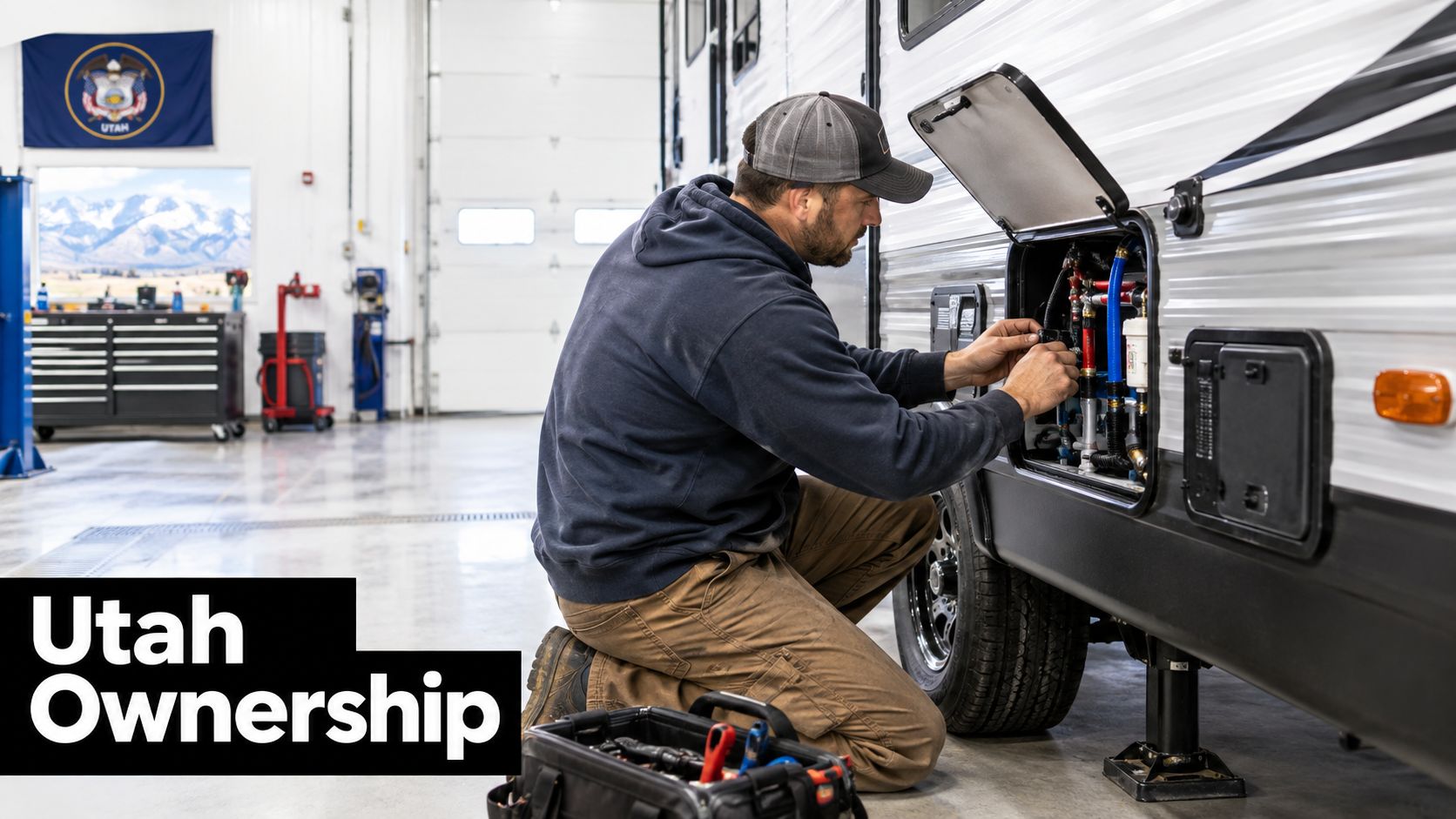
Before winter storage, our service team recommends a careful plumbing and electrical check, proper water-system winterization, battery care, tire inspection, and roof-seal review. Don't assume a covered RV is protected from freezing damage. Water trapped in a line or appliance can cause trouble before the next camping season begins.
Before high-altitude travel:
- Check tires and brakes, especially after storage.
- Inspect seals and roof penetrations for cracks or lifting.
- Confirm battery and converter operation before relying on off-grid systems.
- Review cargo and weight ratings after adding accessories.
- Schedule chassis service for a Class C and hitch, axle, and brake service for a trailer.
The Motor Sportsland Service Center serves Millcreek and Spanish Fork with maintenance checks, repairs, plumbing and electrical work, installations, upgrades, parts, and collision repair. Local service matters because Utah RV owners need support that understands repeated mountain travel, seasonal storage, and the wear created by long Mountain West routes.
How to Choose the Right RV for Your Travel Style
A Utah family heading from Salt Lake City to Moab, then up to a high-country campground, should start with the tow vehicle and route, not the floorplan. Choose a Class C when driving convenience and frequent moves matter more than having a separate daily vehicle. Choose a travel trailer when you already own the right tow vehicle and want more family or cargo layouts.
| Your situation | Better starting point | Why |
|---|---|---|
| You move between several Utah destinations | Class C | One integrated vehicle makes repeated departures simpler |
| You want to leave camp set up for exploring | Travel trailer | Unhitch and use the tow vehicle |
| You need beds for children | Travel trailer | Bunkhouse layouts provide flexible sleeping space |
| You prefer simple travel days | Class C | One-unit operation reduces setup demands |
| You carry motorcycles or outdoor equipment | Travel trailer toy hauler | Dedicated cargo space supports powersports trips |
| You already own a properly rated truck | Travel trailer | The vehicle match may already be solved |
| You dislike towing or managing sway | Class C | You avoid trailer tongue-weight management |
A travel trailer is the practical starting point for many families because towables dominate the market, as noted in RV.com's Class C market analysis. That broad market presence also means used travel trailer inventory in Utah is often deeper, giving shoppers more floorplans at a similar budget. Inventory alone does not make a trailer suitable. Your truck must handle the loaded trailer weight, payload, hitch requirements, and braking demands.
Mountain routes make the vehicle match more important. A trailer that feels manageable on level roads can demand more attention on steep grades, descents, crosswinds, and tight campground approaches. A Class C simplifies the driving connection, but it still needs enough power, braking capacity, and interior storage for your loaded trip. Compare the complete combination, not the brochure weight.
For bunkhouse layouts and family-focused floorplans, read our guide on how to choose a travel trailer. Then compare actual units by loaded weight, length, sleeping arrangement, storage, and the roads you plan to drive.
Motor Sportsland offers new and used Class C motorhomes and travel trailers. Visit the showroom in Salt Lake City or Millcreek, bring your tow-vehicle information, and ask the team to compare mountain-driving fit, cargo capacity, and campsite use before you choose.
Frequently Asked Questions About Class C RVs and Travel Trailers
Is a Class C RV easier to drive than a travel trailer?
For many drivers, yes. A Class C is one integrated motorized unit, while a travel trailer requires attention to hitch connection, payload, tongue weight, trailer brakes, and sway. A trailer can still be comfortable to tow when the combination is properly matched and the driver practices.
Can a Class C tow a car?
Many Class C motorhomes can tow a small car or trailer, but the capacity varies by model. Some smaller units can tow 3,500 to 5,000 pounds, while some larger units list ratings around 7,500 pounds, according to RV towing guidance. Always verify the specific receiver, chassis, braking requirements, and loaded vehicle weights.
Is a travel trailer cheaper to own?
It can be, especially when you already own a properly rated tow vehicle. The comparison changes when you need to buy or upgrade the truck, pay for its fuel and maintenance, or account for depreciation and resale conditions. Compare the complete ownership plan rather than the trailer price alone.
Which RV is better for a Utah family?
A travel trailer is often the stronger fit for a family that wants bunk beds, a dedicated tow vehicle, and a campsite that stays assembled during day trips. A Class C may be better for families that change locations frequently or value easy access between the cab and living area.
What should I check before towing in the mountains?
Check the trailer's loaded weight, the tow vehicle's payload and combination ratings, tongue weight, hitch equipment, trailer brakes, tires, and route grades. Keep trailer weight at or below about 80% of the tow vehicle's rated capacity and keep tongue weight near 10% to 15%, following the guidance cited earlier.
Where can Utah RV owners get service?
Motor Sportsland has service locations in Millcreek and Spanish Fork for maintenance checks, repairs, plumbing and electrical work, installations, upgrades, parts, and collision repair. Schedule an inspection before summer travel or winter storage rather than waiting for a problem at the campground.
