

Class C Motorhome Prices: New vs Used Costs in 2026

RVBlogger's 2024 price guide puts new Class C motorhomes at $70,000 to $150,000 and gently used models at $40,000 to $90,000. Treat those as broad shopping bands, not quotes for a specific coach.
A couple comparing similar listings may see very different asking prices even when both motorhomes have an over-cab bed, kitchen and bathroom. Model year, chassis and condition all affect price; a lower-priced coach may also need tires or roof work before it is ready to travel.
Separate purchase price, ownership cost and financeability before choosing a floorplan. A manageable loan payment can still leave too little room in the budget for storage, mountain travel and repairs.
For Utah buyers, the price bands are only a starting point. The full comparison includes monthly ownership costs and whether a lender's appraisal supports the seller's asking price.
Class C Motorhome Prices by Condition and Year
A couple comparing similar-looking Class C listings should start by separating new retail, used retail and valuation averages. RVBlogger's 2024 price guide reported new Class C RVs generally costing $70,000 to $150,000, versus $40,000 to $90,000 for gently used models. These are useful screening ranges, not a current appraisal for every model year.
Class C motorhome prices by source and condition
| Source or measure | Typical price | Condition or scope |
|---|---|---|
| RVBlogger (2024), cited above | $70,000 to $150,000 | New Class C |
| RVBlogger (2024), cited above | $40,000 to $90,000 | Gently used Class C |
| Pick RV | $89,000 to $180,000 | New MSRP, 22 to 32 ft |
| Dataintelo (2025) | $75,000 to $160,000 | Average price point |
| J.D. Power (2023–2024) | $96,335 to $108,697 | Reported average value, not a listing price; observations cover two-month periods |
The table's ranges overlap, but they don't measure the same thing. MSRP is a manufacturer's suggested price, an advertised sale price is a seller's offer, and a valuation average describes a broader group of vehicles. None automatically tells you what an individual motorhome should sell for today.
The spread in J.D. Power's reported averages also shows why a single national average isn't a permanent price tag. Seasonality, the age of vehicles being valued, supply, demand and condition can all change the result. It doesn't establish that your particular motorhome gained or lost the same amount.
Compare the coach, not just the year
An older premium coach can cost more than a newer entry-level model. Likewise, low mileage doesn't cancel out neglected seals, long periods of inactivity or missing service records.
Create a comparison sheet with:
- Exact model and floorplan. Similar exterior length doesn't mean equivalent sleeping arrangements or storage.
- Coach and chassis details. Confirm the actual platform and equipment rather than relying on photographs.
- Mileage and maintenance history. Separate documented care from a seller's verbal reassurance.
- Price basis. Label each figure as MSRP, asking price, appraisal or written drive-away quote.
Our used motorhome value guide can help you organize that comparison before negotiating.
Practical rule: Choose your budget band first. Then find the floorplan, model year and condition that fit inside it, rather than stretching the budget around the first attractive listing.
What Moves a Class C Price Up or Down
Start with size and layout, then examine the chassis and equipment. That's a useful shopping order, although a premium drivetrain or serious condition problem can outweigh every other factor.
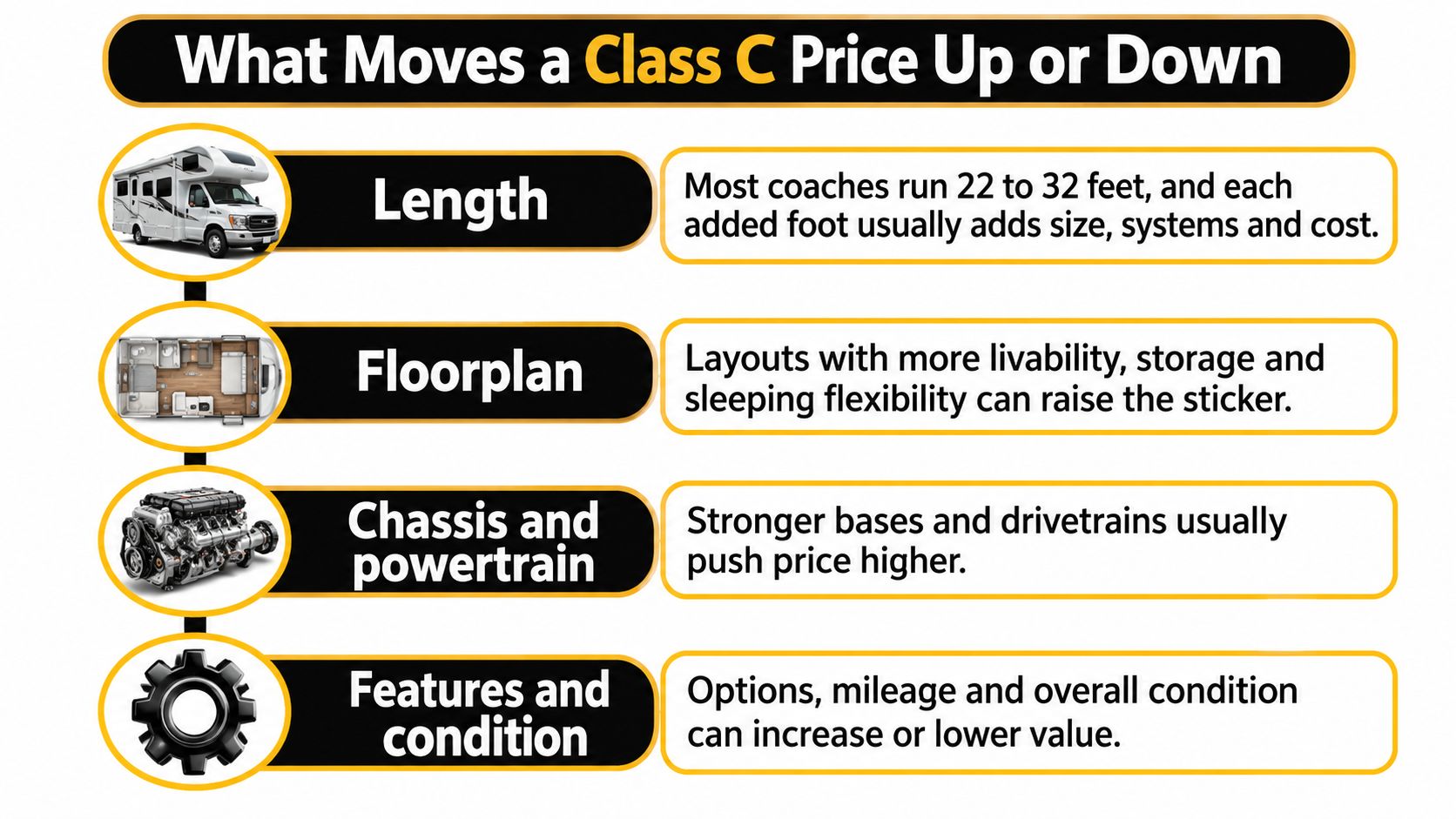
Size and floorplan establish the comparison
Length changes how much living space and equipment a manufacturer can include. A longer coach may provide a separate bedroom and more storage, but it also needs a suitable parking space and campsite. Don't assume the longest coach is the best value if you'll struggle to store or maneuver it.
Floorplan determines whether that space works. A bunkhouse can keep children's beds ready without converting the dinette nightly. A rear-bath layout may suit a couple better, while a slide-out can improve living space but adds another mechanism and sealing system to maintain.
Walk through the coach with the slides retracted. Check whether you can reach the bathroom, refrigerator and essential storage during a travel stop.
Chassis, equipment and usable capacity
A conventional Ford-style platform and a Mercedes-Benz Sprinter chassis aren't interchangeable price comparisons. Premium chassis equipment can raise the purchase price, but you should evaluate driving comfort, service access and actual travel plans before paying the difference.
Treat fuel economy as a trip-budget variable, not proof that a higher-priced diesel will pay for itself. Fuel type, terrain, loading and driving habits affect the outcome. Without a specific coach and travel schedule, there's no defensible break-even claim.
Generators, solar equipment, batteries, upgraded appliances and slide-outs also change Class C motorhome prices. Check what's installed, whether it works and whether you'll use it. A solar panel alone doesn't tell you how long the refrigerator or other appliances can operate away from hookups.
Before paying for extras, read the coach's occupant and cargo carrying capacity label. Passengers, water, propane, luggage, accessories and hitch load all use available capacity. Verify the loaded coach at a scale and check axle limits, not just the overall weight rating.
Brand and model year still matter, but neither substitutes for a usable floorplan and sound condition. An option-heavy motorhome that can't carry your family's gear is the wrong purchase, even at an appealing discount.
Whether a New or Used Class C Saves You Money
How long you'll keep the coach should drive the new-versus-used decision. A buyer planning frequent trade-ins faces a different financial calculation from someone choosing a motorhome for long-term retirement travel.
J.D. Power's depreciation guide says Class C motorhomes generally depreciate more slowly than other motorized camper categories, losing roughly 38% after five years and slightly above 50% after ten years. Applied to a hypothetical $130,000 purchase, the following estimates illustrate the scale, not a resale guarantee.
Estimated value of a $130,000 new Class C over time
| Age | Depreciation | Estimated value |
|---|---|---|
| New | 0% | $130,000 |
| After 5 years | About 38% | About $80,600 |
| After 10 years | Slightly above 50% | About $65,000, rounded |
Mileage, maintenance, accident history, floorplan demand, local supply and condition can move the actual result substantially.
Match the purchase to your ownership horizon
Lightly used makes sense when you want to reduce early depreciation and can find a well-maintained coach with a suitable layout. You may get more living space or equipment for your purchase budget, but inspection quality becomes especially important.
New makes sense when the exact layout, available warranty coverage and current systems matter enough to justify the premium. Confirm what the chassis and coach warranties cover separately, including exclusions and service requirements.
A long ownership period gives you more seasons over which to spread the new-coach premium. A short ownership period makes avoiding early value loss more important. Either way, use the inspection checks below before treating a low asking price as savings.
Total Monthly Cost of Owning a Class C
A Class C's sticker price is only one part of its monthly cost. Your budget also needs to cover the loan, insurance, fuel, storage or camping, maintenance and repairs.
For a financing baseline, America First Credit Union publishes a best-case 7.49% APR for a ten-year RV loan. A $60,000 balance at that rate works out to approximately $712 per month before fees. That rate applies only to qualifying borrowers and specified terms, so use a written offer for your own estimate.
Build a usable monthly worksheet
Enter the approved loan payment. Base it on the amount financed after your down payment, trade equity and any financed transaction costs, not the advertised price alone.
Get an insurance quote for the exact coach. Ask how the policy covers the motorhome, personal belongings, deductibles and your intended use.
Estimate monthly fuel spending. Divide planned annual miles by your expected miles per gallon, multiply by the price per gallon, then divide by 12. Recalculate if your routes or annual mileage change.
Add storage and camping. Check that a storage option fits the motorhome's dimensions. Estimate campground costs based on your expected mix of hookups and dry camping.
Set aside money for scheduled maintenance. Account for chassis service, tires, roof-seal inspections, generator service and winterization.
Keep a separate repair reserve. Appliances, water pumps, slide mechanisms and electrical components can require repairs even when the motorhome drives well.
Regular cleaning and inspection can help you spot leaks or deterioration early. Follow the coach and component manufacturers' instructions, and use maintenance guidance to prevent common RV problems.
Compare scenarios
The figures below are illustrative monthly planning amounts, not quotes. Fuel, insurance, storage, camping and maintenance depend on the coach and how you use it.
| Budget item | Used Class C | New entry-level Class C | Premium Class C |
|---|---|---|---|
| Loan payment | $900 | $1,300 | $2,200 |
| Insurance | $150 | $200 | $300 |
| Fuel | $250 | $300 | $400 |
| Maintenance and repairs | $300 | $200 | $400 |
| Storage and camping | $300 | $300 | $400 |
| Illustrative monthly total | $1,900 | $2,300 | $3,700 |
The used coach has a lower illustrative payment, but its maintenance and repair allowance is higher. A new entry-level model costs more to finance, while the premium scenario carries the highest payment and operating budget. Your own numbers can differ substantially, so replace each estimate with quotes and a realistic travel plan.
Monthly cash budget = payment + insurance + fuel + storage and camping + maintenance and repair allowances. Track depreciation separately; it affects ownership cost but is not a monthly bill.
Motor Sportsland does not charge for Prep, Detail, Orientation, Destination or freight. Request a written drive-away total that identifies applicable taxes and fees before comparing offers.
How Loan Length Changes What You Really Pay
Monthly payment and total interest on a $100,000 loan at 8%
The following rounded illustration accompanies Forbes Advisor's RV financing guidance.
| Loan term | Monthly payment | Total interest |
|---|---|---|
| 10 years | About $1,213 | About $45,600 |
| 15 years | About $956 | About $72,000 |
The longer term lowers the required payment, but you keep paying interest for longer. It can also leave you owing more than the motorhome is worth when you want to trade or sell.
Forbes Advisor describes secured RV-specific APRs of approximately 6% to 15%, personal-loan rates reaching roughly 36%, and repayment periods ranging from 12 to 240 months, depending on lender and amount. Those are broad financing ranges, not approval terms for your purchase.
A lower payment is useful only if the repayment schedule still fits how long you expect to own the coach.
Compare written offers
Request the APR, financed fees, down payment, prepayment terms and total of payments. Advertised best-case rates depend on underwriting, and the coach's age and value can affect eligibility.
Our financing options are meant to match a range of budgets, with a Finance Application and a Pre-Qualify option available. Use our Utah guide to RV financing length to compare repayment choices before committing to a payment.
Utah Pricing Notes for Salt Lake and Wasatch Buyers
There isn't a verified Utah-only Class C price series behind these national bands. Don't add or subtract a supposed Salt Lake City premium without comparing local coaches with the same floorplan, model year and equipment.
A typical Utah season gives you better questions to ask than a generic regional price adjustment. Think through spring preparation, summer mountain trips and cold-weather storage before deciding what condition is worth paying for.

Mountain travel needs a different inspection conversation
A trip through Parleys Canyon on I-80 puts the focus on loaded handling, cooling and braking. Ask about brake service, fluid changes and any overheating history. On the test drive, assess visibility and steering, but don't mistake an empty coach's behavior for its loaded travel performance.
Use the chassis manufacturer's descent and transmission guidance rather than riding the brakes downhill. If you plan to tow, verify the complete combination's ratings before assuming the hitch label tells the whole story.
Storage affects what you're buying
Utah's cold months make documented winterization important. Have the plumbing tested under pressure, inspect accessible fittings and confirm that the water heater and pump operate correctly.
Dry, sunny summers also call for careful inspection of roof materials, sealants and tire sidewalls. Covered storage can help, but a seller's storage claim doesn't replace a close inspection.
- Jordanelle and Bear Lake trips. Confirm that water, heating and electrical systems suit the way you'll camp.
- High-altitude camping in the Wasatch Mountains. Check the generator manual for altitude-related output changes and operating requirements.
- Great Salt Lake outings. Plan for exposed campsites, wind and dependable awning operation rather than judging value by indoor finishes alone.
A clean service history is more useful than a vague claim that a coach was only used locally. Ask where it was stored, how it was winterized and what maintenance followed its mountain travel.
Buying Tips That Protect Your Price
Use the inspection to establish what you're buying and the appraisal to establish what you can finance. Those are separate checks, and either can change whether an advertised bargain makes sense.
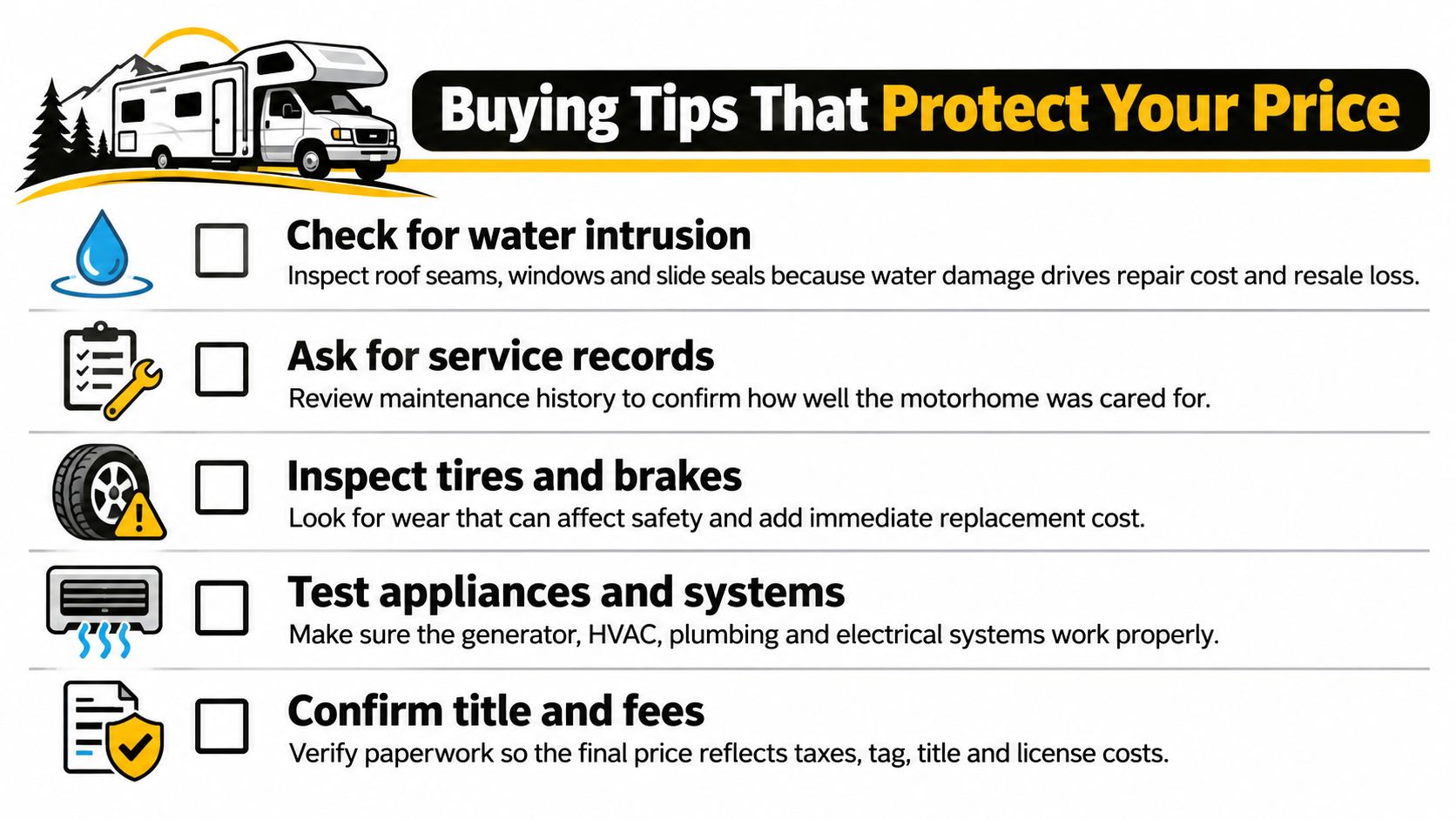
Inspect for water intrusion. Check roof seams, the cab-over area, windows and slide seals for staining, softness, swelling or fresh cosmetic cover-ups. Our used RV inspection checklist helps organize a walk-through without letting attractive upholstery distract from structural concerns.
Review generator hours and service records. Ask for chassis maintenance documents, then run the generator under an appropriate load with the owner's permission. Test appliances, HVAC, plumbing and electrical systems rather than accepting that everything worked last season.
Identify the appraisal gap before paying a deposit. First Citizens Bank generally finances up to 80% of a used RV's appraised value: an $80,000 asking price with a $70,000 appraisal supports $56,000 in financing, leaving $24,000 of the purchase price for the buyer before other costs. That gap already includes the unfunded portion of the purchase price; don't mistakenly add a second down payment to it.
Compare APR and total interest. Make sure every offer uses the same purchase assumptions so a longer loan doesn't appear cheaper because the payment is smaller.
Verify payload for your actual trip. Build a loading list that includes people, water, luggage, outdoor gear and towing equipment. Inspect tires and brakes as well, since immediate replacement needs belong in the purchase decision.
Use trade value as another budget input. We offer a Value My Trade option. Compare net trade equity after any existing payoff, not just the trade allowance printed on the proposal.
Negotiate around specific deficiencies and inventory fit. A dated interior, unwanted options or unresolved repairs give you concrete subjects to discuss. Don't assume a popular, practical layout will receive the same discount as an awkward coach that doesn't fit many buyers.
Before signing: Confirm title status, written repair commitments and every fee on the purchase agreement. Verbal promises aren't an adequate substitute.
Set Your All-In Budget and Visit Motor Sportsland
Start with a budget that leaves your household comfortable after the RV is parked. Compass+ offers a budgeting resource to calculate room for everyday purchases, which can help you test whether camping expenses fit alongside ordinary bills.
Use the dealership website to begin organizing your shortlist.
Bring a decision-ready shortlist
- Set the drive-away ceiling. Include sales tax, tag, title, license and applicable fees, plus money you'll retain for ownership.
- Plan the cash contribution. Confirm the lender's down-payment and valuation requirements before choosing a coach.
- Pre-qualify without commitment. We offer this option before a full credit application.
- Compare suitable floorplans. Bring your budget, pre-qualification result and shortlist to a tour at our Millcreek or Spanish Fork location.
We've served Utah for more than 55 years, and we're a Proud Priority RV Network member and Utah's only Priority RV Network dealer. Our service center can help maintain the coach after purchase, including plumbing, electrical work, repairs and upgrades.
Take a closer look before arranging your visit.
Class C Motorhome Price FAQs
Is a Class C cheaper than a Class A?
Generally, yes. Class C motorhomes are the more accessible motorhome segment in the valuation comparison discussed earlier, but premium models can overlap with other categories. Compare equivalent condition and equipment rather than assuming every Class C is inexpensive.
Are Class C prices falling?
Don't assume every listing is getting cheaper. The RV Industry Association's December 2025 report recorded about 20,903 Class C shipments in 2025, up 5.4% from 2024. Shipments measure manufacturer volume, not local transaction prices, so they don't establish a discount on your preferred coach.
Why does the average motorhome price look lower than Class C prices?
Black Book's Q1 2026 update reported a Q4 2025 average wholesale motorhome selling price of $62,637, combining Classes A, B and C. Wholesale averages aren't equivalent to a particular Class C's retail asking price.
Should I pay cash or finance a Class C?
Compare the cash outlay with the loan's total repayment, then consider how much reserve you'd retain. Paying cash avoids loan interest, but emptying your savings can leave you unprepared for storage, service or repairs.
Motor Sportsland offers new and pre-owned RVs, financing and trade-in options to help you compare Class C motorhome prices against a realistic ownership budget. Visit Motor Sportsland to browse current inventory, then contact our sales team to schedule a tour in Millcreek or Spanish Fork with your budget and shortlist in hand.
