
First Time RV Buyer Guide for Utah

You're standing in a Utah dealership lot, comparing two travel trailers that both look ready for Jordanelle or Bear Lake. One has the bigger refrigerator and a comfortable bunkhouse. The other fits your budget better, but you're not sure whether your truck can tow it through the Wasatch Mountains, what winter storage will cost, or how often you'll realistically use it.
That's the part many first time RV buyer guides skip. The right purchase isn't just the RV with the most features or the lowest monthly payment. It's the unit that matches your tow vehicle, travel habits, storage situation, electrical needs, and actual camping calendar. We'll focus on those decisions, including mountain towing, high-altitude driving, cost per night, inspection, financing, and winter protection, so you can shop with a clear head and enjoy more weekends outdoors.
True Cost of RV Ownership in Utah
A trailer can look affordable on a Utah dealership lot and still cost more than expected once it spends winter in storage. Insurance, maintenance, registration, fuel, financing, and campsite fees continue while the RV sits unused. High-altitude towing adds another expense through slower travel, heavier fuel use, and greater strain on the tow vehicle.
Calculate cost per night before you buy. Add the purchase and financing costs to your expected annual ownership expenses, then divide by the nights you realistically plan to camp. One recent report found that RV owners use their rigs for only 21 nights per year, so this calculation matters for occasional weekend trips (Kansas City Star coverage of RV ownership costs).
Build an honest annual budget
Budget for these costs outside the advertised payment:
- Insurance: Confirm coverage for the RV, personal belongings, liability, and your intended use. If you travel beyond Utah, review this Florida All Risk Insurance RV help for another regional perspective on RV coverage.
- Maintenance: Plan around $1,500 per year for maintenance, based on ownership-cost guidance. Treat that figure as a planning reference, not a guarantee for your specific unit.
- Storage: If your property cannot accommodate the RV, storage may run $75 to $400 per month. Compare covered and uncovered options, especially for Utah's snow, freezing temperatures, and intense sun.
- Fuel and registration: Towing through mountain passes, running a generator, paying registration, and booking campsites all change the cost of each trip.
A low monthly payment does not make an RV inexpensive if you use it only a few nights each year. Divide the annual cost by your actual camping calendar. A simpler used travel trailer can offer better value when you camp often, inspect it carefully, and keep money reserved for repairs.
Match the purchase to your camping calendar
RV ownership now includes a broader and younger group of buyers. The median owner age fell from 53 in 2021 to 49 in 2025, 46% are between 35 and 54, and first-time owners represent 36% of owners, according to RVDA demographic reporting. For Utah buyers, that makes a budget-conscious purchase with manageable storage and practical technology more sensible than a large coach built for long-term occupancy.
Before browsing inventory, write down your tow vehicle's payload, where you will store the RV through winter, your likely destinations, and the number of nights you will camp. Motor Sportsland can help compare new and used inventory, but your driving conditions and usage plan should determine the purchase.
Choosing the Right RV Type for Mountain Adventures
A family bound for Bear Lake needs a different RV from a couple exploring southern Utah on short trips. Your routes, storage site, passengers, and camping habits should decide the type before floorplans or brand names enter the conversation. In Utah, maneuverability often matters more than extra interior space.
| RV Type | Tow Vehicle Needed | Best For | Utah Terrain Match |
|---|---|---|---|
| Travel trailer | Properly matched SUV or pickup | Families, couples, and budget-conscious weekend campers | Flexible for lakes, established campgrounds, and many canyon routes |
| Fifth wheel | Pickup with a compatible fifth-wheel hitch and sufficient payload | Extended stays, retirees, and buyers wanting more interior space | Comfortable for longer stays, but demanding on steep grades and tight roads |
| Class A motorhome | No separate tow vehicle for the main RV | Full-time comfort and long-haul travel | Stable living platform, but less convenient on narrow or crowded destinations |
| Class B camper van | No separate tow vehicle | Solo travelers and couples who prioritize mobility | Excellent for nimble travel and quick stops |
| Class C motorhome | No separate tow vehicle | Families wanting a balance of driving ease and living space | Practical for road trips, with size still important on mountain roads |
Match the RV to your routes and routine
A compact travel trailer is easier to position at tighter campsites and along winding roads near Moab. It can also keep ownership practical for weekend campers. A larger fifth wheel offers more room and a residential feel for longer stays in the Uintas, though its size demands more planning on steep grades and narrow roads.
Fifth wheels require especially careful matching. Their front bedroom and multi-slide layouts create valuable living space, yet the truck must carry the hitch and pin weight as well as its passengers and cargo. A floorplan only works if your pickup, driveway, winter storage location, and preferred routes can handle it.
For a couple taking frequent scenic drives near the Great Salt Lake or through southern Utah, a compact towable or Class B can make parking and repositioning easier. A Class C gives a family driving access to its living space without a separate tow vehicle. A Class A supplies a stable, spacious living platform, but crowded destinations and narrow mountain roads can limit where you take it.
Utah rule of thumb: Buy the smallest RV that comfortably supports your people, equipment, and routine. Extra interior space helps at camp, while extra length and weight affect every mountain pass, storage decision, and night you use the rig.
Compare inventory by weight, length, price range, floorplan, and features before focusing on a brand. That method makes it easier to weigh travel trailers, bunkhouse models, toy haulers, fifth wheels, and motorhomes against your actual trips and cost per camping night. Motor Sportsland can help compare new and used options, but your routes and usage plan should make the final call.
Mastering Tow Vehicle Payload and Towing Limits
A Utah mountain pass exposes weak tow-vehicle matches quickly. The brochure's maximum tow rating matters, but payload is often the binding limit. Your truck must carry passengers, fuel, cargo, hitch equipment, and the trailer's tongue weight at the same time.
Payload equals GVWR minus curb weight. Start with the payload label on the truck or SUV door jamb, not a generic online estimate. Every person, cooler, tool, child seat, hitch component, and trailer load reduces the capacity shown there.
Calculate the loaded combination
Conventional bumper-pull trailers commonly place tongue weight at 10% to 15% of loaded trailer weight (payload and towing limits guidance). A 6,000-pound loaded trailer can put roughly 600 to 900 pounds on the hitch before passengers or gear are counted. That payload guidance makes clear why an empty trailer weight can give you false confidence.
Use this process:
- Read the actual payload number on the door-jamb sticker.
- Subtract passengers, fuel, cargo, hitch hardware, and other equipment.
- Estimate loaded tongue weight, not only the trailer's empty brochure weight.
- Compare the remaining capacity with the trailer load and manufacturer limits.
- Have a qualified technician confirm the complete setup before a mountain trip.
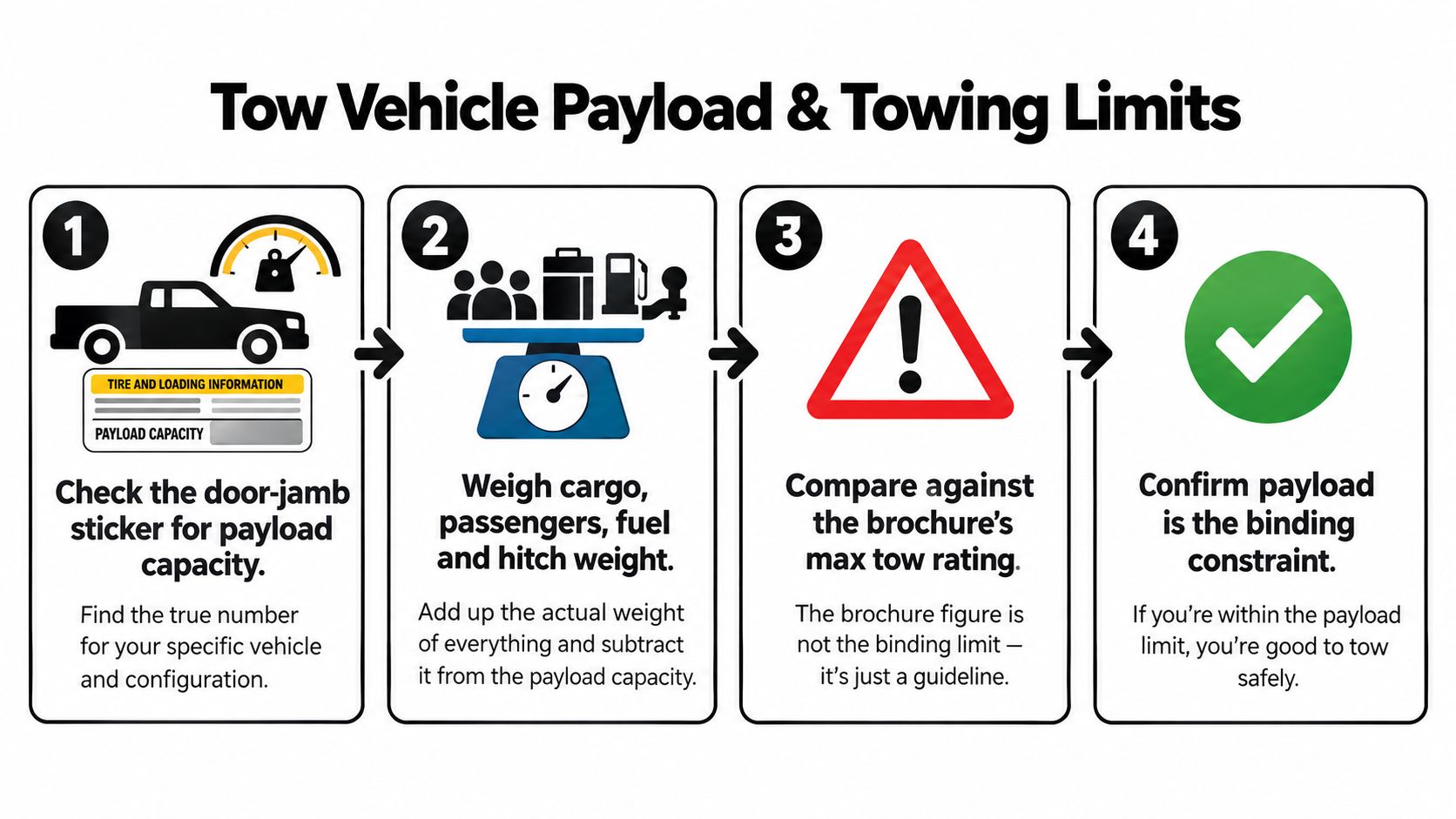
A trailer can fit within the truck's advertised tow rating and still overload the vehicle once the family and equipment are aboard. Proper tongue weight helps trailer stability, yet it consumes payload quickly. You will feel that mismatch on Utah grades, descents, crosswinds, and highway merges.
Use our guide to calculating towing capacity for a worked explanation of the numbers. Watch this towing overview before bringing your vehicle to the dealership:
Understanding Essential RV Electrical and Plumbing Systems
At a Utah campground, a weak battery or overloaded circuit can turn a comfortable trip into a cold, dark evening. Learn the basics before you shop. RVs use a 120V AC shoreline system for campground power and a 12V DC house system for lights, fans, controls, and other low-voltage equipment. The converter/charger connects both systems.
When connected to shore power, the converter changes 120V AC into about 13.6V to 14.4V DC, powering house loads while charging the batteries, as explained in this RV electrical troubleshooting guide. If active equipment needs more current than the converter supplies, the batteries may still discharge while the RV remains plugged in.
Understand service capacity before you camp
A 30-amp hookup handles ordinary campground use, but you must manage high-draw appliances. Air conditioning, a microwave, and other heavy loads running together can trip a breaker, depending on the RV and circuit arrangement.
A 50-amp system uses two 120V hot legs, along with neutral and ground, providing substantially more AC capacity than 30-amp service. That matters in a larger Utah RV with several appliances, particularly when temperatures shift quickly at elevation.
For southern Utah boondocking, inspect the battery compartment, converter rating, solar preparation, inverter setup, and charging options. “Solar-ready” usually means the RV has provisions for equipment, not a complete off-grid system. Match battery capacity and charging capability to your lights, refrigerator controls, water pump, furnace, fans, and personal electronics.
If you plan a custom setup, this guide to building an RV solar kit provides useful background. For a plain-English explanation of shore power, batteries, and converters, read our RV electrical system guide.
Plumbing problems can raise ownership cost quickly, especially after winter storage. Run every faucet, operate the water pump, inspect the water heater area, check the toilet seal, and look beneath sinks for dampness. A clean interior does not confirm a sound water system. Test it before signing, then factor repairs into your true cost per night.
Inspecting and Test-Driving Your Future Rig
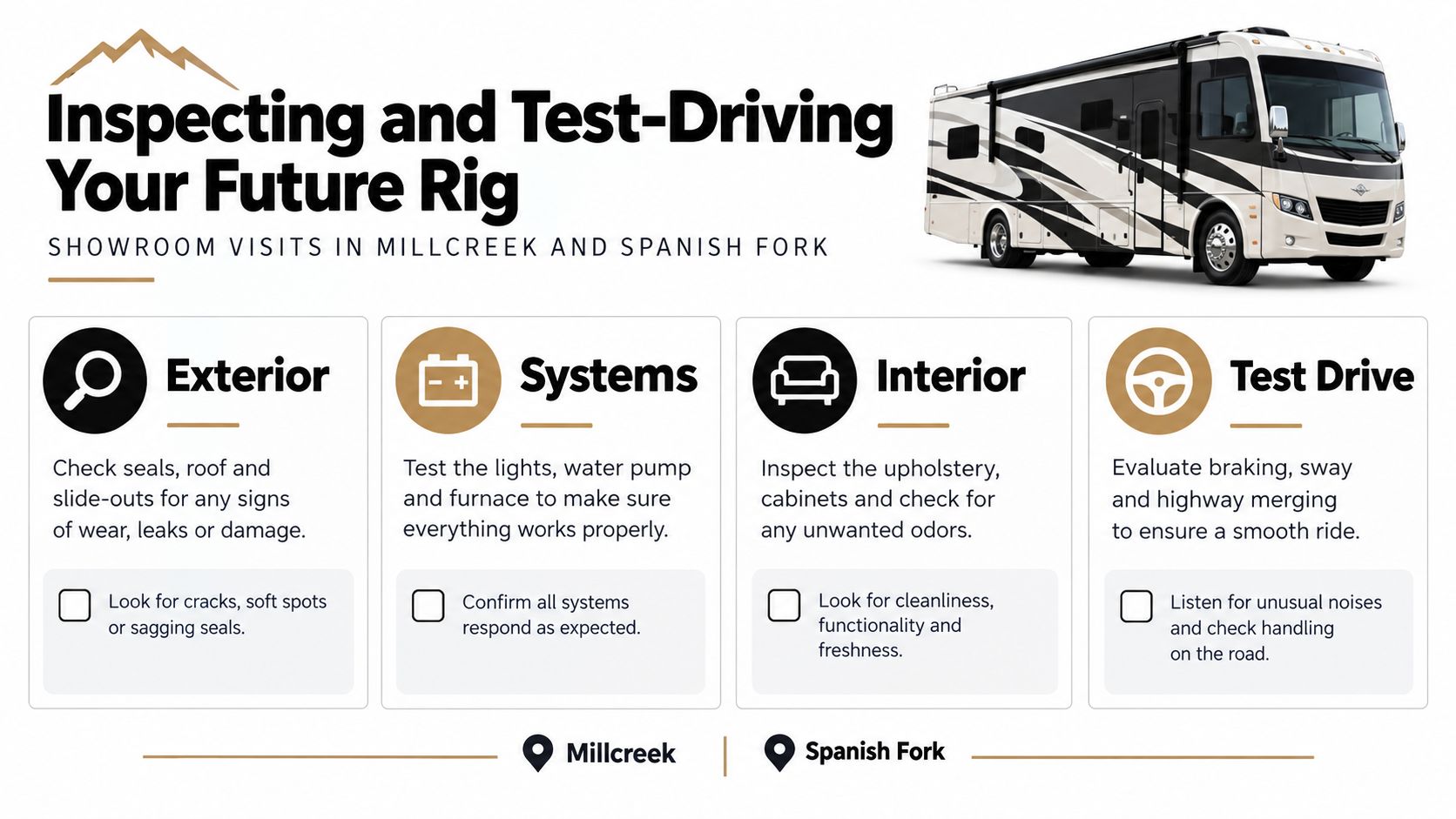
Walk through an RV as if you're already camping in it. In our Millcreek or Spanish Fork showrooms, open every cabinet, stand in the shower, sit at the dinette, and check whether the floorplan works with your travel partners. A beautiful trailer becomes frustrating when the kitchen blocks the bathroom, the bunks don't fit your family, or storage disappears once you pack outdoor gear.
Inspect the structure and systems
Start outside, especially on a used RV:
- Roof and seals: Look for cracked sealant, soft spots, staining, and signs of past water entry around roof penetrations, windows, doors, and slides.
- Slide-outs: Extend and retract each slide. Listen for strain, watch the seals, and check the floor for swelling.
- Tires: Read the date information, inspect sidewalls, and look for uneven wear. Age matters even when tread appears acceptable.
- Chassis and hitch: Look for corrosion, damage, unusual welds, and evidence of poor repairs.
- Systems: Test lights, furnace, air conditioning, refrigerator, water pump, faucets, toilet, outlets, and awnings.
A proper pre-delivery inspection should document what works and what needs attention. On a used unit, ask for service records and insist that unresolved issues appear in writing.
Treat the test drive as a safety check
The driver should notice how the RV accelerates, brakes, shifts, and tracks. On a towable, pay attention to sway, brake response, mirror visibility, and how the combination behaves when merging or encountering crosswinds. A motorhome should feel controllable through turns, lane changes, and stops, not merely comfortable in the parking lot.
Bring the actual tow vehicle when possible. A trailer that feels manageable behind a dealership vehicle may behave differently with your truck's wheelbase, payload, hitch setup, and cargo. Ask our service team to explain any unfamiliar controls before delivery, then take a slow first trip before committing to a demanding mountain route.
Financing, Trade-Ins, and the Modern Buying Experience
A first-time Utah buyer may prefer digital paperwork, quick financing answers, and a clear monthly budget before visiting the dealership. First-time owners now represent 36% of all RV owners, while newer buyers show interest in online financing, solar-ready models, and mobile communication (RVDA demographic reporting). The buying process should match that expectation, with straightforward numbers and no full-day office marathon.
Entry-level towables also deserve a serious look. Travel trailers in the $0 to $25,000 band rose 2% across nearly all income brackets and age groups (RVIA demographic profile). Price alone does not determine value. For Utah families, the right comparison includes tow-vehicle limits, mountain fuel use, winter storage, maintenance, and the true cost per night you expect after purchase.
Make financing serve the camping plan
Set the full ownership budget before choosing a payment. Include insurance, registration, fuel, storage, campsite fees, maintenance, equipment, and repairs. A longer loan term may lower the monthly figure while increasing the total repayment, so request both numbers and compare the complete cost.
Motor Sportsland provides a credit application, pre-qualification tools, and financing support for new and used RV purchases. Compare its options with your bank or credit union, then review this Utah RV financing guide before applying.
Use a trade strategically
A trade-in may include an older RV, vehicle, or powersports toy, depending on its condition and title status. Bring payoff information, maintenance records, keys, accessories, and accurate details about damage. A complete equipment list and clean history make the appraisal more productive.
Plan credit preparation separately if a major household purchase is ahead. This resource on how to improve credit before mortgage offers general guidance. Compare loan terms and fees, and keep the RV payment tied to how often you will camp. A lower payment is not a good deal if the rig sits unused through Utah's winter.
Winterizing and Storing Your RV for Utah Winters
Utah winter storage is not a reminder you check off mentally. Freezing temperatures can damage plumbing, batteries, seals, and appliances when water remains in the wrong place or batteries discharge for months.
Protect the plumbing
Use your owner's manual first, then follow a deliberate process:
- Drain and flush the fresh, gray, and black water tanks.
- Drain the water heater and place it in bypass mode before adding antifreeze.
- Open faucets and low-point drains to remove trapped water.
- Either run RV antifreeze through the plumbing system or blow the lines out with compressed air at about 30 to 40 PSI (winter storage checklist).
- Protect drains and toilet components according to the RV and antifreeze instructions.
- Check the exterior for gaps, damaged sealant, and openings that can allow moisture or pests inside.
Don't use automotive antifreeze in the potable water system. If you're uncertain about the heater bypass, plumbing layout, or compressed-air method, have a qualified technician handle it.
Care for batteries and the exterior
A fully charged lead-acid battery handles subfreezing temperatures better than a neglected, discharged battery. Storage guidance recommends disconnecting batteries or using a battery cutoff to stop parasitic draw, and other instructions recommend removing batteries to a cool, dry location, recharging them periodically, and following chemistry-specific targets for lithium or flooded batteries (RV battery storage guidance).
Before covering the RV, clean the exterior, inspect roof sealant, close vents as appropriate, and choose a cover compatible with the manufacturer's instructions. Don't trap moisture under a cover or leave tires and exposed components unprotected for the season.
Our service center can prepare an RV for winter, complete plumbing and electrical work, install upgrades, and handle spring commissioning. That support matters when you'd rather spend the first warm weekend near Jordanelle than troubleshoot a frozen water line in the driveway.
Motor Sportsland helps first-time RV buyers compare towables and motorhomes, evaluate fit, arrange financing, and prepare units for Utah travel and winter storage. Visit Motor Sportsland to browse current inventory, then stop by our Millcreek or Spanish Fork showroom for a hands-on walkthrough and a towing conversation based on your actual vehicle.
First time RV buyer FAQ
What's the best RV for a first time RV buyer?
For many beginners, a properly matched travel trailer is the practical starting point because it offers flexibility without combining the engine and living space. The right choice depends on your passengers, tow vehicle payload, storage, trip length, and comfort with mountain driving.
Should I choose a travel trailer or a fifth wheel?
Choose a travel trailer when maneuverability, lower weight, and flexible vehicle use matter most. Choose a fifth wheel when you have a suitable pickup and prioritize interior space for longer stays, while carefully verifying pin weight and payload.
How do I know whether my truck can tow an RV?
Read the payload rating on the door-jamb sticker, then subtract passengers, fuel, cargo, hitch equipment, and trailer tongue weight. Compare the remaining capacity with the loaded trailer, not only its dry weight or advertised maximum tow rating.
What does RV winterization include?
Winterization generally includes draining and flushing tanks, bypassing the water heater, protecting plumbing with RV antifreeze or compressed air, and caring for the batteries. Follow the manufacturer's instructions because plumbing layouts and battery chemistries differ.
Is 50-amp service necessary?
Not for every RV. A 50-amp system provides materially more AC capacity than 30-amp service and can be useful for larger rigs or multiple high-draw appliances, while smaller RVs may work well with careful 30-amp load management.
How should I calculate RV ownership cost?
Add the purchase and financing costs to insurance, maintenance, storage, fuel, registration, campsite fees, and equipment. Divide the expected total by the number of nights you'll camp to estimate your cost per night.
