
How to Negotiate RV Price Before You Sign

The discount printed on the window is the number most shoppers fight for. It is usually the wrong one. A lower sticker, a smaller monthly payment, or a flattering trade allowance can all look like a win while the final check gets bigger. If you want to know how to negotiate RV price before you sign, start with total delivered cost: the RV, the fees that apply, the tax and title you cannot bargain, and only the warranties you choose.
That shift matters on a Utah lot. A bunkhouse headed for Jordanelle weekends and a fifth wheel aimed at the Wasatch are not the same negotiation, and a tired towable sitting on carrying cost is not a scarce late-model motorhome. We would rather walk the buyer's order line by line in Salt Lake City than celebrate a percent off MSRP that disappears in paperwork.
Three habits do the work. Get the out-the-door figure in writing. Keep the loan and the trade on their own pages. Push hardest where age, condition, and days on the lot support it, not because the calendar says winter.
Negotiate the Out-the-Door Total in Four Steps
Skip the three numbers that consume a Saturday: the advertised price, the monthly payment, and the trade allowance. Settle the out-the-door total first. On an RV that means the agreed selling price, plus taxes, title and registration, documentation, delivery, dealer-installed equipment, and only the warranties you want.
Get that figure in writing before you visit the lot and before financing enters the conversation. The out-the-door amount should itemize the vehicle price, taxes, and fees so two stores can be compared on the same basis. An RV purchase is several deals at once: selling price, trade-in value, financing, and optional products such as service contracts. Government charges cannot be negotiated. Documentation, accessories, contracts, and prep packages can, and each one should carry its own line price.
The Consumer Reports pre-purchase checklist makes the same point from the buyer's chair: get the complete price in writing, since taxes and fees can add thousands to the advertised figure, and walk when unwanted extras appear in the final breakdown. A store that will not itemize is telling you how the closing will go. Stop the phone negotiation.
A Walkabout worksheet you can copy
Use the 2027 Keystone Walkabout 25MAX, stock #38946, as the worked example. MSRP is $84,786. The sale price is $59,450, plus a $499 documentation fee. We do not charge for prep, detail, orientation, destination, or freight, so those lines are $0 on this unit. The drop from MSRP looks large on paper. The other lines decide whether it stays large at signing.
| Line | What it covers | Walkabout 25MAX example | Negotiable |
|---|---|---|---|
| Selling price | Agreed price of this stock unit | $59,450 vs. $84,786 MSRP | Yes |
| Documentation fee | Processing and paperwork | $499 | Ask; required fees belong in the advertised price |
| Prep, detail, freight, destination | Readying the unit and getting it to the lot | $0 on this stock unit | Decline any prep package added later |
| State and local tax | Utah sales tax for the buyer's city | Written at the buyer's city rate | No |
| Title, registration, license | DMV charges | Written amount requested | No |
| Dealer add-ons and contracts | Warranties, accessories, protection plans | Price each one or decline | Yes |
| Trade equity | Allowance minus loan payoff | Kept off the sheet until unit price is set | Separate deal |
| Financing cost | APR, term, amount financed, total of payments | Quoted only after cash price | Separate deal |
Judge total acquisition cost, never the size of the advertised discount. Add the purchase price, mandatory fees, financing cost, any inspection or repair allowance, and the transport you expect. Home buyers already separate the offer from the closing stack. Offer strategies for Melrose Park buyers show why a clean written number beats a verbal "we can do better."
Run the four steps in this order
- Name a walk-away price first. Pull comparable listings of the same year, floorplan, and condition. Write the transaction price you will accept before anyone mentions a payment. First-time buyers often fall in love with a floorplan and then negotiate comfort instead of cost.
- Send one spec sheet to more than one seller. Include model year, floorplan, hitch weight, cargo door, sleeping count, and stock number. Collect itemized written quotes. A bunkhouse for Bear Lake and a toy hauler for dirt bikes are not comparable just because both say "family RV."
- Settle three deals on three pages. RV price first. Trade value second. Financing third. A fat trade allowance can hide a higher unit price or a messy payoff if you mix them.
- Rebuild the out-the-door total before you sign. Compare the final sheet against your written quotes line by line. A protection package that appears after the handshake is a reason to leave.
Practical rule: Bargaining power comes from a credible second offer and a willingness to leave without signing.
You can pre-qualify with no commitment and start a trade value on our website, then confirm every figure in person. I would not discuss a payment until that worksheet is filled.
Keep the Loan and Trade-In Off the Sticker
A payment quote can be accurate and still cost you thousands. Treat financing as a second purchase with its own benchmark. Before you name an RV, get a bank or credit-union preapproval that states the maximum amount, APR, term, and down payment. The FTC's financing guidance says those terms are what you use to negotiate with the dealer. Pre-qualification is the right first step, and a full application can wait until the unit and the price are real.
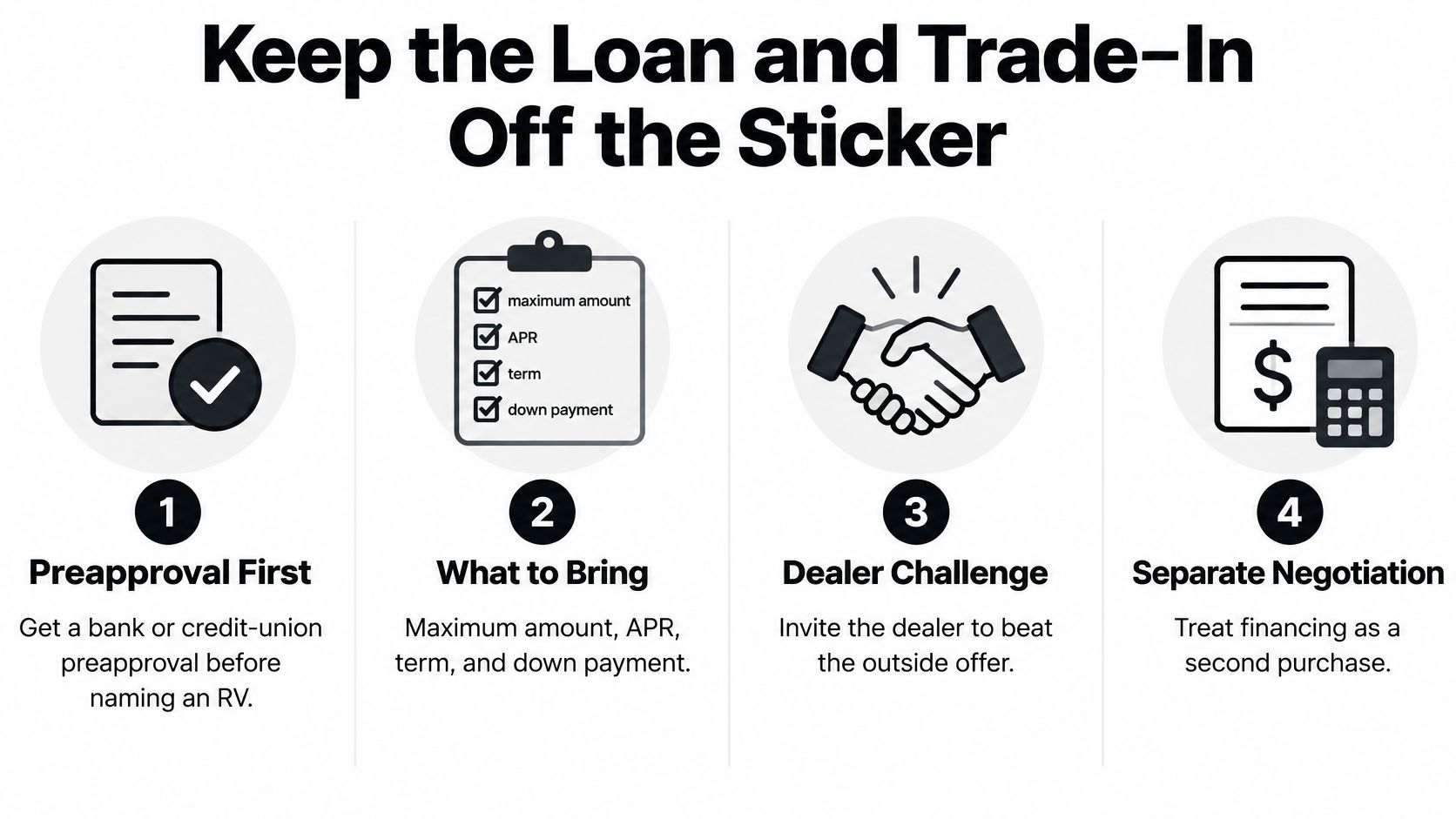
Ask the dealer to quote the same amount financed and the same term as your preapproval. Compare APR, total finance charge, amount financed, and total of payments. A longer term makes a payment look affordable while lifetime cost rises, and a desk can move price, term, down payment, and add-ons in the same pencil.
Take $60,000 financed at 8%. Over 144 months the payment is about $649 and total payments land near $93,500. Stretch the same amount to 180 months and the payment falls to roughly $573, while total payments climb to about $103,200, before taxes and fees. Saving $76 a month costs you nearly $9,700 over the life of the loan.
| Term | What changed |
|---|---|
| 144 months | Payment roughly $649, total payments near $93,500 |
| 180 months | Payment about $573, total payments about $103,200 |
The same trap shows up on a real floorplan. Listed financing on the 2026 Keystone Walkabout 22MAX is 7.99% APR for 240 months with 10% down for Tier 1 approved credit. At a sale price of $54,995, the estimated payment is $414 a month. That payment can fit a family budget. It still needs a total-of-payments check before you call it a deal, because 240 months is a long time to pay for a travel trailer. Confirm that APR, term, and amount borrowed are written into the contract, since conditional terms can change and raise the price.
If the preapproval is stuck on credit history, read realistic credit goals with Superior Credit Repair before you let a long term paper over the file. Our financing desk can try to beat a clean outside offer. It should not invent the benchmark for you.
Trade equity is its own page
Value the trade alone, subtract the payoff, and hold that number until the RV price is in writing. Rolling weak equity into a new loan is a different path from selling the old unit outright. We make cash offers on RVs customers want to sell, and you can start a trade figure through our travel trailer trade-in value process without folding it into the sticker.
Record selling price, trade allowance, cash down, APR, number of payments, amount financed, and total of payments as separate lines. Decline protection products until the base deal is settled. If financing is conditional, get written terms on approval, return of the down payment, and protection of the trade-in before you take the keys.
Leverage by RV Type in 2026
Winter is not automatically the cheapest week to buy. Your negotiating position in 2026 depends on whether the unit is aging towable inventory or a scarce late-model people are waiting on.
Black Book's May 2026 market update puts the Q4 2025 average motorhome selling price at $62,637 and towables at $15,408. Early 2026 towable values continued to fall as high inventory and affordability pressure affected entry-level and older units, while motorhome values softened more modestly. An older travel trailer, fifth wheel, or toy hauler can offer you more room due to comparable aging stock and carrying cost. A desirable late-model motorhome does not owe you an arbitrary percent off MSRP.
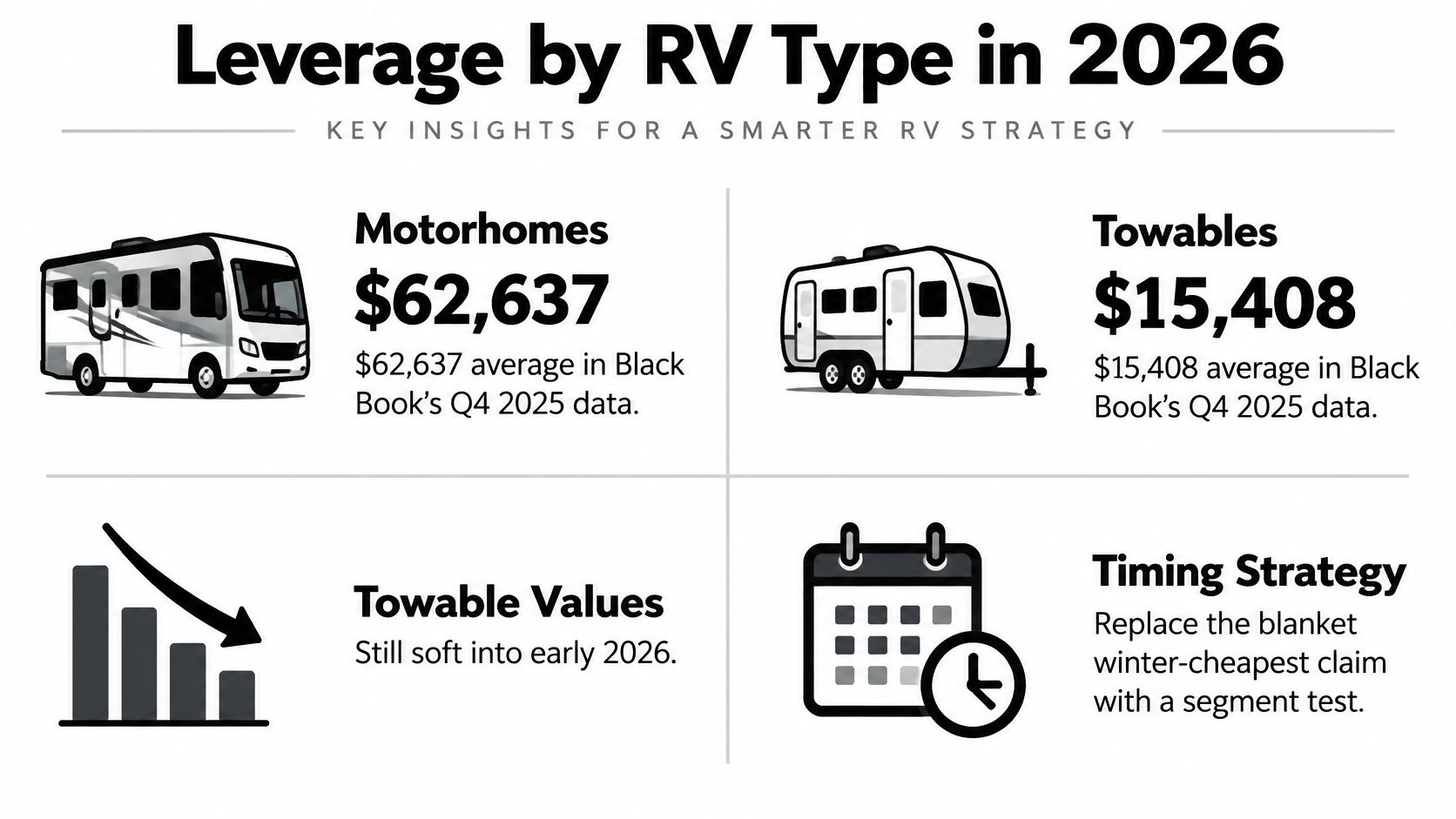
Quality used inventory can still be tight. The same update notes a 10.6% year-over-year increase in average pre-owned RV prices in Q1 2026, with standard-hitch travel trailers at $25,565. Clean units can hold price while tired ones sit.
| Segment | Reported marker | Buyer stance |
|---|---|---|
| Towables, Q4 2025 | Average selling price $15,408 | More room on older and entry-level units with carrying cost |
| Motorhomes, Q4 2025 | Average selling price $62,637 | Modest softness; do not assume a deep blanket discount |
| Standard-hitch travel trailers, Q1 2026 | About $25,565 | Demand can support price; negotiate condition and fees |
| Pre-owned market, Q1 2026 | Average prices up 10.6% year over year | Scarce clean units need comps, not a wish-list percent off |
Watch one stock number for 30 to 60 days
Track days listed, price cuts, model year, floorplan demand, condition, and matching listings. Push on documented defects, aged stock, obsolete electronics, tire age, roof condition, and missing service records. Wholesale auction figures are a benchmark, not a fair retail offer. Retail condition, prep, warranty, and Wasatch-season demand move the range.
A family comparing bunkhouses for Jordanelle or Bear Lake should negotiate an aging trailer differently from a retiree set on a scarce fifth wheel. Powersports owners shopping toy haulers should do the same with cargo-door units that have sat. For motorhomes, read current Class C motorhome prices against the specific coach, not against a winter rule of thumb.
If the unit is scarce and clean, your leverage is condition and fees. If it is old and slow, your leverage is carrying cost.
Dealership Scripts and Add-Ons to Decline
You do not need a speech. You need four lines you can say without sounding rehearsed, then the patience to wait for a written answer.
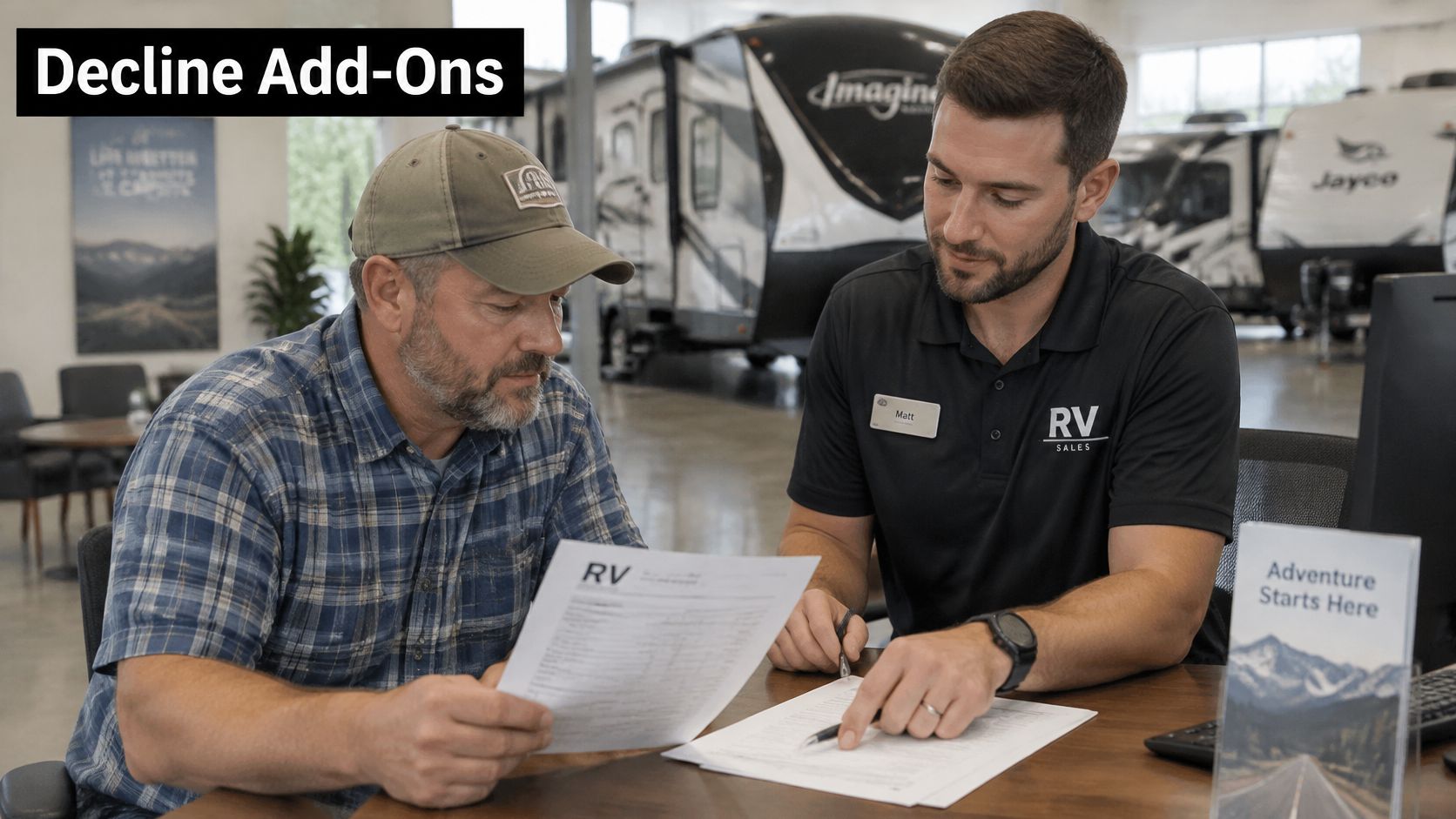
The FTC automobile pricing transparency FAQs set a clear test for an advertised vehicle price. It must be a price a consumer can pay, including mandatory dealer fees, and a required document fee cannot be omitted. Shoppers and dealers may still negotiate lower. Add-ons are not free. Say no when you do not need them, or ask for the individual price and terms before you accept.
Use these lines in order:
- "Can you itemize the out-the-door total and mark which charges are mandatory?" Optional and required should not share a lump sum.
- "What is the individual price and term of this service contract, and can I see it before I decide?" A contract you have not read is not a benefit.
- "I will decide on add-ons after we agree on the RV price." Protection plans, payment insurance, sealant packages, and accessory bundles wait until the base price is in writing.
- "I have a written quote on the same model, year, and stock number. Can you match the total?" Match the delivered number, not the loudest discount.
Turn an inspection into dollars
On a used unit, book an independent inspection. When it finds defects, estimated repair costs can be used to negotiate the price. Ask for a price cut, a repair before delivery, a parts replacement, or a service credit. Tire date codes, roof seams, and slide seals matter more in Utah sun and winter storage than a vague request for a couple thousand off. Mountain miles and a Great Salt Lake winter punish dried seals and old rubber.
This short walk-through shows how a buyer's order should be read before anyone reaches for a pen.
Compare the cleaned-up quote with one other written offer, and be ready to leave. Once the numbers are on paper, schedule a tour so you can check floorplan and weight in person. You can search new and used inventory at both Utah locations by condition, class, manufacturer, or keyword and build that second quote before you drive.
If it is not itemized, it is not agreed.
Price the RV Then Tour It in Utah
Three rules are enough to take onto the lot. Negotiate the written out-the-door total. Keep the trade and the financing on separate pages. Push hardest where aging inventory and documented condition support it, and ease off when the coach is scarce and clean.
Pull one in-stock unit, fill the worksheet, and bring a pre-qualification that is not a full application. We sell new and pre-owned travel trailers, fifth wheels, toy haulers, and motorhomes, including Forest River, Keystone, Jayco, and Winnebago, from showrooms in Millcreek and Spanish Fork. A Salt Lake City family can compare a light trailer for weekend loops with a larger fifth wheel without guessing which fee is real.
Service, parts, and collision repair stay local after the sale. That matters once you are towing toward the Wasatch or storing through a valley winter, but the purchase conversation should stay on price, weight, and floorplan. Do not let a service menu become the close.
Stop by either showroom or call for a walk-through of the numbers on a specific stock unit. Current inventory is on our site, and the sales team can schedule a tour so you see hitch weight, cargo space, and sleeping layout before you sign. I would rather you leave with a clean quote than with a payment that only works on a 15-year note.
Frequently Asked Questions About Negotiating an RV Price
Is the documentation fee negotiable?
Ask whether it is already inside the advertised price. A required document fee should not be left off that price. Our listings add a $499 documentation fee on top of the sale price, and we do not charge for prep, detail, orientation, destination, or freight. You can still negotiate the total down even when every mandatory charge is disclosed.
Do I need preapproval before visiting a dealer?
Yes. A bank or credit-union preapproval gives you an APR, term, maximum amount, and down payment to set beside the dealer's offer. Invite the dealer to beat that structure instead of inventing a payment first. Our pre-qualify option gives you a rate picture with no commitment before a full credit application.
Is a lower monthly payment a good deal?
Read the total of payments before you answer. Stretching the term can shrink the installment and raise what you pay over the life of the note. One of our current listings estimates $414 a month on a $54,995 trailer at 7.99% APR over 240 months with 10% down, a figure that only means something next to the full repayment sum. Price talk and payment talk are different skills, which is why pricing insights from PreSales Unleashed separate the number from the story wrapped around it.
Which add-ons should I decline?
Decline protection plans, payment insurance, sealant packages, and accessory bundles until the base RV price is in writing. If you want one later, price it alone and read the term. An add-on folded into the loan costs more than its sticker once interest runs on it.
Is winter always the cheapest time to buy?
No. Towable values have softened more than motorhome values, and clean pre-owned units can still be scarce. Check that stock number's days listed, price changes, and comparable listings over recent weeks before you name a percent off MSRP. An aging towable that has sat through price cuts gives you room. A scarce late-model unit does not.
Motor Sportsland helps Utah buyers price a specific trailer or motorhome before they sign, with written figures, no-commitment pre-qualification, and tours in Millcreek and Spanish Fork. Bring your worksheet and we will walk the out-the-door total on a stock unit. Visit Motor Sportsland to browse current inventory.
