
Max Towing Capacity: Your Ultimate Utah RV Guide

A truck's advertised max towing capacity is rarely the final number you can use. In certain U.S. federal operating contexts, guidance uses 75% of the vehicle's capacity as a conservative gross trailer limit when another tow rating isn't available, and your actual margin still shrinks with passengers, cargo, fuel, hitch equipment, and tongue weight.
A family can do everything right at the dealership, choose a trailer that appears comfortably within the truck's rating, and still feel uneasy on the climb toward Jordanelle or Bear Lake. The steering feels light, the trailer moves more than expected, and the truck works harder as the road rises through the Wasatch Mountains. That discomfort usually begins before a driver sees an obvious mechanical problem. It starts with treating a brochure number as the complete answer.
Our team has spent more than 55 years helping Utah families match tow vehicles and RVs to real travel plans, not just showroom specifications. The safest setup depends on payload, GCWR, GVWR, tongue weight, hitch ratings, and the loaded trailer, especially when the route includes high-altitude roads, long grades, crosswinds, or winter conditions.
Introduction to Safe Towing in Utah
A new travel trailer can feel perfectly manageable during a short test drive around Salt Lake City. The same combination may behave differently on a mountain grade with a full tank, camping supplies, passengers, bikes, and water aboard. A family heading toward a campground near the Wasatch Mountains may discover that the truck feels less settled than expected, even though the trailer's published dry weight sits below the truck's advertised max towing capacity.
That experience doesn't automatically mean the truck or trailer is defective. It often means the buyer evaluated only the trailer's empty figure and the truck's highest possible tow rating. Real towing adds weight in several places, and those additions affect acceleration, braking, handling, axle loads, and the truck's remaining payload.
Why Utah exposes weak calculations
Utah towing routes can combine steep grades, elevation changes, exposed wind, and long distances between services. A setup that feels acceptable on flat pavement may demand more patience and more reserve capacity near the Wasatch Mountains. Mountain driving doesn't change the rating printed on the vehicle, but it makes a poor match easier to notice.
Before you choose a trailer, read the door-jamb label, consult the owner's manual, and identify the exact truck configuration. Engine, cab, bed, axle ratio, drivetrain, tow package, and options can all affect the published rating. A properly adjusted hitch and sway-control system also matter, which is why our guide to travel trailer hitches and sway bars belongs in the planning process.
Our practical rule: Buy for the loaded trip you expect to take, not the empty trailer sitting on a dealer's lot.
The useful question isn't, “Can this truck tow that trailer?” Ask instead, “How much margin remains after my family, gear, hitch, fluids, and tongue weight are included?” That answer gives you a much better chance of enjoying the drive to a campground near the Great Salt Lake, Jordanelle, or Bear Lake.
Understanding Max Towing Capacity Basics
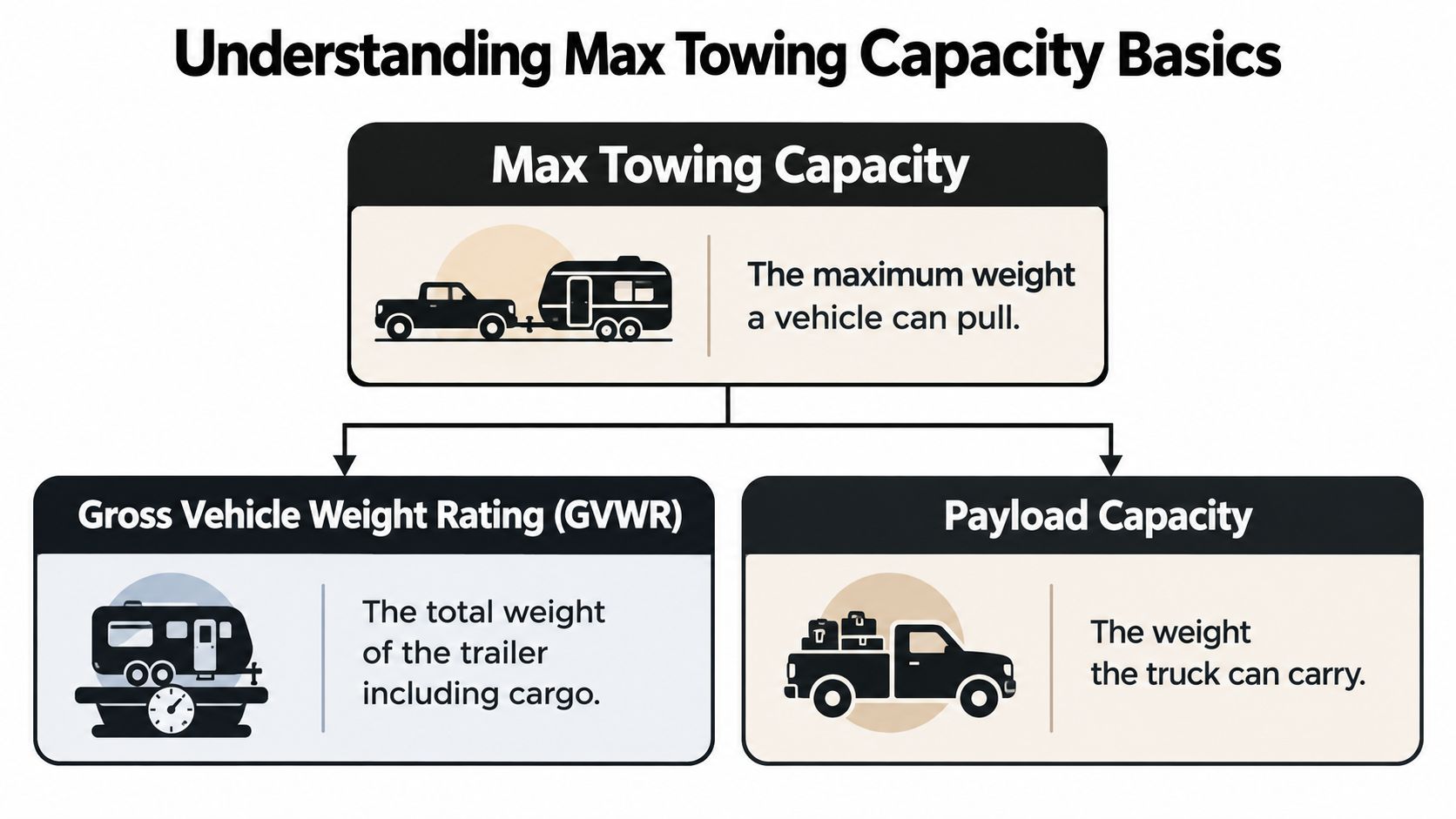
Max towing capacity is the maximum trailer weight a vehicle is rated to pull under specified conditions. It's an important reference point, but it isn't a guarantee that every vehicle with the same badge can tow that amount in every configuration or on every trip.
Think of the rating as the total size of a bucket. The bucket may be large, but the amount of usable water depends on how much space is already occupied and how much weight the handle, base, and surrounding structure can support. Your truck's passengers, cargo, fuel, hitch equipment, and trailer tongue weight consume part of the available capacity before the trailer is fully loaded.
The rating also involves more than engine power. Axle ratio, cooling capacity, transmission, brakes, tires, suspension, stability behavior, and tow-package hardware influence the certified towing envelope. A powerful engine can help a truck climb, but it can't cancel a payload, axle, hitch, or combined-weight limit.
How tow ratings became more comparable
SAE J2807 became the industry benchmark beginning with the 2013 model year. The standard established minimum performance criteria and a calculation method for tow-vehicle gross combination weight rating and trailer weight rating for passenger cars, multipurpose passenger vehicles, and trucks up to 13,000 pounds GVWR, making published ratings more comparable across major North American manufacturers (USDA Forest Service guidance).
That standardization helps shoppers compare vehicles more intelligently, but it doesn't eliminate the need to check the specific vehicle. A maximum rating may apply only to a particular drivetrain, axle ratio, tow package, wheelbase, or equipment combination. The truck sitting in front of you may not have the same rating as the version used in a manufacturer's maximum-capacity test.
What a brochure number leaves out
A trailer's dry weight leaves out the items your family adds for a trip. Depending on the trailer, those items may include propane, batteries, food, clothing, tools, water, outdoor furniture, sporting equipment, and recreational vehicles carried in a toy hauler.
For RV shopping, compare the trailer's GVWR, not only its dry weight, to the tow vehicle's usable margin. The trailer's GVWR represents its maximum loaded weight. Your target isn't to fill that number automatically, but using it for planning helps prevent a dry-weight estimate from becoming an accidental trip-weight assumption.
Key Acronyms That Define Your Limits
The labels on a truck and trailer door define the limits that matter after you leave the dealership. They account for the tow vehicle, passengers, cargo, hitch equipment, tongue weight, and trailer. In Utah, a combination that looks comfortable on a level lot can have far less margin on I-15 or a Wasatch grade once the family and travel gear are aboard.
GVWR and GCWR
GVWR, or Gross Vehicle Weight Rating, is the maximum allowable loaded weight of one vehicle. For the tow vehicle, that includes the truck, occupants, fuel, bed cargo, tools, accessories, hitch hardware, and the trailer weight carried through the hitch. For the trailer, GVWR is its maximum loaded weight.
GCWR, or Gross Combined Weight Rating, is the maximum loaded weight of the complete combination. The tow vehicle, trailer, passengers, fuel, cargo, and equipment all count. The NTEA work-truck trailering guidance defines GCWR as the maximum loaded weight of the entire combination, which explains why a trailer's listed weight never gives the full answer (NTEA trailering guidance).
Payload and tongue weight
Payload is what the truck can carry. Count the people in the cab, bed cargo, tools, aftermarket accessories, hitch equipment, and the trailer's tongue weight. A truck can remain under its advertised max towing capacity while exceeding payload because the cab, bed, and hitch load use up the available allowance first.
Tongue weight is the downward force placed on the hitch by the trailer. It counts against payload and changes how the combination responds in turns, braking, wind, and mountain descents. The lowest-rated part of the system sets the practical limit. That may be the truck, receiver, ball mount, hitch ball, trailer axle, tires, or another component.
The 2026 Ford RV and Trailer Towing Guide places loaded trailer tongue weight within a range of 10% to 15% and states that the lowest-rated towing component determines maximum capacity (2026 Ford RV and Trailer Towing Guide). Use that range to estimate how quickly a trailer consumes truck payload, especially when water, propane, batteries, and family gear raise its travel weight.
A hierarchy worth remembering
Evaluate a proposed combination in this order:
- Trailer GVWR: Use the trailer's maximum loaded weight for planning, rather than assuming its dry weight represents a trip-ready load.
- Tow-vehicle payload: Account for occupants, cargo, hitch equipment, and expected tongue weight.
- Tow-vehicle GVWR: Confirm the loaded truck stays within its rating.
- GCWR: Confirm the loaded truck and loaded trailer stay within the combined rating.
- Component ratings: Check the receiver, hitch ball, tires, axles, and trailer equipment.
Manufacturer numbers establish the starting point. Payload and tongue weight determine how much of that capacity remains for your actual Utah trip.
Calculating Your Real Towing Margin
The most useful calculation begins with the truck in its typical travel condition. Don't start with an empty vehicle if your normal trip includes a family, a full fuel tank, coolers, bikes, tools, and a weight-distribution hitch.
A manufacturer's towing guide expresses the core relationship this way: usable towing capacity equals GCWR minus the actual loaded weight of the tow vehicle (Ford towing information). The arithmetic is straightforward. The difficult part is gathering realistic weights instead of relying on assumptions.
Work through the numbers
Use these steps before committing to a trailer:
- Find the exact ratings for the truck. Check the door-jamb label, owner's manual, manufacturer towing guide, and any trailering information supplied with the vehicle. Confirm the exact engine, drivetrain, cab, bed, axle, tire, and tow-package configuration.
- Identify the truck's loaded weight. Begin with the vehicle's actual curb or scale weight, then add passengers, fuel, cargo, tools, accessories, and hitch equipment. A vehicle scale gives you a more useful answer than a generic model listing.
- Calculate the combined margin. Subtract the loaded tow-vehicle weight from the truck's GCWR. The result is the remaining theoretical trailer allowance under that combination.
- Check payload separately. Add people, bed cargo, hitch hardware, and expected tongue weight. Compare that total with the truck's payload capacity.
- Use the trailer's GVWR for planning. Dry weight can help you compare floorplans, but the loaded trailer's potential weight is the figure that protects your planning margin.
- Inspect the weakest component. Confirm that the receiver, hitch ball, tires, axles, and trailer structure can handle the intended load.
Here's the formula in plain language:
GCWR minus actual loaded tow-vehicle weight equals the remaining combined trailer allowance.
That result still needs a careful payload check. Tongue weight transfers part of the trailer load to the truck, so it can consume payload even though the trailer's axles carry the rest. If you load the truck with passengers and cargo first, then add a heavy tongue, the truck may reach its payload or rear-axle limit before the advertised max towing capacity becomes relevant.
Why scale tickets help
A real scale reading can uncover assumptions that a brochure cannot. Weigh the tow vehicle loaded for travel, then weigh the combination if possible. Keep the results with your registration and inspection notes so you can revisit the setup after adding a generator, bed cover, batteries, cargo rack, or other equipment.
Our towing-capacity calculation guide can help organize the process, but no online calculator replaces the labels and ratings for your exact truck and trailer. When the numbers are close, choose a lighter trailer, reduce cargo, or move to a tow vehicle with more available payload and combined capacity.
A margin also improves the driving experience. More reserve can mean less stress when traffic changes, the road climbs, wind hits the trailer, or you need to brake smoothly. The objective isn't to reach the highest possible figure. It's to create a combination that remains predictable when the trip becomes difficult.
Real-World Example of Towing in the Wasatch
A Salt Lake City family comes to our showroom looking for a travel trailer for weekends near the Wasatch Mountains. They have a truck with an impressive max towing capacity and find a trailer whose dry weight appears comfortably below it. The floorplan fits their family, but the dry figure doesn't include the equipment they plan to carry.
The calculation they almost skipped
The truck's actual travel weight includes the adults and children, fuel, car seats, coolers, camping supplies, recovery equipment, and items placed in the bed. It also includes the weight of the hitch assembly. The trailer's trip weight includes propane, batteries, food, clothing, chairs, tools, water, and the gear the family plans to use at camp.
The family first compares the dry trailer weight with the truck's brochure rating. That looks encouraging, but it answers only whether the empty trailer appears compatible with the headline number. The better process is to compare the loaded trailer's GVWR with the truck's remaining towing margin after calculating the loaded tow-vehicle weight.
They then make two checks:
- Combined weight check: Subtract the loaded truck weight from GCWR to determine the remaining trailer allowance.
- Payload check: Add occupants, cargo, hitch equipment, and expected tongue weight, then compare that total with the truck's available payload.
If either check produces little reserve, the family has a decision to make before signing paperwork. They can choose a lighter floorplan, carry less gear, use a different tow vehicle, or accept that the trailer is not a comfortable match for their intended travel. That decision is far easier in the dealership than on a mountain shoulder.
Mountain grades change the experience
Altitude and grades don't rewrite the vehicle's ratings, but they can make a marginal setup feel more demanding. The driver may need more patience on climbs, earlier braking decisions on descents, and closer attention to trailer sway and following distance. Utah's winding roads and exposed stretches near mountain passes leave less room for a combination that already operates close to its limits.
The SAE J2807 approach improves comparison because it uses repeatable conditions to determine GCWR and trailer weight ratings across manufacturers (Ford RV and Trailer Towing Guide). It doesn't mean every trip will feel identical. Your cargo, weather, road, tires, loading balance, and driving habits still shape the result.
The family ultimately chooses the setup that leaves practical room for their normal gear instead of stretching toward the maximum. That choice may reduce the trailer options on their list, but it improves the odds that the drive to Jordanelle or a mountain campground will feel controlled.
A visual example can help new owners connect the labels on their truck with the behavior they feel behind the wheel.
Electric Trucks and Modern Towing Challenges
Electric trucks bring a useful contrast to conventional towing assumptions. Immediate electric torque can make a heavy trailer feel responsive during acceleration, but responsive acceleration isn't the same as efficient long-distance towing. Buyers need to evaluate the route, trailer weight, charging access, weather, and the time available for travel.
Recent 2026 coverage lists battery-electric pickups with advertised tow ratings of up to 12,500 pounds and 11,000 pounds, while also describing practical range limitations when towing (TrueCar electric truck coverage). Those figures show why max towing capacity is only one part of the buying decision. A truck may have enough rated capacity for a trailer yet require more frequent charging and more detailed route planning under load.
Compare the trip, not only the truck
For an electric tow vehicle, ask:
- Distance: How far must you travel between reliable charging locations while towing?
- Trailer profile: Is the trailer tall, wide, heavy, or loaded close to its GVWR?
- Terrain: Will the trip cross the Wasatch Mountains or include sustained grades?
- Payload: Will passengers, tongue weight, cargo, and charging equipment keep the truck within its limits?
- Recovery plan: What will you do if weather, traffic, or a busy charging location changes the schedule?
The same payload and tongue-weight math applies to an electric truck. Battery weight, passengers, cargo, and hitch equipment still count, and the lowest-rated component still limits the combination. Range planning adds another layer rather than replacing the established weight checks.
Our guide to the best trucks for towing an RV in Utah can help frame the comparison around Utah routes and RV use. The right choice depends on whether your priority is local camping, longer interstate trips, frequent mountain travel, or carrying substantial equipment.
For some buyers, an electric truck can fit the routine well. For others, a conventional truck may make long towing days simpler because the fuel network and travel habits are already familiar. Neither choice should be made from the maximum tow number alone.
Conclusion and Next Steps with Motor Sportsland
The safest way to use max towing capacity is to treat it as the opening figure in a larger calculation. Load the tow vehicle as you'll use it, subtract that weight from GCWR, check payload, account for tongue weight, compare the trailer's GVWR, and inspect every component in the towing chain.
That process matters even more in Utah. A short drive near Salt Lake City may not reveal the same handling demands you'll experience on a Wasatch grade, near Bear Lake, or while carrying extra water and gear for a remote campsite. Reserve capacity gives you more flexibility when the road, weather, or traffic doesn't cooperate.
A buyer's final checklist
Before you purchase or tow, confirm that you have:
- The exact truck ratings: Use the actual vehicle's labels and manufacturer documentation.
- The loaded trailer plan: Consider GVWR, not just dry weight.
- The payload calculation: Include people, fuel, cargo, hitch hardware, and tongue weight.
- The GCWR calculation: Subtract the loaded truck weight from the combined rating.
- The component limits: Check the receiver, ball mount, hitch ball, tires, and axles.
- A realistic route: Account for grades, altitude, weather, charging or fuel access, and campground conditions.
- A reserve: Avoid selecting a trailer that leaves no practical room for normal travel equipment.
Motor Sportsland serves Utah buyers from locations in Millcreek and Spanish Fork, with new and used travel trailers, fifth wheels, toy haulers, folding campers, destination trailers, and motorhomes. Our team can also help owners address maintenance, repairs, installations, plumbing, electrical work, upgrades, parts, and collision needs through the service center. The right conversation starts with your truck, your trailer, your family, and the places you plan to go.
Frequently asked questions
Is max towing capacity the same as payload capacity?
No. Max towing capacity concerns the trailer a vehicle can pull under specified conditions. Payload is the weight the tow vehicle can carry, including passengers, cargo, hitch equipment, and tongue weight.
Should I compare dry weight or trailer GVWR?
Use the trailer's GVWR for conservative planning. Dry weight can exclude water, propane, batteries, food, clothing, tools, and recreational equipment that you'll carry during a real trip.
What is the basic towing calculation?
Subtract the actual loaded weight of the tow vehicle from its GCWR. Then check payload, tongue weight, GVWR, axle ratings, tires, and hitch components separately.
Does tongue weight count against payload?
Yes. Tongue weight presses down on the tow vehicle through the hitch, so it uses part of the vehicle's available payload.
Can an electric truck with a high tow rating tow long distances easily?
Not necessarily. Range can decline under load, so buyers should evaluate charging access, route length, terrain, trailer size, payload, and expected trip conditions alongside the tow rating.
Why does my truck feel different on Utah mountain roads?
Grades, altitude, wind, road curvature, trailer loading, and braking demands can make a marginal combination feel less stable or less responsive. Staying within the ratings and preserving reserve capacity helps maintain control.
Motor Sportsland offers new and used RVs, tow-ready travel trailers, fifth wheels, toy haulers, and service support for Utah owners. Bring us your truck details and travel plans, then visit Motor Sportsland to compare an RV setup that fits your calculated limits and your next Utah adventure.
