
Travel Trailer Hitch and Sway Bars Guide

A trailer can feel perfectly calm leaving your driveway, then start wagging across the lane when a crosswind hits or a tractor-trailer passes on I-15. That sudden side-to-side motion is frightening, especially when your family, campsite, and expensive equipment are all behind you. The good news is that trailer sway usually has a physical cause you can identify and correct.
The right travel trailer hitch and sway bars setup starts with loading, not shopping. You need to know whether the trailer is unbalanced, whether the tow vehicle is carrying the load correctly, or whether your hitch lacks enough sway resistance for the trailer's size and the roads you travel. Our team at Motor Sportsland helps Utah RV owners think through those variables before they spend money on parts that can only mask the underlying problem.
| Hitch setup | How it carries the load | Best fit | Main limitation |
|---|---|---|---|
| Weight-carrying ball mount | Holds tongue weight at the receiver and ball | Lighter trailers within the tow vehicle and receiver ratings | Does little to correct rear sag or restore front-axle load |
| Weight-distribution hitch | Uses spring bars to spread load across the tow vehicle and trailer axles | Many travel trailers, especially when the vehicle squats or steering feels light | Must be matched and adjusted to the actual loaded tongue weight |
| Fifth-wheel or gooseneck hitch | Connects the trailer over or near the tow vehicle's rear axle | Fifth wheels and gooseneck trailers designed for that connection | Not interchangeable with a travel-trailer receiver setup |
Understanding the Critical Role of Your Towing Setup
The first time a trailer starts fishtailing, most drivers instinctively lift off the throttle, grip the wheel, and make a sharp correction. That reaction can make the oscillation worse. The trailer isn't behaving randomly. The combined vehicle and trailer system has been disturbed, and the hitch, loading, tires, speed, and road forces determine whether the movement fades or builds.
Trailer sway is a well-studied stability problem in vehicle-trailer dynamics. Research identifies a critical-speed phenomenon where a vehicle-trailer combination can shift into unstable oscillation after a disturbance. In one full-scale active-hitch test, a steering impulse at 65 km/h produced steady oscillation without control, while the controlled hitch settled the trailer in under 4 seconds (University of Waterloo research).
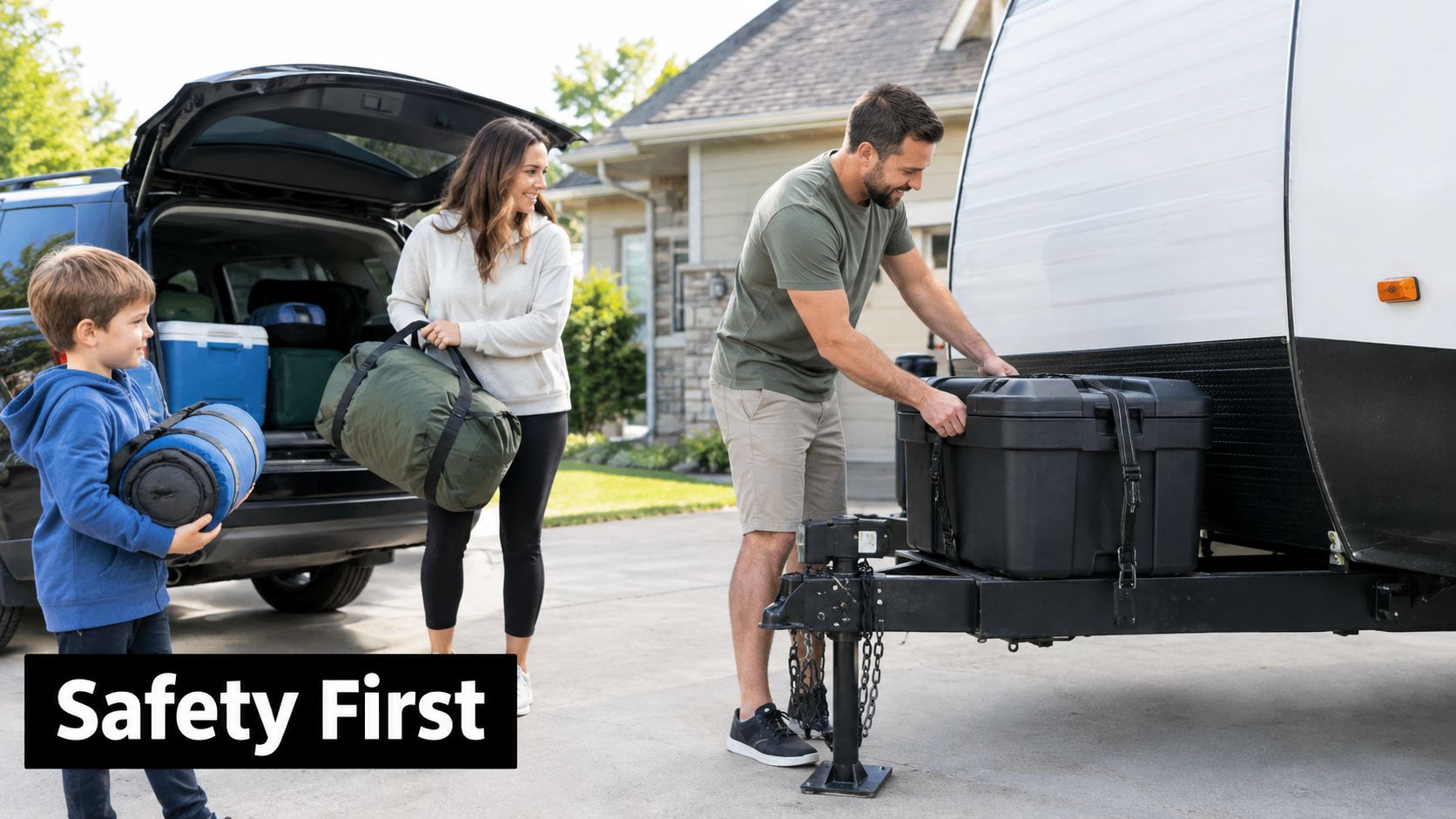
Why the hitch matters
A receiver and ball mount form the mechanical connection between your tow vehicle and your living space. A weight-distribution hitch adds spring bars that apply force between the trailer frame and tow vehicle, helping restore load to the front axle and keep the combination more level. Sway control adds resistance or geometric centering to limit lateral movement.
That distinction matters on Utah roads. A rig that feels acceptable on a calm surface near Salt Lake City may react differently on a mountain curve, exposed desert highway, or windy approach to the Great Salt Lake. Before choosing equipment, confirm the tow vehicle's ratings and learn how to calculate towing capacity, including the loaded trailer rather than relying only on an empty brochure figure.
Practical rule: A sway bar is not a substitute for a correctly loaded trailer or a tow vehicle that can safely handle the combination.
The goal isn't to create a perfect laboratory setup. It's to produce a rig that tracks predictably, responds cleanly to steering, and gives you enough margin to handle wind, traffic, grades, and an unexpected maneuver.
Comparing the Three Main Hitch Types
Choosing among hitch types becomes simpler when you focus on where the trailer's force enters the tow vehicle.
A weight-carrying hitch uses a standard ball mount. The trailer's tongue weight presses down at the receiver, which can squat the rear suspension and reduce load on the front tires. This arrangement can work for a lighter trailer when the vehicle and receiver are rated for it, the trailer remains balanced, and the tow vehicle stays level. It doesn't redistribute weight or actively control sway.
A weight-distribution hitch adds spring bars between the hitch head and trailer frame. Those bars act as levers, sending part of the downward tongue load forward through the tow vehicle and back across the trailer axles. The result is improved stance and steering feel when the system is correctly sized and adjusted. A WD hitch can include built-in sway control or accept a separate friction device.
A fifth-wheel or gooseneck hitch connects the trailer inside the bed of a pickup, near the rear axle rather than at a receiver behind the bumper. That location changes the pivot point and load path, which is why fifth wheels and goosenecks require dedicated tow vehicles and hardware. They aren't an upgrade path for a conventional travel trailer hitch.
What the common choices mean in practice
- Standard ball mount: Keep this choice for a light, properly balanced trailer that stays within the tow vehicle and receiver limits.
- WD hitch without integrated sway control: Useful when the main issue is rear sag and lost front-axle load, but it doesn't provide the same lateral resistance as a system designed to manage sway.
- Integrated WD and sway control: The stronger choice for a high-profile or longer travel trailer, frequent highway use, crosswinds, and passing-truck disturbances.
- Separate friction sway bar: A budget-oriented option for lighter applications, provided the hitch and trailer are compatible and loading is already correct.
- Fifth-wheel or gooseneck hitch: Select only when the trailer is built for that connection and the tow vehicle has the correct bed-mounted equipment.
Integrated weight-distribution hitches with built-in sway control actively resist movement at the hitch interface instead of only damping it after sway begins. Expert summaries identify friction bars as the lower-cost choice for light-to-mid-size trailers, while 4-point or cam-action systems are preferred for heavier rigs and demanding conditions (towing device comparison).
For a deeper explanation of spring bars, receiver ratings, and setup decisions, use our Utah weight-distribution hitch guide.
How Sway Control Systems Work
A trailer that starts wandering after a gust or passing truck needs diagnosis before it needs new hardware. A friction sway bar reacts to sideways movement by pressing friction plates, or similar surfaces, against the motion. That resistance can reduce oscillation, but it cannot correct an incorrect tongue-weight ratio, cargo placed too far rearward, an overloaded tow vehicle, or a hitch set at the wrong height.
An integrated system controls the connection more actively. Depending on the design, it may use spring-bar friction, cams, brackets, or a centering mechanism to resist yaw before the trailer develops a large swing. Blue Ox describes SwayPro as using a caster-based head that continually centers the trailer. CURT also describes sway control that can operate with a weight-distribution hitch or independently through a sway-control ball mount (Blue Ox SwayPro information).
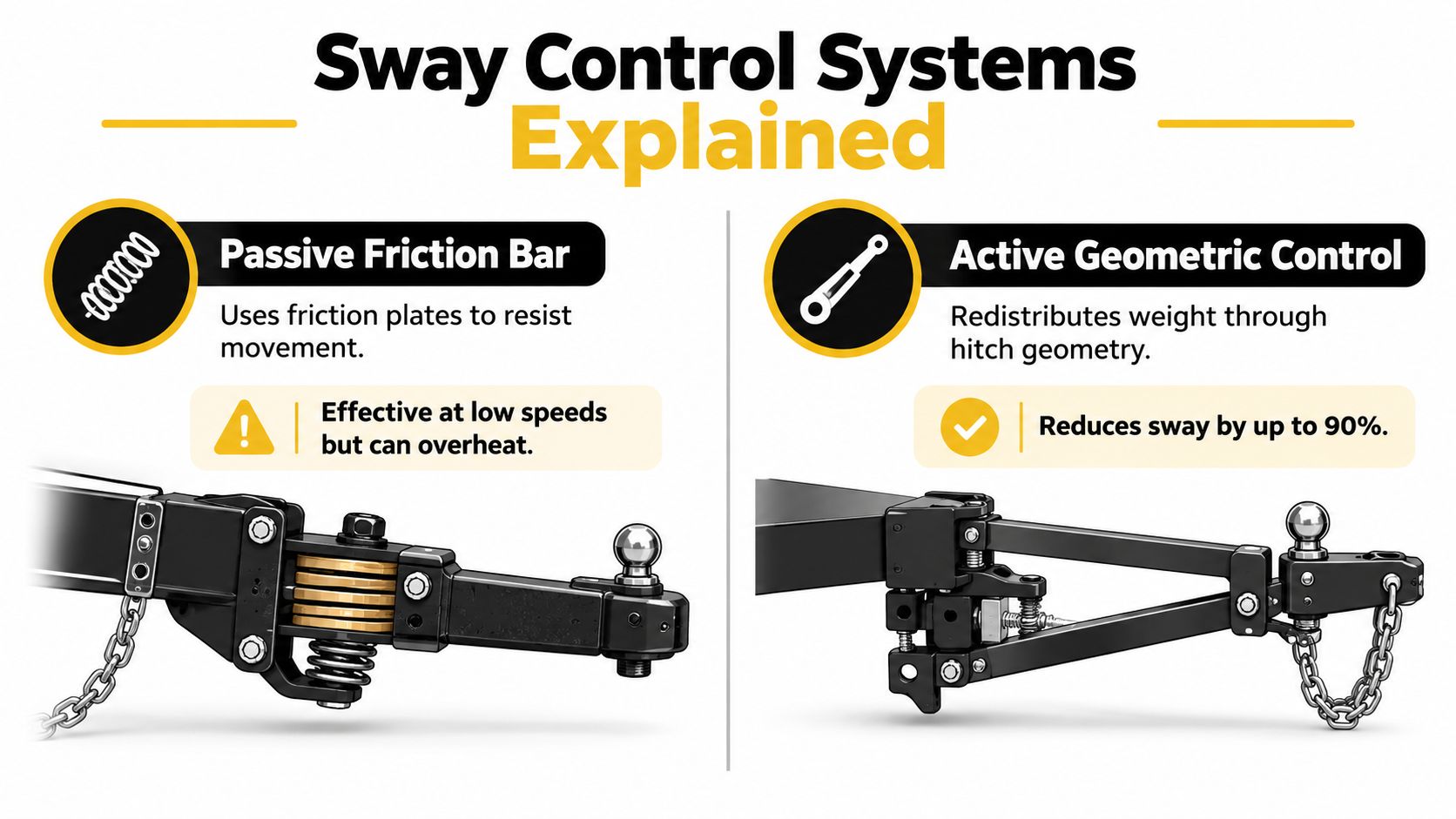
Passive resistance versus active control
A friction bar works like a damper. It slows trailer movement in the same basic way a shock absorber slows suspension travel. That can suit a modest trailer with correct loading. A taller or longer trailer exposes more side area to wind and traffic, so the disturbance reaches the hitch with greater force. An add-on bar may reduce the symptom without providing enough control for the rig.
Cam-action and multi-point systems alter the geometry of the hitch connection. Several contact points resist movement and help guide the trailer back toward center. For a high-profile trailer on exposed Utah highways, that centering action is usually the more predictable choice.
Electronic yaw control
Some tow vehicles include electronic trailer-sway mitigation. The system monitors vehicle behavior and applies braking or other control inputs when it detects oscillation. It adds protection, but it cannot repair poor loading, incorrect hitch height, or an unsuitable tow vehicle. NHTSA materials note that some sway-mitigation functions activate only above 40 mph, so they target highway conditions rather than slow-speed maneuvering (NHTSA technical material).
Academic engineering research also supports active control. One trailer-control study found that hitch-angle control reduced the resonance peak by 67.7% compared with a passive configuration (University of Padua research). The result does not mean every owner needs electronic equipment. It shows why system design matters after loading and mechanical setup have been checked.
Use this anti-sway hitch guide for Utah RV owners to diagnose the cause before buying a larger friction bar.
Diagnosing Your Trailer Weight and Balance
Buying a sway bar before measuring the trailer is backwards. A friction device may reduce the motion you feel, but it won't move cargo forward, restore front-axle load, or make an under-rated tow vehicle safe.
A practical travel-trailer target is 10% to 15% tongue weight based on loaded trailer weight. A WD hitch should be sized to the actual tongue weight, not the dry weight, and its spring bars help restore front-axle load and steering feel (hitch setup guidance).
A useful diagnostic sequence
Load the trailer as you travel. Include normal camping gear, propane, batteries, food, tools, and water you carry. Cargo placed behind the trailer axles can reduce tongue weight and make the trailer more willing to pivot.
Confirm the trailer's loaded weight. Use a certified public scale and record the combined tow vehicle and trailer weight, then weigh the tow vehicle separately when practical. The difference gives you a useful loaded trailer figure.
Measure tongue weight. Use a suitable tongue-weight scale or have a qualified service department measure it. Compare the result with the loaded trailer weight. Don't estimate by pushing down on the coupler or trusting the dry specification.
Check the tow vehicle stance. Look for rear suspension squat, a lifted front end, vague steering, or unusual braking feel. Those symptoms point toward a load-transfer issue, not merely a missing sway bar.
Inspect cargo placement. Heavy equipment belongs where the trailer manufacturer intends it, with enough forward loading to maintain stable tongue weight. Don't move cargo randomly to chase a scale reading. Follow the trailer manufacturer's loading guidance.
Verify the receiver and hitch ratings. The lowest-rated component controls the safe limit. That includes the vehicle, receiver, ball mount, coupler, safety chains, tires, and hitch bars.
What the symptoms tell you
A trailer that sways mainly after rear cargo is added likely has a balance problem. A tow vehicle that squats and feels light at the steering wheel needs its front-axle load and hitch setup checked. A correctly loaded, correctly adjusted rig that still reacts strongly to passing trucks may need integrated sway control rather than a basic friction attachment.
A sway bar can manage motion. It can't repair bad balance.
If your measurements fall outside the stable setup range, correct loading first. If the trailer remains unstable after the physical causes are addressed, then choose a more capable WD and sway-control system.
Selecting Gear for Utah Driving Conditions
Utah exposes weak towing setups quickly. A trip from Salt Lake City toward Jordanelle or Deer Valley can shift from city traffic to steep grades and tight curves. Routes toward Bear Lake add mountain roads and changing weather, while open pavement near the Great Salt Lake can subject a tall trailer to strong crosswinds.

A high-profile trailer catches more side force than a compact utility trailer. Passing trucks and abrupt steering inputs can also disturb the combination. Start with the cause, not the catalog. If the trailer becomes unstable after cargo is added, correct its loading and balance before buying sway hardware.
Match the equipment to the route
A smaller trailer used on calmer roads can work well with a properly rated ball mount or WD hitch paired with a separate friction bar, provided its loaded balance is sound. For a longer or taller trailer on mountain passes, exposed highways, and busy interstate routes, I recommend an integrated WD hitch with built-in sway control. It gives the driver a more consistent response when wind, road shape, and traffic loads change.
That recommendation is based on conditions, not complexity. Mountain grades demand predictable steering and braking, so the hitch must match the trailer, tow vehicle, and actual route. Utah's winter storage also calls for routine care. Before putting the rig away, inspect the hitch head, spring bars, brackets, pins, and friction surfaces. Protect each component according to the manufacturer's instructions.
If you tow a boat to Bear Lake alongside your travel trailer, a properly rated Harbor Freight boat winch keeps loading controlled at the ramp. It does nothing for sway once you are on the highway, so treat it as loading equipment rather than towing equipment.
Here's a visual reference for how wind and road conditions can affect a towing combination:
Reduce speed before the rig feels unsettled. Electronic assistance can help at highway speeds, but no system makes an incorrectly loaded trailer predictable.屣
Installation Best Practices and Common Mistakes
A well-designed hitch can perform poorly when the head angle, height, spring-bar tension, or fastener torque is wrong. The trailer should be level for setup, and the tow vehicle's front-axle height should be checked before and after the spring bars are engaged. The bars need to sit correctly on their brackets and move as the manufacturer intended.
The most common mistakes are avoidable:
- Using dry weight: Select spring bars from actual loaded tongue weight, not the empty trailer figure.
- Skipping measurements: Record the uncoupled and coupled ride heights so you can see whether the setup restores the vehicle's stance.
- Guessing torque: Use the hitch manufacturer's specified torque values and recheck fasteners after the initial tow.
- Setting the hitch too high or low: An incorrect ball height can leave the trailer nose-up or nose-down and change how load moves through the combination.
- Ignoring clearance: Confirm that chains, wiring, propane equipment, sway devices, and spring bars have room to operate through turns.
- Mixing incompatible parts: The receiver, ball, coupler, shank, spring bars, and sway-control components must work together within their ratings.
Too little tongue weight is a direct mechanical cause of sway. A weight-distribution hitch can transfer force forward to the tow vehicle's front axle and across the trailer axles, helping the vehicle regain front-tire load and directional control (NHTSA towing safety material).
Professional installation makes sense when you're unfamiliar with spring-bar tension, can't verify the receiver rating, or still feel sway after making adjustments. Motor Sportsland offers RV service, hitch installation, repairs, and related upgrades, so a technician can inspect the complete connection rather than selling you an isolated accessory.
Final Recommendations for Safe Towing
Use this decision matrix as a starting point, then verify the actual ratings and measured tongue weight for your rig.
| Your situation | My recommendation |
|---|---|
| Light trailer, balanced load, calm local use | A properly rated weight-carrying ball mount may be sufficient |
| Rear suspension squats or steering feels light | Use a correctly sized weight-distribution hitch |
| Trailer is taller, longer, or frequently exposed to wind and passing trucks | Choose integrated weight distribution with built-in sway control |
| Sway continues after loading and setup are corrected | Upgrade from basic friction resistance to a more capable integrated system |
| Trailer is designed as a fifth wheel or gooseneck | Use the dedicated bed-mounted hitch required by that trailer |
| Any setup near a vehicle, receiver, or tire limit | Stop and have the complete combination evaluated before towing |
Remember the order: match the tow vehicle, load the trailer correctly, measure tongue weight, set up the hitch, then add sway control appropriate to the trailer and route. Inspect hitch hardware before every trip, watch for damaged brackets or worn friction surfaces, and don't treat electronic mitigation as permission to drive faster in poor conditions.
If you're buying your first travel trailer, bring the tow vehicle information and your expected camping load to a qualified RV specialist. The right answer may be a different hitch, a better loading plan, or a smaller trailer. Spending money on a sway bar is not a victory if the underlying combination remains wrong.
For more towing decisions, you can also compare travel trailer inventory by weight, length, floorplan, and features before choosing a rig that fits your vehicle.
Motor Sportsland can help you compare travel trailers, verify hitch and sway-control needs, and schedule installation or service for your current setup. Visit Motor Sportsland in the Salt Lake City area to talk through your tow vehicle, trailer, loading plan, and Utah travel routes with our team.
Frequently asked questions
Do sway bars fix an unstable travel trailer?
Not by themselves. A sway bar can resist side-to-side movement, but it won't correct poor cargo placement, insufficient tongue weight, an incorrect hitch setup, or an under-rated tow vehicle. Diagnose loading and ratings first.
Should I use a weight-distribution hitch with sway control?
For many larger, taller, or frequently highway-towed travel trailers, integrated weight distribution and sway control is the sensible choice. It addresses both load transfer and lateral movement in one matched system.
Is a friction sway bar enough for a travel trailer?
It can be appropriate for a lighter, correctly loaded trailer in suitable conditions. Longer, taller trailers and rigs used in crosswinds or heavy traffic usually deserve a more capable integrated system.
How do I know whether my trailer has too little tongue weight?
Measure the loaded trailer and actual tongue weight rather than guessing. If the trailer is packed heavily toward the rear or the combination repeatedly sways, have the setup weighed and inspected before changing hardware.
Can electronic trailer-sway control replace a hitch sway bar?
No. Electronic mitigation is an added safety layer, not a replacement for proper loading, correct hitch adjustment, sound tires, and equipment matched to the tow vehicle and trailer.
Can a weight-distribution hitch increase my vehicle's towing capacity?
No. It can help a properly rated combination distribute load and handle more predictably, but it doesn't raise the vehicle's maximum towing capacity or override the lowest-rated component.
