
RV AC Repair Cost in Utah: Parts, Labor and Fixes

Most RV AC repair cost falls into a narrow band once you know which part failed: capacitors run about $150–$400 installed, thermostats $150–$450, compressor work $600–$1,500 or more, and a complete rooftop replacement $1,200–$2,900, with published figures varying by source. That spread is the whole story of RV air conditioning repair. The same symptom, a rooftop unit that runs but won't cool, can mean a cheap electrical part or a sealed-system failure that costs more than half a new air conditioner.
Say you're parked at Jordanelle in mid-July, the fan is humming, and the air coming out of the ceiling vents is barely cooler than the air going in. The instinct is to brace for a four-figure bill. Often the actual answer is a start capacitor, a dirty evaporator coil, or a weak 12-volt supply to the thermostat, and none of those justify a new rooftop unit.
I'd rather you walk into a shop knowing which of the three cost families your fault belongs to, what measurements the technician should have written down, and when a repair quote is really a replacement decision in disguise. Our team at Motor Sportsland handles this diagnosis regularly for owners across the Wasatch Front, and the pattern is consistent: the owners who get the best outcome ask for readings before they approve parts. Utah adds its own pressure, with canyon climbs, valley heat, and campground pedestals that sag under a July load, so the timing of your service visit matters as much as the price.
Typical RV AC Repair Costs by Failed Part
| Failed part | Failure type | Typical installed cost |
|---|---|---|
| Start/run capacitor | Electrical | $150–$400 installed |
| Thermostat | Electrical | $150–$450 |
| Control board | Electrical | $200–$500 |
| Fan motor | Airflow | $200–$650 |
| Refrigerant leak service | Sealed system | $300–$700 or more |
| Compressor repair or replacement | Sealed system | $600–$1,500 or more |
| Complete rooftop AC replacement | Full unit | $1,400–$2,900 installed (some independent shops quote near $1,200) |
Reading the table by failure type
The dividing line isn't brand or BTU rating. According to Mobile RV Pro's AC repair service guide, RV air-conditioner repair cost is driven primarily by whether the failure is electrical, airflow-related, or inside the sealed refrigeration system, with typical U.S. all-in benchmarks of approximately $150–$350 for a capacitor, $300–$650 for a fan motor, $200–$450 for a thermostat, $700–$1,400 for compressor replacement, and $1,400–$2,900 for a complete 13,500–15,000 BTU rooftop-unit replacement. Those figures include typical parts and professional labor.
Electrical rows are the cheap ones because the parts are accessible, testable with a multimeter and a capacitance meter, and swappable without opening the refrigerant circuit. A failed capacitor can stop the compressor from starting while the compressor itself remains perfectly serviceable, which is why a "dead AC" complaint so often ends with a small silver can and a short invoice.
Why the sealed-system rows change the conversation
Once a technician confirms high running current, bearing drag, grounded windings, or a sealed-system failure, compressor repair can become uneconomic, as the same Mobile RV Pro benchmarks explain. That's the row where you stop asking "what does the part cost" and start asking "what else is worn out on this roof."
Published replacement numbers differ by provider. RV Air Lab's replacement cost guide reported in 2026 that replacing a single rooftop RV air conditioner through an independent repair facility typically costs $1,200–$2,100, which sits below the upper end of the broader benchmark range. Treat the low end of any row as a starting budget, not a quote.
Practical rule: match your symptom to a row, write down the part you suspect, and set a realistic ceiling before you call. If the shop's number lands far outside that row, ask what changed.
Labor, access and the fee nobody mentions
Two modifiers apply to every row. Professional labor benchmarks sit broadly around $125–$225 per hour, and mobile providers often add a service-call charge on top, per the Mobile RV Pro AC repair guide. The same source notes that a technician should identify whether your unit is ducted or non-ducted and verify roof access, because both affect labor time.
When you compare a shop estimate against a mobile quote for a Utah trip, compare the complete trip and diagnostic fee, not the hourly rate. A mobile tech with a lower rate and a long drive to Bear Lake can end up costing more than a bay in Millcreek.
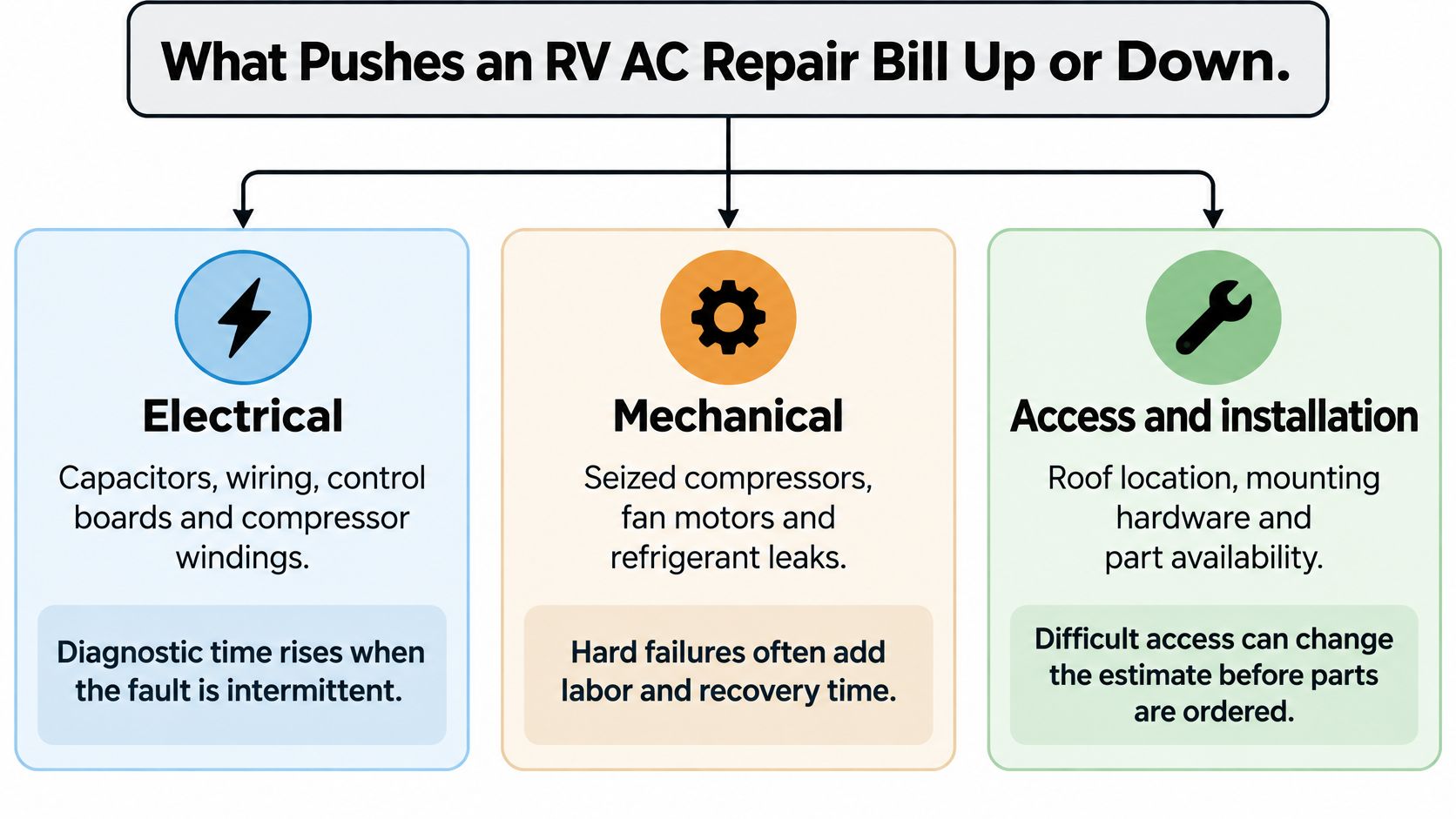
What Pushes an RV AC Repair Bill Up or Down
Three families explain almost every invoice difference. Electrical faults (capacitors, thermostats, control boards, wiring) and airflow faults (fan motors, clogged coils, crushed ducting, a cracked shroud) usually stay in the low hundreds. Sealed-system faults, meaning compressors and refrigerant leaks, push totals up sharply, and on an aging rooftop unit a compressor job can make full replacement the better investment. Micro-Air's RV AC replacement cost guide puts it plainly: relatively inexpensive electrical components can often justify repair, whereas compressor failure or multiple problems in an aging unit may make replacement financially preferable.
The modifiers that move any row
The same guide notes that these figures vary by RV model, accessibility, location, diagnostic charges, and whether the system is ducted. In practice that means a tall fifth wheel with a ladder-free roof, a ducted ceiling assembly that has to come down, or an intermittent fault that only appears after two hours of running will all add paid time before a single part is ordered. If your symptom is really a tripping breaker rather than warm air, work through our guide on why an RV breaker keeps tripping first, because that path often ends in the pedestal or the cord, not the rooftop unit.
A worked comparison
Take a hypothetical pair of invoices on the same roof. One is $180 for a capacitor on an otherwise healthy unit with a short labor window. The other is $900 for compressor work. The first is a quick fix you approve on the spot. The second needs a written diagnosis, a second opinion, and an age check before you sign, because you're buying one renewed component on a unit whose fan motor, board and coil are all the same age as the failed compressor.
Ask any shop three questions:
- Which family: is this electrical, airflow, or sealed-system?
- How many hours: what's the estimated labor time, and what would extend it?
- Is diagnosis included: does the quote absorb the diagnostic fee or bill it separately?
How to Diagnose an RV AC Before Approving Parts
A careful technician checks both electrical systems before anyone authorizes a part. The RV Resources AC troubleshooting guide explains that the thermostat and control board typically operate on 12-volt DC from the RV battery system, while the blower fan and compressor need 120-volt AC from shore power or a correctly sized generator. A DC failure can leave the controls dead while campground power is fine, and a 120-volt problem can kill cooling while the thermostat still looks alive.
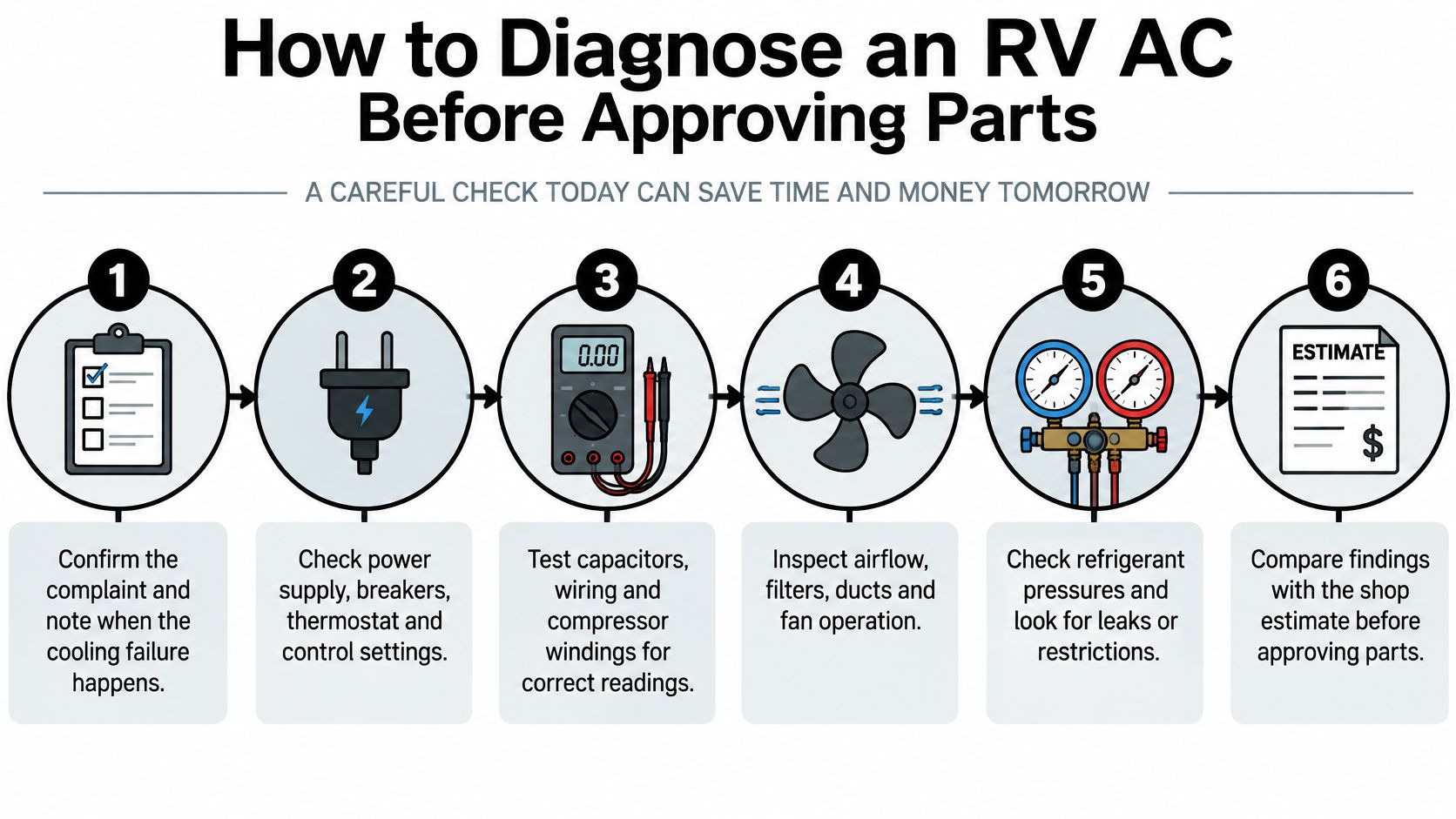
The six checks, in order
- Battery voltage and connections first. Measure at the battery and at the thermostat feed with a digital multimeter, because a tired house battery or a corroded ground mimics a dead air conditioner. The common slip is testing voltage at rest instead of with the fan running.
- Then the 120-volt side. Check pedestal or generator voltage under load, the AC breaker, and the wiring to the blower and compressor. Owners often blame the unit when a long, undersized shore cord is dropping voltage at the plug.
- Airflow before refrigerant. Pull the return-air filter, wash or replace it, and inspect the evaporator and condenser coils, the shroud, and the duct runs. Restricted airflow raises compressor load even with a correct charge, so cleaning first can erase the symptom for the price of a filter.
- Capacitor test. A capacitance meter reading against the rating printed on the can settles this in minutes. It's the cheapest part that can prevent a healthy compressor from starting, which is why it belongs ahead of any sealed-system discussion.
- Record the running numbers. Startup and inrush current, steady-state amperage, fan operation, and the supply-to-return air temperature difference. Without those written down, "the compressor is bad" is an opinion.
- Review findings before replacement talk. Every measurement should tie back to the complaint you described. If it doesn't, ask what else was tested.
A non-cooling symptom is not a compressor diagnosis. Two electrical systems feed that rooftop unit, and either one can shut down cooling on its own.
What generator users should weigh
If your unit trips the generator breaker on startup but runs fine on shore power, a soft-start device is worth pricing. Published benchmarks place installation around $400–$650, and the device reduces startup current to improve generator and inverter compatibility, according to RV Service List's replacement cost guide. Weigh that against your generator's capacity, how often it trips, and the age of the air conditioner. Spending that on a unit near the end of its life is money you'll spend twice.
For a symptom-by-symptom walkthrough you can do at the campsite, our piece on an RV air conditioner that isn't cooling covers the owner-safe checks. Leave the rooftop cover, capacitor testing and anything involving refrigerant to a technician, and hold onto the written measurements when they're done.
When a Refrigerant Recharge Is Not Enough
A recharge is not a repair. Adding refrigerant can restore cold air for a week or a season, but a system that loses charge again has a leak, and every top-off without a fix is money spent on the same fault. That's the gap in most cost guides: they publish one "recharge" price and never separate the work behind it.
The regulatory picture is worth understanding accurately. The EPA's Section 608 regulatory updates require certified recovery procedures when refrigerant is removed from air-conditioning equipment, while federal leak-repair requirements beginning January 1, 2026 apply to certain appliances containing at least 15 pounds of regulated refrigerant, which doesn't necessarily describe a typical rooftop RV unit. So don't assume those leak-repair rules are doing your diligence for you. Your protection is the invoice detail you demand.
Break the quote into lines
A meaningful sealed-system estimate separates the work rather than bundling it:
- Diagnostic labor: time spent confirming the complaint and measuring performance.
- Leak detection: the actual search, whether electronic detector, dye, or nitrogen pressure test.
- The repair: brazing, fitting replacement, or component swap at the confirmed leak location.
- Refrigerant and recovery: the type and quantity, plus certified recovery of what was removed.
- Evacuation and performance testing: pulling a vacuum, recharging to spec, and re-measuring the temperature split.
If a quote shows only "recharge," you're buying the fourth line and hoping the second and third aren't needed.
Why this bites harder in Utah
Recurring low charge means a leak that needs evaluation, not repeated topping-off, and repeated recharges can end up costing more than replacing an older rooftop unit. On a Utah trip that math gets worse fast. High summer temperatures around the Great Salt Lake valley push cooling demand to its peak, and a marginal system tends to quit somewhere between Helper and Price rather than in your driveway. Two recharges plus a lost weekend of camping is a different number than the one on the first invoice.
At the counter, ask for five things: the refrigerant type, the measured charge or pressure, the suspected leak location, whether recovery is included, and the written warranty on the repair.
If a shop can't answer the leak-location question, you're being sold a temporary fix. I'd get a second opinion before paying for a second recharge on the same unit.
Repair or Replace Decision by Failure Type
The dollar estimate alone doesn't answer the question. Failure mode, unit age and parts availability decide it, and the RV Repair Cost replacement guide recommends exactly that model: repair inexpensive electrical or airflow faults, get a second opinion for compressor or sealed-system failures, and compare the installed repair total against a new unit plus roof modifications, disposal and downtime.
My working threshold is simple. Once compressor or sealed-system work approaches about half the installed price of a new standard rooftop unit, replacement deserves a real comparison, especially on an older machine. A compressor job renews nothing else. The fan motor, control board, wiring, shroud and coil all stay exactly as old as they were the day before you paid.
| Situation | Usually worth repairing | Replacement worth comparing |
|---|---|---|
| Capacitor, thermostat or control board fault | Yes, low installed cost | Only after repeated failures on an older unit |
| Fan motor or shroud damage | Yes for the fan motor; a shroud crack alone is usually a repair | Fan failures that recur alongside other faults |
| Compressor failure on an older rooftop unit | Only after a second opinion confirms the fault | Repair approaches about half the installed replacement price |
| Refrigerant loss that keeps returning | Yes, if the leak is located and fixed | Repeated recharges on an aging system |
| Several failures on one aging unit | Rarely, unless one fix is isolated | Usually more economical, per replacement benchmarks |
Read the table as a decision tree, not a verdict. The first two rows are cheap faults that buy you years of service for the price of a dinner out. The bottom three are where age starts voting against you, because each repair lands on a machine whose remaining parts are the same age as the one that just failed.
Separate cosmetic damage from cooling failure
A cracked shroud is a plastic part, not a refrigeration fault. Hail off the Wasatch or a low tree limb at a Bear Lake site can split one, and the fix is a shroud and a seal check, not a new air conditioner. Replacing a unit that still cools because the cover looks rough is one of the most expensive mistakes owners make. The same guide stresses distinguishing cosmetic roof damage from cooling-system failure for precisely this reason.
The test takes ten minutes. Run the unit, measure the temperature split between return and supply air, and check amperage draw against the data plate. A unit with a broken shroud and healthy numbers needs plastic. A unit with a clean shroud and weak numbers needs a diagnosis.
Ask about refrigerant and parts availability
Refrigerant policy adds a layer most cost pages skip. Older refrigerant types are being phased out under federal rules, which means some aging units can still be serviced but at rising cost per pound, while existing equipment is generally allowed to keep running. RV rooftop units don't map neatly onto the residential classifications those rules were written around, so ask two direct questions about any proposed replacement: does it use an available, manufacturer-approved refrigerant, and will parts stay obtainable for the control board and ceiling assembly?
That second question matters more than owners expect. A bargain replacement unit with an orphaned control board or a ceiling assembly that won't communicate with your thermostat can cost more across a few seasons than a pricier model with parts on the shelf. Our detailed breakdown of RV air conditioner replacement cost walks through the installation side.
Before you authorize anything, put the two totals side by side: installed repair versus new unit, roof modifications, gasket and mounting hardware, disposal of the old appliance, and the days your RV sits unusable. Downtime is a real cost when a reservation is already booked. A repair that saves money on paper and strands the trailer in the shop for two weeks in July isn't the cheaper option.
Utah Conditions and Preventive Care That Cut Repair Bills

Long canyon climbs toward the Wasatch Mountains keep a rooftop unit working through heat soak while the tow vehicle grinds uphill, and that's when a weak capacitor or a dragging fan motor finally shows itself. Valley heat around the Great Salt Lake in July and August does the same thing more slowly. At Bear Lake and Jordanelle, pedestal voltage can sag when every loop is running its air conditioner, and generator users see more startup strain and breaker trips, which points toward electrical checks or a soft-start rather than a new compressor.
Winter storage is the quiet one. A covered rooftop unit traps moisture and debris against the coil, and hail or a snow-laden limb can crack a shroud, so fix any tear or leak before the RV sits. One traveler mid-road-trip told us, "Colton listened to our RV issues and immediately fit us into the repair schedule, which was important as we were on a road trip." That's the practical argument for booking early: the trip can't wait for a parts order.
The seasonal checklist, sorted by who does it
- Owner, each season: wash the return-air filter, clear leaves and cottonwood fluff from the condenser coil, and keep roof vents unobstructed so airflow doesn't load the compressor.
- Owner, after every storm: look at the shroud and the mounting gasket area for cracks or lifted sealant.
- Technician, before peak season: capacitor and current readings, coil condition, duct integrity, and voltage under load.
Our service department handles maintenance checks, repairs, installations, plumbing and electrical work, so a pre-season inspection can cover the AC and the systems that feed it in one visit.
Here's a walkthrough of what that rooftop service involves:
Book an Accurate Service Visit Before You Commit
Before you call, gather four things: the RV make, model and year, the rooftop unit's BTU rating if the data label is legible, the symptoms and when they started, and any earlier AC repairs. Note whether the fault appears on shore power, generator, or both. That one detail can save an hour of paid diagnosis.
Booking with us is straightforward. You describe the RV, pick the services you need (repair, installation, or maintenance), choose a time, and our service team confirms the appointment. Our RV service department works with owners across Salt Lake City, Millcreek, Spanish Fork and throughout Utah, and you can reach the team by phone or in person at our Salt Lake City showroom. Questions about sales, service, parts or financing can go through the contact form the same way.
When the diagnosis comes back, ask the team to walk you through the written findings before you approve work. If the readings point to a compressor or an aging unit, ask for the repair-versus-replacement comparison in writing, including installation scope and downtime.
The decision rule holds: approve work only when the diagnosis matches the symptom you described. Cheap electrical and airflow faults are worth fixing, sealed-system failures on old units deserve a second look, and a recharge without leak repair isn't a fix at all. Get the measurements, price the row, then decide.
Frequently Asked Questions About RV AC Repair Cost
How much does RV AC repair cost on average?
Most single-component repairs land between $150 and $700 installed. Compressor work runs $600–$1,500 or more, and a full standard rooftop replacement runs $1,400–$2,900 installed.
Is a capacitor replacement worth paying for?
Yes, when it's the confirmed fault. It's a low-cost part that can stop the compressor from starting while the compressor itself is still sound.
Does adding refrigerant fix an RV air conditioner?
Only temporarily. A system that keeps losing charge has a leak that needs locating and repairing, not another top-off.
When should I replace instead of repair?
When compressor or sealed-system repair approaches about half the installed price of a new unit, or when several failures stack up on an aging rooftop unit.
Why does my AC stop when campground power is connected?
Check the 12-volt battery supply and the 120-volt shore power or generator voltage. Either side can disable cooling on its own.
Can I diagnose the problem myself?
You can check battery voltage, breakers, filters and coils safely. Get written measurements from a technician before approving any parts.
Our service team diagnoses rooftop AC faults with written voltage, current and temperature readings before recommending a part, and we handle repairs, installations and electrical work for RV owners across the Wasatch Front. If your unit is blowing warm before a trip, book a service visit and ask us to compare repair against replacement in writing, or browse current inventory at Motor Sportsland if you'd rather step into a rig with a cooling system that's ready for a Utah July.
