
RV Tire Pressure Monitoring System: What Works for Towing

Twelve miles up Parleys Canyon, a trailer tire can lose fifteen pounds of air and the truck will still feel fine. The dashboard stays quiet, the trailer tracks straight, and the only clue is a sidewall you'd have to stop and squeeze to notice.
Most towing families around Salt Lake City check tire pressure once, in the driveway, then drive six hours to Bear Lake or eight hours toward Moab on whatever those tires happened to hold. Pressure doesn't hold. It moves with temperature, altitude, load and time, and it moves fastest on the trailer axles nobody watches. This isn't a fringe problem: before federal regulation, NHTSA's survey of more than 11,500 vehicles found that 26% of passenger cars and 29% of light trucks had at least one tire inflated at least 25% below the manufacturer's recommended pressure.
An RV tire pressure monitoring system closes part of that gap, but only if you know what it covers. Your tow vehicle's factory system is not a trailer system. A dashboard light is not a measurement. What follows is how the hardware works, where the federal warning floor sits, and how to read an alert without panicking at every warm tire or waving off a real leak.
Why Monitoring Beats Checking Only Before Trips
A cold gauge reading tells you what the tire held in the driveway. It says nothing about the next six hours, when a trailer axle heats up, a slow leak starts, and the spare you have not checked since last season is still at whatever pressure it held then.
Among model-year 2004 to 2007 vehicles without TPMS, 23.1% had at least one tire severely underinflated, meaning 25% or more below the recommended cold pressure, while the comparable rate for TPMS-equipped vehicles was 11.8%, according to NHTSA's nationally representative TPMS effectiveness study. That study collected 6,103 complete vehicle observations, including pressure readings for all four tires, from model years 2004 to 2011. Continuous monitoring roughly halved the share of severely underinflated tires.
Those figures come from passenger vehicles, not travel trailers or fifth wheels. Applying them to a towable is a judgment call, and I would make that call every time. Trailers sit for weeks, they carry changing loads, and the axles and spare are the tires owners assume the truck is already watching. Those positions sit outside what the tow vehicle reports. They are also the ones a mirror barely shows.
A monitor's real job is timing. A nail in a trailer tire often loses only a few psi at a time. You want that news at 5 psi down, not after the sidewall has flexed for forty miles. The spare is the tire most owners never touch, and the one that has to hold on a shoulder with traffic passing at 80 mph. Soldier Summit and the Wasatch grades load one wheel harder than the others. A temperature rise on that position is information a mirror cannot give you, and it shows up in the cab so you are not watching a fender.
The hardware still has hard limits. It does not add air, it does not repair a tire, and it cannot see a sidewall cut or a bulging belt. It reports pressure and, on better systems, temperature. A warm tire that rose with the grade is not the same event as a tire that keeps falling while the others hold. Treat the monitor as the early warning. The cold gauge reading is the number you act on.
If hitch height and load distribution are still unsettled, our guide to towing a camping trailer covers the setup that has to be right before a monitor reading means anything.
Factory TPMS vs Aftermarket Systems for Travel Trailers
Climb Parleys Canyon with a loaded fifth wheel and you can feel the diesel working. What you can't feel is the curbside rear trailer tire that picked up a screw at the last fuel stop. The truck's dashboard is content, because it isn't reading that tire at all.
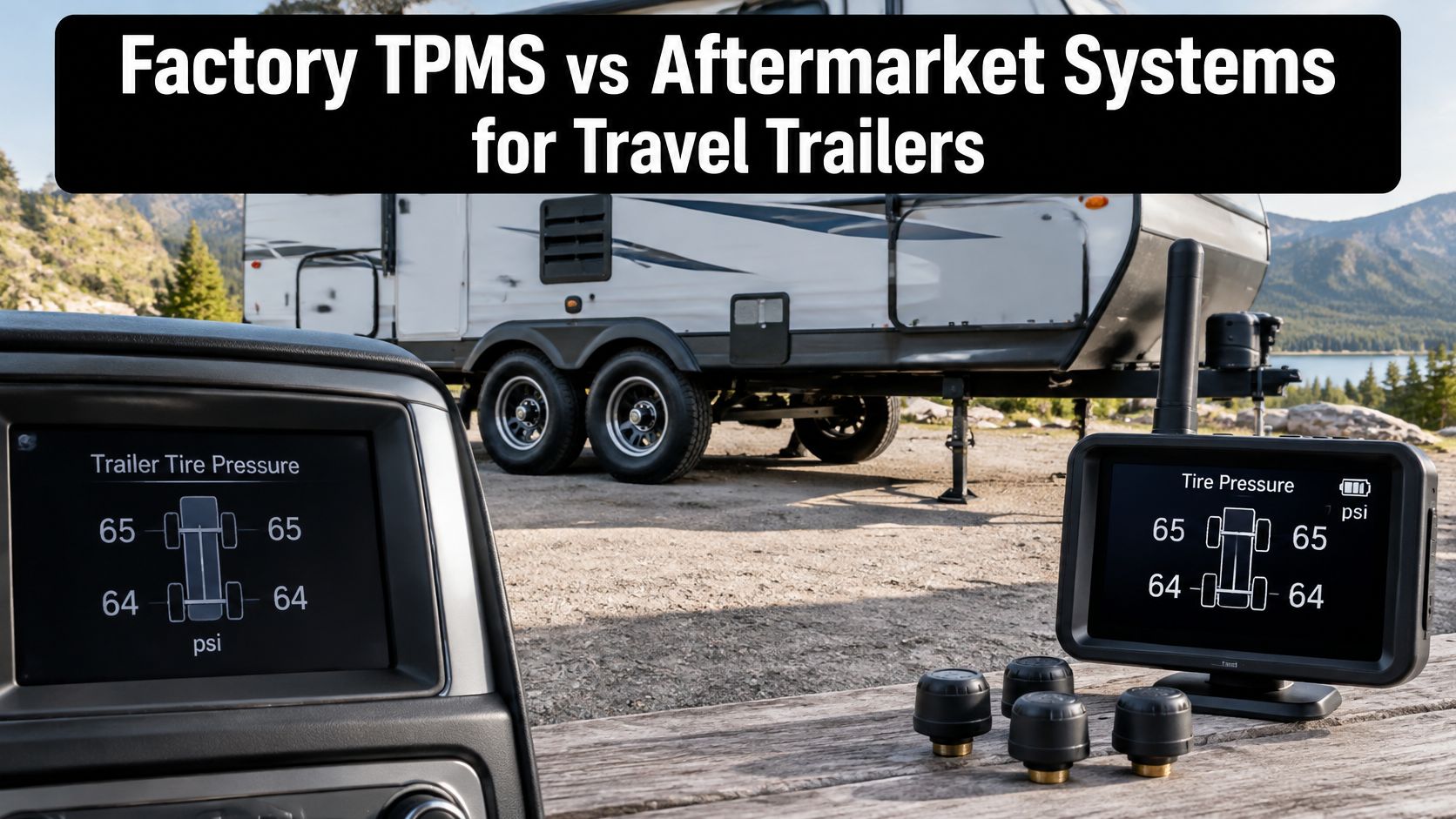
This is the gap that catches first-time buyers. Federal Motor Vehicle Safety Standard 138 applies to passenger cars, multipurpose passenger vehicles, trucks and buses with a GVWR of 10,000 pounds or less, and not universally to trailers or heavier RV combinations, as the current text of 49 CFR 571.138 sets out. Your tow vehicle's factory system reads the tow vehicle's tires and gives you a light. Trailer axles and spares need their own sensors.
NHTSA's own materials acknowledge that trailers can be monitored with a standalone system, which tells you plainly that trailer monitoring is a separate setup, not something an owner should assume came with the truck.
What Each Monitor Type Actually Covers
Four system types show up in this conversation, and only two of them will tell you anything about a trailer axle.
| System type | What it reads | Covers trailer axles | How it warns you |
|---|---|---|---|
| Factory tow-vehicle TPMS (direct) | Pressure at tow vehicle tires | Usually no | Dashboard light or message |
| Indirect system | Wheel-speed differences, no direct pressure value | No | Dashboard light |
| Aftermarket pressure-only, valve-stem sensors | Pressure at each wheel | Yes, with a sensor on every trailer wheel | In-cab display with set thresholds |
| Aftermarket pressure and temperature | Pressure and temperature at each wheel | Yes, with a sensor on every trailer wheel | In-cab display with pressure and temperature alerts |
An indirect system is the weakest option for a towable. It infers a problem from one wheel spinning faster than its neighbors, which means it needs a fairly deflated tire before it notices, and it never gives you a number.
Buying Criteria That Matter for a Towable
Work down this list before you compare brands:
- Wheel count. Count every position you tow, including the spare, then add the tow vehicle if you want one display for the whole combination.
- Dual-wheel axles. A dually truck or a trailer with duals needs sensors that fit the inner wheel and clear the rim.
- Pressure range. Sensors must be rated above your actual cold pressure, not just near it.
- Named wheel positions. The display should say "curbside rear" or "axle 2 inner," not flash a number.
- Temperature readings. On a heavy toy hauler, heat is often the first sign of trouble.
- Adjustable thresholds. You want to set your own alert point, not accept a factory default.
The Trailer Checklist
Five things to confirm before the first trip:
- A sensor on every trailer wheel, no exceptions for the one that's hard to reach.
- Each sensor mapped and labeled by axle position, so the display matches the physical wheel.
- Spare coverage, if the system supports it, and a manual check if it doesn't.
- Signal range tested at the hitch with the trailer hooked up, especially around a fifth wheel or gooseneck frame.
- A written plan for a dropped sensor.
That last one deserves a firm rule. When a sensor drops off the display, that wheel is unmonitored, full stop, and it gets checked by hand at the next safe stop. A missing reading is not a passing grade.
Here's the fifty-thousand-foot summary of what separates these systems in daily use:
"The vehicle has TPMS" does not mean the whole combination is protected.
A solo motorhome with a factory system and a fifth wheel with two trailer axles are different problems with different answers. If your rig is a motorhome, the factory system may be enough for the coach. If your rig is a truck and a trailer, the trailer half is your responsibility.
How Sensors Send Each Tire's Pressure to the Dash
A trailer tire can lose air on the interstate while the truck dash stays quiet. Factory sensors report only the wheels they are paired to. Trailer axles, and the spare if you carry one, stay invisible until their own sensors are on the rig and talking to a receiver you can see.
The path from tire to screen is five steps.
- The sensor measures. It sits on the valve stem or inside the tire and reads pressure, plus temperature on pressure-and-temperature models.
- It transmits. A low-power radio signal carries the reading and the sensor's own ID to the receiver in the cab.
- The receiver matches the ID to a position. That pairing is what lets the display name the wheel instead of showing an anonymous number.
- The display compares. Each reading is checked against the threshold you set from the placard.
- The alarm sounds and the screen names the wheel. Audible plus visual, which matters when you're watching a grade and a crosswind.
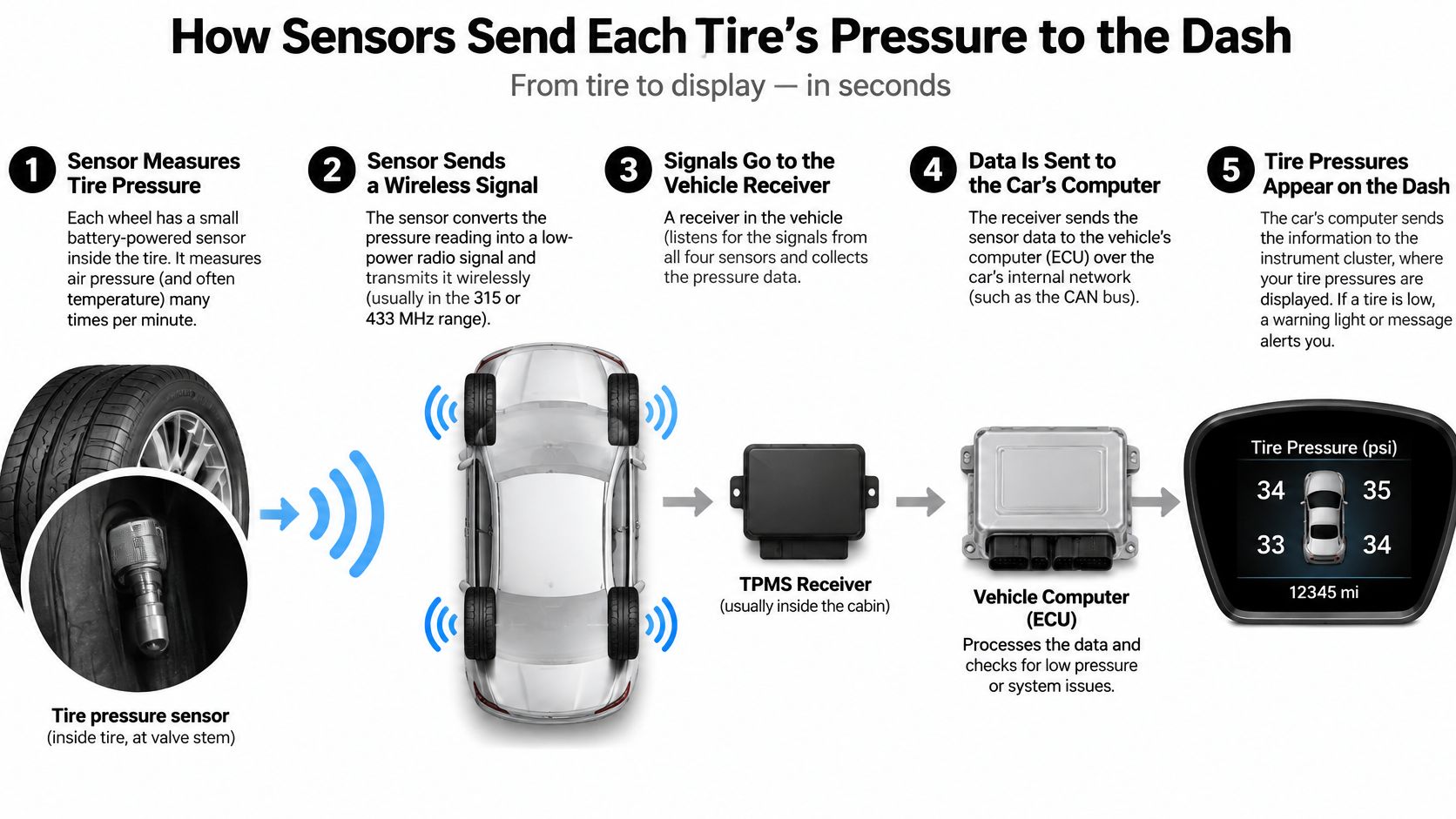
Sensors do not stream a live number every second. They transmit on a schedule, and they transmit again when pressure changes enough to matter. Smaller changes wait for the next scheduled burst. A slow leak can sit between those updates, so a steady reading is not proof the tire is holding.
The other design limit is the sensor's rated pressure range. That range has to sit comfortably above the cold pressure on your placard. A sensor built for passenger-car pressures will not tell the truth about an 80 or 110 psi trailer tire. Match the rating to the tire before you trust the number.
Signal range is the third limit. A long trailer frame and a fifth wheel's metal bulkhead both eat radio signal, so test reception at the hitch before a trip rather than discovering a dropout at 70 mph. Mount the repeater where the manufacturer recommends, usually forward on the trailer or mid-coach, and keep it away from inverters and solar controllers.
A spare shows on the display only if a sensor is mounted on it and the receiver has that ID. Otherwise that tire is a gauge check, not a monitored wheel.
The 25% Warning Floor and Why the Light Comes Late
A factory dash light can stay quiet while a trailer tire is already soft. The federal low-pressure benchmark in FMVSS No. 138 is 25% below the vehicle placard pressure for covered light vehicles, and the warning must illuminate within 20 minutes of additional travel at approximately 50 to 100 km/h (31 to 62 mph), per NHTSA's FMVSS 138 summary. That benchmark is the latest a covered system has to speak. It is a poor pressure to maintain.
The rule applies to the light vehicles it covers. Trailer axles and the spare are the wheels towing families assume the dash already watches, and a tow-vehicle sensor set does not automatically include them. If those positions sit outside the system, there is no late light. There is no light.
Run the arithmetic on a truck or motorhome with an 80 psi cold placard. A 25% reduction is 60 psi. Twenty pounds of air can leave that tire before a factory-style system is required to say a word. On a rig with a 110 psi placard, the floor sits at 82.5 psi, a badly underinflated tire by any working standard.
| Cold placard pressure | Warning floor (25% below) | Pressure lost before alert |
|---|---|---|
| 80 psi | 60 psi | 20 psi |
| 100 psi | 75 psi | 25 psi |
| 110 psi | 82.5 psi | 27.5 psi |
| 120 psi | 90 psi | 30 psi |
I would not wait for that floor on a loaded trailer. A slow leak can live in the gap between placard and the 25% line for a long highway stretch. An unsensored spare never appears on the screen.
Setting the Baseline Correctly
Take cold pressure from the vehicle, trailer, or tire manufacturer's placard, certification label, or owner's manual. The maximum pressure molded into the sidewall describes what the tire can survive, not what your loaded axle needs. Check it with a calibrated gauge before you leave.
A configurable aftermarket system earns its price here. You can alert at 10% below placard instead of 25%, and you can see which wheel is complaining.
Pressure falls overnight as the tire cools, and that drop can light a warning that has nothing to do with a leak. Inspect and correct the tire. A cold morning and a real puncture can look identical on one lamp, so the gauge is what tells them apart. Do not clear the alert and drive on.
Three numbers to write down for your rig, on a card in the glovebox:
- Tow vehicle cold pressure, front and rear, from the door placard.
- Trailer cold pressure, per axle, from the trailer placard.
- Spare pressure, which is usually higher than people guess.
Set Up Your RV TPMS Before the Next Trip
The decision path is short. Pick a system type that covers every trailer wheel and the spare. Set thresholds from the placard numbers you wrote down. Install a sensor on every position, including the ones that are awkward to reach. Test the display against a calibrated gauge. Then run one short trip with a stop at the halfway point to confirm the readings hold and the signal doesn't drop.
Where owners get stuck is the wiring and the pairing, not the concept. Our Service Center handles maintenance checks, repairs, installations, plumbing and electrical work, and the team serves RV owners across Salt Lake City, Millcreek, Spanish Fork and throughout Utah. A short visit is usually enough to match a system to the rig and get the repeater mounted where it will reach the rear axle.
One more detail worth doing before a mountain trip: confirm the sensors are rated for your cold pressures, not just for the number of wheels. A kit that pairs beautifully and reads inaccurately at 110 psi is worse than no kit, because you'll trust it.
The next step is yours, and it's small. Dig out the placard numbers this week, write them down, and then call or book a service appointment through motorsportsland.com before your next tow.
Reading Pressure and Temperature Alerts Without Overreacting
Three readings matter, and owners blend them into one, which is how people end up bleeding air from a perfectly healthy tire.
Cold pressure, taken before departure after the rig has sat. Warm pressure, taken after an hour on the highway. And the left-to-right comparison within a single axle. The first is the record. The second is expected to be higher. The third is the one that catches real problems.
Pressure rises as tires warm on a tow. A modest, even increase across all wheels is normal, and you don't let air out of a hot tire because it reads above the cold spec. NHTSA's TPMS test documentation records both tire pressure and sidewall or roadway temperature, which reflects how much temperature affects what the system reports and how you should read it.
Rely on trends and comparisons instead of a single absolute temperature number. Ambient heat, sun exposure on one side, road surface, brake drag and uneven loading all move readings. A wheel sitting in afternoon sun at a rest stop will read differently from the shaded one across from it.
| What you see | Likely cause | What to do |
|---|---|---|
| Pressure rises after a highway run, all wheels similar | Normal warm-up of the tires | Keep the air in and recheck cold the next morning |
| Low-pressure alert on a cold morning | Pressure drops as the tire cools | Inflate to the placard cold pressure with a gauge |
| One wheel well below its axle mates | Slow leak, valve problem or underinflation | Stop at a safe pull-off and inspect the tire and valve |
| One wheel temperature climbs fast while others hold | Underinflation, brake drag or overload | Stop and inspect the tire and hub before continuing |
| Display disagrees with a gauge | Sensor not refreshed yet or out of range | Check the gauge, pairing and range, then recheck after adding air |
| Alert after sensor signal is lost | Sensor out of range or disconnected | Treat that wheel as unmonitored and check it by hand |
Escalation rule: a wheel far off its axle mates, or a temperature climbing fast on one wheel, earns a controlled stop at a safe pull-off. A sudden pressure drop always does.
When the display and the gauge disagree, the gauge wins. Verify with a calibrated gauge first, then check pairing and range, then recheck after adding air, because the sensor may not refresh the instant you finish filling.
Utah adds its own pattern. After a long descent off a pass, brakes run hot, so a warm wheel near the brake may be dragging brake hardware rather than a tire problem. Inspect both before you continue. Our RV tire maintenance guide covers the wear patterns that show up alongside these alerts.
Routine Checks Before and During Every Trip
Timing first. The U.S. Tire Manufacturers Association recommends checking every tire at least monthly, before each trip and each morning during a trip, including spares and inside dual tires, according to its consumer tire guidance. Pressure should be set cold, after the vehicle has been parked at least three hours or driven less than a mile at moderate speed.
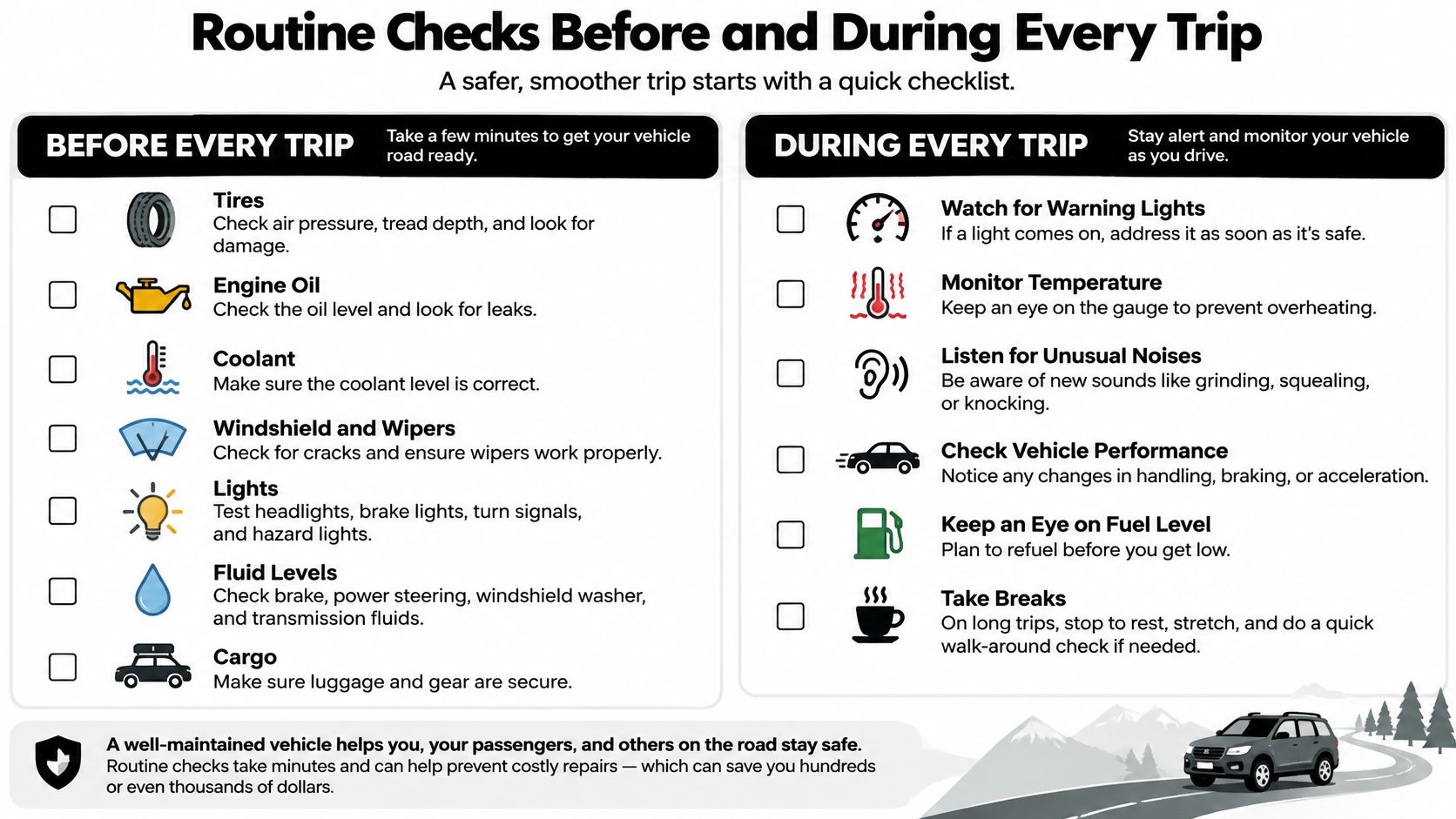
The routine, in order:
- Confirm the tires are cold. Parked three hours or driven under a mile at moderate speed. A hot tire will lie to you.
- Read each tire with a calibrated gauge. Compare against the placard, not against the sidewall maximum.
- Adjust only cold tires. Never bleed a hot tire because the reading sits above spec. It's supposed to.
- Check the spare. It's part of the rig whether or not it's on the ground.
- Match the display to the gauge. Give the sensor time to refresh before you trust a new number.
- Log the readings. A simple notebook page per trip tells you more than memory ever will.
- Repeat the morning check. On any multi-day tow, the cool morning reading is your real baseline.
A sensor reports pressure accurately and still misses a cut sidewall, uneven wear from a bent axle, a leaking valve core or a tire overloaded beyond its rating. The visual inspection stays on the list for exactly that reason.
Put it together for a Utah trip. Do the cold check in the driveway in Sandy or Millcreek before you leave, recheck at the first fuel stop, then repeat the morning check at the campground at Jordanelle or Bear Lake. If you're still dialing in how the trailer loads, our guide on how to measure tongue weight explains why an overloaded axle shows up as heat first.
Frequently Asked Questions About RV Tire Pressure Monitors
Does my tow vehicle's factory TPMS cover my travel trailer?
Usually not. The factory system reads the tow vehicle's tires, and the standard that requires it applies to vehicles at or below a 10,000 pound GVWR, not to trailers. Trailer axles and spares need their own sensors on a separate system.
Can a TPMS replace checking tires with a gauge?
No. The monitor is an early warning, and the cold gauge reading is the record you act on. Sensors can also drift in accuracy, lose signal or refresh slowly, so the gauge stays in the routine.
Why did my low-pressure light come on overnight?
Pressure falls as the tire cools, so a cold morning can push a borderline tire under the threshold. Inflate to the placard cold pressure with a calibrated gauge and recheck in the morning before assuming there's a leak.
Should I bleed air from a tire that reads high after a long drive?
No. Tire pressure rises as tires warm on a tow, so a hot tire reading above the cold specification is normal and should not be reduced. Let it cool and check it cold.
Should the spare be monitored?
Yes, if the system supports an extra sensor, and in any case the spare should be checked manually at least monthly. A flat spare on the shoulder turns a ten-minute fix into a tow.
The right system depends on your rig, not on a spec sheet, and matching the two is what our team at Motor Sportsland does all day at our Millcreek and Spanish Fork locations. Our Service Center handles maintenance checks, installations, plumbing and electrical work for RV owners across Salt Lake City, Millcreek, Spanish Fork and throughout Utah, so you can walk in with your placard numbers and leave with sensors on every wheel and a repeater that reaches the rear axle. Get started at Motor Sportsland or book a service appointment before your next mountain trip.
