
Towing a Camping Trailer Safely in Utah Mountains

The trailer is packed, the kids are buckled in, and you're ready to leave Salt Lake City for a weekend at Jordanelle. Then you look in the mirror and wonder whether the truck's rear end sits lower than it should. Did the generator belong in that front compartment? Should you have filled the water tank before leaving? And will the brakes feel different coming down the canyon?
Those are useful questions to ask before you reach the highway. Towing a camping trailer safely starts with the loaded combination, not the tow rating in an advertisement. Cargo placement, axle loads, hitch setup, and brake adjustment all need to work together.
For a first Utah mountain trip, the most helpful preparation isn't buying another accessory without checking the setup. It's following a repeatable routine: inspect the trailer, measure its actual travel weight, verify the connection, and test braking before entering traffic.
Our team can help you sort through those decisions without treating every truck and trailer alike. Whether you're considering a family bunkhouse or loading motorcycles into a toy hauler, the goal is the same: leave with a setup you understand and a plan for the descent as well as the climb.
Pre-Departure Checks Before You Leave the Driveway
An unplugged trailer connector can be easy to miss in daylight. You pull away, the trailer follows, and nothing feels obviously wrong. But the first driver behind you may not see your turn signal, and the trailer brakes may not respond as expected.
That's why a driveway inspection needs a fixed order rather than a quick glance.
A North Carolina government summary citing NHTSA data attributes 90% of boat-trailering accidents to neglected basic preventive maintenance, including bearings, suspension components, and lighting. That figure concerns boat trailers, not RVs, but the shared equipment makes the maintenance lesson relevant to camping trailers and fifth wheels (trailering maintenance guidance).
Start at the tires and work around
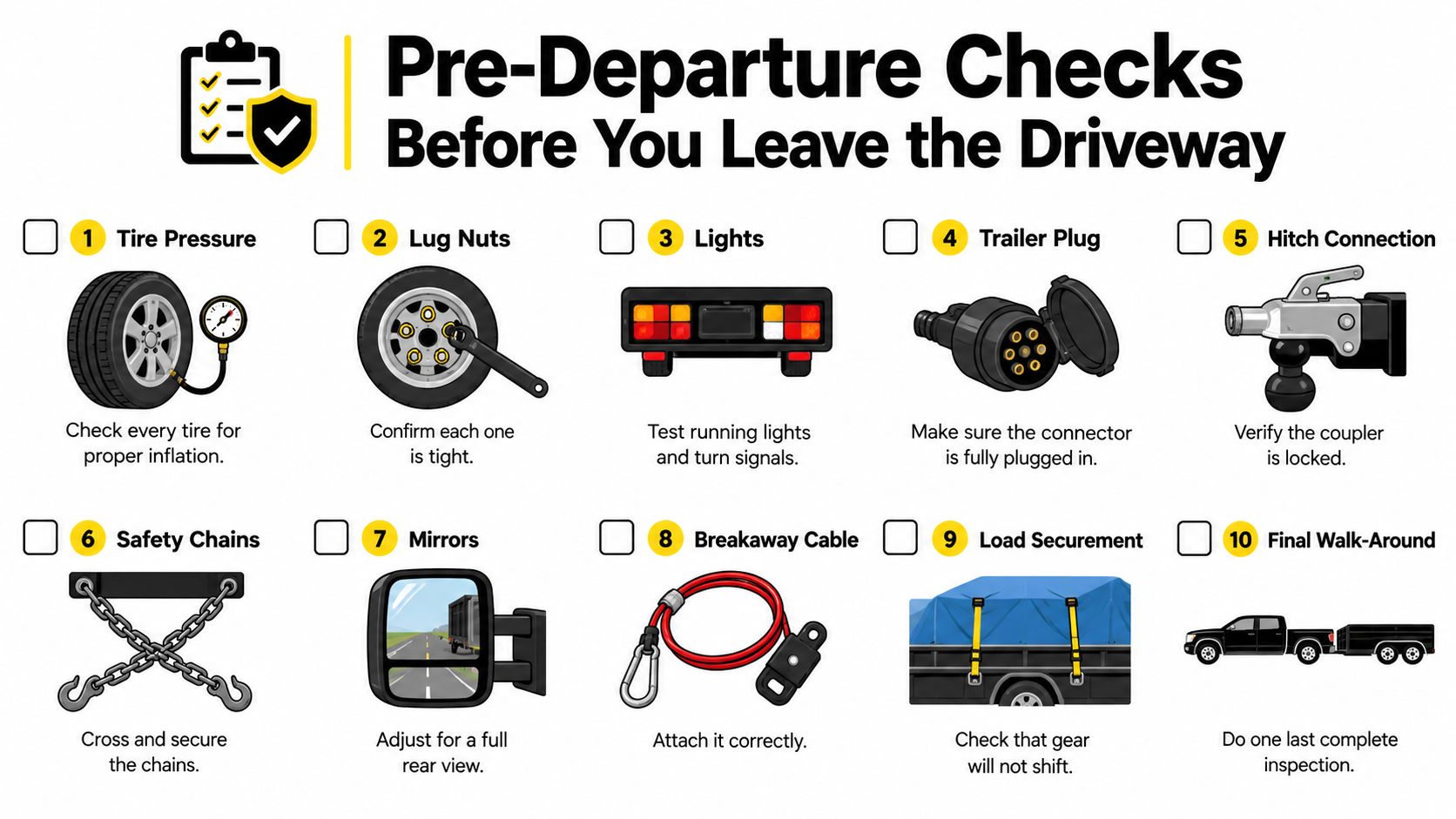
Keep a tire-pressure gauge, the correct torque wrench and socket, and your equipment specifications accessible.
- Tires: Check pressure against the applicable tire and trailer guidance. Look for cuts, cracking, bulges, and unusual wear. Our travel trailer tire-pressure guide can help you prepare for this check.
- Wheels and bearings: Verify lug torque to the manufacturer's specification. Investigate looseness, leakage, or anything unusual around the hubs.
- Underneath: Look at visible suspension components, hanging wiring, and anything that could drag.
- Connection equipment: Inspect the hitch hardware, chains, breakaway cable, and electrical connector. Complete the hookup verification described below.
- Brakes and lamps: Confirm operation rather than assuming that plugging in the connector finished the job.
- Inside and outside: Secure loose equipment, close storage compartments, and verify that departure equipment is stowed.
Use this checklist as a visual reminder beside your written equipment-specific instructions.
Give stored trailers a deliberate inspection
After a Utah winter in storage, don't treat last season's successful trip as today's inspection. Check the tires, battery condition, exposed wiring, and brake operation before loading everyone into the truck.
Driveway rule: If something looks questionable while you're parked at home, resolve it there. A highway shoulder isn't a suitable place to diagnose a known concern.
Loading for Stable Weight Distribution
Dry weight isn't departure weight. Fresh water, waste in holding tanks, propane, batteries, food, tools, clothing, and recreational equipment all contribute to the trailer's operating weight. The loaded trailer must stay within its gross vehicle weight rating, and each axle must stay within its gross axle weight rating (loaded-trailer weight and cargo guidance).
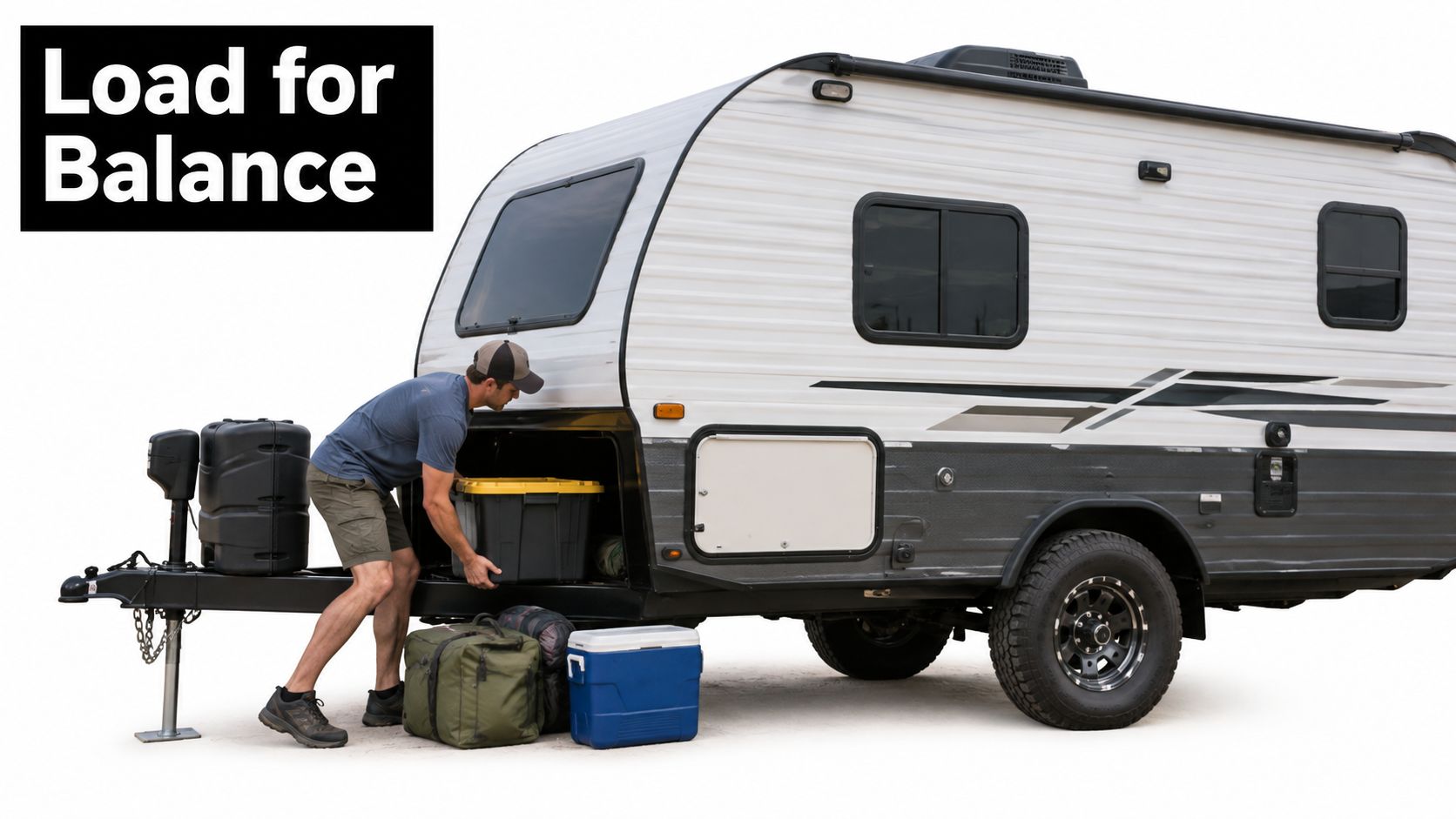
Convenient storage and good loading sometimes conflict. An empty rear compartment may look perfect for a generator, but available space doesn't prove that the location is suitable.
Heavy equipment belongs low and near the axle area, with cargo balanced from side to side and secured against movement. Use this loading image as a reminder to evaluate weight placement, not just compartment capacity.
Measure tongue weight rather than guessing
For a conventional travel trailer, North Carolina's guidance recommends 10% to 15% of gross trailer weight on the hitch. A 5,000-pound loaded trailer would therefore place approximately 500 to 750 pounds on the hitch, while still respecting every vehicle and component limit (North Carolina safe-trailering guidance).
Too much cargo behind the axles can reduce tongue weight and encourage sway. Moving everything forward isn't the answer either, because excessive tongue load can overload the truck's rear axle, tires, suspension, or receiver.
Use a repeatable scale workflow
The University of Maryland Extension recommends weighing the complete loaded combination rather than relying on estimates, because occupants, supplies, fluids, and accessories change operating weight (tow-vehicle selection and weighing guidance).
Use a certified scale that can provide separate axle readings:
- Record the limits. Gather the truck's payload, GVWR, GCWR, axle and tire ratings, trailer rating, and hitch limits. Our guide to calculating towing capacity helps organize them.
- Weigh the occupied tow vehicle alone. Include the passengers, truck cargo, and fuel you expect to carry.
- Weigh the loaded combination. Record the truck's front axle, rear axle, and trailer axle group separately.
- Verify tongue weight. Use an appropriate measurement method and follow the hitch manufacturer's weighing procedure. Weight-distribution equipment affects axle readings.
- Adjust and repeat. Compare every reading with its applicable limit, relocate cargo where appropriate, and weigh again.
For a toy hauler, document motorcycle positions, generator placement, and tank levels. Fixed tanks can't be relocated like storage bins, so their effect needs to be measured.
A trailer can be under its overall weight limit and still be poorly balanced. Keep the scale tickets, not just the memory that it “towed fine.”
Hitching Up with Chains, Mirrors, and Lights
A coupler resting on the ball isn't necessarily locked onto it. A connected electrical plug isn't proof that every circuit works. Treat each connection as a separate item that needs confirmation.
Federal inspection guidance identifies secure connections, freedom from binding, and stable tracking as inspection goals. It also highlights failures involving couplers that are not locked, inadequate chains, disconnected plugs, untested breakaway switches, and underinflated tires (federal towing inspection guidance).
Inspect and seat the coupler
Start with the trailer secured against movement and follow the tow vehicle, trailer, and hitch manufacturers' instructions.
- Receiver and ball mount: Inspect for damage and verify the retaining pin and its keeper are installed.
- Ball and coupler: Confirm the specified match, condition, and ratings. Don't substitute a ball because it looks close.
- Latch: Lower the coupler fully onto the ball, close the latch, and install the prescribed locking pin or device.
- Weight-distribution hardware: If fitted, connect and adjust it according to that system's instructions, including any trailer-jack positioning requirements.
Keep distractions out of this part of the routine. If someone interrupts you, restart at a known checkpoint instead of assuming you finished the latch.
Route chains and cables deliberately
Cross the properly rated safety chains beneath the coupler in an X pattern. Leave enough slack for turns, but not enough for them to drag. The crossed arrangement provides a cradle if the coupler separates.
Attach the chains to the tow vehicle's designated hitch attachment points. Connect the breakaway cable to its specified attachment location, and route both it and the electrical lead so they won't bind during turns.
Seat the electrical connector fully and check its retention. A plug that stays connected while parked may still need better routing to avoid tension during a tight turn.
Confirm your view and the connection
Adjust extension mirrors from your normal driving position. Check the view down both trailer sides and into the adjacent lanes, rather than accepting a mirror full of trailer wall.
Have a helper verify running lights, brake lights, and turn signals. If you're working alone, use a reliable way to observe their operation rather than judging them from dashboard indicators.
Finish the coupling verification with the controlled forward-tension check prescribed for your equipment, before completing jack retraction. Don't improvise a powered pull against a loaded tongue jack. Follow the equipment procedure, then fully stow the jack and confirm clearance before departure.
Choosing Brake Systems and Hitch Types
A higher-rated hitch doesn't automatically improve stopping. Brake controls, trailer brakes, emergency equipment, and load distribution solve different problems.
The cited NHTSA material states that separate functioning brake systems are required for safe control of loaded trailers weighing more than 1,500 pounds, and calls for checks of the controller, breakaway system, and wiring before departure. Confirm the specific legal requirements wherever you register and operate the trailer (NHTSA trailer-braking material).
Trailer Brake and Hitch Options at a Glance
| Option | How It Works | What to Confirm |
|---|---|---|
| Electric trailer brakes | A matched controller commands trailer braking through the electrical connection. | Controller compatibility, wiring condition, adjustment, and actual brake response. |
| Surge brakes | A hydraulic coupler responds to compression at the hitch during slowing. | Coupler operation and compatibility with the intended hitch equipment. |
| Weight-distributing hitch | Hitch hardware redistributes load across the combination. It isn't a brake system. | Vehicle approval, component ratings, setup procedure, and brake-system compatibility. |
| Emergency breakaway system | Activates trailer braking if the trailer separates, according to its design. | Correct cable attachment, switch operation, wiring, and battery condition where applicable. |
Nissan specifically warns that a weight-distributing hitch may affect surge-brake operation and recommends confirming compatibility with the relevant manufacturers (Nissan towing equipment guidance). Don't assume that separately suitable components are suitable together.
Test the setup before the mountain route
Use an empty, level area for a low-speed brake test, following the controller and trailer instructions. A trailer that seems to push the truck during braking needs investigation. Grabbing or wheel lockup also calls for adjustment or service, not something to get used to.
Reassess controller settings when trailer weight or operating conditions change. Don't make your first test of a new setting on a canyon descent. Our camper brake-controller guide for Utah towing provides additional setup context.
Our Service Center provides installation, electrical work, maintenance, and upgrades. Bring the truck and trailer specifications when discussing controller installation or a hitch change, so our team can assess the combination rather than a single component.
Driving Techniques for Turns, Braking, and Backing
The first highway merge isn't the place to learn how the loaded rig responds. Begin with a quiet practice area, then build experience before choosing a demanding route through the Wasatch Mountains.
Mountain towing calls for room to maneuver and an unhurried pace.
Make turns slower and wider
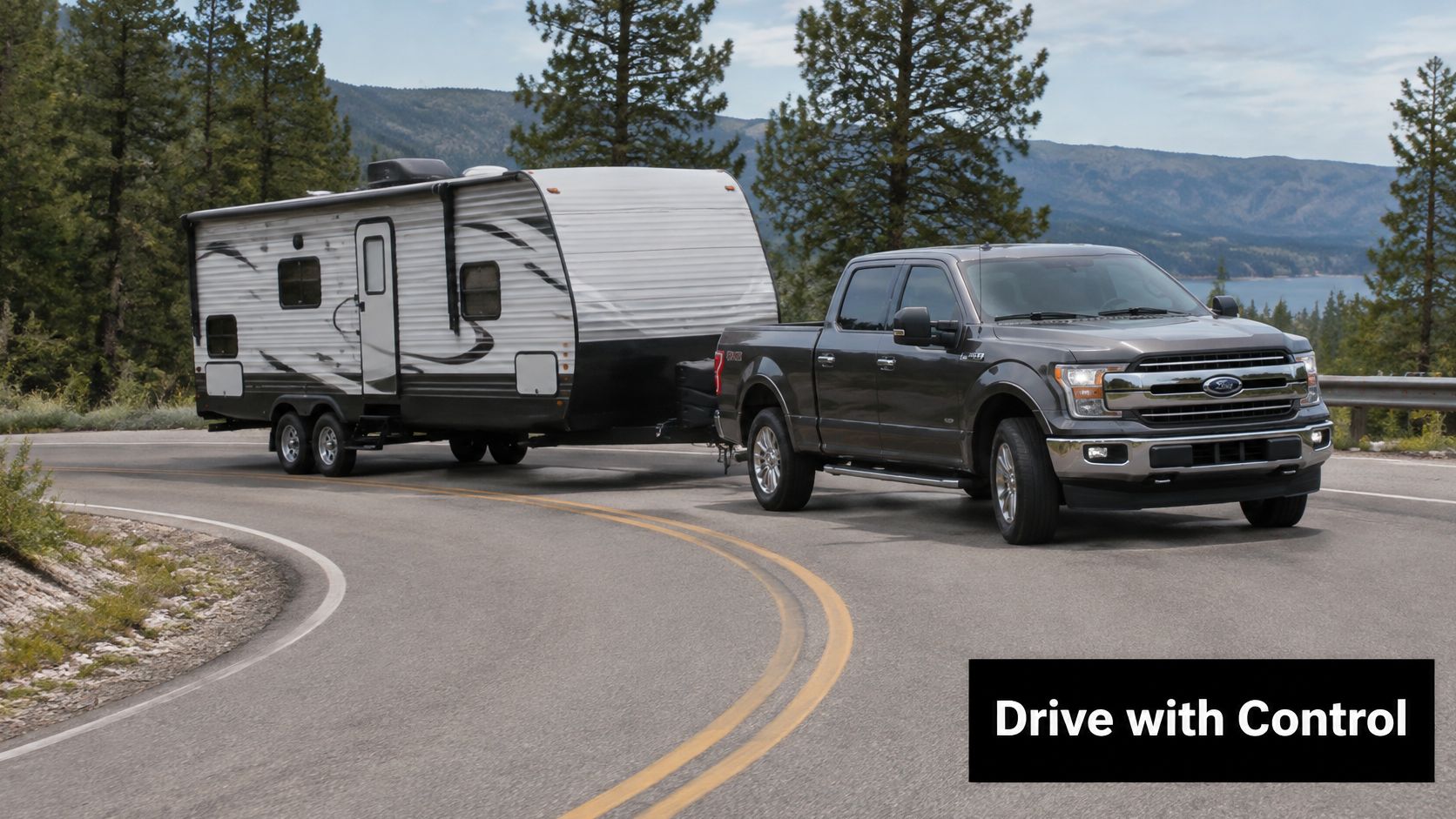
The trailer follows a different path from the tow vehicle, as noted in the earlier state guidance. At a campground entrance or fuel station, watch where the trailer's wheels will travel, not just where the truck clears.
Approach slowly enough to assess the corner before committing. If the available space looks doubtful, stop and find another approach rather than relying on a last-second steering correction.
Leave a larger following gap than you would without the trailer. Increase it further when rain, traffic, or visibility reduces your options. Space lets you brake progressively instead of reacting abruptly.
Prepare for the descent before the crest
On a long Wasatch canyon descent, prioritize controlled speed over keeping up with traffic. Follow the tow vehicle's instructions for tow/haul mode, gear selection, and engine braking. Get those choices settled before the rig starts gaining speed downhill.
Don't use a mountain road to discover whether a brake adjustment worked. If braking feels inconsistent, the trailer pushes, or you notice an unusual smell or response, stop at a safe location and investigate.
Official safety guidance explains that poorly balanced or top-heavy cargo can shift loads during hard braking and weaken steering and braking performance (Army towing safety guidance). Altitude and a steep route are reasons to be conservative, not reasons to compensate for a questionable setup with more throttle or more brake.
Mountain-trip mindset: Reaching the summit doesn't prove the combination is ready for the descent.
Practice backing without an audience
Before backing into a Bear Lake campsite, practice small steering corrections in an empty lot. Move slowly, watch both mirrors, and pull forward to reset when the angle becomes awkward.
- Use a spotter: Agree on signals before moving.
- Keep the spotter visible: Stop immediately if you lose sight of them.
- Get out and look: Check obstacles and overhead clearance yourself when uncertain.
- Avoid chasing the trailer: Pause and straighten the combination instead of adding increasingly large steering inputs.
Use the following video alongside hands-on practice and your equipment instructions.
Handling Sway and Emergencies with a Maintenance Schedule
If the trailer begins swaying, resist the urge to steer sharply against each movement. Hold the wheel steadily, avoid abrupt braking, and reduce speed gradually. If your compatible system has a manual trailer-brake control, use it as directed to help settle the trailer.
Once you can stop safely, investigate the cause before continuing. Don't treat repeated sway as a normal part of towing a camping trailer.
Respond to the problem, then reassess
A tire failure, a loose connection, and shifted cargo require different repairs, but none should become a roadside rush to get moving again.
- Trailer tire problem: Maintain control, avoid sudden inputs, and move out of traffic when safe. Don't attempt roadside work where passing traffic puts you at risk.
- Loose hitch hardware: Stop towing until you identify and correct the cause. Inspect related parts for damage rather than tightening the visible problem and assuming everything else is sound.
- Shifted cargo: Secure the load again and assess whether its new position changed the loading plan. Return to the scale when the resulting axle or hitch loads are uncertain.
During the first miles after departure, choose a safe stopping place to check for unusual wheel temperature, tire issues, loosened straps, and cargo movement. Avoid touching potentially hot components.
Schedule maintenance around use and manufacturer requirements
There isn't a universal service interval that fits every axle, bearing, brake, and battery. Keep a written log and follow the relevant manufacturer's intervals.
| When | What to address |
|---|---|
| Before departure | Complete the walk-around and operational checks already described. |
| After storage | Inspect tires, wiring, battery condition, brake response, and visible suspension condition. |
| At specified service intervals | Service bearings and brake components, and inspect electrical or hydraulic equipment as applicable. |
| After a loading change | Revisit the weighing workflow after adding water, fuel, tools, or recreational equipment. |
| After unusual behavior | Arrange diagnosis before another demanding trip. |
Keep scale tickets with your maintenance records. Together, they document what was loaded, what was measured, and what changed.
Common Towing Questions and Your Next Step
How do I know whether my truck has enough capacity?
Use the loaded measurements from the weighing workflow, not the trailer's brochure weight. Check every applicable rating, because remaining tow capacity doesn't necessarily mean you have remaining payload or rear-axle capacity.
Should I travel with the fresh-water tank full?
Choose based on your destination and the measured effect on the combination. Record the tank level on your scale ticket so you can reproduce that loading condition later.
When should I check tongue weight again?
Recheck after meaningful changes to cargo, tank levels, batteries, or equipment placement. You don't need to guess whether a new loading arrangement matches the previous trip.
Will a weight-distributing hitch fix poor handling?
Not by itself. Use the brake-and-hitch comparison above to separate equipment functions, then confirm loading, ratings, and manufacturer-approved adjustment before assuming another accessory is the answer.
What should I bring to a towing consultation?
Bring your vehicle information, rating-label photos, trailer specifications, hitch details, and any scale tickets. Describe your intended route and recreational cargo, too, so the discussion reflects how you'll travel.
Safe towing a camping trailer comes down to a repeatable process: inspect, measure, connect, test, and drive with room to respond. Keep that process consistent whether you're heading toward the Great Salt Lake or into the mountains.
Motor Sportsland offers towable RV options and service support for maintenance, electrical work, installations, and upgrades. Visit Motor Sportsland to browse trailers or contact our team for a personalized towing consultation at our Salt Lake City-area showroom. Bring your truck ratings and loading plans so we can help you prepare for your next Utah trip.
