
How to Measure Tongue Weight Correctly for Your Trailer

You've loaded the trailer for Bear Lake, put the bikes in place, and filled the truck with people and weekend gear. The truck's tow rating looks adequate, but the rear suspension sits lower than you expected. Before you head into the Wasatch Mountains, you need to know what the trailer is putting on the hitch.
Learning how to measure tongue weight starts with a scale, but it doesn't end with a percentage. You also need to know whether the loaded truck, rear axle, receiver, and tires can carry that load. A trailer can look balanced and still leave the tow vehicle overloaded.
At Motor Sportsland, we want Utah RV owners to understand that distinction before choosing a trailer or adjusting a hitch. The useful result isn't just a tongue-weight number. It's a set of measurements you can compare with the ratings on your actual truck and trailer.
The process below covers choosing a scale, preparing the rig, taking repeatable readings, and correcting a load that doesn't work. Bring a notebook, your owner's manual, and the equipment you'll take camping. Guessing from an empty trailer's specifications won't answer the questions that matter on departure day.
Target Tongue Weight Ranges for Your Trailer
For a 6,000-lb loaded conventional travel trailer, the foundational target is approximately 600–900 lb on the hitch ball, or 10–15% of loaded trailer weight, according to the towing guidance hosted by NHTSA. Tongue weight is the downward force transferred through the coupler onto the tow vehicle's hitch.
Target tongue weight by trailer type and loaded weight
| Trailer type and loaded weight | Target share of loaded weight | Target tongue or pin weight |
|---|---|---|
| Conventional travel trailer, 6,000 lb loaded | 10–15% | 600–900 lb |
| Conventional travel trailer, 8,000 lb loaded | 10–15% | 800–1,200 lb |
| Conventional travel trailer, 10,000 lb loaded | 10–15% | 1,000–1,500 lb |
| Fifth-wheel pin weight, 12,000 lb loaded | 15–25% | 1,800–3,000 lb |
The conventional rows apply the loaded-weight rule above; the fifth-wheel row is a calculated example using the 15–25% pin-load range discussed in the Nissan towing guide. Fifth-wheel and gooseneck owners should use their manufacturers' pin-load instructions, not treat conventional tongue weight as interchangeable with pin weight.
Use the trailer's camping load
Load full propane, your typical fresh-water supply, luggage, bicycles, tools, and the generator before weighing. Keep the passengers' equipment aboard, too. An empty trailer's hitch-weight specification describes a different loading condition from the one you'll tow to Jordanelle.
Toy haulers deserve particular attention. Loading powersports equipment behind the axles can change the balance substantially, while front storage compartments can concentrate weight toward the coupler. Bunkhouse trailers also change as families fill storage spaces that were empty during the dealership walkthrough.
Practical rule: Use the percentage to evaluate trailer balance, then use the vehicle and component ratings to decide whether the combination is acceptable.
Don't aim for a particular number because another owner with the same floorplan uses it. Your batteries, water, accessories, and cargo locations may differ. A satisfactory result must suit the trailer manufacturer's guidance and leave the loaded tow vehicle within its applicable limits.
Tools, Setup, and Choosing Your Weighing Method
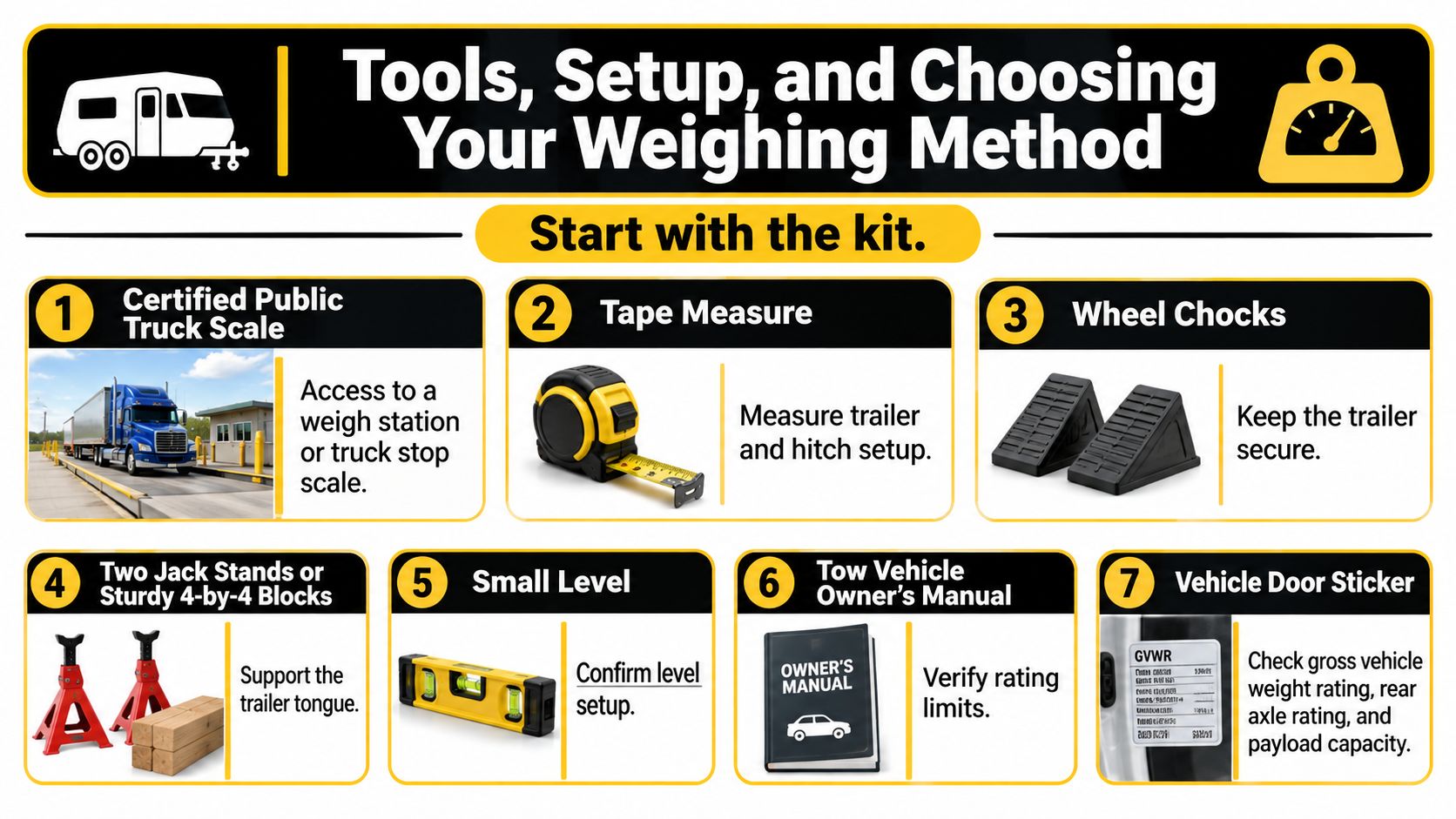
Start with the kit. Arrange access to a certified public vehicle scale, and ask the operator whether the platform layout permits your intended weighing procedure. Not every roadside weigh station accepts public recreational-vehicle weighing, and not every scale allows unhitching on the platform.
Pack these items:
- Tape measure: Record hitch-ball and coupler heights on level ground.
- Wheel chocks: Secure the trailer before disconnecting it.
- Rated supports: Bring suitable jack stands or sound timber blocking appropriate to the procedure and load.
- Small level: Check trailer attitude rather than judging it from the truck's stance.
- Notebook: Keep scale readings, load conditions, and rating information together.
- Owner's manual: Find the vehicle's towing and weight-distribution instructions.
- Vehicle labels: Photograph the door-area ratings and payload label before leaving home.
This checklist keeps the equipment and rating information together.
Choose a method that answers your question
A public scale is the most useful choice when you need both trailer measurements and loaded tow-vehicle axle weights. A dedicated tongue-weight scale is convenient for checking a conventional trailer at home, but it won't tell you whether the truck's rear axle is overloaded.
A Federal Register technical discussion describes many consumer electronic bathroom scales as reading 0–350 lb, making a 400-lb tongue load beyond that cited range. Your particular scale's marked capacity controls. Don't put a heavy trailer coupler on a household scale or improvise a lever arrangement without an appropriate, verified procedure.
Tongue weight measurement methods compared
| Method | Best for | Limit or caution |
|---|---|---|
| Public truck scale with coupler support | Travel trailers; public axle scales also suit fifth-wheel combinations | Requires permission, suitable platform geometry, and safe support; fifth wheels need a pin-load procedure |
| Dedicated tongue-weight scale | Conventional hitch measured at home | Confirm its rated capacity covers the tongue load |
| Bathroom scale | Light tongue loads only | Common household capacity is unsuitable for heavy trailer tongues |
| Fifth-wheel pin-weight reading | Fifth wheels and gooseneck trailers | Use manufacturer pin-load targets and the correct hitch height |
Prepare a repeatable setup
- Load for the trip. Include the water, propane, camping equipment, and cargo you expect to carry. Secure everything before moving.
- Keep occupants consistent. Passengers should remain in their normal seats during vehicle readings, subject to the scale operator's safety instructions.
- Record towing height. Measure the ball and coupler on level ground. A nose-high or nose-low setup can change the measurement.
- Collect label information. Write down trailer ratings and obtain its actual loaded weight rather than substituting dry weight.
- Plan your movements. Choose a lane and staging area where you can approach straight, park safely, and reconnect without blocking traffic.
Separate raw tongue-weight measurement from hitch-adjustment checks. Weight-distribution bars transfer load among axles, so leaving them engaged during a simple subtraction test can change what that difference represents. Follow the equipment manufacturer's procedure for measuring tongue weight, then assess axle loading with the hitch configured for travel.
Our travel-trailer hitch and sway-bar guide provides useful context for understanding those different jobs.
How to Measure Tongue Weight on a Public Scale
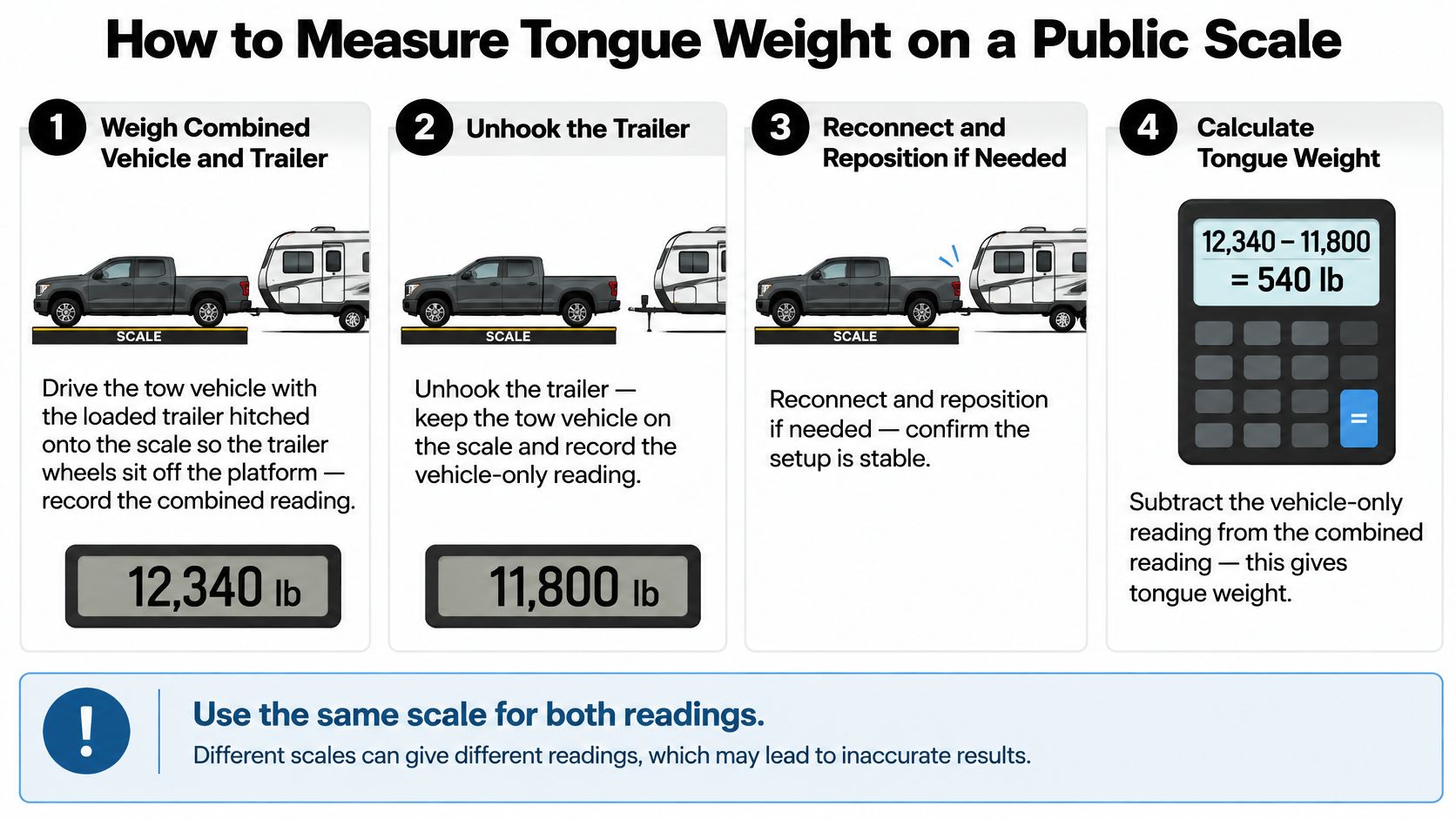
Tell the scale operator you're weighing an RV combination and need repeatable vehicle and trailer readings. Ask where you can disconnect safely and whether the platform can isolate the truck from the trailer axles. Don't unhitch in a live scale lane without permission.
The term combined reading below means the truck's scale reading while it carries the trailer's tongue load. It does not mean the weight of the entire truck and trailer together.
Method A using the tow vehicle's weight difference
- Weigh the hitched tow vehicle. Position all tow-vehicle axles on the platform with the loaded trailer's tires off it. Record the truck's weight while it carries the tongue load, using the manufacturer's prescribed configuration for tongue measurement.
- Disconnect in the approved area. Chock and support the trailer safely, then return the tow vehicle alone to the same scale. Keep occupants, truck cargo, and other conditions unchanged.
- Subtract the solo reading. The difference is the load added to the tow vehicle by the trailer in that measurement configuration. Check that you haven't accidentally used a whole-combination ticket.
- Calculate the loaded percentage. Divide tongue weight by the trailer's actual loaded weight, then multiply by a hundred. Dry weight or a brochure estimate isn't a valid substitute.
As a worked example, 7,800 lb minus 7,050 lb equals 750 lb; dividing that tongue load by a 6,000-lb loaded trailer gives 12.5%. This calculation illustrates the subtraction procedure, but the truck still needs its own axle and rating checks.
Use the graphic as a sequence reminder, and follow the operator's directions about where to disconnect.
Method B using trailer support on a platform
The California DMV recreational-vehicle guide describes a platform method that measures the difference when tongue support moves off the scale. It requires the right platform geometry and permission to work around the scale.
- Position the loaded trailer. Keep its tires and tongue-jack post on the scale, with the coupler extending beyond the platform. Chock the wheels and unhitch safely.
- Record the first reading. With the trailer fully supported on the platform, this gives its loaded total weight.
- Transfer support to the coupler. Place a properly rated stand or suitable blocking beyond the platform, directly beneath the coupler. Transfer the load until the tongue-jack foot clears the scale, keeping the trailer reasonably level.
- Record the second reading. Subtract it from the first reading to determine hitch load. Use the first reading as the denominator when calculating the trailer's tongue-weight percentage.
Never crawl under an unsupported tongue or balance a coupler on unstable blocks. If the platform edge, support height, or ground conditions make this awkward, use another method.
Support location matters
For a direct coupler measurement at home, use a rated scale and support arrangement at the ball-contact location and normal towing height. The trailer's own jack sits behind that point, so a reading taken there isn't automatically the same as force at the hitch ball.
A repeatable reading needs the same load, the same support location, and the same trailer attitude.
Keep both tickets and label them before driving away. Repeat the measurement after meaningful loading changes, and check the subtraction again before using it to adjust cargo or hitch equipment.
Check the Tow Vehicle and Fix Readings That Are Off
Start with the ratings, not the percentage. Compare your measurements with the labels and manuals for the actual vehicle and equipment:
- Gross vehicle weight rating: The loaded tow vehicle must remain within its total weight limit.
- Rear-axle rating: Check the measured rear-axle load, not just the truck's total.
- Available payload: Account for passengers, truck cargo, accessories, hitch equipment, and tongue load.
- Receiver and hitch ratings: Check the applicable weight-carrying or weight-distributing limits.
- Ball, mount, and coupler limits: Every component must suit the load and application.
- Tire load ratings: Verify capacity and the manufacturer's inflation requirements for the measured load.
- Trailer and combination limits: Confirm the loaded trailer and complete combination also meet their applicable ratings.
Keep the measurements beside the specifications while you review them.
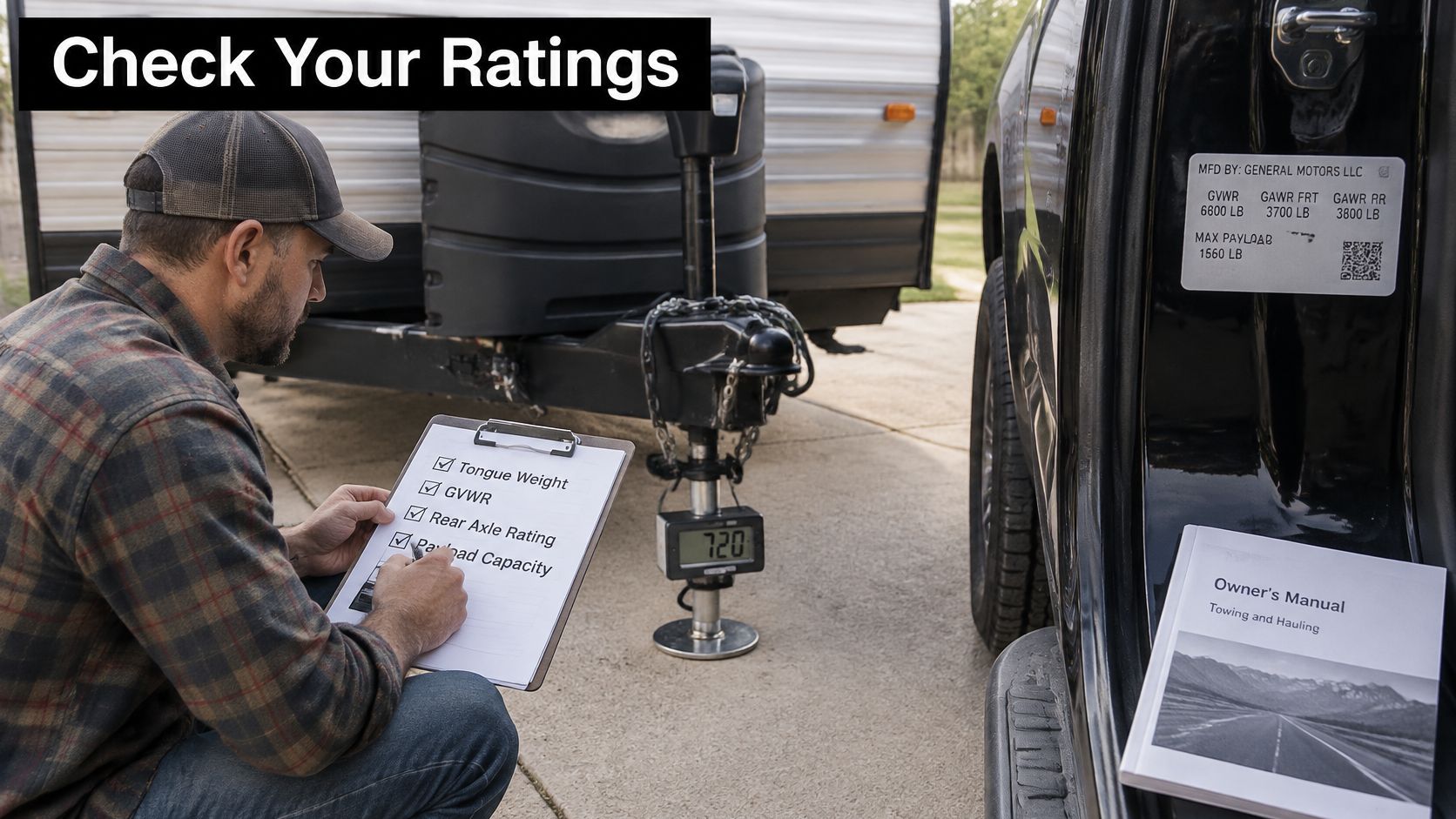
A good percentage can still mean an overloaded truck
The Hyundai owner's manual weighing procedure calls for a fully loaded trailer, passengers in the tow vehicle, and separate vehicle, axle, combination, and trailer readings. It calculates tongue load by subtracting hitched trailer weight from unhitched trailer weight.
That distinction matters: the trailer's balance and the truck's carrying capacity are different questions. A correctly balanced trailer can still put too much load on the receiver or rear axle, especially once the truck carries family members, luggage, bicycles, and a generator.
Our maximum towing-capacity guide explains why the advertised towing limit isn't the only number to use when matching a trailer to a vehicle.
Tongue weight readings, causes and fixes
| Reading | Likely cause | Fix |
|---|---|---|
| Under 10% of loaded weight | Heavy cargo stored behind the axles | Move suitable heavy items forward toward the coupler, then re-weigh |
| Over 15% of loaded weight | Heavy items concentrated at the front | Move suitable cargo rearward toward the axles, then re-weigh |
| Inside 10–15% but rear axle over rating | Tow vehicle's carrying limit exceeded | Reduce cargo or payload; don't chase the percentage |
| Reading changes between weighings | Different fuel, water, passenger load, or setup | Restore the same loaded condition and repeat |
The percentage descriptions in this table apply to conventional trailers using the target range established earlier. They aren't a diagnosis by themselves: first confirm the measurement was taken correctly.
Move cargo deliberately
Moving cargo forward increases tongue weight; moving it rearward reduces tongue weight. For a light tongue reading, a secured tool tote moved from rear storage to an approved forward compartment may help. For a heavy reading, moving a cooler out of front storage toward the axles may help without putting it at the extreme rear.
Keep heavy items low, secure them against movement, and respect each compartment's capacity. Don't move cargo somewhere unsafe just to improve a scale result.
This towing video provides another visual reference while you review the setup.
Re-weigh after adjusting the load. Changing cargo position alters the forces carried by the hitch and vehicle, and a promising tongue-weight reading doesn't prove the rear axle now passes.
If the rear axle remains overloaded, remove unnecessary cargo, reconsider where the truck's own gear travels, or reassess the vehicle-trailer match. Don't shift trailer cargo rearward until the trailer becomes poorly balanced just to relieve the truck.
An equipment limit isn't an adjustment target. You need a compliant loaded combination, not a percentage that hides an overloaded component.
Weight distribution can help restore the intended axle loading when properly specified and adjusted. It doesn't increase the truck's ratings. If the hitch requires adjustment outside its instructions to make the rig appear level, stop and resolve the underlying load or equipment mismatch.
Book a Tongue Weight Check Before Your Next Trip
Before a climb through the Wasatch Mountains or a descent toward Bear Lake, resolve loading questions in a scale lane, not at a highway turnout. Mountain grades demand careful speed management and braking, and they're a poor place to discover that your loading plan depended on an estimate.
Make the check part of preparation after changing the trailer, tow vehicle, or cargo arrangement. A post-storage departure also deserves attention: batteries, accessories, and camping supplies may have changed since your last trip. For high-altitude camping, record the water you're carrying rather than assuming every trip uses the same tank levels.
Leave with a usable record
Keep these measurements together in the glovebox:
- Loaded trailer weight: The denominator for the balance calculation.
- Hitched vehicle reading: Clearly labeled so it isn't confused with whole-combination weight.
- Solo vehicle reading: Taken with matching occupants and truck cargo.
- Calculated tongue weight: Include the subtraction and the resulting share of trailer weight.
- Loaded axle readings: Keep these beside the vehicle's rating information.
Add a short description of the load: water condition, bikes, generator, and any powersports equipment. That note helps you recognize when an old scale ticket no longer represents the current trip.
Motor Sportsland publishes towing guides, including our guide to towing a camping trailer. Use it while preparing your departure checklist, and bring your owner's manual, door-label photos, and scale tickets when you want help reviewing the setup.
Contact our team before bringing a loaded combination to our Millcreek or Spanish Fork location so we can discuss the appropriate service visit. The goal is straightforward: understand what you're carrying, verify the equipment, and leave with fewer unanswered questions.
Tongue Weight Questions Answered
How much tongue weight is too much?
A reading is too high when it exceeds the trailer manufacturer's balance guidance or any applicable vehicle or hitch-component limit. Don't accept an overloaded rear axle when the trailer's percentage looks reasonable.
Can I measure tongue weight at home?
Yes. Use a dedicated tongue-weight scale with adequate capacity on firm, level ground, and support the coupler at normal towing height. A bathroom scale is suitable only when the actual load stays within its marked capacity.
Do passengers need to stay in the tow vehicle?
Keep passengers in their normal travel positions during vehicle weighing when the manufacturer's procedure calls for it and the scale operator permits it. Changing occupants between readings changes the result.
Is measuring fifth-wheel pin weight different?
Yes. Use the manufacturer's pin-load procedure and appropriate king-pin height. Loaded truck axle readings with and without the trailer help evaluate pin load, but keep occupants, cargo, and hitch equipment consistent between measurements.
How often should I re-check tongue weight?
Re-check after changing cargo placement, adding equipment, switching tow vehicles, or changing trailers. Before a mountain trip, confirm that your recorded loading condition still matches what you're taking.
What if the percentage passes but the rear axle is overloaded?
Reduce payload or reconsider the combination. Don't move trailer cargo rearward merely to make the truck's axle reading pass. Knowing how to measure tongue weight is useful only when you also respect the limits of the complete loaded setup.
Motor Sportsland offers RV service, hitch-related guidance, and towing resources to help you prepare your trailer for Utah travel. Visit Motor Sportsland to contact our team about a service appointment, and bring your scale tickets and vehicle ratings so we can help you evaluate your next steps.
