

Sand Sport Toy Haulers for Utah Dunes

You're getting ready for a Saturday at Little Sahara. The machines are lined up, the riding gear is packed, and someone suggests filling the fresh-water tank before leaving Salt Lake City. Then you look at the trailer listing again and wonder whether its advertised weight includes any of that.
That's the right question to ask before buying. Sand sport toy haulers need to fit your machines and your loaded towing combination, not just your campsite wish list. A generous garage and plenty of beds won't help if the truck runs out of payload before the family climbs aboard.
For Utah buyers, the challenge goes beyond choosing a floorplan. There's highway towing, uneven staging areas, sand in moving parts, and a separate set of requirements for the machines and riders once you unload. A trailer that works for dune weekends should also be manageable when you head toward the Wasatch Mountains or switch to a campground trip at Jordanelle.
At Motor Sportsland, we can help you compare a candidate against the numbers you bring to a walk-through. Start with your machine dimensions, truck ratings, and realistic departure load. Those details make the difference between a garage that looks right and a combination you can use.
Loaded Weight for Sand Sport Toy Haulers
A 10,000-pound loaded toy hauler can put a substantial share of its weight on the truck, whether through a conventional hitch or a fifth-wheel pin. The amount depends on the trailer and how it is loaded. Check the trailer and truck labels and manuals for the appropriate hitch or pin limits, then confirm the actual load. Passengers, hitch hardware, cargo, and trailer tongue or pin weight all use truck capacity.
A sand sport toy hauler has a rear cargo bay and ramp, but its weight calculation includes more than the machines. Fuel, riding gear, water, ramps, and spares all add to the departure load. Dry weight is only a starting point.
Sand sport loading worksheet
Use the rows below to identify what needs checking. The figures describe a 10,000-pound loaded trailer and the trailer's listed ratings; they are not a substitute for the labels and manuals for your specific combination.
| Load case | Planning figure | What it does to the rig | Buyer action |
|---|---|---|---|
| Gross loaded trailer | 10,000 lb | The trailer's total weight must remain within its GVWR | Check GVWR and the truck's applicable towing limits |
| Hitch or pin load | Depends on trailer design and loading | Uses truck payload and can affect axle loads | Verify the applicable limits for the truck, hitch, and trailer |
| Machines concentrated near the ramp | Weight shifts toward the rear | Can change hitch or pin load and affect balance | Follow the trailer's loading instructions and verify the resulting load |
| Water, waste, fuel cans, ramps, and spares | Added to the dry or unloaded trailer weight | Uses cargo capacity and raises the departure weight | Include each item in the loaded-weight calculation |
| Short garage, compact-equipment layout | Match the bay to the machines being carried | Garage size does not determine remaining payload | Check machine fit and available capacity separately |
| Long garage, larger-equipment layout | Account for machines and separately secured gear | More floor space does not guarantee more carrying capacity | Recheck loaded GVWR and axle weights |
Cargo position matters. Moving dense gear can change the load on the hitch or pin, so follow the trailer manufacturer's instructions rather than relying on a universal cargo-placement percentage. A load that fits the garage can still exceed a truck, axle, tire, or trailer rating.
Turn the worksheet into a purchase decision
Write down the trailer's GVWR, each GAWR, tire limits, and cargo-carrying capacity. Record the truck's payload, axle ratings, receiver or fifth-wheel hitch limits, and applicable combined-weight rating. Our guide to maximum towing capacity explains why those ratings need to be considered together.
Use the equipped weight of each machine, including installed accessories, rather than its base specification. If a side-by-side also handles property chores, this RZR XP 1000 overview can provide a point of comparison when deciding what equipment to carry.
Buying rule: The loaded combination must stay within every applicable rating. Spare capacity under one limit does not make an overload under another safe.
Weigh the rig in its departure configuration, including tank contents, ramps, spares, and fuel. Compare the measured axle, hitch or pin, and combined weights with the relevant labels and manuals. The decision turns on remaining payload and hitch or pin capacity, not garage length or advertised sleeping capacity.
Match the Garage to Your Machines
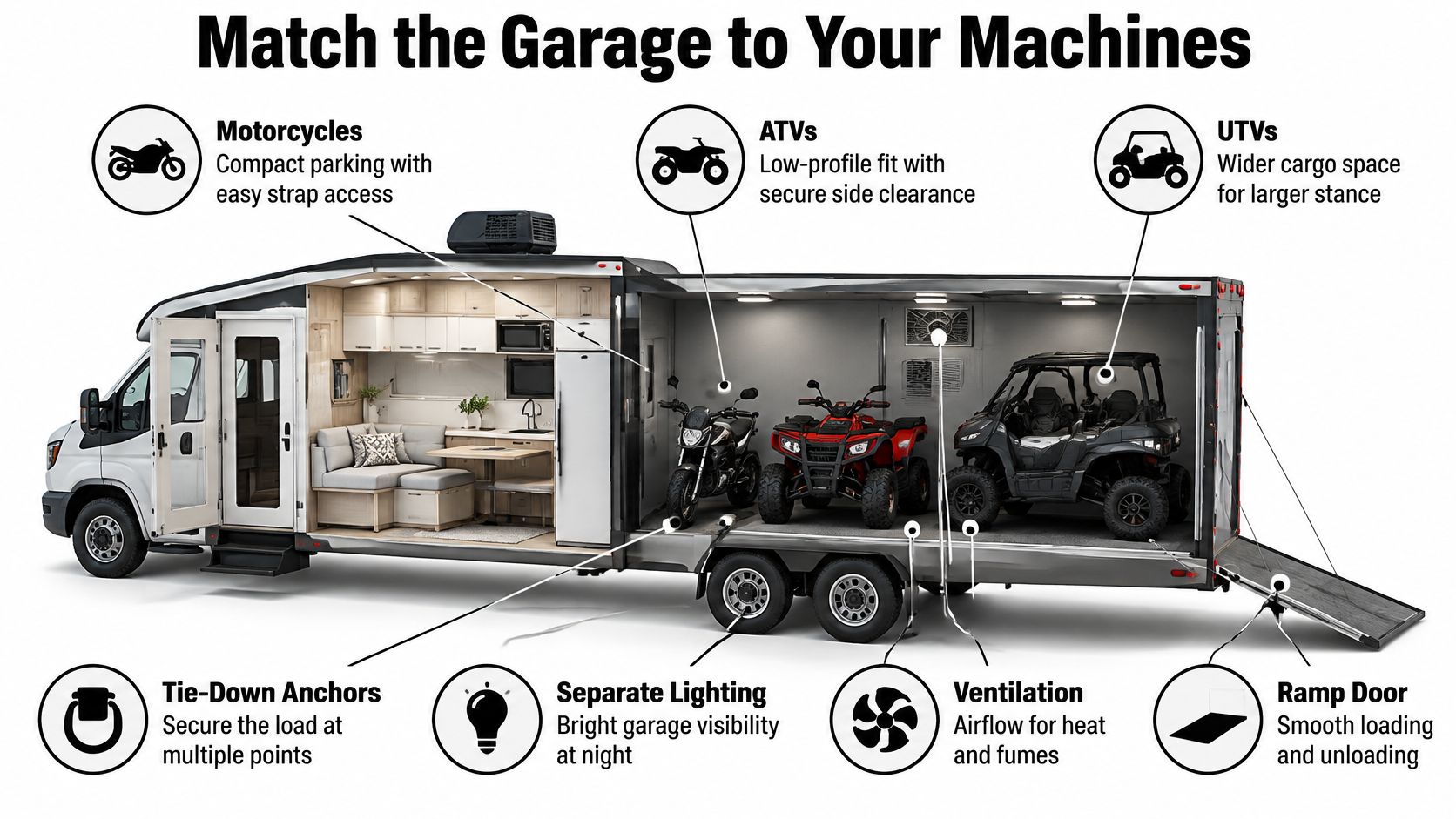
Think of the floorplan as a small house in front and a short enclosed truck bed behind it. The rear bay needs usable floor space, accessible tie-down anchors, a ramp door, separate lighting, and ventilation. The toy-hauler design and patent record provides context for this reinforced-garage layout; approximately 8–16 feet is a useful garage-length planning range, not a promise that every machine fits.
This cutaway shows how the cargo bay and living quarters share the available space.
Compare the machines, not just the floorplans
Measure your longest machine with its spare tire, racks, bumpers, and other installed accessories. Record its widest point and highest fixed point, then check the door opening and interior separately. Leave enough space to reach straps without crawling beneath the machine.
| Utah buyer scenario | What to check during the walk-through | Honest trade-off |
|---|---|---|
| A couple carrying dirt bikes | Handlebar overlap, chock placement, strap access, and folded furniture clearance | A compact travel trailer may work, but garage bunks may be unavailable until unloading |
| A family carrying a two-seat UTV | Cage width, roof clearance, spare-tire projection, and space to remove or store the whip | A machine can fit through the door yet leave poor access around it |
| A group carrying a UTV and a single-rider machine | Actual parking arrangement, anchor access, and fifth-wheel pin-load compatibility | A longer bay may solve floor-space problems while creating truck-payload problems |
As a real inventory benchmark, the used 2017 Pacific Coachworks Sandsport 25FBX has a GVWR of 9,900 lbs. That's its maximum allowable loaded weight, not the weight available for machines. Read the specific unit's cargo label before deciding what equipment, water, and supplies it can carry.
What you gain and what you give up
The appeal is practical: people and equipment share a campsite, the garage provides enclosed storage, and the ramp simplifies loading compared with handling a separate equipment trailer. After unloading, some garage layouts become useful sleeping or dining space.
The compromises deserve equal attention. More garage can mean less dedicated lounge space, and the ramp needs room behind the campsite to open. Grit collects around ramp seals, while additional carried weight adds towing demands on Utah grades.
Use this video alongside a physical walk-through, with your machine measurements in hand.
Count usable beds only after checking where the machines, folded furniture, and riding equipment will sit during travel.
Tie-Downs That Match Machine Weight
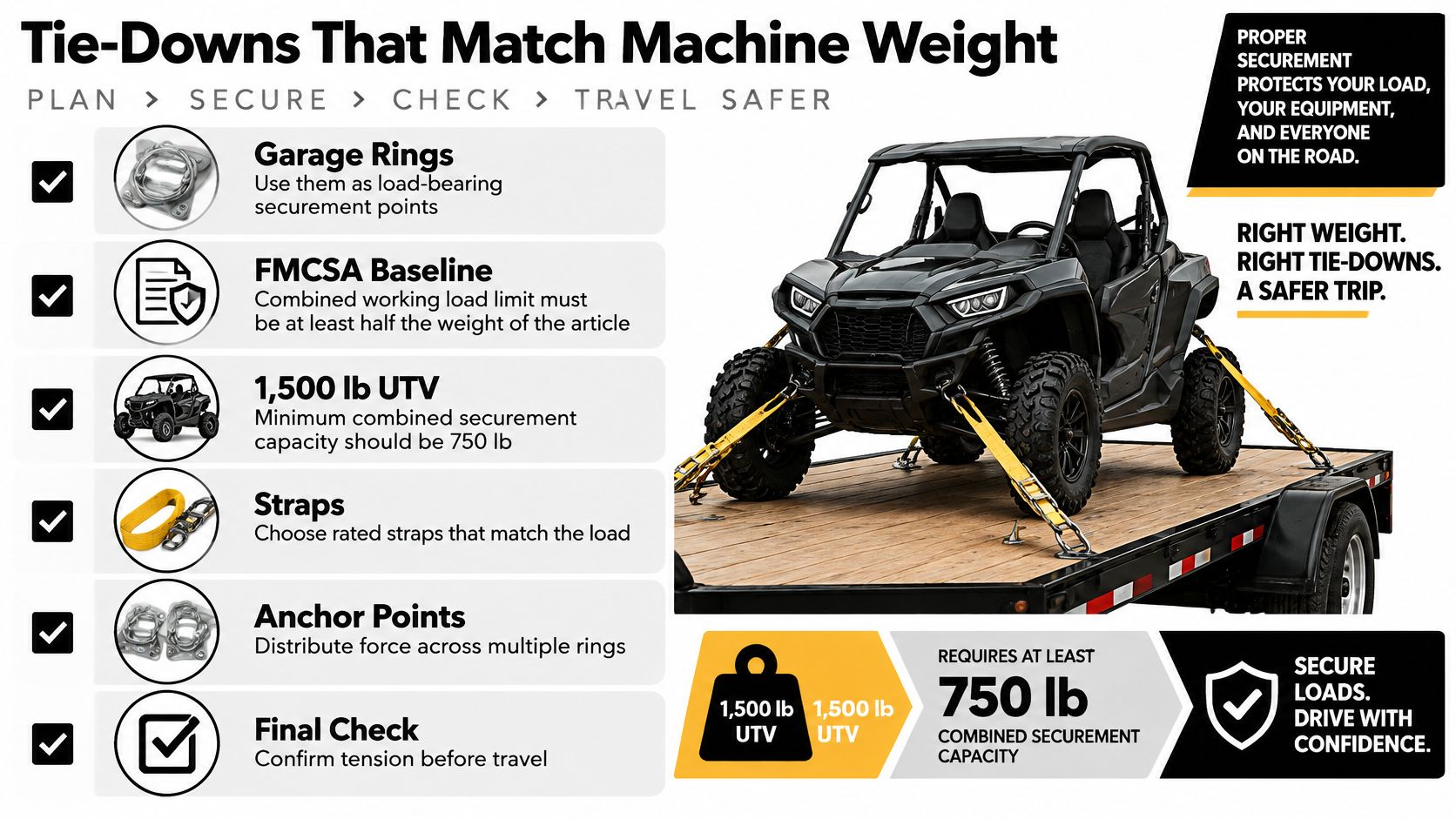
For a 1,500-lb UTV, the baseline aggregate securement working load limit is at least 750 lb, applying the one-half-of-cargo-weight requirement in the FMCSA cargo-securement rules. Those rules address commercial cargo securement, so treat them as a useful baseline rather than a complete recreational toy-hauler loading prescription. The system still needs to restrain forward, rearward, sideways, and upward movement.
The same guidance calls for one tiedown for an article 5 feet or shorter and 1,100 lb or less, and two when it exceeds either threshold, subject to the rule's conditions. Minimum counts don't replace the machine manufacturer's transport instructions or the trailer's anchor ratings.
Use this checklist to evaluate the complete restraint system, not just the straps.
Inspect the load path
Start where the restraint touches the machine and follow it all the way into the trailer structure. A high-rated strap doesn't help if it connects to an unsuitable attachment point or damaged floor ring.
- Machine connection: Use approved transport points or properly fitted wheel nets. Don't assume a convenient suspension component is an approved anchor.
- Restraint rating: Read the working load limit, not merely the breaking-strength advertising. Account for the connection method when evaluating the system.
- Floor hardware: Check rings, fasteners, and the surrounding floor for looseness, distortion, or damage.
- Strap routing: Keep webbing away from sharp edges, hot components, and pinch points. Arrange opposing restraints so the machine can't roll or walk across the bay.
Rated wheel chocks or wheel nets can help locate the machine, but they must be compatible with the tires and installation. If your setup restrains the chassis, compress the suspension only as the machine manufacturer directs. Excessive compression isn't a substitute for correct geometry.
Secure the small equipment too
Clear sand away from the anchors before connecting hooks. Inspect webbing for cuts, embedded grit, and abrasion, then confirm the hooks are seated and the tension is even. Recheck after loading and at an early safe stop.
Fuel cans, ramps, tools, coolers, and spare parts need separate restraint. A stationary UTV doesn't protect occupants or the trailer from a loose toolbox during hard braking.
NHTSA's secure-your-load guidance says cargo must not drop, shift, leak, or escape. A closed ramp isn't a substitute for securement, and stronger straps don't increase GVWR or axle ratings.
Clearance Suspension and Sand Wear
A side-by-side can clear the ramp opening and still hang up where the ramp meets the garage floor. That transition is the breakover point. Test the loading path on firm, reasonably level ground, watching the machine's underside and checking the ramp's load rating before driving aboard.
The trailer has a separate clearance problem. At a soft apron near Little Sahara or Whitewash, the rear bumper, stabilizers, or plumbing may contact the ground before the tires reach firmer terrain. Walk an unfamiliar entrance first, and don't treat a toy hauler as an off-road vehicle just because it carries one.
Match suspension work to the actual problem
Independent suspension and a well-matched leaf-spring system can each suit a trailer, depending on its design and intended use. On washboard access roads, condition, tire pressure, speed, and correct loading deserve attention before shopping for an upgrade. Neither suspension type automatically increases an axle rating.
Keep machine modifications separate from trailer modifications. T1A Auto's explanation of control arm adjustments for off-road builds is useful background when evaluating changes to a compatible off-road vehicle, but it isn't a reason to alter RV suspension geometry without the trailer manufacturer's approval.
Build a sand-specific maintenance routine
Use the owner's manual, a torque wrench, a flashlight, and a written inspection list before the season.
- Wheels and tires: Torque-check lug nuts to the specified procedure, inspect sidewalls and tread, and verify tire capacity and pressure for the loaded application.
- Ramp assembly: Inspect hinges, cables or springs, latches, and seals. Keep hands clear of tensioned hardware.
- Suspension and lubrication: Look for worn bushings, loose hardware, damaged components, and grease points identified by the manufacturer.
- Grit collection areas: Check brakes, steps, slide seals, and exposed connectors for packed sand or abrasion.
After a dune weekend, sweep or vacuum the garage before gentle cleaning. Clean the underside and anchors as the manufacturer permits, avoiding direct pressure-washer spray into bearings, brake assemblies, seals, and electrical connections. Let the bay dry before closing it for storage.
Utah ownership also means preparing for more than desert heat. Long mountain climbs require attention to the tow vehicle's cooling and braking guidance, while winter storage needs a deliberate battery and plumbing plan.
Clearance helps you enter the staging area. Sound running gear helps you leave it, and clean anchors make the next loading inspection easier.
A bigger garage won't correct a poor ramp transition, neglected running gear, or an unsuitable access road.
Utah Dune Rules Before You Roll
The hauler gets your machines to camp. It doesn't make them legal to operate. Separate the paperwork into machine registration or permits, rider education, and dune visibility equipment before packing.
Under Utah's OHV laws and rules, dune flags must be red or orange, at least 6 by 12 inches, and mounted at least 8 feet above the ground; a helmet-mounted flag must extend at least 18 inches above the rider's head. Registration or permits belong to the machine, while education credentials apply to the operator. A shared folder is convenient, but it doesn't replace the credentials required for each machine and rider.
Utah sand-trip compliance matrix
Use this as a departure checklist, then confirm current requirements on the official pages. The flag measurements come from Utah's guidance above; destination and passenger restrictions follow the BLM guidance below.
| Obligation | Applies to | Utah benchmark | Done when |
|---|---|---|---|
| Registration or permit | Each OHV, not the trailer | Papers belong to the machine | Every machine in the garage has its own current credential |
| Education certificate | Each operator | Credentials follow the rider, not the family | Every driver who will operate a machine is covered |
| Whip flag in dune areas | OHVs ridden on dunes | Red or orange, at least 6 by 12 inches, at least 8 feet above the ground | Flag is mounted correctly, or a helmet flag reaches at least 18 inches above the head |
| Where the machine may go | Whitewash and similar BLM dunes | Open riding only inside the designated OHV area | Route and closure check is current for that field office |
| Who may ride along | Passengers | Only on an OHV designed to carry them | Machines are used according to their seating design |
Check the destination boundary
The Bureau of Land Management's OHV guidance requires compliance with state rules and identifies Whitewash's distinction between cross-country travel within the designated open OHV area and designated-route travel outside it. BLM also advises carrying passengers only on machines designed for them. Open-looking sand isn't permission to ride anywhere.
Before leaving Salt Lake City or Spanish Fork, check the destination's current field-office information. Confirm closures, access conditions, lighting and spark-arrestor requirements, and whether any planned road connection requires a street-legal machine.
- Machine check: Match credentials to the machines loaded.
- Rider check: Confirm the people who may drive have the appropriate education credentials.
- Site check: Save the current map and identify the open-area boundary before unloading.
Our responsible RV travel and camping guide adds campsite-planning context for the trip. Resident and non-resident requirements can differ, and effective dates can change, so the current official page takes priority over an old screenshot.
Choose a Hauler and Keep It Road Ready
Choose the smallest practical garage that fits your equipment with safe loading and restraint access. Prove the loaded combination against its ratings, then prepare the machine credentials and destination checklist. That's a stronger buying method than starting with the longest floorplan your budget allows.
Motor Sportsland is a family-owned and operated RV dealer serving Utah since 1957. We're also a Proud Priority RV Network member and Utah's only Priority RV Network dealer. For this purchase, the most useful starting point is a walk-through with your own measurements and weight information, not a general promise that your truck should handle it.
Bring a decision packet
A few documents make a showroom visit much more productive.
- Truck information: Bring photos of the payload label, axle ratings, tire information, and hitch rating, along with the applicable towing information.
- Machine measurements: Include accessories, transport height, and a sketch of the planned parking arrangement.
- Departure estimate: List people, truck cargo, water, fuel, tools, riding equipment, and installed trailer additions.
- Camping priorities: Identify which beds must remain accessible during travel and how much room you need to unload at camp.
Our team can show you through a candidate and help organize the comparison around those details. For an unfamiliar combination, our guide to towing a camping trailer provides another preparation resource. Motor Sportsland publishes towing guides so buyers can arrive with more informed questions.
Resolve uncertainties before the deposit
Inspect the specific unit's labels and condition, especially when buying used. Ask for an explanation of any unclear ramp, hitch, or cargo limit before treating the trailer as a match. A pending question about capacity belongs on the decision sheet, not on the drive home.
Once the fit is established, consider the maintenance work needed before the first dune trip. Ramp condition, suspension wear, and evidence of sand intrusion deserve attention independently of how attractive the interior looks.
The better purchase is the hauler you can load as intended, not the one with space you can't safely use.
Bring your loaded-weight estimates to a Salt Lake City-area walk-through. We'd rather help you narrow the choices with numbers than have you discover a mismatch after packing.
Toy Hauler Questions Buyers Ask at the Counter
Do I need to re-weigh after changing tow vehicles?
Yes. The replacement truck has its own rear-axle, hitch, payload, and combined-weight limits. Weigh the actual loaded combination and evaluate it against that truck's ratings, even if its advertised towing capacity looks higher.
The hitch setup also needs to suit the replacement vehicle. Don't assume the previous adjustment transfers unchanged.
Can I trust the capacity on a used toy hauler?
Start with the weight label on the specific unit, not a brochure for the model year. Then account for equipment installed after manufacture, such as batteries, solar components, storage systems, or replacement appliances.
Those additions leave less capacity for removable cargo. If the modification history is unclear, an actual weight measurement is more useful than guessing from the original specification.
Does a closed garage need ventilation with fuel cans aboard?
Yes. Use the garage ventilation as designed, and carry only fuel containers and quantities permitted by the trailer manufacturer and applicable rules. Keep containers upright, capped, and independently restrained.
Never run an engine inside the garage. If you notice a fuel smell, address the source before using the space for sleeping or other occupancy.
Is a longer garage always the better buy?
No. Extra floor space can cost dedicated living space and may come with a heavier trailer, without providing the remaining cargo capacity your equipment needs. Compare the complete layout and labels rather than assuming garage length establishes capability.
Plan for the longest machine you realistically expect to carry, but don't buy unused space at the expense of a workable towing combination. The right sand sport toy hauler leaves room for safe restraint, practical camping, and the load you take.
Motor Sportsland offers new and pre-owned toy haulers, along with RV service, parts, and financing options to support your Utah dune plans. Visit Motor Sportsland to browse current inventory or arrange a walk-through, and bring your machine dimensions, truck labels, and departure-load estimate so our team can help you compare the right candidates.
