
Class a Motorhome Gas Mileage for Utah Travel

You're comparing Class A coaches online late at night, and every listing seems to promise a different number. One seller swears his coach gets great mileage on the highway. Another won't commit to anything at all. If you're planning to leave Salt Lake City, climb toward the Wasatch Mountains, and keep going to Jordanelle or Bear Lake, neither answer helps you budget. Class A motorhome gas mileage isn't a fixed specification you can look up like tank size. It's a range that shifts with your route, your load, and how fast you drive, and treating it that way is the only honest way to plan.
Why One MPG Number Can Mislead You
A family we talk with often in principle, if not in name, starts in the Salt Lake City area with a simple plan. They've found a used Class A they like, they've seen a mileage figure in an ad, and they've multiplied their route miles by that number to estimate the fuel bill. Then the trip starts.
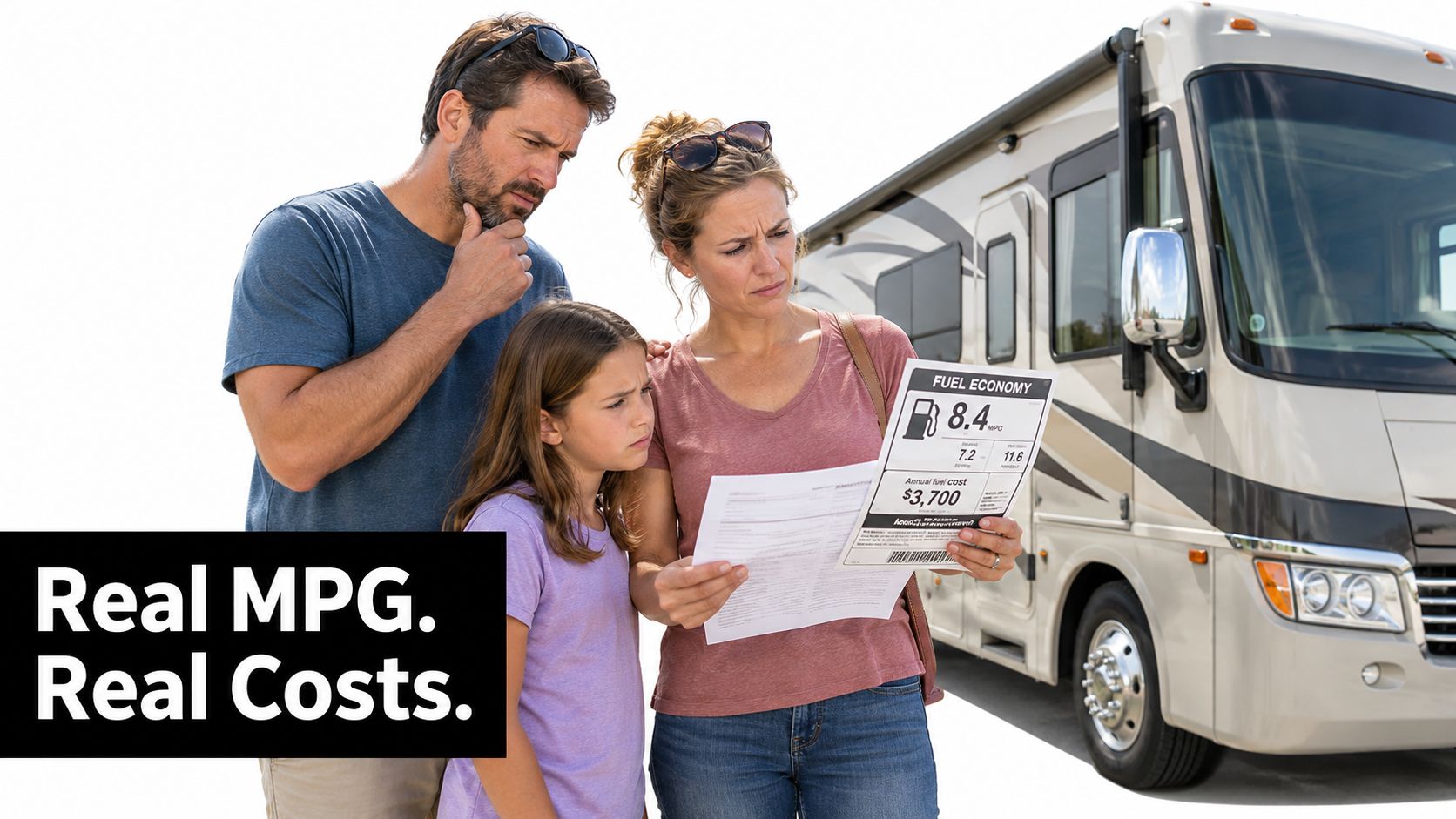
The coach is loaded with food, water, gear, and kids. They're towing a small car. The route climbs, the wind picks up across open interstate, and traffic forces repeated slowing and accelerating. By the second fill-up, the gallons purchased don't match the brochure math at all. Nothing is broken. The estimate was just built for a different trip.
The Question Worth Asking Instead
Don't ask what a Class A gets in ideal conditions. Ask what you should budget for on your actual route, load, and speed. That's the distinction that matters for Utah and Mountain West travel, where high elevations, grades, wind, winter temperatures, and long interstate stretches can all appear on the same weekend as outlined in RVshare's guide to RV gas planning ranges.
Budget with the low end of your range, not the best tank you've ever heard about. If the trip beats your estimate, you've got a pleasant surprise instead of a shortfall.
Once you accept a range, the rest gets practical. You can compare gasoline and diesel coaches, build a fuel budget with a safety margin, and spot which variables you control. You'll also stop judging a coach by a single tank. One fill-up into a headwind on a grade tells you almost nothing, and one gentle downhill run tells you even less.
Understanding Class A Motorhome Gas Mileage
Class A motorhome gas mileage is how many miles a large, bus-shaped motorhome travels on one gallon of fuel. The complication is that there's no standardized label to trust. A practical planning range for a gasoline-powered Class A is approximately 6 to 8 miles per gallon, and that figure is not an official EPA rating for most coaches as explained in CamperSmarts' overview of RV gas mileage.
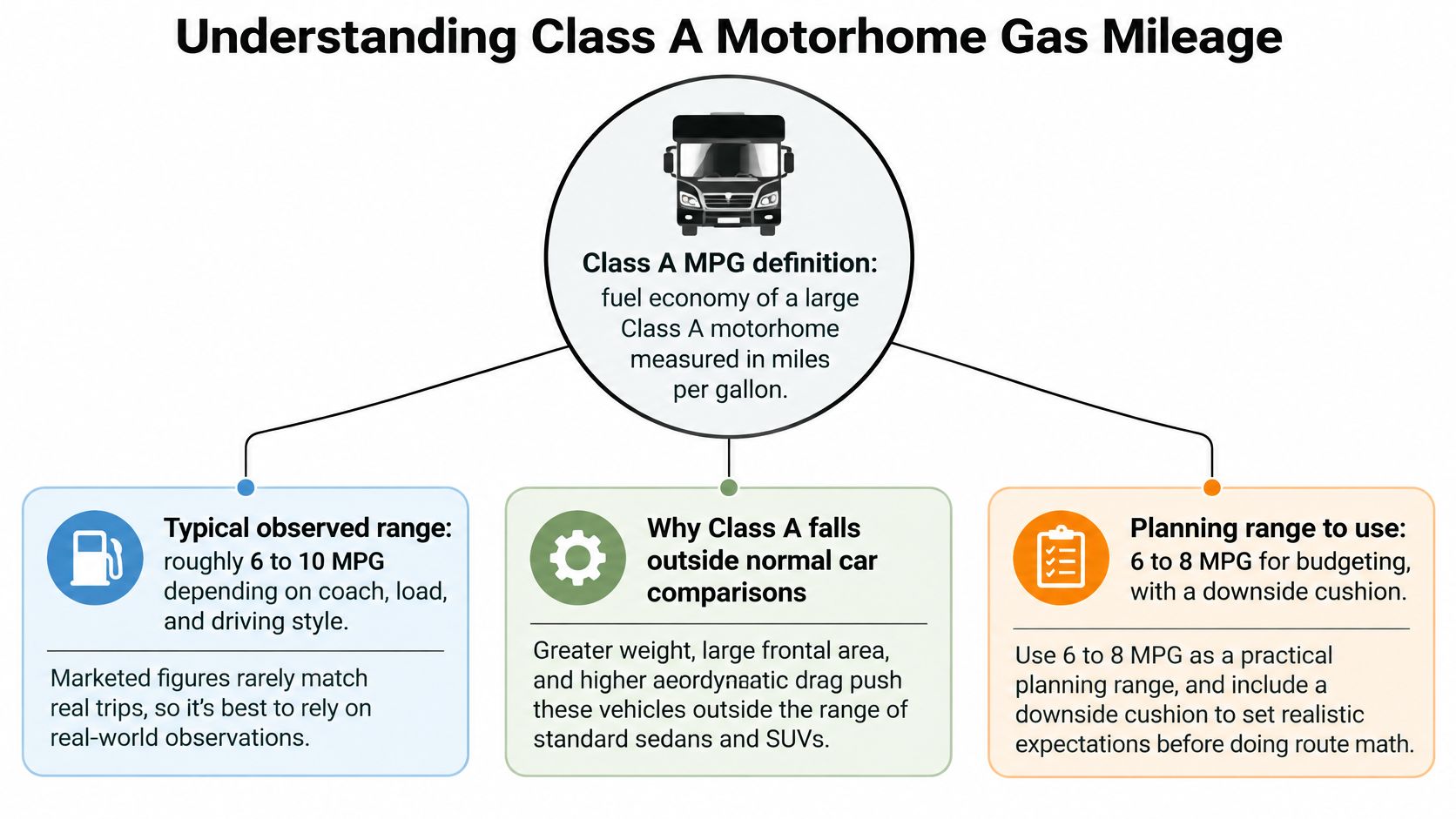
Large motorhomes generally fall outside standard passenger-vehicle fuel-economy testing. A car buyer can compare window stickers because cars are tested the same way. A Class A buyer usually can't, because results depend heavily on weight, aerodynamic profile, engine and transmission, cargo, speed, wind, terrain, and towing. Two coaches with the same floorplan can return different numbers in different hands.
Turn MPG Into Gallons
MPG alone doesn't tell you what you'll buy at the pump. Gallons do. Divide total route miles by your assumed MPG and you get fuel consumption you can price.
- At the low end: A coach returning the low end of that gasoline range on a long trip will use substantially more fuel than the same coach at the high end, even before price changes enter the picture.
- At the high end: The gallons saved look meaningful on paper, but only if your route, load, and speed support that higher figure.
- For planning: Pick the conservative figure first, then treat anything better as a bonus.
That's why repeated records beat a single dashboard reading. A dashboard estimate on one segment can flatter or punish you depending on grade and wind. Gallons purchased divided into miles traveled, recorded over several fill-ups under comparable conditions, gives you a baseline you can defend. Treat advertised or owner-reported MPG as a planning estimate, never as a guaranteed specification, and you'll compare coaches on realistic ground.
Comparing Gasoline and Diesel Class A Options
Diesel pushers often post better MPG than gasoline coaches, and that's where many buyers stop thinking. Don't. Available estimates put gasoline Class A coaches around 6 to 10 MPG and diesel pushers around 7 to 13 MPG, with diesel often achieving roughly 15 to 25% better MPG, yet the fuel-price premium can substantially reduce or erase that operating-cost advantage as shown in RVRove's RV fuel calculator comparison.
Run the gallons, not just the MPG. On a long trip, the diesel coach burns fewer gallons, and that saving is real. If diesel costs materially more per gallon where you travel, though, fewer gallons at a higher price may not leave you ahead. A buyer who drives only a few thousand miles a year may never recover a higher purchase price through fuel savings alone. A frequent long-haul traveler covering serious annual distance has a very different calculation, and may value diesel's range and torque on grades even when immediate fuel savings look modest.
Gasoline and Diesel Planning Comparison
| Decision Factor | Gasoline Class A | Diesel Pusher | Buyer Question |
|---|---|---|---|
| Fuel economy | Lower planning range | Higher planning range | How many gallons will my route actually require |
| Fuel price exposure | Priced at gasoline pumps | Priced at diesel pumps, often at a premium | What do I pay per gallon locally |
| Annual miles | Suits occasional travel well | Rewards high annual distance | How far will I really drive each year |
| Purchase and upkeep | Generally lower entry cost | Generally higher entry cost | What else am I paying for besides MPG |
| Travel pattern | Weekends and regional trips | Long hauls and mountain towing | Where will this coach spend its miles |
Before you decide, work through our detailed comparison of gas versus diesel Class A motorhomes with your own annual mileage in hand. Calculate total fuel cost at a few different yearly distances using current regional prices, then separate fuel savings from non-fuel benefits like towing confidence, range between stops, maintenance expectations, and resale. This matters especially for Utah retirees choosing between a used gasoline coach and a more expensive diesel model. The right answer isn't the highest MPG. It's the drivetrain whose total cost fits how you'll travel.
Factors That Change Real-World Fuel Economy
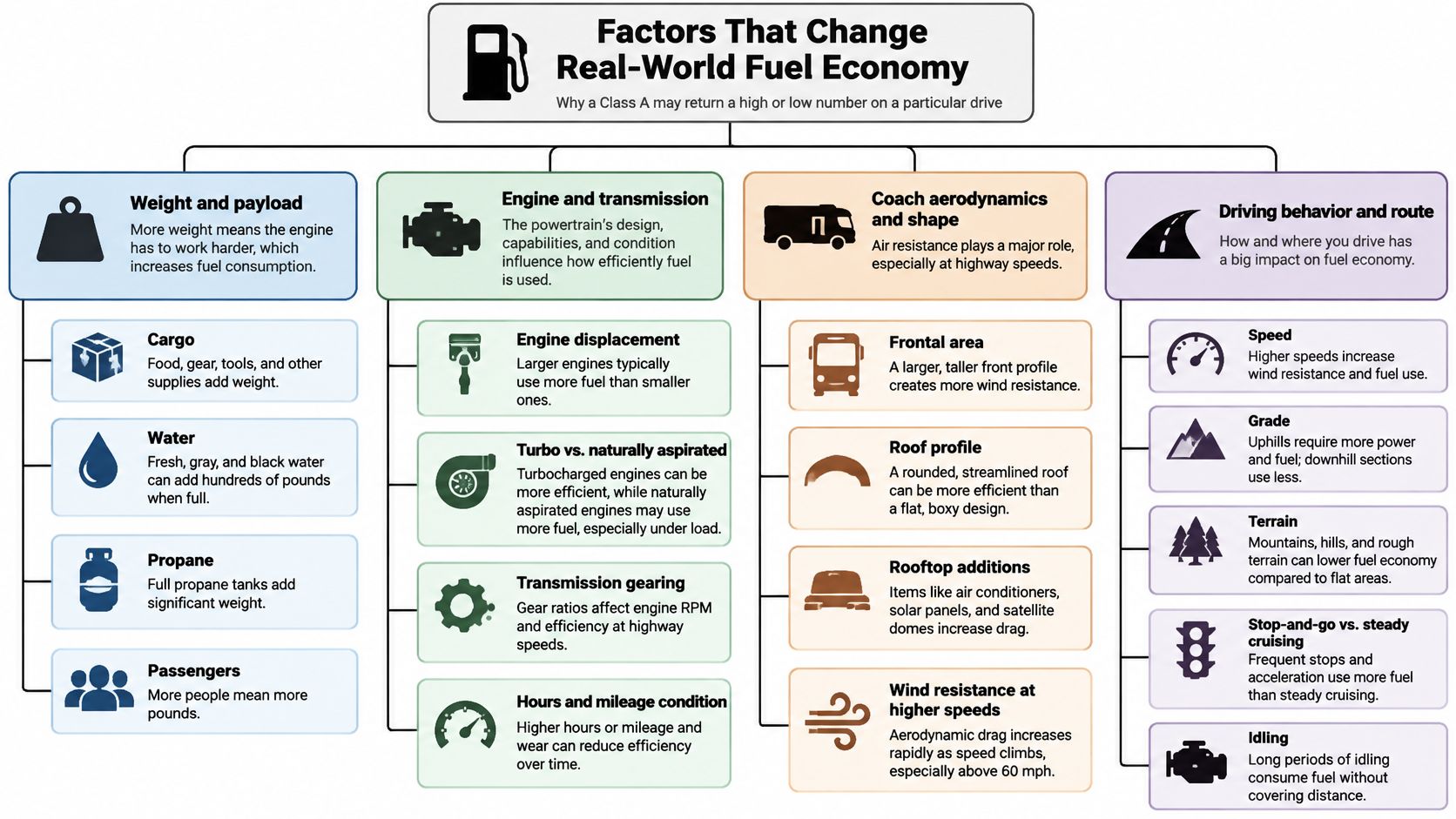
Published estimates commonly cluster around 6 to 10 MPG, but steep terrain can reduce economy to about 4 MPG, while sustained speeds around 55 to 60 mph may improve results. That spread isn't a contradiction. It's the same coach meeting different physics.
What the Coach Brings With It
Some variables arrive with the motorhome itself. Weight and payload sit at the top. Passengers, fresh water, propane, food, tools, and cargo all add pounds the engine must move and, on a grade, lift. A fully loaded family coach performs differently from an unloaded test vehicle, and that's expected.
Engine and transmission pairing matters next. Gearing determines how hard the engine works at cruising speed and on climbs, and the condition of a used powertrain shapes what you'll see. Coach shape matters too. A Class A presents a large frontal area to the wind, and rooftop air conditioners, cargo boxes, and other accessories add drag that grows more punishing as speed climbs.
What You Control on the Road
- Speed: Pushing a tall, flat-fronted coach faster demands disproportionately more fuel, so a moderate, steady pace is your cheapest tool.
- Terrain: Sustained Utah grades toward mountain campgrounds will pull any coach toward the bottom of its range, no matter what it returned on flat interstate.
- Towing: Pulling a car or trailer adds weight and drag, so budget a towed trip separately from an untowed one.
- Weather: Headwinds, cold winter air, and high elevation around the Great Salt Lake basin and beyond all work against you in ways a fair-weather test won't show.
- Driving pattern: Stop-and-go traffic and idling burn fuel without adding miles.
Sorting these into fixed and controllable is the useful exercise. You can't change the coach's frontal area once you've bought it. You can change your speed, your cargo, whether you tow, and how much time pressure you put on a climb. Plan around the fixed factors. Manage the rest.
Building a Realistic Class A Motorhome Fuel Budget
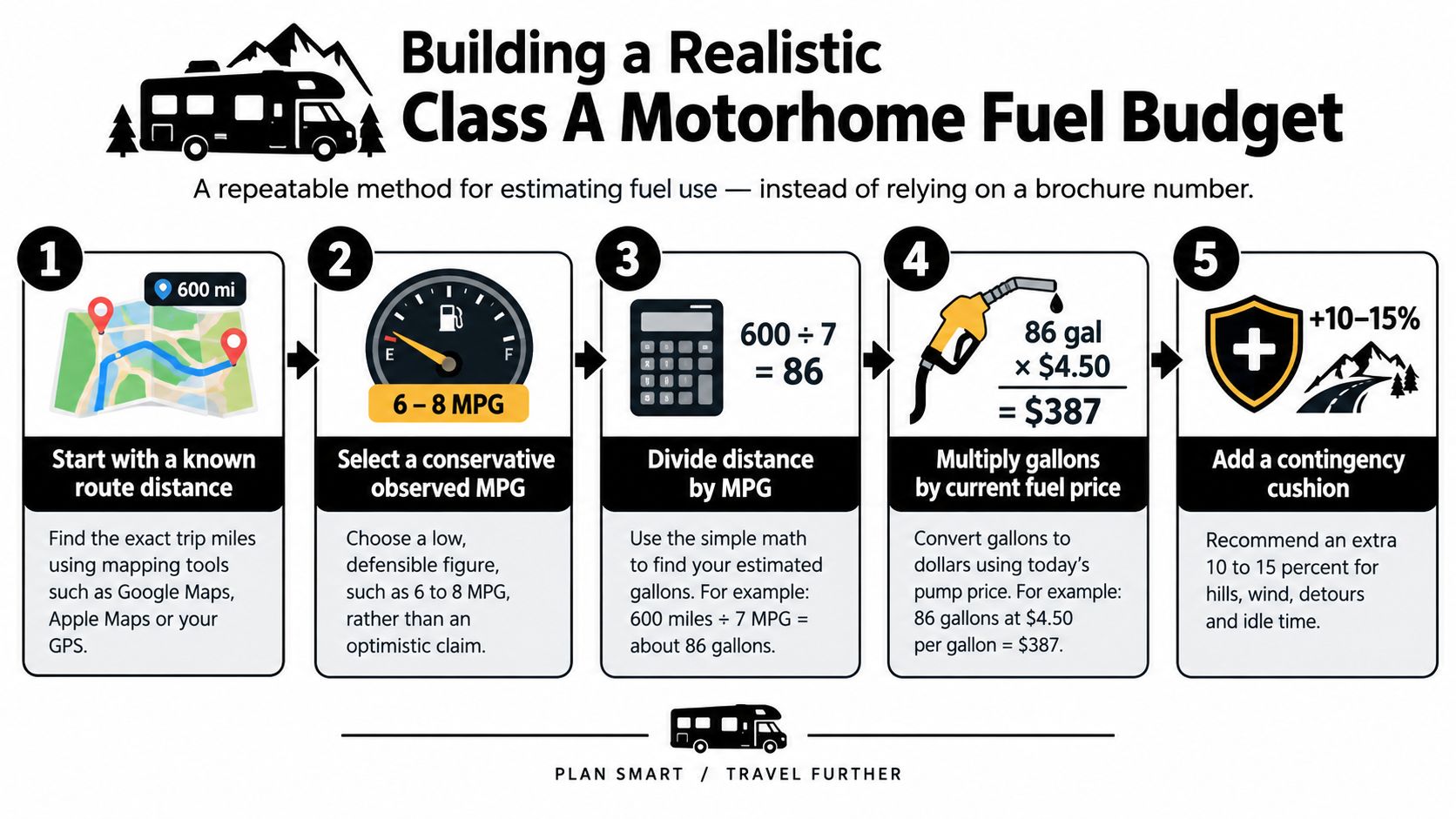
You don't need special software to budget fuel well. You need a repeatable method and the discipline to use a conservative number. For trip budgeting, calculate fuel consumption as total miles divided by observed MPG, then add a margin for mountain travel, idling, and detours following the planning method described in RV Road Log's gas versus diesel guide.
A Method You Can Repeat
- Map the route: Get total miles, including side trips you know you'll take.
- Choose a conservative MPG: Use your own recorded baseline if you have one. If you don't, use the low end of the planning range for your fuel type.
- Divide miles by MPG: That gives expected gallons for the route.
- Price the gallons: Multiply by a realistic pump price for the areas you'll cross, not just your home station.
- Add a cushion: Extra fuel for grades, wind, traffic, and detours protects the budget from ordinary surprises.
Small MPG differences create large gallon differences over distance. For example, a 1,000-mile trip at 7 mpg requires about 143 gallons, while the same trip at 9 mpg requires about 111 gallons, a difference of roughly 32 gallons. That's why optimistic assumptions hurt. If you're new to this, our first-time RV buyer guide covers the other ownership costs to budget alongside fuel.
Build your personal baseline by recording gallons purchased and miles traveled over several fill-ups under comparable conditions. Note whether you were towing, climbing, or cruising flat interstate. Over time you'll have separate expectations for flat highway, mountain, towing, and slow scenic segments, and you can report your trips in fuel cost per mile, which is far more useful than MPG alone.
What Real-World Examples Reveal About MPG
Advertised figures tend to reflect favorable conditions. Independent real-world testing reported an average of about 7.2 mpg for gasoline Class A motorhomes after testing 43 recreational vehicles over approximately 12,000 miles according to testing summarized in Best RV Rental Companies' guide to RV types. That's a useful anchor because it comes from driven miles, not a sales sheet.
The same results listed a Winnebago Vista 35U gasoline Class A at 7.1 mpg over an 890-mile test. Notice where that lands. It's near the middle of the planning range, not at the top. A buyer who budgets around the middle with a cushion for hard segments won't be shocked. A buyer who budgets around the best number anyone has ever posted online usually will be.
What the testing really shows: Expect a large coach to cluster near the middle of its range. Plan for the middle, cushion for the mountains, and let good tanks be a bonus.
Why One Coach Produces Two Stories
Take that same coach out of ordinary highway testing and point it up a sustained Utah grade, loaded, in summer heat or winter cold. The engine works harder, the transmission holds lower gears longer, and consumption climbs for as long as the climb lasts. Descending doesn't fully repay what climbing cost. Owners who don't know this sometimes assume something's wrong with the coach when the route is really the explanation.
Floorplan, loaded weight, tire pressure, driving speed, weather, and chassis configuration can all move the result, so no single test guarantees your outcome. If you're shopping used, our guide to choosing the best used Class A motorhome explains how to weigh condition and maintenance history alongside mileage expectations. Use published testing to set your starting range. Use your own fill-up records to replace it.
Simple Ways to Improve Fuel Efficiency
One published comparison estimates roughly 6 to 9 mpg on ordinary roads and about 4 to 7 mpg on sustained mountain grades, using a 6% grade as its reference condition, and notes that drivers can reduce avoidable consumption by maintaining a steady speed, checking tire inflation, avoiding unnecessary cargo, and allowing extra time rather than aggressively accelerating on grades as described in RVivy's guide to RVs for mountain travel. Those aren't exotic tricks. They're habits.
Before You Leave
- Check tire inflation: Underinflated tires increase rolling resistance and wear, and they're one of the easiest items to verify before departure.
- Audit your cargo: Remove gear you won't use this trip. Carry water based on what you'll need and what your destination provides.
- Think about the roof: Cargo boxes and accessories up top add drag every mile, so mount only what earns its place.
- Decide on towing deliberately: If you won't need the car at your destination, leaving it home changes the whole fuel picture.
While You Drive
Hold a steady speed and let the coach settle. Repeated surging to pass and then slowing again wastes fuel a big coach can't recover. On grades, accept a slower climb. Forcing speed uphill with aggressive throttle burns the most fuel at the exact moment the coach is least efficient, and it saves very little time over a mountain leg. Build extra time into Utah mountain days instead.
None of this guarantees a specific gain on your coach, and anyone who promises one is guessing. Make one change at a time, then compare several fill-ups under comparable conditions. If efficiency drops suddenly without a route or load explanation, that's a maintenance conversation. Share your records and the coach's service history with a qualified technician rather than chasing accessories that promise mileage miracles.
Make Your Mileage Expectations Work for You
A sensible buyer doesn't chase the highest possible MPG. That number, on its own, tells you too little. What matters is whether the coach's realistic range fits your routes, your payload, your towing plans, and your annual distance at fuel prices you can live with.
For Buyers Comparing Coaches
- Start with your routes: Mostly flat interstate to regional campgrounds is a different budget from regular climbs into the Wasatch or long Mountain West hauls.
- Be honest about annual miles: Low annual distance weakens the fuel case for paying more upfront. High annual distance strengthens it, but purchase price, maintenance, and resale still belong in the math.
- Ask for records on used coaches: A seller's actual fill-up history under known conditions is worth more than a claimed best tank.
- Budget cost per mile: Gallons and price together tell you what travel really costs.
For Current Owners
Build your baseline, then recalculate when something major changes. A new towed vehicle, a rooftop cargo setup, a different typical route, or winter travel all justify fresh expectations. Keep the log simple. Date, miles, gallons, towing or not, and where you drove is enough to spot patterns within a season.
The goal was never to find a magic number. It's to leave on a Utah trip knowing roughly what the fuel will cost, with enough margin that a headwind or a long grade doesn't wreck the plan. Pick a conservative range, measure your own results, and let the coach prove itself over several tanks. That's how experienced owners think about Class A motorhome gas mileage, and it's a habit worth adopting before you buy, not after.
If you're weighing gasoline and diesel Class A coaches for Utah travel, our team can walk you through realistic mileage ranges, towing trade-offs, financing, trade-ins, and service support at our Millcreek and Spanish Fork showrooms. Browse current inventory and plan your visit at Motor Sportsland, then bring your route and annual mileage with you so we can help you budget with real numbers.
