
Half Ton Towable Travel Trailer: How to Match Your Truck

You're climbing Parleys Canyon on a July Saturday, and the trailer that felt manageable around Millcreek suddenly feels like a different purchase. The fresh-water tank is full, the truck bed holds bikes and firewood, and your family is wondering why the pickup keeps shifting. At the dealership, the trailer's half-ton-towable label seemed reassuring. On the grade, you want to know what that label promised.
A half ton towable travel trailer can be a sensible choice for Utah camping, but only when its loaded weight fits your particular truck. The number that stops the purchase often isn't the advertised towing capacity. It's payload, the weight your truck can carry while it's pulling the trailer.
The Trailer That Looked Half-Ton Towable
Say a Millcreek family finds a bunkhouse with the right beds, a roomy dinette, and generous front storage. Their pickup's advertising emphasizes maximum towing capability, so the trailer appears comfortably within reach.
Then they pack it.
Passengers occupy the cab, camping equipment fills the bed, and the hitch adds another load behind the rear axle. The trailer still weighs less than the advertised towing maximum, but that doesn't establish whether the truck can carry its share.
The useful question isn't whether a half-ton truck can pull the trailer. It's whether your loaded truck can carry the hitch load while respecting every applicable rating.
Motor Sportsland serves the Salt Lake City area, where matching a trailer means thinking about trips to Jordanelle, Bear Lake, and the Wasatch Mountains, not just driving across a level parking lot. A floorplan needs to work at camp and on the road that gets you there.
Start with your truck's labels, then estimate the trailer's camping weight and tongue load. With those documents ready, the worksheet below gives you a quick preliminary screen before you spend an afternoon touring trailers. Final approval still requires the actual specifications and scale weights.
What Half-Ton Towable Actually Means
A half-ton towable travel trailer is a conventional bumper-pull trailer intended to work with many, but not all, half-ton pickups and full-size SUVs. The phrase describes a market category, not a universal towing certification.
Your truck's engine, cab, drivetrain, axle ratio, equipment, and carried load determine its limits. A different truck with the same badge can have a different allowable trailer weight.
The five limits that decide a half-ton match
| Limit | Where to Find It | What Must Be True |
|---|---|---|
| Maximum tow rating | Manufacturer towing guide for your exact cab, engine, axle ratio, and hitch setup | Loaded trailer weight remains below the rating, with additional operating margin |
| Payload capacity | Door-jamb Tire and Loading Information sticker | Tongue weight plus passengers, bed cargo, accessories, and hitch hardware stays under payload |
| GCWR | Manufacturer towing guide or vehicle documentation | Actual loaded truck weight plus loaded trailer weight stays under GCWR, without counting tongue weight twice |
| Rear GAWR | Truck certification label | Loaded rear-axle weight stays under the axle rating |
| Hitch vertical-load rating | Receiver label and hitch-component ratings | Tongue weight stays within every applicable component rating |
GCWR means gross combined weight rating. GAWR means gross axle weight rating. You must also respect the truck's GVWR, its maximum allowable total weight, along with tire and other component ratings.
Begin at the driver's door jamb. Photograph both the Tire and Loading Information sticker and the certification label, then find the towing-guide entry for your exact configuration. Don't substitute an internet result for a similar truck.
Why dry weight isn't your shopping ceiling
Brochure dry weight describes an unloaded condition, not necessarily the trailer you'll take camping. Depending on the manufacturer's definition, it may omit fluids, batteries, propane, installed equipment, or personal cargo.
Use the trailer's GVWR as a conservative shopping screen. That doesn't mean every trailer travels at its GVWR, but it prevents your match from depending on an unrealistically empty trailer.
The testing behind towing ratings is broader than engine power alone. SAE J2807 addresses acceleration, handling, trailer-sway response, braking, parking-brake capability, and hitch-structure evaluation under defined conditions.
Conventional travel trailers represented approximately 67.9% of all RV shipments in 2025, totaling 232,474 units, according to the RV Industry Association's year-end shipment report. That explains their prominence on dealership lots, but shipment volume can't tell you whether a particular trailer fits your pickup.
The Payload-First Matching Worksheet
A headline rating is useful only after you identify the configuration behind it. MotorTrend reports that the 2024 Ford F-150 can tow a maximum of 13,500 pounds when properly equipped. That isn't a blanket rating for every F-150.
Work from what the truck can carry
The following is a hypothetical calculation, not a specification for a particular vehicle. Replace every example entry with your own weights.
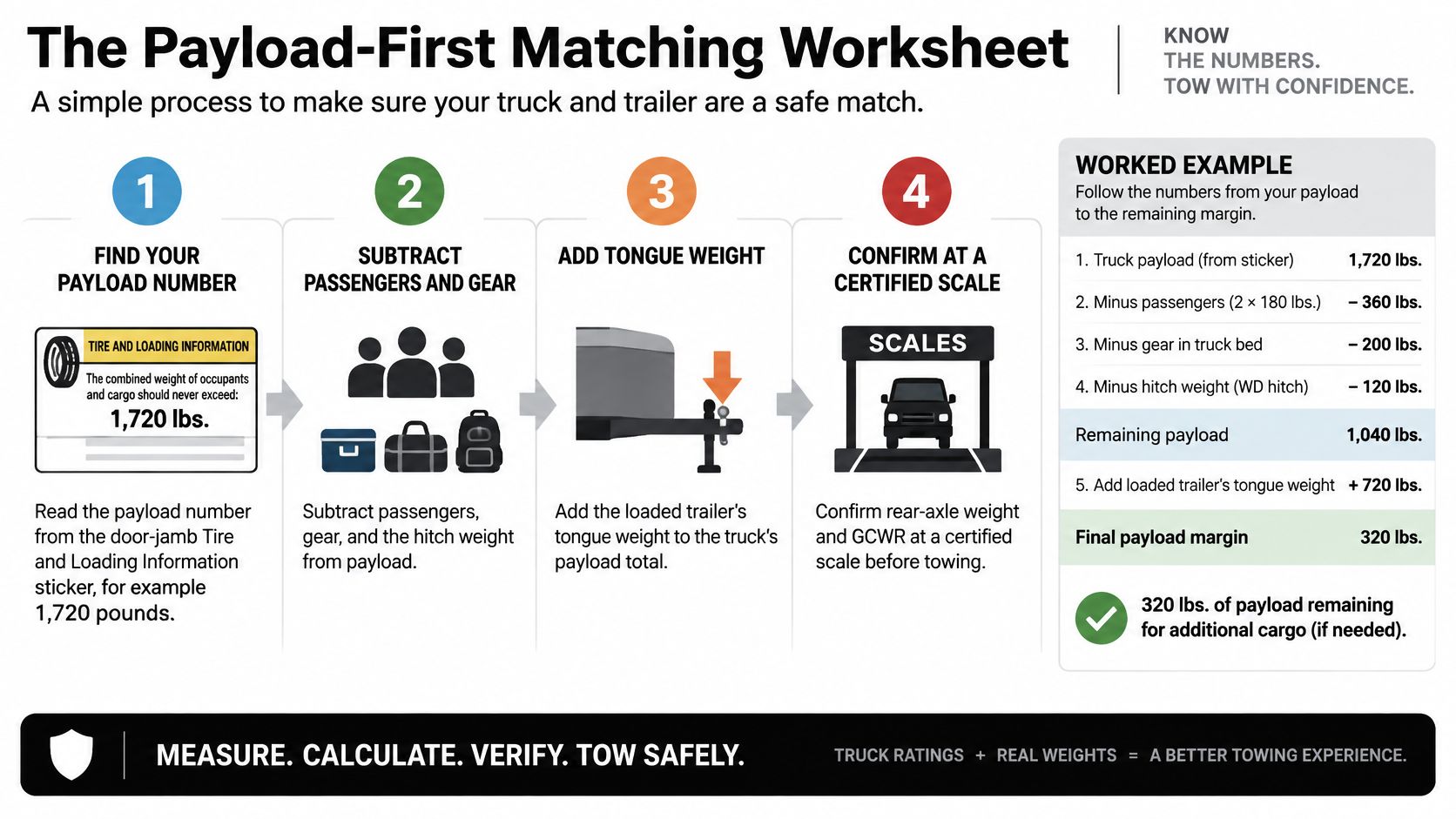
Read the payload sticker. Suppose it lists 1,720 pounds. That's your starting allowance, not your remaining allowance after packing.
Subtract the truck's carried load. In this example, the family weighs 480 pounds, bed cargo weighs 100 pounds, and hitch hardware weighs 40 pounds. Together, they consume 620 pounds. Include pets, aftermarket accessories, and anything else not already accounted for in the truck's rated configuration.
Calculate available tongue capacity. The example leaves 1,100 pounds, calculated as 1,720 minus 620. That is an upper payload allowance, not a target you should automatically use completely.
Translate that allowance into a preliminary trailer ceiling. Using a hypothetical 12% tongue-weight assumption, 1,100 divided by 0.12 gives approximately 9,167 pounds of loaded trailer. This is a screening estimate only, because actual tongue percentage changes with trailer design and loading.
Cross-check the other limits. Find the exact conventional tow rating, then subtract the ready-to-travel truck's weight from GCWR. Check the receiver's vertical-load rating and obtain loaded axle weights. Rear-axle and hitch limits aren't interchangeable with trailer-weight limits, so don't combine them into a single subtraction.
Compare the candidate's GVWR with the lowest applicable ceiling. If the trailer passes that conservative screen, estimate its loaded tongue weight and verify it against the remaining payload and hitch allowance. Reject a match that requires optimistic assumptions to pass.
Use this visual to organize the documents and scale checks.
Turn the calculation into a buying decision
For discretionary planning, leaving a 10%–20% buffer below the tow rating can be a useful preference, not a legal requirement or a manufacturer-approved guarantee. Don't apply that percentage blindly to GCWR or assume it compensates for insufficient payload.
In the hypothetical example, a trailer approaching the calculated ceiling leaves little room for a higher actual tongue percentage. A lighter candidate can preserve capacity for forgotten equipment and changing family needs.
Practical rule: If the match only works with empty tanks, missing passengers, or an unusually low tongue-weight assumption, keep shopping.
Our guide to maximum towing capacity provides additional context for interpreting the truck's advertised number. Bring your completed worksheet to the lot so the conversation starts with your actual capacity rather than a brochure headline.
Estimating Real Loaded Weight and Tongue Weight
Start with the trailer's unloaded weight, then build a packing list instead of adding an arbitrary allowance. Your camping habits determine what belongs on that list.
Account for everything that travels
- Water and waste: Include the fresh water you'll carry outbound and any retained wastewater on the return trip.
- Propane: Account for both the fuel and the cylinders if they aren't already included in the stated unloaded weight.
- Batteries: Use the actual battery specifications, including added battery boxes or mounting hardware.
- Installed equipment: Confirm whether solar, an additional air conditioner, an awning, or other options are included in the trailer's documented weight.
- Camping supplies: Weigh bins of cookware, clothing, food, tools, leveling equipment, chairs, and recreational gear.
Don't assume there's a universal amount to add to dry weight. A lightly packed weekend trailer and an off-grid family setup can have very different ready-to-travel weights.
Tongue weight is the downward load the coupler applies to the hitch. NHTSA technical guidance describes a conventional-trailer planning range near 10%–14% of loaded trailer weight, which produces the calculated examples below.
Tongue weight planning ranges by loaded trailer weight
| Loaded Trailer Weight | Tongue Weight at 10% | Tongue Weight at 14% |
|---|---|---|
| 5,500 lb | 550 lb | 770 lb |
| 7,000 lb | 700 lb | 980 lb |
| 8,500 lb | 850 lb | 1,190 lb |
| 10,000 lb | 1,000 lb | 1,400 lb |
These are planning calculations before hitch hardware, not measured weights or permission to use any percentage within the range. Follow the trailer and tow-vehicle manufacturers' instructions for your combination.
Keep heavy supplies low and close to the trailer axles, and balance the load from side to side. Don't overload the front pass-through, but don't move everything rearward to reduce hitch load either. Rear-heavy loading can reduce tongue weight and encourage sway.
Verify rather than guess
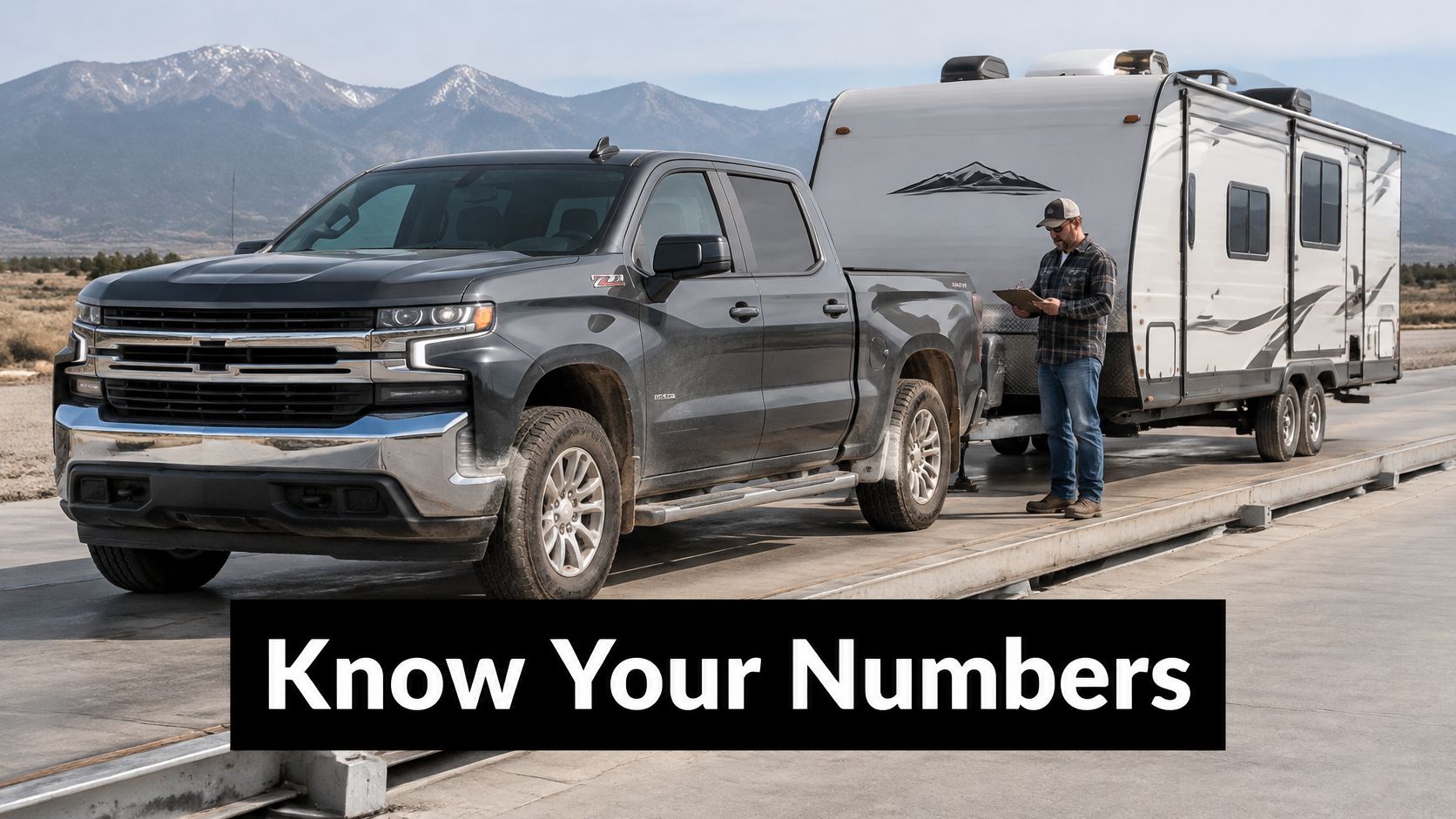
At a CAT Scale or another suitable vehicle scale, obtain separate steer-axle, drive-axle, and trailer-axle readings with the rig packed for travel. Coordinate with the scale operator before unhitching or arranging additional passes.
For a tongue-weight calculation, compare the coupled truck's axle total, with weight distribution disengaged as directed by the hitch manufacturer, against the same loaded truck weighed uncoupled. Keep passengers, cargo, and hardware placement consistent. Rolling the trailer wheels off a platform won't isolate tongue weight reliably.
Our tongue-weight measurement guide explains the measurement choices. Afterward, adjust the weight-distributing hitch according to its instructions and the truck manufacturer's axle-restoration requirements, rather than judging setup by rear-end appearance alone.
Trailer Profiles That Fit a Half-Ton Truck
Use floorplan categories to narrow your search, not to approve a tow combination. The following dimensions and tongue loads are illustrative shopping scenarios, not verified averages or specifications for every trailer in the category.
Trailer profiles and half-ton fit verdicts
| Trailer Profile | Typical Size | Est. Tongue Weight | Half-Ton Verdict |
|---|---|---|---|
| Couples lightweight | Illustrative 16–20 ft, no slide or one small slide | Illustrative 400–600 lb | Promising starting point for many half-ton trucks, subject to the worksheet |
| Family bunkhouse | Illustrative 22–26 ft, one slide, bunk beds | Illustrative 700–1,050 lb | Fits if the payload math works; verify the door-jamb sticker |
| Large family or destination | Illustrative 28–32 ft, larger living area or multiple slides | Calculate from the candidate's loaded weight and verify by measurement | Often beyond a loaded half-ton's comfortable capacity; compare three-quarter-ton options |
Couples layouts preserve more choices
A Murphy bed can combine daytime living space with a shorter body. A rear-living floorplan may offer better seating, but a larger lounge can also mean more length and equipment.
Walk through the trailer with the bed deployed and the slide closed where possible. Check bathroom access, refrigerator access, and whether you can stop for lunch without extending the slide.
A compact trailer isn't automatically the best choice if it forces essential equipment into the truck bed. Consider the whole combination, including where you'll carry bicycles, a generator, and outdoor furniture.
Family layouts need a packing plan
Bunk beds solve bedtime logistics, but the passengers who use them also occupy the tow vehicle. Before choosing a bunkhouse, decide where everyone sits and where their equipment travels.
- Outdoor kitchens: Convenient at camp, but include their equipment and supplies in the loaded-weight calculation.
- Larger tanks: Useful for dispersed camping, provided you can carry the intended water load.
- Additional batteries: Helpful off-grid, but their mounting location can affect tongue weight.
- Slide-outs: Evaluate the exact floorplan and weight documentation rather than assuming every slide adds the same hitch load.
Large destination-style layouts prioritize living space. Their appeal doesn't change the truck's capacity, and adding suspension aids won't create more rated payload.
Choose the sleeping arrangement after establishing the truck's capacity. Otherwise, you may end up shopping for a different truck to support the trailer you've already chosen.
Towing a Half-Ton Match Through Utah Mountains
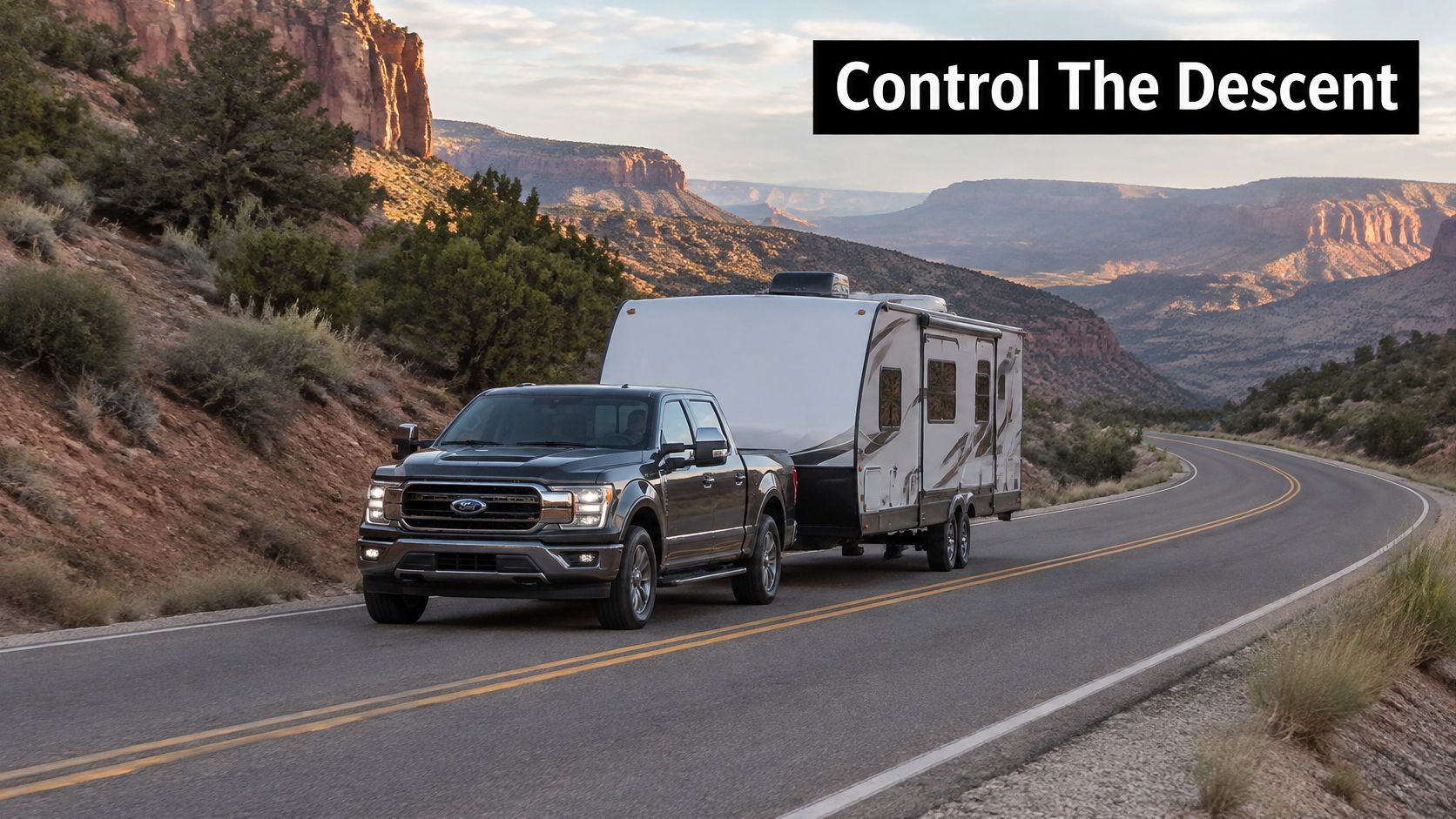
A common descent mistake is waiting until the rig gains speed before choosing a lower gear. Select the appropriate gear before the downhill section, use the truck's tow/haul or grade-braking features as directed, and avoid continuously riding the service brakes.
The setting below is a reminder that towing decisions include the road, not just the campsite.
Prepare for the route and weather
Before heading into Parleys or Provo Canyon, confirm that the trailer brakes work and the controller is adjusted for the loaded trailer. Use the controller manufacturer's test procedure in a suitable clear area, not your first emergency stop.
- Altitude and heat: Engine response and cooling demands change on mountain climbs. Watch the truck's temperature indications and follow its instructions for overheating warnings.
- Open-country wind: Crosswinds near the Great Salt Lake and gusts at canyon openings can make a tall trailer harder to control. Reduce speed appropriately and postpone travel when conditions exceed your comfort or equipment's capability.
- Winter travel: Check road conditions and current traction-equipment requirements before leaving. Cold also affects battery performance, so verify the trailer's electrical readiness rather than assuming summer performance.
Keep reserve capacity for climbing, temperature management, and changing conditions. No discretionary buffer guarantees stability, and there's no single mountain-towing speed suitable for every road and combination.
Use the truck and trailer manuals and current Utah requirements for route-specific restrictions. Don't substitute a generic internet grade, altitude, or braking-distance threshold.
For another towing overview, watch the following video.
Our camping-trailer towing guide can help you organize your departure checks. Once the combination is verified, take a shakedown trip to a nearby campground such as Jordanelle before committing to a longer Bear Lake vacation.
Five Half-Ton Myths That Cost Buyers Money
These assumptions can lead buyers toward unnecessary equipment purchases or a trailer they can't comfortably use. Treat each as a question to investigate, not a shortcut.
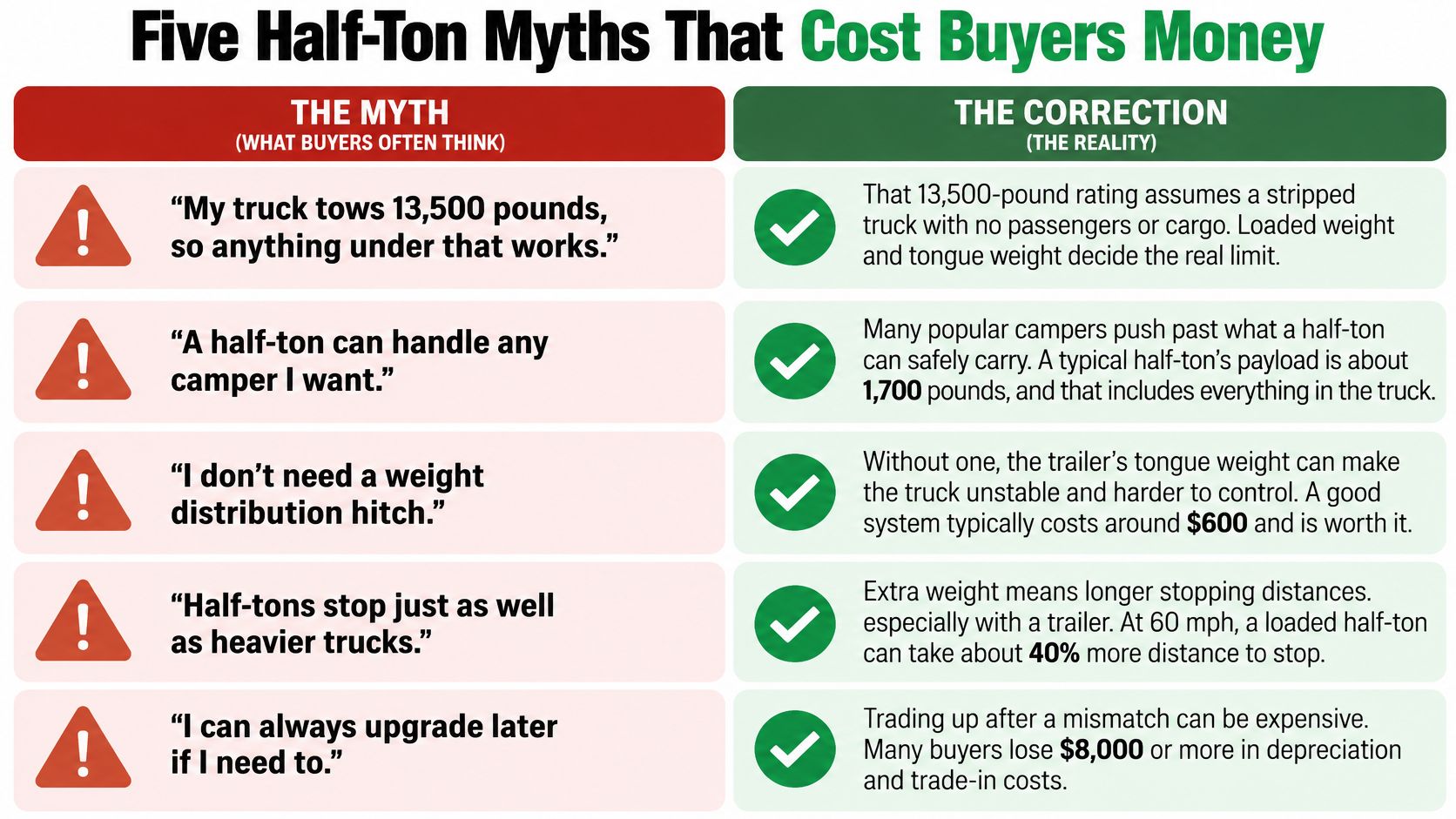
My truck's advertised maximum covers any trailer below it
The maximum belongs to a particular configuration and set of conditions. Confirm the exact towing-guide entry before paying a deposit, especially when comparing crew-cab and differently equipped trucks.
A full-size SUV works like a pickup with enclosed storage
An SUV's seating capacity doesn't establish its remaining carrying capacity. Load the intended passengers and luggage on your worksheet before deciding what trailer it can support.
A lighter trailer always tows better
Consider an illustrative 5,500-pound trailer versus a 6,500-pound trailer. Poor loading, unsuitable hitch adjustment, or a more wind-sensitive body can make the lighter candidate more demanding, so empty weight alone isn't a handling score.
The infographic summarizes the assumptions to challenge, but your vehicle documents remain the controlling reference.
A stronger hitch or suspension upgrade increases payload
A higher-rated component doesn't automatically raise the vehicle manufacturer's ratings. Air springs may change ride height, but they don't establish that the axles, tires, brakes, or vehicle structure can carry more.
The half-ton label means the dealer has already approved my truck
The label doesn't contain your passenger list, accessory weights, or camping load. Ask for the exact trailer's weight documentation and compare it with your own vehicle records.
Bring a written worksheet, door-label photos, and your intended packing list to the lot. Those documents are more useful than a recollection of what a truck advertisement promised.
Your Next Step and Half-Ton Towing FAQs
A half ton towable travel trailer fits your truck when its anticipated loaded weight and measured tongue load respect every applicable vehicle, axle, tire, and hitch limit, with useful operating capacity left over.
A scale ticket turns a promising calculation into a checkable combination.
Can a half-ton SUV tow these trailers?
Some can, provided the exact SUV's ratings support the loaded combination. Check its own door-jamb label and towing guide, including any restrictions associated with its equipment and hitch setup.
Is a weight-distributing hitch required?
Follow the tow-vehicle manufacturer's requirements and the receiver's ratings for weight-carrying and weight-distributing use. Have the hitch selected, installed, and adjusted for the actual combination, including any manufacturer restrictions on its use.
How fast should I tow?
Follow posted limits, the truck manual, and applicable tire and trailer restrictions. Slow further when visibility, wind, curves, grades, or traction call for it, and leave enough following distance to respond smoothly.
When should I step up to a three-quarter-ton truck?
Consider a heavier-duty truck when your preferred layout or camping load leaves inadequate capacity in the half-ton. Compare actual payload and axle ratings on the replacement truck too, rather than assuming the heavier-duty badge resolves every constraint.
Should I rent before buying?
Renting can help you evaluate hitching, backing, packing, and campsite routines before committing. Motor Sportsland offers RV rentals; select a rental that your tow vehicle is already verified to handle, rather than using the trip to test an uncertain match.
Motor Sportsland offers travel trailers, fifth wheels, toy haulers, popup trailers, and destination trailers, along with published towing guides to support your decision. Visit Motor Sportsland to browse inventory by weight, or stop by our Salt Lake City-area showroom with your door-label photos and packing worksheet for a personalized matching conversation.
